
You're coordinating an airport transfer for 18 executives, their luggage, and a schedule that includes several stops. A standard passenger van may technically carry the group, but it can leave little room for bags and creates a less consistent experience. A full-size coach may solve the capacity problem while adding unnecessary bulk and cost.
That's where a 20 passenger mini bus earns its place. It's not just a large van. It's a commercial passenger vehicle whose seating capacity affects licensing, insurance, accessibility planning, vehicle weight, chauffeur qualifications, and the way your transportation provider manages the booking.
What a 20 Passenger Mini Bus Really Is
A corporate booking for 20 passengers crosses an operating threshold. The vehicle sits between a conventional minibus and a full-size coach, but its legal classification depends on jurisdiction. UK guidance defines a minibus as carrying 9 to 16 passengers, placing a 20-seat vehicle outside that narrower category and potentially classifying it as a larger shuttle, mini coach, or small bus. (UK official passenger-carrying vehicle guidance)
For Max's Luxury Rides, that distinction affects how a booking is quoted and assigned. Passenger capacity can change driver requirements, licensing, insurance, inspections, accessibility planning, and vehicle selection. UK rules distinguish between 9 to 12, 13 to 16, and 17 or more passenger seats, while the official legislative definition of a minibus illustrates why a 20-seat vehicle operates as a bridge between a classic minibus and a larger bus.
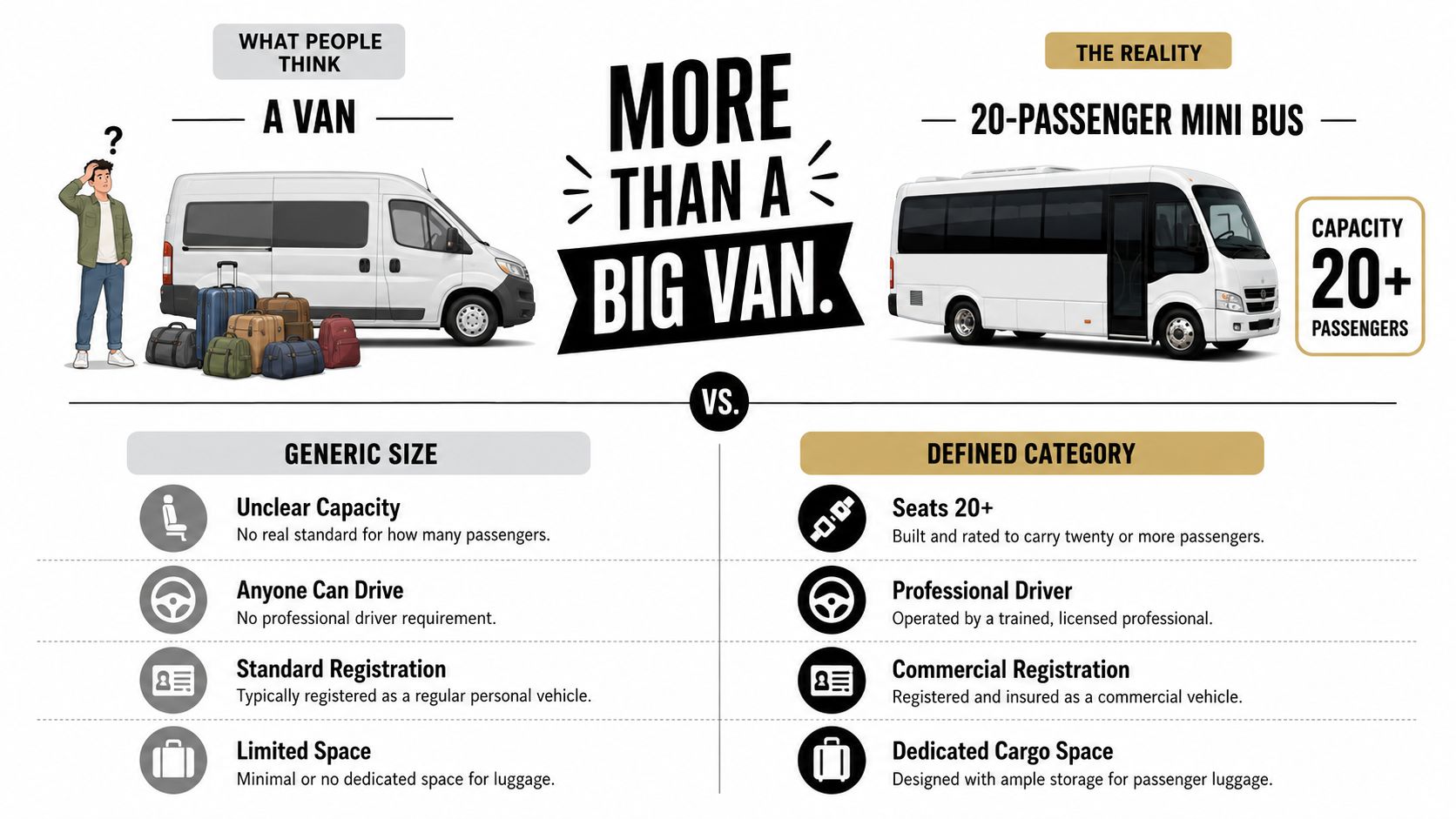
Why the seating threshold matters
A 12 or 15 passenger van may fall under a different licensing and insurance framework from a vehicle designed for 20 passengers. A 20-seat booking can require commercial registration, a properly qualified chauffeur, commercial insurance, and documented inspections. Requirements vary by country and state, so Max's Luxury Rides should verify the operating rules for the route rather than classify the vehicle from its seat count alone.
The platform also shapes the service decision:
- Ford E-450 cutaway: Widely supported, with strong service availability and flexible conversion options.
- Chevrolet Express cutaway: A familiar base for shuttle bodies and straightforward fleet maintenance.
- Mercedes-Benz Sprinter extended wheelbase: A premium conversion platform suited to hotel and corporate routes, with a quieter cabin and, in some configurations, a lower entry profile.
- Freightliner M2: A heavier commercial platform for operators prioritizing durability, structural capacity, and larger conversion choices.
The global minibus market was valued at USD 10.3 billion in 2023 and is projected to grow at more than 4% annually from 2024 to 2032. The 10 to 20 seat segment is expected to hold over 40% of total market share by 2032, according to Global Market Insights' minibus market analysis. For a corporate planner, that places the 20 passenger mini bus in an established commercial category, not the passenger-van segment.
Practical rule: Treat the vehicle as a small commercial bus, not as an oversized passenger van.
Chassis Specs and Dimensions You Should Know
A booking for 20 passengers can fail at the curb if the vehicle has insufficient weight capacity, excessive step height, or dimensions that do not suit the route. Seat count is only the operating threshold. Max's Luxury Rides should confirm the chassis, body, and loaded configuration before assigning a vehicle.
A typical 20-passenger vehicle on a Ford E-450-style cutaway chassis falls within the 12,500 to 14,500 lb GVWR class. Common dimensions include a body length of 22 to 25 ft, overall width of 96 in, interior height of about 80 in, and first-step height near 12 in, according to the Starcraft Allstar vehicle brochure. These measurements affect hotel access, terminal positioning, garage clearance, and passenger boarding time. GVWR is the maximum permitted loaded weight, not spare luggage capacity after every seat is occupied.
GVWR is not payload
Payload covers passengers, luggage, mobility equipment, interior fixtures, fuel, and added amenities. Reclining seats, rear HVAC, overhead racks, an accessibility lift, and a luggage compartment all consume weight capacity. A basic shuttle and a premium vehicle may carry the same nominal number of passengers while offering very different usable payload.
The body builder changes the booking decision as well. A Ford E-450 usually provides broad service access and practical conversion support. A Sprinter-based vehicle can offer a more refined cabin and easier maneuvering around dense hotel districts, while its maintenance profile and conversion cost may differ. A Freightliner M2 supplies a heavier commercial foundation, but its size may complicate short urban transfers and restricted venue access.
| Spec | Ford E-450 | Mercedes Sprinter 170 | Freightliner M2 |
|---|---|---|---|
| Primary strength | Payload and service access | Cabin refinement and maneuverability | Heavy-duty commercial structure |
| Typical application | Airport shuttles and general group transport | Corporate, hotel, and executive routes | High-duty operations and larger conversions |
| Main planning concern | Step height and interior packaging | Payload after luxury conversion | Vehicle size and route access |
| Conversion potential | Broad | Strong premium potential | Strong structural capacity |
Max's Luxury Rides should review torque, braking reserve, and load placement, not just horsepower. A fully loaded passenger vehicle needs predictable braking on airport approaches, hotel ramps, and event traffic routes. Test data in the electric shuttle-bus specifications show that load placement can change stopping distance by more than 1 m at the same total payload. For each booking, match the vehicle's loaded weight, boarding method, and physical dimensions to the route before promising capacity.
Seating Layouts and Interior Amenities
A 20-seat interior can feel efficient or cramped depending on how the builder uses the floor plan. The right layout depends on whether passengers need to work, socialize, board quickly, or carry luggage.
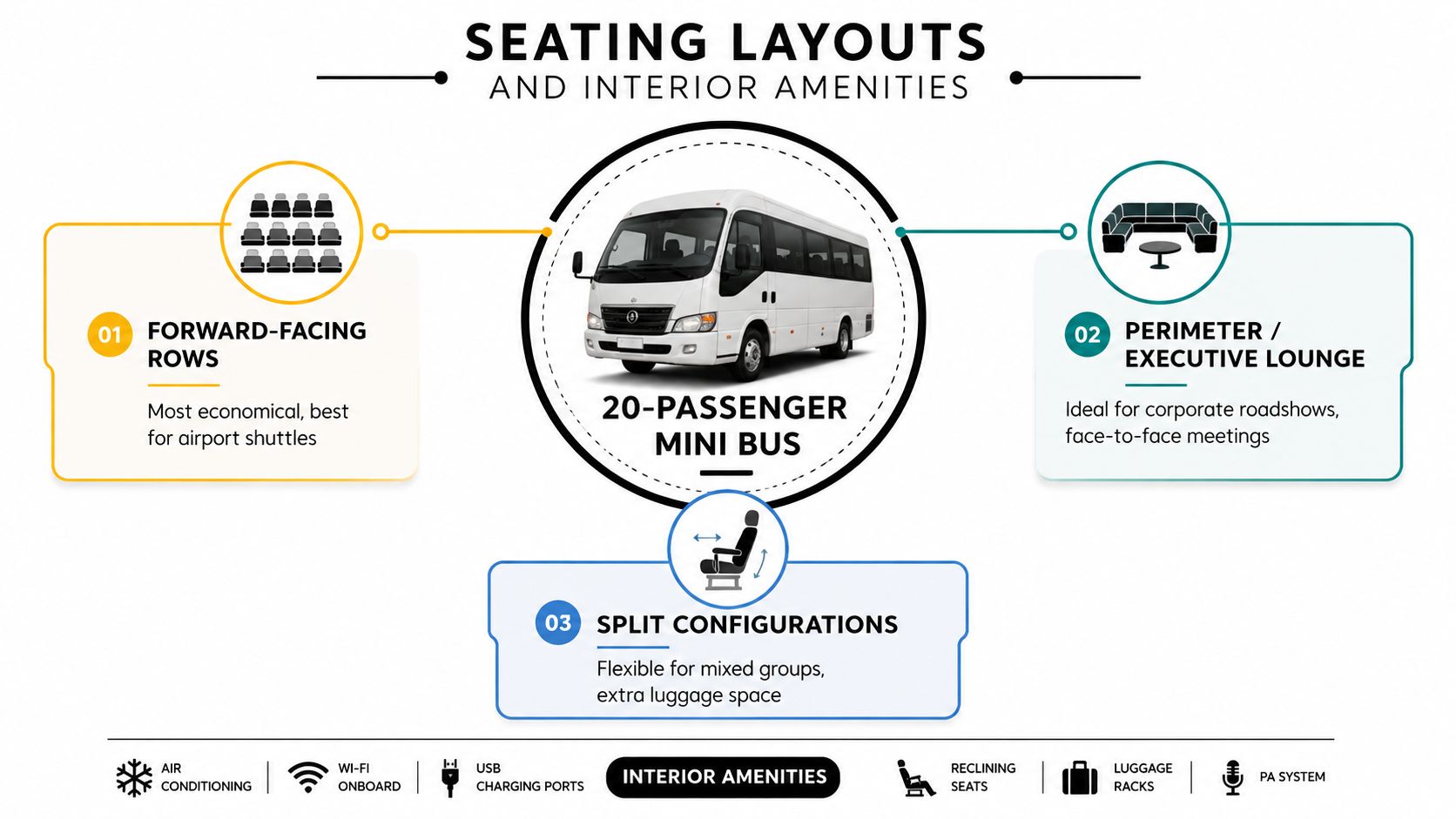
Three layouts dominate bookings
Forward-facing rows are the practical choice for airport transfers. They support quick boarding, clear sightlines, and efficient use of floor space. This layout works well when passengers are moving between terminals, hotels, offices, and venues with limited dwell time.
Perimeter or executive lounge seating changes the purpose of the vehicle. Passengers can face one another, hold informal conversations, and use the cabin as a shared environment during corporate roadshows or wedding transportation. The trade-off is obvious, fewer seats or less luggage space for each square foot of interior.
Conference-style seating suits groups that value interaction over maximum capacity. It can work for private tours, executive site visits, and event movements where the ride itself is part of the experience.
A vehicle that looks comfortable during a showroom inspection can perform poorly on a longer route if the seat pitch is tight, the aisle is narrow, or the first step is awkward. For trips lasting over 90 minutes, ask about seat pitch, armrests, aisle clearance, step geometry, and climate control rather than relying on photographs.
Amenities separate a shuttle from a luxury booking
A rental-grade vehicle usually prioritizes seat count. A luxury configuration prioritizes the passenger experience through high-back reclining seats, individual armrests, USB-C charging, 110V outlets, reading lights, quiet HVAC zones, overhead parcel racks, and a usable PA system.
Max's Luxury Rides' booking workflow should start with the event rather than the vehicle photograph. For corporate groups, confirm power access, Wi-Fi availability, privacy, and whether passengers need to work between stops. For weddings, prioritize comfortable boarding, clean presentation, storage for attire or décor, and a layout that keeps the party together.
Luggage requires an honest conversation. A full seating configuration may not provide enough dedicated space for airport bags, mobility devices, or event equipment. Removing a seat row or specifying a rear luggage deck can solve that problem, but it changes the passenger count and the vehicle's weight distribution.
Booking advice: Never confirm a 20-seat vehicle until the operator has reviewed both the passenger manifest and the luggage profile.
Accessibility Safety and Compliance Considerations
A 20 passenger mini bus can cross a meaningful compliance threshold before it leaves the depot. In many operating environments, 17 or more passenger seats place the vehicle in a commercial classification that affects chauffeur qualifications, inspections, insurance, and operating records. Requirements vary by jurisdiction, route, vehicle design, and whether the service is private, public, interstate, or cross-border. Max's Luxury Rides should treat the vehicle count as an operating threshold, not just a seating specification.
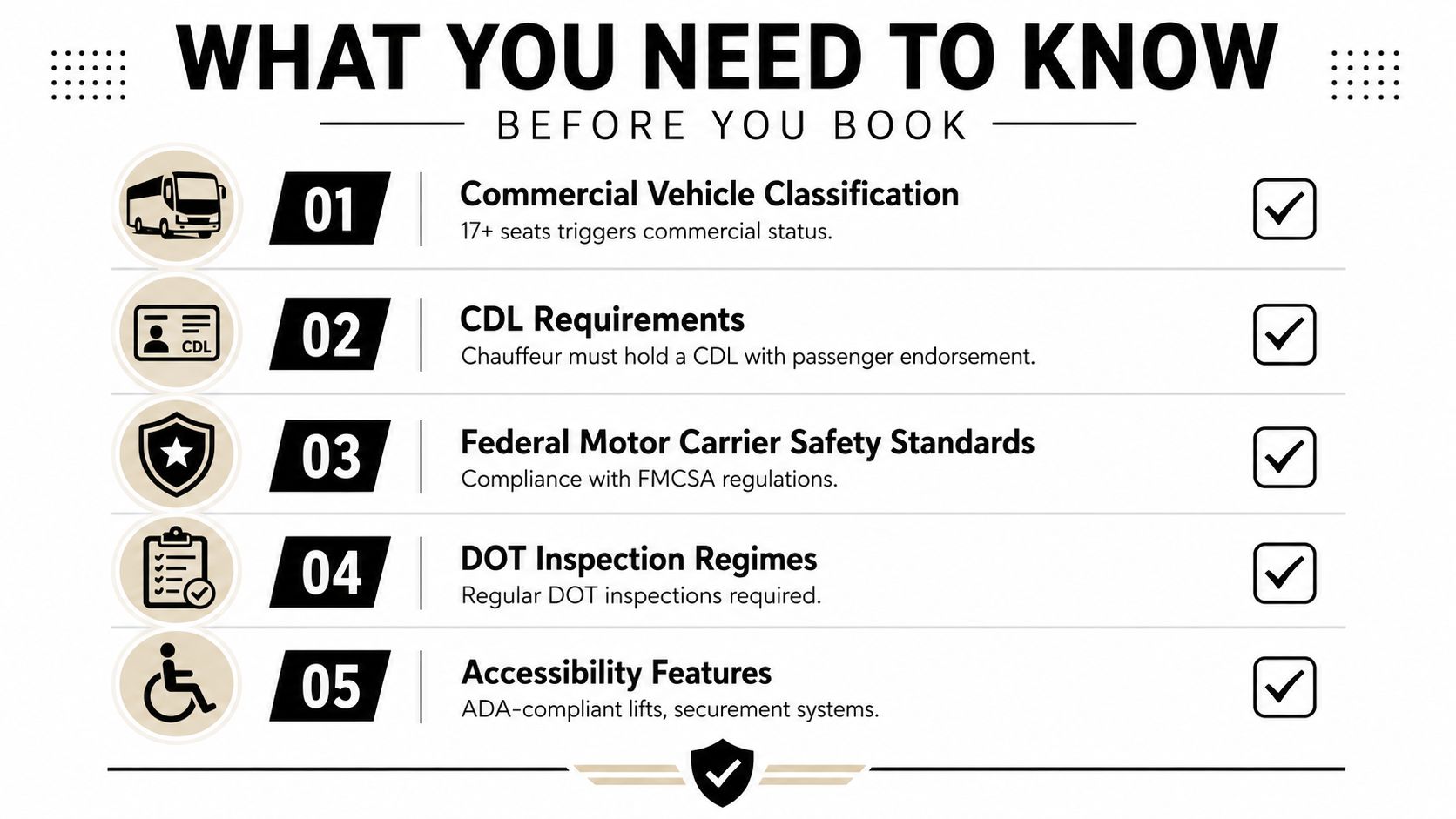
Accessibility starts with the floor plan
An accessible vehicle requires more than a lift fitted to a side door. Confirm lift geometry, boarding clearance, securement stations, grab rails, low-step access, and sufficient interior turning space for the mobility device in use.
A wheelchair position takes floor area away from seating. Retaining every passenger seat may conflict with a forward-facing securement station, while removing seats reduces available capacity. Ask the provider to state the usable capacity with the accessibility equipment in use, rather than quoting only the maximum brochure capacity.
The booking file should also identify emergency and safety equipment, including fire protection, first-aid supplies, emergency exits, seatbelts suited to the vehicle design, reflective markings, and current inspection records. The chauffeur must have a clear procedure for boarding, securement, evacuation, and passenger assistance.
Verify the operator before signing
Use this checklist before approving the charter:
- Driver qualification: Confirm the required commercial license, passenger endorsement, and any applicable air-brake qualification.
- Inspection records: Request current inspection evidence and maintenance documentation.
- Insurance: Verify commercial liability coverage for the service and jurisdiction, then request a certificate of insurance if your organization requires one.
- Testing and screening: Ask whether the operator follows applicable drug-and-alcohol testing and driver-screening obligations.
- Accessibility confirmation: Document the lift type, securement arrangement, usable capacity, and boarding procedure.
- Emergency process: Confirm emergency exits, first-aid equipment, fire protection, and the operator's incident procedure.
For long-term fleet planning, review the applicable passenger-carrying vehicle rules whenever the program, route, or vehicle changes. A vehicle approved for one service may require a different operating arrangement later.
Diesel Hybrid and Electric Powertrain Choices
For Max's Luxury Rides, powertrain selection starts with the booking schedule. Diesel suits airport transfers, highway work, intercity travel, and irregular dispatches because established fueling networks support longer operating stretches without depot charging. Electric works best on predictable shuttle loops with confirmed charging access. Hybrid earns its place on urban hotel circuits, campuses, and other stop-and-go routes.
A market forecast places diesel at about 75.2% share in one projection, while another estimate expects electric minibuses to rise from 8.4% of share in 2025 to 16.2% by 2034. These figures come from Research Nester's minibus market forecast. The same source projects the 10 to 20 seat segment at over 41.1% of minibus revenue by 2035, keeping this vehicle class central as operators change powertrains.
| Powertrain | Typical range | Best-fit use case | Key trade-off |
|---|---|---|---|
| Diesel | Long route capability with established refueling | Airport transfers, intercity travel, irregular schedules | Emissions exposure, fuel cost, and access restrictions |
| Hybrid | Route-dependent, with strongest value in stop-and-go operation | Urban hotel loops, campuses, frequent-stop service | Added system complexity, weight, and acquisition cost |
| Electric | Published platforms show 342 to 400 km of driving range | Predictable shuttle loops with depot charging | Charging access, payload sensitivity, and route planning |
Published specifications for a 20-passenger electric shuttle bus list a kerb weight of about 2,830 kg, total mass of 4,500 kg, rated payload of 1,670 kg, motor output of 60/120 kW, torque of 145/350 N·m, and driving range of 342 to 400 km. The payload equals roughly 83.5 kg per occupant before luggage, based on the published electric platform specifications.
That payload is the operating threshold. A vehicle can meet the passenger count yet fail the luggage plan. Max's booking team should verify charging access, weather effects on battery performance, HVAC demand, driver training, electricity pricing, maintenance support, and sustainability reporting before approving the vehicle.
Renting and Booking the Right Vehicle
A reliable reservation starts with the manifest, not the desired vehicle name. Count passengers, caregivers, assistants, children, mobility devices, cases, equipment, and likely additions. If the group includes 18 executives and airport luggage, a nominal 20-seat layout may be suitable, but only after the operator confirms the cargo plan.
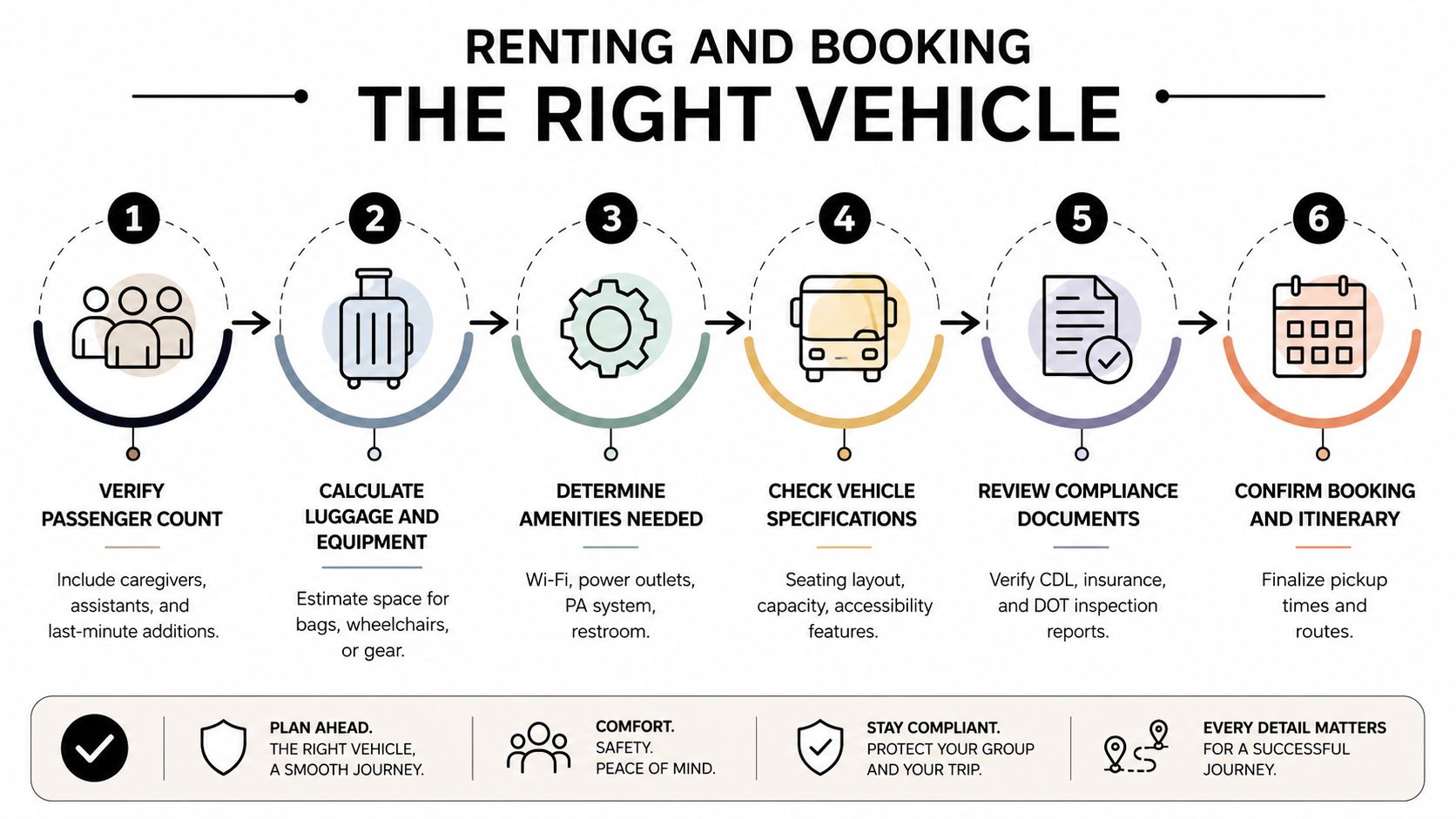
Use the booking sequence operators can execute
- Verify the passenger count. Include every rider and identify anyone who needs extra boarding time or assistance.
- Calculate luggage and equipment. List suitcases, display materials, wheelchairs, musical equipment, floral arrangements, or event supplies.
- Define the route. Give the operator all stops, expected dwell time, hotel access details, airport terminal information, and any restricted streets.
- Select the interior. Choose forward-facing rows for efficient shuttle work, or an executive layout when interaction and comfort matter more than maximum cargo.
- Confirm the powertrain. Match diesel, hybrid, or electric to the route and depot infrastructure rather than choosing from the vehicle's marketing position.
- Review the contract. Confirm the schedule, vehicle class, amenities, accessibility arrangements, overtime terms, tolls, fuel policy, cancellation window, and damage responsibilities.
Vet the chauffeur and operator
Ask for the chauffeur's commercial license class, passenger endorsement, air-brake qualification where applicable, commercial driving background, and motor vehicle record standards. The operator should also provide the insurance documentation your organization requires, along with inspection and maintenance records.
The contract should answer practical questions before the first passenger boards. Who pays tolls? How is overtime calculated? Is billing based on time, mileage, or both? What happens if the vehicle becomes unavailable? Who handles a route change caused by a road closure?
For airport work, confirm the meet-and-greet location, flight tracking, signage, baggage assistance, and communication chain. For multi-stop corporate travel, establish one planner contact and one operations contact. Max's Luxury Rides Inc. offers chauffeur-driven minibuses and coordinated airport, corporate, and special-event transportation, including service involving O'Hare, Midway, FBOs, and other airports.
Contract standard: If the provider can't explain the backup plan, the booking isn't operationally complete.
Choosing the Right Mini Bus for Your Trip
A 20 passenger mini bus becomes the wrong choice when its seating capacity is treated as the only requirement. At Max's Luxury Rides Inc., the booking decision should start with the route profile, luggage demand, accessibility needs, and compliance burden, then confirm whether the vehicle can support the assignment without creating avoidable operating problems.
Match the vehicle to the assignment
Airport transfers require accurate luggage planning. Confirm the number and type of bags, terminal access, curbside restrictions, boarding assistance, and flight monitoring. A forward-facing layout with dedicated luggage capacity usually serves airport work better than a lounge-style interior.
Weddings and special occasions depend on controlled boarding and presentation. Specify clean high-back seating, climate control, practical entry space, storage for attire or décor, and a chauffeur familiar with venue timing. Removing a seat row for luggage may improve the service more than retaining every nominal seat.
Corporate shuttles and roadshows need power access, connectivity, privacy, dependable climate control, and a clear communication process. Passengers moving between offices may need to work during the trip, so the interior should support that workflow rather than leave the vehicle configured only for short transfers.
Long-distance charters require a route review before confirmation. Discuss fuel or charging access, rest stops, luggage weight, accessibility, and the suitability of a restroom-equipped vehicle or larger coach. A 20 passenger mini bus should not be forced into a route that exceeds its practical operating range or storage capacity.
Apply three final filters
Before signing, request:
- Compliance documentation: Confirm the operator's licenses, inspections, insurance, and accessibility records.
- Vehicle condition standard: Ask about maintenance practices, presentation standards, and any age ceiling applied to the assigned fleet.
- Operational redundancy: Verify driver availability, dispatch coverage, and the replacement procedure for an unavailable vehicle or chauffeur.
The market supports this middle category, but market demand does not confirm that a particular vehicle fits your booking. As noted earlier, payload, axle ratings, step geometry, luggage packaging, and passenger count must be reviewed together.
Use four questions to close the booking: How many people and bags are traveling? What rules apply to the vehicle and chauffeur? Does the layout fit the route? What happens if the plan changes? Clear answers indicate an operationally complete reservation. Max's Luxury Rides Inc. provides chauffeur-driven minibuses, mini coaches, executive shuttles, and larger buses for airport transfers, corporate travel, weddings, and special events. Review Max's Luxury Rides Inc. to compare group transportation options and request a booking based on passenger count, luggage, route, and compliance requirements.