
You're probably reading this with a spreadsheet open, a venue contact texting for final counts, and at least one executive asking, “Who's handling airport pickups?” That's usually the moment transportation gets treated like a booking task instead of what it really is. A moving part of the event itself.
When corporate event transportation fails, the damage shows up fast. Speakers arrive rushed. VIPs wait curbside with luggage. Registration opens on time, but the audience doesn't. Guests don't separate that experience from your event brand. To them, the event started the minute they landed.
Beyond Bookings The Strategic Role of Event Transportation
Transportation isn't just how people get to the venue. It's how they form their first impression of the event's organization, pace, and professionalism. If arrivals feel confused, late, or unsupported, attendees carry that friction into check-in, sessions, and networking.
That matters even more now because ground transport is taking a larger share of business travel budgets. The Global Business Travel Association says ground transportation now accounts for 14.7% of total corporate travel expenditure, up from 11.2% in 2019, and one 2026 industry summary estimated the global executive ground transportation market at $87.4 billion, with the corporate segment making up 47% of demand according to this executive ground transportation market overview.
That shift changes the planner's job. You're not just deciding whether to book sedans or buses. You're designing a system that has to absorb flight changes, protect VIP timing, move groups without choke points, and still feel polished.
Practical rule: If transportation is only discussed after the agenda, hotels, and guest communications are locked, you're already managing risk late.
Strong corporate event transportation does three things at once:
- Protects critical timing so keynote starts, executive dinners, sponsor meetings, and airport departures stay intact.
- Supports attendee experience by removing uncertainty at the most stressful moments, especially arrivals and late-night returns.
- Defends the brand because a well-run transfer feels intentional, while a chaotic curbside scene feels cheap even at a premium event.
Transportation planning also works better when it sits beside event design, not behind it. Teams that build it into registration flows, hotel block planning, and guest communications usually avoid the classic scramble. If you're building the broader event plan at the same time, these GroupOS event planning resources are useful for keeping transportation aligned with the overall run of show.
Assessing Your Event's True Transportation Needs
Most planners start with headcount. Operators start with timing. That difference is where good plans begin.
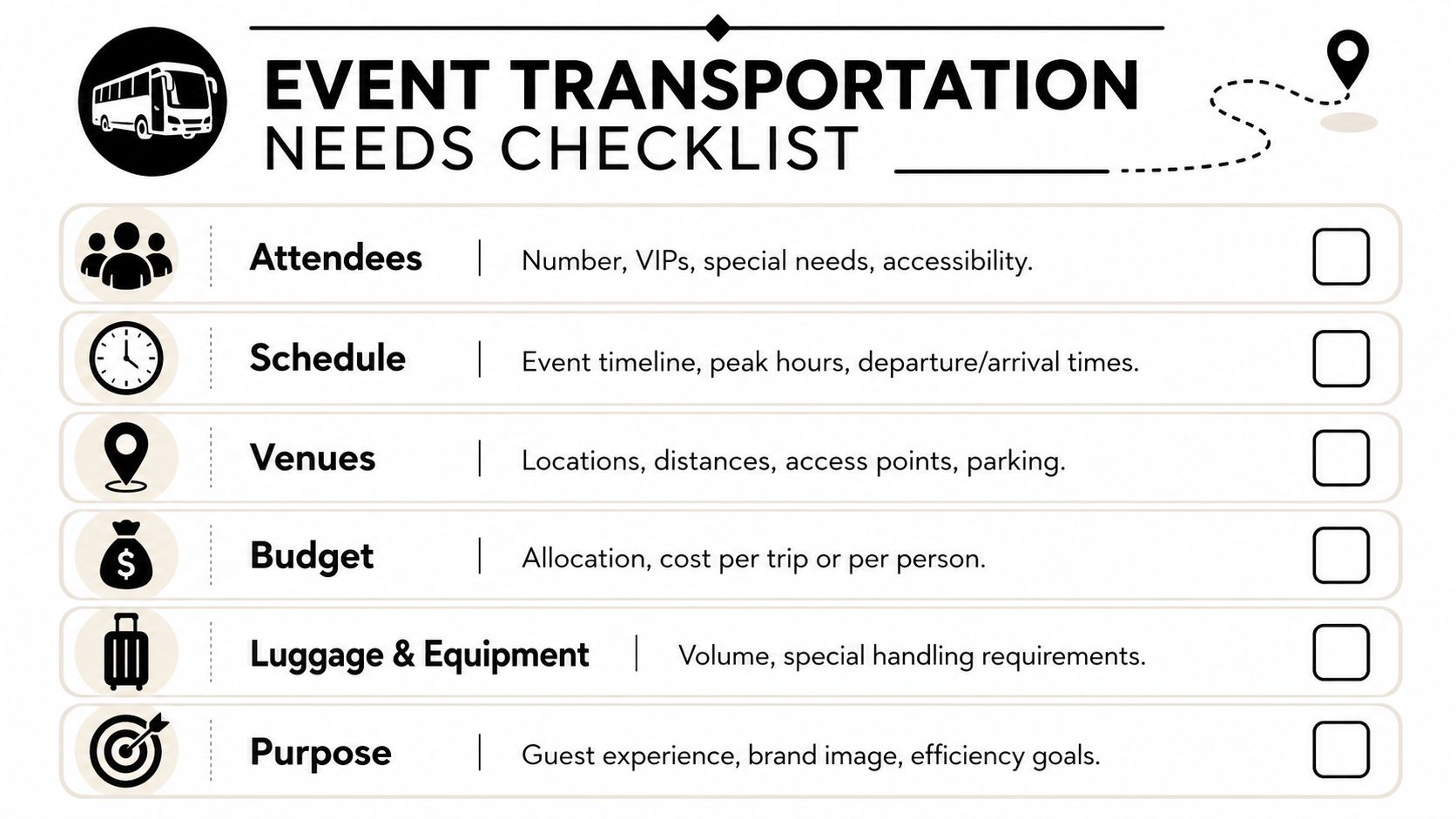
The most reliable method is to plan around arrival priorities instead of raw attendee volume. Fixed arrivals come first. General attendee movement comes second. That approach is the core recommendation in this corporate event transportation planning guide, which also notes a practical booking benchmark of 2 to 4 weeks for mid-size events and 1 to 3 months for large conferences, especially during peak seasons.
Start with timing that cannot slip
Not every guest has the same transportation priority. Treating everyone the same is one of the fastest ways to create delays for the people who matter most to the schedule.
Build your manifest in layers:
Non-negotiable arrivals
Keynote speakers, C-suite guests, board members, sponsors with stage time, and anyone tied to a fixed appearance.Operationally important arrivals
Event staff, production teams, registration leads, interpreters, security contacts, and photographers.Flexible attendee arrivals
General guests who need reliable service, but not necessarily private timing.Sensitive departures
Late-night returns, airport runs tied to outbound flights, and movements after alcohol-served functions.
A manifest should go beyond names. Include flight details, hotel, cell number, luggage notes, accessibility needs, pickup window, and whether the traveler can share a vehicle. If someone is carrying product samples, AV materials, or display items, note that too. The wrong vehicle choice often starts with missing luggage information, not a bad dispatch team.
Separate VIP service from group flow
VIP transportation and attendee transportation are related, but they shouldn't run on the same logic. Executives and speakers need tighter control, fewer touchpoints, and usually more flexibility if the schedule changes. Group attendees need clarity, repetition, and predictable movement.
Here's the split that works in practice:
| Traveler type | Best planning approach | Common mistake |
|---|---|---|
| Executives and speakers | Dedicated schedules, direct pickups, meet-and-greet support | Putting them into shared shuttle timing |
| Sponsors and hosted buyers | Prioritized windows with clear points of contact | Assuming they'll self-navigate airport arrivals |
| General attendees | Grouped by hotel, arrival band, or session start | Building routes around rooming lists only |
| Guests with accessibility needs | Pre-confirmed accessible vehicles and boarding instructions | Treating accessibility as a day-of request |
The best manifests answer operational questions before dispatch asks them.
Ask the questions planners often miss
Before any provider quotes accurately, they need answers to things planners often discover too late:
- Where are the actual pickup points? Hotel front entrance, side drive, motorcoach bay, FBO, baggage claim, or a designated convention center lot.
- What are venue access rules? Some properties allow curb loading for sedans but push shuttles to a secondary entrance.
- Who needs white-glove handling? Not every VIP wants visible luxury. Some want privacy and a quiet arrival.
- What part of the experience matters most? Speed, brand presentation, cost control, or low-stress movement. Usually one of those drives the final design.
If you assess the event this way, transportation stops being a guessing exercise. It becomes a system built around who must move, when they must arrive, and what kind of experience they need along the way.
Matching Vehicles to Your People and Purpose
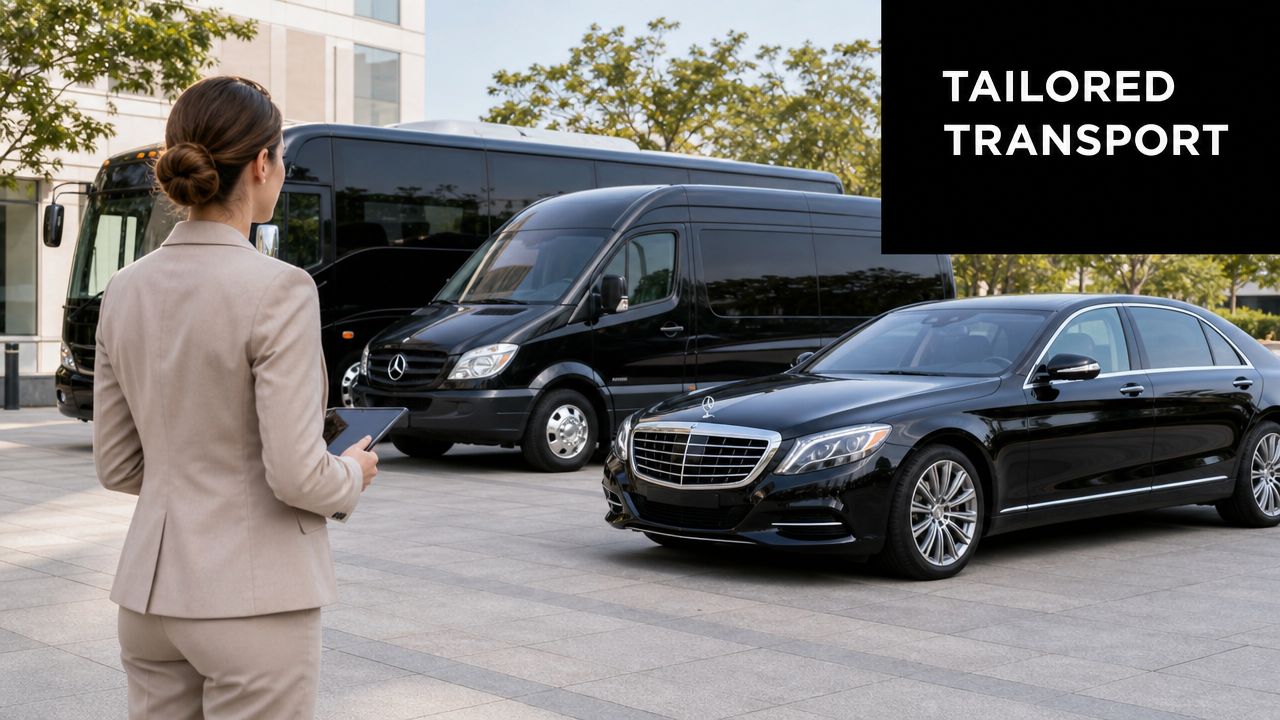
The wrong vehicle can be perfectly fine on paper and still fail in the field. A sedan may look appropriate for an executive until you realize the passenger has two large suitcases, trade show materials, and a tight airport curb pickup. A large shuttle may seem efficient until half the riders are coming from a different hotel cluster and your route turns into a rolling delay.
Choose by use case, not by category
Vehicle selection works best when you match it to the movement pattern, not just the group size.
- Executive sedans fit solo travelers, airport transfers, investor meetings, and discreet leadership moves where privacy matters more than capacity.
- Luxury SUVs work well for small executive teams, travelers with more luggage, or guests who need a little more flexibility without moving into van service.
- Mercedes Sprinter vans and executive vans suit roadshows, sales teams, and small group airport transfers where everyone needs to stay together.
- Minibuses and executive shuttles are practical for hotel-to-venue loops when timing matters more than luxury finishes.
- Coach buses belong in large conference movements, off-site dinners, and any plan that depends on moving a lot of people in disciplined waves.
What doesn't work is trying to make one class of vehicle solve every problem. Mixed-fleet planning almost always performs better because different guests have different risk profiles.
Look past seats and into operating reality
Seats are the least interesting part of a vehicle decision. Three other questions matter more.
First, luggage capacity. Airport arrivals break down when a vehicle is technically seated correctly but physically overloaded.
Second, boarding speed. Low-step access, baggage handling, and a clear curbside process matter more than luxury trim on high-volume transfers.
Third, on-board expectations. For executives, quiet cabin space, charging access, and a professional chauffeur matter. For attendee shuttles, what matters is comfort, climate control, and a departure process that doesn't feel chaotic.
A practical comparison looks like this:
| Scenario | Better choice | Why |
|---|---|---|
| Speaker arriving alone with carry-on | Sedan | Fast, discreet, efficient |
| Executive team going from hotel to client dinner | SUV | Flexible and polished |
| Department group on a tight roadshow | Sprinter van | Keeps the group together |
| Attendees moving between hotel block and venue | Minibus or shuttle | Easier loading and repeatable loops |
| Large off-site dinner return | Coach bus | Controlled departures and safer late-night flow |
Don't treat accessibility as an add-on
Accessibility needs should shape fleet planning from the start. They should never sit in a side note waiting for the final week. If wheelchair-accessible transport is required, confirm it in the booking, in the manifest, and in the dispatch notes. Also verify the loading point and the boarding sequence. Accessibility failures usually come from assumptions between teams, not bad intent.
Providers that handle mixed corporate work well usually maintain options across sedans, SUVs, vans, shuttles, minibuses, and coaches. For example, Max's Luxury Rides Inc. operates across those categories, which makes it easier to align vehicle type with different event movements instead of forcing one fleet class into every assignment.
A polished transportation program doesn't look uniform. It looks intentional.
Mastering the Logistics of Routing and Staging
The route on a map is only half the job. The harder part is what happens when vehicles arrive at the same place, at nearly the same time, with different passenger priorities and limited curb space. That's where corporate event transportation either feels smooth or starts to jam.
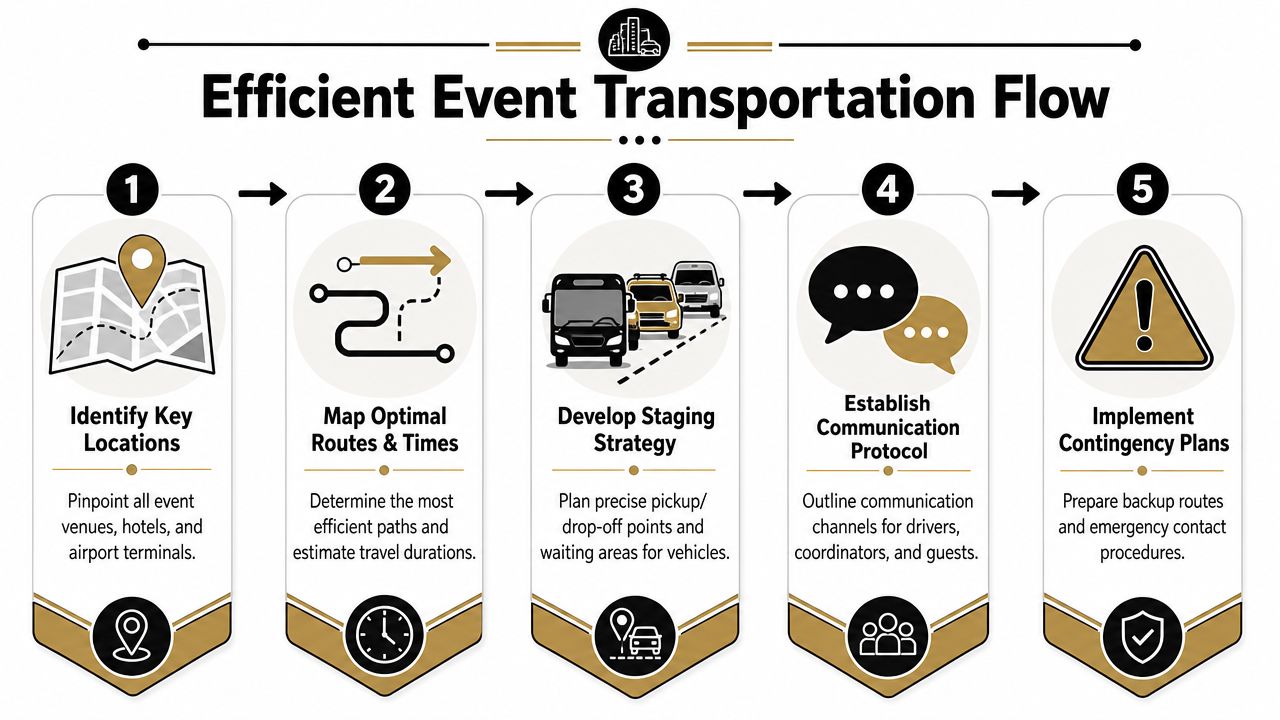
A high-performing shuttle setup uses dedicated pick-up and drop-off zones, on-site coordinators, and real-time vehicle tracking to compress dwell time. Best-practice guidance also recommends mapping hotels, venues, airports, and likely bottlenecks first, then adding buffer time and staggered departures, as outlined in this operational guide to event transportation logistics.
Here's the process in visual form.
Map every node before you write a schedule
A workable transport plan starts with geography, not optimism. You need every movement point on one operating map: airport terminals, FBOs, hotel entrances, venue loading docks, guest pickup curbs, dinner locations, and overflow staging areas.
Then mark friction points:
- Tight loading areas where only one vehicle can board at a time
- Properties with multiple entrances that confuse guests and drivers
- Venues with security screening that slows arrivals
- Rush-hour corridors where one late vehicle can ripple into the next departure bank
Route modeling proves helpful. If your team wants a better framework for thinking through sequencing, dwell, and path efficiency, Routelink route planning offers useful planning concepts even if you're still coordinating through a transportation provider.
Build staging around flow, not convenience
A common mistake is placing pickup zones where they look easiest on paper. That often creates long walks, curb congestion, or conflict with venue traffic.
A stronger staging plan uses separate logic for separate tasks:
- VIP curb near the cleanest entrance, away from shuttle crowding
- General attendee shuttle zone with signage, queue space, and staff visibility
- Overflow hold area where backup vehicles can wait without blocking active loading
- Late-night departure point that's well lit, easy to find, and controlled
The best staging areas are boring. Guests see signs, a coordinator, and a clear line. Nobody has to ask three people where to stand.
If guests are hunting for their ride, the transportation plan is unfinished.
Reduce deadhead miles without hurting service
One of the most overlooked cost leaks in event transportation is the empty movement between assignments. Public advice often focuses on vehicle type, but independent event guidance puts more attention on utilization, grouped arrivals, and routing intelligence. It also highlights flight tracking and clear pickup instructions as ways to reduce missed connections and unnecessary empty runs in this discussion of event transport efficiency and deadhead miles.
That matters because there's a trade-off here. You can minimize deadhead aggressively and still hurt the guest experience if you over-compress the schedule. The better approach is selective efficiency:
- Pair arrivals with similar timing and destination
- Keep VIP service protected from pooled logic
- Stage reusable vehicles near the next likely demand point
- Avoid one giant shuttle loop if two smaller loops will keep headways cleaner
A video walkthrough can help teams visualize how these moving parts fit together.
The practical win isn't just lower operating waste. It's smoother flow. Vehicles spend less time repositioning, guests wait less, and dispatch has more room to recover when something shifts.
Building Resilience with Contracts and Contingencies
Most event transportation plans don't fail because the first schedule was bad. They fail because the world changed and nobody built a response before it did.
Flights get delayed. A dinner runs late. A board member adds an unscheduled stop. Weather affects inbound timing. One venue entrance closes. If your transportation plan only works in a perfect version of the event, it isn't a plan. It's a guess with invoices attached.
Put resilience into the contract
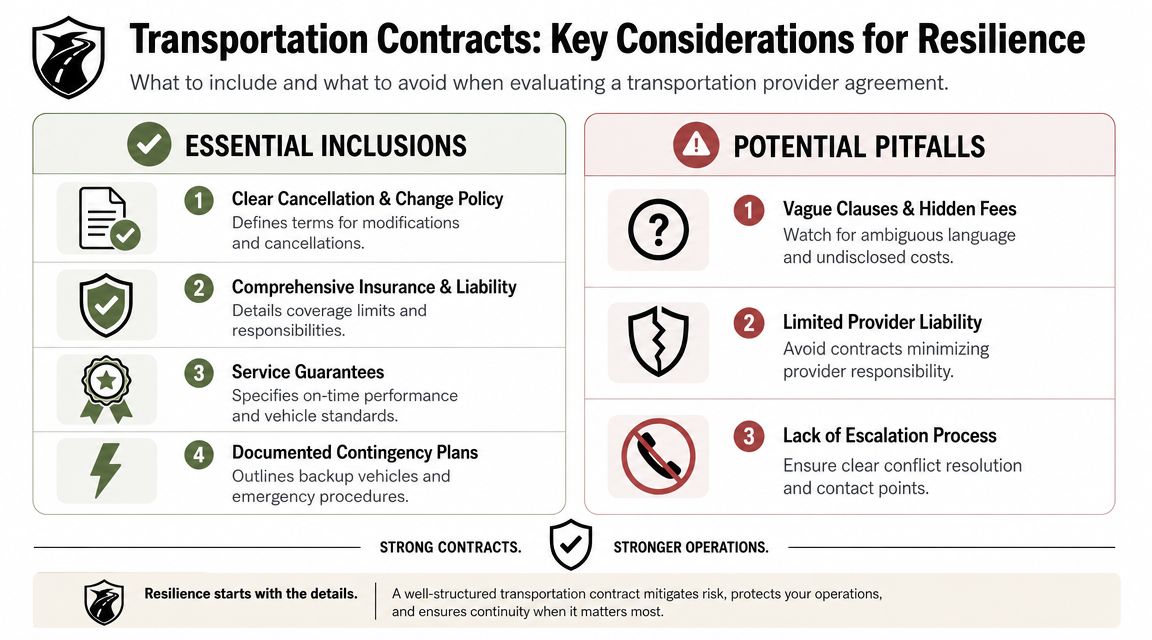
The contract should tell you what happens when the plan changes, not just what you're buying on a good day.
Check for these items before you sign:
- Change and cancellation terms that clearly define cutoffs, fees, and who can authorize updates
- Insurance and liability language that states coverage and responsibility in plain terms
- Vehicle standards covering cleanliness, maintenance expectations, and chauffeur qualifications
- Escalation contacts so you know exactly who answers when operations go sideways
- Contingency language for substitute vehicles, delayed service recovery, and high-priority backup handling
Vague agreements usually become expensive at the exact moment you need flexibility. If a provider can't explain how they handle a delayed keynote pickup, a missed airport meet, or a venue access problem, that uncertainty belongs in the risk column.
Don't use rideshare as your group backup
Planners under pressure often make the wrong compromise. They assume they can cover gaps with app-based rides if anything slips. That may work for one traveler. It is not a resilient event strategy.
Event-transport guidance explicitly warns against relying on rideshare as a fallback for groups over 10, especially in scenarios involving VIPs, multi-venue programs, and disruption planning, as discussed in this overview of corporate transportation risk and continuity.
Here's why that matters in practice:
| Fallback option | Where it works | Where it breaks |
|---|---|---|
| Individual rideshare | Single traveler, low-stakes movement | Peak demand, late-night exits, coordinated group needs |
| Taxi line | Simple solo transfer in a major market | Brand inconsistency, weak control, poor group coordination |
| Reserved chauffeur service | Executive and priority travel | Requires earlier planning and cleaner manifests |
| Shuttle or charter backup | Group continuity, late-night returns, venue surges | Needs standby cost and staging planning |
If the event includes alcohol-served functions, multiple venues, or senior guests, continuity matters more than the cheapest unit cost. You need a system that still functions when supply gets tight.
Field note: Backup capacity only helps if dispatch, the coordinator, and guest communications all know when to trigger it.
Create contingency triggers before the event
A useful contingency plan doesn't just say “have backups.” It defines what causes a switch.
Set clear triggers such as:
Flight disruption threshold
If an arrival slips beyond your planned window, the traveler is reassigned automatically to the next service pattern or a dedicated recovery move.Venue delay protocol
If a dinner or session runs long, dispatch holds vehicles in sequence instead of releasing the whole fleet and rebuilding from scratch.Late-night safe return plan
If guests leave in staggered waves, use staged dispatch and controlled boarding rather than telling people to find their own way back.Manifest change authority
One person approves changes. Without that, drivers get conflicting instructions and the whole operation starts to fragment.
Standardize what guests receive
Attendee confusion creates more operational waste than traffic does. Every guest should receive the same core information in the same format: pickup point, pickup window, vehicle description if relevant, coordinator contact, and what to do if plans change.
The planner doesn't need long emails. They need short, clear transport messages that survive travel stress. Good communications are a resilience tool because they reduce no-shows, misloads, and curbside delays before they start.
Executing Flawlessly on the Day of the Event
Day-of execution is less about heroics and more about control. The smoothest event transportation days usually look uneventful because the team made decisions early, assigned ownership clearly, and kept communication tight.
The most important role is the single transportation coordinator. One person must own the live picture. That can be someone on the planner's team or someone from the transportation provider, but it can't be split loosely across five people with partial information.
Run a real pre-event briefing
Every chauffeur and every field coordinator should receive a concise operating brief before service begins. Not a vague schedule. A real brief.
Include:
- Route assignments with exact pickup and drop locations
- Guest priorities so drivers know who is time-critical
- Venue access notes including where not to queue
- VIP handling instructions covering names, preferred arrival style, and discretion needs
- Escalation chain for traffic issues, guest no-shows, or manifest changes
If the event involves airport work, brief the team on terminal-specific procedures and who is monitoring flights. If it involves an FBO, confirm access and timing. If it involves a multi-stop executive itinerary, review the sequence with the assigned chauffeur directly.
Manage by exceptions, not by panic
A transportation coordinator shouldn't spend the day asking where every vehicle is. They should monitor the exceptions. Who is late, who is unresponsive, what zone is starting to back up, which departure bank needs to be adjusted.
That means your live checklist should focus on decisions:
- Has every priority arrival been confirmed?
- Are shuttle queues building unevenly at one hotel?
- Did a speaker's flight land but baggage delay the pickup?
- Is the dinner return likely to release in one wave or several?
When coordinators chase every normal movement, they miss the one issue that needs intervention.
Good event transport control feels calm because the team knows what deserves attention and what doesn't.
Keep guests informed before they ask
Silence makes delays feel longer. Even a short message can hold confidence if it tells people what's happening and what they should do next.
Use simple communication rules:
- Before pickup send the location and time window
- During disruption send the updated expectation and contact
- At departure surges direct guests to one staffed boarding point
- For VIPs route updates through the assistant or host when appropriate
This matters most at airports, venue exits, and late-night returns. People can tolerate waiting better than they can tolerate uncertainty.
Control departures like arrivals
Planners often obsess over arrival choreography and then let departures happen organically. That's where long queues, wrong loads, and guest frustration show up.
For departure management, use:
- A visible boarding lead at the pickup point
- Vehicle sequencing so drivers don't bunch or leapfrog
- Guest grouping by destination or hotel cluster
- Real-time updates to dispatch when one wave fills faster than expected
Late-night returns deserve extra discipline. Lighting, staffing, and a clear pickup zone matter more at the end of the night because guests are tired and less patient. If the event served alcohol, don't improvise return transportation.
Protect the brand in small moments
Guests remember little things. Was someone there when they arrived. Did the driver know their name. Was the pickup point obvious. Did the shuttle leave when promised. Did anyone seem in control.
Those details don't happen by accident. They come from a transportation plan built for the event you have, not the one you hope unfolds.
If you need a transportation partner for airport transfers, executive movements, shuttle service, or multi-vehicle corporate event transportation, Max's Luxury Rides Inc. provides sedans, SUVs, vans, shuttles, minibuses, and coach options with 24/7 service that can be aligned to event schedules, guest priorities, and day-of coordination needs.