
You're probably considering hourly service because your day doesn't fit neatly into a single pickup and drop-off. Maybe you have an airport arrival, a client lunch, two meetings in different parts of the city, and a dinner that may end early or may run long. The friction isn't just the travel itself. It's the waiting, the rebooking, the uncertainty, and the mental load of stitching together separate rides.
That's where an hourly chauffeur service starts to make sense. Not because it sounds luxurious, but because it can be the more rational choice when your schedule is fluid. The key question isn't “Is hourly service nicer?” It usually is. The better question is when does hourly service become smarter than point-to-point transportation for your specific itinerary?
A seasoned traveler usually learns this the hard way. A transfer to the first stop is simple. The second ride is delayed. The third driver can't find the entrance. The fourth booking shows up at the wrong side of the venue. By the end of the day, the issue wasn't transportation quality alone. It was the lack of continuity.
Understanding Your Private Transportation Options
A common business day illustrates the difference clearly. You land in the morning, head to a meeting downtown, finish earlier than expected, and suddenly have an hour before the next appointment. You could wait in a lobby, call another ride, move to a coffee shop, then repeat the process again later. Or you could step back into the same vehicle, leave your bag where it is, and keep your day moving without renegotiating transportation every time the calendar shifts.
That second option is what an hourly chauffeur service provides. You're reserving a professional chauffeur and vehicle for a block of time, rather than buying one trip from A to B. The vehicle stays with you, or close by, as your day unfolds.
If you've looked at Uptown Rent A Car's guide, you've already seen a useful way to think about chauffeur-driven travel. The service isn't only about getting somewhere. It's about removing coordination work from the client's day.
Three common models
| Option | Best for | Main limitation |
|---|---|---|
| Point-to-point transfer | One clear trip with a defined destination | Poor fit for schedule changes and added stops |
| Ride-share or taxi | Quick, simple local travel | Inconsistent vehicle, driver, pickup timing, and experience |
| Hourly chauffeur service | Multi-stop days, waiting time, uncertain end times | Can cost more if your itinerary is mostly one long direct drive |
The confusion usually starts here. People assume hourly means “more expensive by default.” Sometimes it is. Sometimes it isn't. If your day includes waiting time, repeated pickups, venue uncertainty, or a need to keep belongings in the car, the comparison changes quickly.
Practical rule: If your transportation plan involves both movement and standby time, compare the full day's logistics, not just the first trip fare.
The As-Directed Model Explained
As-directed service means the vehicle is reserved for your use during a set time window, and the route can evolve as needed. It's less like hailing a taxi and more like retaining a mobile office with a professional handling the driving, timing, and staging.

How it differs from a transfer
A point-to-point booking is a single assignment. Pickup, drop-off, done. If your plans change, you start over with a new reservation.
An hourly chauffeur service works differently. The vehicle remains tied to your schedule, not just one route. If your meeting ends early, you leave early. If a lunch runs long, the car is still part of the plan. If you add a stop, you usually don't need to rebuild the whole day from scratch.
That continuity matters in practical ways:
- You keep the same vehicle
- You keep the same chauffeur
- Your belongings can stay with you
- You don't lose time searching for the next ride
- You avoid uncertainty at venue exits or crowded pickup zones
Why this model works best in the city
The biggest operational detail most clients overlook is the included distance allowance. Some providers include about 40 km per booked hour, while others include around 20 km per hour before overage charges apply, as shown by Blacklane's hourly car service terms.
That one detail changes the economics.
If your day involves short hops between offices, a hotel, a restaurant, and an event venue, hourly service often fits well because the vehicle may spend much of the booking parked or repositioning nearby. Time is the main resource you're buying.
If your itinerary is one long drive out to another city and then another long drive back, hourly service can become a weaker fit. You're consuming both time and distance steadily, and a flat transfer or city-to-city rate may be cleaner.
The simplest way to think about it
Use this analogy:
- A transfer is like buying a single train ticket.
- An hourly chauffeur service is like reserving the carriage for your own schedule.
You're not paying only for motion. You're paying for availability.
That's why hourly service suits roadshows, weddings, custom tours, shopping days, and event transportation so well. The value isn't just the ride. It's immediate readiness throughout the booking window.
How Hourly Chauffeur Pricing and Booking Work
A client books a sedan for what looks like a simple afternoon. Two meetings run long, one stop moves across town, and the restaurant valet charges more than expected. The hourly rate did not change, but the final cost did, because hourly service is built around reserved availability, operating limits, and real-world trip conditions.
The headline hourly rate is only the starting point. A reliable quote usually combines time, vehicle type, distance use, and trip-specific charges. Nier Transportation's hourly chauffeur page shows this clearly with a minimum booking requirement and service conditions that shape the actual price.
The parts of the quote
An hourly booking works like reserving a professional driver and vehicle for a block of time, not merely paying for miles on the road. That distinction matters.
A typical quote includes:
Reserved time block
Many providers require a minimum number of hours before the booking can begin.Vehicle category
A sedan, SUV, Sprinter van, or minibus changes both cost and trip suitability.Geographic use
A tight loop in the city is priced differently from repeated trips to outer suburbs or multiple distant venues.Included distance
Some bookings consume hours slowly but cover a lot of ground. Others spend more time waiting than driving.Trip extras
Tolls, parking, venue fees, and airport access charges are often billed separately.
Two clients can both request "hourly service" and still receive different totals. The difference usually comes from itinerary shape, not from inconsistency in pricing.
Why hourly quotes sometimes feel unpredictable
The confusion usually starts when clients compare hourly service to a transfer as if both are measuring the same thing. They are not.
A transfer is priced around a defined route. Hourly service is priced around reserved time and readiness. If your schedule changes, the car and chauffeur remain committed to you. That has value, but it also means the provider has to account for waiting time, repositioning, and usage limits.
Common quote changes look like this:
| Situation | Why the quote changes |
|---|---|
| Trip extends to outer suburbs | A longer minimum or service-area rule may apply |
| Several long driving legs are added | Included mileage may be used faster |
| The venue charges for parking | Parking is often passed through |
| The day runs over schedule | Extra time is added to the reservation |
One sentence explains the whole model. Decision-grade pricing comes from the itinerary, not the advertised hourly number.
How to calculate the crossover point
This is the part many guides skip. The smarter question is not "What is the hourly rate?" It is "At what point does hourly service cost less, or buy enough flexibility to justify the difference?"
Use a simple comparison:
Estimated hourly cost = minimum hours or expected hours booked, plus likely extras
Estimated transfer cost = all separate rides you expect to need, plus the cost of any schedule changes, delays, or extra pickups
Then test your day against four factors:
How many separate rides are involved?
Count each airport run, office transfer, meal stop, venue move, and return trip.How much idle time sits between those rides?
A three-hour meeting in the middle of the day may make separate transfers look cheaper. A series of uncertain finish times may make them harder to manage in practice.How compact is the route?
Hourly service often makes better economic sense when stops are close together and timing is fluid.How likely is the plan to change?
If one delayed meeting can trigger missed pickups, surge pricing, or repeated rebooking, hourly service often protects the schedule better.
A useful rule of thumb is this: the more your day resembles a chain of fixed trips, the stronger the case for point-to-point pricing. The more your day resembles a moving appointment book with waiting, revisions, and uncertain end times, the stronger the case for hourly booking.
What to send when requesting a quote
Accurate pricing depends on clear trip details. Send:
- Pickup time and location
- Expected end time, or at least an end window
- Passenger count
- Luggage estimate
- Known stops
- Meeting, event, or reservation times
- Special requests, such as extra cargo room or a quiet cabin
Specific details help the provider price the trip correctly the first time. They also help you judge whether you are paying for convenience, schedule protection, or more vehicle time than your itinerary really needs.
Key Advantages of an On-Demand Chauffeur
A client leaves an afternoon meeting 40 minutes early, adds a hotel stop for documents, then learns dinner has been pushed back. On paper, that day can still look simple. In practice, it creates a chain of small decisions, new pickup requests, uncertain wait times, and extra coordination.
That is where an on-demand chauffeur often earns the higher line item. The value is not just the ride itself. It is the ability to keep the day intact when timing shifts.
Flexibility that protects the plan
Hourly service works best when your itinerary behaves less like a train schedule and more like a live calendar. Meetings end early. Events run long. A host adds one more stop. The transportation stays available, so the schedule can bend without forcing you to rebuild every leg of the trip.
A good comparison is a hotel day rate versus paying separately for every small use of the space. If you know your plans may change, buying time can be more practical than buying each movement one by one.
That matters for business travel, but it also matters for personal events. Weddings, family celebrations, shopping days, and medical appointments often involve timing that looks firm in advance and softens once the day begins.
Fewer hidden costs from waiting and re-coordination
The biggest financial mistake is comparing hourly service to a single transfer. The better comparison is hourly service versus the full cost of multiple rides plus the friction between them.
Those hidden costs show up in familiar ways:
- Waiting after an early finish
- Rebooking when one stop changes
- Paying premium rates during busy pickup windows
- Losing time while locating the next vehicle
- Splitting responsibility across several separate reservations
None of those items may look dramatic on its own. Together, they can push a transfer-based plan closer to the cost of hourly service, especially on days with several short hops and uncertain timing.
Better use of the hours between stops
People often focus on drive time because it is easy to measure. Transition time is the part that gets overlooked.
Transition time includes the minutes spent walking to a pickup point, confirming the next ride, explaining changes, or standing outside while the next car works through traffic or venue congestion. With an on-demand chauffeur, those gaps are usually shorter and easier to manage because the vehicle and driver remain tied to your day.
For an executive, that may mean handling calls in a quiet cabin. For a host, it may mean staying available to guests instead of tracking vehicles. For a family, it may mean less stress.
More consistency over the course of the day
Continuity has practical value.
Using one chauffeur for several hours usually means one person understands the route, your timing preferences, the passenger group, and any special requests. That reduces repetition and lowers the chance that a small handoff problem turns into a missed connection or a late arrival.
The experience is often smoother because fewer pieces need to line up at exactly the right moment.
Service built around your schedule
Hourly chauffeur service is also a different operating model from app-based ride requests. You are reserving dedicated time, not just requesting the next available car.
That changes the standard of service in a useful way. The driver is assigned to your itinerary, prepared for multiple stops, and available for adjustments during the booking window. If your day has no slack in it, that reliability can be worth more than chasing the lowest fare on each individual leg.
When to Choose an Hourly Chauffeur Service
The easiest way to judge the model is to test it against real itineraries. Some days clearly favor transfers. Others almost announce that hourly service is the cleaner choice.
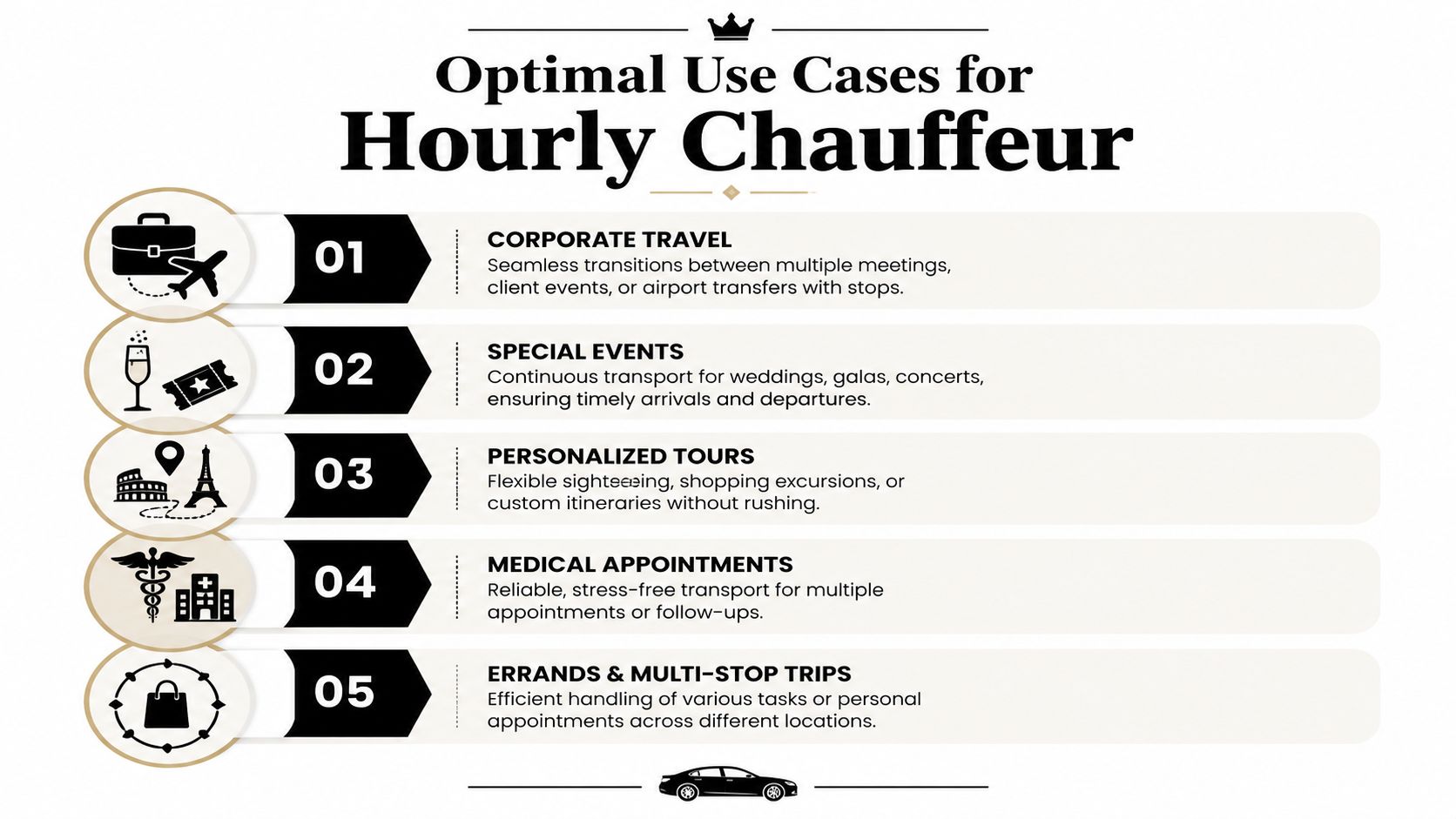
Corporate travel with schedule drift
An executive arrives for a morning airport pickup, then has meetings at a law office, a lunch venue, a client headquarters, and an evening dinner. None of those stops is especially difficult by itself. The challenge is the spacing between them. There are short waits, uncertain end times, and at least one location change that happens midday.
That's where hourly service usually earns its keep. The cost comparison shouldn't be “one hourly block versus one transfer.” It should be “one hourly block versus a chain of separate bookings plus idle time plus pickup risk.”
Weddings and formal events
A wedding day almost never moves in a straight line. The bridal party may need transportation from hotel to ceremony, then to photos, then to reception. Family members may need extra runs. Timing changes without much warning.
An hourly booking fits that pattern because the service is organized around sequence, not just destination.
Sporting events, concerts, and crowded exits
Post-event pickups are where many separate ride plans start to unravel. Everyone exits at once. Pickup zones get crowded. Communication gets harder.
With a dedicated chauffeur, the departure is already part of the plan. The vehicle and chauffeur are tied to your reservation, not thrown into a live dispatch scramble.
A quick visual summary may help:
Custom touring and errand days
Hourly service also makes sense for a visitor who wants a half-day city tour, a family handling several appointments, or a client doing shopping and dining across multiple neighborhoods. These itineraries share one trait: the order can shift.
Here's a simple decision table:
| Use case | Usually better model | Why |
|---|---|---|
| Single direct airport transfer | Point-to-point | Clear route, clear end point |
| Three or more city stops with waiting | Hourly | Less friction between stops |
| Event with uncertain end time | Hourly | Standby availability matters |
| Long one-way intercity trip | Transfer or city-to-city rate | Distance may outweigh standby value |
Group transportation needs extra planning
For larger vehicles, there's another layer to consider. The Federal Motor Carrier Safety Administration applies Hours of Service rules to covered passenger operations, including vehicles designed or used to carry 9 or more passengers for compensation, as explained by the FMCSA Hours of Service framework. That matters for events, corporate outings, and wedding transportation involving Sprinter vans, minibuses, or similar group vehicles.
So if your itinerary involves a larger group and a long service window, professional planning becomes part of the value. Scheduling isn't only about convenience. It also has to account for compliance, vehicle type, and realistic duty limits.
Your Guide to Booking with Maxs Luxury Rides
When you're ready to book, the process works best when you treat the reservation like a logistics brief rather than a casual car request.

Start with the shape of the day
Before you book, write down the day in sequence:
- First pickup
- Known stops
- Likely waiting periods
- Estimated final destination
- Passenger count
- Luggage or equipment needs
You don't need a perfect schedule. A workable draft is enough. What matters is giving dispatch a realistic picture of how the vehicle will be used.
Match the vehicle to the job
A solo executive heading to meetings may want a sedan. A family with luggage may need an SUV. A wedding party or corporate group may need a Mercedes van, Sprinter limousine, executive shuttle, minibus, or coach.
The right choice usually depends on three things:
- How many people are traveling
- How much cargo or luggage they have
- Whether the day involves long standby periods or repeated loading and unloading
If the trip includes airport legs, event staging, or multiple pickups, mention that early. Those details affect routing and vehicle planning more than clients often realize.
Give the transportation team your likely version of the day, not the ideal version. Realistic planning produces cleaner service.
Add the details that matter operationally
Experienced clients anticipate their needs. Include any preferences that change how the service should be delivered:
- Quiet cabin for calls
- Extra space for garment bags or presentation materials
- Assistance for older family members
- Child seating needs if applicable
- Pickup instructions for hotels, venues, or FBOs
Max's Luxury Rides operates around the clock and offers a broad fleet for airport transfers, corporate travel, special events, and group transportation. That variety is useful only if the itinerary details are clear enough to match the right vehicle and timing to the reservation.
Hourly Chauffeur Service FAQs
Can I use hourly service for a one-way long-distance trip?
You can, but it isn't always the smartest pricing model. If the trip is mostly one continuous drive with little waiting and few stops, a point-to-point or city-to-city structure may fit better. Hourly service usually shines when the day includes standby time, schedule changes, or multiple stops in a compact area.
Why does chauffeur service cost more than a standard ride app?
Because you're not buying the same product. You're paying for a reserved professional, a scheduled vehicle, service continuity, and a more controlled experience. The wage picture supports that distinction. The U.S. Bureau of Labor Statistics lists a $20.00 median hourly wage for Shuttle Drivers and Chauffeurs in May 2023, with percentile wages ranging from $12.38 at the low end to $24.00 at the high end in the published distribution, according to BLS wage data for chauffeurs.
How far in advance should I book?
For ordinary weekday use, earlier is usually better. For weddings, major events, airport travel during busy periods, and group transportation, don't wait until the last minute if you want specific vehicle types or tighter itinerary control.
What if my schedule changes during the booking?
That's one of the main reasons clients choose hourly service. Small changes are often easier to accommodate because the vehicle is already committed to your time block. The important part is to communicate updates as early as possible during the day.
Is hourly service good for group travel?
Yes, especially for event sequences and multi-stop outings. For larger vehicles, the provider also has to plan around the operating rules that can apply to passenger transportation, vehicle type, and service duration.
If your day includes multiple stops, waiting time, or a schedule that may shift, a custom quote will tell you quickly whether hourly service is the sensible choice. Max's Luxury Rides Inc. can help map your itinerary to the right vehicle and booking format so you can compare hourly and point-to-point options with fewer surprises.