
Your CEO lands late. The client dinner moved up. The assistant booked a ride-share, the driver canceled twice, and now the executive is taking calls from a curb outside the terminal while your team scrambles. That's not a transportation problem. It's a reliability problem, a duty-of-care problem, and in some cases a reputation problem.
For a new travel manager, the marketing noise begins. Every provider claims luxury. Every website shows black cars, polished interiors, and vague promises about professionalism. None of that helps you decide who can move executives, clients, and teams without creating risk.
A real corporate limousine service isn't about leather seats. It's about controlling variables. You need on-time execution, documented safety standards, clean billing, flight tracking, responsive dispatch, and chauffeurs who understand they're representing your company the moment they pull up.
The Strategic Value of Professional Ground Transportation
Ground transportation deserves the same scrutiny you give air, hotel, and traveler safety. If your company moves executives, clients, board members, or sales teams on tight schedules, the car service is part of business operations. A weak provider creates missed meetings, wasted executive time, avoidable support work, and exposure your travel program does not need.
The spending reflects that reality. Analysts at Market Intelo valued the global limousine service market at $6.8 billion in 2025. The corporate segment accounted for 35.8% of revenue, or about $2.43 billion, and North America represented 42.5% of the market at $2.89 billion. Companies keep buying these services for one reason. Predictable ground transportation protects schedules and reduces operational risk.
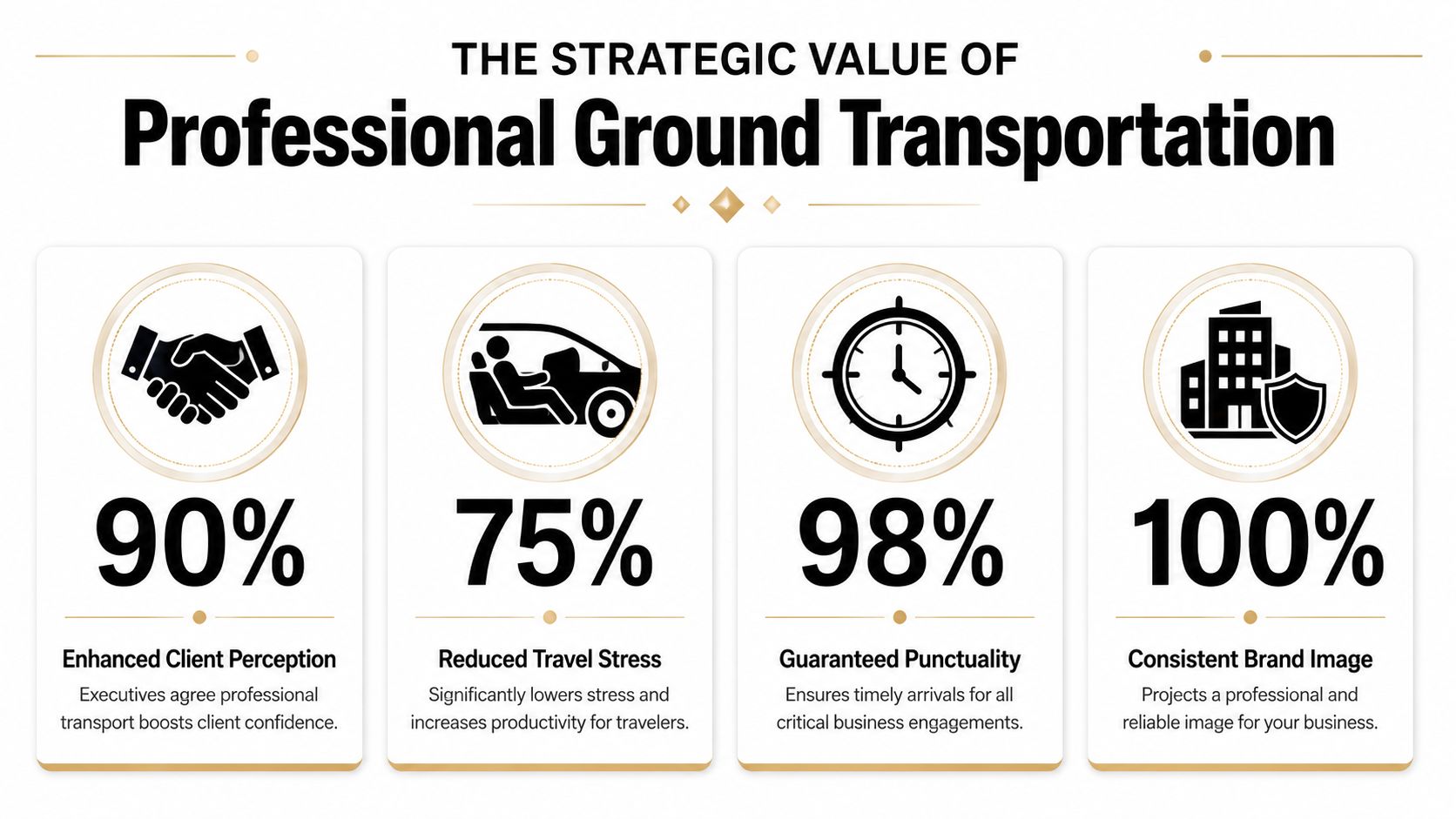
What companies are really buying
A corporate car booking should produce a controlled outcome, not just a completed ride.
That outcome includes:
- Schedule protection: Dispatch oversight, airport timing, and route management reduce the odds that one late pickup derails a full day of meetings.
- Executive productivity: A quiet, well-kept vehicle gives travelers usable time for calls, email, prep, or recovery between appointments.
- Client confidence: The pickup experience shapes perception before the meeting starts, especially for investor, legal, and enterprise sales travel.
- Program control: Centralized reservations, billing, and service standards make policy enforcement easier across offices and traveler groups.
For a travel manager, that last point matters more than it gets credit for. Random booking methods create random service records, random billing, and random accountability. You cannot manage cost, safety, or duty of care with fragmented ground transportation.
Professional ground transportation earns its budget when it prevents one missed meeting, one executive delay, or one avoidable client complaint.
Where the ROI shows up
The return shows up first in time. Your team spends less effort chasing drivers, fixing pickup errors, and answering panicked traveler calls. Executives spend less time waiting at curbs and more time preparing for the meeting that justified the trip.
It also shows up in control. A serious provider supports approved billing, consistent communication, trip visibility, and records you can review later. That matters for expense discipline, but it matters even more for risk management. If a traveler is delayed, rerouted, or involved in an incident, you need a provider that can document what happened and respond fast.
That is the strategic value. Better ground transportation reduces friction, protects revenue-generating schedules, and gives your company a transportation process you can defend to finance, operations, and legal.
Defining the Modern Corporate Limousine Service
A modern corporate limousine service should be judged on operations, not aesthetics. If a provider leads with champagne, mood lighting, or “VIP treatment,” they're probably selling event transportation language to a business buyer. Corporate travel requires a different standard.
The three traits that matter
The first is reliability. That means the provider doesn't merely accept a reservation. They manage it. They track flight status, confirm assignments, monitor delays, and keep dispatch engaged until the traveler is inside the vehicle.
The second is professionalism. The chauffeur isn't just a driver. For your traveler, that person functions like a mobile extension of office support. They should understand discretion, routing discipline, guest interaction, and when silence is part of the service.
The third is duty of care.
Duty of care in corporate transportation means the provider can show how it protects travelers through vetted chauffeurs, maintained vehicles, documented insurance, active trip monitoring, and responsive support when plans change.
That definition matters because many companies still confuse “premium” with “safe.” They're not the same thing. A glossy vehicle doesn't prove compliance. A polished website doesn't prove procedures.
What separates corporate service from standard limo rental
A standard limo rental often focuses on the vehicle and the occasion. A corporate provider focuses on process. That difference changes everything.
Look for signs of an operations-first service model:
- Booking discipline: Reservations capture flight details, pickup instructions, contact information, and special handling needs.
- Dispatch visibility: Someone is actively managing live trips, not just sending confirmations.
- Chauffeur standards: Drivers follow appearance, conduct, and communication expectations suitable for executives and clients.
- Billing structure: Finance teams get clear invoices, usable receipts, and account-level reporting instead of consumer-style transaction chaos.
The easiest test to apply
Ask yourself one blunt question. If a board member's flight diverts, the arrival terminal changes, and the pickup time shifts, does this provider have a system for handling it without your intervention?
If the answer is vague, it's not a real corporate solution.
A dependable corporate provider removes decision fatigue from the traveler and operational chaos from the travel manager.
That's the standard. Anything less is dressed-up car service.
Matching the Right Vehicle to Your Business Needs
Travel managers waste money when they mismatch the vehicle to the job. They either overspend on unnecessary capacity or underbook and create discomfort, luggage problems, and backup calls to dispatch. The right choice depends on passenger count, trip purpose, luggage, and whether the ride needs to function as workspace, shuttle, or simple transfer.
Corporate Fleet Guide and Use Cases
| Vehicle Type | Passenger Capacity | Ideal Use Case |
|---|---|---|
| Executive sedan | 1 to 3 passengers | Solo executive airport transfers, client pickups, short city meetings |
| Luxury SUV | 1 to 6 passengers | Senior leaders with luggage, small teams, roadshow transfers, weather-sensitive trips |
| Mercedes Sprinter van | 6 to 14 passengers | Airport runs for small groups, offsite transport, team transfers with gear |
| Executive shuttle or minibus | 14 to 30 passengers | Conference group movements, hotel shuttles, corporate dinners, site visits |
| Mini coach or full-size coach bus | Larger groups | Major events, multi-department movements, airport manifests, all-day shuttle loops |
Passenger capacity varies by interior configuration and luggage load, so confirm the exact setup before booking.
Executive sedans for routine high-value trips
The executive sedan is the default choice for one traveler or a pair of travelers who need a smooth airport transfer or direct ride to meetings. It's efficient, discreet, and usually the easiest category to deploy consistently across a corporate account.
Use a sedan when the goal is speed and simplicity. Don't use it when the traveler has multiple large bags, presentation equipment, or wants room to work more comfortably on the move.
Typical expectations include a quiet cabin, charging access, bottled water if included by the provider, and a chauffeur trained for low-friction business service.
Luxury SUVs for flexibility
SUVs solve common corporate problems. They give you extra luggage room, easier ingress for longer airport runs, and more comfort for senior travelers or small groups. They're often the smarter pick when weather, road conditions, or unpredictable baggage count could complicate a sedan booking.
A luxury SUV also makes sense for client-facing pickups where you want a bit more presence without moving into event-style transportation.
Book the SUV when uncertainty is part of the trip. Extra room is cheaper than a failed pickup.
Sprinters, shuttles, and coaches for moving teams
Mercedes Sprinter vans sit in the sweet spot between premium experience and group practicality. They work well for executive teams, investor meetings, production crews, and airport transfers where everyone needs to stay together.
For larger movements, move up to executive shuttles, minibuses, or coaches. These are logistics tools, not just bigger vehicles. They reduce staggered arrivals, simplify headcounts, and lower the chance that one late vehicle delays an entire event schedule.
When you're comparing larger formats, ask for specifics:
- Luggage handling: Don't assume passenger count equals baggage capacity.
- Boarding efficiency: Side-entry and step height matter for older guests and formal attire.
- Onboard setup: Some trips need conference-style seating or workspace feel. Others just need efficient shuttle throughput.
- Trip duration: Comfort expectations change fast once the route becomes more than a simple hotel transfer.
The practical rule for selection
Choose the smallest vehicle that reliably supports the trip. Not the cheapest. Not the flashiest. The smallest one that handles passengers, luggage, timing, and comfort without creating contingency work for you later.
That's how you control spend and protect service quality at the same time.
Navigating Corporate Service Packages and Offerings
Providers often advertise “airport service” or “event transportation” as if those are simple categories. They aren't. The value is in how the service is packaged and managed. Good providers build workflows around recurring corporate needs so your team isn't reinventing the process for every trip.
Airport transfers done properly
The cleanest example is the airport meet-and-greet. A traveler lands after a delayed flight, exits into a crowded terminal, and sees a chauffeur who already knows the updated arrival time, terminal information, and final destination. No texting loop. No curbside confusion. No need for the traveler to coordinate while carrying luggage and fielding calls.
That's what a proper airport package should include in practice: flight monitoring, dispatch oversight, standardized pickup instructions, and a backup process if the traveler's plans shift.

Roadshows and multi-stop itineraries
Financial roadshows, legal meetings, and investor tours are where weak providers get exposed. One city day can include airport pickup, hotel transfer, multiple office stops, schedule compression, and constant route changes. A driver alone can't manage that well. You need dispatch support and a company that understands itinerary control.
In these cases, hourly service is usually the operational fit because the schedule can move. The provider should track the day in real time, communicate clearly with the booker or assistant, and adjust routing as meetings run early or late.
A strong roadshow package should account for:
- Flexible stop sequencing: Meetings shift. The transportation plan must shift with them.
- Chauffeur continuity: Executives shouldn't have to repeat instructions at every leg.
- City knowledge: Traffic patterns, venue access, and alternate routes matter.
- Administrative simplicity: One managed booking is easier than stitching together separate rides.
Large-scale event transportation
Corporate event transportation is a different discipline. Think conference arrivals, dinner transfers, venue loops, airport manifests, and executive VIP handling all happening at once.
The providers worth hiring don't just send vehicles. They build movement plans. They assign staging areas, define pickup windows, coordinate dispatchers, and match vehicle types to group size and access constraints.
Event transportation fails when everyone assumes the vehicles are the hard part. The hard part is timing, routing, and communication.
For travel managers, the key question is whether the company can handle complexity without pushing that burden back onto your team. If you still have to direct every movement yourself, you're not buying a package. You're buying cars and doing the operations work in-house.
Understanding Corporate Transportation Pricing Models
Most frustration with a corporate limousine service comes from bad quote comparisons. One provider looks cheaper until the invoice lands. Another looks expensive until you realize the first quote excluded half the trip realities. Your job is to compare structure, not just price.
The three common pricing models
Hourly pricing works best when the itinerary might shift, when there are multiple stops, or when the traveler needs standby service. This is common for roadshows, executive days packed with meetings, and event support. The catch is that hourly bookings often come with minimum time requirements, so ask what the actual billable floor is.
Point-to-point flat rates are cleaner for standard airport transfers and straightforward city trips. If the route and timing are predictable, flat rates make budgeting easier and reduce invoice disputes.
Dynamic pricing appears when demand spikes, vehicle supply tightens, or special events affect availability. That doesn't automatically make a provider unreasonable. It means you need to understand when demand-based pricing applies and whether your corporate account can lock in any protections or preferred structures.
The hidden-cost checklist you should always review
A quote isn't usable until you know what it excludes. Ask for all likely trip charges in writing.
- Fuel surcharges: Some providers separate them. Others embed them in the base rate.
- Wait time: This matters for airport pickups, delayed meetings, and guest no-shows.
- Tolls and parking: These can materially change the final bill on urban routes.
- Airport fees: Some airports impose access or pickup-related charges.
- Administrative fees: If present, they should be disclosed up front.
- Chauffeur gratuity: Some accounts include it automatically. Others leave it open.
- Cleaning or damage fees: These should be defined, not vaguely reserved.
- Cancellation terms: These often cause “cheap” bookings to become expensive.
How to compare quotes properly
Don't ask, “What's your rate?” Ask, “What would the final invoice typically include for this exact trip type?”
Then test providers with one realistic scenario. For example, a flight delay, luggage claim slowdown, and downtown hotel destination. Or a four-stop executive afternoon with uncertain timing. If the response is clear and itemized, you're dealing with an operator who understands corporate buyers.
If the response is fuzzy, that's a warning.
Practical rule: If a provider can't explain billing in plain English before the trip, expect disputes after the trip.
What good pricing feels like
Good pricing isn't always the lowest rate. It's predictable, documented, and aligned to the service you need. The best corporate accounts reduce invoice surprises and internal approval friction. Finance gets consistency. Travelers get reliability. You spend less time reconciling exceptions.
That's the primary pricing advantage.
Verifying Safety Professionalism and Technology
Demand proof, not promises. Safety, chauffeur standards, and technology are key separators in a corporate limousine service. Any company can write “professional drivers” on a website. Serious buyers ask what that means.
What to verify before you book
Start with chauffeur vetting. You want a provider that can clearly explain how it screens drivers, reviews driving records, and handles ongoing training. If the answer is generic, assume the process is weak.
Next, ask about insurance and compliance. Existing market commentary highlights a major gap in how providers explain this. It notes that 74% of corporate clients explicitly request proof of $100,000 to $300,000 liability coverage per accident before booking, yet many companies don't display that information clearly, according to industry commentary on limo service compliance expectations. Whether those exact thresholds match your policy or not, the takeaway is obvious. Corporate buyers want documented coverage, not vague reassurance.

Technology is part of duty of care
Real-time visibility is no longer optional. GPS tracking supports route compliance, pickup adherence, and accurate arrival updates, as explained in Way Plan's overview of technology in limousine operations. For a corporate client, that's not a novelty feature. It's operational control.
A provider should be able to tell you:
- Where the vehicle is: Not eventually. In real time.
- Whether the route is being followed: This matters for service quality and compliance.
- How updates are delivered: Text, app, email, dispatcher call, or some combination.
- What happens during disruption: Delays, reroutes, no-shows, and location mismatches need defined protocols.
If you want a concrete example of what modern oversight can look like in practice, review Fleetalyse tracking and dashcams. The useful takeaway isn't the brand itself. It's the standard: integrated telematics and recorded trip visibility are becoming normal expectations for fleets that take accountability seriously.
Professionalism should be measurable
Professionalism isn't just attire. It includes discretion, communication, vehicle condition, and how chauffeurs behave when the traveler is stressed, delayed, or changing plans.
Ask for specifics such as:
- Background check policy: What is reviewed and how often?
- Training scope: Service etiquette, safety procedures, airport protocols, client privacy.
- Vehicle maintenance records: Can they show documented upkeep?
- Dispatch availability: Is someone reachable when a trip goes sideways?
If a provider won't document safety, insurance, and monitoring practices, don't assume they have them.
Corporate transportation buyers don't need more branding language. They need evidence.
How to Choose and Partner with a Provider
The U.S. market is crowded. The limousine and town car services industry comprises about 196,000 businesses in 2026, and market size reached $11.6 billion, according to IBISWorld's U.S. industry profile for limousine and town car services. That scale is exactly why casual selection is a bad idea. Plenty of companies can take a booking. Far fewer can support a corporate account well.

Use a shortlisting process, not a gut feeling
Start with three to five providers and test them against real scenarios. Don't ask abstract questions like “Are you reliable?” Ask how they handle a delayed flight, an itinerary revision, or a late-night executive pickup from a fixed-base operator.
Your initial screening should cover:
- Account structure: Can they support centralized billing, traveler profiles, and approval workflows?
- Service area fit: Do they handle your specific airports, offices, hotels, and event venues well?
- Fleet fit: Do they offer the vehicle classes your travelers require?
- Support model: Is live dispatch available when plans shift?
- Documentation: Can they provide insurance, licensing, and operating details promptly?
What to ask before signing a corporate account
The contract matters as much as the vehicles. Review terms the same way you'd review a hotel or travel management agreement.
Focus on these clauses:
- Cancellation rules: Know the cutoff windows and airport-specific exceptions.
- Wait-time rules: Especially for meet-and-greet and international arrivals.
- Billing detail: Confirm what appears on invoices and how disputed charges are handled.
- Confidentiality expectations: This matters for executive and legal travel.
- Service escalation: You need a named account contact and a path for urgent issues.
If your travelers also rely on white-glove trip planning outside ground transport, resources on luxury travel for busy professionals can help you think more broadly about how concierge-style support should integrate with executive itineraries. The point isn't to outsource everything. It's to set a higher standard for coordinated service.
What a workable provider example looks like
One practical benchmark is whether the operator's published capabilities line up with the standards above. For example, Max's Luxury Rides Inc. offers executive sedans, luxury SUVs, Mercedes vans, shuttles, minibuses, mini coaches, and full-size coaches, along with airport and corporate transportation services, vetted chauffeurs, 24/7 availability, and standard reservation support. That doesn't make it the right fit for every buyer. It does make it the kind of provider profile worth evaluating against your actual policy and route needs.
Before you finalize any partnership, watch how the company communicates during the sales process. Slow replies, vague answers, or sloppy confirmations usually get worse after the contract is signed.
Here's a useful mindset to keep while evaluating partners:
The decision rule I'd use
Choose the provider that makes your program easier to manage under stress. Not the one with the flashiest vehicles. Not the one with the cheapest starting rate. The one that can prove it will protect schedules, travelers, and internal admin time when a normal travel day stops being normal.
That's the partner you want.
Frequently Asked Questions About Corporate Limo Services
How far in advance should I book?
For standard executive airport transfers, book as early as your itinerary is stable. For larger groups, event transportation, or multi-vehicle movements, book much earlier because vehicle coordination and dispatch planning get more complex.
If the trip is high stakes, don't wait for the last minute just because the route looks simple. The route is rarely the issue. Availability and coordination are.
Is gratuity usually included on corporate accounts?
Sometimes yes, sometimes no. Never assume. Ask whether chauffeur gratuity is built into the contracted rate, applied automatically on invoices, or left to traveler discretion.
Your travel policy should settle this in writing. Otherwise, you'll create avoidable reimbursement confusion.
What should I ask about luggage capacity?
Ask for luggage guidance tied to the exact vehicle model, not just the category label. An executive sedan may work for one traveler with standard luggage and fail for two travelers carrying large cases, sample kits, or presentation gear.
For group moves, ask two separate questions: how many passengers and how much luggage. Providers hear the first question all day. The second is what prevents operational mistakes.
Book based on people plus bags. Not people alone.
How are last-minute itinerary changes usually handled?
Good providers route changes through dispatch, not just the chauffeur. That matters because dispatch can rework timing, update records, and manage downstream trip impact if the same vehicle has later assignments.
Ask the provider how they handle added stops, arrival changes, and extended standby time. You want the answer before the first disruption, not during it.
Do I need a corporate account, or can I just book trips individually?
If your company books recurring transportation, set up a corporate account. It gives you cleaner billing, traveler consistency, and better oversight. Individual bookings might seem simpler at first, but they create fragmented records and inconsistent service standards.
A corporate account also provides an advantage. You can standardize pickup instructions, contact protocols, and invoice requirements.
What's the biggest mistake new travel managers make?
They buy on image instead of process. A polished fleet doesn't guarantee dispatch discipline, chauffeur vetting, or clean billing.
Your job isn't to book the nicest-looking ride. It's to build a transportation program that works repeatedly, safely, and without constant intervention.
If you're evaluating options for executive airport transfers, corporate rides, or group transportation, Max's Luxury Rides Inc. is one provider you can review against the criteria above. Look at fleet fit, chauffeur standards, dispatch responsiveness, and account support first. That's how you choose a service that protects your travelers and your time.