
A presidential convoy turns an ordinary city street into a moving security zone. The public sees a glossy black limousine. Security professionals see a protected passenger cell, a backup plan on wheels, and a choreography of people and vehicles timed down to the minute.
That's why the chauffeur driven vehicle that presidents ride in is interesting far beyond its celebrity status. It shows how serious transport changes when the passenger isn't just important, but mission-critical.
Beyond the Limousine The World of Presidential Transport
The motorcade arrives before onlookers fully register what they're seeing. A lead element moves first, support vehicles hold formation, and the presidential car stays wrapped inside a layered shield of people, communications, and contingency planning.
That's the first point many readers miss. The president's vehicle is more than a luxury sedan with a skilled driver. The vehicle sits inside a complete transport system built for security, continuity, and control.
More than a car
The public nickname, “The Beast,” makes the limousine sound like the whole story. It isn't. The car matters, but the full capability comes from the combination of vehicle design, route management, staffing, and redundancy.
A useful way to think about presidential ground transport is this:
- The limousine is the survival capsule.
- The motorcade is the moving perimeter.
- The logistics team is the hidden operating system.
When those three layers work together, the president can move through a crowded city, attend events, and remain protected even when conditions change quickly.
Presidential transport is less like VIP travel and more like a mobile infrastructure project that happens at street level.
Why this matters outside politics
Corporate travelers and event planners can learn a lot from that model. Most executive ground transportation doesn't require armor or federal agents. It does require the same underlying principles: trusted drivers, dependable vehicles, route discipline, communication, and backup options when conditions shift.
That's where presidential transport becomes practical, not just fascinating. If you're responsible for a CEO arrival, a wedding party transfer, a conference shuttle plan, or a family airport pickup with tight timing, the lesson is simple. Reliability isn't luck. Someone has to build it into the trip.
Inside The Beast The Ultimate Presidential Vehicle
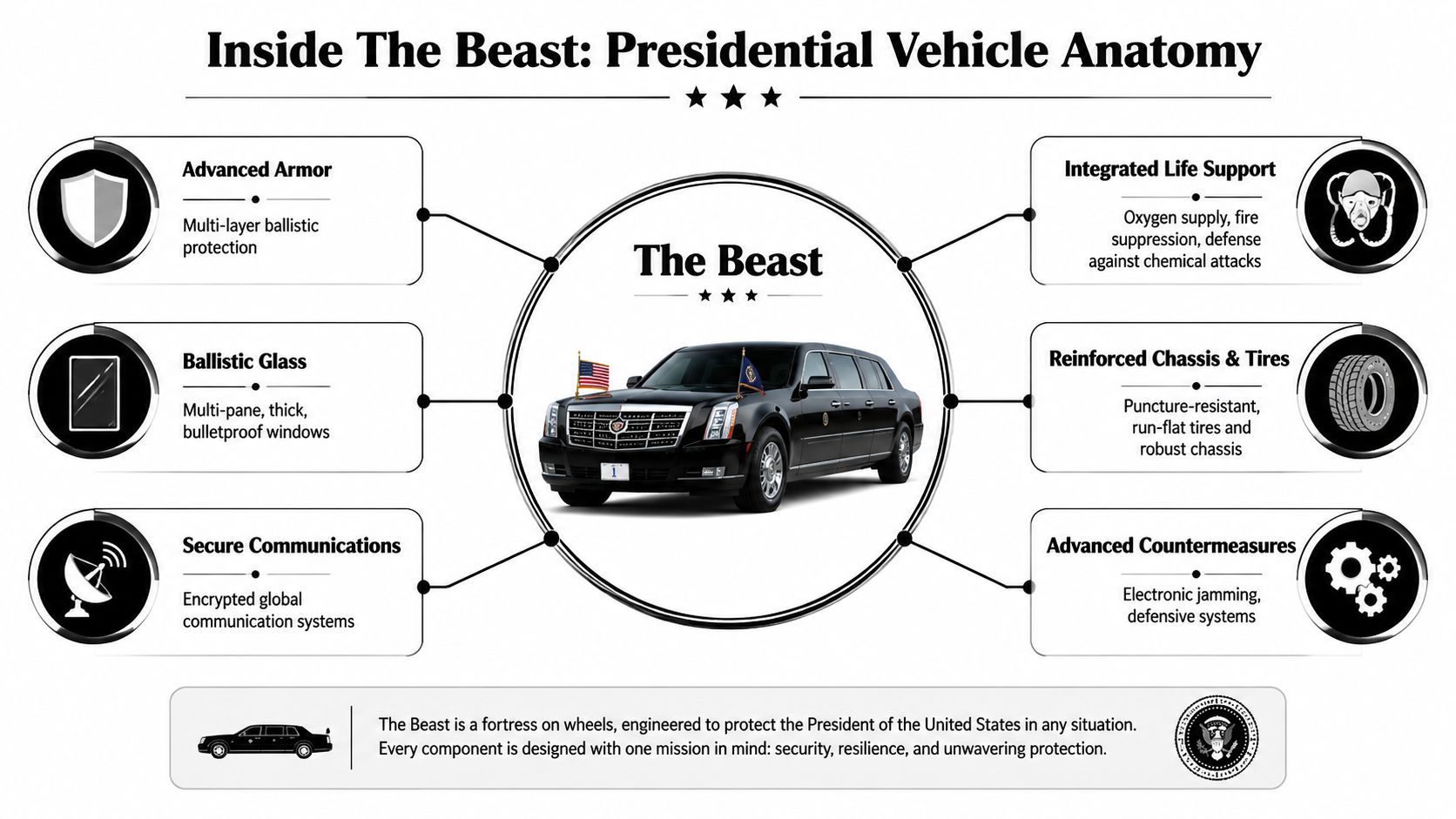
A presidential limousine has the aura of a luxury car, but its job is closer to a rolling safe room. Doors close. Air can be isolated. Tires can fail and the vehicle is still expected to move. That is the first secret-agent detail to understand. The car is built to preserve options during the worst few minutes of a crisis.
The best-known vehicle in that system is the limousine officially called Cadillac One and widely nicknamed The Beast. According to this technical profile of the presidential armored Cadillac limousine, the current U.S. presidential limousine weighs about 20,000 pounds (9,072 kg), uses a modified medium-duty truck platform, and carries T6-level armoring designed to withstand high-powered rifle fire.
Why it's built like a truck
That truck-based foundation often surprises readers. It helps once you stop comparing The Beast to a premium sedan and compare it to an armored rescue vehicle wearing formal clothes.
Armor is heavy. Ballistic glass is heavy. Reinforced doors, protected fuel systems, communications gear, and emergency equipment all add mass. A normal luxury-car chassis is built to feel light and responsive. The presidential limousine is built to carry extraordinary weight without losing structural integrity. The engineering priority is not nimble cornering. It is surviving an attack, protecting the occupant, and getting clear.
A bank-vault comparison fits here. The passenger cabin works like a hardened capsule, and the underlying frame has to support that capsule under stress.
What the protective features do
Security features can sound dramatic until you translate them into plain language.
- Ballistic armor and glass protect the passenger compartment from gunfire and fragmentation.
- Run-flat mobility systems let the vehicle keep going after tire damage.
- Reinforced lower structure helps the car tolerate blast effects, debris, and severe road impact.
- Sealed life-support capability helps protect the occupant if the outside air becomes unsafe.
The same vehicle profile notes a 1-inch-thick steel floor and wheel systems designed to keep operating after tire destruction. That matters because protective driving is about function under failure. Security professionals do not judge a vehicle only by how quiet and polished it feels on a normal street. They judge it by whether it still works after the trip stops being normal.
That mindset carries over to civilian executive transport, even without armor. A corporate travel planner may never need blast protection, but the same planning logic still applies. Can the car continue after a puncture? Is the driver trained for evasive rerouting? Is there backup communication if a phone fails? Presidential transport answers those questions at the highest level, which makes The Beast useful as a teaching model, not just a curiosity.
A lot of readers also mix up tinted windows with ballistic glass. They solve different problems. Tint manages privacy, glare, and legal compliance. Ballistic glass is part of the protective structure. For a civilian fleet, that distinction matters because high-end transport still has to operate within public road rules, including visibility standards such as the legal limits for limo tint in Georgia.
Another detail from the same source helps explain the vehicle's philosophy. The Beast can reportedly maintain 50+ mph even after tire destruction because of its wheel and insert design. That is not a comfort feature. It is a continuity feature. In protective movement, motion is safety.
A short visual helps make the engineering easier to grasp:
Why ordinary luxury cars aren't comparable
A premium chauffeur sedan is designed to make the ride smooth, quiet, and impressive. The presidential limousine starts with a different question. How do you keep the principal alive, connected, and movable under attack?
That difference is the lesson for corporate and event planners. Elite civilian service should not imitate the armor. It should imitate the discipline behind it: careful vehicle selection, maintained equipment, trained drivers, backup plans, and a professional standard that holds up when the schedule slips or the route changes.
Calling The Beast a chauffeur-driven presidential car misses the larger point. It is a hardened transport platform inside a larger security machine, and that broader system is what civilian luxury transport can learn from best.
Anatomy of a Presidential Motorcade
At street level, a presidential arrival can look like a burst of black paint and flashing lights. To security professionals, it looks more like a moving fortress with assigned jobs, timed spacing, and backup layers built into every minute of travel.
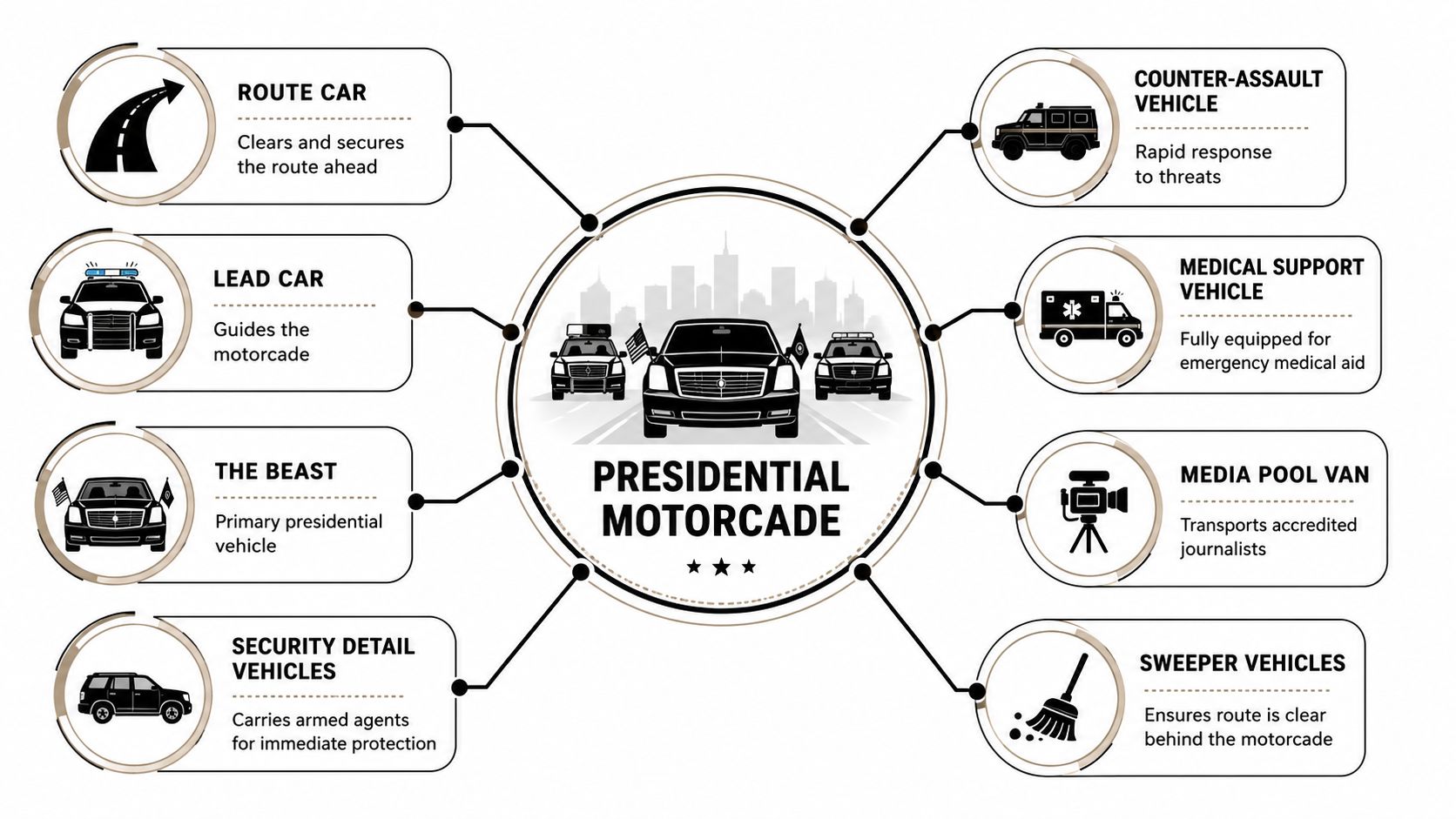
The limousine sits at the center, but it is only one part of the system. According to this overview of presidential motorcade operations, a U.S. presidential motorcade typically involves about 50 vehicles and more than 100 staff members, and a one-hour ground trip from Washington, D.C. to New York can cost roughly $156,820, or $2,614 per minute. Those figures make more sense once you stop viewing the convoy as a fancy car service and start viewing it as a mobile security operation.
The convoy as a layered shield
A motorcade works like concentric rings around one passenger. The front of the formation helps control the route and spot trouble early. The center protects the principal. The surrounding vehicles carry the people and tools needed to respond if the trip stops being routine.
That structure matters because threats do not always appear at the limousine door. A blocked intersection, a mechanical problem, a medical emergency, or a communication failure can all break a movement plan. The convoy is designed to absorb those problems without losing control.
A simplified view looks like this:
| Motorcade element | Main role |
|---|---|
| Lead and route vehicles | Prepare and guide the path ahead |
| Presidential vehicle | Carry the president inside the most protected platform |
| Security detail vehicles | Place agents close enough for immediate response |
| Counter-assault support | Respond rapidly if the convoy is attacked |
| Medical support | Keep emergency care within the moving formation |
| Staff and media transport | Move essential personnel without breaking convoy discipline |
The exact order can change by city, threat picture, and event type. The operating principle stays the same. Every vehicle has a reason to be there.
The hidden logistics machine
The story begins long before departure. Routes are studied, timing windows are coordinated, alternates are prepared, and personnel are assigned so the convoy can keep functioning if something changes with little warning.
As noted earlier, Spyscape reports that the White House Transportation Agency manages this work as a 24/7 unit staffed by Army noncommissioned officers. That detail helps explain why presidential transport feels so controlled. It is not ceremonial improvisation. It is continuous planning, rehearsal, and support.
Three ideas sit underneath that planning:
- Route control: Streets are treated as operating space that must be prepared, not just roads to be driven.
- Redundancy: More than one vehicle, more than one route option, and more than one support function reduce single points of failure.
- Continuity: The mission is to keep the movement working even if timing, traffic, or conditions change suddenly.
A motorcade costs so much because it tries to reduce chance.
What corporate and event planners can borrow
Corporate transport does not need armored limousines, counter-assault teams, or media buses. It does benefit from the same logic. Clear roles, route checks, communication discipline, and backup vehicles are what separate a polished executive move from an expensive guess.
That is the useful contrast many articles miss. The presidential model is not just about The Beast. It is about the wider system around it, and that system offers practical lessons for civilian planning. A CEO airport transfer, a board meeting shuttle, or a sensitive conference pickup all run better when one person owns dispatch, one person owns passenger communication, and the driver is briefed on alternates before the client enters the car.
For planners handling sensitive arrivals or high-visibility events, this guide to secure event transportation shows how those principles carry over into the civilian world. The scale is smaller. The need for preparation is not.
The car is only the visible part. The actual service is the system wrapped around it.
Presidential Security vs Commercial Luxury Chauffeur Services
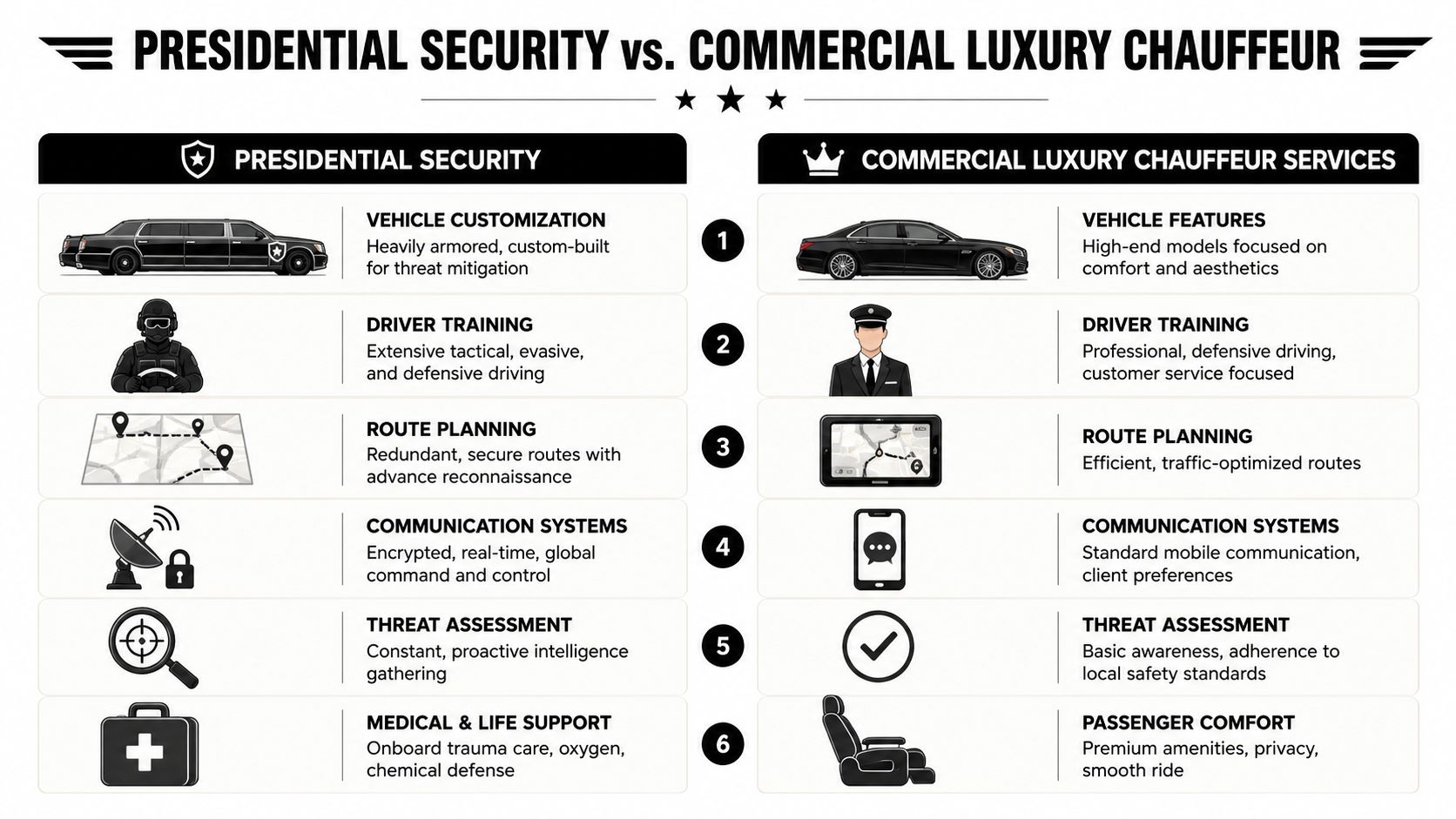
Presidential transport and commercial luxury chauffeur service operate in different threat environments, but they share one basic mission. Both are trying to move an important passenger safely, punctually, and without avoidable surprises.
The difference is in the level of force, specialization, and state resources. A president gets armored platforms, federal protection teams, and mission-scale route control. A civilian client won't get that. What a strong commercial service can provide is something more realistic and still very valuable: disciplined execution.
The same principles, different tools
Here's the most useful comparison for non-government readers:
| Category | Presidential transport | Commercial luxury chauffeur service |
|---|---|---|
| Vehicle strategy | Custom-built armored survivability platform | Premium vehicle selected for comfort, reliability, and suitability |
| Driver role | Protective specialist inside a security mission | Professional chauffeur focused on safety, discretion, and service |
| Route planning | Security-led with layered contingencies | Traffic-aware, schedule-aware, and event-aware planning |
| Communications | Secure command coordination | Consistent dispatch and client communication |
| Contingencies | Built around active threat response | Built around delay recovery, route changes, and service continuity |
That difference matters. The president's car is trying to survive attack. Your executive sedan is trying to avoid operational failure. But the mindset is closer than it first appears.
What high-end civilian service should still copy
Elite civilian transport can't replicate state security hardware, but it should borrow the operating habits that matter most.
- Vetting the driver: In luxury service, the chauffeur shouldn't just know how to drive smoothly. The operator should be screened, reliable, calm under pressure, and consistent in professional conduct.
- Choosing the right vehicle: The best vehicle isn't always the fanciest one. Airport runs, wedding groups, investor roadshows, and executive site visits all call for different equipment.
- Planning beyond the route: Good providers think about pickup timing, venue access, weather, loading space, and backup options, not just the fastest GPS line.
- Maintaining communication: Passengers need to know who's arriving, when the vehicle is positioned, and what happens if an inbound flight or event timeline changes.
For readers arranging travel around sensitive meetings or public-facing events, this guide to secure event transportation is useful because it frames transport as a risk-management decision, not just a comfort purchase.
The civilian version of “presidential standards” isn't armor. It's disciplined professionalism applied before the ride, during the ride, and when the day stops going to plan.
Where people often choose poorly
Many clients compare only vehicle photos and price. That's understandable, but it misses the significant risk. A polished SUV with a weak dispatch process and inconsistent chauffeur standards can fail at the exact moment the schedule tightens.
That's why the presidential model is so instructive. It teaches that the visible car is only the surface. The true service quality lives underneath, in staffing, planning, and execution.
The Untrained Chauffeur Paradox in Presidential Convoys
It is often assumed that every driver in a presidential convoy is a highly trained security professional. That assumption sounds reasonable. It also isn't fully true.
Reporting summarized by ABC7 on Secret Service transport practices found that volunteers with “little or no emergency training” often drive vans for White House staffers and the press corps, receiving a background check and a day-of briefing rather than formal professional security or driving training.
Why this surprises people
The president's own vehicle sits at the center of an elite protective operation. So observers naturally extend that aura of professionalism to every surrounding vehicle. They picture an unbroken ring in which everyone has the same level of preparation.
That isn't how large operations always work. Even highly visible systems can contain uneven standards across different roles. The core protective unit may be exceptionally specialized, while support transportation for staff and media operates under a much lighter model.
What this reveals about transport risk
This doesn't mean the entire motorcade is careless. It means not every seat in the convoy is supported by the same standard of driver preparation.
That distinction matters because support vehicles still operate inside a complex environment. They move in formation, carry people whose schedules matter, and must respond calmly to changes in routing, timing, or roadside conditions. A driver with minimal preparation may be adequate for a narrow task. But adequacy is not the same as excellence.
A useful way to frame the issue:
- The president's driver represents peak specialization.
- Some surrounding vehicles reflect a practical staffing shortcut.
- The convoy, therefore, is not uniformly “presidential” in every human role.
Prestige can hide inconsistency. A famous transport system may still rely on ordinary standards in places the public rarely sees.
The takeaway for civilian clients
The presidential example holds unexpected value for corporate and event planning. If even a famous government convoy can include a professionalism gap in support driving, private clients shouldn't assume quality based on appearance alone.
Ask harder questions. Who hires the drivers? Who vets them? What training do they receive? Are they professional chauffeurs or merely available operators filling a schedule?
Those questions matter more than the badge value of the vehicle itself. For a company roadshow, wedding party, airport arrival, or board meeting transfer, the practical standard should be straightforward: every passenger vehicle should be driven by someone chosen for the role, not merely assigned to it.
That's the paradox. The most recognizable motorcade in the world still shows why professional chauffeuring is a separate discipline, not an automatic byproduct of status.
Applying Presidential Standards to Your Executive Travel
Presidential transport offers a simple lesson for civilian travel planning. Don't chase spectacle. Chase systems. The visible vehicle matters, but the dependable outcome comes from preparation, adaptability, and trained people.
One especially useful example is how the convoy can change shape when conditions change. A video explanation of presidential motorcade adaptation notes that the configuration can shift to be composed entirely of “beasts” when traveling in places with “questionable road conditions” or higher danger levels. The principle is what matters: serious transport changes the plan when the environment changes.
A practical executive travel checklist
If you're booking transport for executives, wedding parties, event guests, or family travel, these are the questions worth asking before confirming the reservation:
Who exactly will drive the vehicle?
You want a named, professional chauffeur standard, not a vague promise that “a driver will be assigned.”What vehicle is being sent, and why is it the right one?
A sedan, SUV, Mercedes van, Sprinter, shuttle, or coach should fit the trip's people, luggage, venue access, and timing.What happens if the route changes?
Strong providers don't freeze when traffic builds, flights shift, or venue access gets restricted.How is communication handled on the day of service?
You should know how updates, arrival notices, and schedule changes are passed to both passengers and organizers.What backup thinking is built into the trip?
A quality service should be able to explain its approach to timing buffers, replacement options, and operational continuity.
What “presidential standards” should mean in real life
For civilian use, that phrase shouldn't mean armored glass or tactical formations. It should mean four things:
- Reliability: The vehicle arrives when promised.
- Professionalism: The chauffeur behaves like a trained operator, not an app-based improvisation.
- Discretion: Passenger privacy and smooth handling are treated as part of the service.
- Adaptability: The plan can absorb real-world friction without the client having to rescue it.
That's what high-stakes passengers need. The board member doesn't need a convoy. The board member needs a car service that won't miss the pickup, confuse the terminal, send the wrong vehicle, or go silent when the itinerary shifts.
A better way to judge premium transport
Many buyers still start with leather seats, glossy paint, and model names. Those things matter, but they come after operating discipline.
Use this quick screen before booking:
- Ask about chauffeur standards: Find out how the company selects and evaluates chauffeurs.
- Ask about fleet fit: Make sure the proposed vehicle matches your passenger count and trip type.
- Ask about dispatch support: Confirm that someone is reachable when schedules move.
- Ask about contingency planning: Look for calm, specific answers rather than generic reassurance.
The strongest luxury transport feels effortless to the passenger because someone else has done the hard planning in advance.
Presidential travel makes that visible at the highest level. The rest of us can still apply the same logic on a smaller scale and get the part that matters most: confidence in the ride.
If you want that kind of reliability for airport transfers, executive travel, weddings, or large events, Max's Luxury Rides Inc. offers professionally chauffeured transportation with a broad fleet, 24/7 availability, and service built around punctuality, clean vehicles, and smooth coordination.