
You land after a long flight, clear the aircraft, and reach the terminal with the same question every time. Will the next thirty minutes be controlled, or wasted?
At a busy airport, the weak point is rarely the flight itself. It's the handoff from air to ground. Ride-hail pickup zones shift. Taxi lines stall. One driver cancels. Another circles the wrong terminal. If you're heading to a board meeting, hosting a client, moving a wedding party, or managing a speaker schedule, that uncertainty isn't a minor annoyance. It affects the day.
That's why more travelers now pre-arrange ground transport instead of leaving the arrival to chance. The global pre-book airport transfer market is forecast to grow from USD 13.4 billion in 2025 to USD 38.8 billion by 2035, reflecting stronger demand for reliable premium transportation in corporate and luxury travel, according to Future Market Insights on the pre-book airport transfer market.
An executive airport transfer solves a very specific problem. It removes improvisation from the part of the journey that punishes poor planning most quickly. The vehicle is assigned. The driver is vetted. The pickup plan exists before the plane pushes back. That's the difference clients pay for, and in many cases, it's exactly what keeps a travel day from unraveling.
The End of Airport Travel Stress
The most common mistake in airport transportation is treating arrival as if it were simple.
A traveler can have a confirmed seat, a polished itinerary, and a full calendar waiting on the other side, then lose control the moment they step into baggage claim. At that point, every small delay compounds. A missed text from a driver. A crowded curb. A pickup point that changed while the flight was in the air. None of this feels dramatic on paper. In practice, it creates friction fast.
An executive airport transfer changes the arrival experience because it is designed backward from the traveler's objective, not forward from vehicle availability. If the passenger needs to be at a hotel check-in with no wasted time, at a private terminal with discreet handling, or at a downtown meeting without a messy curbside scramble, the transfer is planned for that outcome.
What the arrival feels like when it is managed properly
With a standard on-demand ride, the traveler often becomes the coordinator. They watch the app, locate the driver, answer calls, and adjust to whatever vehicle and timing appears.
With an executive arrangement, the coordination happens before the aircraft lands. The traveler's role is reduced to one thing. Exit, connect with the chauffeur, and leave.
That difference matters most when the traveler is already depleted. Long-haul arrivals, tight event schedules, family travel with luggage, and VIP guest hosting all expose the weakness of ad hoc transport.
A calm arrival isn't a luxury detail. It's the first proof that the day is under control.
Why this matters more now
Business and premium travelers are buying predictability, not ornament.
The primary appeal isn't leather seats or bottled water. It's the absence of preventable problems. The client doesn't want to negotiate the ground portion of the trip in real time. They want a known pickup, a clean vehicle, and a driver who already understands the route, timing, and expectations.
That's what has pushed executive airport transfer service beyond a niche preference. For travelers who can't afford a sloppy handoff between airport and destination, it has become the practical standard.
What Is an Executive Airport Transfer
An executive airport transfer is a pre-booked, chauffeur-driven service built around punctuality, discretion, and controlled logistics. It is not just a nicer version of a taxi. It is a different operating model.
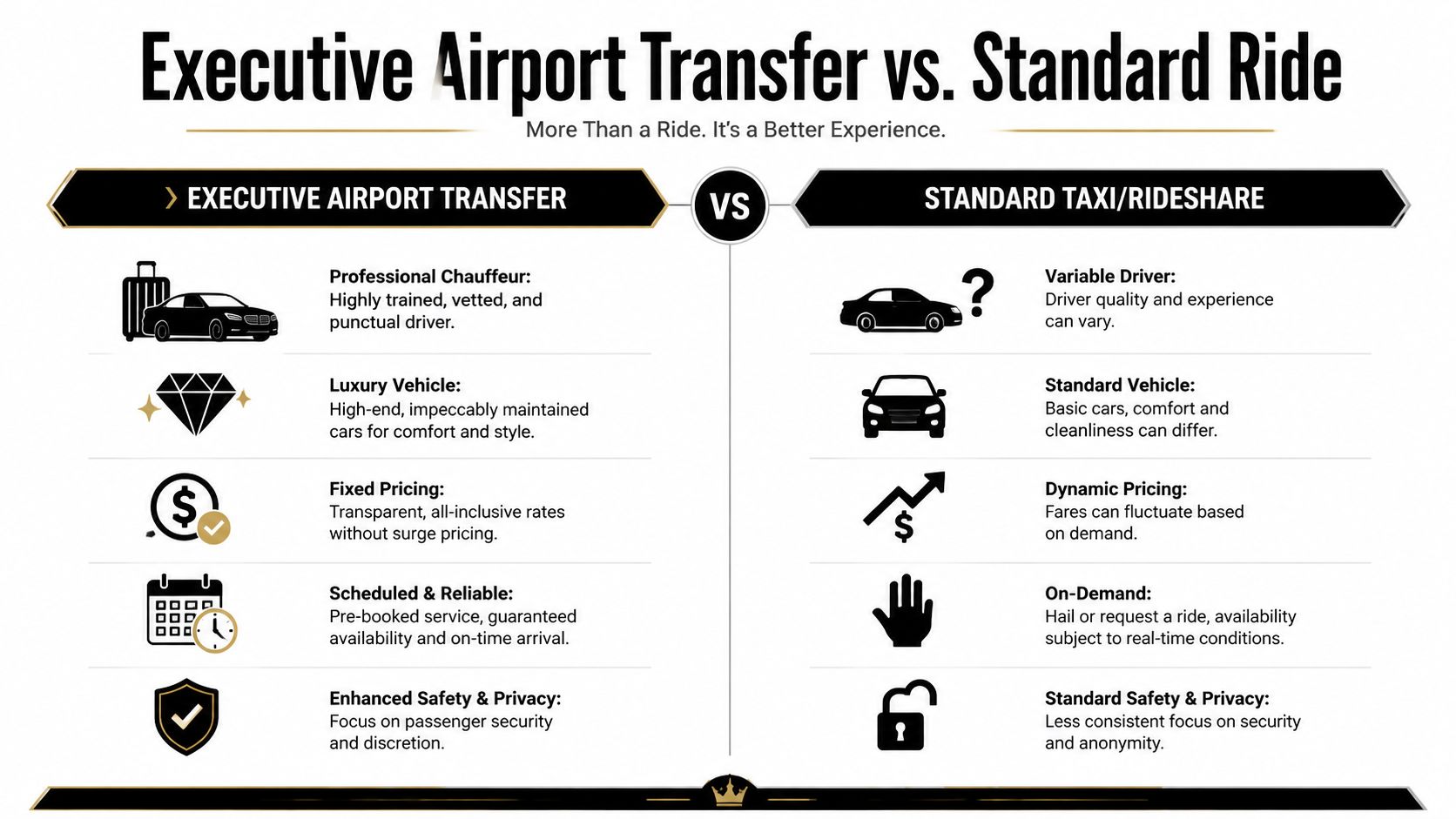
The distinction starts before pickup. In an executive service, the reservation captures flight details, destination requirements, passenger count, and often luggage considerations. The provider then assigns the right vehicle and manages timing against the trip itself. That differs sharply from street-hailed taxis and most app-based rides, where the vehicle appears only when requested and the service quality can vary from trip to trip.
This service versus the standard alternatives
A simple side-by-side view makes the difference clear.
| Service factor | Executive airport transfer | Standard taxi or rideshare |
|---|---|---|
| Booking method | Reserved in advance with trip details | Usually requested on demand |
| Driver standard | Professional chauffeur with service expectations | Experience and presentation can vary |
| Vehicle consistency | Higher vehicle standard and cleaner presentation | Vehicle type and condition can vary |
| Pricing model | Typically fixed and confirmed in advance | Often subject to live conditions |
| Arrival handling | Planned pickup process and luggage support | More self-managed by the passenger |
| Privacy | Better suited for confidential conversation | Less predictable environment |
That difference becomes especially relevant for companies trying to simplify travel operations. Teams responsible for reducing ground transportation load usually aren't looking for glamour. They're looking for fewer moving parts, fewer day-of calls, and fewer transport failures.
What the premium actually buys
The premium buys accountability.
If a rideshare driver misses the terminal or cancels, the passenger absorbs the problem. If an executive transfer is managed correctly, the provider owns the problem and resolves it before it reaches the traveler.
That's why executive service is often selected for:
- Corporate arrivals where the passenger goes directly from terminal to meeting
- VIP hosting where the greeting and first impression matter
- Private aviation movements where timing and discretion have no margin for guesswork
- Event logistics where one delayed passenger can disrupt a larger schedule
Decision test: If the cost of a transport mistake is higher than the fare difference, book the executive option.
What it is not
It's not merely a black car with a dressed-up label.
A true executive airport transfer includes disciplined reservation handling, chauffeur standards, appropriate vehicle assignment, and a clear operational chain on the day of travel. If any of those are missing, the service may still be comfortable, but it isn't executive in the way discerning travelers need.
The Three Pillars of a Premier Service
A premium transfer succeeds or fails on three points. The chauffeur. The vehicle. The logistics behind both. If one is weak, the whole experience feels fragile.
The chauffeur
Clients often focus on the car first. The operator matters more.
A qualified chauffeur does more than drive. They arrive composed, present well, handle luggage without prompting, communicate clearly, and understand when to speak and when to stay quiet. For executive travelers, discretion is part of the product. So is the ability to move through airport and city traffic without making the passenger feel rushed or unmanaged.
Good chauffeurs also understand handoffs. They know how to execute curbside pickup efficiently, how to work a terminal meet-and-greet without confusion, and how to adjust if the traveler exits from an unexpected point.
What doesn't work is a driver who treats the booking like a basic point-to-point fare. Executive clients notice that immediately.
The fleet
Vehicle quality isn't just about appearance. It's about fit.
One of the most practical booking rules is the luggage-to-passenger ratio. According to Chauffeur Services Group on airport chauffeur vehicle selection, a Mercedes E-Class suits a solo executive with two suitcases, while a Mercedes V-Class or Sprinter becomes necessary for teams of 4+ people with significant luggage. That principle is simple, but it's ignored all the time.
Here's the usual mistake. A group books by seat count only. On paper, the car fits. At the curb, luggage doesn't.
A premier service avoids that by matching vehicle type to the actual movement:
- Executive sedans for solo travelers or couples with light luggage
- Luxury SUVs for clients who want extra room without moving into van format
- Mercedes vans or Sprinters for teams, families, and airport runs with heavier baggage
- Shuttles or coaches for conference groups, wedding parties, and event transport
The wrong vehicle creates stress before the trip even starts. The right one makes boarding feel effortless.
The logistics
Here, executive service earns its price.
The reservation must be actionable, not just accepted. That means the provider tracks flight status, confirms key details, understands the pickup method, and maintains communication on the day of travel. The client shouldn't need to chase updates once the journey is underway.
The best operators also know how to handle changes in the manifest. A senior executive is added. A colleague arrives on another flight. A larger luggage load appears. A final destination changes while the original passenger is still taxiing to the gate. These aren't unusual situations. They're normal travel realities.
A premier service doesn't panic when details move. It has a process for absorbing the change without exporting the confusion to the passenger.
Strategic Benefits Beyond Simple Transportation
Companies often evaluate executive airport transfer service as if they were buying a ride. They are not. They are buying continuity.
The practical benchmark in this category is punctuality. Corporate travel managers are advised to target 98% or higher on-time performance for executive airport transfers because it relates directly to fewer missed connections and stronger itinerary efficiency, according to Detailed Drivers on executive ground transportation standards. The same source notes that airport transfers for reliable executive service typically range from $125 to $225 per transfer.
That price looks different when you compare it to the cost of failure. A delayed executive arrival can push back a pitch, reduce preparation time before an event, or create a poor first impression for a hosted guest. In those situations, the fare is not the expensive part. The disruption is.
The mobile office argument is real
A well-run executive transfer gives the traveler a controlled cabin, not just transportation.
That matters when the passenger needs to review notes, answer messages, or make a confidential call on the way from the airport to a hotel, office, venue, or private meeting. A standard ride can complete the route. It often can't provide the same level of quiet, privacy, and composure.
For senior staff and client-facing travelers, that in-between time is often still working time.
Duty of care and reputation
There is also a duty-of-care layer that many companies only appreciate after a bad transport experience.
When a company arranges executive ground travel for employees, guests, or speakers, it is signaling that arrival logistics are managed. That affects safety, but it also affects brand standards. If a VIP guest lands to confusion, inconsistent driver communication, or an inappropriate vehicle, the host organization wears that failure.
A polished transfer tells the traveler something useful before the first meeting begins. The host pays attention.
Where the investment usually pays off
The premium is easiest to justify in these situations:
- High-stakes meetings where a late arrival has visible consequences
- Client hosting where the ground experience is part of the relationship
- Executive itineraries with back-to-back commitments and no recovery time
- Event operations where one delayed principal affects the wider schedule
Operational view: Premium transport is justified when the trip has no room for improvisation.
Navigating Chicago Airport Logistics Seamlessly
Chicago rewards precise airport planning. It does not reward assumptions.
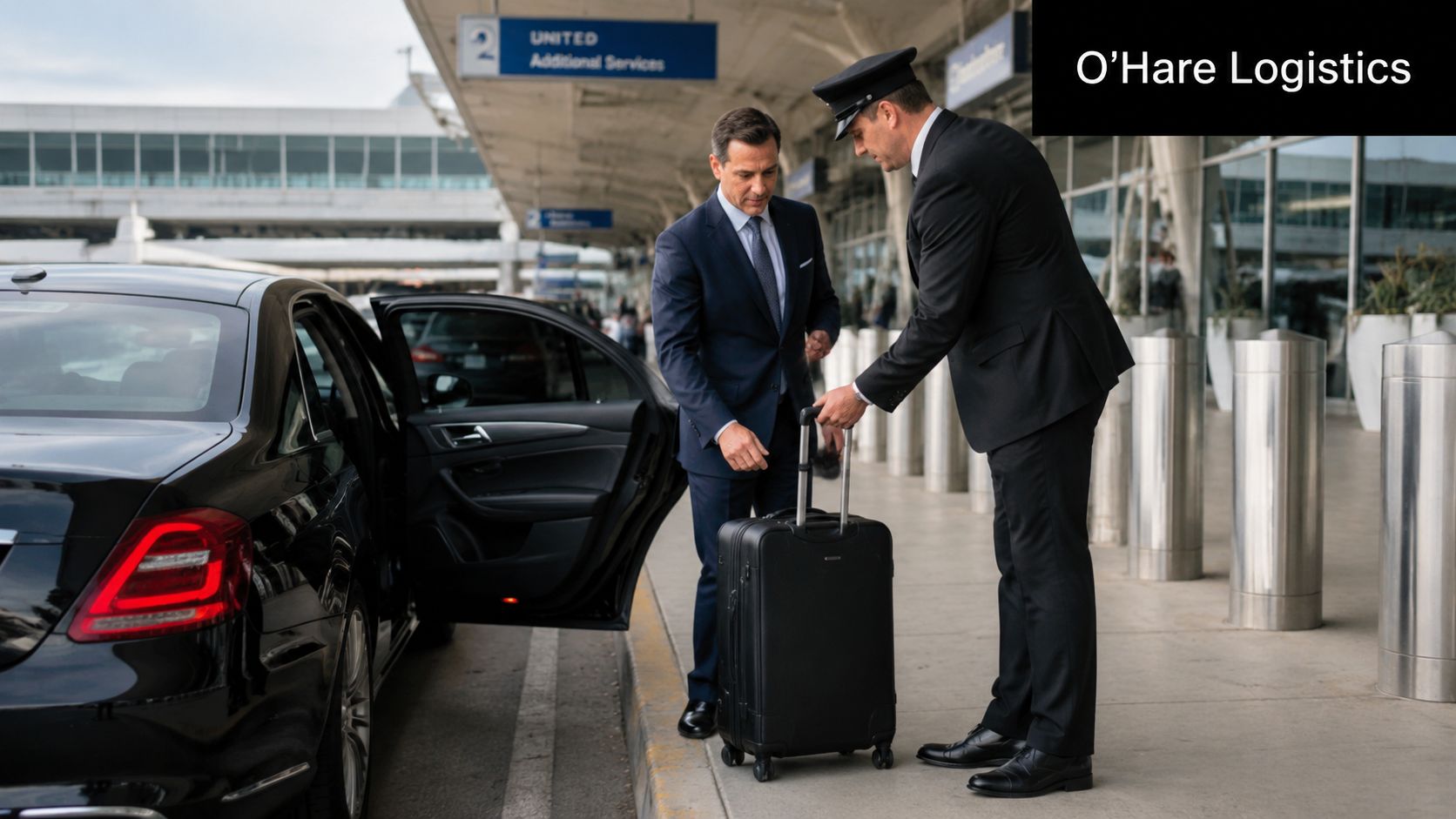
At both O'Hare and Midway, the most important decision isn't the vehicle. It's the pickup method. Clients usually choose between curbside coordination and a formal meet-and-greet inside the terminal. Both can work. The right choice depends on the traveler, the terminal flow, the amount of luggage, and what happens after the pickup.
O'Hare and Midway require different handling styles
At O'Hare, volume and terminal spread make ambiguity expensive. If the traveler is comfortable using a phone, moving briskly, and traveling light, curbside pickup can work well with clear instructions. If the traveler is arriving internationally, carrying multiple bags, hosting guests, or shouldn't be left to manage the handoff, meet-and-greet is usually the cleaner option.
At Midway, the scale is more manageable, but the same principle applies. The transfer should be designed around passenger friction, not provider convenience.
One overlooked factor is what happens before the traveler even reaches the car. A provider should plan from the business consequence of delay, not merely the posted arrival time. Aerotour's guidance on arranging executive airport transfer service highlights this distinction, noting that strong providers plan around the consequences of delay and account for issues such as customs buffers or high-stakes meetings.
How to choose the pickup style
Use this decision filter:
- Choose curbside when the passenger knows the airport, has light luggage, and wants the fastest exit.
- Choose meet-and-greet when the traveler is VIP, elderly, international, unfamiliar with the airport, or carrying presentation materials and multiple bags.
- Use a named coordinator when several passengers are arriving separately and one late handoff could affect the full schedule.
At major airports, the best pickup plan is usually the one that asks the least of the arriving passenger.
For travelers building in extra comfort around an O'Hare itinerary, it can also help to browse LoungeDeal for O'Hare SAS lounge when a layover or pre-departure window needs a quieter holding space.
FBO coordination is its own discipline
Private aviation pickups are more exacting than commercial arrivals.
At an FBO, the vehicle often needs to align with aircraft timing, crew communication, access rules, and a passenger who expects immediate movement on arrival. That requires precise naming, tail-side coordination where permitted, and a clear communication chain. The chauffeur must know who is authorizing pickup changes, where the passenger will emerge, and whether security or staff escorts are part of the handoff.
What doesn't work is treating an FBO transfer like a standard terminal job. The expectation is sharper, the passenger is less tolerant of confusion, and the service has to feel invisible in the best possible way.
Common Scenarios for Executive Ground Travel
The best way to understand executive airport transfer value is to look at the jobs it handles well. Not every booking is an airport-to-hotel run. Many are moving parts inside a larger schedule.

The roadshow day
A corporate roadshow is where weak transportation planning gets exposed. One executive lands early, another is delayed, a third needs to go directly to a lunch, and the entire afternoon depends on keeping the sequence intact.
In that situation, the car is not just a ride. It is part of the operating schedule. The chauffeur needs to understand standby expectations, multi-stop routing, and the reality that pickup instructions may change between meetings.
The hosted VIP arrival
Conference planners and event teams often arrange executive ground travel for keynote speakers, investors, board members, or major clients. The traveler may only see the service for an hour, but that hour sets the tone.
What matters here is polish and calm. The passenger should never feel like they have to figure out the arrival themselves. The host wants one clean handoff from terminal to vehicle, then from vehicle to hotel, venue, or dinner reservation.
The wedding or family movement
This category is different, but the standards are just as high. Weddings, milestone events, and multi-generational family travel create pressure because everyone notices logistics when they fail.
A wedding party doesn't want scattered arrivals, missing luggage, or an elderly relative climbing into the wrong vehicle. Families coming off a long flight don't want to split up because the booked car can't absorb the bags. Good executive transport planning protects the event from avoidable confusion.
A short visual example helps show how that service is often presented in the market:
The group night with high coordination needs
Sporting events, concerts, and corporate hospitality programs often require a mixed fleet. A few principals may travel by sedan or SUV while the wider group uses a van, shuttle, or coach.
Executive service transitions from focusing on a single passenger to becoming a coordination exercise. Vehicle timing has to align. Pickup points must be easy to execute in crowded post-event conditions. A single contact needs to own the movement so guests aren't calling different drivers while exiting into a busy street.
That level of coordination is what separates premium ground travel from a collection of disconnected rides.
How to Book Your Transfer with Maxs Luxury Rides
Booking goes smoothly when the reservation is specific. Vague bookings create vague service.
The market itself is substantial. The U.S. corporate ground transportation market is projected to reach $12.8 billion in 2026, with the executive segment accounting for $5.8 billion, according to Detailed Drivers on corporate transportation industry projections. The same source notes that high-volume corporate clients often negotiate discounts of 15–25% on their ground transportation spend.
What to have ready
Before booking, gather the details that affect execution:
- Flight information including airline, flight number, and arrival or departure timing
- Passenger count so the vehicle matches the actual load
- Luggage details especially if the group is carrying large cases, garment bags, or event materials
- Exact destination including hotel, office, venue, or FBO
- Pickup style preference such as curbside or meet-and-greet
The cleanest booking process
Use a simple checklist:
- Submit the itinerary early so the reservation team can assign the correct vehicle class.
- Clarify any special handling such as child seats, accessibility needs, multiple stops, or VIP meet-and-greet.
- Confirm the contact chain so the right person receives updates on the day of service.
- Review the final confirmation and make sure names, dates, terminal details, and destinations are correct.
For repeat corporate travel, it also helps to standardize traveler profiles and billing details in advance. That reduces errors and shortens approval cycles.
Because Max's Luxury Rides operates 24/7 and accepts all major credit cards, the booking process is built to stay simple even when plans change late.
Frequently Asked Questions
How far in advance should I book an executive airport transfer
As early as you can once the itinerary is stable. Advance booking gives the provider more room to assign the right vehicle and plan the pickup method properly. For important meetings, events, and group travel, last-minute booking leaves less room for thoughtful coordination.
What happens if my flight is delayed
A professional service should monitor the trip and adjust pickup handling accordingly. What matters most is that the communication chain is clear, especially if the arrival time affects a meeting, event check-in, or onward connection.
Is meet-and-greet worth it
Usually yes, when the traveler is arriving internationally, carrying several bags, unfamiliar with the airport, hosting guests, or requires a frictionless handoff. Curbside can work well for experienced travelers who want speed and can move through the terminal independently.
Can I request a specific vehicle type
Yes, and you should if the passenger profile or luggage load makes the vehicle choice important. This is especially relevant for executive sedans versus SUVs, and for vans when a team wants to stay together.
Can one provider handle both individual and group transportation
Yes, if the fleet and dispatch structure are set up for it. The key question isn't whether multiple vehicles are available. It's whether one team can coordinate them as a single movement with clear accountability.
When the trip matters, the handoff from runway to road can't be left to chance. Max's Luxury Rides Inc. provides 24/7 executive transportation for airport transfers, corporate travel, special events, and group movements, with a fleet that ranges from executive sedans and luxury SUVs to Mercedes vans, Sprinters, shuttles, minibuses, and coach buses. If you want ground transportation that is punctual, clean, and easy to book, reserve your ride directly and travel with a plan instead of a backup plan.