
Travel requests rarely arrive in a clean queue. They show up in Slack, email, text threads, calendar invites, and hallway conversations. One employee books a flight directly with an airline because it's faster. Another grabs a hotel outside the preferred program because the venue is nearby. Finance finds out later, after the receipts start coming in and nobody can tell whether the trip followed policy, stayed on budget, or covered the traveler door to door.
This is often the corporate travel booking process in many companies. It isn't broken because people don't care. It breaks because the process usually covers flights and hotels first, then treats approvals, expenses, airport transfers, and event logistics as separate problems.
That separation creates avoidable gaps. The traveler gets to the destination, but nobody has confirmed how they'll get from the airport to the hotel, from the hotel to the client site, or from the conference venue back to the airport if the schedule changes. For travel managers, those missing pieces create cost leakage, incomplete itineraries, and weak duty of care.
With high volumes of corporate travel, proper management becomes critical. Global business travel spend is projected to reach $1.57 trillion in 2025, and Americans take over 405 million business trips annually, according to Atlys' business travel statistics roundup. At that scale, an informal booking habit isn't a nuisance. It's an operational risk.
Taming the Chaos of Unmanaged Business Travel
The first problem usually isn't price. It's visibility.
When employees book in different places, approvers can't see the full trip before money is spent. Finance can't match bookings to policy without detective work. HR and operations can't confirm where travelers are during disruptions. Ground transportation gets arranged at the last minute, often by the traveler, often without any vendor review.
That's why unmanaged travel creates a false sense of flexibility. It feels fast at the moment of booking. Later, the organization pays for it through fragmented data, inconsistent approvals, and support headaches when plans change.
What unmanaged travel looks like in practice
A weak corporate travel booking process usually has a few recognizable symptoms:
- Requests arrive without structure: Employees send partial trip details and expect operations, finance, or an executive assistant to fill in the rest.
- Bookings happen off-channel: Flights, hotels, and rail may be split across consumer sites, supplier apps, and loyalty portals.
- Ground transport is improvised: Travelers book rides on arrival, expense them later, and hope availability lines up with their schedule.
- Approvals happen after spending: Managers react to booked trips instead of approving the business purpose and trip design in advance.
- Expense review becomes cleanup: The expense team spends time sorting exceptions that should have been prevented at booking.
Unmanaged travel doesn't remove work. It moves work downstream, where fixes are slower and more expensive.
A good process does the opposite. It moves decisions upstream. The trip purpose gets reviewed before booking. Policy checks happen before ticketing. Airport transfers and event movements get built into the itinerary instead of left to chance.
The practical shift that matters
The companies that run travel well don't just “centralize booking.” They centralize trip design.
That means every business trip is treated as a complete movement plan, not a flight and hotel reservation with loose ends attached. The traveler's route, arrival timing, meeting schedule, hotel location, airport transfer, venue transport, and after-hours support all belong in the same operating model.
That's the only way the corporate travel booking process becomes predictable enough to scale.
Building Your Corporate Travel Policy Foundation
Most travel teams don't have a tooling problem first. They have a policy problem.
If the policy is vague, too long, or hard to find, employees will work around it. That matters even more now because only 16% of travel managers report full compliance with company policies, and 46.9% of organizations use a hybrid model of managed and self-booked trips, according to the Digital State of Business Travel report referenced here. In a hybrid environment, policy has to do more than exist. It has to guide behavior in channels you don't fully control.
Write the policy for real booking decisions
A usable policy answers the questions travelers face while booking:
- Can I book directly with an airline if the approved tool doesn't show the fare I need?
- What class of service is allowed for a short flight versus a long one?
- What hotel rate is reasonable in a major city during a conference week?
- When does a manager approve, and when does finance review too?
- What do I do if I arrive late and need a pre-arranged car?
- Which expenses are reimbursable only if booked in advance?
If the document only states principles and leaves exceptions undefined, travelers will create their own rules.
Corporate Travel Policy Checklist
| Policy Component | Key Considerations |
|---|---|
| Booking channels | Define which tools, agencies, and direct booking scenarios are allowed, and when exceptions apply |
| Approval rules | Set who approves by trip type, destination, urgency, and spend level |
| Air and rail standards | Clarify allowable cabin or class by trip conditions and business need |
| Hotel rules | Set nightly caps, preferred properties, and location standards tied to duty of care and meeting access |
| Ground transportation | Specify approved providers, when pre-booking is required, and how airport and venue transfers are handled |
| Expense eligibility | List reimbursable categories, receipt expectations, and non-reimbursable items |
| Traveler safety | Include emergency contacts, after-hours support paths, and required itinerary visibility |
| Group and event travel | Define who coordinates attendee lists, rooming, manifests, venue transfers, and supplier communication |
| Exception handling | Require documented justification and identify who can approve policy deviations |
| Communication access | State where the latest policy, contacts, and booking instructions are stored |
Keep the language short and operational
Travel policy fails when it reads like procurement language instead of a booking manual. Use direct statements. Spell out defaults. Put exceptions in their own section so employees don't have to interpret edge cases on the fly.
A practical structure looks like this:
- Purpose and scope: Who the policy applies to.
- Booking rules: Approved channels and timing.
- Spend guardrails: Air, hotel, rail, meals, and transport.
- Approvals: What gets auto-approved, what needs review.
- Exceptions: Medical, client-required, event-driven, urgent travel.
- Support and safety: Contacts, disruptions, emergency escalation.
- Expense submission: Deadlines and required documentation.
Practical rule: If a traveler can't skim the policy in a few minutes and know what to do, the document is too complicated.
Don't leave ground transport outside policy
Many policies become incomplete. They define airfare and lodging in detail, then reduce local movement to a generic line about taxis, rideshare, or car rental.
That's too loose for a mature corporate travel booking process. Ground transport should address airport pickup, station transfer, hotel-to-office movement, event shuttle needs, executive travel, late-night arrivals, and vendor standards. If your company hosts roadshows, conferences, or offsites, this section matters even more because event logistics create the biggest coordination failures when nobody owns them upfront.
Make compliance easier than noncompliance
Employees usually bypass policy for one of three reasons. The process is slow. The rules are unclear. The approved path doesn't solve the trip they need to take.
Good policy design accounts for all three. It gives the traveler a simple default path, a workable exception path, and enough flexibility to handle real schedules without forcing them off-platform. That's how policy stops being a PDF and starts acting like an operating system.
Choosing Your Booking Tools and Vendor Partners
A booking setup usually breaks in the same place. The flight is ticketed, the hotel is confirmed, then someone realizes the traveler lands after midnight with no transfer, or 40 attendees are arriving on different schedules with no ground plan tied to the event agenda. The core tool was never the whole process.
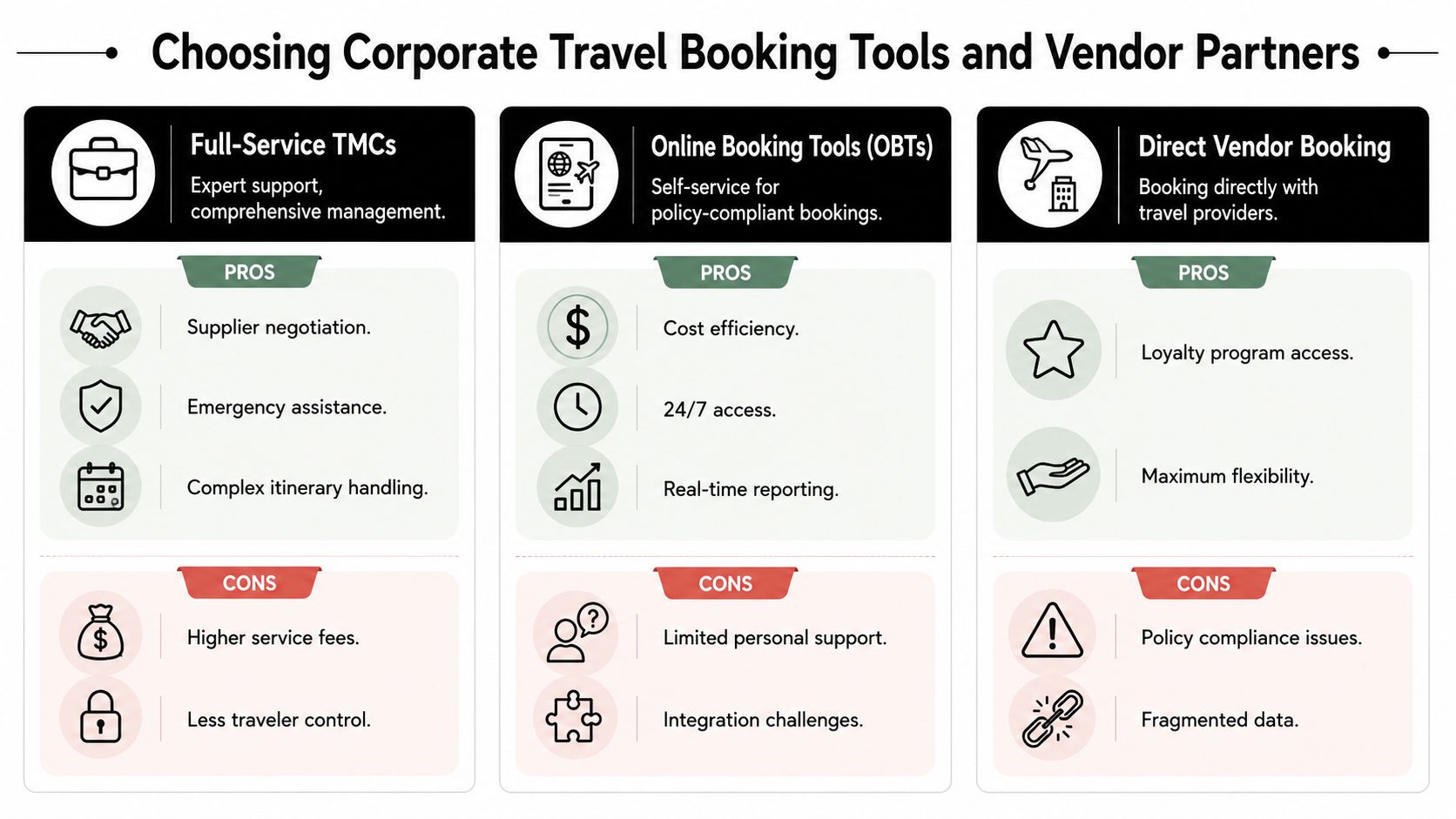
Tool selection should start with trip complexity, support needs, and how the itinerary gets handed off to finance, security, and ground transportation. A TMC, an online booking tool, and direct supplier channels all have a place. The mistake is treating them as interchangeable.
Where each model fits
A full-service TMC fits programs with international travel, executive bookings, frequent changes, VIP handling, or multi-city itineraries that need human intervention. Service fees are higher. In return, you get agents who can reroute travelers, coordinate exceptions, and manage supplier escalation when plans fall apart.
An OBT fits repeatable travel with clear policy rules and predictable approval paths. It cuts admin work and gives procurement and finance cleaner data. It also exposes every weak configuration choice. If fare rules, profile data, cost centers, payment methods, and policy logic are sloppy, the tool spreads inconsistency faster.
Direct supplier booking can still make sense for specific hotel programs, airline corporate portals, or supplier relationships where service recovery matters. Keep it narrow. Once direct booking spreads beyond defined use cases, reporting splits across channels and duty-of-care visibility weakens.
The group travel test
Group travel is where nice demos stop mattering.
Most OBTs are optimized for individual travelers and fail to automate group bookings for 20+ people, which forces managers into a manual RFP process with airlines and hotels and increases error rates and delays by 30 to 50%, according to AltexSoft's review of corporate group travel workflows.
That gap shows up fast in conference travel, board meetings, sales kickoffs, and client events. One traveler and one approval path is a booking task. A rooming list, staggered arrivals, venue transfers, speaker movements, and late-night pickups is an operations task.
Teams that handle tours, hosted events, or packaged group movements also need booking technology that supports payment and checkout flows built for multi-party coordination. Some companies solve that side of the process with tools focused on streamlining tour operator bookings.
Choose tools based on the hardest trip your program runs every month, not the easiest trip your travelers book every day.
Build a vendor map, not just a tech stack
Flights and hotels get budget attention because they are visible line items. They are still only part of the itinerary.
A booking process holds up when the travel team also defines who handles airport transfers, event shuttles, executive car service, group vehicle movements, and after-hours changes. These pieces are often left outside the main booking flow, and that is where duty-of-care gaps start. If the traveler has a confirmed flight but no vetted ride after a late arrival, the itinerary is incomplete. If an event team is building shuttle plans in a separate spreadsheet after rooms are booked, the booking process is already behind.
A practical vendor map usually covers:
- Airport transfers: Late arrivals, unfamiliar destinations, and travelers carrying equipment
- Event transportation: Venue shuttles, offsite dinners, attendee manifests, and speaker moves
- Car service and chauffeur bookings: Executive schedules, client-facing travel, and tight meeting windows
- Coach and van movements: Conferences, roadshows, and team travel from multiple hotels
- After-hours support: Rebooking and transport coordination outside office hours
One option in that mix can be Max's Luxury Rides Inc., which provides airport transfers, executive sedans, SUVs, Sprinter vans, minibuses, and coach options for corporate and event transportation. That kind of partner is useful when the trip includes group movement, executive handling, or venue coordination that an airline and hotel booking alone will not solve.
How to decide without overengineering
Use three filters.
First, map the trip types you run. Weekly client travel, executive roadshows, field service visits, and annual conferences create different requirements. Buy for the pattern, not the exception, but make sure the exception has a defined support path.
Second, identify where bookings fail today. Some programs have a tool problem. Others have a handoff problem between travel, finance, and event operations. If travelers keep booking outside policy because the approved channel cannot handle venue transfers, group manifests, or complex schedules, adding another airfare search screen will not fix it.
Third, test the integrations that matter in real life. Traveler profiles, approval routing, payment methods, expense coding, TMC servicing, risk visibility, and ground transportation all need to connect cleanly enough that no one rebuilds the itinerary by hand. That is the difference between a booking tool and a booking process.
Designing Smart Approval and Booking Workflows
A solid workflow removes guesswork without slowing down routine travel. That means standard trips should pass quickly, while exceptions surface early enough for a human review. Most travel teams know this in theory. The miss usually happens in what gets included.
Ground transportation is the common omission. Manager guides note that ground transportation is the most frequently skipped step in the corporate booking process, often left to traveler discretion, which creates duty-of-care and itinerary completeness gaps, as noted in this 2026 corporate travel booking process guide.
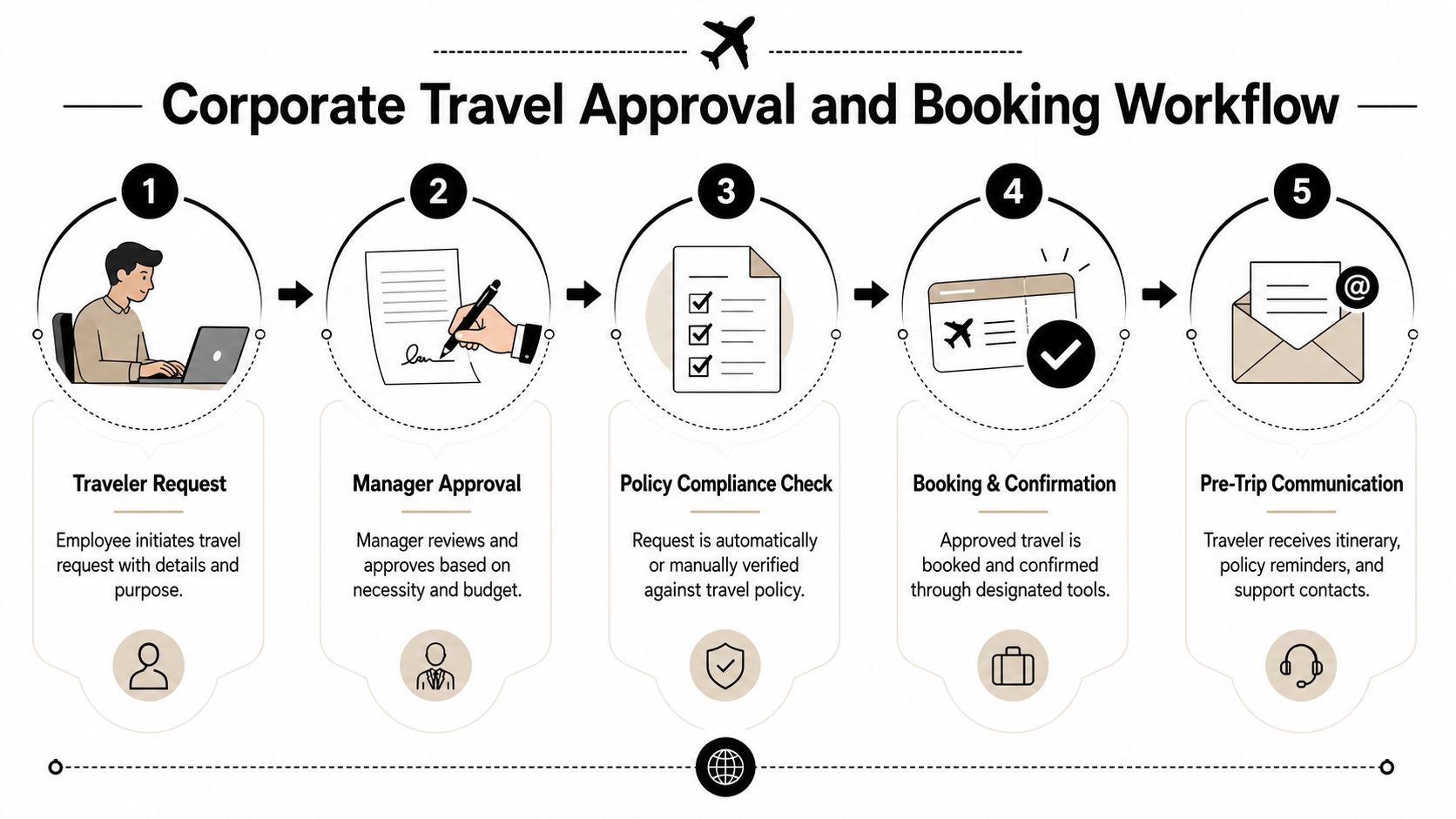
The five workflow stages that actually work
The basic sequence is simple. The discipline is in the details.
Traveler request
The request form should capture business purpose, destination, preferred dates, meeting schedule, known event timings, luggage or equipment needs, and whether airport or venue transport is required. If the traveler is joining a group movement, that should be identified here, not after flights are booked.
Manager approval
The manager should approve necessity and timing, not just cost. A trip that fits policy can still be unnecessary. A trip that exceeds standard pricing may still be justified if the schedule is fixed by a client or event.
Policy compliance check
This can be automated for common trips. The request gets checked against approved channels, spend limits, route logic, and any required pre-booked transport rules. If the traveler needs an exception, the workflow should require a reason before booking proceeds.
Booking and confirmation
Many teams stop too early in the booking process. Booking should produce a complete itinerary, not just air and hotel confirmations. If the traveler lands late, has a same-day client meeting, or attends a conference with offsite movements, transport needs should be booked here too.
Pre-trip communication
The final message should include itinerary details, support contacts, booking references, policy reminders, and instructions for changes. If transport is pre-arranged, include pickup details clearly so the traveler doesn't make duplicate bookings.
Build the workflow around the whole journey
A practical booking checklist often looks like this:
- Confirm the reason for travel: Client meeting, internal offsite, conference attendance, executive visit, or group event
- Check timing dependencies: Early arrivals, same-day meetings, venue schedules, and return flight risk
- Book core inventory: Air, rail, hotel
- Add movement layers: Airport pickup, station transfer, hotel-to-venue movement, return transfer
- Issue one usable itinerary: The traveler should receive one complete trip view, not scattered confirmations
Book the transfer when you book the flight. If you wait until arrival day, you've already accepted an avoidable gap.
This is also why travel managers can learn from adjacent booking environments. Teams that handle tours, events, and structured itineraries often think in end-to-end movement rather than isolated reservations. There's useful crossover in tools focused on streamlining tour operator bookings, especially when your corporate program includes multi-stop agendas and coordinated participant flows.
Design for exceptions, not just standards
The smoothest workflows don't pretend every trip is routine. They identify where human review belongs.
Use manual checkpoints for executive travel, traveler safety concerns, group logistics, after-hours arrivals, client-hosted events, and any booking that requires supplier coordination outside normal inventory. Automation should remove repetitive admin. It shouldn't erase judgment.
Communicating with Travelers and Managing In-Trip Changes
Travelers don't need more policy reminders. They need clearer support in the moments when plans move.

A workable communication model has three pieces. One place to find the latest travel rules. One pre-trip message with the actual itinerary and support contacts. One clear process for changes, delays, and emergencies.
What travelers need before departure
The most useful pre-trip communication isn't long. It's specific.
Send a single message that includes confirmed bookings, airport or venue transfer details, who to contact for changes, how to handle an exception expense, and what to do if a flight delay affects onward travel. If the traveler has to search through old emails to figure out the pickup plan, the process is already too fragile.
For international trips, connectivity matters too. Travelers who can't get online quickly can't receive updates, contact support, or confirm transport changes. A practical resource for planning that part is this guide to the best international travel eSIM, especially for teams trying to reduce arrival friction.
How change management works in real life
Consider a common disruption. A traveler lands late after a missed connection and the original ground plan no longer fits. If the process is weak, the traveler books whatever is available, expenses it later, and the itinerary becomes incomplete. If the process is mature, the traveler already knows which support channel to contact, the updated movement is logged, and the company retains visibility.
Another example is conference travel. The employee's flight and hotel may be fine, but the event dinner moves locations or the closing session runs late. Without an owned transport plan, the traveler improvises. With a proper process, event logistics are part of trip operations from the start, so schedule changes trigger vendor communication, not traveler confusion.
The traveler should never have to guess whether they're allowed to solve a disruption on their own or expected to contact support first.
Keep the tone useful, not controlling
Communication fails when every message sounds like enforcement. Employees won't engage with a travel program that feels punitive unless they have no choice.
Use plain language. Tell them what to do, who to contact, and what happens if plans change. Keep policy reminders tied to decisions that matter, like approved booking paths, exceptions, and expense treatment. Everything else should be framed as support.
That balance matters because a good corporate travel booking process isn't only about control. It gives travelers confidence that someone has thought through the trip beyond the reservation itself.
Mastering Expense Management and Performance Reporting
If booking is the front half of travel operations, expense and reporting are the test of whether the process was successful.

The weak version of travel management ends with reimbursement. Receipts come in, finance reviews them, employees get paid back, and the cycle repeats. The stronger version closes the loop. It turns booked data, card data, and expense data into one usable record of what the trip cost, where policy broke, and which suppliers the company used.
Automation is the dividing line
The most important difference isn't whether employees upload receipts from a phone or desktop. It's whether booking and spend data flow automatically into finance.
Travel programs where booking data flows automatically into financial systems achieve policy compliance rates above 80%, while programs relying on manual reconciliation fall below 50% compliance and see error rates climb as high as 35%, according to this analysis of 57 corporate travel programs.
That's why manual reconciliation feels expensive even when the software bill looks low. Finance teams spend time matching charges to trips. Travelers resubmit missing context. Policy violations are found after the trip, when the only remaining choice is exception handling.
What to track every month
A practical reporting set includes:
- Policy compliance: Not just whether a fare or hotel rate fit policy, but whether the traveler used the approved booking path
- Average trip cost: Segmented by trip type, team, or purpose so the data is decision-ready
- Advance booking behavior: Useful for seeing whether late approvals are driving higher costs
- Preferred vendor usage: Shows whether negotiated programs are being used in practice
- Out-of-policy categories: Especially direct bookings, missing approvals, and transport booked outside the workflow
- Expense cycle time: How long reimbursement and reconciliation take
If ground transport is part of your booking process, report on it explicitly. Otherwise it disappears into miscellaneous expense lines and nobody can tell whether airport transfers, event shuttles, and local movement are being managed or improvised.
Make the expense experience easier for travelers
Travelers comply more consistently when the process is simple. Pre-coded expenses, synced card feeds, receipt capture, and category defaults reduce the amount of cleanup later. If you're reviewing options to simplify business travel expenses, focus on tools that reduce manual matching between booking records and submitted spend.
A useful rule is to remove duplicate entry wherever possible. If the trip already exists in the booking system, the expense system should inherit that context instead of asking the traveler to reconstruct it.
Here's a quick explainer worth sharing internally when you're tightening the close-the-loop side of the program:
Reporting should change decisions
Too many travel reports are descriptive and not operational. They show totals, but they don't tell you what to fix.
The reports that matter lead to action. They show where approval delays are pushing bookings closer to departure. They show whether one department books outside approved channels more often than others. They show which event types create the most manual transport work. They show whether your vendor mix matches the trips you run.
A reporting dashboard is useful only if it changes policy, workflow, or vendor decisions.
That's the final step in a mature corporate travel booking process. Book the full trip. Capture the true spend. Feed the data back into the next booking decision.
If your travel program needs tighter control over airport pickups, executive transfers, or event transportation, Max's Luxury Rides Inc. is one option to evaluate for pre-booked ground logistics. Their fleet covers individual travelers through larger corporate groups, which can help close one of the most common gaps in business travel workflows: getting people where they need to be, on time, after the flight and hotel are already confirmed.