
You can have the venue booked, the flowers confirmed, and the keynote deck finalized, and still lose the day because three arrivals hit the same dock at once. The shuttle is late, the freight truck is circling the block, the AV crew is waiting for clearance, and someone in the VIP party is asking why nobody seems in charge. That's the point where event logistics planning stops being administrative support and becomes the thing holding the whole event together.
The hard truth is that most failures don't come from one dramatic mistake. They come from small timing gaps, weak handoffs, and transportation treated like a checkbox instead of a system. The event logistics market was valued at USD 72.4 billion in 2025 and is projected to reach USD 174.6 billion by 2035, with a 9.2% CAGR from 2026 to 2035, while North America held 38.3% of revenue, about USD 27.7 billion, in 2025, which tells you how much real operational weight sits behind this discipline Market.us.
Why Event Logistics Planning Matters More Than You Think
A polished guest list means nothing if the arrivals stagger into chaos. I've seen teams spend weeks refining decor while nobody owned the loading dock schedule, then watch the caterer and production truck arrive at the same entrance with no marshal to separate them. The result isn't just annoyance, it's a delayed setup, rushed staffing, and a room that opens looking unfinished.
The mistake is treating logistics as a task list. It works better as a risk discipline, because every movement has to be sequenced before the first vehicle reaches the venue. Large events should start logistical planning 12 to 18 months ahead, while a large-scale corporate conference often needs 9 to 12 months of lead time, because transportation, freight, compliance, and venue coordination all depend on locked dates and clear sequencing Service Bureau. The same source says 94% of professional event managers experience logistical problems, 38% report technical problems, and 32% of customs delays at cross-border events come from documentation errors. That is a blunt reminder that problems are normal unless the plan is built to absorb them.
What changes the outcome
The events that run cleanly usually share the same habits. Someone owns the master schedule. Someone else owns arrivals. Vendor promises are written down, not buried in chat threads.
Practical rule: if a transport detail, dock window, or handoff only lives in one person's head, it isn't planned yet.
The difference shows up in small moments. A chauffeur knows exactly where to stage, the freight team knows the venue's access rules, and the host team knows which arrival gets priority when schedules collide. That is how logistics stops being invisible chaos and starts becoming a controlled system.
Transportation Planning for Events
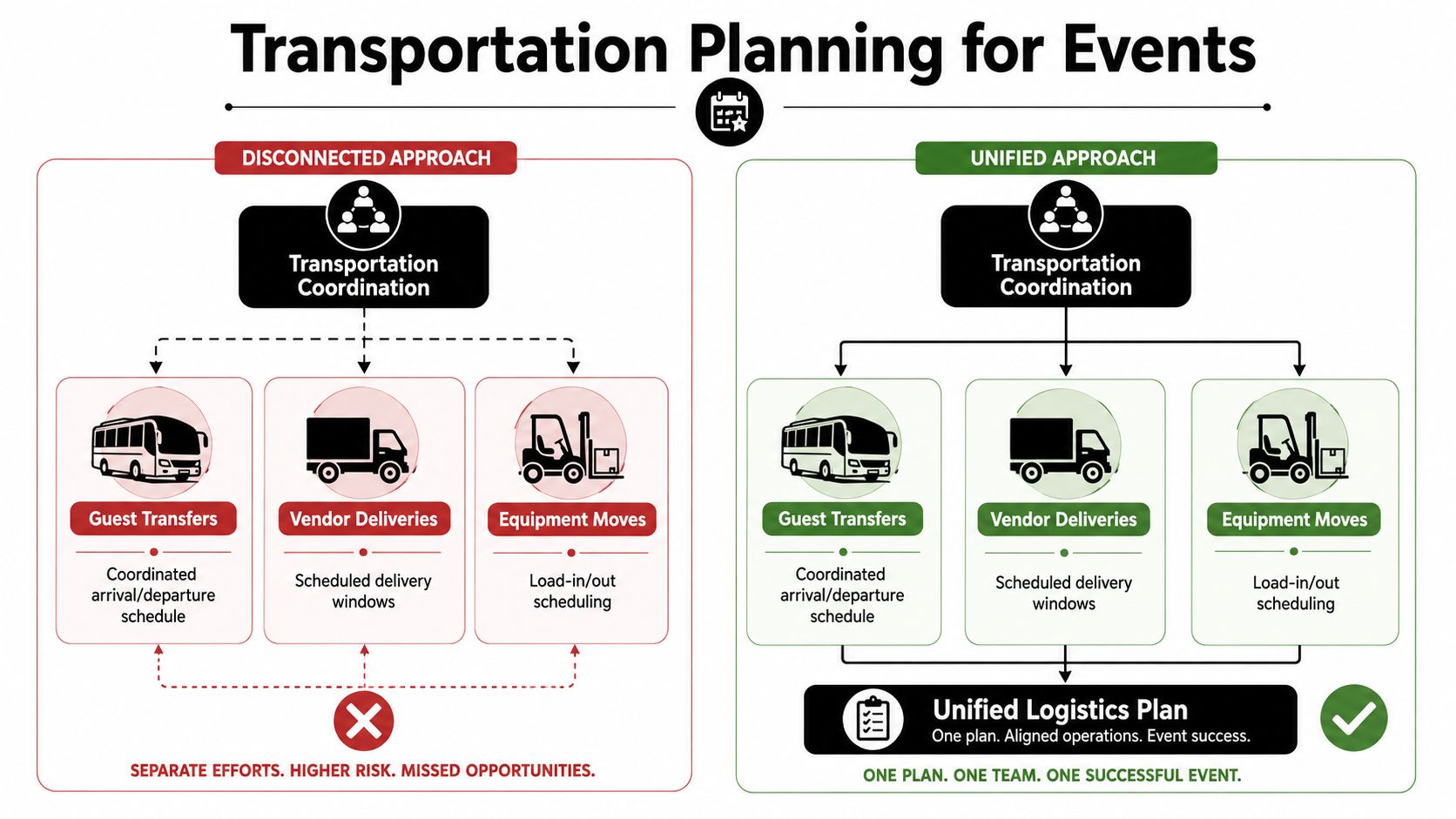
A guest shuttle stuck behind a freight truck at the same loading gate can ruin the start of an event before the first arrival is even announced. That happens because transportation is often treated as separate pieces, guest movement, vendor deliveries, and equipment freight, even though they all meet at the same curb, dock, or access road. If the schedule is not built around those shared points, every correct booking can still create a bottleneck.
Build arrivals as a choreography problem
Start by separating movement types on paper, then fold them into one operating model. Guest transfers need predictable arrival and departure windows. Vendor deliveries need controlled dock access. Equipment moves need enough time for load-in and staging without colliding with people flow.
A transportation manifest should list every vehicle, driver contact, pickup time, and destination in one place. Paperwork is the means, visibility is the goal. When one coordinator can see the full picture, they can catch overlap before it turns into congestion at the perimeter.
Choose vehicles for the job, not for appearances
A luxury sedan, a Sprinter, a shuttle bus, and a coach bus all solve different problems. Executive arrivals need privacy and timing discipline. Guest shuttles need repeatable headways. Freight moves need enough cargo capacity and enough access to unload efficiently. If you book by image instead of by function, you will pay for empty seats or miss the loading sequence.
Timing matters more than raw vehicle count. A short airport delay can push a vendor arrival, which then pushes setup, which then compresses rehearsal. Small delays compound because each one steals margin from the next team in line. For airport transfers, business conference movements, or important-event pickups, a coordinated provider such as Max's Luxury Rides Inc. can fit into a controlled arrival plan, because the service is built around airport transfers, corporate travel, and special occasions rather than one-off ride requests.
Route the perimeter, not just the map
The best route on a navigation app is not always the best event route. Loading-dock access, vehicle turning radius, queueing space, and the place where guests will wait when the car door opens all shape the plan. A beautiful drop-off point that creates bottlenecks is a bad drop-off point.
For VIPs, the goal is quiet predictability. For freight, the goal is a clean unload window. For group shuttles, the goal is a repeatable loop that does not interfere with guest-facing entrances. That is why transportation deserves its own plan, not just a line on the master checklist.
If the trip is part of a larger field day, tournament, or hospitality program, the same logic applies to how to plan a golf tournament, where arrivals, equipment, and guest movement have to stay out of each other's way.
Building Your Event Timeline and Milestone Checklists
A calendar full of dates isn't a timeline. A usable timeline starts with the fixed anchor, then works backward through every dependency that has to happen before that moment. If the venue opens at 4:00 p.m. and the caterer needs three hours on-site, the delivery can't arrive at 3:30 and still be considered “on time.”
Work backward from the event date
That backward method forces realism. Final walkthroughs happen before setup. Vendor confirmations happen before walkthroughs. Staffing assignments happen before confirmations. Once you lay it out in reverse, the weak spots become obvious because every delay has to fit somewhere.
One playbook recommends documenting all vendor commitments, delivery windows, and scope details in writing, centralizing communication in one platform, and adding a 20 to 30 percent buffer to load-in, setup, and transition times so the plan can absorb common delays without sliding Guidebook. That buffer isn't padding. It's the difference between a controlled setup and a crew that's still moving tables when guests are being seated.
Build the timeline around the slowest dependency, not the fastest guess.
Use phases instead of one giant task list
A phased model keeps the work from turning into a blur. Pre-event planning handles venue, vendors, transport, and staffing. On-site work handles arrivals, setup, and live coordination. Post-event work handles load-out, debrief, and financial wrap-up UPE.
For a practical example of how timing and coordination show up in a niche event, the structure in how to plan a golf tournament is useful because it forces a planner to think about staged movement, start windows, and controlled flow rather than loose scheduling. That same logic applies across conferences, weddings, and live events.
The video below shows how timeline discipline is often explained in visual planning terms, but the lesson is operational, not decorative.
Keep checklists parallel, not merged
Vendors, staffing, and guest flow each need their own checklist. When they're merged into one giant master list, the important items disappear into noise. The better approach is a master timeline with separate action streams so one delay doesn't obscure three unrelated responsibilities.
Coordinating Vendors and Managing Contracts
Vendor coordination fails most often when communication is spread across inboxes, texts, and side conversations that nobody trusts later. The caterer says one thing, the decorator says another, and the venue says neither of them got approved access. By event week, everyone has a version of the truth and nobody has the truth.
Create one source of truth
Every commitment needs to live in writing, with delivery windows, scope boundaries, contact numbers, and load-in procedures spelled out clearly. The point isn't bureaucracy, it's dispute prevention. If the agreement says one truck can use the side dock between 9:00 and 10:00, then nobody should be improvising at 9:15 because a different team “thought it would be fine.”
Centralizing communication in one platform also prevents version-control problems. A shared spreadsheet, project board, or event app works better than scattered email chains because the latest instruction is easy to find. If a vendor changes a delivery time, that update has to land where everyone can see it, not in a private thread.
Contracts should cover real failure points
A contract that looks complete can still leave the planner exposed. Late delivery penalties, cancellation terms, insurance requirements, backup vendor language, weather clauses, and force majeure terms all matter because they define who absorbs the loss when something goes wrong. If those terms are missing, the event team ends up paying with time, money, or reputation.
For lower-visibility items, even something like budgeting for custom event shirts can affect the logistics chain because apparel deadlines, quantities, and pickup timing often get treated casually until they become a problem. The same discipline that protects a decor or AV contract should protect any branded material with a delivery date.
Give one person authority on the day
Day-of decision-making needs a clear chain. If a vendor asks for a route change, a dock shift, or an exception to timing, there has to be one person authorized to say yes or no. Without that, vendors start negotiating with whoever answers fastest, which is how a controlled plan turns into a cluster of exceptions.
Practical rule: if a vendor promise can be changed by anyone, it will be changed by everyone.
On-Site Staffing Communications and Risk Planning
The plan on paper loses value fast once people start moving, radios begin crackling, and the first problem reaches the floor. On-site execution depends on who stands where, who has authority, and how quickly the team can report an issue without making the situation harder to manage. The cleanest events usually feel quiet because the staff structure is doing the heavy lifting behind the scenes.
Position people at the failure points
Every event has single-point failures. It might be the one person with keys to the production room, the driver who knows the back route, or the staffer who can reroute a vehicle without asking five people for approval. Those roles need backup before the doors open, not after the first delay turns into a bigger mess.
A simple staffing map helps. Put your strongest communicators at access points, put your fastest problem-solvers at congestion points, and give your least-experienced staff lower-risk tasks with clear escalation paths. If you're covering guest movement, event security coordination, and arrival support, the staffing map should follow traffic, not hierarchy.
Tighten communication into one chain
Multiple group chats create noise exactly when the team needs clarity. One incident lead, one primary channel, one backup channel, and a standard update rhythm will resolve more issues than a dozen loosely connected messages. Better routing of information matters more than more talking.
For safety-heavy events, it helps to review essential event safety steps alongside the staffing plan because security, access control, and crowd movement all overlap at the same pressure points. The logistics team and the safety team cannot operate like separate islands when people and vehicles are converging in the same space.
Spend backup money where failure hurts most
Redundancy helps, but overbuying backup can waste budget without reducing the biggest risks. Some events need extra transport capacity. Others need more staff at entrances. Others need better process design instead of a bigger buffer. The right answer depends on whether the likely failure is a single point of collapse or a coordination problem.
That is the trade-off most guides miss. More backup is not always better. If the main issue is congestion at a shared access point, the fix may be arrival sequencing and access control, not more vehicles sitting idle.
Buy redundancy after you know which bottleneck hurts the event.
Templates for Corporate Events Weddings Concerts and Sporting Events
Different event types fail in different ways, so the template has to match the risk profile. A corporate conference cares about punctuality, technology, and presentation polish. A wedding cares about emotional timing, family movement, and weather backups. A concert cares about load-in speed and crowd flow. A sporting event cares about mass arrival, safety, and gear transport.
Corporate events
Corporate logistics usually centers on executive movement, registration flow, AV reliability, and media coordination. Lead time is typically longer because room blocks, speakers, and transport windows all have to be locked early. A solid corporate run sheet should separate VIP arrivals from general attendees and assign one person to each stream.
Key priorities include clear signage, reliable check-in, and a transport plan that gets speakers and leadership in the building without friction. If the event has multiple sessions or press activity, the venue map needs to show who enters where and when.
Weddings
Wedding logistics is often emotional logistics. Family transport, vendor meals, ceremony timing, and weather contingencies all matter because a small delay can affect a moment that can't be repeated. Shuttle coordination is especially useful when the ceremony and reception sit in different places or when the guest list includes older relatives and out-of-town travelers.
The best wedding plans leave room for grace without becoming vague. Vendor timing has to be tighter than the emotional tone suggests, because flowers, photos, and food service all depend on movement that happens on schedule.
Concerts and sporting events
Concerts and sporting events are more about volume and sequencing. Equipment freight, crew staging, artist or athlete transport, parking control, and ingress or egress all need to be mapped before anyone arrives. The problem isn't just getting people in, it's getting them in without creating unsafe congestion.
The table below gives a simple priority matrix that planners can adapt without starting from zero.
| Event Type | Primary Focus | Lead Time | Critical Risk Area |
|---|---|---|---|
| Corporate Event | Executive flow, AV, registration | Longer planning window | Guest punctuality and presentation continuity |
| Wedding | Family movement, weather, emotional timing | Moderate planning window | Ceremony timing and shuttle coordination |
| Concert | Load-in sequencing, stage crew flow, crowd ingress | Tight, operationally dense planning | Perimeter congestion and freight timing |
| Sporting Event | Athlete, official, and spectator movement | Event-specific planning window | Safety and mass transportation |
Build every template around the same controls
Each template should still include a milestone checklist, vendor contact list, risk register, and day-of run sheet. The differences are in what gets the most attention, not in whether the controls exist. Once those pieces are in place, the event type only changes the order of priorities.
Putting It All Together
Good event logistics planning isn't about eliminating every problem, because that doesn't happen in live events. It's about making sure the plan survives contact with reality. Transportation becomes a managed system, timelines run backward from fixed dates, vendor coordination lives in one source of truth, and on-site staffing is positioned around the points where the event can fail.
The planner who treats logistics as a discipline will usually look calm while everyone else is reacting. That calm comes from choreography, not luck. Start with the transportation manifest, lock the timeline backward, document every vendor commitment, and assign your on-site decision chain before the first vehicle arrives.
If you need a transportation partner that can support airport transfers, corporate travel, and special occasions with coordinated ground movement, Max's Luxury Rides Inc. offers a practical option for event-day arrivals and departures. Visit Max's Luxury Rides Inc. to plan transportation that fits the schedule instead of fighting it.