
You've just landed at O'Hare, your phone is alive again, and your bag is finally in hand. Now comes the part that trips people up, the curb looks simple, but the choice isn't simple at all. If you take the wrong line, you'll pay for it in time, stress, or both.
A taxi O'Hare airport pickup is not just “walk outside and grab a cab.” At O'Hare, you're dealing with a regulated system with designated taxi stands, shared-ride cabs, pre-arranged suburban pickups, and luxury cars that operate on a different playbook. The right move depends on where you're going, how many people you've got, how much luggage you're dragging, and whether you want certainty or just the cheapest seat in the car.
What Every O'Hare Traveler Faces at Baggage Claim
The carousel stops. That's the moment the decision starts.
You've got one bag in each hand, your flight app is closed, and suddenly three things are competing for your attention. You can join the city taxi queue at the lower-level curb, walk toward a pre-arranged pickup lane, or open a rideshare app and hope the pickup point doesn't turn into a scavenger hunt. All three are legal, all three are common, and all three are used by people who think they made the “obvious” choice.
What a taxi actually means here
At O'Hare, a taxi isn't just any car with a meter. It usually means a metered city cab staged at a designated taxi stand, with the airport and city rules controlling how it loads passengers. A shared-ride taxi is different, because it's a regulated airport product with a specific passenger count and a published fare. A livery car, luxury sedan, or pre-booked SUV is another product entirely, and it's built around reservation, not curbside improvisation.
That distinction matters. People lose time at O'Hare because they assume every vehicle at the airport serves the same purpose. It doesn't.
Practical rule: if you want the fastest no-drama move, decide before you leave baggage claim whether you're taking a stand taxi, a pre-arranged car, or a shared ride. Waffling at the curb is how travelers end up standing in the wrong place.
The airport's ground-transportation setup is heavily regulated, which is exactly why it works better than a free-for-all. The system is designed to separate product types so licensed cabs, shared rides, accessible vehicles, and pre-arranged cars don't all collide at the same curb. Once you accept that, the rest gets easier. You stop “looking for a ride” and start choosing the right category for your trip.
Where to Catch a Taxi at Each Terminal
The easiest mistake at O'Hare is walking out the wrong door and asking the first person in a vest where the taxi is. Don't do that. Use the lower-level curb outside baggage claim, because that's where the standard city taxi stands are set up.
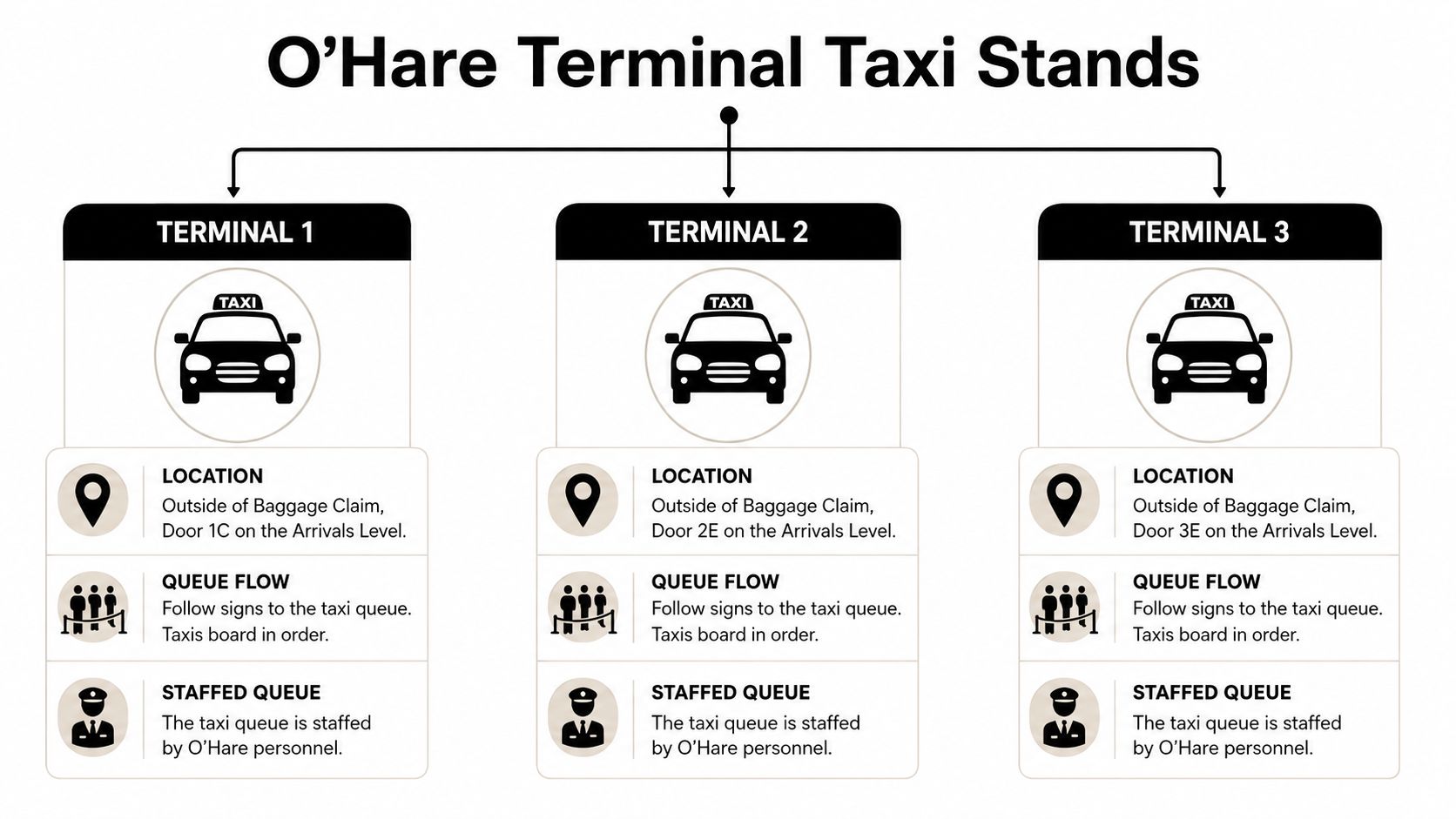
At Terminals 1, 2, and 3, the general flow is the same. You exit baggage claim, go to the lower-level curb, and join the staffed taxi queue at the designated stand. Licensed city cabs rotate through that line. You do not hail random cars. You do not wave down a driver in the lane. You get in the queue and wait your turn.
Terminal by terminal habits that save time
Terminal 1 travelers should expect the standard city taxi flow. Follow the signs to the lower level, then look for the staffed stand instead of drifting toward the rideshare activity. The queue exists so the next cab is assigned cleanly, not negotiated by hand.
Terminal 2 works the same way. The stand is part of the airport's controlled curb system, so you're not hunting for an unmarked pickup. If you've got more than one bag or you're tired from a long connection, stick to the posted taxi flow and let the line do the sorting.
Terminal 3 also uses the lower-level curb front outside baggage claim. A lot of domestic arrivals go wrong here, because they see multiple vehicle types and assume the first curbside car is the right one. It usually isn't.
Terminal 5 deserves extra attention because many international arrivals come through there and the curb can feel busier and more confusing. The pickup logic is still the same, though. Find the correct ground-transportation curb and use the posted taxi access point instead of wandering into unrelated lanes.
Do this instead: ask yourself one question before you leave baggage claim. Am I going to a standard city taxi stand, or do I have a reservation for a pre-arranged pickup? That one question eliminates most curbside mistakes.
Two special cases need separate handling. Accessible vehicles can be requested through the airport's dedicated phone number, so don't assume the standard queue will solve that on its own. Suburban taxis are pre-arranged and meet passengers in the center lane, not at the regular curbside stand. If your destination is outside the city or your ride has mobility needs, you're in a different system than the downtown taxi line.
Real O'Hare Taxi Fares and How They Add Up
Chicago travelers love to ask for a number, then ignore the part where traffic changes the number. With O'Hare taxis, you need both the headline fare and the world add-ons.
The airport publishes about $50 as the typical taxi fare to downtown Chicago, and the shared-ride product is published at $24 per person to downtown, $24 per person to McCormick Place, and $37 per person to Midway FlyChicago taxi page. Chicago code also defines shared rides from O'Hare as a 2 to 4 passenger product offered only from the airport at designated cab stands Chicago code on shared rides.
The number that matters is the one you pay at the end
A downtown metered taxi can look modest at first, then creep upward as traffic slows, tolls get added, and the airport tax shows up in the total. In practical terms, that means a downtown ride that starts near the airport's published average can land in a broader range once the meter keeps moving. Shared ride caps the price per person, but it also forces you into a specific airport-only product with multiple passengers and a more structured pickup.
For the traveler, the lesson is blunt. If you're alone and going downtown, the metered taxi is straightforward. If you're two to four people and the destination fits the shared-ride rule, that product can make sense. If you're heading to Midway, McCormick Place, or a suburb, the right answer depends on who's riding and how much certainty you need.
| Service Type | Destination | Price | Notes |
|---|---|---|---|
| City taxi | Downtown Chicago | About $50 | Published airport average, meter can move with traffic |
| Shared-ride taxi | Downtown Chicago | $24 per person | Requires 2 to 4 passengers and airport stand pickup |
| Shared-ride taxi | McCormick Place | $24 per person | Same airport-only shared-ride product |
| Shared-ride taxi | Midway | $37 per person | Same airport-only shared-ride product |
The decision is not “taxi or not taxi.” It's whether you want a meter, a shared fare, or a pre-booked price. If your traveler profile is messy, family, heavy luggage, formal attire, disability access, or a suburban drop, the published fare on the board is only part of the story.
Taxi vs Rideshare vs Pre-Booked Car Service
The bad habit I see all the time is people treating these three options like the same thing with different apps. They're not the same, and at O'Hare the differences show up fast.
What each option actually gives you
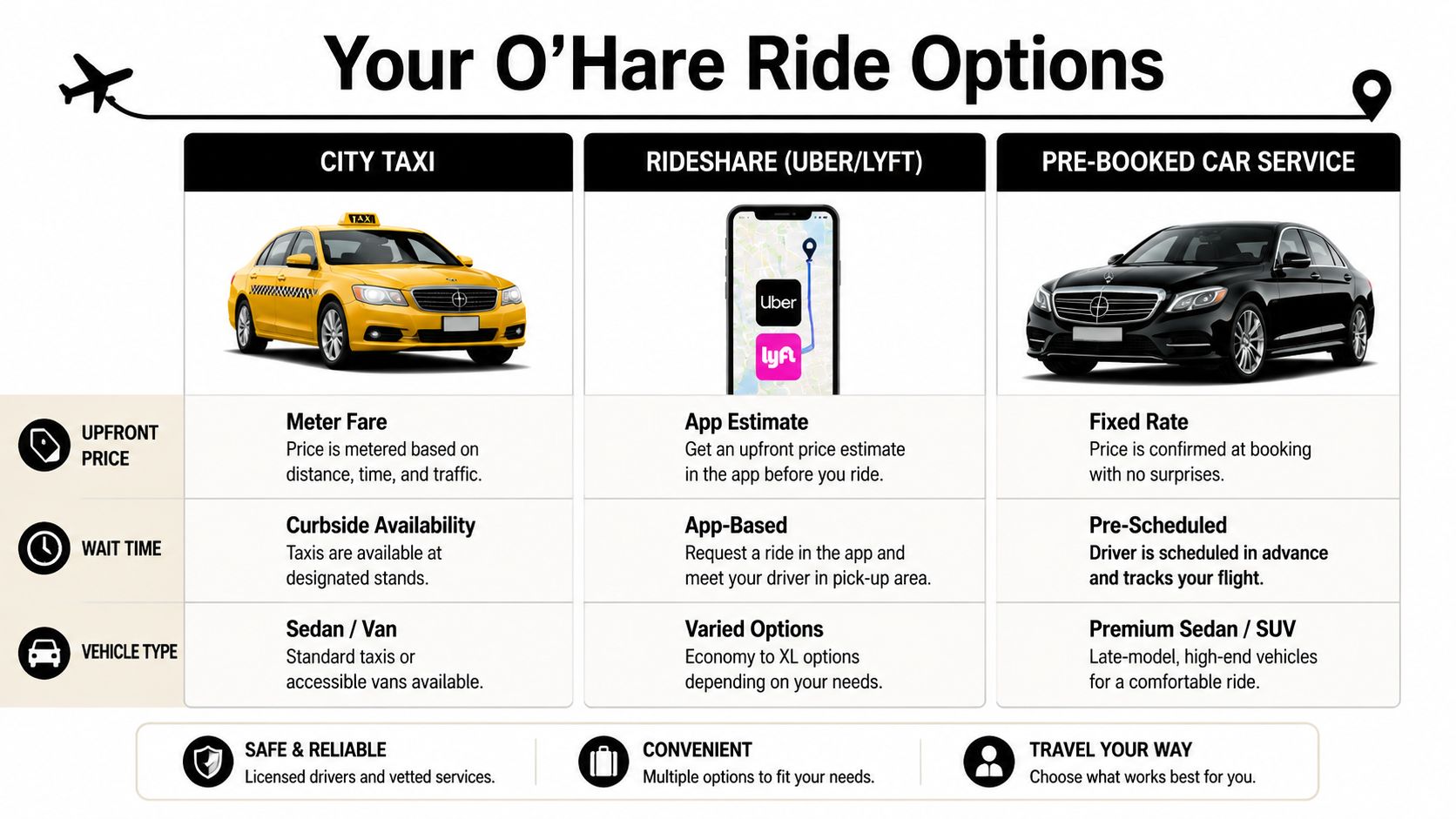
City taxi is the curbside workhorse. You get a licensed cab, a meter, and a queue that moves. It's the cleanest choice when you're solo, tired, and heading downtown with minimal luggage.
Rideshare gives you app convenience, but not the same curb certainty. You still have to match the pickup rules at O'Hare, and that means some walking, some waiting, and some uncertainty if the app is busy or the pickup location changes.
Pre-booked car service is a different category. You're paying for a specific vehicle class, a reservation, and a driver who's expecting you, not a car that appears when the queue hands it off. For families, formal arrivals, or business travelers who care about presentation, that difference matters.
| Option | Upfront price | Wait time | Vehicle type | Best fit |
|---|---|---|---|---|
| City Taxi | Metered | Short if the stand is moving | Sedan or van, depending on what rolls up | Solo travelers, simple downtown trips |
| Rideshare | App estimate | Variable | Mixed fleet | Travelers who don't mind pickup friction |
| Pre-Booked Car Service | Fixed or reserved | Scheduled | Premium sedan, SUV, van, or larger vehicle | Families, groups, corporate, events |
A solo traveler with one bag and a downtown hotel should usually take the taxi stand. A family of five with car seats and North Shore luggage should not gamble on a random curb pickup. A wedding party with formalwear, or a corporate group arriving together, should skip the guesswork and book a pre-arranged vehicle that fits the actual party size.
If you're wondering about car seats, baggage, and app-based pickups, this independent guide on do you need a car seat for is worth reading before you assume every ride option handles families the same way.
My rule is simple. If you need certainty, book ahead. If you need the cheapest clean taxi from the curb, use the stand. If you need a vehicle class, a meeting point, or a professional arrival, pre-book it.
Accessibility, Group Travel, and Corporate Pickups
The standard taxi stand solves a lot of airport problems, but not all of them. The moment your trip involves mobility needs, multiple passengers, bulky luggage, or a formal arrival, the curbside yellow cab stops being the right tool.
Accessible vehicles at O'Hare are available through the airport's dedicated phone line, which tells you everything you need to know. If you need that vehicle, call ahead, describe the mobility requirement plainly, and do not expect the normal taxi queue to handle it on the fly. That's not a complaint. It's just how the system is built.
When the trip outgrows a single cab
A corporate team of eight doesn't need “a taxi.” It needs a coordinated pickup plan, usually a Sprinter van, executive shuttle, or similar group vehicle. A wedding party in formalwear needs room for garment bags and the kind of vehicle that won't force people to split across separate rides. A concert crowd headed to a venue with a fixed return time needs a pickup plan that can be repeated without starting from scratch at midnight.
That's where a fleet operator comes in. Max's Luxury Rides Inc. offers executive sedans, luxury SUVs, Mercedes vans, Sprinter limousines, executive shuttles, stretch limousines, minibuses, mini coaches, and full-size coach buses, with 24/7 reservation access and major credit card acceptance. It also handles O'Hare, Midway, and FBO airport transfers. That mix matters because group size, luggage, and timing drive the vehicle choice more than the airport itself does.
Use this standard: if one bag per person and no special access needs fit in a single sedan, a taxi works. If the trip requires coordination, multiple seats, or a branded arrival, move to a pre-booked vehicle class.
Corporate pickups need one more layer of discipline. The chauffeur has to show up clean, on time, and ready to load without drama. Event travel needs the same thing. Nobody at a wedding wants to stand at the curb negotiating who fits where while the photographer waits.
The point is not to overcomplicate things. The point is to stop forcing a standard taxi to do a job that really belongs to a reserved vehicle with the right capacity.
When a Pre-Booked Luxury Ride Beats the Taxi Stand
A lot of travelers assume a taxi is the default smart choice because it looks cheaper at first glance. That's only true when the trip is simple.
A pre-booked sedan, SUV, or Sprinter wins when certainty matters more than chasing the lowest visible fare. You get the vehicle class you asked for, a known pickup plan, and a driver who's there for your reservation instead of whoever clears the stand next. That matters for corporate arrivals, wedding transportation, and any airport trip where presentation is part of the job.
Where the premium earns its keep
The meter is not your friend when traffic is ugly. A fixed-price or pre-booked ride removes that uncertainty and keeps the arrival from becoming a running total. For groups, the math changes again because one larger vehicle can be easier than splitting into multiple taxis and trying to keep everyone together.
A pre-booked ride also changes the airport experience. The driver meets you in the pickup lane by arrangement, which is calmer than standing in a line and hoping the next cab is the right size. That's especially useful if you're carrying formalwear, business materials, luggage for several people, or equipment that doesn't belong in a random sedan.
When the taxi stand still wins
Use the taxi stand when you're solo, downtown-bound, and don't care what exact car arrives as long as it's licensed and moving. Use the shared-ride product when you fit the airport rule and the fare split makes sense. Use a pre-booked ride when the trip has stakes, style, or logistics that a curbside cab can't handle cleanly.
For O'Hare, that's the honest hierarchy. Taxi first for simple utility. Pre-booked car service for control. Shared ride when the airport product fits the group and the destination. Anything else is usually a compromise dressed up as convenience.
Quick Decision Checklist and Common Questions
Keep this on your phone before you leave baggage claim.
- Take the city taxi stand if you're solo or a couple, heading downtown, and want the quickest curbside answer.
- Use the shared-ride stand if you have 2 to 4 passengers and your destination qualifies for the airport's shared product.
- Call for an accessible vehicle if mobility needs are involved. Don't wait for the standard queue to solve it.
- Pre-book a car if you're a family, corporate group, wedding party, or event crew with luggage, timing, or presentation concerns.
- Use suburban pre-arrangement if your ride isn't a typical city drop and needs a center-lane pickup.
What if a driver no-shows or I lose something? Go straight back to the airport's ground-transportation staff or the operator you booked through. Don't spend ten minutes guessing in the curb lane.
What if a driver refuses my card? Ask for the fare policy before you load the bags. If you're at a standard taxi stand, confirm payment expectations immediately.
Do I tip? Yes, if the ride is ordinary and the service is decent. Keep it simple, ask for a receipt if you need one for work, and don't turn the curb into a debate.
Can a pre-booked ride be changed? Usually, yes, if you contact the operator early enough. That's one of the reasons reservations beat improvisation for airport work.
If you want airport transportation that's built around the actual O'Hare curb instead of guesswork, Max's Luxury Rides Inc. handles O'Hare and Midway transfers, corporate pickups, and larger group vehicles with 24/7 reservations. Book ahead when the trip matters, because that's how you stop the curb from dictating your day.