
Most guides get coach bus vs charter bus wrong from the first sentence. They treat the terms as two competing vehicle types, then leave you to guess whether your quote includes a restroom, enough luggage space, or a driver who can manage a complicated event schedule.
The useful distinction is simple: coach describes a vehicle class, while charter describes a rental or service model. A coach can be chartered for a private trip, but a chartered vehicle might also be a minibus, shuttle, school bus, or executive van. For procurement, the label matters far less than the exact vehicle, itinerary, amenities, and operating terms in your quote.
| Planning question | Coach bus | Charter service |
|---|---|---|
| What does the term describe? | A vehicle class designed for comfortable group travel, often over longer distances | A private rental arrangement for a specific group and itinerary |
| Typical use | Intercity travel, tours, retreats, sports travel, large transfers | Weddings, corporate events, airport transfers, private tours, shuttles |
| What determines the booking? | Size, luggage capacity, restroom, seating, accessibility, onboard equipment | Vehicle selected, route, schedule, driver service, stops, and operating terms |
| Can the two overlap? | Yes. A coach bus is frequently provided through a charter booking | Yes. A charter booking may use a full-size coach, minibus, van, or another vehicle |
Why the Coach Bus vs Charter Bus Confusion Exists
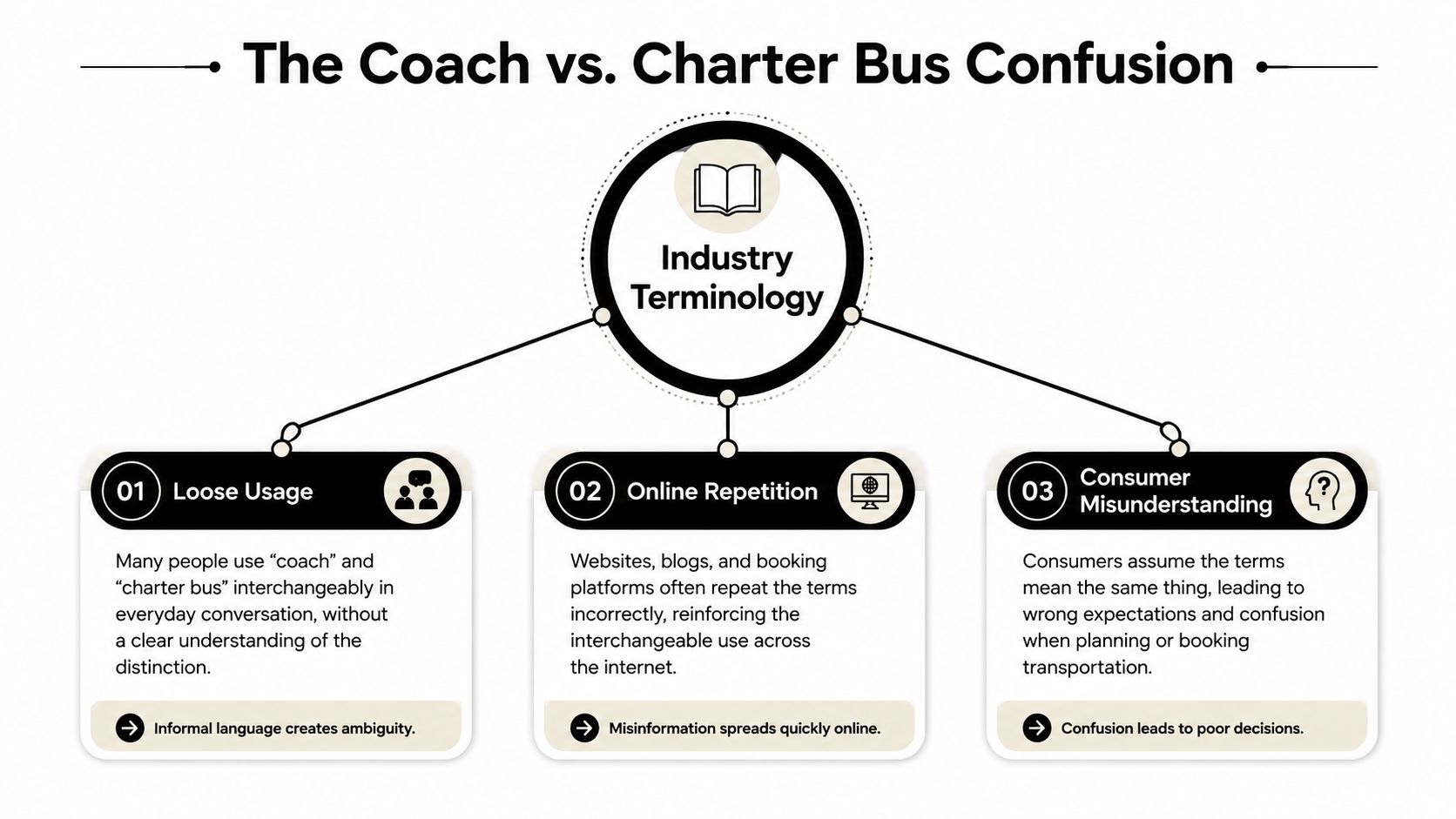
The most common assumption is that a coach bus and a charter bus are separate vehicles. They aren't. The industry uses the words loosely because operators often provide coach-class vehicles through private charter arrangements, and marketing pages frequently use the terms side by side.
A coach is a physical vehicle category. It generally means an over-the-road bus built for seated comfort, luggage storage, climate control, and longer journeys. Charter refers to how the vehicle is used. Your group reserves it for a defined route and schedule instead of sharing a fixed public route with other passengers.
That distinction also explains why searching for a “charter bus” can produce listings for full-size motorcoaches, minibuses, Sprinter-style vehicles, and other group-transportation options. A charter is a service model, not a guaranteed specification.
The procurement question isn't “Which label do I need?” It's “What vehicle will the operator assign, and what service terms come with it?”
The market's scale makes the terminology especially easy to encounter. In the U.S. and Canada, 1,566 companies operated 27,630 motorcoaches in 2022, carrying 30.8 billion passenger miles, according to the 2023 Motorcoach Census. By 2025, the same source reported 1,891 companies operating 50,968 motorcoaches, with passenger miles reaching 43.9 billion. Charter service was offered by 86.9% of companies in 2025, which helps explain why commercial providers often use “coach bus” and “charter bus” in overlapping ways.
Historical data reinforces that motorcoaches aren't merely occasional private-hire vehicles. U.S. motorcoach carriers recorded 601 million passenger trips in 2010, 627 million in 2011, 637 million in 2012, and 605 million in 2013, while annual passenger miles ranged from 63 billion to 76 billion, as shown in the Bureau of Transportation Statistics passenger travel table. The terminology may be informal, but the operational category is substantial and highly varied.
For a corporate travel manager, wedding planner, or event organizer, the solution is to stop treating the phrase as a vehicle specification. Ask whether the provider is offering a coach-class vehicle on a chartered basis, then confirm its dimensions, seating, storage, accessibility, amenities, driver coverage, and cancellation terms.
Comparing Specifications and Amenities
The passenger experience comes from the vehicle's build, not the word printed on the quote. A full-size coach bus is designed to carry people comfortably over the highway, while a smaller vehicle may be easier to position at a hotel entrance, urban venue, or narrow pickup area.
Typical full-size coach dimensions fall in the range of 39 feet 4 inches to 45 feet long, 8 feet 4 inches to 8 feet 6 inches wide, and roughly 12 feet 6 inches tall, according to the coach bus dimensions reference. Depending on its configuration, seating commonly falls between 44 and 49 passengers for some coaches and 50 to 56 passengers for larger charter-style motorcoaches.
| Specification | Full-size coach or charter-style motorcoach | Smaller coach or minibus |
|---|---|---|
| Seating | Commonly configured for 44 to 56 passengers | Lower capacity, selected around the group and route |
| Seating layout | Often 2-by-2 reclining seats | May prioritize aisle access and maneuverability |
| Luggage | Substantial underfloor storage plus overhead racks | More limited storage, requiring careful baggage planning |
| Road use | Strong fit for highway and intercity travel | Better for local routes and dense urban access |
| Restroom | Common on long-distance charter configurations, but confirm | Often unavailable |
| Boarding | One large vehicle simplifies group movement | Smaller footprint can improve curb access |
A standard full-size charter coach is often rated for 50 to 56 passengers and approximately 54,000 pounds gross vehicle weight, with 13 to 14 rows of 2-by-2 reclining seats, overhead racks, climate control, a restroom, and significant underfloor luggage capacity, according to this charter bus specification guide. These specifications favor road-trip endurance and passenger comfort, but they can make curbside positioning more demanding.
Amenities need written confirmation
Don't assume every vehicle marketed as a coach includes the same package. Ask the operator to identify the actual unit or configuration and confirm whether it includes:
- Restroom access: Important for long routes, older passengers, children, and schedules with limited stop time.
- Wi-Fi and power: Valuable for corporate travelers, but availability can vary by vehicle and service area.
- Reclining seats: More useful on extended journeys than on short venue transfers.
- Luggage capacity: Underfloor bays are a major advantage for suitcases, sporting equipment, and event materials.
- Accessibility equipment: Confirm lift or ramp availability, wheelchair positions, boarding procedures, and storage for mobility devices.
- Climate control: Essential for a comfortable group experience, particularly when passengers board at different locations.
A basic shuttle can move people efficiently, but it may not provide the storage, restroom, seat comfort, or onboard workspace expected from a long-distance coach. Conversely, a full-size coach may be unnecessary for a short local movement where the pickup area cannot accommodate its length and height.
The right comparison is therefore vehicle specification against trip requirements. If the quote doesn't state the vehicle type and amenity package, it isn't specific enough to approve.
Real-World Use Cases and Who Each Option Serves Best
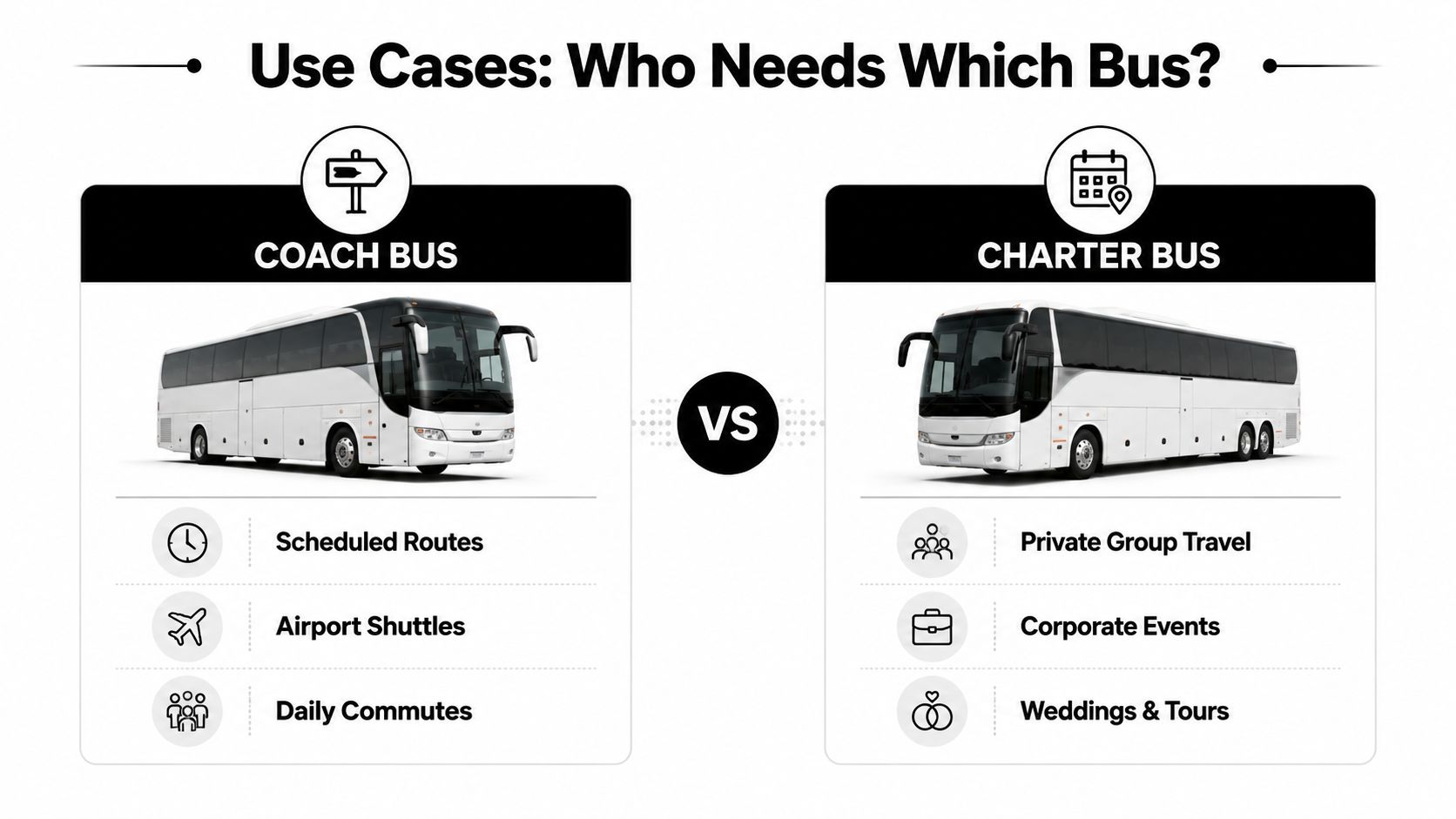
A useful vehicle decision starts with the problem you're trying to solve. The same group might need an executive van for a board dinner, a minibus for a hotel loop, and a full-size coach for an airport arrival with luggage.
Corporate travel
Corporate groups usually care about schedule control, professional presentation, and a productive ride. An executive shuttle, Mercedes van, or Sprinter limousine can suit a smaller team moving between offices, hotels, meeting venues, and site visits. Ask about power, Wi-Fi, quiet seating, luggage handling, and whether the driver understands timed multi-stop itineraries.
For a larger retreat, conference movement, or employee transfer, a full-size coach provides one coordinated vehicle rather than a collection of cars. That reduces the number of arrivals a coordinator must track and gives the group a consistent boarding experience.
Airports and FBOs
Airport transportation is a luggage problem as much as a passenger problem. A full-size coach makes sense when a group arrives together with substantial baggage, especially when the itinerary requires direct movement to a hotel, venue, or meeting location. The operator must still confirm curb access, terminal procedures, staging rules, and the exact luggage plan.
Smaller groups may be better served by executive sedans, luxury SUVs, Mercedes vans, or Sprinter limousines. These vehicles can reach tighter pickup locations and may avoid paying for capacity the group won't use.
Weddings and private celebrations
Wedding planners should prioritize punctuality, presentation, and route coordination. A coach can connect hotels, ceremony sites, receptions, and after-party locations, while a minibus or luxury van may work better for a smaller wedding party or a venue with restricted access.
The service model matters here. A privately chartered vehicle keeps guests on the planner's schedule, rather than forcing everyone to arrange separate rides. Confirm the guest manifest, loading sequence, return timing, luggage or décor requirements, and backup communication process before signing.
Sports, concerts, and family travel
Sports teams need room for people and equipment, with dependable departure and return coordination. Full-size charter coaches are a strong fit when the group travels together over a substantial distance, while minibuses can serve smaller teams or local movements.
Concerts and major events create a different challenge. Efficient boarding and post-event dispersal often matter more than luxury features. Two smaller vehicles may work better than one large coach if the venue has restrictive access or staggered departure points.
Families and social groups should match the vehicle to the headcount, baggage, and route. A mini coach or executive shuttle can provide door-to-door convenience without the footprint of a full-size motorcoach.
Choose the vehicle that solves your hardest logistics problem, not the vehicle with the most impressive name.
Understanding Pricing and Total Cost Factors
A “coach bus” quote and a “charter bus” quote can cost the same when they describe the same vehicle and operating plan. They can also differ sharply when the provider assigns a different size, service period, route, or amenity package. Terminology doesn't set the price. Operations do.
The first driver is vehicle class. A full-size motorcoach requires more equipment, space, and operating resources than a smaller shuttle or executive van. The second is the itinerary. Distance, mileage, rental duration, waiting time, number of stops, overnight requirements, and route complexity all influence the quote.
Read the quote as an operating plan
Request a line-item explanation covering:
- Vehicle assignment: Identify the class, seating configuration, restroom status, luggage capacity, and accessibility equipment.
- Service time: Confirm when the clock starts, how idle time is billed, and whether the vehicle remains dedicated to your group between movements.
- Distance and route: Ask how mileage, tolls, parking, deadhead travel, and out-of-area operations are handled.
- Driver coverage: Clarify driver fees, lodging on extended trips, relief-driver requirements, and scheduled break planning.
- Fuel treatment: Determine whether fuel is included or subject to a surcharge under the operator's terms.
- Extra services: Separate premium amenities, specialty equipment, pet transport, clean-out charges, and additional stops from the base service.
- Cancellation terms: Review deposits, deadlines, rescheduling rules, and charges for reducing vehicle size or changing the itinerary.
Seasonal demand can affect availability and rates, particularly around weddings, conferences, holidays, sporting events, and concerts. A short rental can also be less economical than expected if the provider applies a minimum service period or must keep the vehicle idle while your event takes place.
Compare equivalent proposals
The lowest headline price isn't automatically the lowest total cost. A cheaper quote may exclude parking, tolls, driver lodging, waiting time, or the restroom and luggage capacity your passengers need. A more expensive proposal may include those requirements and avoid a second vehicle or last-minute transfer.
Give every provider the same written brief. Include passenger count, baggage volume, pickup addresses, exact timing, stops, return requirements, accessibility needs, and required amenities. Then compare the assigned vehicle and included services, not just the words “coach” and “charter” at the top of the page.
How to Choose the Right Option for Your Trip
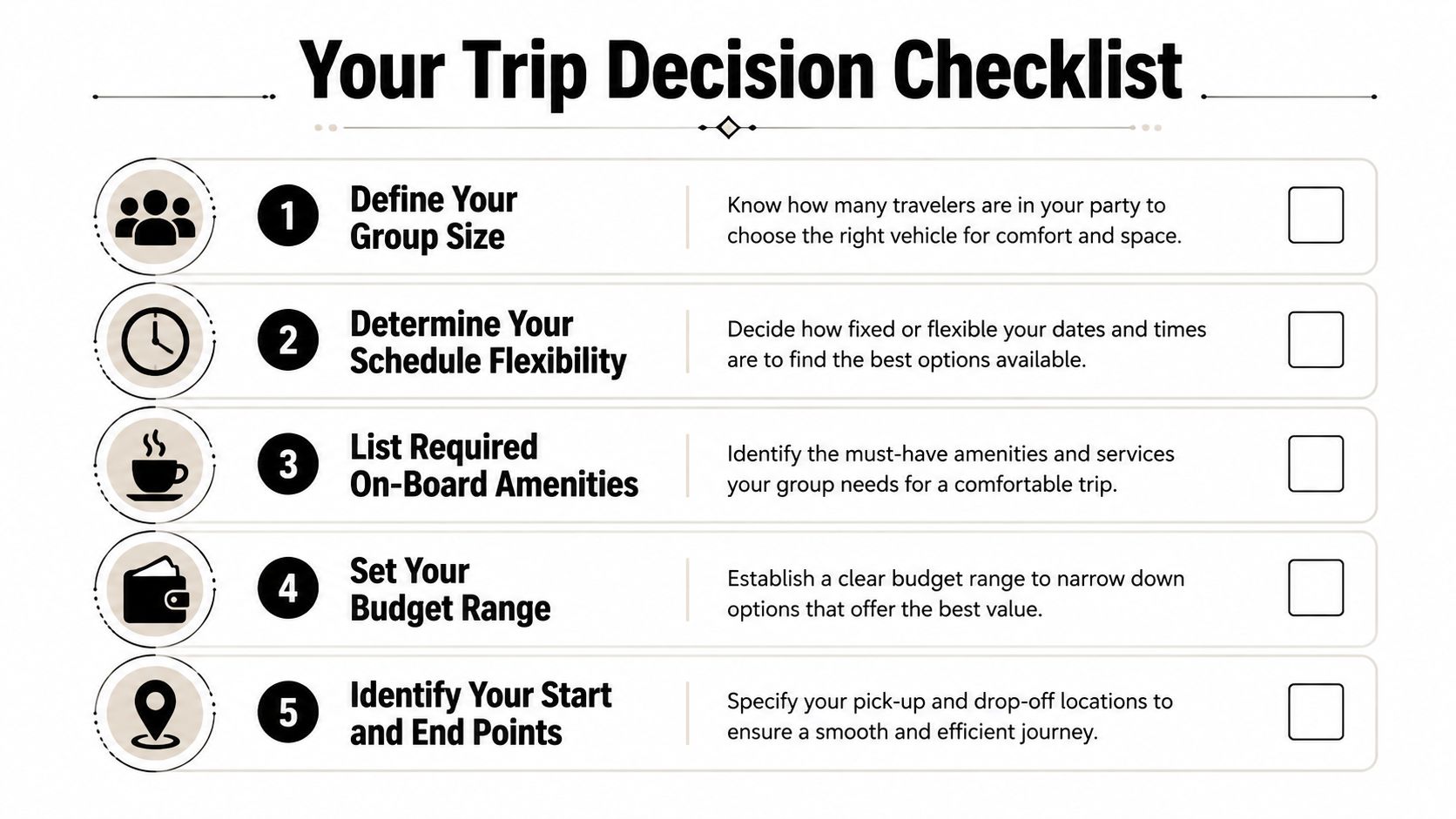
Use five variables to make the decision: passenger count, luggage volume, route, amenities, and budget. The booking should follow those facts, not the terminology used in a search result.
Start with the group and the baggage
Count passengers who need transportation, then account for luggage, equipment, children, mobility devices, and likely additions. A group of more than 40 people traveling on a highway with substantial baggage should begin with a full-size coach evaluation. A local group under 20 may get better flexibility from executive vans, Sprinter limousines, or another smaller vehicle.
Don't select capacity by seats alone. A full vehicle with suitcases in the aisle is a poor fit, even if the nominal passenger count works.
Match the route to the vehicle
Review every pickup location before requesting a quote. Check driveway access, curb restrictions, low clearances, tight turns, loading zones, parking garages, and venue staging instructions. A vehicle that works on the highway may be awkward at a downtown hotel or historic event venue.
For a multi-leg itinerary, group nearby stops into logical movements and build realistic loading time into the schedule. Tell the provider whether the vehicle waits with the group or leaves and returns later. That distinction changes both availability and cost.
Set amenity priorities
Write down what passengers need:
- Long-distance comfort: Prioritize reclining seats, climate control, restroom access, and luggage bays.
- Corporate productivity: Confirm Wi-Fi, power, quiet seating, and reliable timing.
- Accessibility: Verify the lift or ramp, wheelchair space, boarding process, and secure storage.
- Event presentation: Review vehicle condition, cleanliness, uniformed chauffeur expectations, and arrival procedure.
- Local flexibility: Favor maneuverability when the route has short hops, tight curbs, or several urban stops.
Approve the operator, not just the vehicle
Before you deposit, request the written itinerary, vehicle specification, insurance information, cancellation policy, driver-service details, and emergency contact process. Confirm who handles schedule changes on the day of travel and how the provider communicates with the group leader.
Availability also matters. Same-day and urgent requests can limit vehicle choice and create premium pricing because the operator has fewer ways to position staff and equipment. Provide the date, times, addresses, passenger count, and amenity requirements as early as possible, then ask the provider to recommend the most efficient vehicle combination.
A good booking file should let another coordinator understand the trip without calling you for missing details.
Recommendations from Max's Luxury Rides Fleet and Services
The practical recommendation is to select the smallest vehicle that comfortably handles the people, baggage, route, and service expectations. Use executive sedans and luxury SUVs for VIP airport transfers and individual executive movements. Mercedes vans and Sprinter limousines suit midsize corporate groups, wedding parties, and small-event transportation where curb access and presentation matter.
For family gatherings and moderate group outings, executive shuttles and minibuses offer a sensible balance of capacity and maneuverability. Mini coaches fit medium-scale event transportation, while full-size coach buses are the right starting point for large airport transfers, corporate retreats, wedding guest logistics, sporting events, concerts, and longer group runs.
Max's Luxury Rides Inc. offers this range alongside 24/7 reservation support, major credit-card acceptance, dedicated transportation to O'Hare and Midway, worldwide FBO service, and customized event packages. Its affiliates are thoroughly vetted professional chauffeurs, with service priorities that include punctuality, cleanliness, and guest comfort.
For your next booking, describe the trip in operational terms: passenger count, luggage, route, pickup constraints, amenities, schedule, and return plan. Then ask for the exact vehicle and a complete quote. That process will give you a dependable answer to the coach bus vs charter bus question before the deposit is paid.
Max's Luxury Rides Inc. provides executive vehicles, Mercedes vans, Sprinter limousines, minibuses, mini coaches, and full-size coach buses for airport transfers, corporate travel, weddings, concerts, sporting events, and private group transportation. Visit Max's Luxury Rides Inc. to request a vehicle recommendation and quote based on your actual itinerary.