
Your team lands at O'Hare after a long flight. Eight people collect their bags, open separate rideshare apps, and discover that the group is split across three vehicles. One driver is circling the terminal, another has stopped at the wrong pickup area, and the first car reaches the hotel well before everyone else. The meeting starts soon, but nobody has the full group, the luggage, or a reliable arrival time.
That's the problem Sprinter van transportation solves. It consolidates people, bags, schedules, and communication into one planned movement instead of forcing an organizer to manage a convoy of unrelated vehicles. Mercedes-Benz introduced the Sprinter in 1995, and the model reached its 30th production year by 2025, with the company saying it was on track to surpass five million units sold by then (Mercedes-Benz Sprinter background).

Why Sprinter Van Transportation Is Reshaping Group Travel
A group booking fails when the planner thinks only about seats. The challenge is moving everyone through the same itinerary, with the same information, while keeping luggage, timing, and changes under control.
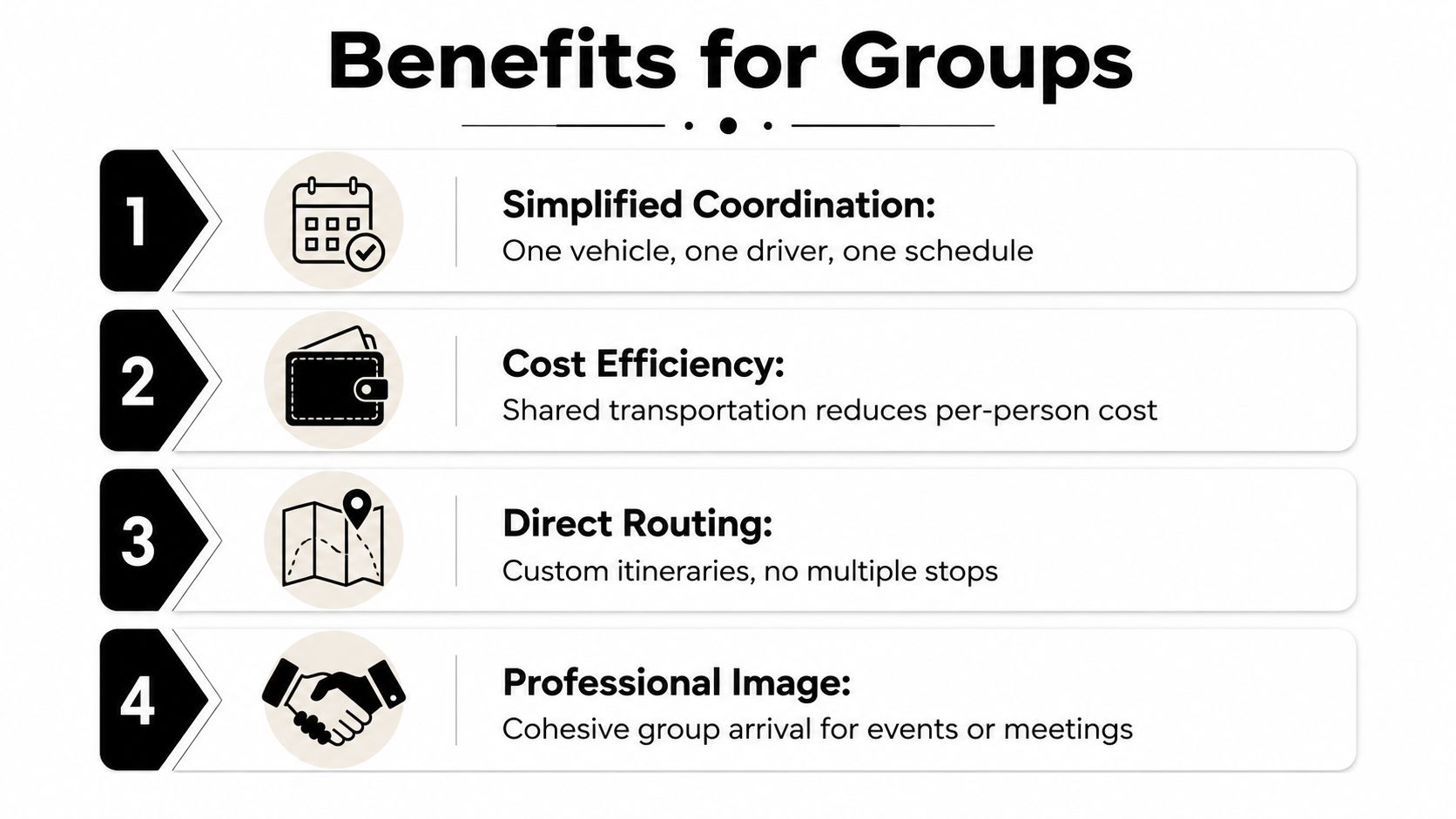
A Sprinter van gives the group one vehicle, one chauffeur, and one operating plan. That matters after an airport arrival, but it matters even more when the itinerary includes a hotel, conference venue, client dinner, private aviation terminal, and return flight. With separate sedans or rideshares, every additional stop creates another chance for a driver to miss an instruction or a passenger to fall behind.
The hidden cost of fragmented bookings
Multiple cars create work that rarely appears on the transportation invoice. Someone must distribute passenger names, send pickup instructions, track vehicles, answer “Where are you?” messages, and decide what to do when one car is delayed. Luggage gets divided across trunks, which creates another coordination problem at the destination.
That administrative burden is why centralized group travel has become more attractive to corporate planners. Mercedes-Benz reported selling around 134,000 new Sprinter units in Europe and North America between July 2013 and the end of May 2014, evidence of broad commercial traction outside Germany (Mercedes-Benz USA release on the Sprinter's history). The vehicle now occupies a useful middle position, larger and more coordinated than a sedan, but more maneuverable and less excessive than a full-size coach.
Practical rule: Choose the vehicle that reduces coordination work, not merely the vehicle that matches the passenger count.
Why the middle category matters
A sedan works well for an executive traveling alone. Several SUVs can handle a small group, but they still divide passengers and luggage. A coach bus makes sense for a large delegation, yet it can be cumbersome for hotel entrances, tight city streets, and short multi-stop itineraries.
A Sprinter is often the practical answer for executive teams, wedding parties, event guests, and airport groups that need to stay together without booking a large bus. It turns transportation from a collection of individual rides into a managed logistics function.
What Sprinter Van Transportation Involves
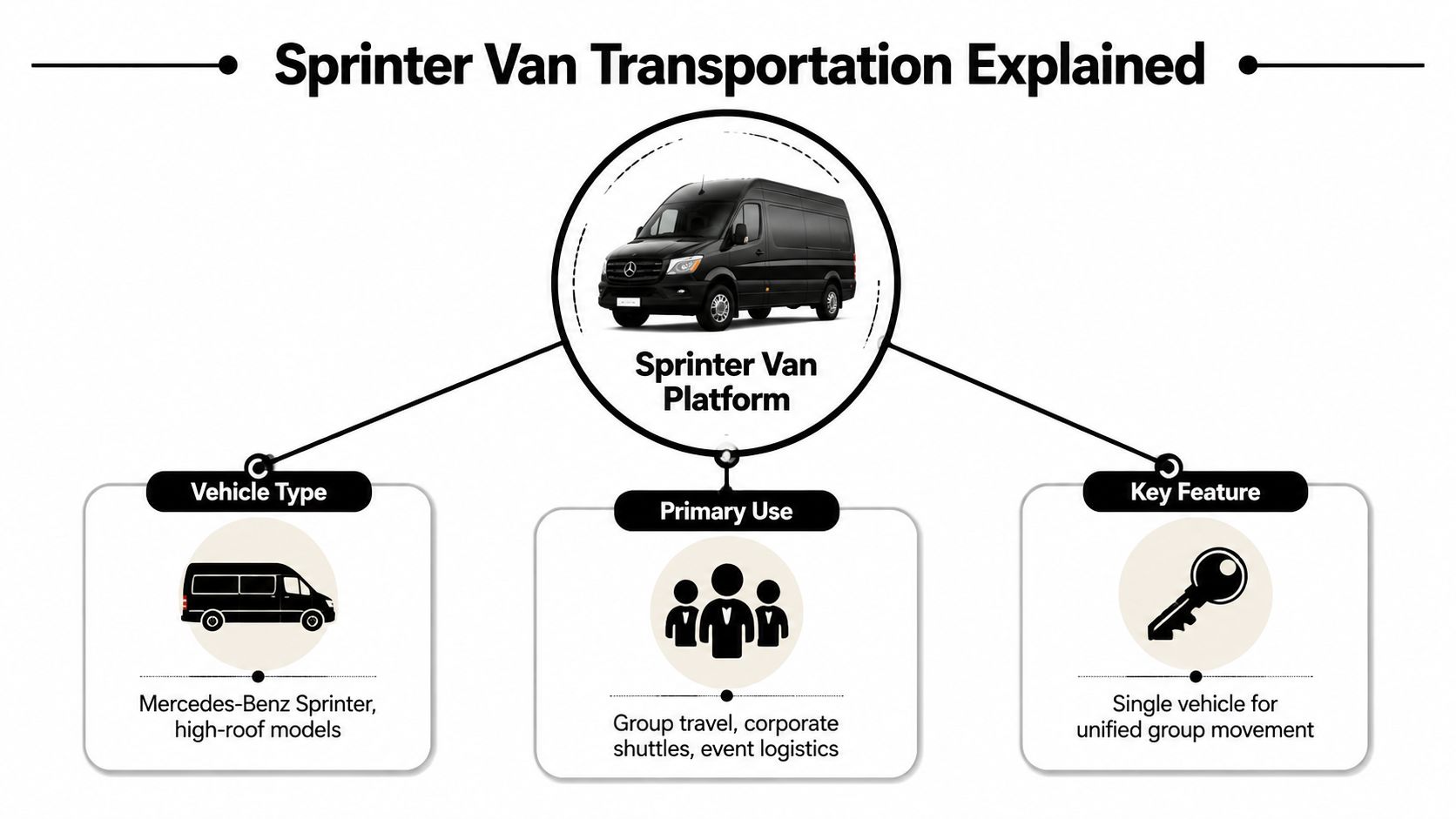
Sprinter van transportation combines a Mercedes-Benz Sprinter platform with a planned chauffeur service. The provider assigns a vehicle configuration, professional driver, pickup procedure, and route based on passenger count, luggage, stops, and timing. The result is one coordinated movement instead of several separate bookings that create extra calls, staggered arrivals, and divided responsibility.
Start the booking with the itinerary, not the vehicle name. Give the operator the pickup location, flight details when relevant, passenger count, luggage description, destination sequence, accessibility requirements, and preferred arrival time. A capable dispatcher can recommend the appropriate build and schedule rather than sending a standard van without checking the trip's requirements.
Vehicle configuration determines the experience
Passenger Sprinters can be fitted for executive travel, event transportation, or higher-capacity shuttle work. Executive layouts may prioritize individual comfort and open space, while shuttle layouts may prioritize seat count and efficient boarding. Common service features include a professional chauffeur, climate control, USB charging, Wi-Fi, leather seating, and entertainment equipment, but availability varies by operator and vehicle.
Mercedes-Benz said 75% of Sprinters worldwide are customized for specific industry needs, which shows why “Sprinter” describes a platform rather than one standardized interior (Sprinter model overview). A corporate transfer and a wedding shuttle may use the same vehicle family while requiring different seating, luggage capacity, and operating plans. Confirm those details before comparing quotes.
Dedicated service versus fixed-route shuttle
A standard shuttle often runs on a fixed route or repeating schedule. Sprinter service is usually reserved for a specific group and itinerary, allowing the chauffeur to follow scheduled pickups, planned stops, and direct communication with the organizer.
That difference matters at conferences and private events. A group may leave from several hotels, collect equipment, stop at a venue, and return after the event ends. A fixed-route shuttle may not support that sequence. A dedicated Sprinter can, provided the operator has the right vehicle and enough time in the reservation.
The chauffeur's operating plan matters as much as the interior. Ask who handles flight delays, where the vehicle waits, how the driver identifies the group, and how luggage assistance works. Those answers reveal whether the booking will reduce coordination work or just move the same problems into one larger vehicle.
Key Benefits for Corporate Travelers and Event Groups
The strongest benefit is operational, not cosmetic. A group that travels together has fewer moving parts, fewer messages to answer, and fewer arrival times to reconcile.
One schedule replaces a vehicle convoy
With one Sprinter, the coordinator can issue one pickup instruction and one destination plan. The chauffeur handles navigation and timing while the group remains available for conversation, briefing, or recovery after travel.
Corporate teams gain particular value when the itinerary includes a hard arrival time. A shared vehicle keeps executives together for a pre-meeting discussion and avoids the awkward situation where the client-facing group arrives in stages. It also gives the organizer one primary service contact instead of several unrelated drivers.
For events, the same structure supports hotel-to-venue transfers, venue-to-dinner movements, and late-night returns. The operator can plan the sequence in advance rather than asking guests to arrange separate rides at every stage.
Luggage stays with the people carrying it
Baggage is where many group bookings break down. A sedan trunk may hold one passenger's belongings comfortably, but a larger party can quickly exceed the available space. Splitting bags between vehicles means the organizer must track both passengers and property.
The right Sprinter configuration creates a better balance between seating and luggage. That balance still requires honest information. Tell the provider whether the group has standard suitcases, garment bags, presentation materials, sports equipment, strollers, or event supplies. “Eight passengers” isn't enough information to select a vehicle.
Professional timing has practical value
A chauffeur service can build the trip around scheduled pickups and, for airport arrivals, flight information. That doesn't eliminate every delay, but it gives the provider a basis for adjusting the pickup plan and communicating with the organizer.
The value is clearest when a group has a narrow window between landing and a meeting. Rideshare vehicles may arrive at different times, use different pickup points, or require passengers to make separate app-based decisions. A prearranged Sprinter removes much of that uncertainty.
Booking insight: If the itinerary has several stops, evaluate the transportation plan by the number of decisions it removes from the organizer.
Watch the practical difference between coordinated service and a collection of individual rides:
Sprinter service isn't automatically the economical choice for every group. For one or two travelers, a sedan is simpler. For a large delegation, a coach may carry more people efficiently. The value appears when consolidation improves timing, luggage management, communication, and group continuity at the same time.
Comparing Sprinter Vans to Other Transport Options
Vehicle selection should follow the trip's operating requirements. Passenger count is only one input. Luggage, urban maneuverability, number of stops, service expectations, and the cost of managing multiple vehicles can change the answer.
| Vehicle Type | Passenger Capacity | Luggage Capacity | Coordination Complexity | Best For |
|---|---|---|---|---|
| Executive sedan | One small party | Limited trunk space | Low for individuals, high for group convoys | Individual executives or very small transfers |
| Luxury SUV | Small party | Moderate, depending on seating and bags | Moderate when several are required | Small groups with lighter luggage |
| Rideshare convoy | Varies by vehicle availability | Divided across vehicles | High | Informal trips where timing and consistency are flexible |
| Sprinter van | Commonly configured for a midsize group | Configurable, with seating and cargo trade-offs | Low with one assigned vehicle | Corporate teams, airport groups, weddings, and event movements |
| Minibus | Larger group than a Sprinter | Strong group capacity | Moderate | Larger delegations requiring more seats |
| Full-size coach bus | Large group transportation | High overall capacity | Moderate, with greater access constraints | Major conferences, large tours, and sizeable event movements |
When a Sprinter is the right middle ground
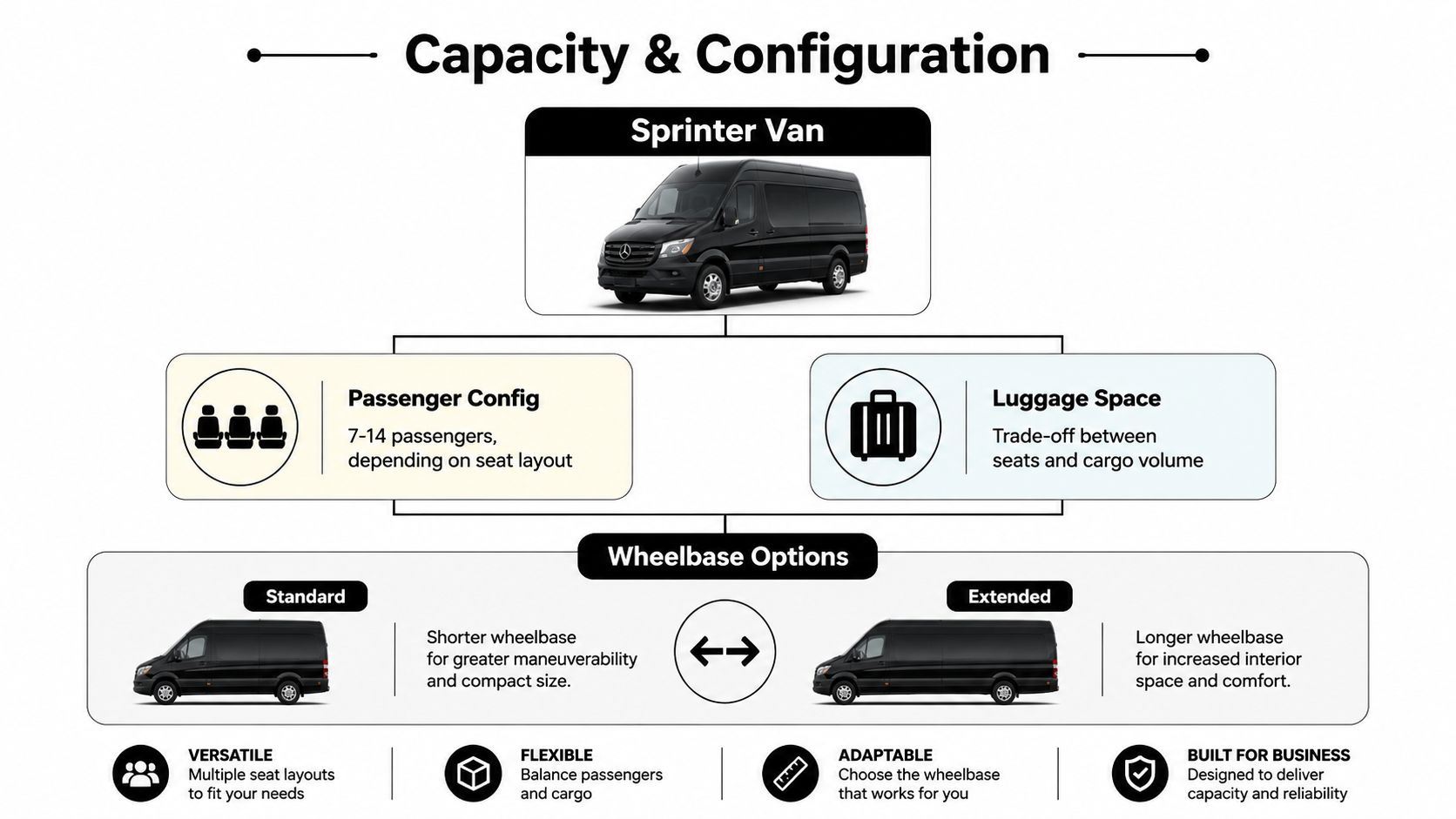
For a group in the 7 to 14 passenger range, a Sprinter often offers the best balance when the group has meaningful luggage or several scheduled stops. That range is a planning guideline, not a guarantee. Seat layout and baggage requirements can reduce usable capacity, so the operator should confirm the actual build.
A sedan or SUV is usually the cleaner choice for one to three passengers. Booking a Sprinter for that trip adds vehicle size without solving a coordination problem. Conversely, a group of 20 or more passengers may need a minibus or coach, especially when everyone must travel at once.
Consider maneuverability, not just seats
A large bus can be difficult around hotel loading zones, narrow streets, event entrances, and airport pickup areas. A Sprinter is easier to position in many urban environments, while still providing shared travel and a dedicated chauffeur.
Event planners who manage repeated departures can also benefit from structured reservation tools. Resources such as online booking for day tours can help operators organize itinerary details, availability, and customer information, although the transportation provider still needs to verify vehicle fit and accessibility directly.
The correct comparison is not “luxury versus economy.” It's one coordinated movement versus several separate rides, matched against the physical demands of the itinerary.
Capacity Configurations and Onboard Amenities
A Sprinter's interior involves practical trade-offs. Adding seats reduces open luggage space. Choosing a longer body increases cargo capacity but can complicate tight pickup zones. A tall roof gives passengers more standing room and easier movement, yet may limit access to garages and loading areas.
A 2024 Mercedes-Benz Sprinter 2500 cargo model is listed with a 144-inch wheelbase, 233.5-inch length, 96.3-inch height, 319 cubic feet of cargo capacity, and 4,211-pound maximum payload (2024 Mercedes-Benz Sprinter specifications). These figures describe a cargo configuration rather than a passenger layout, but they show why operators can build the same platform for very different group requirements.
Match the chassis to the route
The 144-inch wheelbase is easier to position in dense urban pickup and drop-off zones. It fits the operating realities of downtown hotels, office buildings, and venues with limited curb space. For a group transfer, that maneuverability can reduce staging problems that otherwise create delays across several vehicles.
Longer variants can reach 274 to 290 inches in length, with the heaviest cargo configuration reaching 6,812 pounds of maximum payload (Sprinter dimensions and payload specifications). That added capacity may justify the larger footprint for airport runs with substantial baggage, event equipment, or longer regional transfers. Do not select it solely for extra seats. Confirm that the route can handle the vehicle.
Ask the provider to assess three details before confirming:
- Passenger layout: How many people can sit comfortably without consuming the luggage area?
- Baggage profile: How many cases, garment bags, or specialty items will travel?
- Access conditions: Will the vehicle use a garage, narrow entrance, loading dock, or restricted curb?
Amenities should support the trip
Executive captain's chairs, climate control, charging ports, Wi-Fi, and entertainment systems can improve corporate and event transfers. They come after clean seating, dependable climate control, safe entry, and adequate luggage room. Confirm which amenities are installed in the assigned vehicle, not merely listed in a provider's general fleet description.
Fuel planning also matters. Car and Driver recorded 15 mpg for a 2019 diesel Sprinter on its 75-mph highway route, while industry and specification listings commonly place diesel Sprinters around 14 to 17 mpg depending on configuration and engine output (Car and Driver Sprinter review and testing). Heavier loads, taller roofs, and high-output diesel configurations can reduce efficiency in exchange for carrying ability. Choose the smallest configuration that meets the passenger, baggage, and access requirements, then keep the group consolidated in one properly matched vehicle.
Pricing Factors and Smart Booking Strategies
A Sprinter quote reflects the work required to operate the trip, not only the distance between two addresses. Providers generally consider duration, routing, vehicle configuration, time of day, demand, waiting requirements, and added stops. Meet-and-greet service, luggage assistance, airport procedures, and event staging can also affect the final proposal.
Don't compare quotes until the itineraries are comparable. One provider may price a direct transfer, while another includes a waiting window, multiple stops, or a larger vehicle. Ask for the inclusions in writing.
The booking details that protect the trip
Send the operator a complete trip brief. Include:
- Passenger information: List the actual number of travelers and identify executives, children, or guests needing additional assistance.
- Luggage details: Describe suitcase quantity and unusual items instead of giving a vague “with bags” note.
- Routing: Provide every stop, venue, hotel, airport terminal, and FBO involved.
- Timing: State the required arrival time, not only the departure time.
- Service expectations: Confirm Wi-Fi, charging, meet-and-greet, luggage help, and accessibility rather than assuming they're included.
Rate pressure and capacity constraints make early planning more important in 2026, particularly for airport peaks, weddings, conferences, concerts, and major sporting events. Recent transportation-industry coverage points to continued rate pressure and tight van capacity in 2026, which makes lead time, cancellation terms, and backup planning important buying criteria (transportation industry trends for June 2026).
Judge the provider, not just the vehicle
Review the operator's fleet condition, chauffeur screening, dispatch communication, and airport procedures. Ask how the company handles flight delays, vehicle substitutions, late passengers, and last-minute itinerary changes.
Confirm the cancellation window, deposits, overtime or waiting charges, damage policies, and refund terms before payment. A low initial quote isn't useful if the contract leaves the group exposed when the itinerary changes.
For airport transfers, reserve once flights and passenger details are firm. For weddings and large events, book as soon as the date and schedule are established. The objective is not to secure a flashy van. It's to secure the correct configuration, a reachable dispatch team, and a written plan that another person could execute without guessing.
Frequently Asked Questions About Sprinter Van Transportation
Can a Sprinter be wheelchair accessible?
Some Sprinters are built or modified for wheelchair access, while others aren't. Ask about the ramp or lift, securement position, boarding clearance, and whether the accessible passenger can remain in the chair during travel. Never assume that a passenger van is automatically accessible.
How do passenger numbers affect luggage space?
Seats and luggage compete for interior volume. A group may fit by seat count but still need a larger or differently configured vehicle for suitcases, garment bags, strollers, or event equipment. Provide the operator with a real baggage description before booking.
Can a Sprinter serve an FBO?
Yes, a Sprinter can serve a Fixed Base Operator when the provider is authorized and familiar with that facility's access rules. Give the operator the FBO name, aircraft timing, passenger contact details, and any curbside or security instructions.
What happens if a flight is delayed?
Ask whether the provider monitors the flight, how long included waiting time lasts, and how revised pickup timing is communicated. A professional plan should identify the responsible dispatcher and explain any additional waiting or rescheduling charges before travel.
Is a Sprinter better than multiple sedans?
For groups that need to arrive together, share luggage, or follow a multi-stop itinerary, it usually is. For a very small party with a direct transfer, a sedan or SUV may be more efficient. Select the vehicle based on coordination requirements, not the label “luxury.”
Max's Luxury Rides Inc. provides Mercedes Sprinter luxury limo-style vans and executive shuttles for airport transfers, corporate travel, weddings, and event transportation, with professional chauffeurs, 24/7 reservations, and service to O'Hare, Midway, FBOs, and airports worldwide. Visit Max's Luxury Rides Inc. to submit your passenger count and itinerary, then request a vehicle configuration that keeps your group, luggage, and schedule together.