
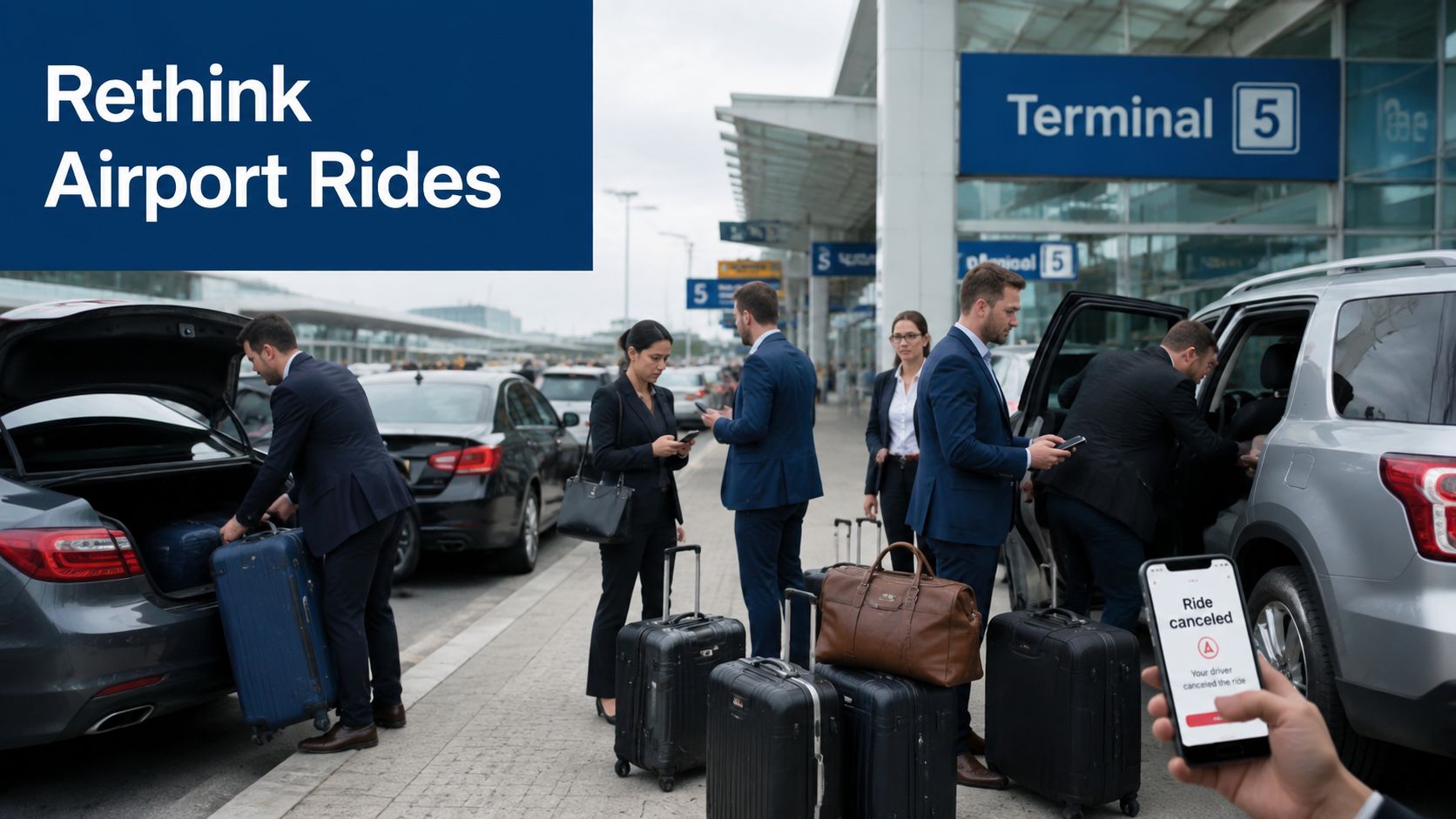
A six-person executive team lands at O'Hare after a long flight. By the time everyone reaches Terminal 5's pickup area, the group has split across three rideshares, luggage is crowding the sidewalk, and one driver has canceled mid-request. The travelers arrive at the hotel in separate waves, expense receipts sit across several apps, and the person managing the itinerary spends the next hour tracking cars instead of preparing for the meeting.
That's the operational problem a Sprinter van airport service is designed to solve. One vehicle, one chauffeur, one pickup plan, and one accountable transportation provider can keep a group together from baggage claim to the hotel, office, venue, or private aviation terminal. The decision isn't mainly about leather seats or a luxury image. It's about controlling time, luggage, communication, and responsibility at the curb.
Why Groups Are Rethinking Airport Transportation
Fragmented airport transportation creates work that nobody budgets for. A coordinator must watch multiple vehicles, confirm separate pickup points, reconcile several receipts, and explain why the group didn't arrive together. If one car gets delayed in terminal traffic, the entire arrival sequence becomes harder to manage.
For groups of five to fourteen travelers, a single van often provides the cleaner operating model. Everyone clears baggage together, loads once, and follows the same route. Executives can discuss the day's priorities in transit. Event planners can send one arrival update instead of coordinating a convoy. Families can keep children, mobility equipment, and luggage in one controlled environment.
Practical rule: If the group must arrive together, book the transportation as one operating unit rather than assembling several independent rides.
The financial issue is just as practical. Multiple cars multiply the opportunities for surge pricing, toll charges, tips, cancellation problems, and disputed receipts. A fixed group transfer may not always be the lowest quoted vehicle rate, but it gives the coordinator a single booking to compare against the total cost and administrative burden of several cars.
The broader airport-ground transportation market supports this consolidated model. One independent report valued the global on-demand shuttle market at $2.8 billion in 2025, with a projection of $4.9 billion by 2033, implying a 7.2% CAGR. The same report identified North America as the leading region with roughly 44% share, evidence that organized airport transportation is already a mature service category in major travel markets, where Sprinter vans commonly serve private transfers, corporate travel, and group airport runs. Read the market segmentation and forecast.
Even group celebrations benefit from the same discipline. Coordinators planning a flawless hen do already know that group dynamics become difficult when attendees move on different schedules. Airport transportation should reduce that friction, not add another coordination problem.
What a Sprinter Van Airport Service Actually Includes
A professional service is more than reserving a van. It's a managed transfer with a vehicle, a qualified chauffeur, a dispatch process, and clear rules for delays, luggage, access, and communication.
The vehicle platform
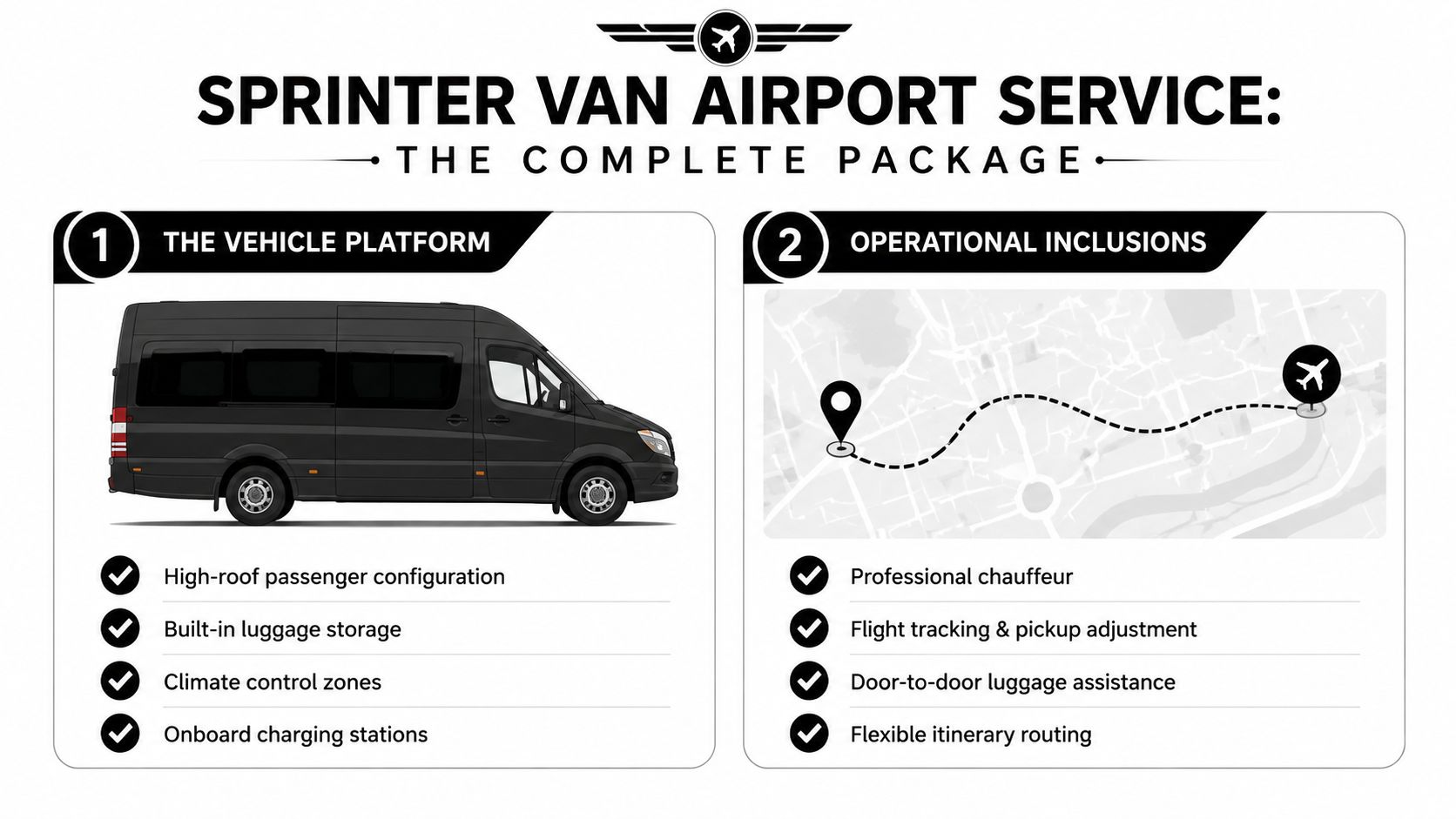
Most premium airport configurations use a Mercedes-Benz Sprinter passenger van, commonly in a high-roof format with an extended wheelbase. The platform's value comes from usable interior geometry. Independent specifications show a maximum load width of around 1,780 millimeters, while load length ranges from roughly 2,700 to 4,800 millimeters, depending on body length and roof height. That broad, long load bay gives staff more options for loading suitcases and soft cases without building an unstable stack. Review the independent Sprinter dimensions.
A properly appointed passenger van may include:
- Climate control: Useful when passengers arrive in different clothing, carry formalwear, or need a comfortable transition after a flight.
- Executive seating: Captain's chairs create more personal space than a standard shuttle layout.
- Power access: USB-C and AC charging help travelers restore devices before the next meeting.
- Connectivity: Onboard Wi-Fi can support email, calls, and itinerary updates, subject to the provider's service.
- Privacy glass: Tinted windows provide a quieter, less exposed environment for business travelers.
- Luggage storage: The operator should confirm whether luggage sits in a rear compartment, within the passenger cabin, or in another approved arrangement.
The managed transfer
The chauffeur's role starts before the vehicle reaches the terminal. A serious operator should receive the flight number, monitor arrival information, confirm the correct terminal, and adjust the pickup plan when the itinerary changes. At the airport, the chauffeur should know where commercial vehicles can stage, where passenger loading is allowed, and how to reach the group without creating a curbside obstruction.
The meet-and-greet process should be explicit. Confirm whether the chauffeur meets passengers inside at baggage claim, waits at a designated pickup area, or uses a named sign and phone call. These details matter at O'Hare, Midway, and private terminals because the most convenient meeting point for a traveler may not be the legal staging location for a commercial vehicle.
A peer-to-peer rental leaves those decisions with the group. A professional airport service should provide commercial insurance, applicable transportation compliance, chauffeur credentials, dispatch coverage, and a defined availability window. Ask for those details before payment, not after a delay.
Vehicle Capacities and Luggage Logistics Explained
The most common booking mistake is treating the seat count as the usable airport capacity. A van may have enough seats for a full party, yet lack the payload margin or luggage geometry for that party's actual bags.
The 2025 Mercedes-Benz Sprinter 2500 illustrates the trade-off clearly. A 144-inch-wheelbase, standard-roof configuration is listed with 319 cubic feet of cargo space and a 4,211-pound payload capacity. The 170-inch high-roof configuration increases cargo volume to 488 cubic feet, but payload falls to 3,814 pounds. The longer, taller body may hold more baggage, but passengers, luggage, seats, flooring, cabinetry, and other upfit equipment still count toward the vehicle's legal limits. Compare the listed Sprinter payload configurations.
That's why I ask for three pieces of information before approving a group transfer:
- Passenger count, including children and anyone requiring additional space.
- Bag count, separated into checked bags, carry-ons, garment bags, strollers, cases, and unusual items.
- Equipment weight, especially for trade shows, sports, skiing, production work, or event installations.
Capacity planning table
| Passenger Count | Checked Bags (Large) | Carry-Ons | Comfort Level | Recommended Use Case |
|---|---|---|---|---|
| 7 to 8 | Confirm with operator | Confirm with operator | Highest practical flexibility | Executive teams with substantial luggage |
| 9 to 10 | Confirm with operator | Confirm with operator | Comfortable when luggage is planned | Corporate groups and family transfers |
| 11 to 12 | Confirm with operator | Confirm with operator | Configuration dependent | Groups with lighter or efficiently packed bags |
| 13 to 14 | Confirm with operator | Confirm with operator | Tight when luggage is substantial | Passenger-heavy trips with limited baggage |
The table intentionally avoids promising a universal bag count. Interior layouts differ, and luggage weight can matter as much as volume. A group with compact soft bags may load efficiently, while a smaller group carrying hard cases, presentation materials, or mobility equipment may need a larger vehicle or a second unit.
Capacity check: A booking is ready only when the operator has confirmed both seats and luggage, not just the passenger total.
A nine-person corporate team with one checked bag per traveler may fit comfortably in the right configuration. A twelve-person family group with oversized luggage may not. The responsible answer could be a luggage trailer, a support vehicle, or a larger shuttle, depending on local rules and the operator's fleet.
Comparing Sprinter Vans to Other Airport Transport Options
Airport transportation works best when the vehicle matches the group's operating requirements. A sedan prioritizes individual comfort, a rideshare prioritizes immediate app availability, and a shuttle bus prioritizes volume. The Sprinter occupies the middle ground, offering group cohesion without committing to a full-size coach.
| Vehicle Type | Max Passengers | Luggage Capacity | Cost Efficiency | Group Cohesion | Privacy Level |
|---|---|---|---|---|---|
| Sedan | Small party | Limited | Weak for groups | Low | High |
| Luxury SUV | Small party | Moderate | Moderate for small groups | Moderate | High |
| Rideshare vehicles | Varies by vehicle | Uncertain | Unpredictable during demand spikes | Low | Variable |
| Shuttle bus | Large group | High | Strong at larger scale | High | Low to moderate |
| Sprinter van | Group configuration dependent | Strong, subject to layout and payload | Strong for organized groups | High | High |
A sedan can work for an executive traveling alone with a compact suitcase. It becomes an inefficient choice when a team needs several vehicles. The coordinator must align different drivers, passengers may reach the destination at different times, and luggage gets distributed according to whichever trunk has room.
Luxury SUVs improve the experience but still impose a hard limit on cargo geometry. They're useful for small groups, VIPs, and travelers who value individual privacy. They aren't a substitute for a properly configured van when the group carries extensive baggage or needs everyone in the same conversation.
Rideshare service adds another layer of uncertainty. Vehicle quality varies, the available car may not match the requested category, and demand-based pricing can change while the group is requesting several vehicles. The coordinator also loses a single point of contact when drivers change or apps assign separate pickup instructions.
Shuttle buses solve the capacity problem but can be excessive for a smaller delegation. They may use fixed routes, require more formal staging, and provide less privacy. A Sprinter is usually more practical for a direct airport-to-hotel movement, a private FBO pickup, or an event itinerary with several controlled stops.
Decision standard: Choose the Sprinter when keeping the group together is operationally valuable, not merely visually impressive.
The market data reflects why larger group vehicles remain relevant. A separate study placed the global airport shuttle bus market at about $1.8 billion in 2026, projecting $2.4 billion by 2033 at a 4.5% CAGR. It identified airport terminal transfers as the largest application segment at 51.7% in 2025, while 30 to 50 passenger vehicles held 44.1% share. Those figures describe a broader shuttle market, not Sprinter-specific performance, but they reinforce the continuing demand for organized, luggage-capable airport transfers. Review the airport shuttle market study.
Key Benefits for Corporate Teams and Event Groups
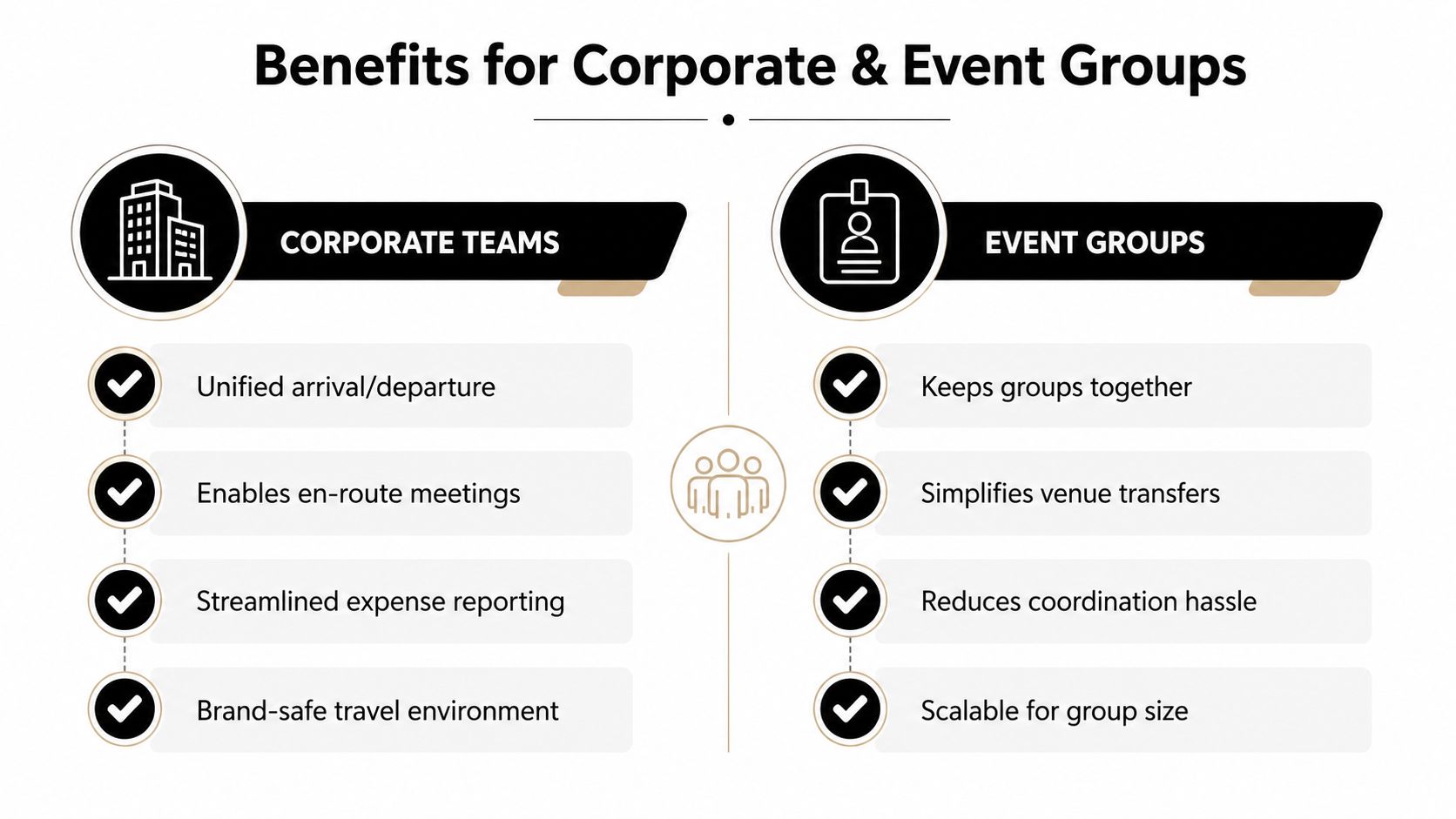
Corporate teams gain the most from a Sprinter when the transfer itself is part of the agenda. Everyone lands, clears baggage, boards once, and follows one itinerary. The travel coordinator can send one dispatch update to the group and receive one arrival confirmation from the operator.
A connected cabin can also turn transit into useful working time. Executives may review presentation materials, make calls, or align on meeting roles while the chauffeur handles the route. That doesn't mean every transfer should become a conference room. It means the group retains the option to work instead of spending the ride comparing arrival times.
Where the format performs well
- Corporate arrivals: One chauffeur manages one pickup, one vehicle, and one destination sequence.
- Trade show teams: The booking can account for display cases, sample materials, and equipment that won't fit safely in ordinary cars.
- Sports groups: Equipment bags stay with the people using them, reducing the risk of scattering gear across vehicles.
- Wedding parties: Formal clothing, gifts, and attendants travel together without forcing delicate items into small trunks.
- Family reunions: A high-roof van can be easier for older travelers, children, and passengers managing strollers or mobility equipment than climbing into a low SUV.
- Incentive programs: A coordinated vehicle creates a consistent arrival experience and gives the planner one movement schedule to manage.
For event planners, the benefit extends beyond the airport. The same vehicle can support hotel-to-venue transfers, off-site dinners, rehearsals, and departure movements when the itinerary is booked appropriately. That continuity reduces the number of handoffs between transportation providers.
If the event includes photography, videos, or attendee-generated content, the organizer can also gather team event media while the transportation plan remains separate and controlled. The two workflows support each other, but neither should depend on passengers solving logistics from the curb.
The time advantage comes from coordination rather than a guaranteed travel duration. One pickup means one loading sequence, one driver conversation, and one departure decision. Multiple vehicles require several arrivals, repeated luggage loading, and constant checking for missing passengers.
Use the onboard environment responsibly. It's suitable for a briefing or document review, but confidential conversations still require judgment, especially when the vehicle includes a chauffeur and connectivity is shared.
Booking Considerations and Service Area Coverage
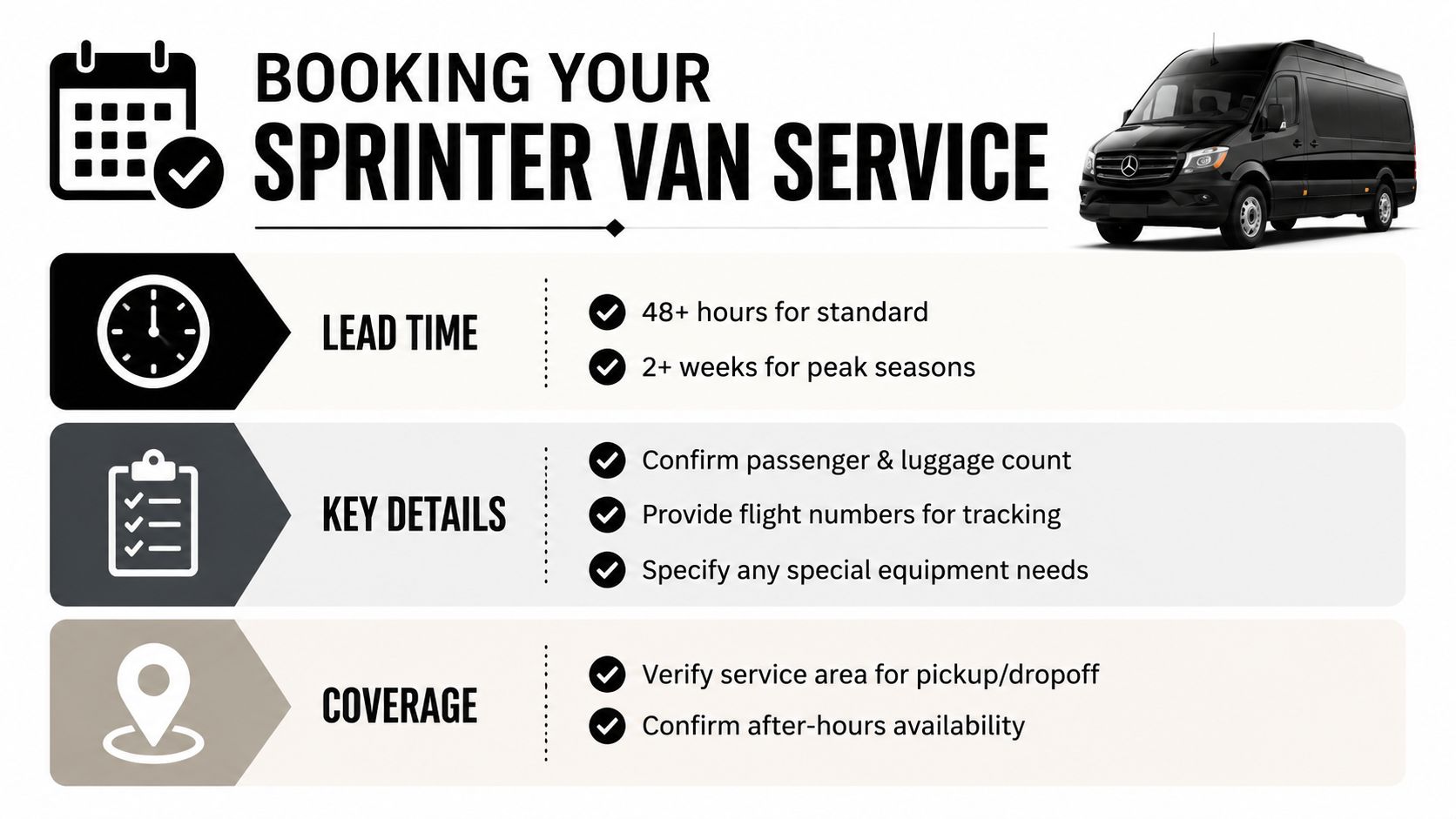
Start with the itinerary, not the vehicle glamour. Provide the airport, terminal or FBO, flight number, destination, passenger count, bag count, special equipment, and requested pickup experience. The operator can't make a responsible capacity recommendation from the phrase “a group of ten” alone.
For standard reservations, I recommend booking at least 48 hours ahead. Peak travel periods and large fleet requests deserve two weeks or more, because availability, vehicle configuration, and commercial pickup rules become harder to solve at the last minute.
Confirm the commercial terms
A written quote should identify what the base rate covers and what can change. Ask about:
- Fuel and tolls: Confirm whether they're included or itemized separately.
- Gratuity: Ask whether it's included, expected, or left to the client.
- Wait time: Confirm how the operator handles delayed arrivals and how the clock starts.
- Cancellation: Request the cancellation window and the rebooking process.
- Additional stops: Clarify whether multiple hotels, offices, or venues change the rate.
- Billing: Corporate clients should ask for one itemized invoice and a recurring account option.
Verify the operating area
For Chicago travel, confirm service to O'Hare International Airport, Midway International Airport, and private aviation facilities such as DuPage and Chicago Executive airports. Commercial terminals and FBOs don't operate the same way. At an airline terminal, the chauffeur may need to use a designated commercial pickup zone or coordinate a meet-and-greet inside the terminal. At an FBO, the vehicle may be able to stage closer to the private aviation facility, but access still depends on airport and facility rules.
Ask for the exact meeting procedure in writing. “Airport pickup” is too vague. The confirmation should state the terminal or FBO, passenger meeting point, driver contact process, vehicle description, flight tracking status, and instructions if the group can't immediately reach the curb.
For operator vetting, request proof of commercial insurance, applicable DOT compliance, vehicle details, and chauffeur credentials. A clean-looking van is not enough. The provider must also demonstrate that it can manage airport access, schedule changes, and luggage responsibly.
Frequently Asked Questions and Next Steps
How early should a group reserve?
Reserve standard service at least 48 hours ahead, and allow two weeks or more for peak periods or larger fleet requests. Earlier booking gives the operator time to match the group with the right passenger layout and cargo arrangement.
Can the service provide child seats?
Some operators can arrange child seats by request. Give the provider the child's age, size, and seating requirement before confirmation, then ask whether the seat is supplied, installed, and included in the quoted service.
Are ADA-accessible configurations available?
Availability depends on the fleet and the specific airport movement. Don't assume a standard Sprinter can accommodate a wheelchair without modification. State the mobility requirement during the initial inquiry and ask for the vehicle's boarding method, interior clearance, securement arrangement, and luggage implications.
What happens if the flight is delayed?
Provide the flight number and confirm that dispatch monitors it. The operator should explain whether the chauffeur adjusts the pickup automatically, how much arrival wait time is included, and when additional charges begin.
How does meet-and-greet work?
At O'Hare and Midway, confirm the terminal, baggage claim meeting point, commercial vehicle staging location, and driver identification process. At a private FBO, provide the facility name and aircraft arrival details, then verify whether the chauffeur can meet inside the FBO or must wait at a designated vehicle area.
What if the luggage exceeds the plan?
The operator may need to change the vehicle, add a support unit, use a luggage trailer where lawful, or revise the passenger arrangement. Don't ask the chauffeur to solve an overloaded van at the curb. Payload limits include people, baggage, and upfit weight, so the booking team needs accurate information in advance.
What should I know about gratuity and cancellation?
Ask for both policies in the written quote. Operators handle gratuity, cancellation windows, holiday conditions, and itinerary changes differently, and verbal assumptions create avoidable disputes.
A Sprinter van airport service is the right tool when the group's priority is one coordinated movement with controlled luggage and clear accountability. It's not automatically the right vehicle for every party, but it's far more dependable than improvising several cars around a crowded terminal.
Max's Luxury Rides Inc. offers Sprinter vans and other group transportation for O'Hare, Midway, private FBOs, corporate travel, and special events, with reservation support available around the clock. Visit Max's Luxury Rides Inc. to discuss your passenger count, luggage requirements, airport access needs, and next group transfer.