
At 11:47 p.m., a corporate traveler steps off a red-eye at O'Hare, finds the bags already circling the carousel, and sees a black SUV waiting at the curb. The chauffeur is holding a printed name sign. The cabin is set to 68 degrees, water is in the door pockets, and dispatch has already checked the route around overnight construction. The traveler doesn't need to explain the delay, repeat the destination, or wonder whether the ride is ready.
That calm arrival is customer service excellence in action. It isn't created by a polished greeting alone. It comes from preparation before the passenger lands, coordination between dispatch and chauffeur, a controlled in-vehicle experience, and decisive recovery when something goes wrong. For a luxury transportation operator, service quality is the product.
What Customer Service Excellence Means Behind the Wheel
The O'Hare arrival feels effortless because the client sees only the final moment. Behind it, several people have completed small tasks correctly. Dispatch has monitored the flight and reviewed the road conditions. The chauffeur has inspected the vehicle, confirmed the passenger details, positioned the SUV properly, and prepared for luggage handling. The passenger experiences one smooth handoff rather than a chain of internal processes.

For luxury ground transportation, customer service excellence is the cumulative discipline of making the journey feel anticipated. It includes accurate booking details, clear confirmations, flight-aware dispatch, vehicle presentation, appropriate conversation, discreet luggage assistance, and communication that reaches the traveler before uncertainty becomes frustration.
A generic ride-hail trip usually sells availability and transportation from one point to another. A chauffeured service sells confidence around a time-sensitive journey. The difference matters to a senior executive arriving for a meeting, a family transferring after a long international flight, or a wedding planner coordinating several vehicles around a fixed arrival schedule. The client isn't paying only for a seat. They're paying to remove decisions and reduce risk.
Practical service standards also need to be translated into observable behavior. A useful reference is CallZent's customer experience insights, which helps frame excellence through consistency, responsiveness, empathy, and effective resolution. On the road, those ideas become concrete: answer the booking question accurately, acknowledge a delay before the passenger has to ask, and close the issue instead of passing it between departments.
Operational rule: If the passenger has to coordinate your team, the service has already broken down.
Chauffeured travel is harder to manage than a conventional contact center because the service is physical, mobile, and exposed to conditions outside the operator's control. A flight can divert, a terminal can change, a vehicle can develop a fault, and a curb can become inaccessible. Excellence doesn't mean eliminating every disruption. It means preparing for predictable failure points and giving the client one calm, accountable point of contact when conditions change.
Core Principles of Luxury Chauffeur Service
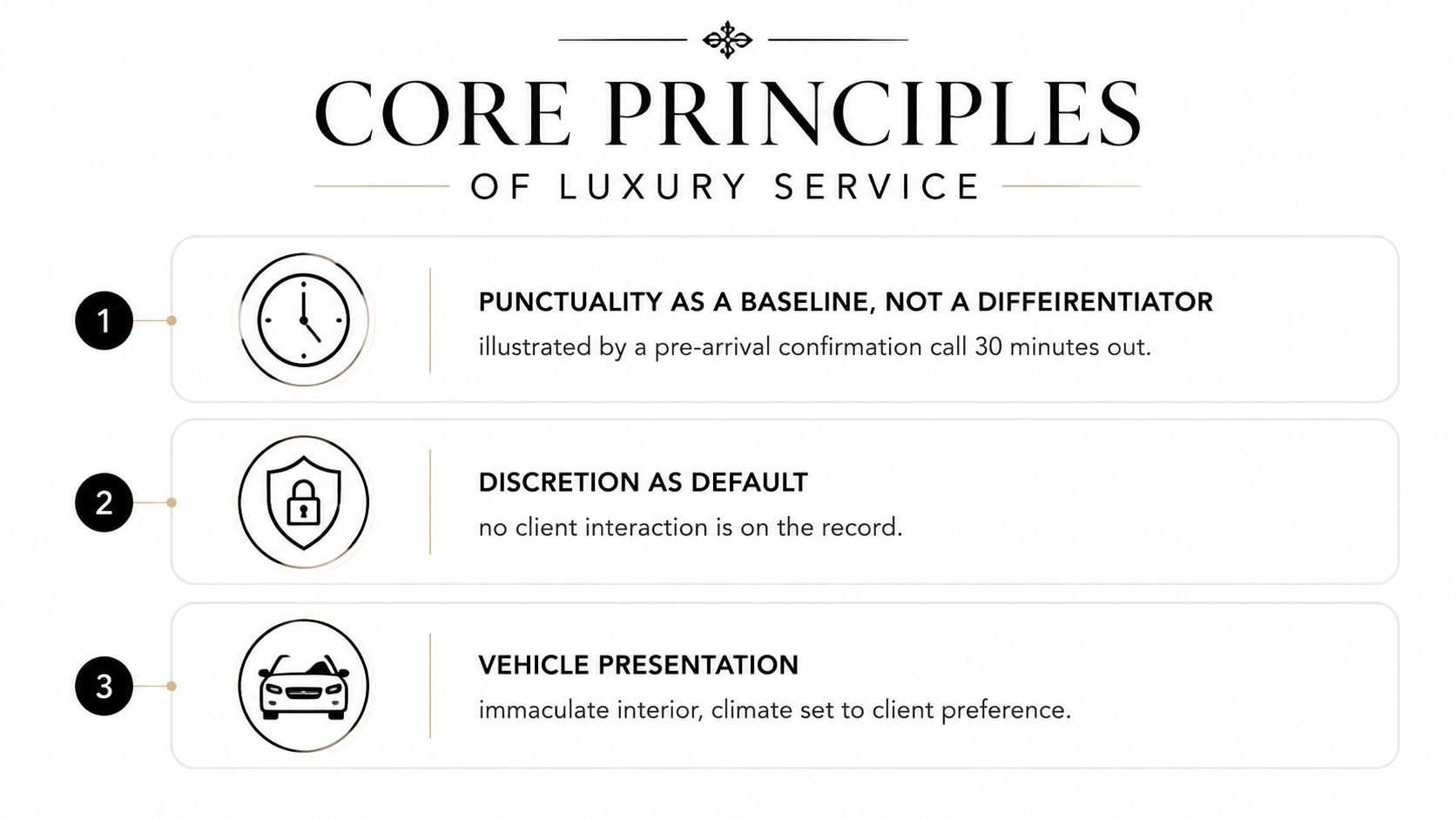
A premium service model starts with principles that chauffeurs and dispatchers can apply under pressure. These standards shouldn't live only in a handbook. They need to appear in booking notes, pre-trip checks, coaching sessions, and the language used during a recovery.
Punctuality is the baseline
A 4:55 a.m. pickup isn't an opportunity to arrive at 4:54 and call it success. The chauffeur should arrive early enough to absorb gate access, luggage loading, traffic around the property, and a client who comes downstairs sooner than expected. Early arrival creates operating room, but the vehicle shouldn't crowd the passenger or signal impatience. Stage discreetly, confirm the location, and remain ready.
Discretion is a default behavior
During a celebrity transfer, the chauffeur may notice people taking photographs near the vehicle. The correct response is not commentary, curiosity, or an attempt to manage the client's public profile. Keep attention on safe movement, protect the passenger's privacy, and avoid discussing the booking with anyone who doesn't need to know.
Preparation starts before the curb
Vehicle presentation includes the visible details and the hidden ones. Inspect the cabin, clean the glass, check luggage capacity, confirm climate preferences, review amenities, and verify the route. Pull relevant preference notes from the CRM, but use judgment. A note about quiet travel should influence the interaction without becoming an awkward announcement.
The cabin should adapt to the passenger
Some travelers want a quiet workspace. Others want help with luggage, a conversation about the city, or a quick stop before the destination. Chauffeurs should open the interaction with a professional greeting, read the passenger's cues, and avoid filling silence because silence makes them uncomfortable. Clean seats, working charging options, suitable temperature, and orderly storage matter more than a long list of decorative extras.
Proactive communication prevents avoidable anxiety
When a flight is delayed or a route changes, dispatch should communicate before the client begins searching for answers. The message should state what has changed, what the team is doing, and what the passenger needs to do next. “We're monitoring the terminal change and your chauffeur will meet you at the revised location” is useful. A vague “We're looking into it” transfers the uncertainty to the customer.
Ownership closes the loop
If a vehicle arrives with an issue, the client shouldn't hear a defense of the vendor, the previous shift, or the traffic. The team should acknowledge the impact, provide a solution, document the cause, and confirm that the matter is closed. Operators building this culture can also review culture-fit assessment insights when designing hiring and coaching practices around accountability and consistent behavior.
These principles interlock. Punctuality cannot compensate for a careless greeting, and a spotless vehicle won't repair a missed airport pickup. The client judges the complete chain, so the operation has to train and measure the chain rather than celebrate isolated moments.
Measurable KPIs and Quality Benchmarks
Luxury operators need a weekly dashboard that connects service promises to observable results. Track on-time performance by early and late windows, not just a single arrival status. A chauffeur who arrives excessively early may create a different problem from one who arrives late, especially at a private residence or a crowded event venue.
First-contact resolution deserves particular attention. Industry benchmarks typically place good FCR at 70% to 79%, while world-class teams target 80% or higher, as documented in customer service benchmark guidance. In transportation, FCR means the client's request is solved in the first exchange, whether that involves changing a vehicle, clarifying a terminal, or confirming a child-seat requirement.
| KPI | Benchmark Target | Coaching Trigger |
|---|---|---|
| On-time arrival | Within the operator's defined early and late window | Repeated late arrivals or unexplained early staging |
| Missed pickups | Zero | Any missed pickup requires immediate review |
| Airport wait time | Hold within the agreed service window, with a 15-minute airport target where operationally appropriate | Unlogged or unexplained excess wait |
| Booking confirmation | Prompt confirmation with complete itinerary details | Delayed response or missing passenger information |
| Vehicle and amenity audit | Consistent pass on cleanliness, climate, supplies, and luggage space | Any failed presentation check before dispatch |
| Chauffeur presentation | Full compliance with attire and meet-and-greet standards | Repeated appearance or greeting failures |
| CSAT or NPS | Stable improvement over the operator's baseline | Sudden decline or a pattern tied to one route or chauffeur |
| Repeat-client rate | Track by account, route, and booking type | Drop in a key corporate or planner account |
| Complaints per 100 rides | Downward trend with root-cause notes | Repeated complaint category, even if the total is small |
| First-contact resolution | 70% to 79% is a good benchmark, 80% or higher is world-class | Repeated handoffs or unresolved first replies |
CES adds another layer because it measures friction rather than general sentiment. CEB/Gartner-linked reporting states that 94% of low-effort customers will repurchase versus 4% of high-effort customers, while 96% of high-effort customers become disloyal versus 9% of low-effort customers, according to Customer Effort Score statistics. For a chauffeur company, survey the booking, pickup, ride, and issue-resolution journey separately. A pleasant ride can still follow a difficult reservation process.
Data only helps when chauffeurs and dispatchers trust how it was collected. Review exceptions with trip records, GPS context, flight information, and client notes before coaching. Use immediate conversations for safety issues, missed pickups, confidentiality failures, and repeated preventable lateness. Reserve quarterly reviews for broader patterns, such as recurring airport congestion or a booking workflow that creates avoidable handoffs.
Hiring and Training Chauffeurs for Excellence
A chauffeur should be hired as a service professional who drives, not as a driver who happens to carry passengers. The hiring funnel needs to test judgment, composure, route flexibility, communication, and respect for privacy before the candidate receives access to clients.
Screen for behavior before technical skill
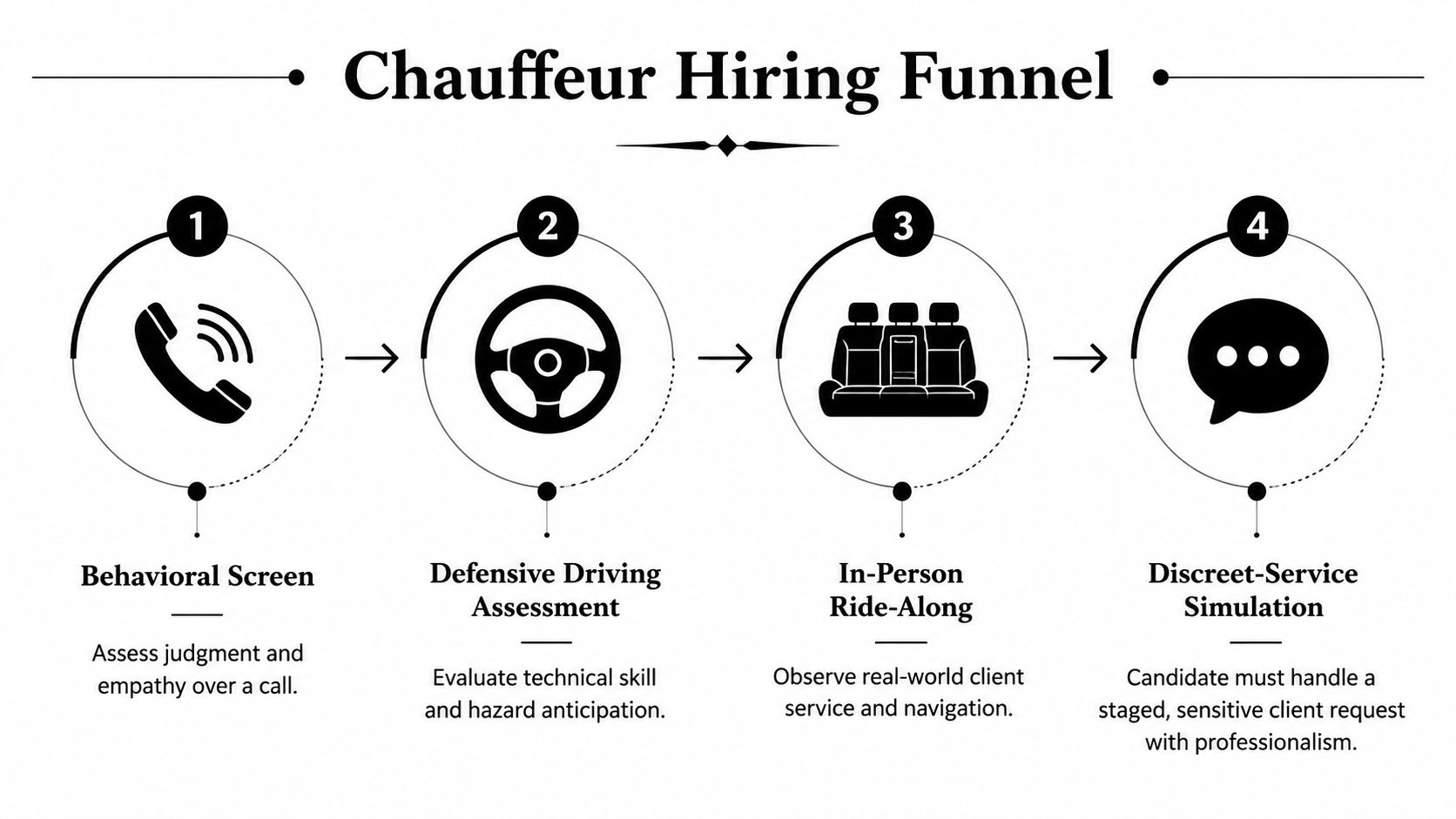
Start with a behavioral phone screen. Ask how the candidate would respond to a delayed executive, an unavailable passenger, a changed terminal, or a client who wants silence. Listen for ownership and sequencing. Candidates who blame the passenger, resist route changes, talk over the client, or treat punctuality as an aspiration rather than a duty should not move forward.
Follow with a defensive-driving assessment, then an in-person ride-along. Observe mirror use, hazard anticipation, braking smoothness, navigation decisions, curb positioning, trunk handling, and whether the candidate keeps attention on the passenger experience while driving safely.
Make onboarding practical
A discreet-service simulation should place the candidate in an unfamiliar sensitive situation. For example, stage a delayed VIP transfer with incomplete information and a demanding travel companion. The candidate should identify the immediate risk, contact dispatch appropriately, protect confidentiality, and speak to the client without dramatizing the disruption.
A 30-day onboarding sequence can be structured as follows:
- Week 1 ride-shadowing: Follow a senior chauffeur and study greetings, vehicle checks, luggage handling, and quiet professionalism.
- Week 2 supervised airport work: Complete solo runs with a mentor reviewing meet-and-greet posture, door timing, terminal awareness, and trunk handling.
- Weeks 3 and 4 dispatch pairing: Work with a senior dispatcher on flight-aware rerouting, status updates, and changes that affect multiple bookings.
- Certification review: Complete a 40-item SOP checklist covering attire, greetings, luggage, amenities, and confidentiality, with every item passed before independent premium assignments.
Training fails when it ends at orientation. Review two KPIs in each monthly coaching session, use ride recordings only with consent, schedule a ride-shadow each quarter, and collect feedback from dispatchers and corporate accounts. Coach one behavior at a time, then verify it on a later trip.
The person behind the wheel remains the largest controllable variable in service delivery. Dispatch software can surface a delay, but it can't decide whether the chauffeur communicates calmly, protects privacy, or takes responsibility for the client's next step.
Airport Corporate and Event Protocols Compared
Airport, corporate, and special-event bookings may look identical on a dispatch screen, but each has a different failure pattern. A chauffeur who uses one script for all three will eventually be early in the wrong place, too conversational with the wrong passenger, or unprepared for a coordinated arrival.
| Dimension | Airport | Corporate | Special Event |
|---|---|---|---|
| Primary priority | Flight awareness and clear terminal coordination | Predictable timing and quiet professionalism | Choreography, presentation, and group control |
| Pre-arrival work | Monitor flight status, confirm terminal, stage near the correct meeting point | Review route, building access, passenger preferences, and schedule sequence | Confirm venue map, staging position, vehicle order, guest list sensitivity, and contact hierarchy |
| Client contact | Hold the sign at the correct carousel or door and guide the traveler | Use a concise greeting, then allow the passenger to set the tone | Follow the agreed arrival script and protect photo-safe positioning |
| Delay response | Track the flight and update the passenger before uncertainty grows | Offer route or timing adjustments without creating noise | Coordinate all affected vehicles through one lead dispatcher |
| In-vehicle behavior | Assist with luggage and help the tired traveler settle | Keep the cabin calm and support work on request | Manage group energy, luggage, stops, and changing instructions |
| Safety and discretion | Verify identity without announcing private details | Protect business conversations and schedules | Apply tighter confidentiality around principals, guest lists, and alcohol-related risks |
Airport service is flight-aware and time-pressured. The chauffeur should know where the passenger is expected to emerge, avoid asking a delayed traveler to explain what dispatch can already see, and maintain a clear plan if the terminal or meeting point changes.
Corporate service prioritizes repeatability. The passenger may need a quiet cabin, a dependable route, and exact curbside timing for a sequence of meetings. Small talk should wait until the client starts it. The chauffeur's job is to create a stable working environment, not to perform hospitality.
Special events reverse the emphasis. The vehicle may need to arrive in a precise order, stop where photographers can work safely, and remain available for changes that occur after the ceremony, concert, or reception. If the principal has been drinking, the escort plan must protect safe travel without embarrassing the passenger. A written protocol lets the chauffeur adjust behavior without waiting for a briefing during a busy event night.
Escalation Workflows That Protect the Client Relationship
Many damaging incidents begin with a minor problem that nobody owns. A vehicle swap, unclear curb location, delayed luggage, or route change becomes a relationship issue when the client has to chase updates or explain the impact repeatedly.
Give every team member permission to escalate
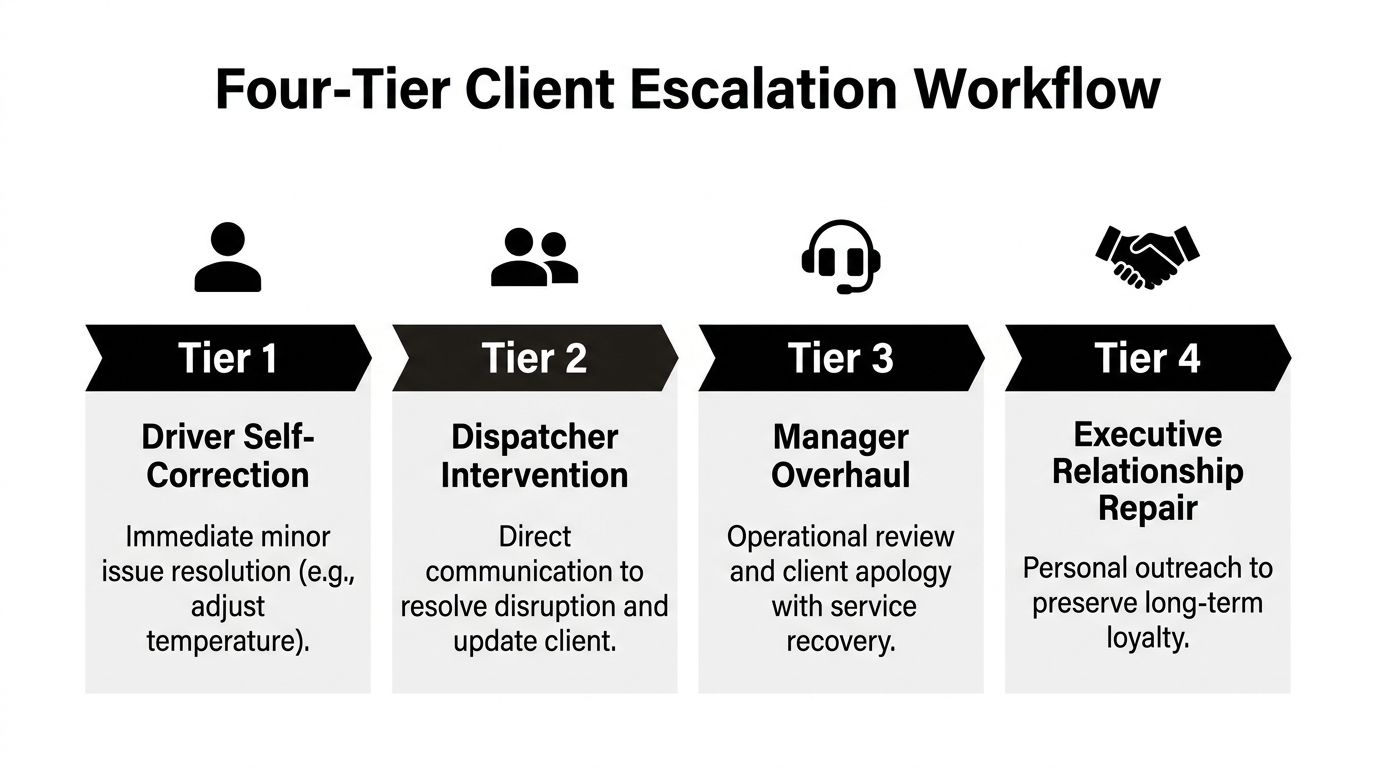
A four-tier model keeps decisions fast and proportional:
- Tier 1, in-moment correction: The chauffeur or dispatcher resolves a minor issue, such as adjusting cabin temperature or correcting a meeting point, then logs it in the trip record.
- Tier 2, dispatcher intervention: The dispatcher contacts the client proactively, ideally within 10 minutes of identifying a meaningful disruption, explains the fix, and records the recovery plan.
- Tier 3, manager recovery: An operations lead contacts the client before the next reservation, owns the root cause, and applies a service credit or upgrade matched to the inconvenience.
- Tier 4, executive relationship repair: An account manager and operations lead meet within 48 hours for incidents involving safety, confidentiality, or a corporate principal.
Consider a Max's Luxury Rides client landing at O'Hare while the assigned sedan is pulled for a mechanical fault. Tier 2 dispatch can send an equivalent SUV within 12 minutes, have the replacement chauffeur call from the staging area, and give the traveler one clear meeting instruction. The operations lead then follows up the next morning with a written explanation and a credit.
The recovery isn't successful because the company hides the problem. It works because the client receives timely information, an equivalent solution, and accountable follow-up. The trip record should capture the original failure, the decision path, the client impact, and the preventive action. That record protects the next passenger from the same mistake and gives managers something more useful than a general reminder to “communicate better.”
The customer should never have to decide which internal department owns the disruption.
Escalation also needs boundaries. A chauffeur shouldn't promise a refund without authority, but they should be able to alert dispatch immediately. A dispatcher shouldn't wait for a manager to approve a safety response. Clear thresholds turn good intentions into repeatable action, especially during overnight airport operations when senior leaders may not be physically present.
A 90-Day Roadmap to Lift Service Quality
A service improvement program doesn't need to rebuild the fleet, replace every system, or overwhelm the team with new forms. Sequence a few high-value changes, verify them in live operations, and let each improvement strengthen the next.
Days 1 to 30 establish the baseline
Capture current on-time performance, complaint frequency, repeat-booking behavior, confirmation response time, and first-contact resolution. Audit booking notes and dispatch handoffs from airport, corporate, and event trips. Ask chauffeurs where information arrives too late and ask dispatchers which client questions require repeated work.
End the first phase with the three highest-friction touchpoints documented in plain language. Examples might include unclear airport meeting points, incomplete vehicle preference notes, or a handoff that leaves a client waiting for a response.
Days 31 to 60 tighten the operating system
Refine the SOP library around those friction points. Standardize pre-arrival checks, confirmation wording, vehicle presentation, and delay messages. Pilot one KPI, such as curbside wait-time variance, with a small chauffeur group before making it a fleet-wide requirement.
Use the pilot to remove bad measurement rather than defend it. If chauffeurs can't tell whether a delay came from the passenger, airport access, or dispatch timing, improve the trip record before using the result for coaching.
Days 61 to 80 rehearse recovery
Introduce the four-tier escalation process, run mystery-ride audits with appropriate privacy safeguards, and begin weekly coaching tied directly to the dashboard. Practice vehicle swaps, terminal changes, late principals, and multi-vehicle event movements during controlled sessions.
Managers should review whether staff can trigger escalation without permission and whether clients receive one consistent message. A recovery plan that works only when the operations lead is present isn't a reliable plan.
Days 81 to 90 consolidate standards
Lock in separate protocols for corporate, airport, and event work. Review trends with dispatch and chauffeur teams, remove measures nobody trusts, and publish the final service standards in the tools employees use every day. Finish by rehearsing the disruption playbook until the team can execute it without supervision.
Customer service excellence grows through disciplined repetition. Measure the baseline, fix the most visible friction, train the behavior, and verify the recovery. That approach gives an operator such as Max's Luxury Rides Inc. a practical way to improve service without losing control of daily operations.
Max's Luxury Rides Inc. provides 24/7 airport transfers, corporate transportation, special-event packages, and group travel using executive sedans, luxury SUVs, Mercedes vans, Sprinters, shuttles, limousines, minibuses, and coaches. Visit Max's Luxury Rides Inc. to review vehicle options and request transportation built around punctuality, communication, discretion, and passenger comfort.