
You've booked the venue, confirmed the guest list, and promised everyone a smooth ride. Then the coach arrives and can't fit through the hotel loading zone. The driver isn't cleared for the airport's commercial staging area. The “all-inclusive” quote suddenly excludes tolls, parking, and gratuity. Your group is ready to move, but the transportation plan is already under pressure.
I've coordinated enough group trips to know that the bus itself is rarely the only problem. Vehicle fit, operational readiness, pricing language, safety controls, and cancellation terms decide whether a booking feels effortless or becomes an expensive emergency. The following framework focuses on the details most booking guides skip, including non-crash injuries, driver-behavior indicators, replacement obligations, and contract traps.
Why Most Group Transportation Bookings Go Wrong
A corporate planner once described a familiar failure pattern to me. She had reserved a coach for an airport transfer based almost entirely on passenger capacity. The bus had enough seats, but its turning radius didn't suit the hotel driveway, the pickup point wasn't approved for commercial vehicles, and the quote treated several trip costs as “additional” without explaining them clearly.
That booking failed on three fronts:
- The vehicle didn't match the route. Seat count says nothing about loading-zone access, luggage volume, low-clearance areas, tight turns, or venue staging rules.
- The price wasn't complete. A low base rate can become much less attractive after tolls, parking, overtime, repositioning, cleaning, and driver expenses appear.
- The operator's credentials weren't verified. A professional-looking website doesn't prove that the carrier owns the vehicle, employs the driver, or has a workable breakdown plan.
Practical rule: A coach bus quote is only useful when it describes the exact vehicle, itinerary, inclusions, exclusions, and backup obligations in writing.
The North American industry is substantial and operationally demanding. In 2023, the United States and Canada had 1,984 motorcoach carriers operating 47,946 motorcoaches, with an average of 24 motorcoaches per carrier, according to the 2024 Motorcoach Census. That structure means many coach bus companies manage multiple vehicles, drivers, maintenance schedules, and dispatch decisions at once. Your booking needs to account for that complexity rather than treating the transaction like a simple vehicle rental.
I evaluate providers in a fixed order: match the group and luggage to the vehicle class, compare the pricing model, verify safety and insurance, map the logistics, then negotiate the contract. Reviews and amenities matter, but they come after the questions that determine whether the right bus and qualified driver will appear at the right place.
Matching Your Group Size to the Right Bus Type
Passenger count is the starting point, not the answer. A group of 22 people can need two very different vehicles depending on luggage, trip duration, accessibility needs, and how much personal space passengers require.
Start with capacity, then subtract real-world demands
Use the vehicle range as a planning guide, not a promise that every seat will be comfortable or practical.
| Vehicle Class | Passenger Range | Luggage Capacity | Best For | Typical Hourly Rate |
|---|---|---|---|---|
| Minibus | 15 to 28 | Limited to moderate | Short transfers, small corporate groups, local outings | Request an itemized quote |
| Mid-size coach | 30 to 40 | Moderate undercarriage storage | Weddings, regional trips, organized shuttles | Request an itemized quote |
| Full-size motorcoach | 45 to 56 | Large undercarriage storage | Airport movements, conferences, long-distance travel | Request an itemized quote |
| Double-decker | 60 to 80 or more | Varies by configuration | Large event circulation and high-volume routes | Request an itemized quote |
The table's rate column should stay open until the operator has the itinerary. Hourly pricing changes with vehicle class, operating area, minimum hours, date, mileage, parking, and staffing. Any provider that offers a confident rate without asking about those details is giving you a rough lead, not a dependable budget.
A 22-person corporate shuttle carrying briefcases and carry-ons may fit comfortably in a minibus. A 22-person wedding party with garment bags, gifts, floral materials, and formal clothing may need a mid-size coach. The extra capacity gives passengers more aisle room and provides better access to undercarriage storage. Booking to the last available seat often creates a miserable ride, even when the operator technically meets the passenger count.
Account for equipment and accessibility
Ask whether anyone will bring wheelchairs, musical instruments, display materials, coolers, sports equipment, samples, or production cases. Also ask whether passengers will board with large luggage at multiple stops. A full coach with empty seats can still be functionally overloaded if the storage plan doesn't work.
ADA requirements need to be discussed at the first inquiry, not the day before departure. Confirm whether the lift-equipped vehicle has an appropriate wheelchair position, securement equipment, and enough space for boarding without disrupting the itinerary. Accessible configurations can reduce vehicle availability because not every coach in a fleet has the same layout.
You also need a written passenger manifest that reflects actual riders. Don't assume you can add “just two more people” after selecting a vehicle. The carrier is responsible for operating within applicable weight and safety limits, and an organizer who pressures a provider to exceed the approved configuration creates an avoidable liability problem.
The right question isn't “How many seats does it have?” It's “What does this group need to carry, how long will it ride, and how will every passenger board safely?”
Amenities should follow the trip. For a long journey, undercarriage luggage space, climate control, reclining seats, power access, and an onboard restroom may matter more than a newer-looking interior. For a short executive transfer, fast loading and reliable staging access are usually more valuable than entertainment features.
Understanding Pricing Models and Hidden Fees
The cheapest quote often wins because buyers compare totals before comparing billing structures. That's backwards. A pricing model determines who carries the risk of traffic, itinerary changes, repositioning, and mileage uncertainty.
Hourly, trip-based, and passenger-based quotes
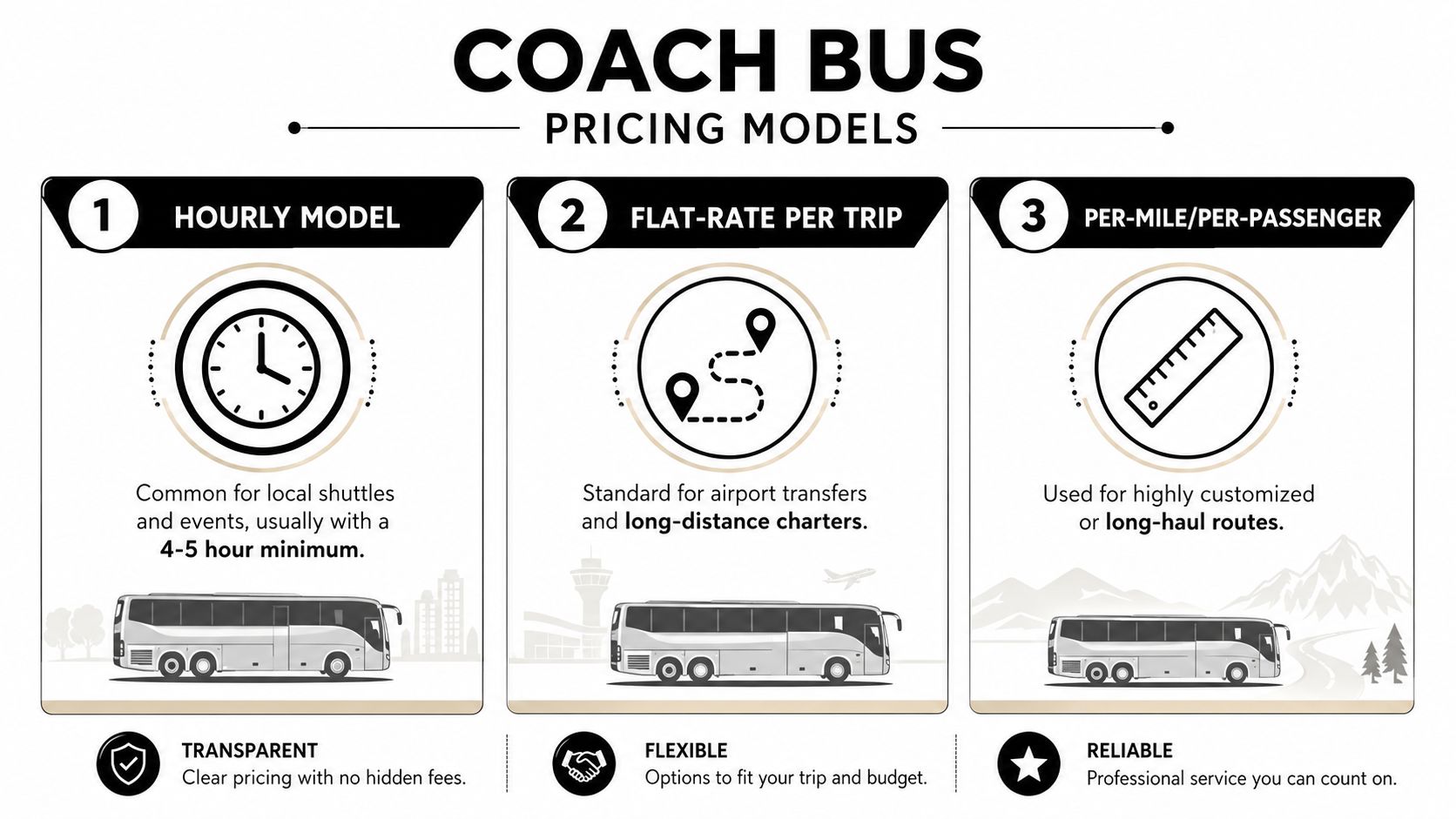
Hourly pricing is common for local shuttles, weddings, conferences, and event circulation. Operators often apply a minimum booking period, commonly described in quotes as a four- to five-hour minimum, but the exact requirement must appear in your proposal. This model works when the bus will remain active at one venue or make repeated short movements. It exposes you to added charges when traffic, delayed speakers, venue congestion, or a late reception pushes the schedule beyond the contracted time.
Flat-rate per trip suits airport transfers and point-to-point service. It gives the buyer a clearer base cost, but check whether the rate includes a mileage limit, wait time, extra stops, tolls, parking, and commercial staging fees. A “flat” price can still contain variable charges.
Per-passenger pricing appears in some recurring shuttle arrangements and customized long-haul services. It can simplify budgeting for a stable route, but it may shift risk to the buyer if the passenger count changes or the operator applies minimum ridership assumptions.
Fees that deserve a written answer
Request each of these items before signing:
- Fuel adjustments: Ask whether the quote includes fuel or permits a later surcharge.
- Driver expenses: Overnight lodging, meals, and lodging taxes may be billed separately on extended trips.
- Tolls and parking: Confirm whether the operator includes them, estimates them, or passes them through at cost.
- Deadhead mileage: Ask whether you're paying for the bus to travel from its garage to your pickup point and back.
- Cleaning charges: Events involving food, drinks, decorations, or large groups may trigger cleaning provisions.
- Overtime: Get the exact trigger, billing increment, and approval process.
Verbal estimates are useful during an initial call, but they don't protect your budget. Ask for an itemized quote attached to the contract, with variable charges capped or tied to receipts. If the provider won't state what happens when traffic adds time, the invoice is not finished.
A useful negotiation sentence is: “Please revise this as an all-in quote and identify every charge that could be added after departure.” If the answer is vague, keep comparing coach bus companies.
Verifying Safety Records and Insurance Coverage
Checking a USDOT number is necessary, but it's only the first screen. A carrier can be properly registered and still fail to answer practical questions about maintenance, driver supervision, passenger movement, or incident response.
Look beyond collision totals
European safety analysis found that 2% of road fatalities in 2022 occurred in crashes involving buses or coaches, compared with 14% involving heavy goods vehicles, but that comparison shouldn't make a group organizer complacent. A coach carries many passengers at once, so safety teams should examine exposure, severity, driver contribution, and passenger handling, not just raw fatality counts. The same European review reported that about 60% of injured bus and coach occupants were hurt in non-crash incidents, including braking events and passenger falls, according to the European Commission's bus and heavy goods vehicle road-safety factsheet.
That changes what you should ask. Does the company train drivers in smooth braking? How does the crew manage boarding, standing passengers, aisle movement, wheelchair securement, and overhead luggage? A carrier that discusses only collision avoidance is overlooking a large part of passenger exposure.
UK analysis found that 84% of bus and coach drivers assigned a contributory factor in police-attended incidents were assigned at least one driver error or reaction factor, as documented in the RoSPA analysis of bus and coach drivers. Ask providers whether they track hard braking, harsh acceleration, speeding alerts, fatigue events, and post-incident coaching. They may not disclose proprietary dashboards, but a serious operator should be able to explain the indicators it monitors.
Use a documented due-diligence sequence
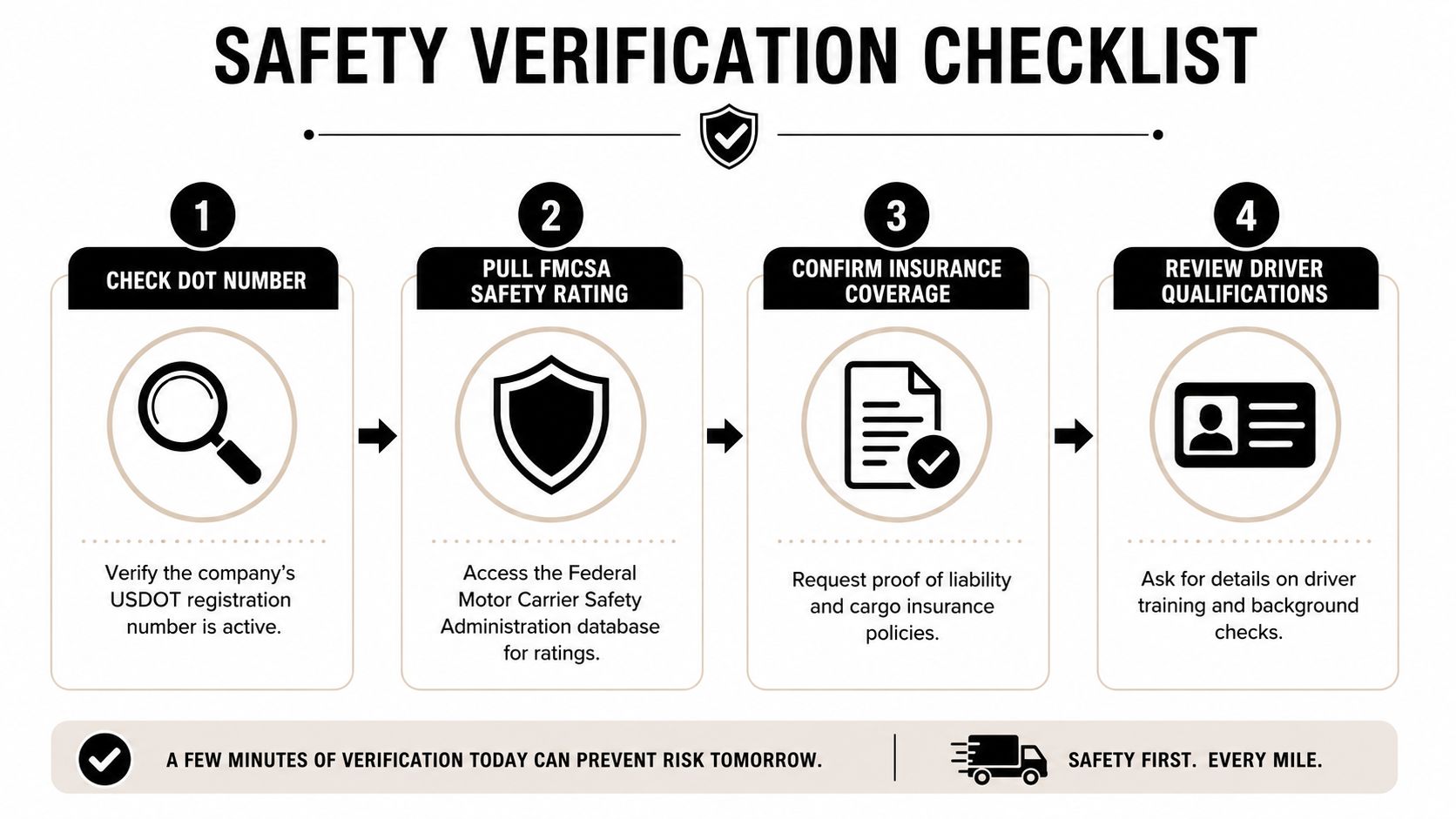
- Confirm the carrier identity. Obtain the legal company name, USDOT number, operating authority details, and the name of the actual transportation provider. Ask directly whether the company owns and operates the coach or is arranging a third party.
- Review the safety record. Use the FMCSA database and evaluate safety ratings before purchase before you treat a polished sales presentation as evidence of operational quality.
- Request insurance documentation. Ask for a current certificate of insurance and policy details covering passenger liability and relevant cargo or property exposure. Have your event risk manager confirm whether additional-insured wording is required.
- Check vehicle controls. Request evidence of preventive maintenance, inspection procedures, pre-trip checks, tire controls, and defect reporting. A refusal to explain the process is a material red flag.
- Ask about driver files. Confirm commercial licensing, passenger endorsements where applicable, qualification reviews, drug and alcohol testing programs, hours-of-service controls, and ongoing training.
- Test the breakdown plan. Get the response process, dispatch contact, escalation path, and replacement expectations in writing.
A provider that can't produce basic documentation, changes the operating company after payment, or refuses to identify the assigned carrier should be removed from consideration. Safety diligence isn't an administrative chore. It's how you find out who will be responsible for your group when the itinerary becomes difficult.
Planning Logistics for Events and Airport Transfers
A coach can be mechanically sound and still fail your event because the schedule assumes perfect traffic, instant boarding, and unrestricted access. Those assumptions don't survive airports, hotels, stadiums, convention centers, or wedding venues.
Build the movement plan around physical constraints
Start with the exact curb, not the street address. Confirm the legal pickup zone, bus-height restrictions, turning space, commercial staging rules, and whether the venue requires a permit or advance registration. Airport transfers need a defined meeting point and a dispatch procedure for passengers who exit at different times.
For a 50-person airport transfer, establish the pickup location, passenger lead, luggage loading procedure, driver contact, and escalation contact before travel day. Give the group a single instruction sheet instead of relying on scattered text messages. The driver should know who can authorize a route change, and the organizer should know who can reach dispatch if the bus is delayed.
Multi-stop events require dwell-time discipline. Every stop needs an arrival window, unloading plan, passenger count check, and departure trigger. If a corporate event uses several venues, don't let one late departure consume the time reserved for later pickups. A dispatch contact should track the vehicle's position and communicate changes to every affected location.
Add buffers where the plan can break
Use the following as planning prompts, not guaranteed universal formulas. The carrier and venue should confirm the actual timing requirements.
| Trip Type | Base Buffer | Peak-Hour Buffer | Key Risk Factor |
|---|---|---|---|
| Airport transfer | Add a modest contingency beyond the planned drive | Increase the contingency when roads or terminals are busy | Curb access, luggage loading, passenger readiness |
| Wedding shuttle | Allow extra time at each hotel and venue | Expand the window around ceremony and reception changes | Formalwear, photography delays, venue congestion |
| Concert or sports event | Schedule early arrival and controlled release | Add more time for road closures and post-event surges | Restricted staging and simultaneous departures |
| Corporate multi-venue event | Build a departure window at every stop | Add protection around keynote and meal transitions | Dwell-time drift and executive schedule changes |
Driver legal rest periods and hours-of-service limits must shape the itinerary. Don't ask a driver to “make up time” by skipping required breaks. If the route is long or spans multiple operating periods, ask the carrier how it will handle driver changeovers and relief coverage.
Your contingency plan should answer four questions: who calls dispatch, who informs passengers, what happens after a breakdown, and how the group reaches the next critical appointment. Get the driver's direct contact before departure, but keep dispatch as the formal escalation channel.
Negotiating Contracts and Cancellation Policies
The contract is where an attractive quote can become a bad deal. Organizers often focus on the deposit and total price, then discover the exposure in cancellation, force majeure, substitution, and delay language.
Three clauses I challenge immediately
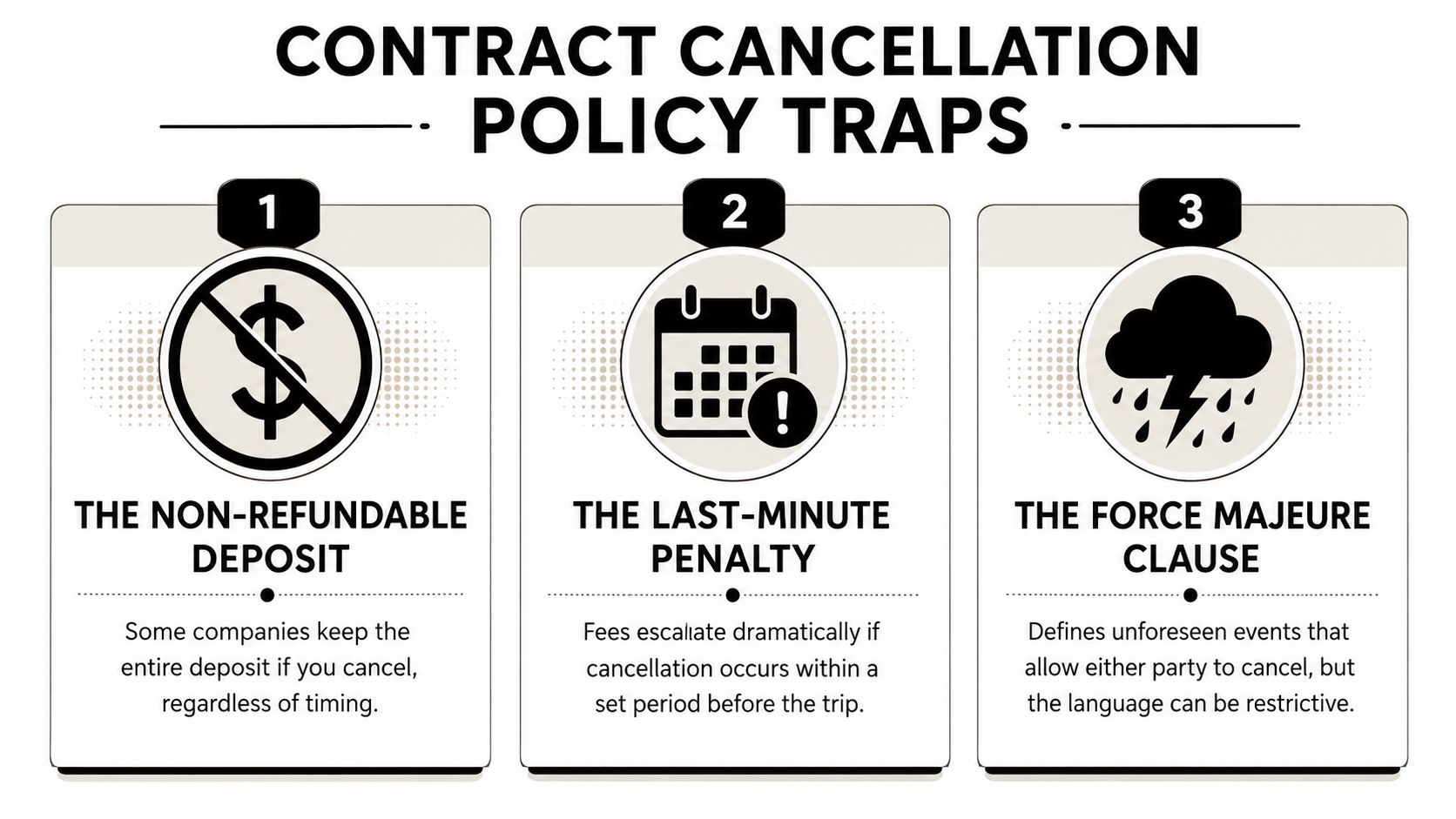
Escalating cancellation penalties can move from a manageable deposit to the entire contract balance well before the trip. Don't accept a schedule you haven't modeled against your venue's own cancellation deadlines.
Force majeure language often sounds balanced but may define qualifying events so narrowly that severe weather, venue closure, road restrictions, or event changes remain your problem. Ask what happens if the transportation service can't legally or safely operate, and whether you receive a refund, credit, or equivalent replacement.
Rebooking and substitution clauses can charge you for changes even when the carrier caused the disruption. The contract should distinguish customer-requested changes from carrier failure, vehicle unavailability, inspection failure, or driver scheduling problems.
Put protection in the agreement
Request a penalty-free cancellation window of 72 hours after signing where the provider's process allows it, then negotiate a reasonable stepped schedule tied to the operator's actual unrecoverable costs. Add language requiring an equivalent replacement vehicle if the assigned coach fails inspection, becomes unavailable, or suffers a mechanical breakdown.
A practical redline might read:
- “Carrier will provide an equivalent or superior replacement vehicle at no additional cost if the assigned vehicle becomes unavailable for a carrier-related reason.”
- “Customer-requested itinerary changes are subject to written approval and a stated fee. Carrier-caused changes will not trigger rebooking fees.”
- “Variable charges require prior written approval or documented third-party receipts.”
- “Customer liability for passenger belongings is limited to the amount required by applicable law and the carrier's documented policy.”
Negotiate off-peak dates, multi-event commitments, or prompt payment in exchange for better cancellation terms, capped overtime, or waived administrative fees. You don't need to win every clause. You need to prevent the clauses that can strand your group or leave you paying for a service you didn't receive.
Your Booking Checklist and Questions to Ask Providers
A reliable booking file should let another organizer understand the trip without calling you. Keep the itinerary, quote, insurance certificate, vehicle assignment, driver contact, payment record, and contract in one shared folder.
Use four checkpoints
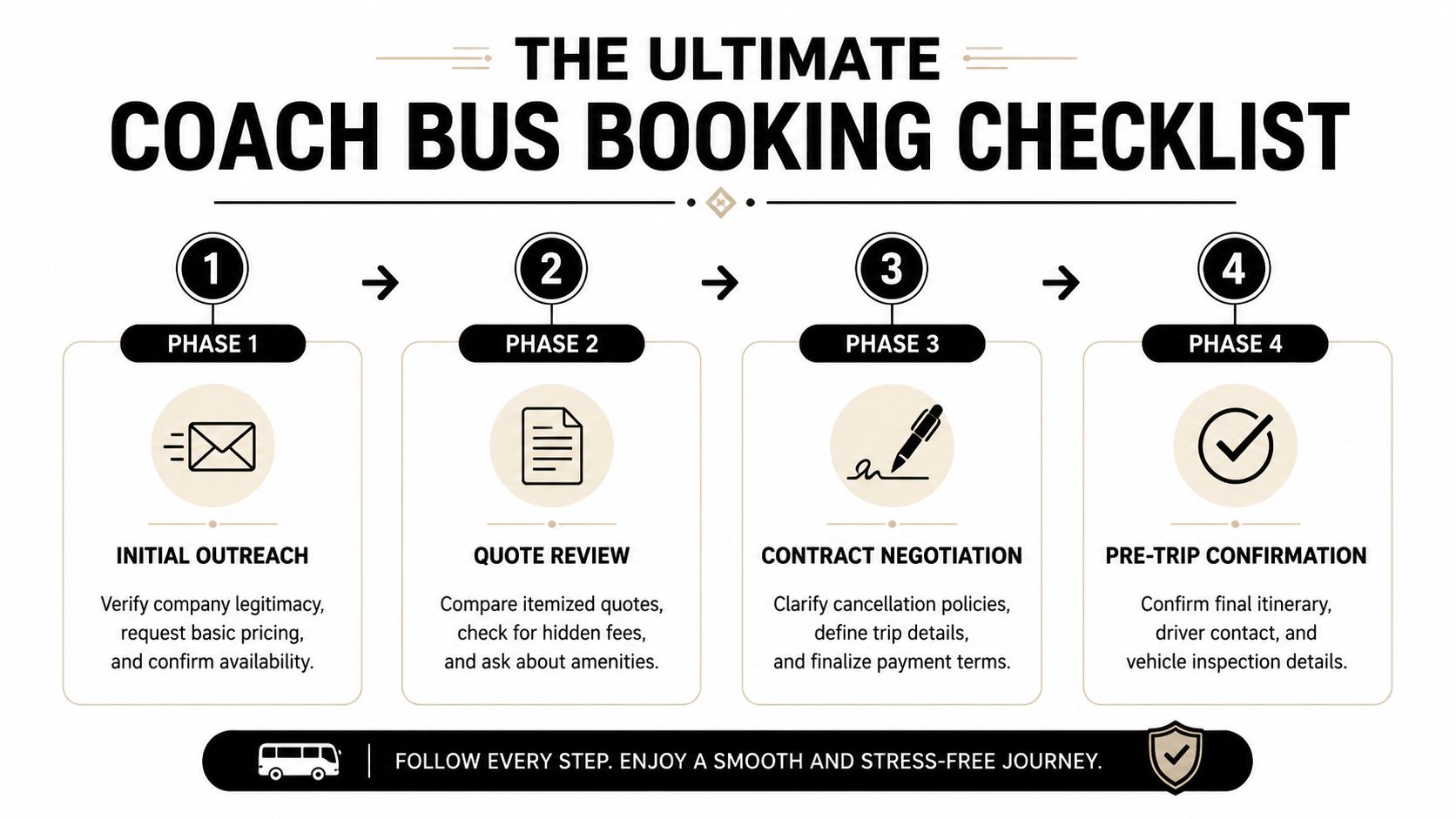
Initial outreach
- Confirm the legal carrier name, USDOT number, service area, and ownership of the vehicle.
- Provide passenger count, luggage, equipment, accessibility needs, dates, stops, and exact locations.
- Ask which vehicle class the provider recommends and why.
Quote review
- Require an itemized total with hours, mileage, overtime, tolls, parking, gratuity, fuel, cleaning, lodging, and deadhead treatment.
- Confirm the actual amenities, not just the fleet's general features.
- Ask whether the quote is for the carrier's own vehicle or a subcontractor.
Contract review
- Mark cancellation, force majeure, substitution, breakdown, delay, damage, and payment provisions.
- Set an approval process for added charges.
- Define equivalent replacement standards and carrier responsibility.
Pre-trip confirmation
- Reconfirm vehicle type, passenger capacity, accessibility setup, pickup instructions, staging permissions, and route restrictions.
- Obtain the driver's name and direct number, plus the dispatch escalation contact.
- Send passengers one final meeting-point instruction with a clear departure time.
Copy and paste these questions
- Which specific vehicle class fits our passenger count, luggage, equipment, and trip duration?
- What is the legal name and USDOT number of the operating carrier?
- Do you own and operate the assigned coach, or will another carrier provide it?
- What hours and miles are included in this quote?
- How do you calculate overtime and deadhead mileage?
- Are tolls, parking, permits, fuel adjustments, gratuity, cleaning, and driver lodging included?
- What passenger and cargo insurance documentation can you provide?
- How do you monitor hard braking, speeding, fatigue, and hours-of-service compliance?
- What procedures cover boarding safety, luggage securement, and wheelchair securement?
- What happens if the assigned coach fails inspection before departure?
- How quickly can you provide an equivalent replacement after a breakdown?
- Can the driver legally and safely complete this itinerary with required rest periods?
- What charges apply if we change a stop or departure time?
- When does the cancellation penalty increase, and what does force majeure cover?
- Who is our single point of contact on the travel day?
Organized questions change the conversation. They signal that you're comparing operational competence, not just shopping for a low number. If you coordinate recurring transportation, score providers after every trip on punctuality, communication, vehicle accuracy, invoice accuracy, driver conduct, and problem resolution. A simple scorecard can turn one successful booking into a dependable vendor relationship. If your organization is beginning to manage multiple carriers, routes, or recurring movements, this guide to first TMS for logistics can help you think through the systems needed to keep those records organized.
Max's Luxury Rides Inc. offers coach buses, minibuses, mini coaches, executive shuttles, Sprinter vehicles, and other group transportation options for airport transfers, corporate travel, weddings, sporting events, concerts, and special occasions. The company operates around the clock, coordinates service for Chicago O'Hare and Midway as well as FBOs and airports worldwide, and provides reservation support for groups that need a clearly managed itinerary.
If you're booking a corporate transfer, wedding shuttle, airport movement, or special event, compare the vehicle, operating plan, safety documentation, and contract before comparing the headline price. Contact Max's Luxury Rides Inc. with your passenger count, luggage needs, locations, and schedule, and ask the team to help build a coach bus plan that protects your group from avoidable delays and surprise charges.