
A 6 p.m. departure has moved to 11:45 p.m. The gate is packed, your phone is nearly dead, and the chauffeur who was supposed to meet you after landing now appears to be scheduled for a completely different evening. One announcement has created several immediate problems: whether to rebook, whether the airline owes you dinner, how to reach your hotel, and what happens to the meeting waiting at the other end.
That's why flight delay protection should never be treated as a single policy or a reassuring badge on a booking confirmation. Real protection combines money back for qualifying costs, care during the wait, and transportation from the airport to your final destination. The following guidance is the practical playbook to use before departure, during the disruption, and after you land.
What a Delayed Flight Really Feels Like
The first mistake travelers make is treating a delay as one problem. It's a chain reaction. A late departure changes your connection, your hotel arrival, your airport pickup, your meal plans, and sometimes an entire business day.
Start with the facts on the airline's app and at the gate. Confirm the revised departure time, check whether the aircraft has changed, and ask staff for the official reason. A mechanical issue, severe weather event, air-traffic restriction, and crew problem may trigger different airline commitments or insurance outcomes.
Then protect the decisions that become harder to reverse:
- Secure the next viable flight: If your connection is at risk, investigate alternatives immediately instead of waiting for the gate queue to shrink.
- Record the delay: Save app notifications, boarding passes, emails, and any written confirmation from the airline.
- Reset the ground plan: Contact your hotel, meeting host, and airport transportation provider before the original arrival window passes.
- Separate covered costs: Keep meals, accommodation, local transportation, and replacement-ticket expenses distinct from ordinary trip spending.
Practical rule: A delay becomes expensive when travelers lose control of the next decision. Document first, communicate early, and preserve options.
Care during the wait is only one layer. The airline may provide food, rebooking, or accommodation depending on the route, cause, and applicable law. A travel policy or card benefit may reimburse expenses later, but reimbursement usually depends on eligibility and documentation. Neither layer automatically guarantees that a vehicle will still be waiting when you finally reach the arrivals curb.
The complete view is simple. Financial protection helps absorb qualifying expenses. Airline assistance helps you continue the journey. Recovery logistics gets you from the airport to the hotel, office, residence, or event venue after the schedule changes. A useful delay plan accounts for all three before the gate announcement arrives.
Defining Flight Delay Protection
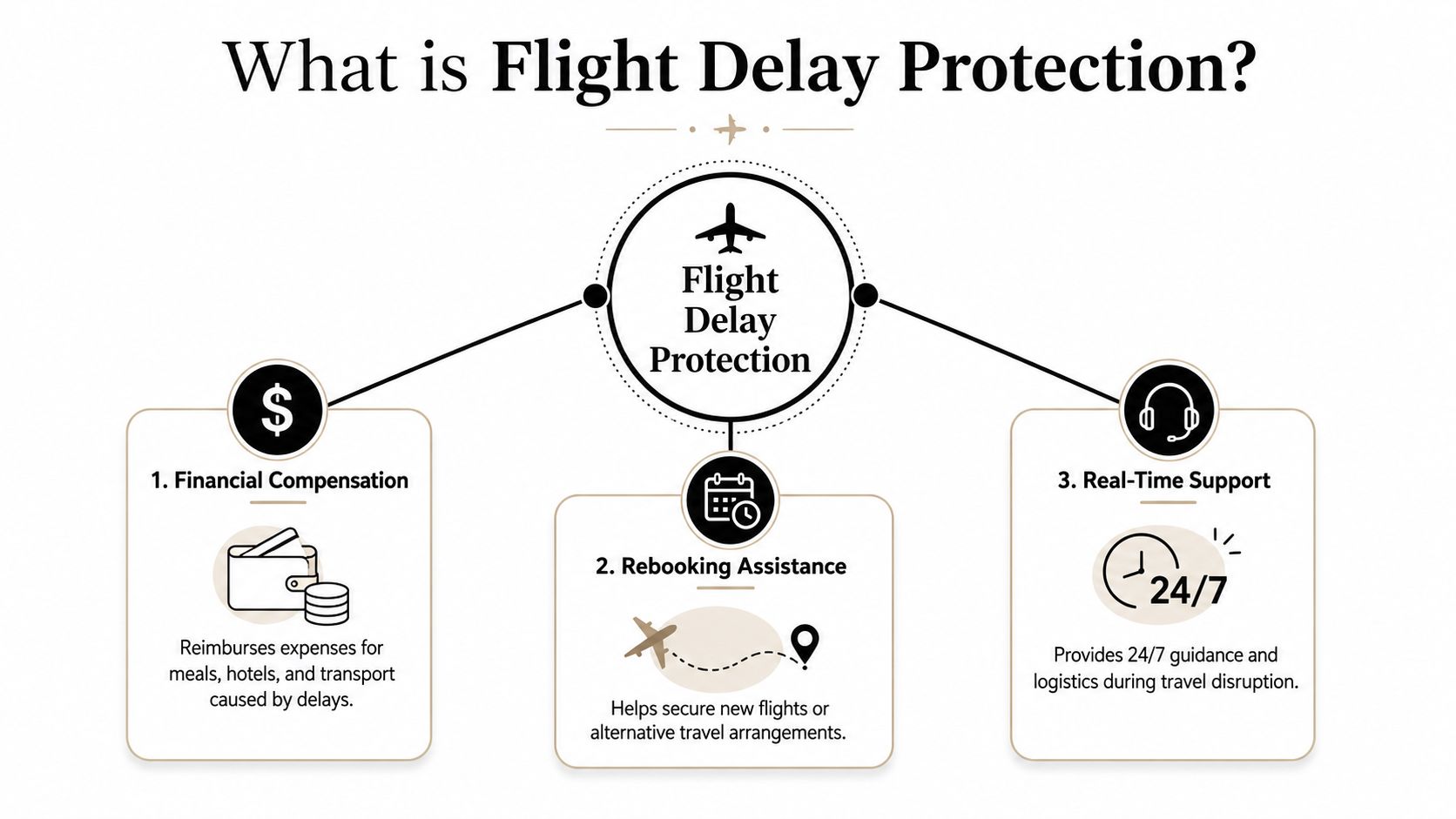
Flight delay protection is a set of financial, service, and logistical arrangements that helps a traveler manage the consequences of a delayed flight. It isn't limited to compensation, and it shouldn't be confused with a promise that every expense will be paid.
The first function is financial. Depending on the applicable airline rules, insurance contract, or card benefit, protection may help with qualifying meals, lodging, replacement transportation, or other necessary expenses caused by the disruption. The second function is care and assistance. That includes practical help such as rebooking guidance, meal support, hotel arrangements, and communication while you wait.
The third function is recovery logistics. Once the airline has moved your arrival time, someone still needs to coordinate the final transfer. A reliable ground provider should know whether the flight is late, canceled, diverted, or operating on a revised schedule, and its pickup rules should be clear before the vehicle is dispatched.
Protection is a stack, not a product
Travelers often use “protection” to describe several different arrangements:
- Airline obligations: These arise from the carrier's policy, fare conditions, or passenger-rights law.
- Travel insurance: This may reimburse qualifying delay expenses, missed-connection costs, interruption losses, or other covered events.
- Credit-card benefits: These can provide secondary reimbursement or travel assistance when the eligible fare was purchased with the card.
- Ground-transport policies: These determine whether a chauffeur tracks the flight, adjusts pickup time, waits through a delay, or charges for a changed itinerary.
Trip cancellation insurance belongs in a different category. Cancellation generally concerns abandoning a trip before departure for a covered reason. Delay protection concerns disruption during travel, although a delay can later contribute to interruption or missed-connection claims.
Airline customer service also isn't the same as contractual protection. An agent may show flexibility, but discretionary help can vary by carrier, airport, cause, fare, and availability. A working definition to remember is this: flight delay protection is the combined system that limits financial loss, provides assistance during the disruption, and preserves the journey after landing.
The Three Main Types of Protection
The right choice depends less on the product label than on the consequence of failure. A short domestic trip with flexible meetings needs a different arrangement from an international itinerary tied to a wedding, cruise, or executive presentation.
Airline protections
Airline assistance is the first resource because the carrier controls the reservation. In the United States, airlines aren't generally required by federal law to pay cash compensation for ordinary delays. Voluntary commitments may still cover meals, rebooking, or a hotel for lengthy disruptions caused by factors within the airline's control, but the offer can depend on the carrier and circumstances.
European rules provide a more standardized framework. Under Regulation (EC) No 261/2004 and the European Parliament's passenger-rights summary, travelers may receive care and assistance after 2, 3, or 4 hours, depending on flight distance, reimbursement after a 5-hour delay, and cash compensation when arrival is 3 hours late or more in qualifying cases. The fixed compensation scale is €250, €400, or €600, based on flight distance and qualifying conditions.
Airline protection is strongest for immediate rebooking and basic care. It's weaker when you need reimbursement for downstream business losses, premium ground transport, or costs the carrier says weren't its responsibility.
Travel insurance
Travel insurance fills gaps, but only when the plan's trigger, covered cause, exclusions, and expense rules match the event. Standard delay benefits commonly focus on reasonable meals, lodging, and local transport after the policy's waiting period. Missed-connection and interruption benefits may address the larger cascade, such as reaching a tour, cruise, or prepaid accommodation after the original connection is lost.
“Cancel for any reason” is not a substitute for delay coverage. It may offer broader cancellation flexibility before departure, while a delay rider addresses qualifying expenses after the journey has begun. Read the policy before purchase, particularly the definition of a covered delay and the requirement for receipts.
Credit-card benefits
A premium travel card can provide useful secondary protection when the common-carrier fare was paid with that card. Benefits may include delay reimbursement, lounge access, concierge assistance, or help locating alternative arrangements. The card's guide to benefits controls, not the marketing summary.
| Source | Trigger | Typical Benefits | Payout Form | Best For |
|---|---|---|---|---|
| Airline | Delay, cancellation, or disruption under carrier rules or applicable passenger-rights law | Rebooking, meals, accommodation, reimbursement, or statutory compensation where applicable | Voucher, direct airline service, reimbursement, or compensation | Travelers who need immediate control of the reservation |
| Travel insurance | Covered cause plus the policy's stated delay threshold | Meals, lodging, local transport, missed connections, and interruption expenses | Reimbursement after a claim | International, complex, or expensive itineraries |
| Credit card | Eligible common-carrier purchase plus the card's delay conditions | Secondary expense reimbursement and travel assistance | Reimbursement or card service | Travelers who already have qualifying card coverage |
For a short domestic hop, airline support and a strong card benefit may be enough. For international travel, add insurance after checking the exclusions. For high-stakes business travel, prioritize rapid rebooking and a ground provider that can adapt after the airline changes the arrival plan.
Coverage Limits and the Claims Process
A protection plan pays only inside its rules. The delay length, cause, route, purchase method, covered expense, and filing procedure all matter.
The clearest operational thresholds come from passenger-rights rules. The UK Civil Aviation Authority's delay guidance states that care becomes available after at least 2 hours for flights under 1,500 km, 3 hours for flights between 1,500 and 3,500 km, and 4 hours for flights over 3,500 km. The same guidance reflects the importance of separating a care threshold from a compensation threshold.
In the United States, the Bureau of Transportation Statistics flight-delay data uses a 15-minute cutoff for on-time reporting. That's a useful warning signal, not a payout trigger. Cause classification matters too. The cited BTS dataset attributes 21.90% of delayed flights to weather, while European aviation data for 2023 identified airline-related delays as averaging 4.5 minutes per flight, airport restrictions 1.8 minutes, local weather 1.2 minutes, and government procedures 0.4 minutes per flight. These figures show why a claim cannot rely on the word “delayed” alone.
The claim file you should build
Use a disciplined sequence:
- Get the airline record. Request written confirmation of the delay, cancellation, diversion, and stated cause.
- Preserve the itinerary. Keep the original ticket, boarding pass, booking confirmation, rebooking notice, and final arrival record.
- Separate expenses. Photograph itemized receipts for meals, hotel, local transportation, essentials, and replacement travel.
- Check duplicate recovery. Don't claim the same expense from the airline, insurer, and card provider if one party already paid it.
- Submit promptly. Follow the specific deadline in the applicable airline, insurance, or card terms.
- Escalate with a record. If a valid claim stalls, keep copies of correspondence and use the relevant regulator, insurer appeal process, or consumer complaint channel.
| Protection Type | Typical Delay Threshold | Maximum Coverage | Covered Expenses | Filing Deadline |
|---|---|---|---|---|
| Airline assistance | Route and applicable rule dependent, with care thresholds beginning at 2, 3, or 4 hours in the CAA framework | Depends on the applicable law or carrier commitment | Meals, care, rerouting, reimbursement, and compensation where qualifying | Follow the carrier or governing rule |
| Travel insurance | Policy dependent | Policy dependent | Qualifying meals, lodging, local transport, missed connections, and interruption costs | Follow the policy wording |
| Credit card | Card benefit dependent | Card benefit dependent | Eligible delay-related expenses under the card guide | Follow the card benefit terms |
The documents passengers forget most often are the official cause confirmation, proof of payment, unused hotel or ticket records, and evidence that the airline did not already provide the claimed item. Save them before leaving the airport.
Practical Steps When Your Flight Is Delayed
Use the clock as your operating system. A delay feels chaotic because every decision arrives at once. Assign each action to a time window and you'll protect both your options and your claim.
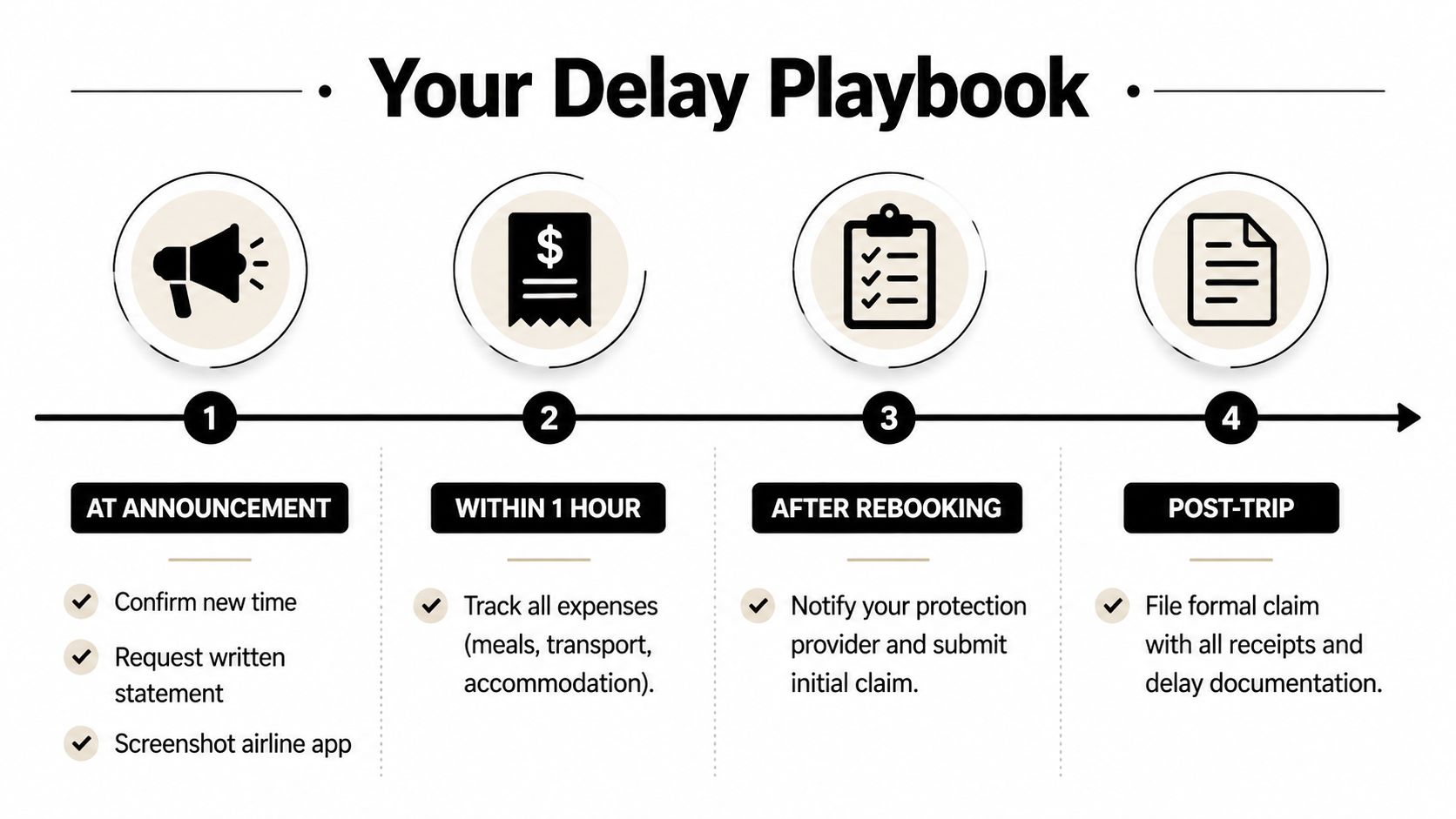
At the announcement
Confirm the revised departure and arrival times. Ask whether the delay is mechanical, weather-related, air-traffic-related, crew-related, or still under investigation. Screenshot the airline app, photograph the board if useful, and request written confirmation.
If a connection is threatened, begin looking at alternatives immediately. Travelers with status, flexible fares, or access to an airline app often move faster by investigating available seats themselves, then asking an agent to process the selected option.
During the wait
Within the early part of the disruption, alert the hotel, meeting contact, event organizer, and transportation provider. Don't wait until boarding resumes. A short message that states the revised arrival estimate and promises another update is more useful than silence.
At the applicable care threshold, request meal assistance and use eligible lounge access. Keep receipts for anything you pay personally, even if the purchase seems too small to matter. The ground transportation arrangements you made for arrival should also be reviewed at this point, especially if the pickup depends on a fixed flight number or a narrow arrival window.
After several hours, reassess the entire itinerary. Decide whether the connection, hotel night, meeting, or event remains viable. If the delay could extend overnight, contact the insurer or card-benefits administrator before making expensive choices, unless waiting would leave you stranded.
After landing
Save the final arrival time and file the relevant airline, insurance, or card claim while the timeline is fresh. Follow up with a concise record of the original schedule, actual arrival, cause, expenses, and prior communications.
Don't assume self-rebooking is automatically reimbursable. Get approval where the terms require it, and choose a reasonable alternative that preserves the trip rather than upgrading without a documented need.
How Max's Luxury Rides Supports Disrupted Travelers
Ground transportation is where many delay plans fall short. The airline may eventually place you on another flight, and an insurer may later reimburse an eligible expense, but neither action guarantees that the vehicle at the destination will adjust with you.
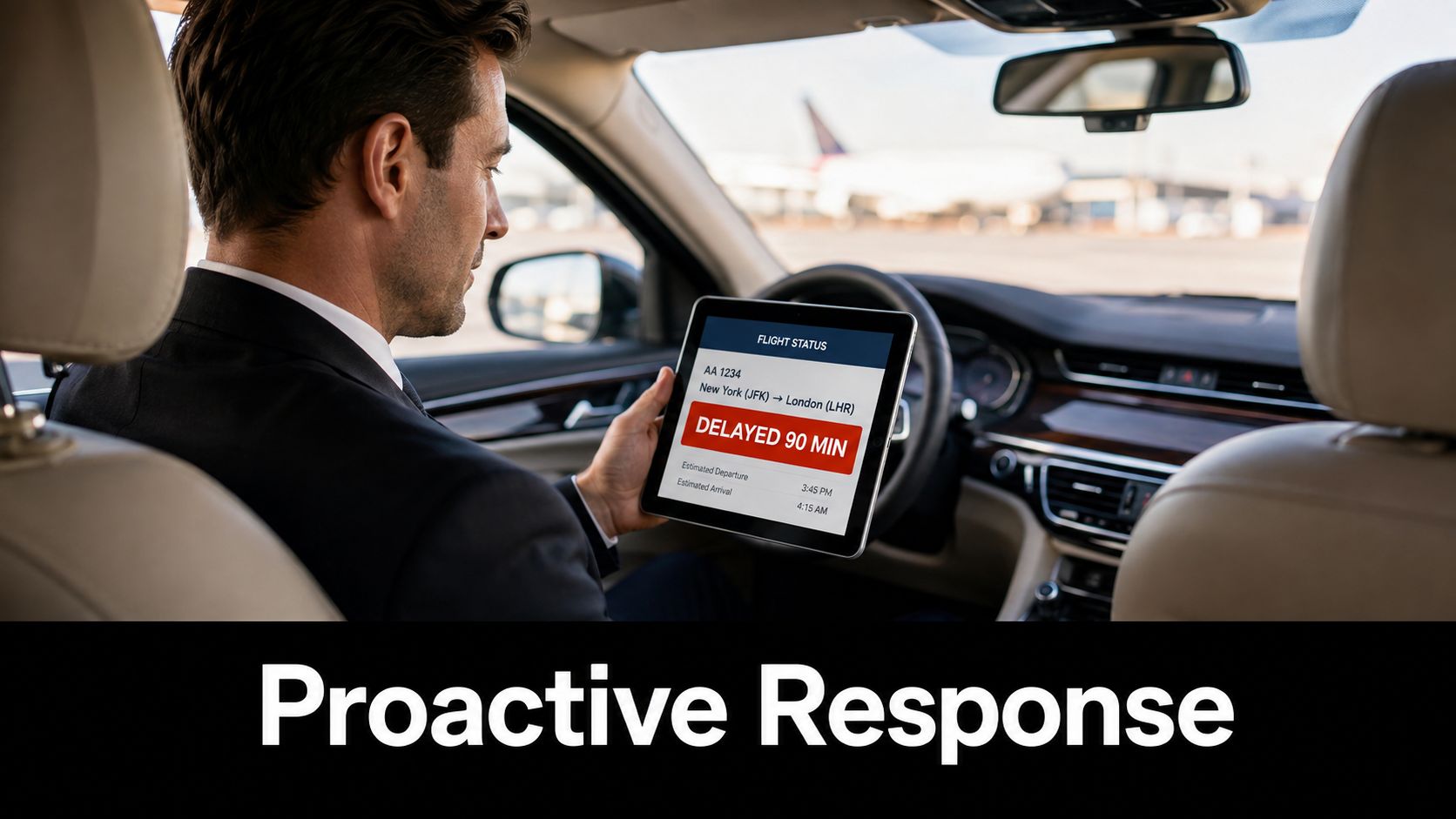
Consider a 90-minute mechanical delay. Max's Luxury Rides monitors the incoming flight against the original pickup window, sends the passenger a text update, and holds the chauffeur at no charge for up to 60 minutes under the described disruption policy. The passenger isn't left guessing whether the driver has departed or whether a new reservation is required.
A more difficult case involves a 4-hour overnight delay and a missed late-night arrival. Dispatch can contact the passenger, propose a later pickup, reschedule without cancellation fees, and offer a daytime airport-to-hotel transfer at the original rate. That approach keeps the ground plan connected to the actual itinerary instead of treating the initial booking time as immutable.
A diversion requires a different response. If the aircraft lands at a nearby alternate airport, dispatch reroutes the assigned vehicle, confirms the new curb location by SMS, and adjusts the route while preserving the original fare quote. The traveler still needs to verify whether the airline or insurer will cover the added ground expense, but the immediate transportation problem has an owner.
The useful feature isn't a vague promise of flexibility. It's the communication cadence: flight-status alerts at each change, one point of contact rather than a call-center queue, and a no-questions-held approach to wait time when the disruption is airline-caused. For travelers managing executive arrivals, family transfers, wedding schedules, or event transportation, that continuity matters as much as reimbursement.
Here's a short visual reference for how disrupted business travel can be managed in real time:
Before departure, confirm the 24/7 booking line, disruption mailbox, pickup location, passenger mobile number, and flight number. Those details give dispatch the information needed to act when the itinerary changes.
Matching Protection to Your Travel Style
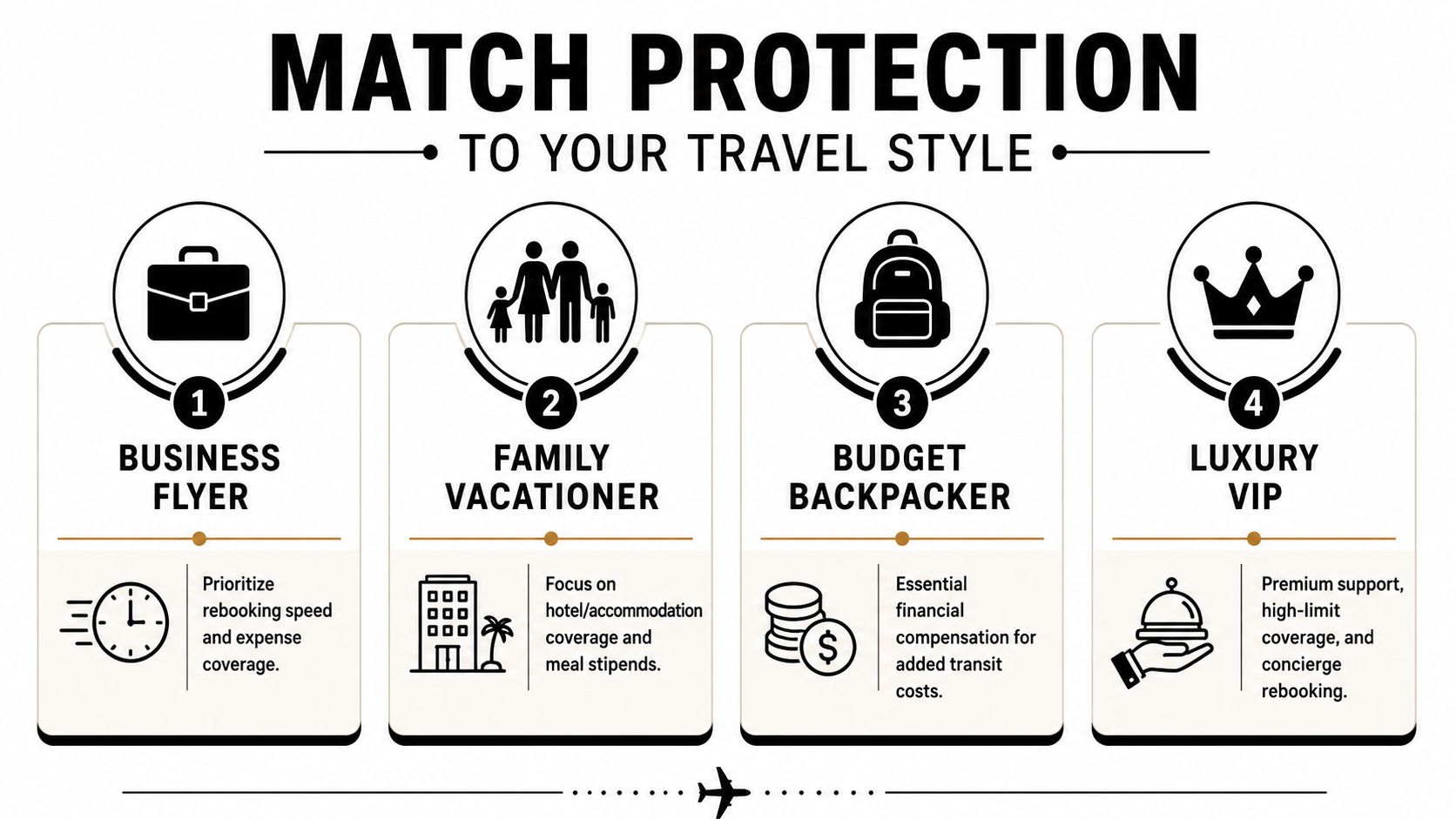
A frequent business flyer should buy for speed. Use airline status or a flexible fare for faster rebooking, review credit-card delay benefits, and add insurance when a missed connection could disrupt a paid engagement or nonrefundable plan. Arrange ground transport that tracks the flight rather than relying on a fixed pickup time.
A family vacation needs cost control and simple support. Prioritize a policy that addresses accommodation, meals, local transportation, and missed connections. A card benefit may serve as backup, but confirm whether every traveler and every fare is covered.
A budget backpacker should avoid paying for overlapping benefits. Check the airline rules, card protection, and insurance exclusions first. The useful coverage is the layer that handles necessary alternative transit and basic delay expenses without imposing a premium that outweighs the trip's financial exposure.
Luxury and VIP travel demands continuity. High-limit coverage, concierge rebooking, airline status, and a chauffeur partner that can monitor arrivals create a stronger operational chain. The vehicle is not an accessory when a late arrival affects a private meeting, event entrance, or secure hotel transfer.
Use this pre-trip checklist:
- Review the policy: Confirm triggers, covered causes, exclusions, reimbursement limits, and claim procedures.
- Download the tools: Keep the airline app, insurer contact details, card-benefits guide, and transport contact available offline.
- Scan the documents: Save tickets, IDs, hotel confirmations, policy details, and receipts in a secure folder.
- Confirm the pickup: Verify the flight number, terminal, curb instructions, passenger phone, and disruption contact.
- Plan the escalation: Know who handles rebooking, who handles reimbursement, and who handles the final transfer.
Stacking works best when each layer has a distinct job. Insurance is the financial safety net, card benefits are the backup, airline status is the speed booster, and dependable ground transportation is the logistics equalizer.
Max's Luxury Rides Inc. provides 24/7 airport transfers, corporate transportation, group vehicles, and flight-aware pickup coordination for travelers whose arrival plans change. Review your next itinerary and contact Max's Luxury Rides Inc. to arrange ground transportation that stays connected to the flight, not just the original booking time.