
A standard stretch limo seats 6–10 passengers, with 8 as the comfort sweet spot. Super-stretches and SUV stretches can reach 14–20 passengers, but advertised numbers often overstate what fits comfortably once luggage, formalwear, and event gear enter the cabin.
You're probably asking because the group count looks close to a vehicle's advertised capacity. A wedding party of twelve is debating whether one limo will work. Eight prom guests want room for dresses, tuxedos, and personal bags. A corporate team of fifteen is trying to avoid splitting an airport transfer between multiple vehicles.
The answer depends on more than the number printed on a booking page. Vehicle model, interior layout, legally recognized seating positions, luggage, and comfort all affect the decision. A “ten-passenger stretch” may legally provide ten positions while feeling crowded with eight adults and their belongings.
This guide gives you practical breakpoints by vehicle class and group size. My advice is simple: book for the way the ride will feel, not for the largest number a salesperson can place beside the vehicle name.
Planning a Group Ride and Wondering What Fits
Start with the exact passenger count, then describe what each passenger is bringing. A wedding party of eight in everyday clothing is a different load from eight people wearing formal attire, carrying garment bags, gifts, flowers, and personal items. An airport group with eight passengers and rolling luggage creates a different problem again.
The standard market range is 6–10 passengers for a traditional stretch limousine, while larger SUV stretches can carry 10–20 passengers, depending on the build and layout, as explained in this stretch limousine capacity guide. Those figures describe a category, not one universal vehicle. A classic sedan stretch, a Chrysler-style stretch, and an SUV conversion may all be marketed as limousines while offering very different cabins.
Use the comfort number first
For most classic stretch limousines, treat 8 passengers as the practical target. Treat 10 as a maximum that requires confirmation, especially when the group has luggage, bulky clothing, beverage service, or equipment. An industry discussion cited in the same capacity reference notes that a “ten-passenger” vehicle may realistically feel comfortable for roughly 7–8 passengers behind the partition, particularly when the cabin carries additional items.
Practical rule: The number on the website is usually the advertised or legal maximum. Ask the operator for the comfortable passenger count for your specific trip.
If your group is larger than the comfort range, don't solve the problem by squeezing harder. Move into an SUV stretch, Sprinter-style vehicle, party bus, or another larger class that gives the group usable space.
Make the booking conversation specific
Ask for the exact make, model, seating layout, and insured seating-position count. Then tell the operator whether the ride is for a wedding, prom, corporate transfer, airport pickup, or night out. That context lets the dispatcher recommend a vehicle based on the actual load instead of matching a headcount to a marketing label.
Standard Stretch Limo Capacity by Model
The phrase “stretch limo” covers several vehicle families. The original sedan conversions sit at the smaller end of the category, while extended SUV and super-stretch builds add length, seating positions, and often a different operating classification.
A traditional stretch limousine commonly falls within the 6–10 passenger range. Many classic models use 8 passengers as the common benchmark, while some Lincoln Town Car stretches and Chrysler-style stretches are marketed for 10. Larger SUV stretches can reach 10–20 passengers, but their interior arrangement and legal limits must be checked for the specific vehicle and jurisdiction. These ranges are summarized in the limousine seating overview from 110 Limo.
| Model / Class | Advertised Capacity | Comfort Capacity |
|---|---|---|
| Classic sedan stretch | 6–8 | 6–8 |
| Lincoln Town Car stretch | 8–10 | 7–8 |
| Chrysler-style stretch | 8–12 | Confirm layout before booking |
| Larger SUV stretch | 10–20 | Depends on cabin configuration |
| Super-stretch limousine | 14–20 | Best suited to larger groups |
What the model names tell you
A classic Lincoln or Chrysler stretch usually serves small groups that want a private luxury cabin without moving into a bus-style vehicle. An eight-passenger configuration is often the sensible choice for weddings, proms, and corporate outings where comfort matters more than filling every position.
A super-stretch adds substantial body length and can create room for a much larger group. That doesn't mean every super-stretch provides the same usable space. Door placement, bench depth, seat width, partition position, and the conversion design determine whether the extra length becomes practical seating or mostly becomes additional interior and amenity space.
An SUV stretch changes the experience again. It may offer a broader cabin and a more open feel than a sedan conversion, which makes it a stronger choice for groups that want more room to move or need to carry event items. Ask whether the stated capacity includes the chauffeur, because local definitions can treat the driver differently.
Ask the right fleet question
Don't ask, “How many people fit in a stretch limo?” Ask, “What exact vehicle will you send, how many passengers can sit in its installed positions, and how many adults do you recommend with our luggage?” That wording forces the company to address the actual vehicle rather than quote a generic fleet range.
Where Advertised Capacity Meets Real Comfort
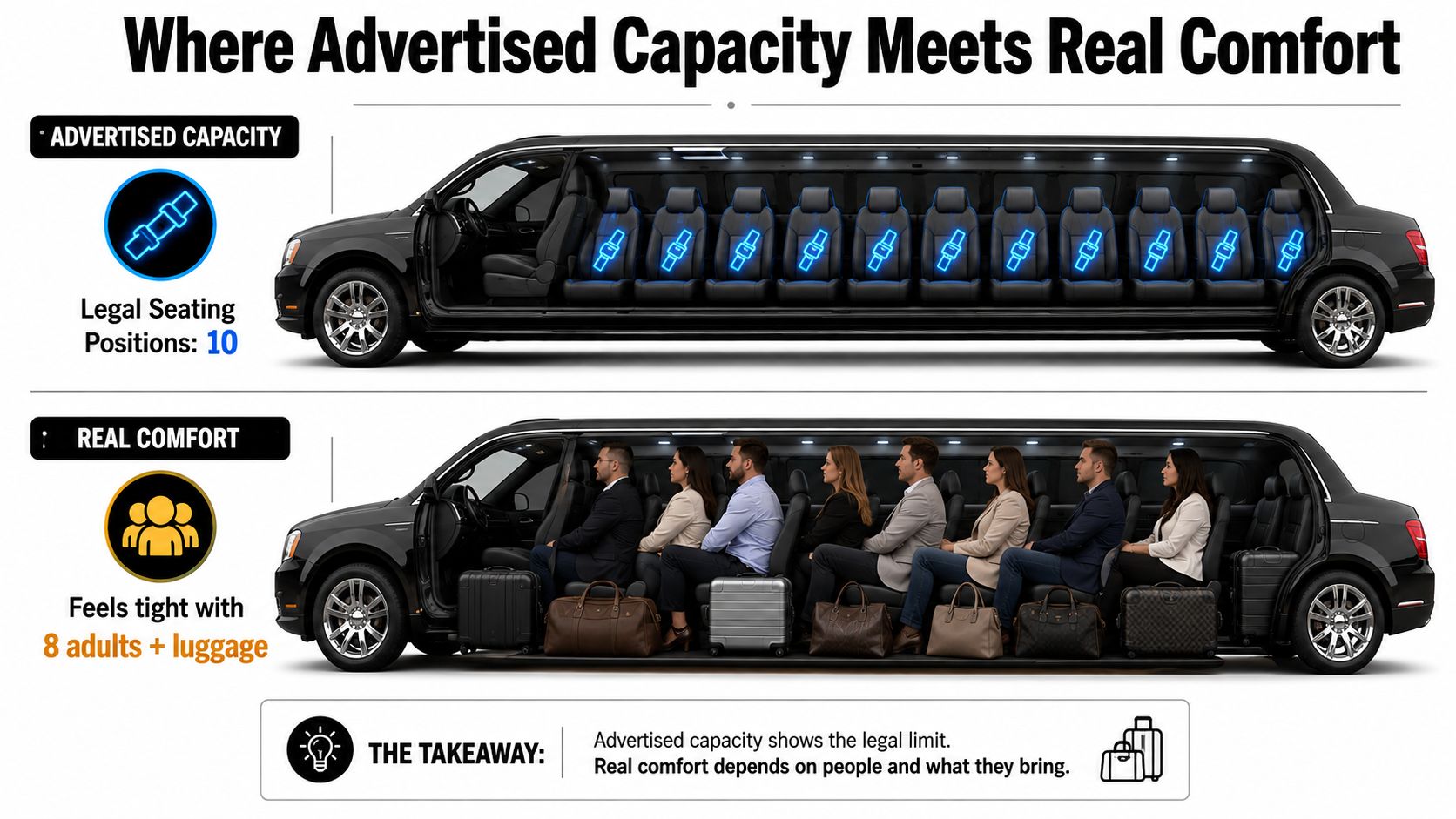
A capacity rating counts recognized seating positions. It doesn't measure how relaxed the cabin feels after passengers sit down with coats, handbags, formalwear, or a cooler. The distinction matters because seat width and interior geometry can limit practical occupancy even when the exterior body appears long enough.
Michigan provides a clear example. Its regulations use 14 inches per seating position under 49 CFR § 571.10, and Michigan treats vehicles with 8 passengers or fewer as limousines, while 9 or more passengers moves the vehicle into bus regulation, according to the state's bus and limousine frequently asked questions.
The eight-passenger reality check
For a classic sedan stretch, 7–8 passengers is the range I'd recommend when the group wants a comfortable ride. People can sit without constantly negotiating elbow space, conversations remain easier, and the cabin still has a chance of handling modest personal items.
At the advertised maximum, the experience changes. Jackets may end up on laps, larger passengers may lose usable shoulder room, and any luggage or beverage equipment competes with the seating area. The vehicle may still be compliant, but compliance isn't the same as comfort.
Capacity is a legal and construction question. Comfort is a passenger-experience question. You need both answers before you reserve.
California caps limousines at no more than 10 passengers including the driver, while Oklahoma City defines a limousine as a stretched or late-model luxury vehicle with seating for at least 5 and no more than 15 passengers. The difference, documented in the Oklahoma City municipal code, shows why a fleet website can't answer the legal question by itself.
How Luggage and Gear Shrink Your Effective Seating
Luggage turns a borderline booking into an uncomfortable one quickly. A stretch limo may have a long passenger cabin, but that doesn't mean it has a large cargo compartment. When bags don't fit in the trunk, they take floor space, bench space, or the area beside passengers.
Use this planning method:
- Count every passenger. Include children and anyone joining for only part of the route.
- List the cargo. Include rolling bags, garment bags, handbags, coolers, gifts, flowers, boxes, and equipment.
- Separate trunk items from cabin items. Ask the operator what the actual vehicle can carry without placing gear beside passengers.
- Reduce the comfort count when cargo takes a seat-equivalent amount of space.
A party of eight may be a good fit for a standard stretch when everyone carries only a small personal item. The same eight can feel cramped when the trip includes airport luggage, wedding attire, prom dress packaging, or beverage containers. The capacity guidance from Elegant Limo Service NYC also emphasizes that a vehicle suitable for a party group may handle fewer passengers on an airport run because luggage consumes the available space.
| Vehicle | Advertised Seats | With Full Luggage | With Luggage + Attire/Gear |
|---|---|---|---|
| Classic sedan stretch | 6–8 | Fewer usable seats | Confirm a smaller comfort group |
| Ten-passenger stretch | 10 | Below advertised comfort | Can become a poor fit |
| SUV stretch | 10–20 | More flexible | Depends on configuration |
| Sprinter-style vehicle | Larger group format | Often better for cargo | Confirm installed seating and storage |
Apply the cargo test
For an airport transfer, tell the operator the number and type of bags, not just “we have luggage.” For a wedding, mention dress volume, garment bags, bouquets, gifts, and any items that must remain upright. For a corporate group, identify presentation cases, sample bags, and rolling equipment.
Booking formula: Count passengers and cargo together, then choose a vehicle whose comfort capacity remains above the headcount after the cargo is loaded.
If the company can't explain where the bags will go, the vehicle isn't properly sized yet.
Matching the Right Vehicle to Your Party Size
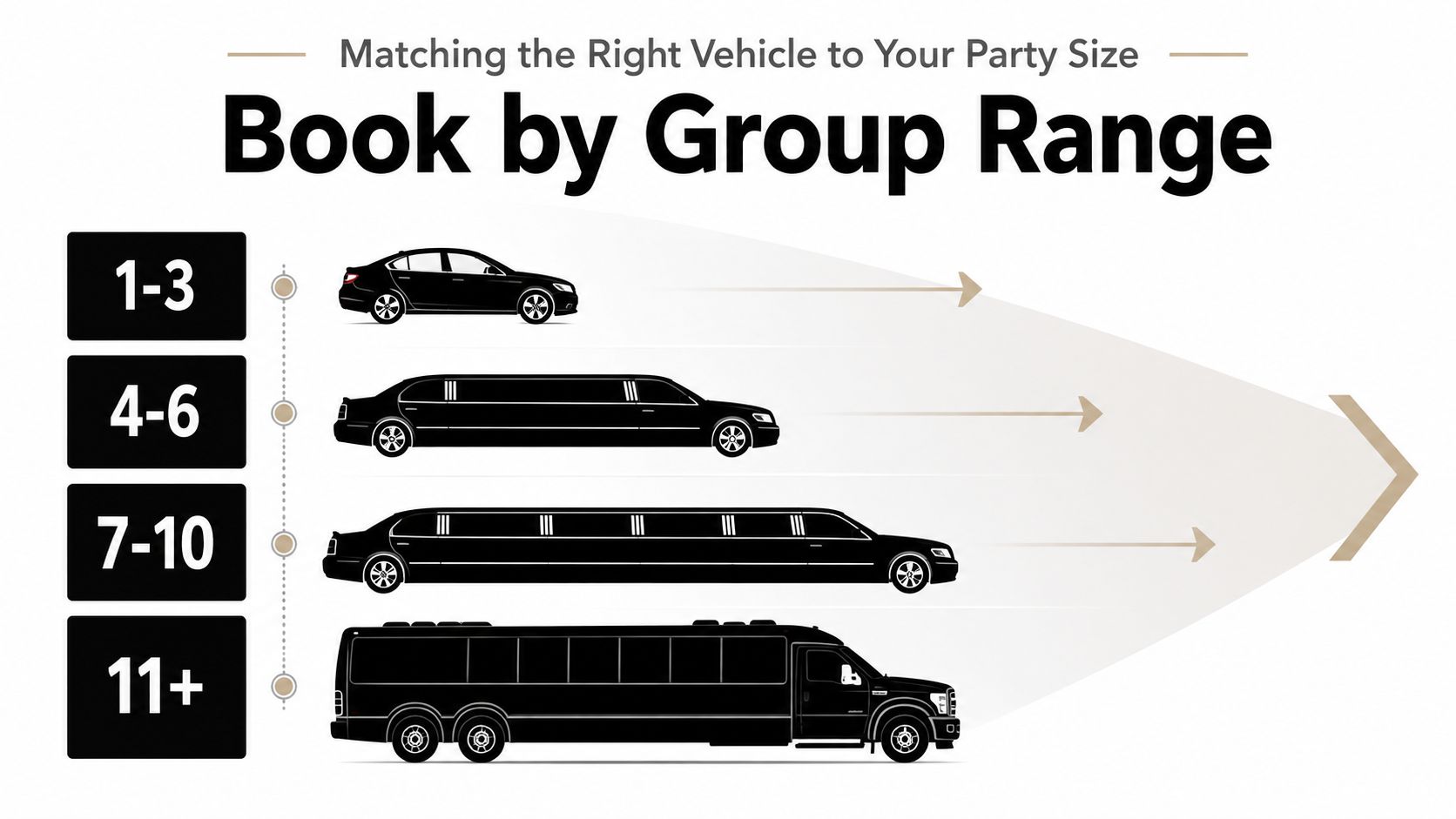
Book by group range, not by the word “limo.” A luxury sedan is the right tool for a very small party. A classic stretch works for a compact event group. A larger vehicle becomes necessary when passenger count, luggage, or the desired atmosphere exceeds the sedan-based cabin.
Choose the vehicle that fits the trip
- 1–3 passengers: Use a black car, executive sedan, or luxury SUV. A stretch limousine adds space you won't use.
- 4–6 passengers: A classic Lincoln or Chrysler 300 stretch usually makes sense, especially for an event transfer with limited luggage.
- 7–10 passengers: Choose a properly configured standard stretch, super-stretch, or Sprinter-style vehicle. For formalwear or bags, don't book at the advertised ceiling.
- 11–20 passengers: Look at an SUV stretch, party bus, minibus, or another larger vehicle. A standard sedan stretch isn't the right answer for this range.
- More than 20 passengers: Move to a larger group vehicle, such as a full motor coach, rather than combining everyone into an oversized stretch.
Match the cabin to the experience
I wouldn't put ten guests into a twenty-passenger super-stretch just because the number technically works. Unless the group specifically wants the larger party-vehicle atmosphere, an underfilled cabin can feel awkward and may cost more than a correctly sized option.
An SUV stretch is the better choice when passengers want a broader, more open interior. A Sprinter-style vehicle is often more sensible when luggage dominates the trip because its layout can handle group movement and cargo more effectively than a traditional sedan stretch.
The right vehicle can also simplify operations. One correctly sized vehicle keeps the group together, avoids duplicate pickup timing, and prevents the chauffeur from managing an over-capacity cabin. Amenities matter, but they shouldn't decide the booking before seating and cargo do.
Legal Limits, Licensing, and Why 8 or 10 Passengers Changes the Rules
The vehicle company's advertised capacity isn't automatically its legal or insured capacity. Regulators may count the driver, define seating by installed positions, or move a vehicle into a different regulatory category when passenger count crosses a threshold.
Michigan classifies commercial for-hire vehicles with 8 passengers or fewer as limousines and 9 or more as motor buses, while New York can classify a stretch limousine at 9 or more occupants including the driver, according to the state's bus and limousine FAQ. Those differences can affect licensing, inspection, insurance, and operating requirements.
California's legal definition permits no more than 10 passengers including the driver, while Oklahoma City's definition allows at least 5 and no more than 15 passengers, as described earlier. The practical lesson is direct: a ten-passenger vehicle in one market may not be legally usable for ten riders in another.
Ask about the actual seating positions
Seat width matters. Michigan's 14-inch-per-position standard shows why operators must rely on recognized seating geometry rather than just measuring the vehicle's length. A longer body doesn't guarantee additional compliant seating.
New York's 2025 legislative activity concerning rollover protection devices and anti-intrusion bars for stretch limousines also shows that larger and modified vehicles face continuing safety attention. New York DMV definitions separately identify stretched or modified limousines capable of carrying 11 or more persons including the driver, reinforcing the need to ask about the exact vehicle and operating class.
For larger group transport, this passenger bus DOT guide provides useful background on the regulatory questions that arise when a vehicle operates as passenger transportation rather than a small limousine.
Ask for the insured seating-position count in writing. A website's capacity label isn't enough for a wedding, airport transfer, or corporate booking.
A Quick Booking Checklist Before You Reserve
Use one phone call to remove the ambiguity. Ask these questions in order:
- Confirm the exact passenger count. Tell the operator how many people will ride, then ask whether the quoted vehicle's capacity is legal capacity, advertised capacity, or comfort capacity.
- Identify the vehicle. Get the make, model, and seating layout for the actual vehicle, not a generic stock photo.
- Ask about seating positions. Have the company confirm the installed and insured passenger positions, especially when the group approaches a regulatory threshold.
- Describe luggage and gear. List rolling bags, garment bags, gifts, coolers, flowers, equipment cases, and anything that may occupy cabin space.
- Clarify the price assumptions. Ask whether the quote changes if the group arrives with one additional passenger, more luggage, or a different vehicle requirement.
- Request an interior photo. Ask for a current image of the specific cabin so you can judge bench depth, aisle space, and storage.
- Confirm the license class. If the party exceeds 10 passengers, ask which classification and operating requirements apply in your location.
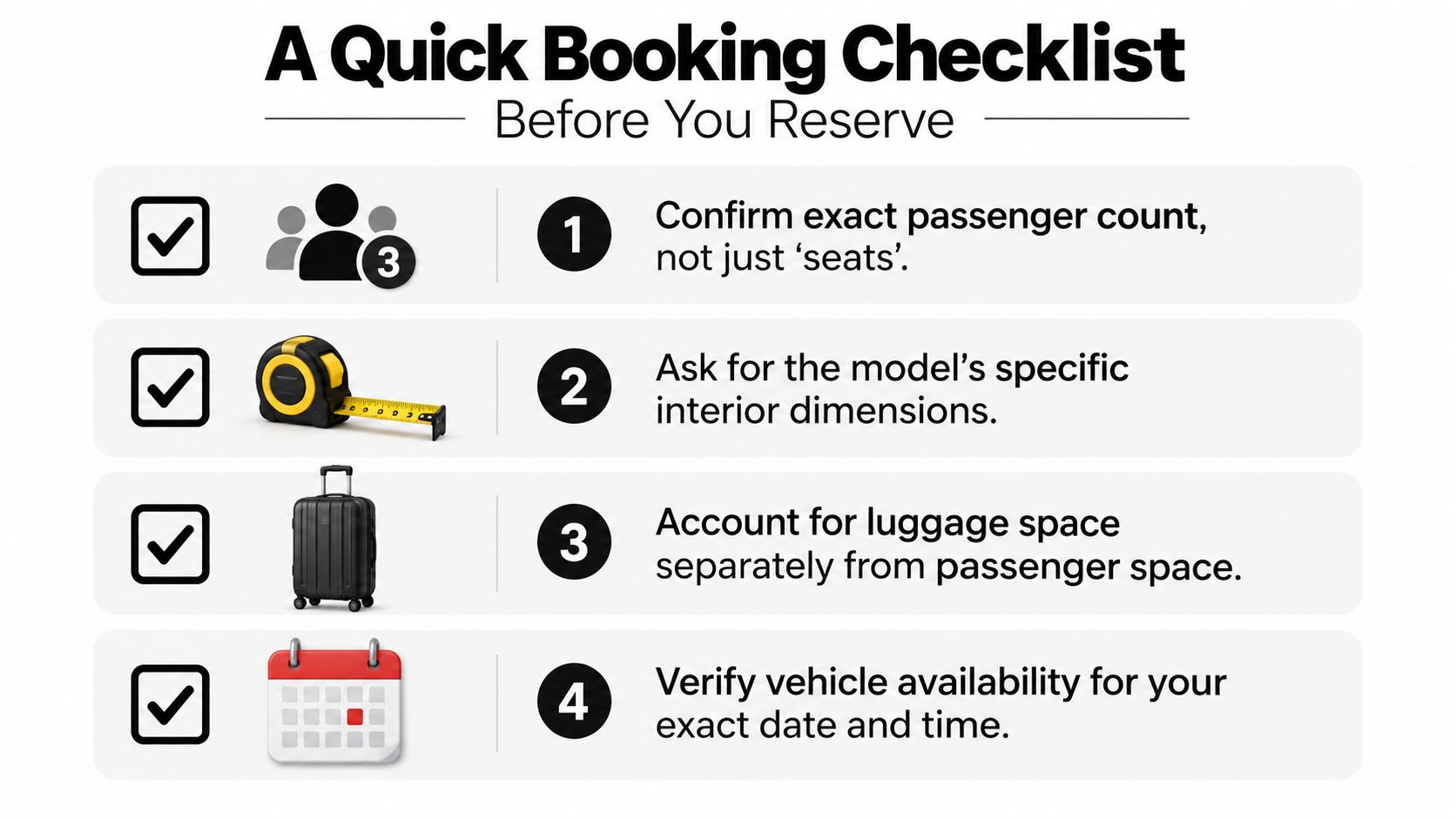
The safest booking is the one based on how many people will be comfortable, where the bags will go, and what the operator is legally authorized to carry.
Max's Luxury Rides Inc. offers executive sedans, luxury SUVs, Sprinter limousines, stretch limousines, minibuses, mini coaches, and full-size coach buses for airport transfers, corporate travel, and special events. Visit Max's Luxury Rides Inc. to match your passenger count and luggage needs with a properly sized vehicle, then request a reservation for your exact date and route.