
An event planner has a familiar problem: executives land at the airport within minutes of one another, a larger group is arriving on different flights, and the first meeting starts at a venue across town. The transportation plan must control costs, protect travelers, accommodate luggage, and absorb flight delays without forcing the planner to coordinate every vehicle by text message.
That's why effective corporate travel best practices extend well beyond a booking rule. They connect policy design, approvals, vendor standards, reservations, traveler communication, expense visibility, safety, sustainability, and disruption response. Ground transportation becomes a managed operating process rather than an isolated reservation.
The scale makes that discipline necessary. Global business travel spending reached $1.47 trillion in 2024 and was forecast to rise to $1.57 trillion in 2025 and $1.71 trillion in 2026, with worldwide business travel trips projected to exceed 1.84 billion in 2026, according to the GBTA business travel forecast. This guide follows the complete ground-transportation lifecycle, from platform integration and supplier contracts to safety, service measurement, sustainability, and crisis readiness.
The best travel policy is one travelers can follow under normal conditions and trust when plans change.
1. Centralized Travel Management Platform Integration
A centralized platform should give planners one operational view of reservations, approvals, traveler details, costs, and vehicle status. Without that connection, a booking may live in email, the approval in chat, the invoice in accounting software, and the driver's update in a separate dispatch system. That fragmentation makes simple questions difficult to answer, such as who's traveling, which department is paying, and whether a delayed flight affects the transfer.
Corporate travel tools such as Uber for Business, SAP Concur, and TravelPerk can support different parts of the workflow. The right choice depends on the systems already used by finance, human resources, procurement, and event operations. A platform that works well in isolation may still fail if it doesn't exchange traveler profiles, cost centers, approval status, or booking records with the company's existing tools.
Build the workflow around the traveler
A practical setup should connect with tools employees already use, such as Outlook, Slack, Salesforce, or the company's expense system. Mobile access matters because an executive assistant may need to alter a transfer from an airport lounge, while an event manager may be moving between venues. Automated approvals should route routine requests quickly and send unusual bookings to the correct budget owner.
The platform also needs a clear service boundary. Decide which reservations travelers can make themselves, which require an assistant, and which must go through an event transportation desk. A provider such as Max's Luxury Rides could be evaluated for a white-labeled or integrated booking experience where corporate clients need a consistent front end for executive sedans, SUVs, vans, shuttles, or coaches.
Implementation checklist
- Map the data flow: Connect booking, traveler, approval, dispatch, and expense records.
- Set approval rules: Route executive, group, late, or out-of-policy requests to named approvers.
- Test mobile access: Confirm that travelers can book, modify, track, and contact support from a phone.
- Train new users: Add platform training to employee and planner onboarding.
- Review analytics: Use booking patterns to identify unused suppliers, recurring routes, and avoidable manual work.
2. Preferred Vendor Agreements and Contract Management
A preferred transportation vendor should earn that status through documented performance, not familiarity or a convenient sales relationship. Corporate buyers need reliable availability, transparent pricing, defined escalation channels, and service standards that apply to airport transfers, executive movements, group transportation, and events.
The contract should distinguish between service categories. An executive traveling alone may need a premium sedan and a discreet chauffeur. A conference group may need coordinated minibuses, Sprinter vehicles, or full-size coaches. Treating every ride as the same unit makes rate comparisons difficult and can encourage planners to choose an unsuitable vehicle because its base price looks lower.
Negotiate for control, not only discounts
Rate discussions matter, but a low rate doesn't compensate for missed pickups, unclear cancellation terms, or weak backup coverage. Include service-level expectations for on-time performance, vehicle condition, chauffeur conduct, communication, billing accuracy, and incident reporting. Quarterly operating reviews should examine actual bookings, exceptions, complaints, credits, and capacity issues.
Use a primary and backup supplier in important markets. A backup relationship isn't wasteful if it protects an event with multiple arrivals or an executive itinerary with no recovery time. The trade-off is that splitting volume can reduce negotiating power, so segment the program carefully. Keep the primary vendor for predictable routes and planned events, while preserving a secondary option for overflow, vehicle shortages, or service recovery.
Procurement teams should also verify insurance documentation, licensing, payment terms, data handling, and subcontractor controls. Contract language should explain what happens after repeated failures, including remediation plans, credits, or removal from the preferred list.
A preferred vendor agreement should tell your team what happens before, during, and after a service failure.
Implementation checklist
- Define service tiers: Separate economy, premium, executive, group, and event requirements.
- Document service levels: Specify pickup communication, vehicle standards, chauffeur conduct, and billing detail.
- Create redundancy: Maintain an approved backup supplier for critical routes and events.
- Schedule reviews: Hold quarterly operating meetings and a formal annual contract review.
- Assign ownership: Give procurement, travel, finance, and event operations clear responsibilities.
3. Pre-Booking and Advance Reservation Policies
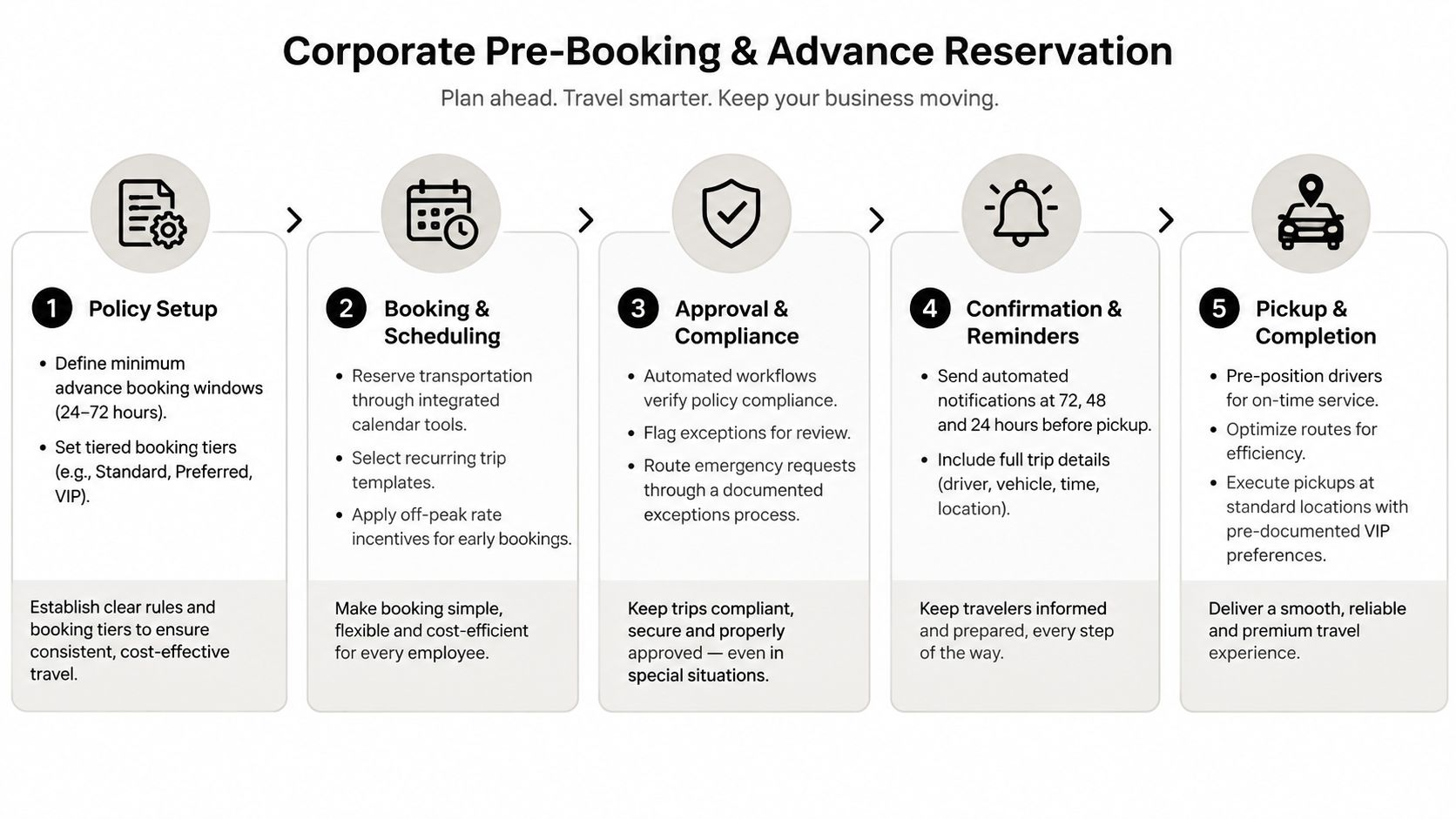
Advance booking gives transportation teams time to match the vehicle to the passenger, route, luggage, accessibility needs, and schedule. It also gives the traveler a better chance of receiving the preferred supplier and service class. For event organizers, advance reservations make it possible to build a manifest, group arrivals by flight, coordinate staging areas, and brief chauffeurs before the first guest lands.
A single deadline rarely works for every trip. Standard airport transfers can use a longer booking window, while premium executive service may have a different requirement. A same-day client meeting, an unexpected board request, or a flight disruption needs an exception path rather than a rigid denial.
Make exceptions controlled and visible
The policy should explain who can approve a late booking, what information the requester must provide, and how the exception appears in reporting. Required fields might include passenger name, mobile number, pickup location, flight information, passenger count, luggage requirements, vehicle class, and billing code. If those details are missing, dispatchers lose time confirming basic facts.
Recurring routes deserve templates. An assistant arranging weekly transfers between an office, airport, and hotel shouldn't rebuild the same request each time. Event planners can create templates for airport waves, venue shuttles, VIP movements, speaker transportation, and post-event departures.
Avoid fabricated incentives or arbitrary penalties. If the supplier offers a real advance-booking benefit, document it in the policy. Otherwise, focus on operational reasons for early booking, such as availability, accurate vehicle allocation, and better disruption planning.
Implementation checklist
- Set booking windows: Define separate rules for standard, executive, group, and event trips.
- Create an exception route: Name the approver for urgent or client-driven requests.
- Use recurring templates: Save frequent routes, passenger details, and billing information.
- Automate reminders: Send reminders before pickup and request confirmation of changes.
- Measure exceptions: Review late bookings by department, trip type, and root cause.
4. Traveler Safety and Duty of Care Framework
Safety starts before the vehicle arrives. A company needs to know which supplier is carrying the traveler, which chauffeur is assigned, what vehicle is in use, and how the traveler can request help. That information should remain accessible during the trip, not disappear inside a vendor's private dispatch system.
Driver vetting should cover identity, licensing, driving history, references where appropriate, and any legally permitted background checks. The company should also collect current insurance and vehicle documentation from suppliers. A contract that says “professional service” isn't a safety framework unless the provider defines the standard and demonstrates compliance.
Build a response chain
Real-time trip status can help travel managers identify missed pickups, route changes, and travelers who may be affected by an incident. Travelers should receive the chauffeur's name, vehicle description, pickup instructions, and an emergency contact method. Female travelers, travelers with disabilities, and employees visiting unfamiliar locations may need additional preferences or guidance.
Safety procedures must include reporting. Decide who receives an incident report, how quickly the supplier must respond, who contacts the traveler, and when security, human resources, legal, or insurance teams become involved. Companies supporting field teams can also reinforce transportation procedures with resources such as this guide to critical safety for field teams.
For an event, create a live transportation roster and an escalation sheet. Include venue security, hotel contacts, airport meet-and-greet staff, dispatch, the event lead, and the company's emergency contact. Keep a second communication channel available if the primary booking platform becomes unavailable.
Implementation checklist
- Verify suppliers: Collect driver, vehicle, licensing, and insurance documentation.
- Share trip details securely: Give travelers clear pickup, vehicle, and support information.
- Define escalation: Assign contacts for dispatch, security, human resources, and management.
- Plan for vulnerable situations: Record accessibility, privacy, and traveler preference requirements.
- Exercise the plan: Test a missed pickup, vehicle breakdown, medical event, and platform outage.
5. Mobile App and Self-Service Booking Accessibility
Self-service works when it reduces effort without removing control. A traveler should be able to request a compliant ride, see the reservation, communicate a change, and access support without calling several people. That convenience improves adoption, but only if the mobile experience is fast, understandable, and usable by employees with different needs.
Established platforms such as Uber for Business, Lyft Concierge, Grab for corporate accounts, and supplier-specific applications may be more practical than building an app internally. The decision should follow the company's integration, privacy, security, and accessibility requirements. A polished app that doesn't connect to expense reporting or traveler records can create another disconnected workflow.
Test the experience with real users
Run usability tests with executives, assistants, frequent travelers, event staff, and employees who use accessibility features. Test airport pickup instructions, changes to passenger count, delayed flights, special vehicle requests, and cancellation handling. Travelers shouldn't have to guess whether “airport pickup” means curbside, baggage claim, or a fixed meeting point.
Saved preferences can make repeat booking easier, including vehicle category, accessibility requirements, child-seat needs, or communication preferences. One-click recurring routes are useful, but they should still display the pickup time, destination, passenger details, and cost center before confirmation.
The app should support live driver tracking, secure messaging, receipt access, and 24/7 support where the service requires it. It should also let a planner book on behalf of another traveler without confusing the booker, passenger, approver, and payer.
Implementation checklist
- Choose the right channel: Compare supplier apps, corporate platforms, and portal access.
- Prioritize accessibility: Test screen readers, contrast, text size, and clear navigation.
- Enable delegated booking: Let assistants and planners reserve rides for others.
- Display critical details: Show meeting point, chauffeur information, vehicle, timing, and support.
- Test disruptions: Confirm that users can modify bookings after delays, cancellations, or venue changes.
6. Expense Tracking, Reporting, and Cost Allocation Systems
A transportation program can't manage cost if invoices arrive without trip context. Every charge should connect to a passenger or group, date, route, vehicle category, project, department, and approval record. That level of detail helps finance teams reconcile invoices and helps travel managers understand whether a policy is producing the intended behavior.
Tools such as SAP Concur, Expensify, Certify, and Chrome River support different expense and accounting workflows. Selection should begin with the company's chart of accounts and approval structure, not with a feature list. A system that captures receipts but cannot assign event transportation to the correct project still leaves finance with manual work.
Design the data before selecting the report
Create standard categories for airport transfers, executive travel, client entertainment, conferences, employee shuttles, and emergency transportation. For events, use a project or event code that allows the planner to see transportation as a complete program rather than a collection of individual rides.
Automated receipt capture can reduce manual entry, but automation needs exception handling. A missing passenger name, an altered route, a no-show fee, or a vehicle upgrade should trigger review rather than pass without notice. Monthly reconciliation should compare bookings, completed trips, cancellations, credits, and invoices.
Use reporting to support decisions, not to punish travelers. If a department repeatedly books late or outside the preferred channel, investigate whether the policy is unclear, the platform is difficult to use, or the supplier lacks availability.
Teams that need a deeper process reference can consult this travel expense management guide.
Implementation checklist
- Standardize coding: Define cost centers, project codes, trip types, and approval owners.
- Require itemization: Capture route, vehicle, passenger, wait time, tolls, fees, and credits.
- Automate exceptions: Flag missing receipts, unusual charges, duplicate invoices, and upgrades.
- Reconcile regularly: Compare reservations with completed trips and supplier billing.
- Share useful reports: Give managers actionable views of spend, compliance, and service issues.
7. Sustainable and Eco-Friendly Transportation Policies
Sustainability policy needs to reflect actual transportation choices. A company can prioritize electric or hybrid vehicles where charging infrastructure and route length make them practical. It can also consolidate passengers, reduce empty repositioning, combine trips, and choose an appropriately sized vehicle rather than defaulting to separate cars.
The best policy acknowledges trade-offs. An electric vehicle may suit an urban airport transfer but be less practical for a long event route with limited charging access. A coach can reduce the number of vehicles for a group, but only if the schedule and pickup locations work. A smaller vehicle may use fewer resources, while an undersized booking can create a second trip and increase operational inefficiency.
Measure what the supplier can document
Ask suppliers how they identify vehicle type, fuel type, passenger count, mileage, and deadhead travel. Align the fields with the company's ESG reporting process. Avoid presenting estimated offsets as if they were direct reductions, and don't require employees to choose an option that creates a safety or accessibility problem.
For events, sustainability planning starts with the agenda. A venue shuttle loop may replace many individual transfers, while a centralized hotel block can reduce route complexity. Communicate the reason for shared transportation and make the booking process easy. Employees are more likely to follow a sustainable option when it's convenient, reliable, and clearly explained.
The company should review supplier capabilities periodically. A provider with executive sedans, SUVs, Sprinter vehicles, minibuses, and coaches may support different group sizes, but the sustainability value depends on actual vehicle assignment and utilization.
Implementation checklist
- Define eligible options: Identify when electric, hybrid, shared, or larger vehicles are appropriate.
- Collect emissions inputs: Request vehicle, mileage, passenger, and fuel information from vendors.
- Plan event routes: Consolidate hotels, venues, airports, and meeting locations where practical.
- Protect traveler needs: Never trade accessibility, security, or operational reliability for a target.
- Report accurately: Separate measured reductions from estimates, credits, and offsets.
8. Driver Training, Professionalism, and Customer Service Standards
The chauffeur is often the traveler's most visible contact with the company's transportation program. A clean vehicle and on-time arrival matter, but so do discretion, communication, local awareness, luggage assistance, and the ability to handle a last-minute change without creating stress.
Write those expectations into the supplier agreement. “Professional chauffeur” should translate into observable standards, including appropriate attire, respectful communication, safe driving, vehicle cleanliness, passenger privacy, and clear confirmation procedures. Cultural sensitivity matters when teams include international visitors, clients, speakers, or senior executives.
Match training to the assignment
Airport transfers require accurate flight monitoring, meeting-point knowledge, and luggage support. Executive travel may require discretion and schedule awareness. Event work demands manifest management, venue coordination, staging discipline, and consistent passenger instructions. A supplier should explain how it trains chauffeurs for each assignment type and how it handles substitutes.
Customer service measurement should combine traveler feedback with operational evidence. A high rating doesn't excuse unsafe driving or inaccurate billing, while a late arrival may have resulted from a flight delay or venue closure. Review the context before assigning corrective action.
Max's Luxury Rides states that its affiliated chauffeurs are vetted and focused on punctuality, cleanliness, and guest comfort. Those standards can serve as evaluation criteria, but corporate buyers should still verify documentation, escalation processes, fleet availability, and service performance against their own requirements.

Implementation checklist
- Publish conduct standards: Cover attire, privacy, communication, driving, and vehicle presentation.
- Train by scenario: Include airport, executive, group, accessibility, and event assignments.
- Verify substitutes: Apply the same checks to backup chauffeurs and subcontractors.
- Use quality reviews: Combine feedback, dispatch records, incident reports, and billing accuracy.
- Recognize reliable service: Share positive feedback and address recurring failures directly.
9. Post-Trip Feedback, Performance Monitoring, and Continuous Improvement
A transportation program improves when it captures the traveler's experience and the operator's performance in the same review. Ask whether the chauffeur arrived as planned, whether the vehicle matched the booking, whether pickup instructions were clear, and whether the traveler could get help when needed. Then compare those answers with dispatch timestamps, cancellations, no-shows, route changes, and invoice exceptions.
Short post-trip surveys work best when they're tied to a specific ride and sent while the experience is still fresh. Use open-text responses for context, not just a rating. An executive may report that a ride was acceptable but mention that the pickup location was unclear. That detail points to a process fix rather than a chauffeur problem.
Turn feedback into supplier accountability
Create a dashboard that shows service by vendor, market, trip type, and event. Review missed pickups, late arrivals, vehicle substitutions, complaints, safety incidents, cancellation handling, and billing corrections. Don't rely on a single satisfaction score, because it can hide serious operational weaknesses or unfairly penalize a supplier for conditions outside its control.
Quarterly reviews should end with named actions, owners, and due dates. A supplier might improve airport signage instructions, revise event staging procedures, add a backup vehicle, or retrain chauffeurs on passenger communication. The next review should confirm whether the action worked.
Technology can support continuous improvement, but tools aren't a substitute for judgment. The travel manager still needs to distinguish a one-time disruption from a systemic failure and decide whether to coach, renegotiate, or replace a vendor.
Implementation checklist
- Survey key trips: Ask about punctuality, communication, vehicle fit, comfort, and support.
- Join data sources: Compare feedback with dispatch, booking, incident, and invoice records.
- Review by segment: Separate airport, executive, group, event, and emergency performance.
- Assign corrective actions: Give every recurring issue an owner and review date.
- Reassess the program: Update policy, training, vendor terms, and platform workflows based on evidence.
9-Point Corporate Travel Best Practices Comparison
| Item | 🔄 Implementation complexity | ⚡ Resource requirements | ⭐ Expected outcomes | 📊 Ideal use cases | 💡 Key advantages / Tips |
|---|---|---|---|---|---|
| Centralized Travel Management Platform Integration | High, systems integration & training | Significant, platform licensing, IT, training | Streamlined bookings; policy compliance; cost visibility | Large enterprises; multi-site travel programs | Centralized analytics; integrate calendars; ensure mobile access |
| Preferred Vendor Agreements, Volume Discounts, and Contract Management | Medium–High, procurement & legal negotiation | Moderate, account management, legal support | Predictable pricing; cost savings; service consistency | High-volume travel; recurring routes; executive transport | Negotiate SLAs & tiered discounts; include backup vendors |
| Pre-Booking and Advance Reservation Policies | Low–Medium, policy design & enforcement | Low, incentive costs, admin for exceptions | Better fleet utilization; lower surge costs; predictability | Regular events; repeat routes; airport transfers | Use tiered windows, incentives, automated reminders |
| Traveler Safety and Duty of Care Framework | High, vetting, tracking, emergency systems | High, background checks, tracking tech, training | Reduced liability; faster emergency response; trust | High-risk travel; global mobility; regulated sectors | Require vetting, GPS tracking, SOS; document safety measures |
| Mobile App and Self-Service Booking Accessibility | High, app development & integrations | High, development, maintenance, support | Faster bookings; higher traveler satisfaction | Distributed/remote teams; on-the-go booking needs | One-click booking, real-time tracking; consider white-label partners |
| Expense Tracking, Reporting, and Cost Allocation Systems | Medium–High, accounting integrations & workflows | Moderate–High, integration, analytics, support | Real-time spend visibility; faster reimbursements; audit trails | Firms with complex cost centers; project billing needs | Auto-receipts, coding, ERP integration; set budget alerts |
| Sustainable and Eco-Friendly Transportation Policies | Medium, sourcing + policy + reporting | Moderate, EVs, offsets, incentives | Lower emissions; ESG alignment; improved reputation | Companies with ESG targets; urban fleets | Start with urban EVs, carpool incentives, emissions tracking |
| Driver Training, Professionalism, and Customer Service Standards | Medium, curriculum & quality assurance | Moderate, trainers, time, evaluation programs | Higher satisfaction; safety; premium positioning | Luxury services; executive transport; hospitality clients | Defensive driving, soft-skills, mystery shoppers, incentives |
| Post-Trip Feedback, Performance Monitoring, and Continuous Improvement | Medium, survey & analytics systems | Moderate, feedback tools, reporting, follow-up | Improved quality; vendor accountability; data-driven fixes | Multi-vendor programs; quality improvement initiatives | Automate surveys, track NPS/CSAT, create vendor dashboards |
Make the Policy Work When Plans Change
A corporate travel program should be rolled out as an operating system, not as a document placed in an employee handbook. Start by documenting the policy, approval rules, traveler information requirements, vehicle classes, exception process, and expense codes. Keep the language practical. A traveler needs to know what to book, where to book it, when approval is required, and whom to contact when the approved option isn't available.
Next, select a primary supplier and approved backups for each important market. Compare vendors against the same requirements, including fleet range, airport coverage, chauffeur vetting, insurance, accessibility, dispatch communication, billing, and crisis support. The lowest quoted rate may not be the lowest operational cost if it creates missed pickups, duplicate bookings, or manual recovery work.
Define service standards before the first reservation. Specify what “on time” means for an airport transfer, how flight monitoring works, where chauffeurs meet passengers, how long the vehicle waits, and how changes are confirmed. For executive travel, document privacy and communication expectations. For group movements, define manifests, staging areas, vehicle numbering, signage, dispatch roles, and venue coordination.
Then connect booking to expense workflows. Travelers and planners should enter the right department, project, event, or client code when they request the ride. Finance should receive itemized billing that distinguishes completed trips, cancellations, wait time, tolls, upgrades, and credits. Travel managers should be able to see whether employees are booking through the approved channel and whether exceptions reflect genuine business needs.
Publish traveler communication procedures in plain language. Include pre-trip confirmations, airport meeting-point instructions, chauffeur contact details, emergency support, schedule-change rules, and after-hours assistance. Test those messages with someone who hasn't worked on the program. If the person can't explain what to do after a delayed flight, the instructions need revision.
Crisis readiness requires a live test. Run a tabletop exercise for a flight cancellation, vehicle breakdown, severe weather event, venue change, and booking-platform outage. Confirm who contacts travelers, who reallocates vehicles, who approves additional spend, who informs leadership, and who records the incident. A plan that exists only in a shared folder won't help if nobody knows who has authority during the disruption.
Sustainability belongs in the same review cycle. Track vehicle choices, shared rides, utilization, route consolidation, and the data suppliers can provide. Treat environmental goals as part of trip design, while preserving safety, accessibility, and reliable service.
Use recurring reviews to keep the system current. GBTA's technology research found that travel buyers estimated 18% of their overall program budget was spent on technology, while only 36% of travel buyers expected technology spending to grow, as reported in its 2024 corporate travel technology study. That points to a disciplined approach. Improve integration, automation, reporting, and traveler experience before adding more disconnected tools.
A final planner's review should cover:
- Airport transfers: Confirm flight tracking, meeting points, baggage needs, wait terms, and after-hours support.
- Executive travel: Verify vehicle class, privacy expectations, chauffeur contact, and schedule flexibility.
- Group movements: Match passenger counts to vehicles, prepare manifests, and assign a dispatch lead.
- Event transportation: Coordinate hotel, venue, airport, signage, staging, manifests, and backup vehicles.
- Last-minute exceptions: Require a reason, an approver, a billing code, and a documented supplier response.
- Traveler contacts: Provide passenger, planner, emergency, venue, hotel, and vendor escalation details.
- Vendor escalation: Define the path from dispatcher to account manager to corporate decision-maker.
- Itemized billing: Reconcile routes, passengers, vehicle type, wait time, fees, credits, and project codes.
- Post-trip review: Capture traveler feedback and compare it with operational and financial records.
Max's Luxury Rides may be evaluated as a preferred ground-transportation partner where its stated fleet, professional chauffeur standards, 24/7 operations, reservation options, airport services, and event packages match the organization's documented requirements. Its stated coverage includes Chicago O'Hare, Midway, FBOs, and airports worldwide, along with executive sedans, luxury SUVs, Mercedes vans, Sprinter limousines, shuttles, minibuses, mini coaches, and full-size coach buses. The right decision comes from matching those capabilities to the service levels, safety controls, reporting needs, and contingency procedures defined in the corporate program.
Max's Luxury Rides Inc. provides 24/7 airport transfers, corporate transportation, executive chauffeur service, group vehicles, and event packages, with options ranging from sedans and SUVs to Sprinter vehicles, minibuses, and coaches. Review your transportation requirements and contact Max's Luxury Rides Inc. to discuss dependable ground-transportation support for airport runs, meetings, conferences, client travel, and organized events.