
A Miami business trip rarely goes off track because of the meeting itself. It goes off track in the handoff points. The flight lands late. The executive exits the terminal and can't immediately tell whether the hotel shuttle is curbside, circulating, or gone for another loop. A hotel that looked “close to the airport” on a map turns out to be operationally inconvenient once baggage, traffic flow, and terminal pickup rules enter the picture.
That's why I treat hotel choice and ground transportation as one decision. If you separate them, you create avoidable risk. If you integrate them, the trip feels controlled from touchdown to check-in.
For teams flying private or coordinating around fixed schedules, it also helps to review expert tips for Miami private jets before locking in lodging. The flight plan, airport choice, and curbside strategy should support the same objective: getting the traveler where they need to be without unnecessary waiting, rerouting, or improvisation.
The Executive's Arrival in Miami
An executive lands in Miami with one goal: move quickly, stay productive, and avoid friction. That sounds simple until the everyday sequence begins. Terminal exit, baggage timing, pickup point confusion, shuttle uncertainty, hotel check-in line, then a rushed reset before the first call or dinner.
I've seen the same mistake repeatedly. A company books an airport hotel because it appears convenient, then treats transportation as an afterthought. That's backwards. The key question isn't whether the hotel is near an airport. It's whether the hotel and the transfer plan function as a single, reliable system.
When that system is weak, small delays stack up. A missed shuttle loop becomes a late arrival. A vague pickup instruction leads to phone calls from the curb. An executive who should be reviewing briefing notes is instead trying to locate the right vehicle.
Business travelers don't remember the booking process. They remember whether arrival felt smooth or disorganized.
The right airport executive hotel in Miami reduces decisions at the exact moment the traveler has the least patience for them. The best choice isn't always the cheapest room or the most recognizable brand. It's the property that fits the airport, the itinerary, and the transfer method with the fewest moving parts.
Defining the True Executive Airport Hotel
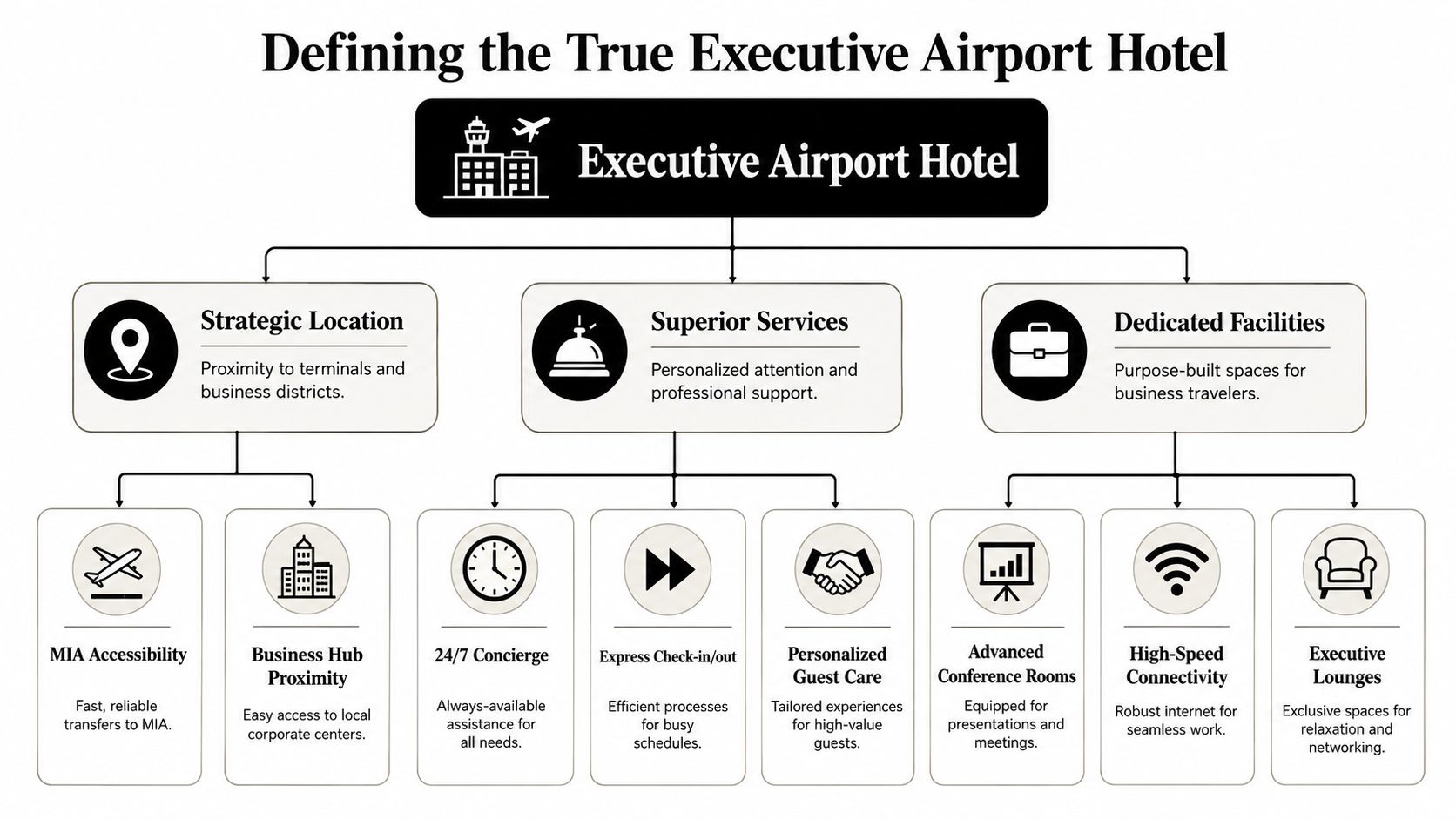
A true executive airport hotel removes decisions after landing. The property, pickup method, check-in process, and next departure all need to work together, because executives lose time at the handoff points, not in the room itself.
Start with operational location
For an airport executive hotel in Miami, location is only useful if it shortens the full chain from aircraft to car to room. A hotel can be close to the airport on a map and still create friction if the shuttle runs infrequently, the pickup point is vague, or the route adds unnecessary traffic exposure.
The Sheraton Miami Airport Hotel & Executive Meeting Center, located at 3900 NW 21st Street, is a strong MIA example. It sits very close to the airport and runs a frequent 24/7 shuttle service. That setup works well for commercial arrivals that need a fast reset before the next meeting. It works less well if the executive's real priority is direct access to another part of Miami and the airport hotel results in one more transfer.
That is the standard I use. Judge the hotel and the ground plan as one operating system.
It also helps to look beyond the room product. Clean, well-managed common areas matter for traveler confidence, especially after long-haul arrivals, and broader industry attention to addressing airport hygiene challenges reinforces the same point. The arrival environment shapes the traveler's first impression before any meeting starts.
Look for business-specific utility
An executive property should support work immediately, with minimal setup and minimal improvisation. The useful question is not whether the hotel offers amenities. It is whether those amenities reduce the need for extra car movements, schedule reshuffling, or last-minute problem solving.
Use this checklist when screening options:
- Meeting space should match the trip's purpose: If the itinerary includes internal reviews, investor discussions, or a quick board-style session, on-site meeting capability saves a separate venue transfer.
- Food service needs to be practical: A polished restaurant is less important than reliable access to a quick meal, early coffee, and late service when flights shift.
- Arrival handling has to be predictable: Late check-in, responsive front desk staff, and clear billing processes matter more than design flourishes.
- Guest rooms should support short-notice work: Desk space, quiet conditions, and stable Wi-Fi let the executive recover lost time without leaving the property.
Separate executive utility from airport convenience
A polished lobby can hide a weak operation. I have seen hotels marketed to business travelers that still force guests into avoidable delays because the shuttle is inconsistent, dining shuts down too early, or there is no realistic place to take a private call.
A better filter is to test the property against the actual pressure points of executive travel:
| Question | What you want |
|---|---|
| Can the traveler move from airport exit to room with clear instructions? | Defined pickup flow, predictable transport timing, low curbside confusion |
| Can work continue if the schedule changes? | Quiet room setup, meeting support, reliable connectivity |
| Can the hotel absorb disruption without adding another transfer? | On-site dining, responsive staff, professional handling of late changes |
Practical rule: If a hotel only solves overnight proximity, it is a convenience booking. Executive lodging also protects the traveler's time between the airport and the next commitment.
Navigating Miami's Airports MIA vs TMB
Miami travel planning breaks down when people treat MIA and TMB as interchangeable. They're not. The right hotel for one can be the wrong hotel for the other, even if both look “airport-adjacent” on a booking site.
MIA works differently from TMB
MIA is the commercial airport problem. The traveler deals with airline arrivals, terminal flow, pickup zones, shuttle bays, and more layered traffic patterns. In that environment, a hotel with established airport access can work well if the traveler's schedule is built around commercial service.
TMB is a different operational model. Travelers using private or charter aviation usually care less about terminal retail or large hotel ecosystems and more about direct access to the specific airport environment their flight uses.
The distinction becomes clearer with one example. The Best Western Plus Miami Executive Airport Hotel & Suites is positioned directly across from Miami Executive Airport (TMB), allowing transfer times of under 2 minutes and letting guests walk to the terminal, as noted on the Best Western property page. That's a material advantage for TMB-based travelers. It removes an entire transfer layer.
Match the hotel to the airport, not the city
A common planning error is booking by city geography instead of airport function. Someone sees “Miami airport hotel” and assumes any airport-adjacent option is suitable. It isn't.
Use the comparison this way:
- Commercial airline traveler through MIA: prioritize structured airport access, late check-in reliability, and a property that can absorb irregular arrival timing.
- Private aviation traveler through TMB: prioritize immediate airport adjacency and minimal transfer friction.
- Executive team split across airports: don't force one hotel to serve two incompatible arrival patterns unless the meeting need clearly outweighs the transfer inefficiency.
A related issue often gets overlooked: the traveler's condition on arrival. Long terminal exposure, crowded public areas, and inconsistent cleanliness can shape first impressions before the ride even begins. Teams that want a better grasp of that side of the experience should read about addressing airport hygiene challenges, because airport environment affects how much recovery time a traveler needs after landing.
Choose the airport first, then the hotel, then the transfer method. Reversing that order usually creates rework.
If your traveler is using MIA, optimize for managed transition. If your traveler is using TMB, optimize for directness. Those are different strategies, and they should lead to different bookings.
Essential Amenities and Business Services
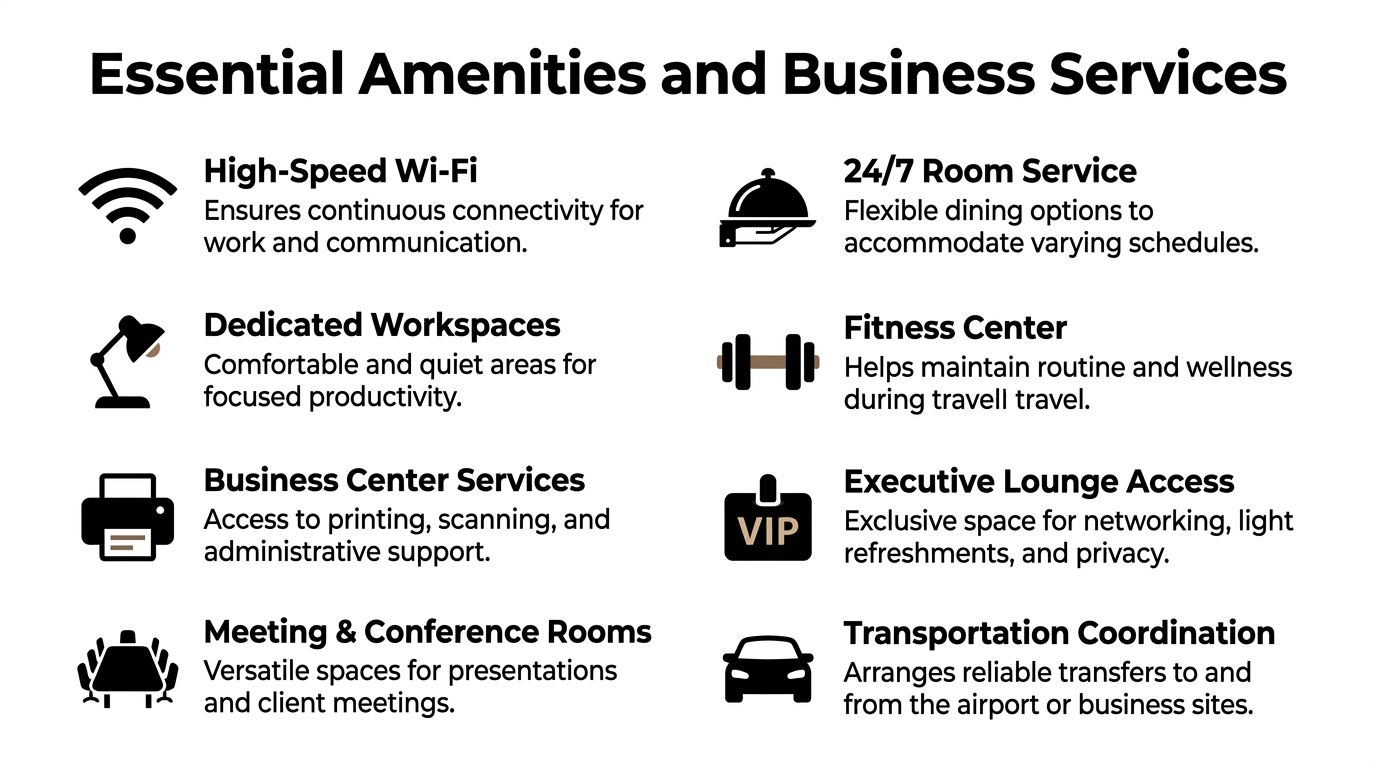
The right airport executive hotel in Miami works as an operations base, not just a place to sleep. Hotel choice and ground transportation have to be planned together. If the property covers meals, meetings, recovery time, and late-hour support on site, the car schedule stays tighter and the traveler avoids extra movements across the city.
Meeting capacity changes the value of the stay
Meeting space matters because it changes how many transfers the day requires. A property with serious conference capability can absorb an agenda change without forcing executives back into traffic for a boardroom, briefing room, or private working session.
As noted earlier, the Sheraton Miami Airport Hotel & Executive Meeting Center stands out in this market for its conference positioning and scale of meeting space. For an executive itinerary, that creates a practical advantage. A late inbound flight does not automatically break the schedule. The team can land, transfer once, meet on site, and leave for the next appointment only when there is a real reason to move.
That is the standard to use. Ask whether the hotel can host the meeting you may need, not just the room you booked.
The hotel should reduce off-property movement
Short executive stays fall apart when the property handles lodging but not the work around lodging. The hotel should support the first meal, the first call, the first workout, and the late-night adjustment without adding another car booking.
KAYAK's hotel page describes this property as offering a 24-hour front desk, multiple on-site dining options, suite inventory, and fitness and pool access on a stay pattern that skews short, as shown on KAYAK's hotel page. Those details matter less as amenities on a list and more as control points for the itinerary. If dinner is on site, the evening stays protected. If the front desk is staffed at all hours, a delayed check-in does not turn into a service chase. If there is a real workspace and room-category flexibility, the property can support both a solo overnight and a higher-level traveler who needs more privacy.
I usually judge airport hotels by one question. How many extra trips will this booking create?
A good executive property keeps that number low. Use this checklist:
- On-site dining that can handle business use: suitable for a quick client meal, not just a convenience snack option
- Workable meeting and breakout space: enough privacy for calls, reviews, and schedule changes
- 24-hour staffed support: useful when flights slip and arrivals land outside normal service patterns
- Fitness or recovery options on site: helps travelers reset without burning time on another transfer
- Room types that match traveler seniority: standard inventory for short stays, upgraded space when privacy or prep time matters
What works and what usually fails under pressure
The weak point is rarely the room itself. The weak point is the chain reaction created by a hotel that cannot support the rest of the trip.
| Strong business support | Weak business support |
|---|---|
| Meeting rooms that keep internal sessions on property | Public lobby space passed off as a work area |
| Dining that can absorb a delayed arrival or quick dinner meeting | Limited food service that forces an off-site run |
| Full-time desk coverage for irregular schedules | Reduced-service gaps that show up late at night |
| Inventory that supports both solo travelers and senior executives | Little flexibility once the booking changes |
The best amenity is the one that removes a separate car movement. In Miami, that is not a small detail. It is how an airport hotel stops being a generic convenience booking and starts functioning as part of the executive transport plan.
Mastering Arrival and Departure Logistics
Arrival logistics decide whether the first hour in Miami feels controlled or chaotic. Many travel plans often falter during this phase. The hotel may be appropriate. The room may be confirmed. But the actual transfer from airport to property still depends on a weak handoff.
A lot of travelers assume a “24/7 shuttle” solves that problem. It doesn't always. Research notes that while many airport hotels advertise 24/7 shuttles, their protocols for off-hours private or cargo flights at airports like TMB are often opaque, creating a reliability gap that leaves travelers depending on unconfirmed transport for late-night arrivals, according to Trip.com's hotel research page. The issue isn't whether transportation exists in theory. The issue is whether the traveler can count on it at the exact minute they need it.
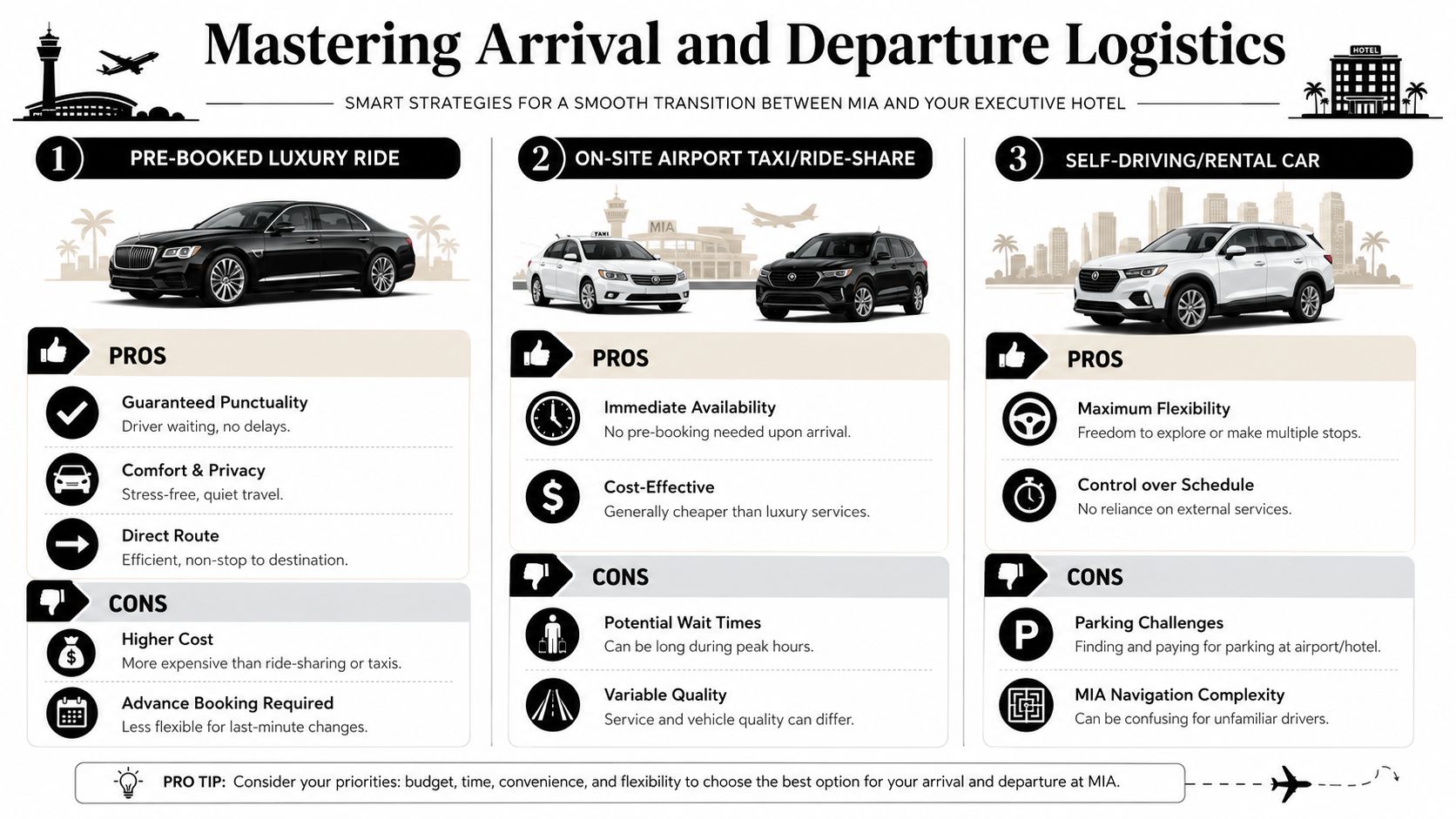
For a quick visual breakdown of the main transfer models, use this comparison:
Why shared hotel transport often underperforms
Shuttles are fine when all of the following are true: the traveler is on a standard commercial schedule, has time buffer, doesn't mind waiting, and isn't carrying client-facing urgency into the next appointment.
That's not most executive travel.
Shared airport transport usually creates friction in three places:
- Pickup timing uncertainty: The traveler often waits without a precise arrival window.
- Routing inefficiency: Other passengers and loop stops extend the transfer.
- Low flexibility: Delayed flights, changed terminals, or unusual arrival times are where systems break down.
Why a pre-arranged car is a risk decision
A chauffeured transfer isn't just a comfort upgrade. It's a control measure. It reduces ambiguity, shortens decision time after landing, and presents a more professional experience for senior travelers or hosted guests.
This video offers a useful look at airport transfer planning in practice:
Here's the practical comparison I use when advising teams:
- Use the hotel shuttle when the traveler is solo, schedule-sensitive only in a moderate way, and arriving on a conventional timeline.
- Use airport taxi or ride-share when flexibility matters more than presentation, and the traveler can tolerate some variation.
- Use pre-arranged car service when punctuality, privacy, or executive presence matters from the curb onward.
If a missed pickup would affect a meeting, a client impression, or a same-day turnaround, don't rely on an improvised transfer.
Miami punishes vague logistics. The cleanest trip plans remove curbside guesswork before the plane lands.
Coordinating Transfers with Max's Luxury Rides
When a trip matters, the transportation plan should be written down as clearly as the flight details. That means traveler name, airport, arrival method, luggage profile, destination hotel, and who's responsible if the itinerary shifts. Premium transfer coordination works best when it's treated as part of the travel brief, not as a separate errand.
A useful outside perspective on that standard is this luxury airport transfers guide, which gets at the same core principle: premium ground service is most effective when it removes uncertainty, not when it merely looks upscale.

Build the reservation around the traveler, not the vehicle
The first step is matching the service to the travel pattern.
- Solo executive: An executive sedan or luxury SUV usually fits best when the priority is speed, privacy, and a quiet ride for calls or decompression.
- Small leadership group: A larger SUV or Mercedes van works better when several people arrive together and need coordinated movement without splitting into separate cars.
- Corporate team or event movement: Executive shuttles, minibuses, mini coaches, or full-size coach buses make sense when a company wants one coordinated arrival flow rather than multiple fragmented pickups.
The key is to book from the itinerary backward. Don't start by asking which vehicle looks impressive. Start by asking who is traveling, how tightly the timing is built, and whether the transfer needs to support conversation, recovery, or group coordination.
Confirm the operational details early
A professional transfer plan should include a short confirmation checklist before travel day:
- Verify the airport and arrival type. Commercial pickup flow is different from private aviation handling.
- Confirm party size and baggage profile. This prevents under-booking the vehicle.
- Align hotel destination exactly. Miami-area properties can be close in name but different in routing.
- Set communication expectations. The traveler should know who to contact and what happens if the flight timing changes.
- Account for return transfer timing. Departure rides should be scheduled with the same care as arrival.
What a good provider changes
Max's Luxury Rides states that it operates 24/7, accepts major credit cards, and offers a fleet ranging from executive sedans and luxury SUVs to Mercedes vans, executive shuttles, stretch limousines, minibuses, mini coaches, and full-size coach buses, according to the company information provided by the publisher. For planners, the operational value is straightforward: one provider can handle individual executives, small groups, and larger corporate movements without forcing a patchwork of separate vendors.
That matters most in three scenarios:
- Late arrivals: The team doesn't have to gamble on whatever transportation happens to be available.
- Multi-passenger coordination: Everyone follows the same plan instead of improvising separate arrivals.
- Client-facing transport: The transfer becomes an extension of the company's professionalism.
A well-run airport transfer should feel invisible to the traveler. They should never have to solve it in real time.
That's the standard worth aiming for in Miami.
Your Blueprint for Executive Travel in Miami
The right airport executive hotel in Miami does more than shorten the drive from the runway. It supports the whole trip. That includes the airport being used, the business purpose of the stay, the need for on-site work or meetings, and the reliability of the transfer connecting each step.
The practical blueprint is simple. Match the hotel to the actual airport. Choose a property that can function as a work base, not just a place to sleep. Then lock in transportation with the same seriousness you give the flight and the room.
Executives don't need more “convenient” options. They need fewer failure points.
When Miami travel works, it feels effortless because someone planned the handoffs. The arrival is clear. The hotel supports the schedule. The departure happens without last-minute calls, curbside confusion, or wasted time. That's what good coordination looks like, and it's the standard worth setting for every executive trip through the city.
If you need a dependable ground partner to complete that plan, Max's Luxury Rides Inc. offers 24/7 airport transfers, corporate transportation, and group vehicle options ranging from executive sedans to full-size coaches. For business travel in Miami, that means one reservation path for solo executives, leadership teams, and larger event groups, with professional chauffeurs and a fleet built to keep arrival and departure logistics organized.