
A passenger lands after a long international flight, clears customs, collects luggage, and discovers three possible exits, several pickup zones, and no clear sign of the assigned driver. The vehicle may be waiting legally at the airport, but the traveler still has to find it. For a corporate executive, wedding guest, or family managing children and luggage, that gap between “driver is waiting” and “passenger is safely in the vehicle” creates unnecessary risk.
An airport meet and greet service closes that gap. A professional greeter coordinates the arrival inside the terminal, manages the passenger handoff, assists with luggage, and connects the traveler with the chauffeur under airport access rules. The value isn't the name sign alone. It's controlled movement from aircraft arrival to vehicle departure.
What an Airport Meet and Greet Service Does
A traveler arriving at O'Hare Terminal 5 after a long-haul flight must manage customs, baggage claim, unfamiliar signage, terminal distances, and changing pickup instructions. A basic curbside pickup leaves those tasks with the passenger. A professional airport meet and greet service assigns a trained person to coordinate the arrival and keep the transfer on schedule.
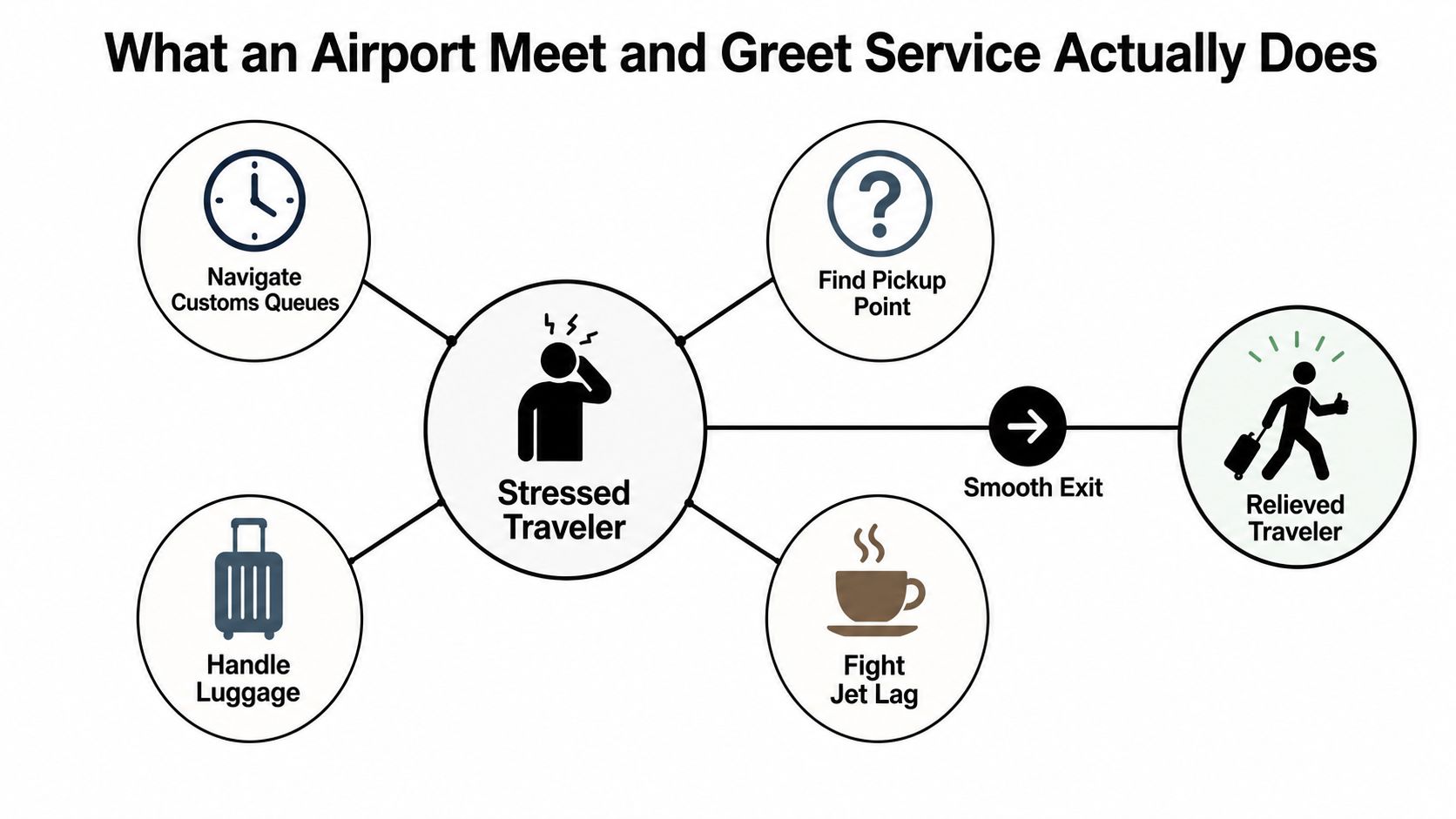
The work begins before the aircraft reaches the gate. Dispatch links the passenger's name, flight number, arrival time, terminal, and vehicle assignment. The team monitors the flight and revises the meeting plan if the aircraft arrives early or late. At the airport, the greeter waits at the agreed location, often baggage claim or a designated arrivals meeting area, rather than searching the terminal for the passenger.
More than a name sign
A name sign is the visible signal. The service depends on the operating steps behind it:
- Arrival interception: The greeter meets the passenger at the agreed point after customs or at another permitted location.
- Wayfinding: The greeter leads the traveler through baggage claim, exits, elevators, and terminal routes.
- Luggage coordination: Bags are gathered and moved toward the vehicle, so the traveler does not search for a curbside zone.
- Dispatch communication: The greeter confirms the passenger's location and readiness with the chauffeur.
- Controlled handoff: The passenger moves from terminal assistance to the assigned vehicle through a planned commercial pickup process.
Airport assistance may begin at the aircraft or passenger bridge and end at the curb or terminal meeting point. Depending on the airport and booking, it can include luggage help, passport or control navigation, fast-track access where available, and an escort to the vehicle, as described by TAV Operation Services' meet and greet information.
Practical rule: Ask where the greeter meets the passenger, not just whether a greeter is included.
The distinction matters at complex airports. O'Hare and Midway operate differently from a small regional terminal, and passengers need clear instructions after leaving baggage claim. Verify the meeting point, the permitted access area, and the communication method before booking.
If the provider sends only a chauffeur to a curbside zone, the traveler still handles terminal navigation. A professional greeter confirms the passenger, coordinates the exit, and completes the handoff under the airport's commercial pickup rules. Clear passenger-facing instructions also help the operation succeed. The provider should start the conversation right, with a recognizable contact method and a precise meeting location.
How the Service Works from Booking to Vehicle Handoff
A dependable airport meet and greet service follows a defined chain of custody for the passenger. Every handoff should have an owner, a location, and a communication method.
Reservation captures the operating details. The booking should include the passenger's full name, flight number, airline, terminal, arrival date, passenger count, luggage needs, destination, and vehicle type. For groups, provide a manifest rather than relying on a single contact name.
Dispatch validates the meeting point. International arrivals commonly require the greeter to meet after customs and baggage claim. Domestic arrivals may use a different terminal exit or arrivals area. The provider should confirm the location in writing because airport access rules vary by facility.
The team monitors the flight. Dispatch watches for delays, early arrivals, gate changes, diversions, and extended baggage waits. Flight tracking doesn't remove every delay, but it gives the team a basis for changing the chauffeur's timing instead of asking the traveler to manage the adjustment.
The greeter executes the terminal meeting. The greeter carries the agreed identification, meets the passenger at the approved location, and confirms the traveler against the reservation. A professional doesn't ask the passenger to walk around the terminal looking for a vehicle.
The greeter manages the exit. Luggage is gathered, the route to the pickup point is selected, and dispatch receives a readiness update. The chauffeur remains positioned according to airport rules, not wherever the traveler happens to be standing.
The chauffeur completes the vehicle handoff. The greeter and chauffeur coordinate the final movement, load luggage, verify the destination, and close the trip in the dispatch system. If a bag is delayed or a passenger needs additional assistance, the team should communicate the change before the vehicle departs.
DFW permits bookings up to 36 hours before the requested date and time, according to its official meet and greet guidance. New York regulations require ground transportation meet-and-greet activity in the baggage claim area with a hand-held sign that meets specified size and pedestrian-flow requirements. These rules illustrate why a provider can't promise unrestricted terminal access or an informal aircraft-side greeting at every airport.
Changi, by contrast, requires advance booking of at least 48 hours, as stated in its meet and greet FAQ. The lesson for travel managers is straightforward. Confirm the airport's rule, the provider's cutoff, and the exact passenger meeting point before issuing instructions.
The following video provides a visual reference for the booking and handoff concept:
For diversions or major delays, the provider should move the booking into an exception workflow. That may mean a new terminal, a revised pickup point, a replacement vehicle, or a direct call to the passenger's coordinator. If the provider can't explain that process before booking, it isn't ready for executive or event work.
Who Benefits Most from Professional Airport Assistance
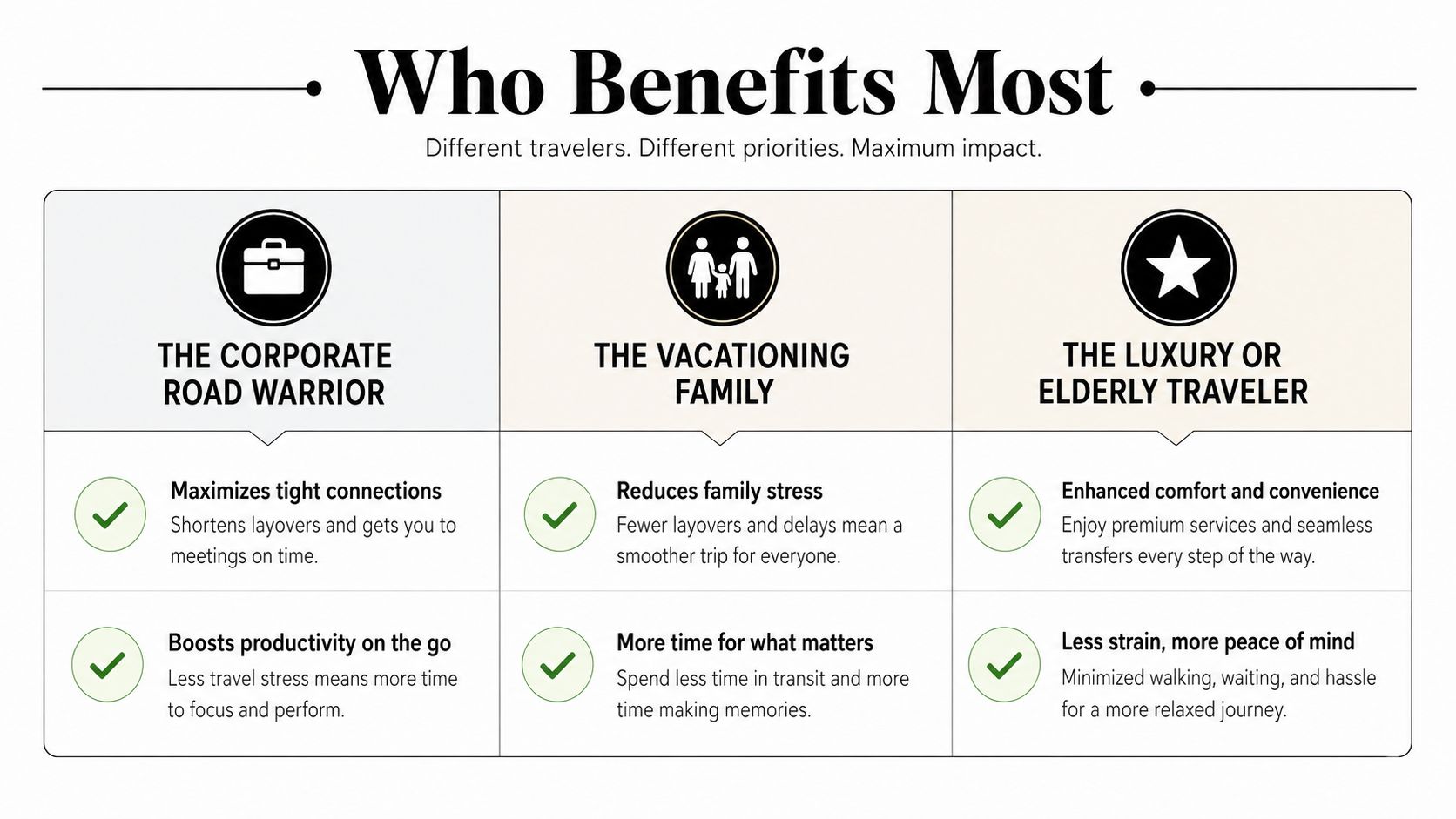
Meet and greet isn't necessary for every arrival. It earns its place when the cost of confusion is higher than the service fee, or when a passenger can't comfortably manage the terminal-to-vehicle transition alone.
Corporate travelers
An executive arriving for back-to-back meetings shouldn't spend the first part of the day locating a driver, moving between pickup zones, or explaining a delay to several contacts. A greeter provides one accountable point of contact inside the terminal, while dispatch handles the vehicle's position and timing.
The benefit isn't just comfort. It protects the meeting schedule and gives the traveler a controlled transition from airport to office, hotel, or event venue. Corporate travel managers should use the service when the passenger is visiting an unfamiliar airport, carrying sensitive equipment, traveling with a team, or operating under a tight arrival schedule.
Wedding and event guests
Event planners face a different problem. They may have multiple arrivals, different airlines, changing luggage loads, and guests who don't know the local airport. A standard pickup arrangement often creates scattered phone calls and uncertain arrival order.
A meet-and-greet coordinator can give each guest a clear instruction set and report who has arrived, who is delayed, and who is moving toward the vehicle. For a wedding party or conference delegation, that visibility is more valuable than a generic promise of “airport pickup.” The planner gets a managed arrival rather than a collection of independent rides.
Families, older passengers, and travelers needing assistance
Children, strollers, multiple suitcases, and unfamiliar terminal layouts create friction even when the airport itself is operating normally. Older travelers or passengers with mobility challenges may need a slower route, elevator access, luggage assistance, or coordination with the airport's own passenger assistance system.
Airport assistance can be activated at call points, check-in desks, or arrival areas, and some systems require advance notice to arrange a designated pickup point. A private meet-and-greet provider shouldn't replace official accessibility support where that support is required. Instead, the provider should coordinate the ground transportation portion and confirm what the passenger can safely manage.
The broader demand is not limited to luxury travelers. UK airport assistance demand has risen 115.8% since 2015, compared with 23.9% overall passenger growth, according to the market material citing UK assistance trends at MarketIntelo. That difference supports a practical conclusion: accessibility and friction management are core use cases, not decorative upgrades.
Comparing Meet and Greet to Other Airport Pickup Options
The operational difference appears at the terminal handoff. A rideshare passenger manages the app, pickup instructions, terminal walk, vehicle identification, and luggage. A taxi passenger joins the queue and confirms the destination with the driver. A standard chauffeur service may provide a polished vehicle, yet still leave the traveler inside the terminal until the chauffeur can legally approach the curb.
| Service Type | Wait Time | Luggage Assistance | Terminal Navigation | Flight Delay Handling | Best For |
|---|---|---|---|---|---|
| Rideshare | Dependent on app availability and pickup-zone traffic | Usually limited to passenger and driver arrangements | Passenger finds the assigned pickup zone | App-based updates, service quality varies | Flexible, self-directed travelers |
| Traditional taxi | Queue and dispatch dependent | Usually limited | Passenger exits to the taxi rank | Driver generally responds to passenger updates | Travelers who want an immediate conventional option |
| Standard chauffeur pickup | Coordinated vehicle arrival, often curbside | Driver assistance may begin at the curb | Passenger usually finds the vehicle | Depends on provider's flight-monitoring policy | Travelers comfortable navigating the terminal |
| Professional meet and greet | Greeter coordinates the passenger before vehicle departure | Greeter and chauffeur coordinate luggage | Greeter leads the terminal-to-vehicle route | Dispatch adjusts the handoff plan | Executives, families, groups, and complex arrivals |
At O'Hare, the traveler may walk from the terminal interior to a designated commercial pickup location while handling luggage and checking a phone. At Midway, lower-level pickup restrictions and traffic flow can make a curbside meeting harder to manage. Rideshare and taxi services can work well for independent travelers. Their operating model does not assign one team responsibility for the full terminal-to-vehicle transfer.
A professional provider must also follow airport access rules and commercial insurance requirements. The greeter may be permitted to meet in a specific baggage claim area, while the vehicle waits at an approved staging or pickup location. That separation is standard. The process fails when dispatch, greeter, and chauffeur do not share the same passenger status, flight update, and meeting instructions.
A polished car doesn't create a professional airport transfer. The process does.
Verify three details before booking: where the greeter is authorized to meet, where the vehicle is allowed to wait, and who owns the handoff if the flight changes. Also confirm whether the greeter remains with the passenger through luggage collection or transfers responsibility at baggage claim.
Choose a basic pickup when the passenger knows the airport, has light luggage, and can manage the terminal independently. Choose meet and greet when the traveler is time-sensitive, unfamiliar with the airport, responsible for a group, or likely to need hands-on assistance.
Pricing Factors and Booking Best Practices
Airport meet-and-greet pricing is built from operational inputs, not just vehicle size. The provider may account for terminal access, greeter labor, waiting exposure, airport-specific restrictions, vehicle class, luggage capacity, after-hours coverage, and the complexity of coordinating multiple passengers.
Don't accept a single unexplained price for a corporate or event booking. Ask whether the quote includes the greeter, flight monitoring, luggage assistance, airport fees, wait time, taxes, gratuity, and additional stops. A lower base rate can become expensive when essential services appear as separate charges.
What changes the quote
- Airport and terminal: O'Hare and Midway have different layouts, access patterns, and commercial pickup procedures.
- Vehicle class: A sedan, SUV, passenger van, Sprinter, or larger event vehicle carries different passenger and luggage requirements.
- Passenger movement: One traveler meeting at baggage claim is simpler than a group arriving on separate flights.
- Timing: Overnight arrivals, extended baggage waits, and last-minute requests may require additional dispatch coverage.
- Service scope: Terminal greeting, luggage handling, accessibility coordination, extra stops, and event management should be itemized.
Market research places the global airport meet and assist services market at $1.2 billion in 2025, with a projection of $2.2 billion by 2034 and a projected 7.8% CAGR, according to MarketIntelo's 2025 market report. That projection describes the category, not an individual provider's pricing. Your quote still depends on the airport, passenger, vehicle, and service design.
Booking checklist
Before confirming, provide:
- Flight details: Airline, flight number, arrival date, and terminal.
- Passenger information: Full names, group size, lead passenger phone number, and language or accessibility needs.
- Luggage profile: Number of checked bags, carry-ons, strollers, mobility devices, or unusual equipment.
- Destination plan: Final address, additional stops, hotel details, and event schedule.
- Communication plan: Greeter contact, dispatch number, emergency contact, and instructions for a dead phone.
- Cancellation terms: Cutoff time, no-show rules, delay treatment, and charges for changes.
For corporate programs, request a master account with standardized traveler instructions and consolidated billing. For events, appoint one coordinator and use a shared manifest. Don't book a large vehicle based only on passenger seats. Luggage and venue timing matter just as much.
Book early when the arrival is important, the group is large, or the airport requires advance notice. Changi requires booking at least 48 hours ahead, while DFW allows booking up to 36 hours before the requested time, according to the airport guidance cited earlier. Those different rules are exactly why a generic “book before travel” instruction isn't enough.
How Max's Luxury Rides Delivers Premium Airport Service
A premium airport service should solve the operational problems already identified, not just add a nicer vehicle. Max's Luxury Rides Inc. offers airport meet and greet at Chicago O'Hare and Midway, as well as transportation to FBOs and airports worldwide. Its stated process includes an in-terminal baggage claim greeting with the passenger's name, luggage assistance, and an escort to the waiting vehicle.
The fleet covers executive sedans, luxury SUVs, Mercedes vans, Sprinter limousines, executive shuttles, stretch limousines, minibuses, mini coaches, and full-size coach buses. That range matters because an executive traveling alone and a conference delegation don't have the same capacity or loading requirements. A travel manager should match the vehicle to passenger count, luggage, accessibility needs, and the route's timing rather than selecting a vehicle by appearance.
The service controls that matter
Max's operates 24/7, accepts major credit cards, and provides reservation options for airport transfers, corporate travel, and special occasions. The company describes its affiliated chauffeurs as vetted professionals focused on punctuality, cleanliness, and guest comfort.
For a provider evaluation, ask for the details behind those broad commitments. Confirm how the team handles flight monitoring, what happens when baggage is delayed, where the greeter waits, and how dispatch releases the chauffeur from staging. Ask how the company manages a simultaneous wedding-party arrival or several executives landing close together. The answer should identify a coordinator, a manifest, vehicle assignments, and a communication plan.
Event packages can be useful for weddings, corporate retreats, conferences, sporting events, and concerts when multiple pickups need one accountable transportation partner. They should define passenger tracking, coordinator access, vehicle substitutions, wait policies, and billing before the event begins.
Insurance and maintenance also deserve direct questions. Verify that the vehicles are commercially insured, regularly maintained, and appropriate for the passenger load. Confirm that the provider's terminal procedures comply with the airport's commercial access rules. A luxury interior cannot compensate for an unclear handoff, an under-sized vehicle, or a chauffeur who doesn't know where the passenger is permitted to meet.
Frequently Asked Questions About Airport Meet and Greet
What happens if the flight is delayed or diverted?
A professional dispatch team monitors the booked flight and adjusts the meeting plan for ordinary delays. A diversion is different. It may require a new airport, terminal, vehicle, greeter, or booking approval. Ask before travel whether diversion handling is included, and make sure the provider has a reachable passenger or corporate contact.
Can the greeter help with customs and baggage claim?
The greeter can usually guide the traveler toward baggage claim and the approved exit, assist with luggage coordination, and escort the passenger through permitted public areas. They can't control immigration decisions, customs processing, or restricted airport zones. Confirm whether the service includes airside or CIQ escort because a basic arrivals-hall greeting isn't the same service.
How late can I book?
Cutoffs vary by airport and provider. DFW lists booking availability up to 36 hours before the requested date and time in its official guidance, while Changi requires booking at least 48 hours ahead according to its FAQ. Last-minute requests may be possible, but availability, airport approval, and vehicle location become limiting factors. Don't treat urgent availability as guaranteed.
Does meet and greet include a curbside pickup?
Not necessarily. True terminal meet-and-greet means the greeter meets the passenger at an agreed interior location, often after customs and baggage claim, then escorts them toward the vehicle. The chauffeur may remain in a commercial staging area or permitted curbside zone until dispatch confirms the passenger is ready.
Can I add a stop?
Usually, yes, if the provider approves it before dispatch. Additional stops change the route, schedule, vehicle availability, and sometimes the price. Give the complete itinerary at booking rather than asking the chauffeur to improvise at the curb.
What about gratuity and cancellation?
Policies differ. Ask whether gratuity is included, whether the greeter and chauffeur are treated separately, and what happens after a flight delay. Request the cancellation window and no-show terms in writing. A clear policy is more valuable than a vague promise of flexibility.
Can the service accommodate mobility needs or an unaccompanied minor?
Tell the provider at the time of booking. Describe the mobility device, walking limitations, transfer needs, age, guardian contacts, and airline requirements. An airport's official passenger assistance program may need to handle part of the journey, while the private provider manages the ground transfer. Unaccompanied-minor transportation requires written procedures and airline coordination. Don't assume a standard chauffeur booking covers it.
For decision-makers, the test is simple: identify the passenger pain point, verify the airport rule, and confirm who owns each handoff. If the provider can't answer those questions, you're buying a name sign rather than a managed arrival.
Max's Luxury Rides Inc. offers in-terminal meet and greet, luggage assistance, flight-aware airport transfers, and vehicles ranging from executive sedans to group coaches for corporate and event travel. Visit Max's Luxury Rides Inc. to plan an airport arrival with a defined meeting point, coordinated vehicle handoff, and support matched to your passengers.