
You land tired, the bags take too long, the terminal is louder than you expected, and the first decision of the trip is simple. Do you trust a random app car, stand in a taxi line, or get into a vehicle that was already staged for your flight before you touched down? That's the core value of an airport transfer chauffeur service, it removes the friction that shows up exactly when you're least interested in dealing with it.
The market is big for a reason. One industry study put the broader chauffeur service market at $34.8 billion in 2025, projected to reach $67.2 billion by 2034 at a 7.6% CAGR, and said airport transfers held 31.4% of revenues, or about $10.9 billion in 2025 market study on the chauffeur service market. That size tells you something practical, airport transfers aren't a side feature, they're the core use case for corporate travelers, families, and premium event logistics.
What an Airport Transfer Chauffeur Service Actually Is
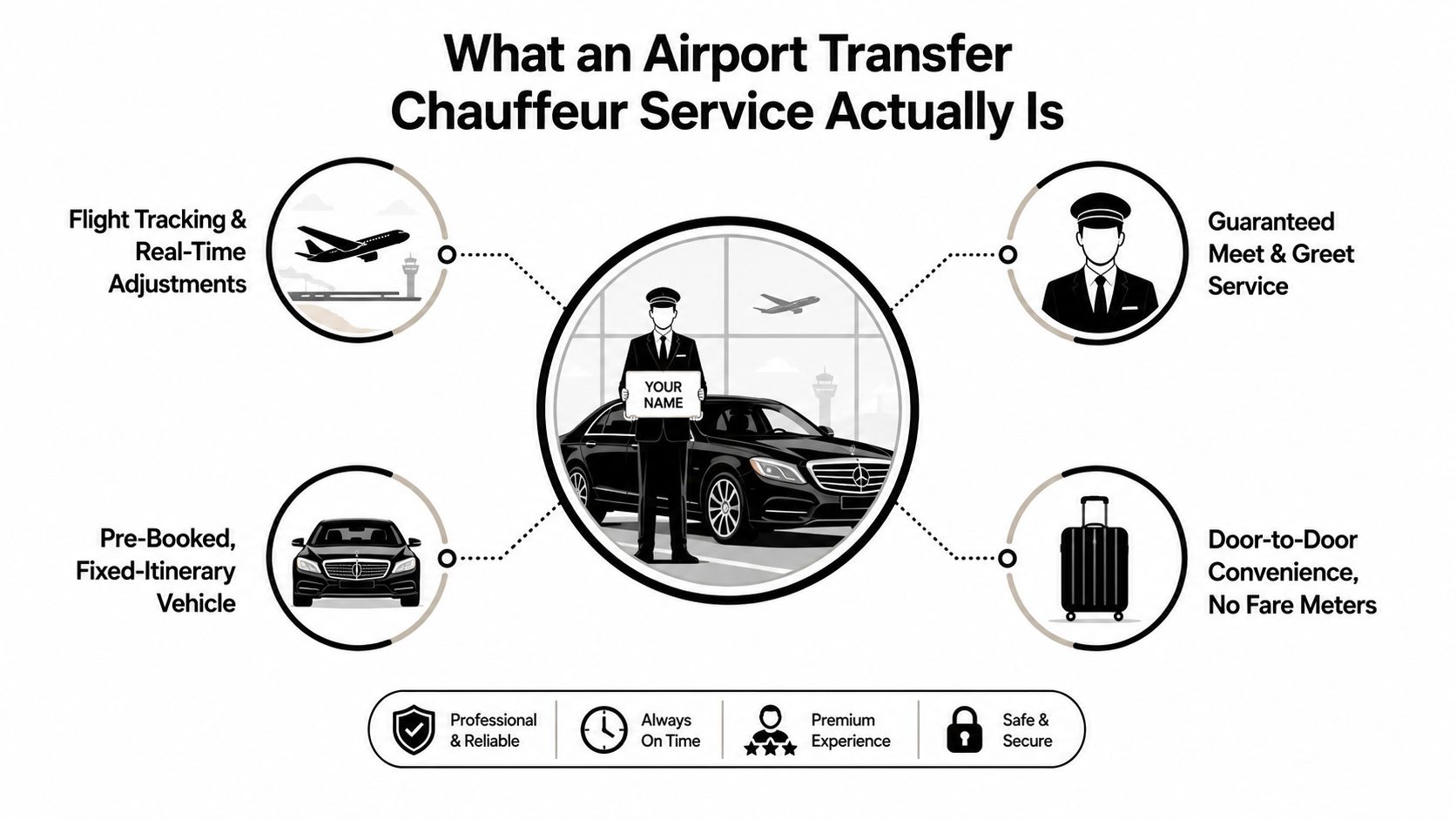
A real airport transfer chauffeur service is not just a nicer car. It's a pre-booked, flight-tracked, professionally driven service with a fixed itinerary, a named pickup plan, and a human being who already knows where you're going before you walk out of the terminal. That sounds basic until you compare it with rideshare, where the driver may cancel, the pickup point may change, and the price can move with demand.
A corporate traveler coming into O'Hare with two checked bags needs a different model than a solo rider heading across town. A family arriving late with a sleeping child needs a driver who waits, helps with luggage, and understands that a delayed bag carousel is not the passenger's problem. An event planner moving a wedding party or an executive team needs coordinated vehicles, not a stream of separate app cars that arrive at different times.
Where It Fits Best
Practical rule: if the trip has a flight number, a hard arrival window, or baggage that matters, book chauffeur service instead of improvising on arrival.
That's why this category exists as a distinct service. It sits between ordinary point-to-point transport and full private mobility management, and it works because the provider takes responsibility for timing, meet-and-greet, and vehicle assignment. The best operators treat airport pickup like an operational workflow, not a casual ride request.
The clearest use cases are straightforward. Solo business travel benefits from predictable billing and a quiet cabin. Families benefit from luggage help and a pickup plan that doesn't collapse when the flight lands early or late. Groups benefit from one dispatch system managing multiple passengers instead of asking everyone to “text when you land.” FBO transfers for private aviation clients are even more exacting, because the pickup window is tighter and the handoff point is usually more controlled than a commercial terminal.
If you only remember one thing, remember this. A legitimate airport transfer chauffeur service sells certainty, not just leather seats.
Why Corporate Travelers and Families Choose Chauffeur Transfers
Corporate travelers don't pay for the car. They pay to avoid operational mess. The ride has to happen on time, the invoice has to be predictable, and the pickup has to survive the usual airport chaos without the traveler having to negotiate with a driver in a curbside lane.
Reliability Beats Guesswork
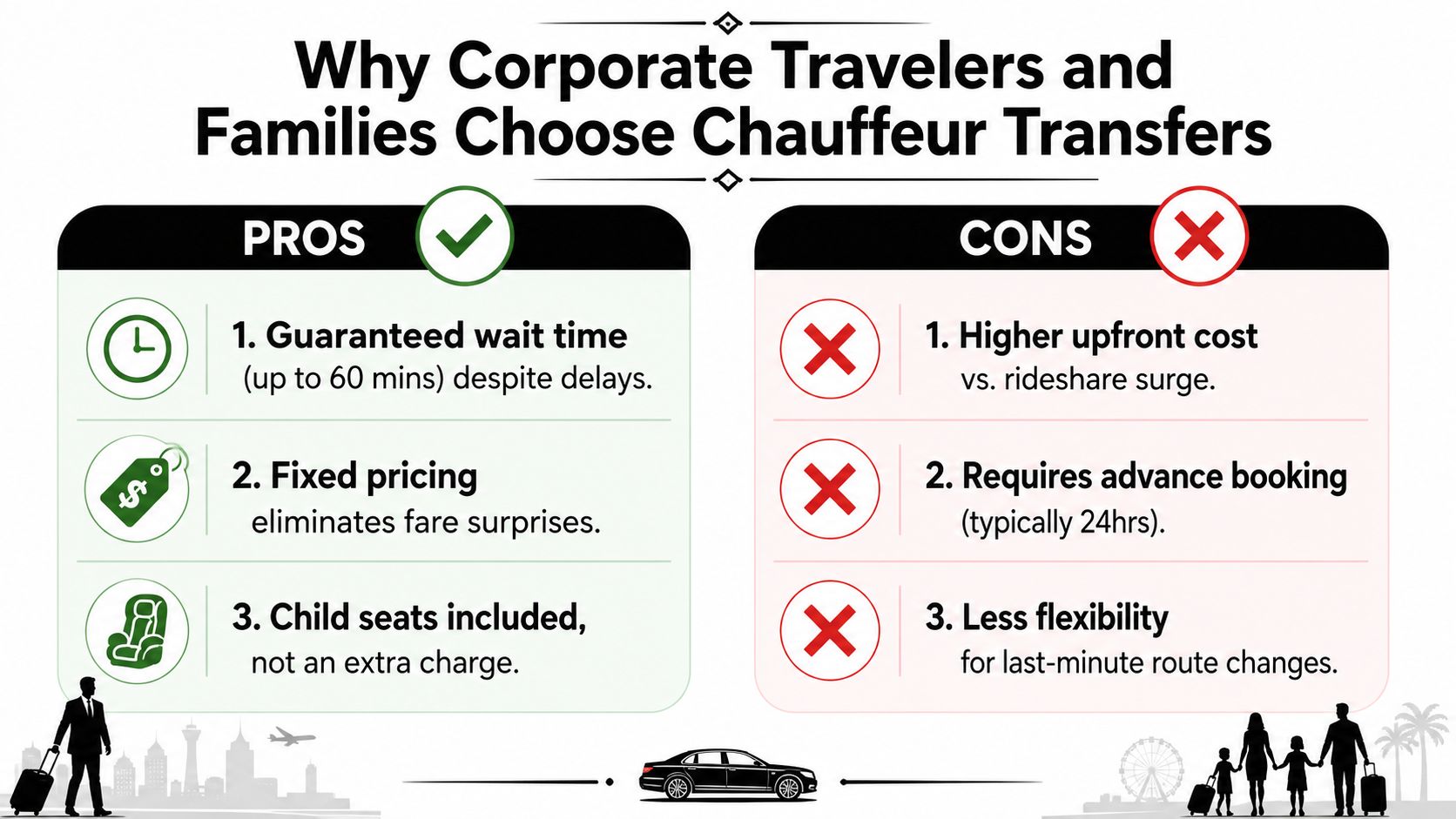
The strongest reason people choose an airport transfer chauffeur service is reliability. Industry guidance recommends flight tracking, 60 to 90 minutes of complimentary wait time from landing, and fixed-fare pricing with no surge component luxury chauffeur service guide. That combination matters because it turns uncertain arrival timing into a managed dispatch problem instead of a customer service fight.
Families feel this most sharply. A delayed flight, a bathroom stop, or a slow baggage carousel can wreck an app-based pickup if the driver is already impatient or the ride timer is ticking. Corporate travelers feel it differently. They need a receipt that matches the booking, not a messy reconciliation later, and they need the car to be there when the meeting ends or the client dinner runs long.
Comfort Is a Logistics Feature
Comfort gets talked about like a luxury, but in airport transfer work it's really a logistics feature. Luggage handling matters. Child-seat availability matters. A quiet cabin matters when someone is answering email after a red-eye. If you're moving a group, the vehicle choice matters even more because multiple passengers and multiple bags can turn a simple transfer into a coordination problem.
Bottom line: the premium is easiest to justify when the trip has low tolerance for failure, delayed flights, family logistics, executive duty-of-care, or a schedule where one missed pickup creates a chain reaction.
There's also the compliance angle. Travel managers don't choose chauffeur service only for comfort. They choose it because the service is easier to document, easier to invoice, and easier to defend internally when duty-of-care questions come up. The data on U.S. airport transportation demand supports that reality, with more than 819 million passengers traveling to or from U.S. airports in 2023 and 65.5 million using limousine services, according to an industry article citing those figures U.S. airport passenger transportation data.
If you're choosing between chauffeur transfers and a premium rideshare, ask one question. Which option still works when the flight is late, the terminal is congested, and the itinerary changes once already?
Fleet Options and Which Vehicle Fits Your Trip
Vehicle choice is where bad bookings happen. People underbook the size, overestimate comfort, and then act surprised when four adults and six bags do not fit neatly into a sedan. The right fleet choice is not about status. It's about capacity, baggage, and how much friction you're willing to tolerate.
Match the Vehicle to the Mission
| Vehicle Class | Passenger Capacity | Luggage Space | Best For |
|---|---|---|---|
| Executive sedan | 1 to 2 | Light luggage | Solo business travelers, quick airport runs |
| Luxury SUV | 3 to 5 | Moderate luggage | Families, small teams, heavier bags |
| Mercedes Sprinter or Sprinter limousine | 7 to 14 | Group luggage, mixed baggage | Corporate delegations, wedding parties, event groups |
| Executive shuttle or minibus | Mid-size groups | Practical group storage | Team transfers, multi-passenger airport runs |
| Full-size coach bus | Large groups | High-volume luggage | Conference arrivals, large event shuttles |
That's the cleanest way to think about it. If the traveler count is fixed and baggage is light, a sedan is efficient. If you have children, strollers, golf bags, or presentation cases, move up immediately. Nobody regrets a vehicle that's slightly too large, but plenty of people regret booking too small and then trying to solve the problem at the curb.
Dispatch Matters More Than the Badge on the Hood
A professional operator also has to manage overlapping bookings. If one flight is delayed and another lands early, fleet assignment has to shift without making the passenger feel like they've been forgotten. That's why mature providers stage spare capacity and keep vehicle classes flexible across their calendar.
Operationally, many companies fail. They sell premium transportation but don't reserve premium recovery options when timing slips. If you care about how good operators organize their assets across the day, fleet management best practices for 2025 is a useful reference point for thinking about maintenance, utilization, and dispatch discipline.
For airport work, the rule is simple. Book for the baggage, not just the bodies.
How Airport Chauffeur Pricing Really Works
Most travelers only hear the headline rate, then find out later that the bill had more moving parts than they expected. Pricing is where this category becomes either transparent or annoying, and the difference usually comes down to whether the operator is quoting a true transfer or treating it like a flexible ride.
What Actually Changes the Bill
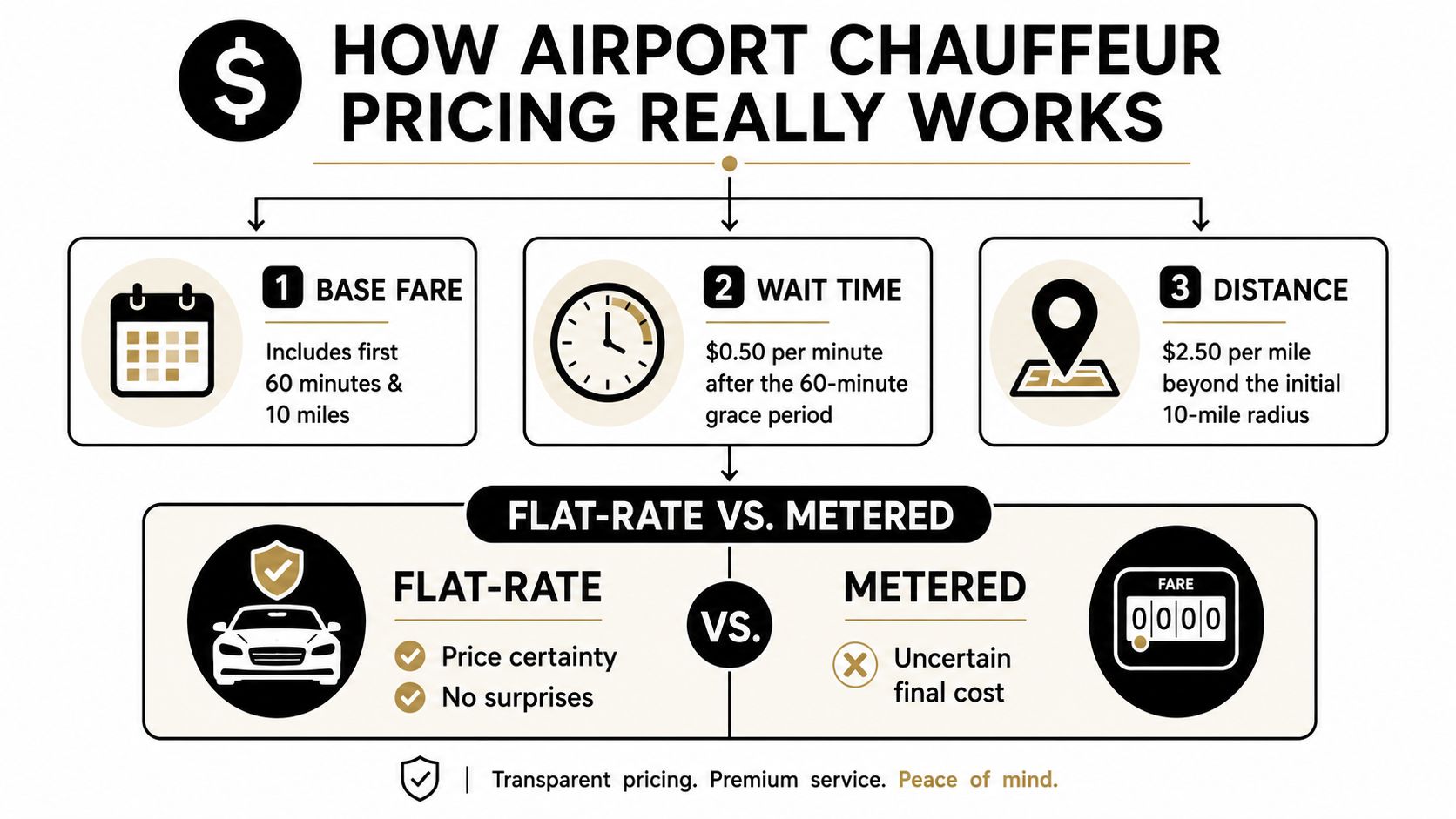
A solid airport transfer quote usually starts with a base fare, then accounts for wait time, distance, and any trip-specific conditions. If the company uses a flat fare, you get more certainty. If it uses metered logic, the final cost can drift when the flight is delayed, the curb is congested, or the route changes.
The hidden charges are usually the same ones. Late-night premiums. Parking when the driver has to wait longer than expected. Tolls. Return-trip rules that may or may not lower the per-leg price. On longer suburban-to-airport transfers, the quote can stop being simple altogether. One provider notes that trips over 75 miles require a personalized quote, which is exactly the point where standard flat-rate language starts to break down airport chauffeur service guide.
Ask These Questions Before You Book
- Is the fare fixed or metered? Fixed pricing is the safer choice for airport work because it removes surge uncertainty.
- How much wait time is included? You need the answer in writing, not as a vague comfort statement.
- What happens after hours? 24/7 availability is useful only if the dispatch coverage is staffed and the rate structure is clear.
- Are tolls and parking included? If not, ask how they're billed and when.
- Does a longer route require a custom quote? If the itinerary is outside the standard zone, don't assume the website price applies.
Rule of thumb: if the provider can't explain wait time, tolls, and late pickup handling in one clear sentence, the quote isn't finished.
For operators thinking about cost control and dispatch discipline, it helps to compare airport pricing with broader fleet planning. The logic is similar, keep utilization tight, reduce unnecessary dead time, and know exactly what you're charging for. For airport passengers, the takeaway is simpler. Never book a transfer on price alone if the terms are unclear.
How to Choose the Right Chauffeur Service Provider
Good providers are easy to spot if you know what to check. Bad ones look polished until the flight changes, the pickup point shifts, or the driver can't find the terminal entrance. You want evidence of operations maturity, not just a nice website.
Start With the Operational Basics
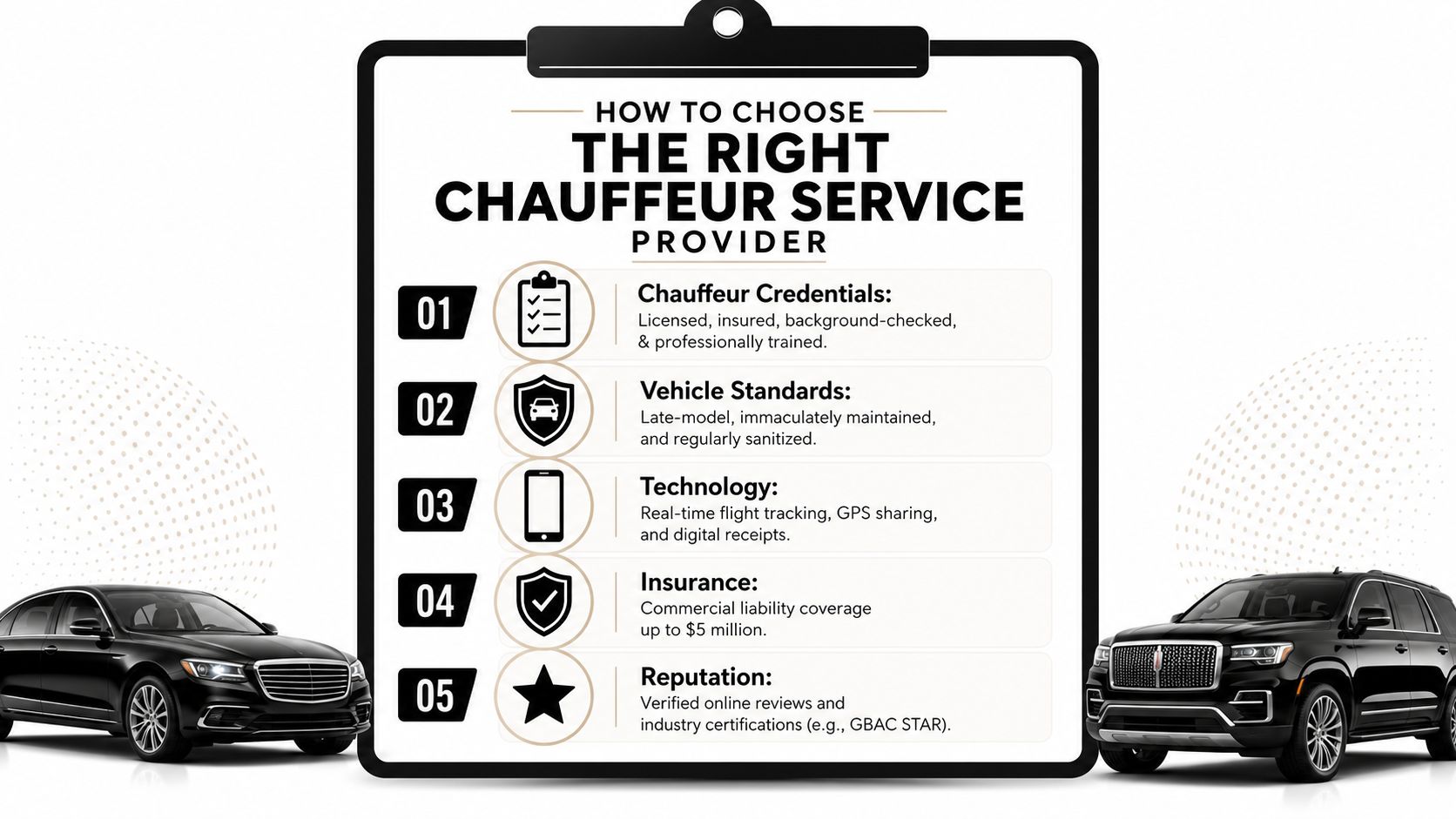
A legitimate provider should be able to explain chauffeur vetting, fleet maintenance, and insurance without stalling. The booking desk should know whether drivers are background-checked and trained, whether the vehicles are commercially insured, and how they handle digital receipts and communication.
That's not paperwork for the sake of paperwork. It's how you reduce failure points. If a company also offers flight tracking, automatic pickup adjustments, and complimentary wait time after landing, you're dealing with a provider that understands airport reality. If it only talks about luxury features and never mentions dispatch processes, keep looking.
Check Reviews for Patterns, Not Praise
A five-star average means less than the comment pattern underneath it. Read the language customers use when flights change, when luggage takes longer than expected, or when the pickup happened at an airport with complicated curb rules. Specific praise about responsiveness is more useful than generic compliments about a nice car.
A few signals separate decent operators from serious ones:
- Chauffeur Credentials: licensed, insured, background-checked, and professionally trained.
- Vehicle Standards: late-model, clean, and consistently maintained.
- Technology: real-time flight tracking, GPS sharing, digital receipts.
- Insurance: commercial coverage that's clearly documented.
- Reputation: repeat mentions of punctuality, clear communication, and problem resolution.
Max's Luxury Rides Inc. is one option in this category. It offers airport transfers, corporate travel, and event transport with executive sedans, SUVs, Sprinters, shuttles, minibuses, and coach buses, along with 24/7 reservations and airport coverage that includes O'Hare, Midway, and FBO transfers.
Don't book the provider that talks the best. Book the one that can describe exactly what happens if the flight lands early, lands late, or lands at the wrong terminal.
The right provider gives you clear cancellation terms, a live contact path, and a written pickup plan. If any of those are vague, treat that as a red flag.
Airport-Specific Logistics and Booking Strategies
Airport transfers get messy at the exact places many travelers assume are simple. Commercial terminals, private aviation facilities, and international arrivals all create different handoff rules, and a provider that handles one well doesn't automatically handle the others well.
Terminal Handoffs Aren't All the Same
At major airports like O'Hare and Midway, the pickup point matters as much as the car. Curbside access can change with congestion, construction, or airport restrictions, and a driver who knows the local flow will usually save you time and confusion. For private aviation clients, the FBO pickup is a different world altogether. The timing is tighter, the meet-and-greet is more exact, and the operator has to coordinate around a fixed ground handling environment.
International arrivals add another variable. Customs and baggage delays are normal, which is why the wait-time buffer described earlier matters so much. If the provider tracks the flight but ignores the reality of customs queues, it's only doing half the job.
Book Like the Trip Is Going to Change
The smartest booking strategy is to confirm the flight number, terminal, passenger count, luggage count, and contact method before the day of travel. Then reconfirm the pickup instructions about 24 hours before departure so nobody is guessing about where the handoff happens.
If you manage a route-heavy schedule and want a useful analogy, optimizing delivery routes is a good way to think about airport transfers. The point is the same, you're reducing wasted motion, avoiding bottlenecks, and choosing the sequence that keeps the whole operation stable.
For multi-passenger bookings, don't assume one confirmation covers everyone. Different flights, different terminals, and staggered landing times require separate timing notes. The best chauffeurs and dispatch teams handle these as coordination problems, not as simple ride requests.
The practical rule is blunt. Give the operator more information than you think it needs, because airports punish vague instructions.
Frequently Asked Questions About Airport Chauffeur Transfers
Are child seats available? Usually yes, but you should request them during booking and confirm the type you need. Don't assume a child seat is automatic just because the vehicle is premium. Safety and compliance should be explicit, not implied.
What happens if my flight is canceled or badly delayed? A proper service tracks the flight and adjusts pickup timing when the schedule moves. If the cancellation is same-day, you need the provider's change and cancellation policy in writing before you travel.
Are gratuities included? Sometimes they are, sometimes they aren't. Ask before the ride, because guessing at the curb is a bad habit and a worse expense policy.
How are group bookings coordinated? The driver or dispatcher should confirm vehicle count, arrival order, terminal location, and a single lead contact. If a provider can't manage that cleanly, it's not ready for event traffic or executive delegations.
Is chauffeur service really worth it over a premium rideshare? Yes, when the trip is time-sensitive, baggage-heavy, or tied to duty-of-care. It's less compelling for a short, flexible, low-stakes ride where surge risk is minimal and timing doesn't matter much.
If you're booking for a wedding, board meeting, family arrival, or private aviation pickup, stop comparing cars and start comparing how each company handles disruption.
The right answer depends on how much failure you can afford. If the trip can't absorb a missed pickup, don't buy the cheapest option and hope for the best.
If you want airport transfers handled with a dispatcher's discipline instead of guesswork, Max's Luxury Rides Inc. books airport, corporate, and group transportation with a full range of vehicles and 24/7 reservation support. Visit Max's Luxury Rides Inc. to review service options and reserve the transfer that fits your flight, your passenger count, and your schedule.