
You've just landed with a tired toddler, a folded stroller, several bags, and a transfer reservation that says only “family vehicle.” At the curb, the chauffeur arrives in a suitable car, but nobody can confirm whether the child seat is rear-facing, installed, or even inside the vehicle. That's the operational gap behind many airport transfers with car seats: a provider may legally transport your child without one, while your family still reasonably expects a safe, correctly fitted restraint.
Book the seat as a required safety item, not as a casual add-on. The details that matter are your child's size, the vehicle, the installation plan, and whether the same arrangement is confirmed for the return journey. This guide shows you how to specify all four before travel, including in destinations where taxi exemptions make the legal minimum much lower than the family-safety standard.
Why Car Seats Change the Airport Transfer Equation
At an airport pickup, families have little room for improvisation. A child may be overtired after a flight, luggage can block access to the back seat, and a stroller may need to fit beside suitcases. If the vehicle arrives without the correct restraint, you're forced to choose between delaying the journey, carrying the seat yourself, or accepting a setup you didn't intend to use.
That choice matters because child restraint systems materially reduce harm in passenger cars. Transportation safety authorities report that they reduce fatal injury risk by 71% for infants and 54% for toddlers ages 1 to 4. The same safety guidance reports that car seats saved 325 children under age 5 in a single year, while CDC data show that 43% of children killed in crashes weren't buckled up. These figures are documented by the National Highway Traffic Safety Administration's child passenger safety guidance.
The curbside decision
A car seat isn't comparable to complimentary bottled water or extra luggage space. It's part of the vehicle's safety system, and the correct choice depends on the child and the way the restraint fits the vehicle.
Practical rule: If you'd insist on having a booked airline seat for your child, insist on a confirmed vehicle restraint for the road journey too.
The distinction becomes even more important because airport travel contains several separate segments. A child may travel from home to the airport, through an aircraft cabin, from the arrival terminal to a hotel, and back again later. A device suitable for one segment may not work for another.
The broader planning principles in this ground transportation guide are useful, but families should apply one stricter rule to transfers: request the exact seat category, vehicle class, and installation arrangement in writing. A provider that says “child seats available” hasn't yet guaranteed that the right seat will be waiting at pickup.
Car Seat Categories and Age or Weight Rules
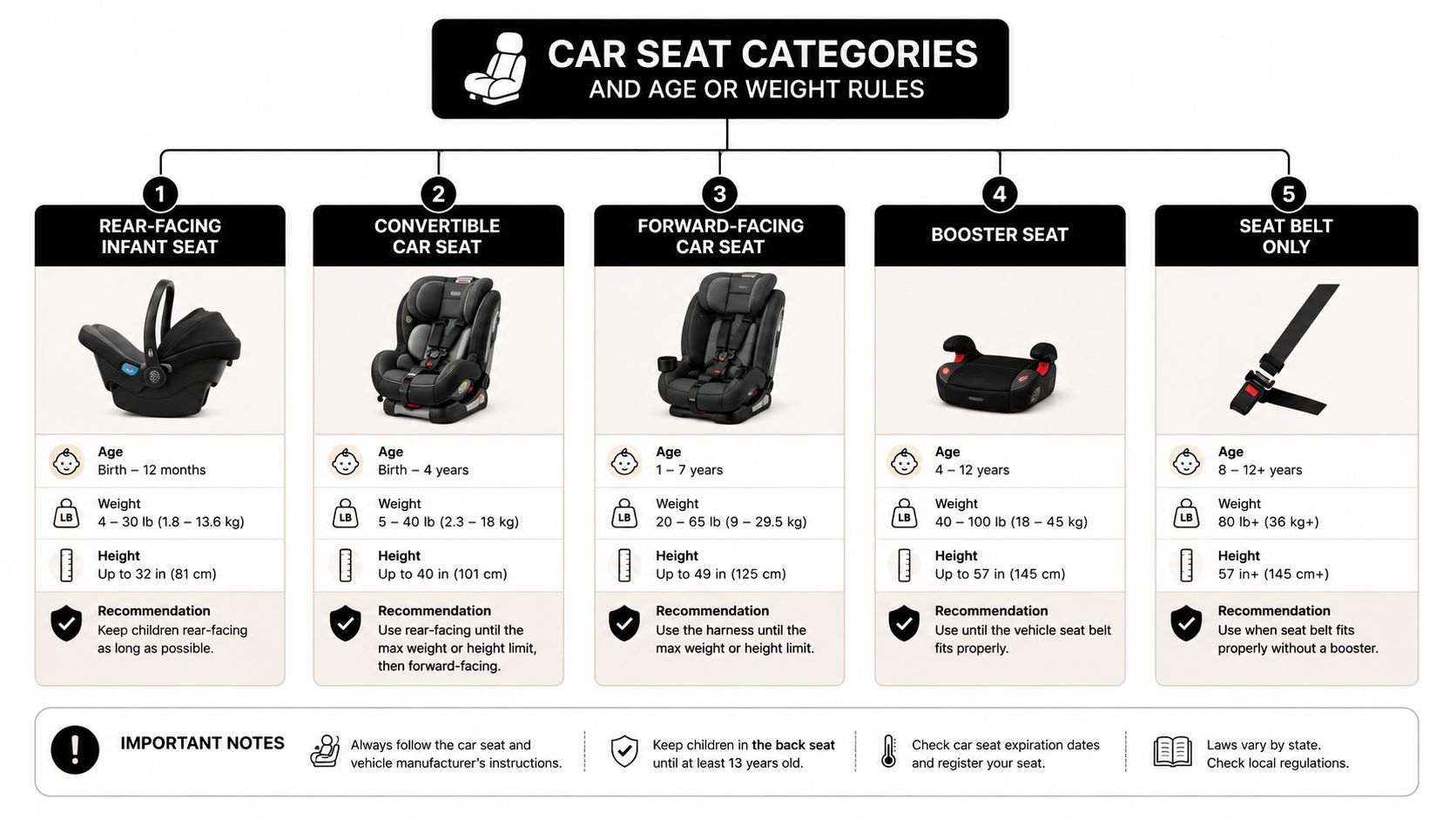
Start with the child, not the booking platform's generic “car seat” checkbox. The main categories are rear-facing infant seats, forward-facing toddler seats, and belt-positioning boosters. The correct selection depends on the child's weight and height limits, the seat manufacturer's instructions, and the applicable road rules.
A rear-facing infant seat supports a small baby whose head and neck still need the protection provided by that orientation. A forward-facing seat uses an internal harness for a larger child who has outgrown the infant seat but still needs more support than a vehicle belt can provide. A booster raises an older child so the vehicle's lap and shoulder belt cross the body correctly.
Match the restraint to the child
Don't rely on age alone. Two children of the same age may need different restraints because their height, weight, torso length, and seating position differ. Give the dispatcher the child's current measurements and ask the provider to select a seat within its manufacturer-approved range.
Use this booking language:
- Infant: “Please provide a rear-facing infant seat suitable for my child's current weight and height.”
- Toddler: “Please provide a forward-facing harness seat, subject to the manufacturer's limits for my child.”
- Older child: “Please provide a belt-positioning booster compatible with the vehicle's lap and shoulder belt.”
The FAA makes another distinction that parents often miss. Its guidance says the safest place for a child under 2 on an airplane is an approved child car seat or similar device, with the device appropriate for the child's weight. That recommendation appears in the FAA's child safety seat guidance.
Aircraft approval doesn't equal road approval
CARES, the FAA-approved child restraint, is approved for all phases of flight, including taxi, takeoff, landing, and turbulence. The FAA also states that CARES is approved only for aircraft use, not motor vehicles, as explained in its kids' travel safety information.
That means an aircraft-approved restraint may still be unusable during the airport transfer. If your family brings one for the cabin, separately arrange a vehicle-compatible seat for the road. Tell the provider whether you're carrying an aircraft restraint, because that detail prevents the chauffeur from assuming the cabin device will cover the ground journey.
Legal Requirements and Taxi Exemptions Across Markets
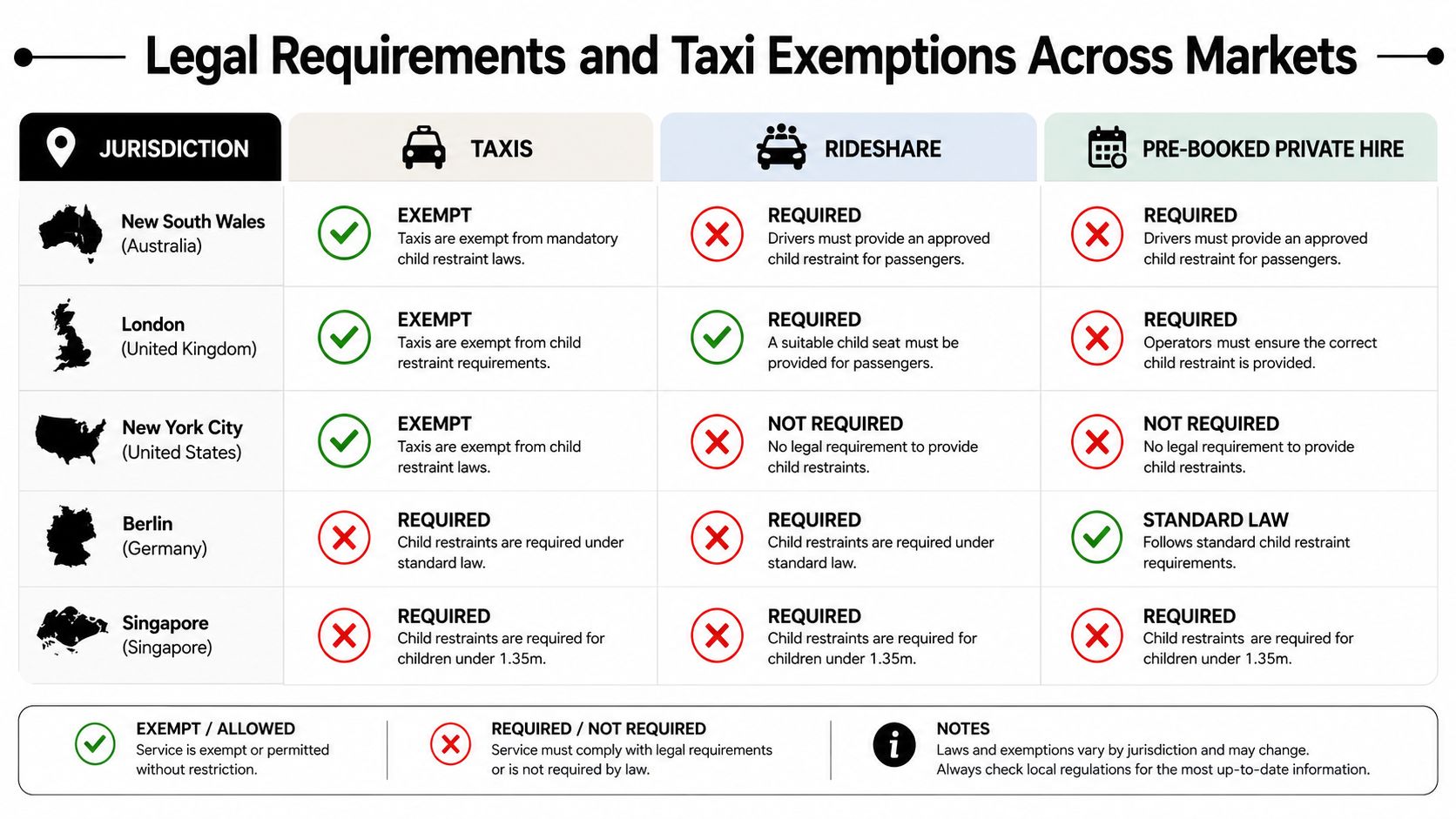
Taxi law can create false reassurance. A vehicle may be permitted to carry a child without the restraint your family expects, especially when the service is classified as a taxi rather than a private pre-booked transfer. Legal compliance is the floor. It isn't automatically the safest booking decision.
New South Wales illustrates why the child's age must be stated before pickup. Official guidance says children under 1 year can't travel in a taxi unless they're secured in a suitable approved child restraint. The guidance also provides age-based options for older children and tells airport arrivals who need a restraint to contact the taxi rank marshal. Families should consult the New South Wales child restraint guidance for point-to-point vehicles for the current local framework.
North Carolina takes a different approach. Its guidance explicitly says taxis and rideshare vehicles aren't exempt from child passenger safety law. A ride that appears identical to a Sydney taxi journey can therefore have a different legal baseline in North Carolina.
Compare the service types before booking
| Service type | What families should confirm |
|---|---|
| Street taxi | Whether local law provides an exemption, and whether the driver actually carries the required restraint |
| Rideshare | Whether the specific vehicle and jurisdiction follow ordinary child-passenger rules |
| Pre-booked private hire | Whether the provider guarantees the requested seat, vehicle class, and installation before dispatch |
The United Kingdom and Japan also demonstrate the difference between law and family preference. Licensed taxis and private hire vehicles in the UK are exempt from the child-seat requirement, and taxi or hire-car use in Japan is also exempt. Those exemptions may make an on-demand ride legal, but they don't make it equivalent to a transfer with a correctly installed restraint.
Booking standard: Ask, “Will the exact seat type be physically installed in the vehicle before pickup, and is that guarantee valid for the return trip?”
If the answer is vague, choose another arrangement. A provider's legal exemption shouldn't decide your child's restraint strategy.
How Premium Providers Supply and Install Child Seats
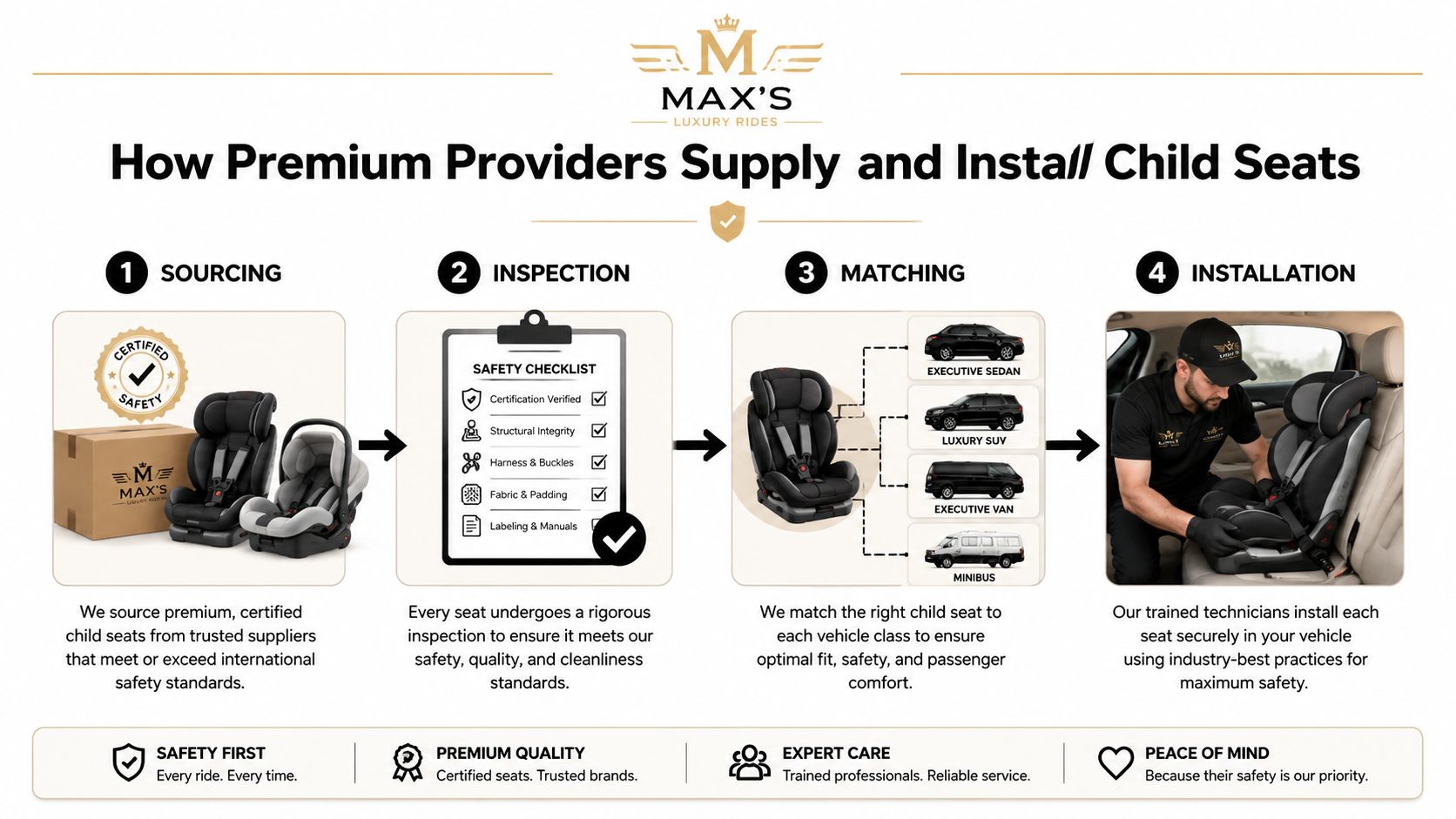
A reliable child-seat transfer begins before the chauffeur reaches the terminal. The operator needs to obtain suitable seats, inspect them, assign them to a vehicle with compatible seating and belts, and make sure the installation plan is understood by the person handling pickup.
Max's Luxury Rides uses a useful operational model for this kind of service. Its fleet includes executive sedans, luxury SUVs, Mercedes vans, Sprinter limousines, executive shuttles, minibuses, mini coaches, and full-size coach buses. That range matters because a seat that fits one vehicle class may not be practical in another, especially when families also carry strollers and luggage.
Four checks behind a properly prepared transfer
Sourcing comes first. The provider should maintain a dependable supply of approved infant, toddler, and booster seats rather than search for one after receiving a booking. Families should ask whether the requested category is reserved specifically for their trip.
Inspection protects against damaged, incomplete, or poorly maintained equipment. A professional process should include checking the harness, buckle, belt path, padding, labels, and overall condition before the seat enters service.
Matching connects the restraint to the vehicle. An executive sedan may work for one child and modest luggage, while a luxury SUV or Mercedes van may be more appropriate for siblings, a stroller, and several bags. Larger groups may need a Sprinter, minibus, or coach rather than forcing multiple restraints into a crowded passenger compartment.
Installation should happen before the family reaches the vehicle. The chauffeur or trained affiliate needs to secure the seat using the vehicle's available restraint system, then check that it's stable and positioned correctly. The parent should still inspect the harness fit on the child before departure, because the final adjustment depends on the child's clothing and body size.
The video below provides additional visual context for the preparation process.
Ask who performs the installation, whether chauffeurs receive child-restraint training, and how affiliates follow the same procedure. If the answer is “the driver will figure it out,” the provider hasn't built a dependable system.
Reservation Checklist for a Guaranteed Child Seat
The booking form should contain more than a passenger count. A dispatcher can't choose a safe restraint from the words “one child,” and a chauffeur can't solve an undisclosed stroller or luggage problem at the curb without affecting the available seating.
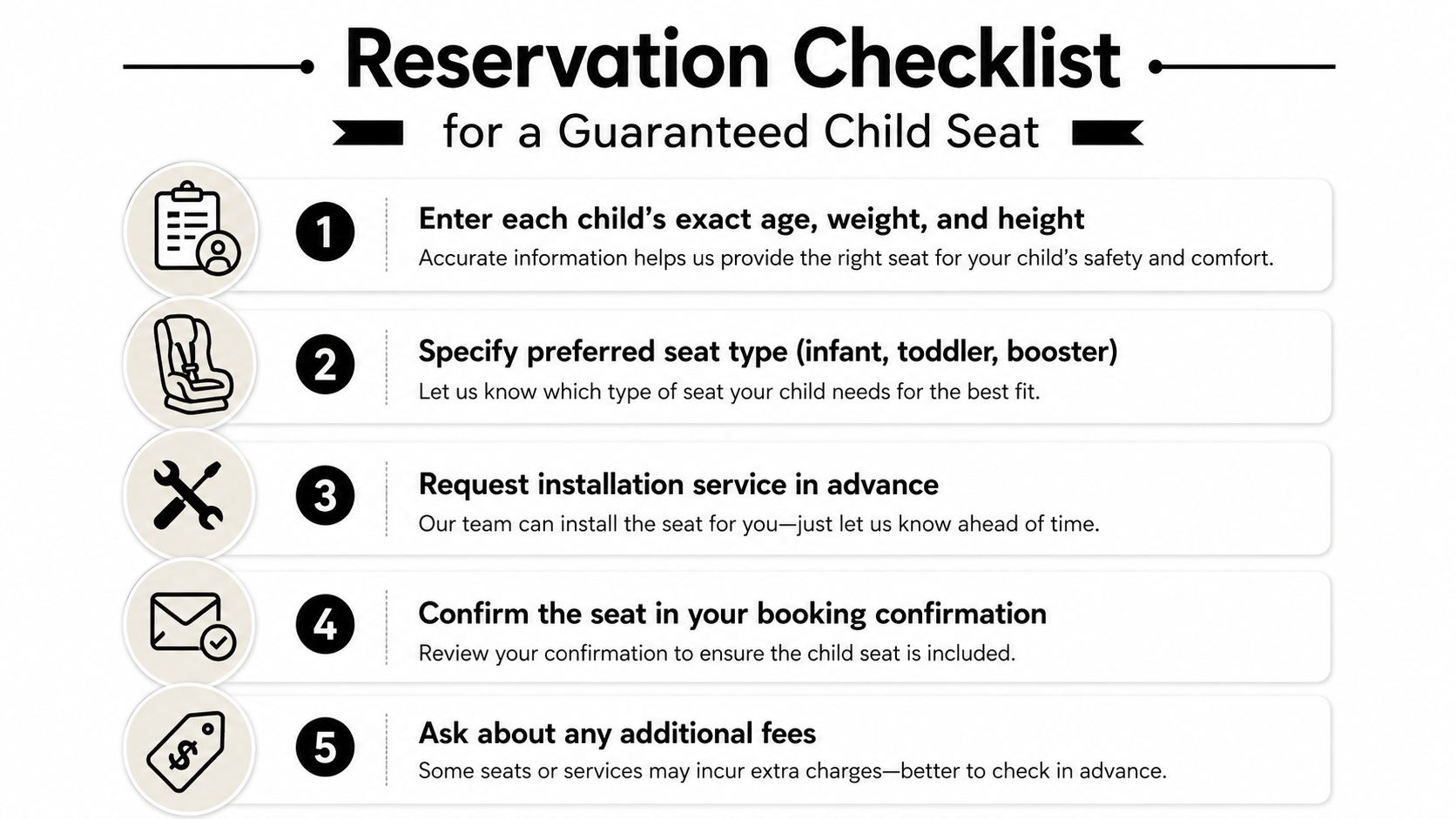
Use this checklist when you reserve:
- Enter each child's exact details. Provide age, current weight, and height for every child. Don't group siblings under one note.
- Name the preferred category. State infant rear-facing seat, toddler harness seat, or booster, then ask the provider to confirm suitability.
- Declare the equipment load. List strollers, car seats you're bringing, large suitcases, sports equipment, or other bulky items.
- Provide flight information. Include the flight number, terminal, arrival or departure date, and mobile contact details so the provider can manage the meeting point if the schedule changes.
- Book both directions together. State clearly that the restraint is required from the airport and for the return transfer, with the same or an agreed equivalent category.
Copy and paste this request
“We need airport transfers with car seats for two children. Child one is [age], [weight], and [height], and needs [seat category]. Child two is [age], [weight], and [height], and needs [seat category]. We'll have [number] stroller[s] and [number] luggage pieces. Please confirm the vehicle class, that both seats will be installed before pickup, who will check the installation, and that the same requirements are confirmed for the return trip.”
Request written confirmation that repeats the seat types. Ask whether a seat fee applies, whether installation is included, and what happens if the assigned vehicle changes. A generic confirmation saying “family transfer booked” isn't enough.
Confirm the vehicle class rather than accepting “van.” A van may have the right passenger capacity but insufficient luggage space, or a seating layout that makes two restraints difficult to install. If the provider can't guarantee the vehicle and seat arrangement, ask for a larger class or separate vehicles.
International Travel and Multi-Child Logistics
International itineraries require a segment-by-segment plan. The same family may face one rule at the departure airport, another after landing, and a different expectation for the return journey. Don't assume that a legal taxi exemption in one destination will apply to a pre-booked vehicle elsewhere.
Build a simple matrix for each ride:
| Question | Record before payment |
|---|---|
| Who is traveling? | Each child's age, weight, and height |
| What restraint is needed? | Infant, toddler, or booster category |
| What vehicle works? | Sedan, SUV, van, Sprinter, minibus, or coach |
| What must fit? | Seats, strollers, luggage, and mobility equipment |
| What happens on return? | Same seat category, same vehicle class, and new flight details |
Sibling groups often expose weak booking systems. One child may need an infant restraint while another needs a booster, and a single-seat vehicle offer won't solve that configuration. Event planners arranging transportation for wedding guests or corporate travelers with children should collect child-seat requirements alongside passenger names, not as a last-minute note.
Separate vehicles can be the safer operational choice when several seats, strollers, and luggage compete for the same cabin. A larger vehicle may work if the provider can confirm compatible seating and enough storage, but capacity on paper doesn't guarantee a workable installation layout.
Families traveling with babies should also plan the terminal experience, not only the vehicle. A practical resource such as this baby changing tables guide can help you anticipate care stops before a long transfer or connection.
For return trips, ask the provider to store the complete itinerary, not just the outbound request. Reconfirm the pickup location, flight number, seat category, and vehicle assignment before leaving the destination. That prevents a carefully arranged arrival transfer from becoming an improvised departure ride.
Common Questions About Airport Transfers with Car Seats
Can I bring my own car seat?
Yes, but tell the provider in advance. Confirm that the seat is suitable for the vehicle, that the chauffeur will allow time for installation, and that you still have a compatible restraint for the return leg. An aircraft-approved device isn't automatically suitable for a motor vehicle.
What happens if my flight is delayed?
Give the provider your flight number and ask how they monitor schedule changes. Confirm whether the chauffeur adjusts the pickup time or whether you must contact dispatch after landing. Don't assume a generic airport taxi queue will preserve a prearranged seat.
How are boosters handled for older children?
State that you need a belt-positioning booster, not just a “child seat.” The vehicle must also provide a compatible lap and shoulder belt, and the child should be positioned according to the booster manufacturer's instructions.
How do I confirm the return trip?
Book both legs in one reservation and request written confirmation of the seat category for each direction. Before departure, ask the provider to reconfirm the return vehicle, installation responsibility, and child details.
Should I use an on-demand taxi with an exemption?
Only if you've deliberately accepted the safety tradeoff. Families who want a restraint should pre-book a service that names the seat, vehicle, and installation plan. For wider arrival planning, a 3rd-i personal safety app may complement your transportation arrangements, but it doesn't replace a properly fitted vehicle restraint.
“Please confirm that the requested infant, toddler, or booster seat will be installed before pickup on both legs. If the vehicle or seat changes, contact us before dispatch.”
Max's Luxury Rides Inc. offers pre-arranged airport transportation with infant, toddler, and booster seats available by request, along with vehicles ranging from executive sedans and SUVs to Mercedes vans, Sprinter limousines, minibuses, and coaches. Send your children's measurements, luggage details, flight information, and return-trip requirements when you visit Max's Luxury Rides Inc. to request a transfer that's planned around the right seat and the right vehicle.