
Bleisure travel is mainstream now, with 42% of consumers planning a bleisure trip in 2025. That's not a perk for a few senior road warriors anymore, it's a normal travel behavior, and the key question is how to manage it without creating expense, insurance, and logistics problems.
Bleisure used to mean “stay a weekend after the conference.” Today it covers weekend extensions, early arrivals, and family-inclusive trips that blend meetings with personal time. The practical challenge isn't definition, it's execution, especially when finance teams, managers, and travelers all need clean rules for what gets booked, billed, insured, and moved around a city.
What Bleisure Travel Means in 2026
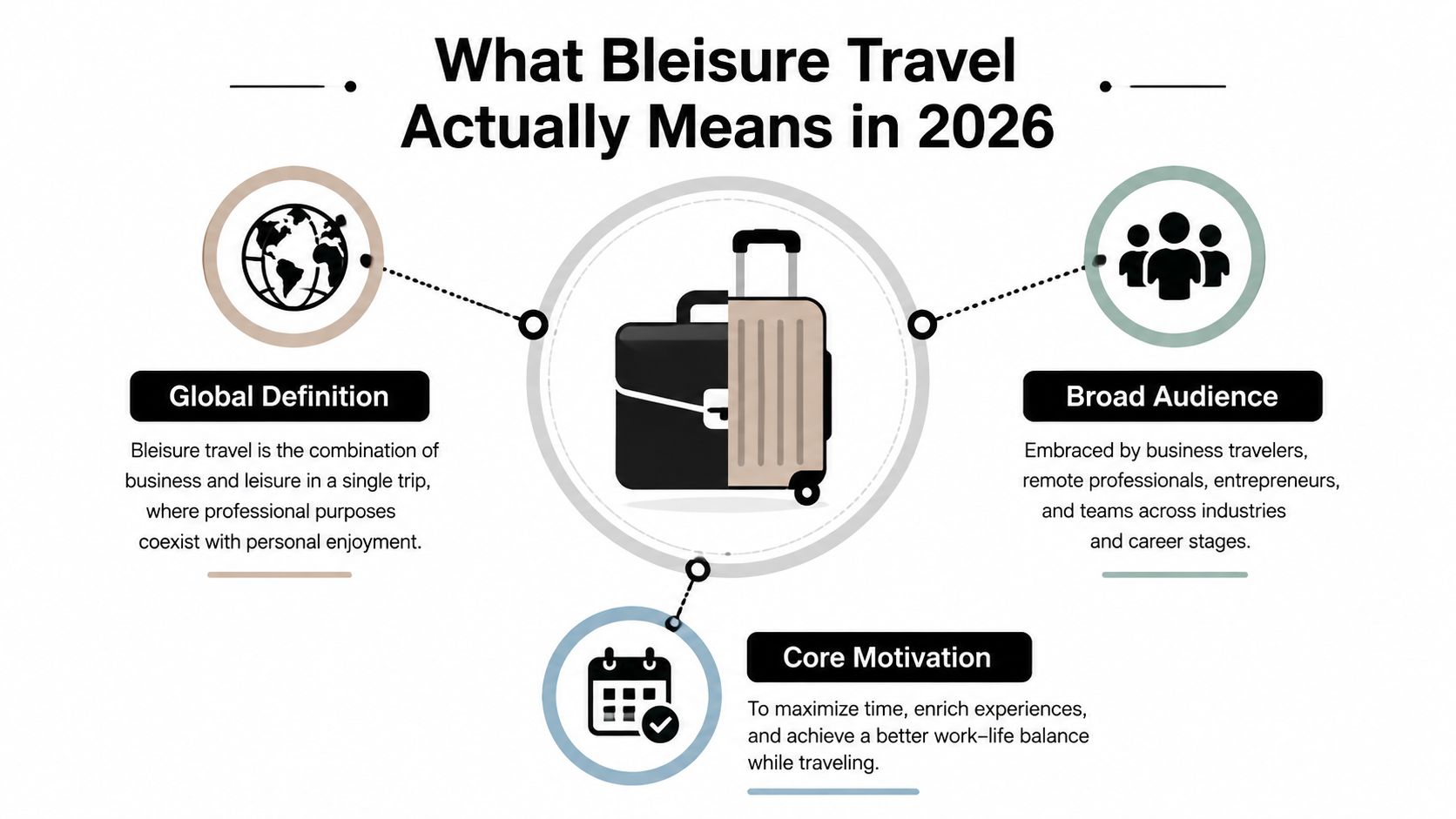
Bleisure travel means combining a business trip with personal leisure time in the same itinerary. In practice, that usually shows up in three forms, a weekend extension after meetings, a pre-trip add-on to arrive early and settle in, or a post-trip extension to stay longer once the work is done.
The behavior is clearly mainstream. Expedia Group's 2025 Traveler Value Index reported that 42% of consumers planned a bleisure trip, up from 29% in 2023, a 13-point increase in two years, which tells you this isn't a fringe habit anymore, it's a travel norm for a broad slice of working adults. That also explains why people who used to separate “work trips” and “vacations” are now treating them as one connected journey, especially when flexibility makes that easier.
The working definition you should use
A clean way to explain it is this. Business travel covers the work obligation, while bleisure adds personal time around that obligation without turning the whole trip into a vacation. That distinction matters because the trip can still be business-first even when it includes leisure.
Practical rule: If the meeting is the reason the trip exists, and the sightseeing comes after, it's bleisure travel. If the person is working remotely from a leisure destination with no real business anchor, that's closer to a workation.
That's why the phrase “blend travel with work” gets used so often in discussions of mixed-purpose trips, and it is a useful framing if you are explaining the concept to a manager or finance team. For a plain-language primer in a related context, Madeira Remote's guide on blend travel with work is a useful comparison point.
Who's doing it now
This isn't limited to executives. Bleisure now spans consultants, sales teams, conference attendees, and employees who don't want to waste a destination they've already flown to. The audience widened because remote-friendly policies and hybrid work changed the culture around being away from home.
The cleanest way to differentiate bleisure from a traditional business trip is intent. Traditional business travel ends when the meeting does. Bleisure keeps the work purpose intact, then adds personal time around it, usually in a short, manageable extension rather than a full second vacation.
Market Size and Why Bleisure Is a Core Travel Segment
The market data makes one point very clearly, bleisure is too big to dismiss as a side behavior. Fortune Business Insights estimated the global bleisure travel market at USD 762.01 billion in 2025 and projected it to reach USD 2.21 trillion by 2034, with a 12.69% CAGR over that period, according to Navan's summary of the market estimates. Precedence Research placed the category at USD 816.24 billion in 2025 and projected growth to about USD 4.06 trillion by 2035 at a 17.40% CAGR, while Grand View Research estimated USD 933.31 billion in 2022 rising to USD 2.33 trillion by 2030 (Navan's bleisure travel statistics roundup).
The exact figure matters less than the signal. All three research houses are describing a category measured in hundreds of billions, with multi-trillion-dollar projections on the horizon. That's the point where suppliers, travel managers, and corporate policy teams should stop treating bleisure as an exception and start treating it like a core segment of business travel.
What the size tells you operationally
Big categories change supplier behavior. Hotels adjust inventory, airlines protect mix, and ground-transport providers start seeing more airport-to-hotel-to-event movement with leisure extensions layered on top. In major corporate travel regions such as North America and Europe, that scale is enough to shape how travelers book, how companies reimburse, and how destination services are packaged.
Here's the simple takeaway. When a travel behavior becomes this large, every friction point becomes expensive. If a policy is vague, finance feels it. If ground transport is inconsistent, the traveler feels it. If a hotel stay is booked without considering the leisure extension, the whole itinerary gets messy.
| Research Firm | 2025 Valuation (USD) | Forecast Endpoint (USD) | Implied CAGR |
|---|---|---|---|
| Fortune Business Insights | 762.01 billion | 2.21 trillion by 2034 | 12.69% |
| Precedence Research | 816.24 billion | about 4.06 trillion by 2035 | 17.40% |
| Grand View Research | not specified in 2025 | 2.33 trillion by 2030, from 933.31 billion in 2022 | not specified |
Why corporate travel programs should care
Bleisure's scale makes it a policy issue, not just a traveler preference. Once enough employees are extending trips, companies need clear rules for what's allowed, what's reimbursable, and what happens when the trip stops being strictly business. Suppliers should be planning for mixed-purpose demand, and buyers should be pricing for it instead of pretending it's a rare edge case.
Trip Length Patterns That Shape Your Itinerary
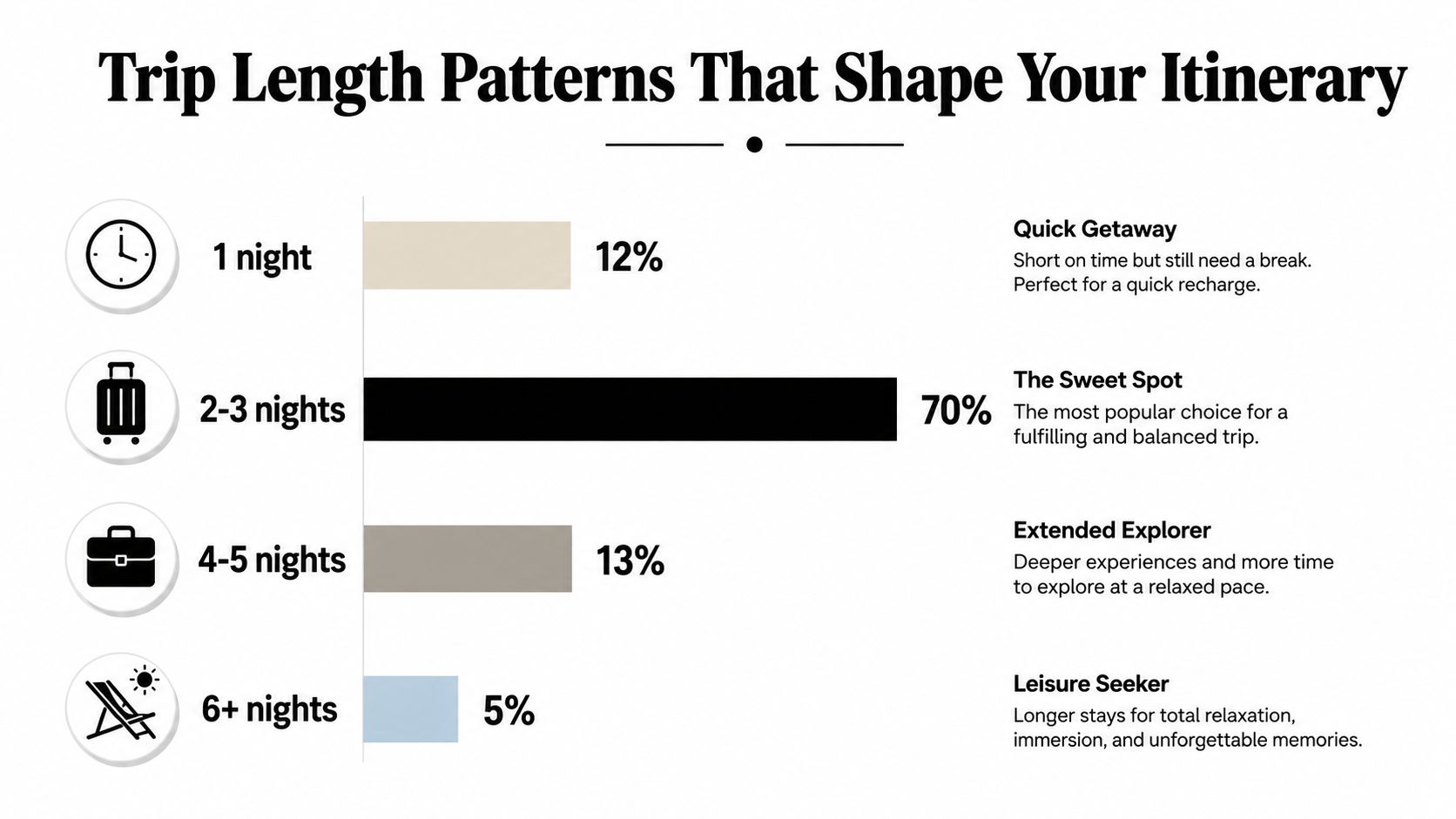
Bleisure trips skew short, and that is exactly why the itinerary has to be tight. Most travelers are attaching a leisure tail to a business trip, not building a second vacation around it, so the schedule has to respect both halves of the trip. Marriott reported a 20% increase in average business stay length in 2023 versus 2019, and the same industry data set shows 70% of bleisure trips last 2 to 3 nights, 12% last one night, and 17% last four nights or more (HotelTechReport's bleisure statistics).
That pattern changes the logistics immediately. You are not absorbing a weak transfer inside a long stay. You are managing a compressed trip where airport arrivals, same-day meetings, late checkout, and departure windows all have to line up without waste.
Why the short tail matters
A traveler who adds two days at the end of a conference does not need a new philosophy, they need a clean handoff between work time and personal time. The leisure block usually comes after the meetings, which means the last work transfer, hotel checkout timing, and return ride home need to be planned with more care than usual.
The same data set also reports an average spend of USD 1,566 per bleisure trip (HotelTechReport's bleisure statistics). That is the warning sign. Small changes in the itinerary can push ancillary spend up fast, and the difference shows up in the vehicle choice, dining plan, and transfer sequence. A better ride and a cleaner handoff often improve the trip more than another night of luxury branding ever will.
What this means for scheduling
Use the itinerary window aggressively. If meetings run late, do not stack a complicated evening activity on top of them. If departure is early, keep the final leisure block light and close to the hotel. Bleisure works best when the work day has a hard boundary and the leisure day starts without friction.
For meeting-heavy trips, the venue choice matters too. If you are coordinating a corporate event, a conference-room rental, or a client session, a resource like top corporate meeting spaces can help you plan the business segment without crowding the leisure side of the trip.
Short bleisure trips work when the traveler does not have to think about transport twice. Every extra transfer steals time from the only part of the trip that feels personal.
Corporate Policy, Expenses, and Insurance for Mixed Trips
This is the part most bleisure content skips, and it is the part finance teams care about most. Once a trip mixes business and personal time, the company has to separate cost, documentation, and coverage with discipline. Ramp's guidance is straightforward, the business portion needs separate receipts and a comparable business-only fare for flights, while personal extension costs belong to the employee and insurance can shift during personal days (Ramp's bleisure travel guidance).
A clean policy saves arguments later. If the traveler books one itinerary for work and leisure, finance still needs a clear split between reimbursable business expenses and personal add-ons. That means the company should define the business portion before departure, not after someone returns with a mixed stack of receipts.
What should be expensed and what should not
The rule is simple, business costs are reimbursable, personal add-ons are not. That sounds obvious until a traveler books a flight that is pricier because of a weekend extension, or keeps one hotel folio open across both the business and leisure portions of the stay. The cleaner the separation, the fewer disputes finance has to sort out later.
Here's the standard employees should follow:
- Flights: keep a record of the comparable business-only fare, because the employer covers the work portion, not the personal extension.
- Hotel nights: separate the nights tied to meetings from the nights added for personal time.
- Meals and local transport: reimburse only what maps to business days and business purpose.
- Receipts: keep them separated by date and purpose, not dumped into one folder and explained later.
The expense policy also needs to be blunt about mixed receipts. If a traveler pays for dinner after a client meeting and then stays out for personal sightseeing, the business meal should be documented on its own. If a hotel stay includes one work night and two leisure nights, the folio should be split the same way. That is the level of discipline that keeps mixed trips from turning into reimbursement disputes.
Why insurance needs a hard boundary
Coverage does not automatically follow the traveler into personal days. That is the trap. The employee may assume corporate insurance still applies because the trip started as business travel, but the coverage line can change once the itinerary becomes personal. The policy has to say, in plain language, when business coverage ends.
Practical rule: If a traveler adds leisure days, assume every protection, reimbursement, and duty-of-care assumption has to be rechecked before departure.
Booking's 2026 roundup says corporate travelers are widely planning to add leisure time to business trips, and international work trips are increasingly being extended for personal time. That level of adoption means ambiguity is no longer acceptable. The policy has to be readable, and the traveler has to know exactly what happens if the trip is extended.
The same logic applies to pets and dependents. If a traveler brings family or a companion, the company cannot assume the same coverage terms still fit the trip. Passpaw's explanation of what pet insurance covers is a useful reminder that coverage always depends on the terms, not the assumption.
Family-First Bleisure and the Group Logistics Problem
Bleisure is no longer just a lone traveler adding a weekend. More reporting now describes it as moving into family-first workcations, which changes the unit of planning from one employee to a small group itinerary. When spouses, children, or friends come along, the trip stops being a simple business extension and becomes a coordination exercise.
The transport implications are immediate. A solo executive can get by with a sedan. A family with luggage, gear, and shifting schedules needs a different vehicle class entirely. Once the itinerary includes companions, luggage capacity, pickup timing, and room for child seats or extra bags become operational requirements, not nice-to-have details.
Why the solo-traveler model breaks down
A family-inclusive bleisure trip adds friction at every handoff point. Airport arrivals take longer. Event transfers need more timing flexibility. City touring after meetings works only if the transportation partner can handle multiple stops without forcing the traveler to rebook each leg separately.
That's why a single ground-transport partner matters more than many travelers admit. One booking can cover airport pickup, hotel transfers, dinner transport, and sightseeing movement, which is much easier than stitching together ride-hail apps, hotel cars, and local taxis. For multi-person itineraries, consistency beats improvisation every time.
If a trip includes more than one traveler, the logistics problem is no longer “how do I get there.” It's “how do I move everyone without wasting the business part of the day.”
What planners should ask before booking
- Who is traveling: one person, a spouse, children, or a small group.
- What gets packed: business gear, leisure luggage, or family items that change vehicle needs.
- When transfers happen: early morning, after-hours, or around meetings.
- How much flexibility is needed: if plans shift, can the transport provider absorb it without chaos?
That's the hidden shift in bleisure. The trip is no longer judged only by the hotel or the destination. It's judged by whether the family or companion segment feels effortless while the traveler is still responsible for business obligations.
Planning a Sample 3-Night Bleisure Trip
A good 3-night bleisure trip runs on discipline, not spontaneity. The traveler arrives, finishes work, protects the personal extension, and leaves without turning expense reporting into a puzzle. That's the only way the common 2-to-3-night pattern stays clean enough for finance and comfortable enough for the traveler.
A workable Monday-through-Thursday structure
Day 1, arrival and transfer. Book the airport pickup before the trip starts, especially if the flight could land early or late. The traveler goes straight to the hotel, checks in, and keeps the first evening open unless the work schedule absolutely demands a dinner meeting.
Day 2, meetings. Use one transport provider for hotel-to-meeting movement so the business purpose stays obvious in the record. If there are multiple stops, keep the itinerary tight and avoid unnecessary detours.
Day 3, personal time starts. Finish the final meeting, then switch the mindset from corporate transport to leisure movement. If there's sightseeing, dinner, or a show, it should be booked as a separate personal block.
Day 4, departure. Keep checkout and airport transfer simple. Don't pack a busy morning around a flight unless the return window is generous.
How to keep the records clean
The trip gets messy only when the traveler blurs the day types. Separate receipts by date, mark the business purpose on work-day expenses, and keep personal bookings out of the business file. That makes reimbursement easier and protects the traveler if finance asks for support later.
A clear split also helps with ground transport. If one provider handles the business transfers and the personal side separately, the itinerary stays readable. If you're moving between meetings, hotel, and airport, a chauffeured vehicle beats ride-share uncertainty because the timing is fixed and the handoffs are predictable.
Ground Transport as the Unifying Logistics Layer
Ground transport is the piece that makes bleisure feel either polished or chaotic. Most travelers obsess over the hotel and then improvise the moves between airport, meetings, dinner, and leisure plans. That's backwards. The vehicle is the thread that holds the whole mixed-purpose trip together.
For solo executive bleisure, a chauffeured executive sedan or luxury SUV is the right fit because it keeps the trip efficient and private. For family or small-group bleisure, Mercedes vans and Sprinter limousines make more sense because they handle luggage, companions, and schedule changes without turning every transfer into a separate decision. For corporate teams traveling together, executive shuttles and coach buses are the practical scale-up, especially when meetings, offsites, or event blocks are grouped close together.
Why one provider reduces friction
A single provider can handle airport arrivals, hotel transfers, event movement, and the leisure segment without forcing the traveler to juggle separate vendors. That matters when the day starts at the terminal, moves through meetings, and ends at a concert, sporting event, or dinner reservation. One booking also reduces the chance that the traveler gets stranded between business and personal plans because each leg is managed differently.
Max's Luxury Rides Inc. fits naturally into that workflow because it provides 24/7 operations, airport transportation for O'Hare and Midway, FBO service, and event packages for concerts, sporting events, and sightseeing. Its fleet includes executive sedans, luxury SUVs, Mercedes vans, Sprinter limousines, executive shuttles, minibuses, mini coaches, and full-size coach buses, which covers the solo, family, and team cases without needing a new vendor every time the trip shape changes.
Why chauffeured transport beats ad hoc options
Predictable pricing matters in cities where surge pricing can blow up a simple transfer. Vetted chauffeurs also matter because bleisure travelers are often moving at odd hours, with luggage, work gear, or companions in tow. When the transfer is dependable, the traveler doesn't waste mental energy on logistics that should already be solved.
The right vehicle class isn't a luxury detail. It's the difference between a mixed-purpose trip that feels controlled and one that leaks time at every stop.
Practical Checklist Before You Mix Business and Leisure
Start with policy, not the booking screen. Check your company's rules on expense classification, get the comparable business-only fare if your flight is being extended, and confirm where insurance coverage stops. If finance has to guess later, you already waited too long.
During the trip, keep business and personal receipts separate by day and purpose. Use one ground-transport provider for the business portion if you can, because it makes the audit trail cleaner and reduces the chance that a random ride-hail receipt creates confusion. Protect your work devices on leisure days, too, because a personal extension doesn't erase the fact that you still have company data on hand.
After the trip, submit expenses in the correct categories and don't mix personal meals, personal transfers, or extra hotel nights into the business claim. Save the itinerary as a reusable template if the trip worked well, because repeatable structure is what keeps bleisure manageable instead of annoying.
- Review the policy first: know what's expensed, what's personal, and what coverage applies.
- Separate receipts immediately: don't wait until you're back home to sort them.
- Keep work gear secure: a leisure day still includes corporate devices and documents.
- Choose transport deliberately: one reliable provider simplifies every handoff.
- Build a template: use the same structure next time if the trip went smoothly.
Max's Luxury Rides Inc. handles the airport transfers, chauffeured sedans, SUVs, vans, and larger vehicles that make mixed-purpose trips easier to manage. If you want one transportation partner that can support the business segment and the leisure extension without turning every transfer into a separate project, visit Max's Luxury Rides Inc. and compare the fleet and service options before your next trip.