
When we talk about managing business travel expenses, we're really talking about a strategic way to handle all the costs that come with sending your team on the road. It’s far more than just pinching pennies; it's about creating a smart, balanced system that keeps your budget in check while also making travel efficient and even pleasant for your employees.
Why Smart Expense Management Is About More Than Just Saving Money

For too long, managing travel spending has been seen as a tug-of-war between the finance department and the employees racking up the miles. This old-school mindset, where cost control is pitted against traveler convenience, simply doesn’t work anymore. The best approach today is to build a system that’s strategic, fair, and beneficial for everyone involved.
When you get it right, you build trust. A clear, reasonable policy paired with easy-to-use tools tells your team that you value their time and well-being. That simple message can do wonders for morale and make them more productive when they're away from the office.
Moving Beyond Basic Budgeting
A solid expense strategy does more than just track spending after the fact—it gives you the data you need for sharp financial planning and forecasting. Instead of just reacting to a pile of expense reports, you can start to see spending patterns, identify opportunities for savings, and negotiate better deals with airlines, hotels, and car rental agencies.
This kind of proactive management is crucial, especially now. The GBTA Business Travel Index Outlook projects that global business travel spending will hit a record US$1.57 trillion in 2025. This steady growth means companies need to get a handle on these costs with precision and a forward-thinking plan. You can discover more about these global travel spending trends and what they might mean for your bottom line.
A well-designed expense management approach improves employee trust, ensures effortless compliance, and delivers the data you need for accurate financial planning. It’s a foundational element of a healthy, growing business.
The Core Pillars of Success
From my experience, a truly successful system always rests on three core pillars that have to work together:
- A Clear Policy: Think of this as your rulebook. It lays out clear expectations for everything—from how to book a flight to what the daily meal allowance is. It eliminates confusion for both the traveler and the person approving the expenses.
- The Right Technology: Modern expense software is a game-changer. It automates all the tedious stuff, like scanning receipts and building reports, which cuts down on human error and frees up a ton of time.
- Actionable Analytics: This is where you transform raw spending data into real business insights. It’s what allows you to make smart, informed decisions that boost efficiency and drive savings across the board.
Building a Travel Policy That People Actually Follow
Let's be honest: most corporate travel policies are either gathering dust on a server or actively being ignored. An outdated or overly rigid policy just creates friction. It forces employees to find workarounds, leaves finance teams chasing receipts, and ultimately erodes trust. Real, effective travel expense management begins with a policy that people can actually understand and get behind—one that’s clear, fair, and designed for the realities of modern travel.
The goal isn't to micromanage every dollar. It’s about building a culture of responsible spending. A great policy gives your team the autonomy to make smart decisions within a flexible framework, rather than making them feel like they're being watched over their shoulder for every expense.
This process really boils down to a clear flow, from setting the rules to getting the final sign-off.
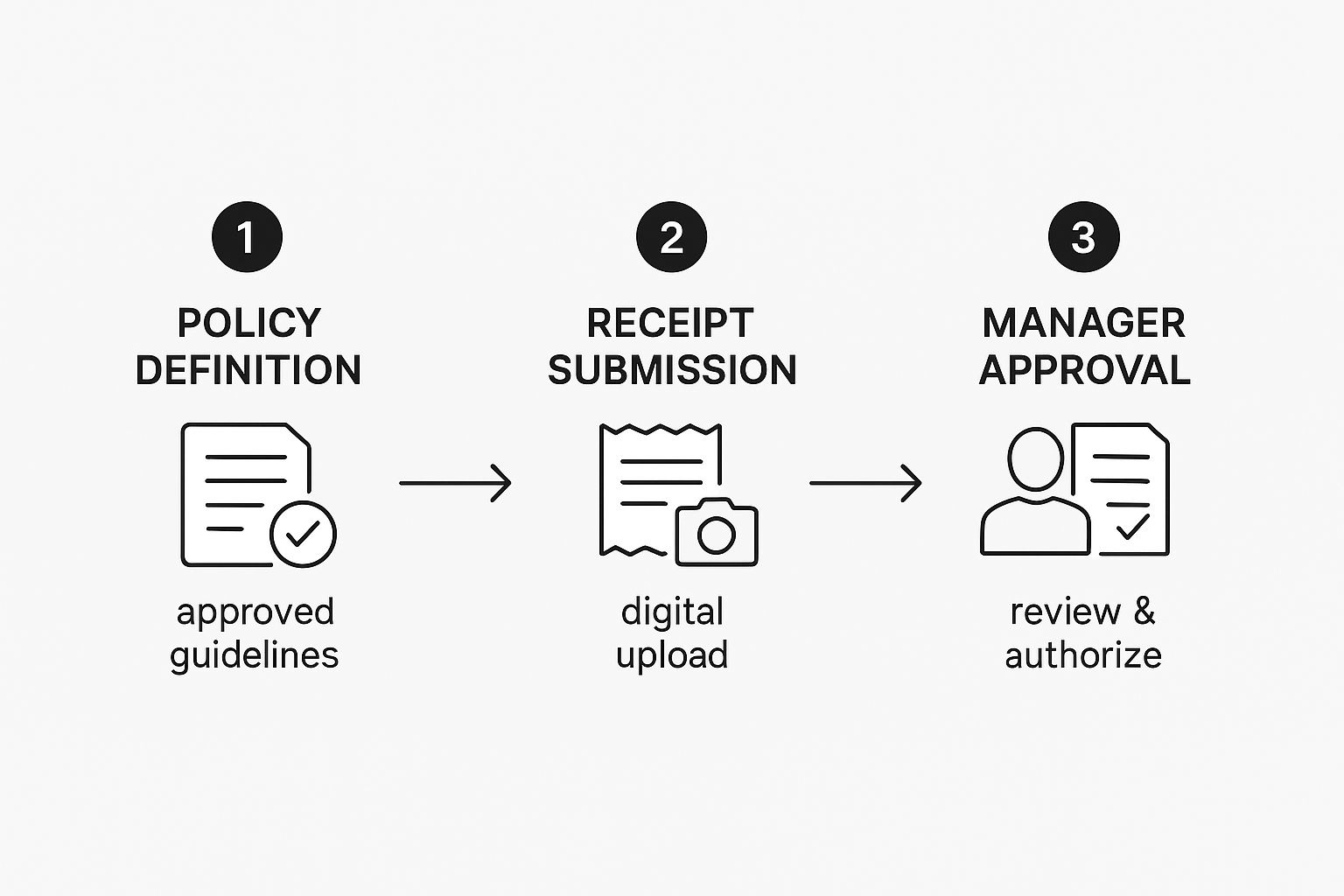
As you can see, it all starts with solid guidelines. From there, a simple digital submission process and a quick manager review keep things moving and prevent those frustrating bottlenecks that kill productivity.
Establish Clear Booking Guidelines and Per Diems
Your policy's success hinges on its core guidelines for booking travel and handling daily expenses. This is where most confusion—and out-of-policy spending—comes from. Vague rules are your worst enemy.
First, clarify how travel should be booked. Do employees need to go through a specific corporate travel portal? Or can they book directly with airlines and hotels? If they book on their own, what are the rules for comparing prices to ensure they’re getting a reasonable deal? Spell it out.
Next up are the per diems for meals and incidentals. These need to be realistic and, crucially, location-specific. A $60 daily meal allowance might work perfectly in Omaha, but it's completely unrealistic for a trip to San Francisco. I've found that tiered per diems, adjusted for the cost of living in major cities, are the most effective solution.
A policy should serve as a guardrail, not a cage. Its purpose is to guide employees toward cost-effective and compliant choices while still giving them the flexibility to handle the realities of business travel.
A well-crafted T&E policy is the backbone of any effective expense management strategy. It provides clarity for employees and control for the company. Below are the key components you should consider including.
Key Components of a Modern T&E Policy
| Policy Component | Key Considerations | Example Guideline |
|---|---|---|
| Booking Channels | Define mandatory vs. preferred booking tools. Clarify rules for direct bookings. | "All flights and hotels must be booked through the company's designated travel platform, TripActions." |
| Air Travel | Set rules for cabin class (e.g., economy for domestic). Define advance booking requirements. | "All flights under 6 hours must be booked in Economy. Bookings must be made at least 14 days in advance." |
| Accommodation | Establish nightly rate caps based on location tiers. List preferred hotel chains if applicable. | "Hotel rates should not exceed $250/night in Tier 1 cities (e.g., NYC, London) without prior approval." |
| Meals & Entertainment | Specify per diem rates or receipt requirements. Set clear limits for client entertainment. | "Daily meal per diem is $75. Client entertainment expenses require itemized receipts and guest names." |
| Ground Transportation | Outline preferred methods (rental cars, ride-sharing, public transit). Clarify reimbursement for mileage. | "Use ride-sharing services for trips under 10 miles. Rental cars are approved for multi-day trips outside major cities." |
| Non-Reimbursable Items | Explicitly list expenses that will not be covered to avoid confusion. | "Non-reimbursable expenses include in-room movie rentals, mini-bar charges, and airline seat upgrades." |
This table serves as a starting point. The key is to tailor these guidelines to your company's culture, budget, and travel frequency to create a policy that truly works.
Embrace Modern Travel Realities
The world of work has changed, and a policy written five years ago just won't cut it. One-size-fits-all rules feel restrictive and out of touch. Take "bleisure" travel—the blending of business trips with a little personal vacation time. This isn't a niche trend anymore; the 'bleisure' segment is expected to grow 500% over the next decade. To stay relevant, your policy has to keep up with these evolving business travel statistics.
A forward-thinking policy addresses these modern scenarios head-on.
- Bleisure Travel: Don't leave it to guesswork. Set clear guidelines for employees who want to add a weekend onto their trip. For instance, the company covers the flight that gets them there and back for the business portion, but the employee is on the hook for the extra hotel nights and personal expenses. Simple.
- Sustainability: More and more companies are weaving their ESG goals right into their T&E policies. This is easier than it sounds. It could be as simple as encouraging train travel for short-haul trips or highlighting preferred hotel partners with certified green practices.
- Role-Based Flexibility: A salesperson entertaining key clients has vastly different needs than an engineer attending a technical conference. A smart policy recognizes this and allows for different spending tiers or rules based on an employee's role and the specific purpose of their trip.
By building a policy that has both structure and common-sense adaptability, you're creating a system that your team will actually understand, respect, and follow. And that’s the foundation of managing travel expenses without all the usual headaches.
Finding the Right Tech for Tracking and Reporting
Let’s be honest. Are you still chasing down crumpled paper receipts and fighting with messy spreadsheets? If so, you already know that manual expense tracking is more than just tedious—it's a massive productivity killer for your travelers and your finance team alike. It's time to ditch the old ways and bring in tech built for the realities of modern business travel expense management.
The right software turns this whole process from a reactive mess into a smooth, proactive system. Automation takes over at every turn, which means human error plummets and your team gets valuable hours back in their day.
Key Features to Look For in an Expense Platform
When you start looking at different platforms, some features are simply non-negotiable. These are the tools that will actually drive efficiency and give you the ROI you're looking for.
- Mobile Receipt Scanning: This is the big one. Your team needs to be able to snap a photo of a receipt on their phone and have the software instantly pull the key details like vendor, date, and amount using Optical Character Recognition (OCR). No more manual data entry.
- Corporate Card Integration: A platform that syncs directly with your company cards is a true game-changer. It automatically pulls in transactions, so reconciliation becomes a simple task of matching a receipt to a charge that's already there.
- Automated Policy Enforcement: The smartest systems let you build your T&E policy rules right into the software. This allows the platform to automatically flag—or even prevent—out-of-policy spending before an expense report even gets submitted.
- Seamless Accounting Software Sync: Make sure the tool you choose plays nicely with your existing accounting system. Whether you use Xero, NetSuite, QuickBooks, or something else, this direct connection eliminates manual bookkeeping and keeps your financial data accurate.
The right technology does more than make expense reports less painful. It gives you a real-time, consolidated view of where your money is going. That kind of visibility is gold for accurate forecasting, spotting savings opportunities, and keeping a firm grip on your budget.
Choosing the Right Type of Solution
The market for these tools is crowded. You'll find everything from simple, single-purpose apps to massive, all-in-one platforms. The best fit for your company really comes down to your specific needs, your size, and the other software you're already using.
A small startup, for example, might be perfectly happy with a dedicated mobile app that just focuses on receipt capture. It's a low-cost way to solve the most immediate pain point without adding unnecessary complexity.
On the other hand, a mid-sized company with a team of frequent travelers will get far more value from an all-in-one solution. These platforms often bundle travel booking, expense reporting, and corporate card management into one unified system. This gives you complete control and visibility, from the moment a trip is planned to the final reimbursement check.
At the end of the day, you're looking for a tool that solves today’s headaches and can grow with you. By picking the right technology, you’re not just buying software; you’re investing in a more efficient, compliant, and data-driven way to manage your company's travel spend.
Crafting a Seamless Reimbursement Workflow

There are few things more demoralizing for an employee than a slow, confusing reimbursement process. When your team has to front their own money for company business and then wait weeks—or even months—to get it back, it creates a ton of unnecessary financial stress and resentment. The secret to great business travel expense management lies in building a workflow that is not just quick, but also completely transparent and predictable for everyone.
This starts well before an expense report is even filed. A simple, mandatory pre-approval step for larger costs, like flights or conference passes, is a game-changer. It stops out-of-policy spending before it happens and gives managers a heads-up, ensuring no one is blindsided when the final report lands on their desk.
Nail Down Your Submission and Approval Process
Once the trip is over, the goal is to make submitting expenses as painless as possible. The first step is setting clear, non-negotiable deadlines. A common and effective rule of thumb is requiring all reports to be submitted within 15 to 30 days after the trip ends.
This is where your expense management software really proves its worth. Good software can automatically scan submissions and flag anything that falls outside your policy. This frees up managers from having to manually cross-reference every single line item, which saves an incredible amount of time and reduces human error.
Look for tools that offer features like:
- Automated Nudges: The system can send friendly reminders to employees as the submission deadline approaches.
- Instant Policy Flags: Expenses that violate policy, like first-class tickets or stays at unapproved hotels, are flagged immediately for review.
- Clear Audit Trails: Every step, from submission to final approval, is logged. This creates a transparent record that protects both the employee and the finance team.
A seamless workflow is about more than just speed—it’s about building trust. When your team knows exactly what to expect and when they'll be paid back, they see the system as fair and respectful of their personal finances.
Set a Payout Schedule People Can Count On
The final piece of the puzzle, and arguably the most critical, is the actual payout. Nothing will sabotage your entire process faster than an unpredictable reimbursement schedule. Your employees need to know, without a doubt, when their money is coming back.
A fantastic way to achieve this is to sync reimbursements with your company's regular payroll cycle. For instance, you could establish a policy where all expense reports approved by the 10th of the month are paid out on the 15th, and reports approved by the 25th are included in the end-of-month payroll.
This simple predictability removes all the anxiety from the equation. It turns what was once a source of frustration into a reliable, routine administrative task. By combining clear deadlines, automated software checks, and a rock-solid payment schedule, you create an experience that encourages prompt submissions and keeps everyone on your team happy.
Your Travel Data Is a Goldmine for Hidden Savings
https://www.youtube.com/embed/mgMJobWP1mw
Your company’s expense reports are so much more than a simple record of spending. When you know how to look at them, they become a strategic asset—a goldmine of data that can reveal some serious, and often surprising, opportunities to save money. This is what truly effective business travel expense management is all about: transforming your finance team from a reactive department just processing receipts into a proactive partner driving real cost efficiency.
The real shift happens when you stop just approving reports and start analyzing the trends buried within them. This data-first mindset is what allows you to make smarter, more informed financial decisions that directly strengthen your bottom line.
Key Metrics That Tell the Real Story
To start finding these savings, you need to know what you’re looking for. A good expense management system will give you dashboards that let you slice and dice your travel data in meaningful ways. I've found that focusing on a few critical metrics is the best way to uncover the most actionable insights.
Keep a close eye on spending across these key areas:
- Top Vendors: Which airlines, hotel chains, and car rental agencies are getting the lion's share of your business? This data is pure leverage when it comes time to negotiate better corporate rates or exclusive discounts.
- Departmental Spend: Start comparing travel costs between departments. A spike in one team's budget might be completely justified by a new project, or it could be a red flag signaling a need for policy clarification or a bit more training.
- Trip Purpose: Dig into the costs associated with different kinds of travel—client meetings, internal training sessions, or big industry conferences. This helps you start to understand the real ROI on each type of travel activity.
- Policy Violations: Pay attention to how often and why out-of-policy expenses are happening. Are employees consistently booking last-minute flights or opting for premium hotels? This points directly to gaps in your travel policy or communication breakdowns that need fixing.
By making a habit of reviewing these numbers, you can spot anomalies and troubling trends long before they snowball into major budget headaches.
Your travel and expense data tells a story about your company's spending habits. Learning to read that story is the first step toward rewriting it for a more cost-effective future.
Turning Insights Into Actual Savings
Once you have a clear picture of where your money is going, you can take specific, targeted action to optimize that spending. This is where your analysis turns into real, tangible savings.
Let’s say your data shows that a whopping 70% of your hotel spending is concentrated with just two major chains. You're now in a fantastic position to negotiate a preferred partnership. You can walk into that conversation armed with your spending data and ask for a corporate discount, better room rates, or even value-added perks like free breakfast or Wi-Fi for your travelers.
This strategic approach is especially important as the travel market finds its footing again. After a few volatile years, global business travel costs are starting to level out. One recent report noted that while average ticket prices rose 4.8%, they are actually projected to decline by 2.2% in 2025 as airline supply finally catches up with demand. You can discover more insights about these pricing trends to make your negotiations even sharper.
Here's another real-world example. Imagine you notice one department consistently overspending on meals. Your first instinct might be to assume they're breaking the rules. But the data might show that their travel is mostly to high-cost cities like New York or San Francisco, where the standard per diem just doesn't cut it. Instead of a blanket crackdown, you can use that insight to refine your policy. By introducing location-based tiers, you create a system that’s fairer, more realistic, and ultimately drives better compliance because it makes sense for your travelers.
Frequently Asked Questions About Expense Management
Even with the best policy and the slickest software, questions are going to pop up. Managing travel spending in the real world is messy, and being ready to answer the common "what if" scenarios is what makes a system truly work. If you can give your team quick, clear answers, you'll avoid a ton of confusion and keep things running smoothly.
Let’s dig into some of the most common questions we hear from both travelers and the finance teams trying to keep it all straight.
How Should We Handle Last-Minute Travel Changes?
We’ve all been there. A flight gets canceled, a connection is missed, and suddenly a simple trip gets complicated. It's a frustratingly common part of travel today. In fact, a recent survey showed that nearly 9 out of 10 business travelers have had their trips disrupted, forcing them to spend money on things like an extra hotel night or an overpriced airport sandwich.
Your policy has to account for this reality. Here’s how you can prepare:
- Have a Go-To Contact: Make sure travelers know exactly who to call or message when a flight is canceled at 10 PM. A clear, real-time communication channel for getting unexpected costs approved is non-negotiable.
- Spell Out What’s Covered: Be crystal clear about what the company will reimburse in these situations. Think reasonable hotel stays, meals, and booking a new flight or train ticket. Don't leave your team guessing.
- Get the Paper Trail: Instruct employees to hang on to every email, text, or notification from the airline or hotel about the disruption. This documentation is crucial for their expense report and gives you a clean audit trail.
The goal here is to be supportive without losing control. A policy that’s too rigid just makes a stressful situation worse and erodes trust. You have to build in some flexibility for things that are completely out of your employee’s hands.
What Is the Best Way to Manage International Travel Expenses?
Traveling internationally throws a few curveballs into the mix, especially when it comes to currency exchange rates and foreign taxes like VAT. Trying to manually convert every single receipt is a surefire way to introduce errors and frustrate your team. Honestly, this is one area where you should let technology do the heavy lifting.
Modern expense platforms and corporate cards completely solve this problem. They can automatically handle the foreign exchange conversion right when the purchase is made, locking in the correct daily rate. This takes all the guesswork away from the employee and gives your finance team perfectly accurate data. Plus, many of these tools are smart enough to flag VAT-eligible expenses and help you generate the reports needed to reclaim that money—a direct win for your bottom line.
Can We Set Different Spending Rules for Different Teams?
Not only can you, but you absolutely should. A one-size-fits-all spending policy is rarely effective. Think about it: the way your sales team travels to meet high-value clients is going to be completely different from how your engineering team travels for a technical conference.
The smart move is to create role-based or department-specific spending rules. For instance, your sales reps might need a higher budget for meals and client entertainment, while other teams have more modest limits. The best expense management software lets you build these unique rule sets right into the system. When an employee goes to submit an expense, the platform automatically enforces the correct policy for their role, making compliance pretty much automatic.
For corporate travelers in Chicago needing reliable ground transportation that aligns with clear expense policies, Max's Luxury Rides Inc. offers professional black car and limousine services perfect for airport transfers and executive travel. Book your ride at maxsluxuryrides.com.