
You're in the middle of a real booking mess. The guest list keeps moving, the bridesmaid who “might come after all” just texted back, the corporate shuttle needs to hit two hotels before the opening keynote, and someone just asked whether the golf bags fit without stealing seats. That's the moment charter bus capacity stops being a trivia question and turns into a planning decision.
Start with headcount. That's the easy part. The hard part is figuring out what that number means once luggage, comfort, accessibility, and timing hit the floor plan. If you've ever tried to book one vehicle for a group that looks simple on paper and messy in real life, you already know why a static seat count is a bad way to think about it.
A better way to plan is to treat capacity as a configuration, not a label. A 56-seat coach is not always 56 usable seats, and a smaller bus can be the smarter choice when the trip is short, the bags are light, or the group needs to stay nimble. If you want a quick comparison of how event planners think about size, local party rental tips and capacity charts are a useful parallel, because the same mistake shows up everywhere, people confuse the quoted maximum with the right working number.
When the Head Count Is the Easy Part
A wedding planner calls because the ceremony starts in four hours and the guest list just landed at 42. A corporate organizer needs a shuttle from the hotel to the conference center, then back again after dinner. A family reunion is trying to get everyone to O'Hare without splitting grandparents, cousins, and bags across three rides. The head count is known, but the booking still feels fragile.
That's because charter bus capacity isn't just “how many people can sit down.” It's whether the group can move together, keep its luggage out of the aisle, and avoid awkward compromises that make a simple trip feel clumsy. The question isn't “Do we have enough seats?” It's “Do we have the right bus for the way this group travels?”
The cheapest quote usually comes from the wrong size vehicle. The right quote comes from the bus that fits the trip without forcing a second guess on the day of travel.
That's also why a consumer article that lists a single number misses the point. A planner doesn't need a textbook definition, and a dispatcher doesn't book by theory. You need to know what vehicle tier matches the group you've got, what the bags will do to that plan, and whether the trip's logistics make a larger or smaller vehicle the smarter call.
The rest of this guide stays on that practical track. It's about the bus that works, not the one that looks tidy in a brochure. If you're booking now, the only question that matters is which fleet tier fits the trip you're really planning.
What Charter Bus Capacity Means
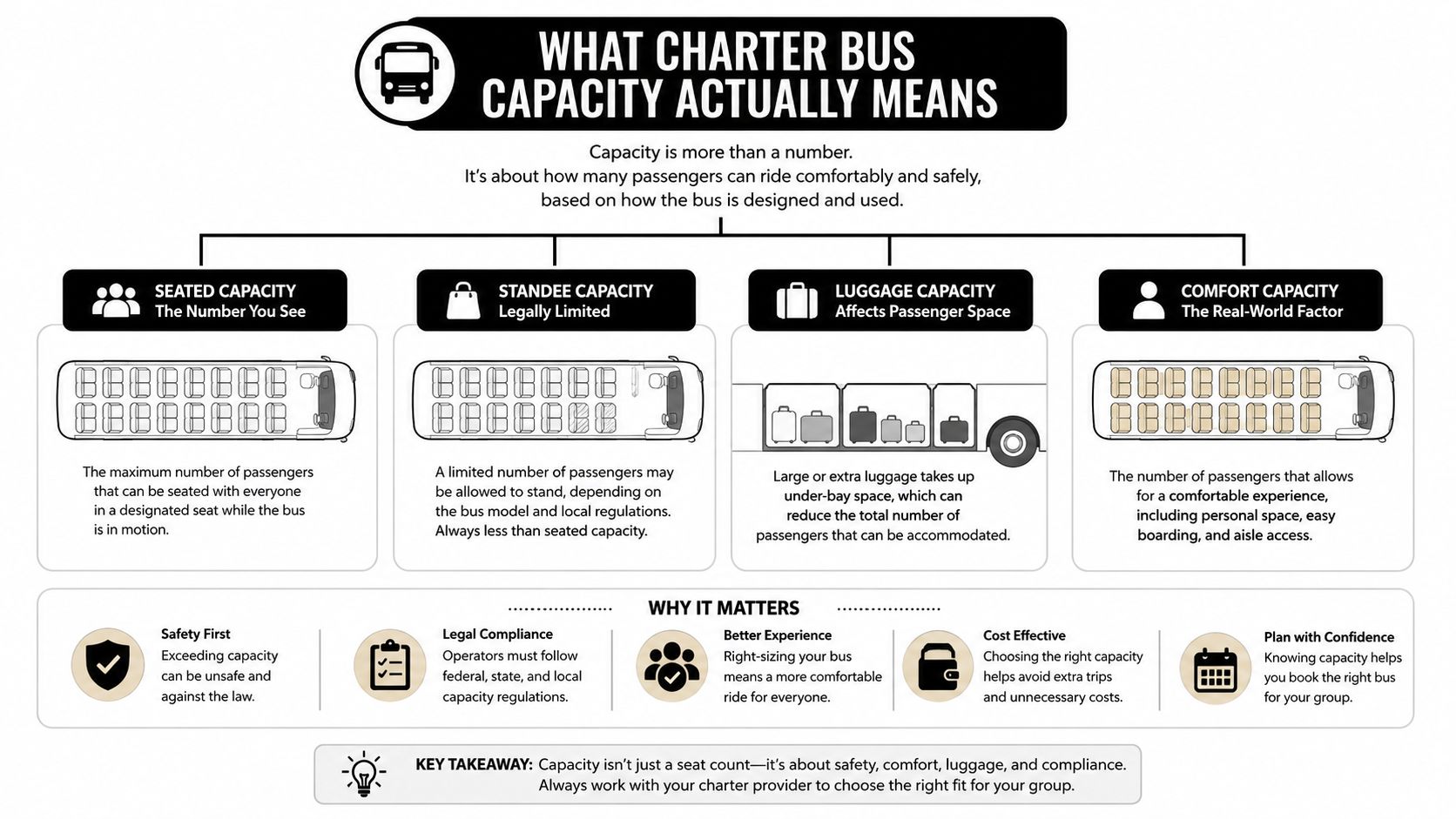
Capacity is not a single number. In practice, operators work in bands, with minibuses around 15 to 30 seats, full-size charter coaches around 30 to 56 seats, and larger specialty vehicles above that. Those ranges exist because fleets are built around real operating limits, not just how many seats can be squeezed into a shell.
The U.S. scheduled and charter bus market was estimated at $6.9 billion in 2026 with 9,062 businesses, after growing at a 5.0% CAGR from 2020 to 2025 according to IBISWorld's scheduled and charter bus services profile. That matters because a market built on repeated bookings settles into repeatable vehicle sizes. Operators do not invent a new coach for every quote, they work from a small set of proven configurations.
The seat count is a product category
A “50-passenger motorcoach” is a standardized vehicle type, not a loose estimate. The dimensions of full-size coach buses show why the count stays in a narrow band. Full-size motorcoaches are typically built around a 40 to 45 ft body and commonly seat 47 to 56 passengers, with that range shaped by wheelbase, aisle width, emergency-exit placement, and onboard amenities like lavatories or larger luggage bays.
That is why charter bus capacity should be read in tiers. A mini-coach, a standard motorcoach, and a double-decker solve different problems even when the marketing language sounds similar. The vehicle choice gets set by the capacity band first, then by the details of the trip.
If you know the band, you already know a lot. A small group does not need a highway coach just because the brochure makes it sound impressive. A large group should not gamble on a vehicle that only fits on paper. Capacity is the first filter, not the final answer.
Matching Vehicles to Group Size in the Fleet
Here's the cleanest way to think about the fleet. Start with the smallest practical vehicle and move up only when the group, luggage, or comfort level forces you to. That keeps you from paying for air, and it keeps the group from getting split into awkward pieces.
| Vehicle Type | Typical Seats | Luggage Room | Best For |
|---|---|---|---|
| Executive Sedan | 1 to 3 | Limited trunk space | Solo airport transfers, VIP point-to-point rides |
| Luxury SUV | 4 to 6 | Better cargo room than a sedan | Small families, airport runs, business travel |
| Mercedes Van | 8 to 14 | Good for carry-ons and a few larger bags | Small teams, airport transfers, private outings |
| Sprinter Limousine | 8 to 14 | Moderate, depending on interior build | Social trips, executive small-group travel |
| Executive Shuttle | 15 to 30 | Better than vans, less than a coach | Mid-size corporate and event transport |
| Minibus | 15 to 30 | Practical for day bags and light luggage | Wedding shuttles, local group movement |
| Mini Coach | 30 to 40 | Strong luggage capacity for the size | Conferences, tours, day trips |
| Full-Size Coach Bus | 40 to 56 plus | Large underfloor bays and overhead storage | Large groups, airport transfers, multi-stop travel |
A sedan or SUV makes sense when the trip is simple and the group is tiny. Once you move into vans, Sprinters, and shuttles, you're buying flexibility, easier loading, and a better fit for people who want to travel together without stepping up to a full coach. That middle tier is where most real-world bookings live, because it covers the awkward zone between “too small for a car” and “too big for a bus.”
Practical rule: if your group can fit in one van and still leave room for bags, don't jump to a bus just because it sounds more comfortable. Size up only when the group, luggage, or trip length forces it.
Minibuses and executive shuttles are the workhorses for group travel that isn't huge but still needs coordination. They're the right move when you want everyone on one timeline without committing to a large coach. Mini coaches belong in the next tier up, especially when the group is in the 30-plus range and the luggage starts to matter.
Full-size coaches are the default answer once the group gets large enough that splitting people becomes a real problem. Max's Luxury Rides Inc. lists full-size coach buses in its fleet, and that matters because the whole point of a coach is to keep the group together while giving you the room a smaller vehicle can't.
Capacity in Real Booking Scenarios
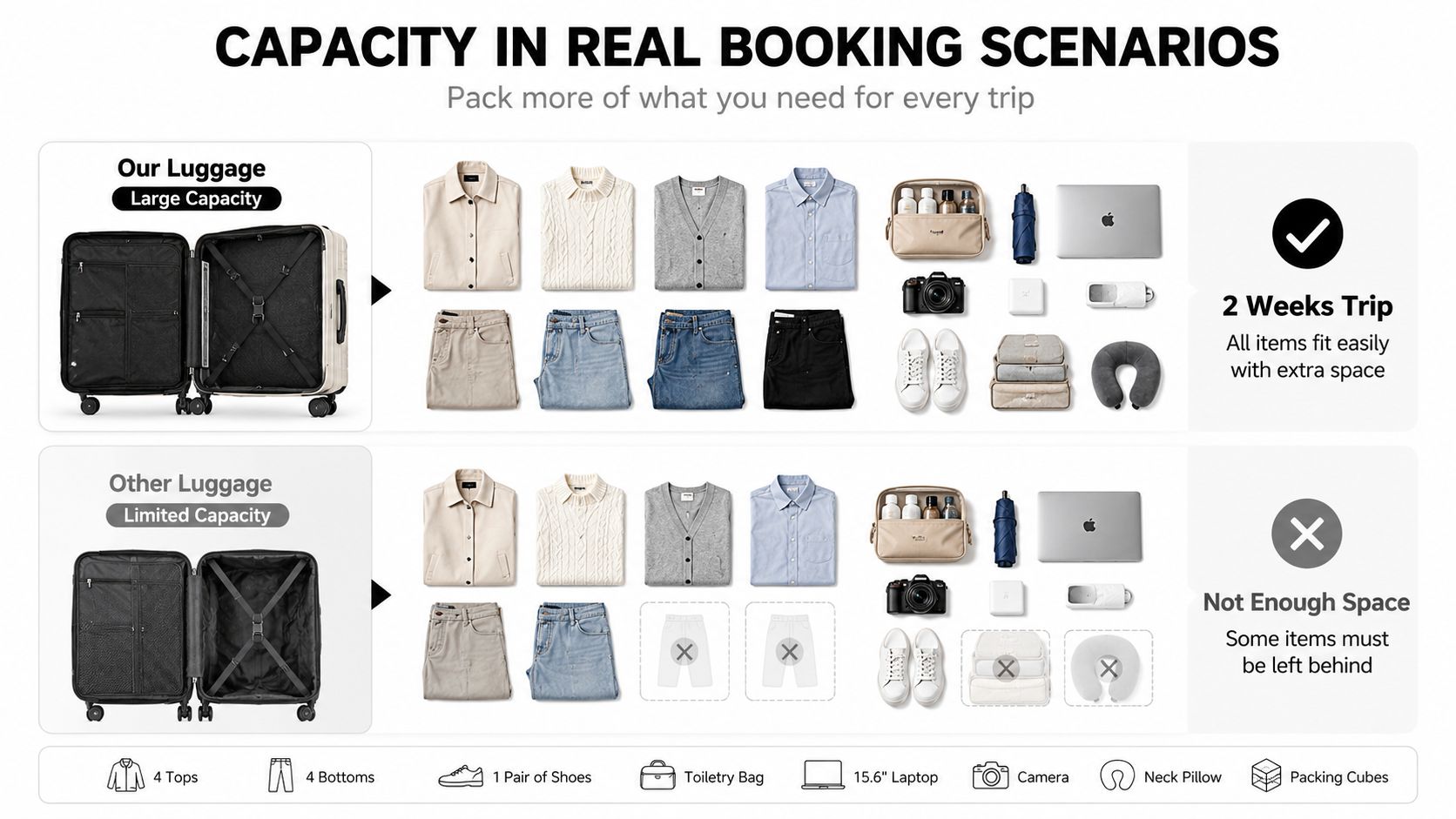
The cleanest way to choose a vehicle is to match the actual trip pattern, not just the headcount. A 12-person airport run is a completely different booking from a 45-person wedding or a 60-person concert loadout, even though all three fall under the same umbrella of group travel.
For a family of 12 going to O'Hare or Midway, a Mercedes van or luxury SUV is usually the smarter fit. The smaller vehicle keeps loading simple, handles luggage without making the ride feel oversized, and avoids the waste of booking a coach for a group that doesn't need one. A full-size bus would be overkill unless the bags are heavy or the group is unusually spread out.
A corporate team of 28 moving between hotel and conference should go with an executive shuttle or minibus. That size keeps the group intact and gives enough room for the kind of rolling bags and briefcases business travelers carry. If you put 28 people into something too small, you create friction at pickup and on arrival. If you move them onto a coach, you're paying for more capacity than the itinerary needs.
A wedding party of 45 plus luggage is where a full-size coach starts making real sense. The full-size charter bus range of 49 to 56 passengers is the right reference point for that kind of trip, but the luggage load can push you to size up carefully. If the trip involves an overnight stay, bags matter as much as bodies.
Concert and sporting event groups of 60-plus are simple. One standard coach won't do it, and trying to force it only creates a split group. At that point, you either move to a larger specialty vehicle or book more than one bus.
Wedding planners should also think about how guests get access to details and timing. If you're already using Wedding QR codes for event coordination, the same discipline applies to transportation, clear guest instructions reduce confusion before boarding starts.
Why the Max Capacity Is the Wrong Planning Number
A bus marked at 56 seats is not a reason to plan for 56 people. That number assumes the cleanest possible setup, and group trips rarely stay that tidy once you add bags, special boarding needs, or any expectation of comfort. The brochure number is a ceiling, not a booking target.
The better planning number is the one that matches how the group will travel. A full-size coach may be listed near the top of its seating range, but once you account for aisle space, emergency exits, lavatories, and luggage storage, the usable load starts to shrink fast. That is the part operators know, and planners ignore it at their own risk.
Three Ways Seats Disappear in Practice
A wedding shuttle with carry-ons and garment bags can burn through usable rows quickly. A corporate transfer with one wheelchair rider changes how the interior gets assigned, and the seating plan may no longer look like the quote. A sports trip with teenagers packed tight may look fine on a reservation sheet, but it turns uncomfortable fast if the ride is longer than a short hop across town.
Use the marketed max only for short, light, simple trips. If the group has bags, accessibility needs, or a long ride, treat the published seat count as the ceiling and book below it.
I'd build in a 10 to 15 percent comfort buffer under the marketed maximum. A full bus feels full at the curb, not on paper. That buffer gives you room for the cousin who appears at the last minute, the stroller nobody mentioned, or the extra bag pile that steals a row. If the itinerary is tight on timing or the ride matters to passenger comfort, size up instead of squeezing people in.
The practical takeaway is simple. A “56-seat” bus is often a 56-seat product, not a 56-seat plan. That distinction is where a lot of bad bookings start.
Luggage, Accessibility, and Safety Rules That Reshape Capacity
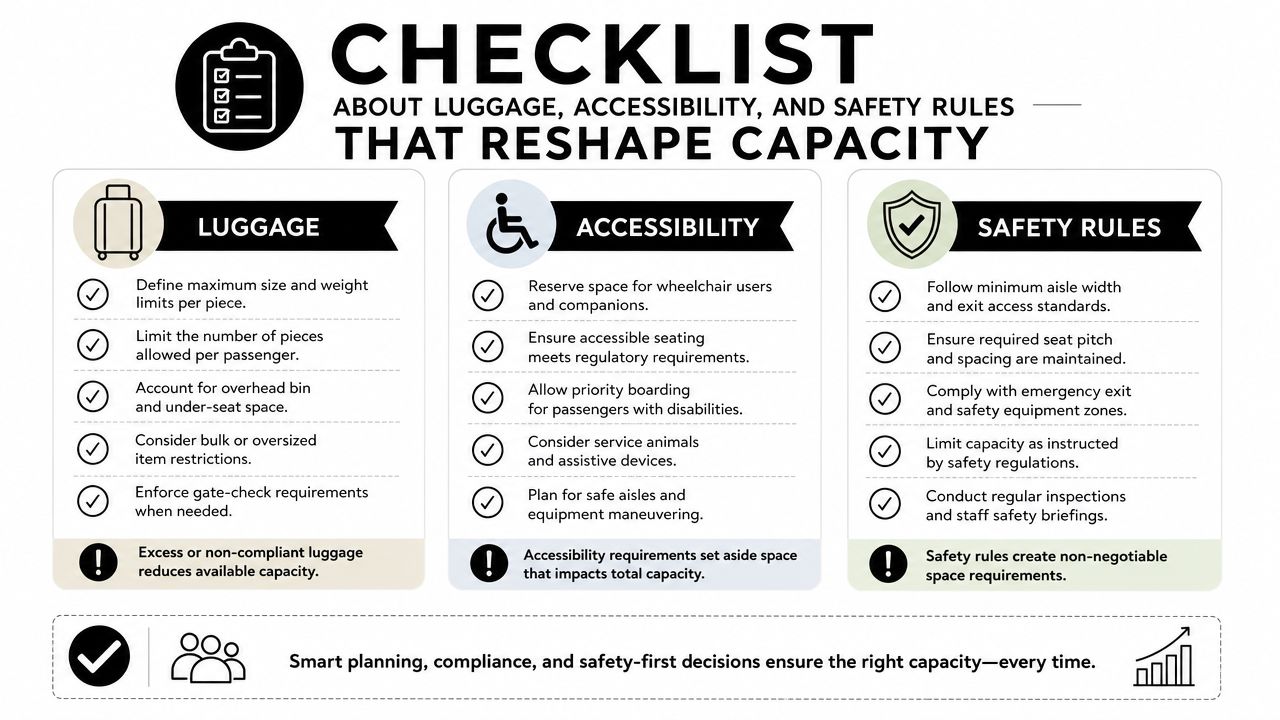
The fastest way to get capacity wrong is to ignore what people are bringing with them. One checked bag and one carry-on per traveler is already enough to change the layout on a smaller vehicle, and that's before you factor in coats, gift bags, sports gear, or wedding parcels. If the quote doesn't ask about luggage, it's not a serious quote.
Accessibility is the other quiet limiter. If you need to account for a wheelchair user or a service animal, you should measure the space they need, not just assume a listed seat is available. A helpful place to sanity-check that planning is the DME Superstore wheelchair dimensions guide, because the width and turning space of mobility devices directly affect how a bus is loaded.
The rules I check before I confirm a bus
- Luggage first: Ask where bags go, because underfloor storage and overhead racks are not interchangeable on every vehicle.
- Accessibility second: Flag wheelchair use, walkers, and any boarding limitations before the vehicle is assigned.
- Safety third: Keep aisle clearance, emergency exits, and seat access a priority.
Once a group exceeds the largest standard motorcoach, a second vehicle is required, and short-notice extra buses are not guaranteed, according to Escot Bus Lines' FAQ guidance. That's exactly why buffer sizing matters. If you leave no margin for luggage or accessibility, you don't just create discomfort, you risk changing the whole booking.
How to Book the Right Vehicle for Your Group
Start with the headcount, then subtract your comfort buffer, then add the baggage reality. If the result sits comfortably inside a vehicle tier, book that tier. If it lands on the edge, size up. That's the rule I use, because the cheapest vehicle is only cheap if it does the job.
For groups in the low teens, I'd book a van or SUV unless the trip is unusually bag-heavy. For mid-size groups, a shuttle or minibus is the honest answer. Once you move into the 30s and low 40s, the mini coach becomes a serious option because it keeps people together without forcing you into a larger coach too early.
If your group is large enough that one seat row matters, split the load before you split the room. Two smaller vehicles beat one oversized bus when the itinerary has separate pickup points or when people are moving at different times. One large coach beats two smaller vehicles when simplicity matters more than flexibility.
Tell the dispatcher three things, the exact headcount, the luggage load, and any accessibility needs. That's enough to get you out of the guessing game.
Max's Luxury Rides Inc. offers a mix of executive sedans, luxury SUVs, Mercedes vans, Sprinter limousines, executive shuttles, minibuses, mini coaches, and full-size coach buses, so you can match the vehicle to the trip instead of forcing the trip into one vehicle type. That range is the right approach, because the right booking is the one that fits the group without waste or friction.
A Quick Reference Before You Book
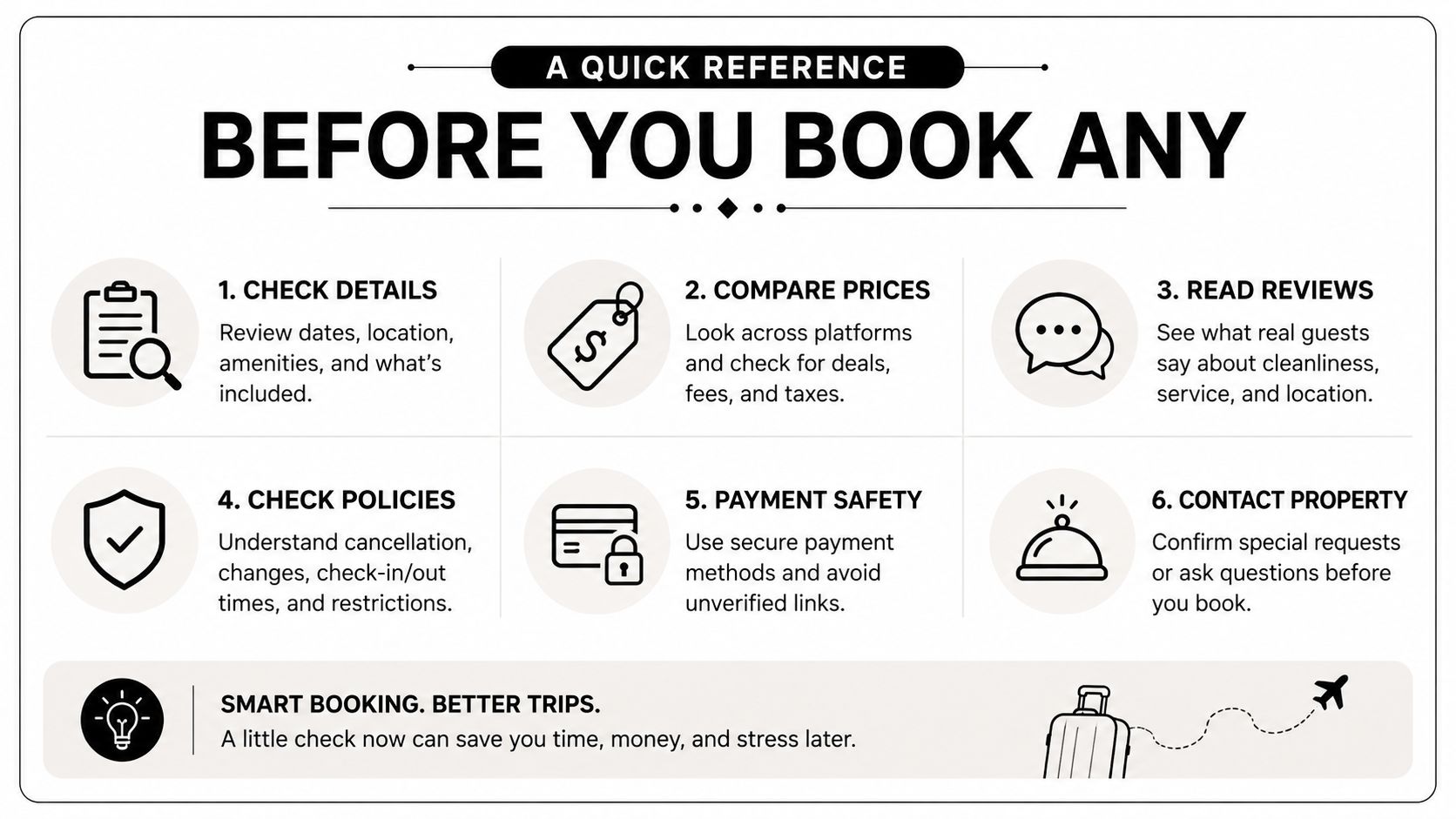
Keep it simple. 15 to 30 seats usually means a minibus or executive shuttle, 30 to 56 points to a full-size coach tier, and anything above that calls for a larger specialty vehicle or a second bus. Use the 10 to 15 percent buffer rule, count the bags, and flag accessibility needs before you lock in the quote.
The four common bookings are straightforward. A family airport transfer fits a van or SUV. A corporate group in the high 20s fits a shuttle or minibus. A wedding with around 45 travelers and luggage belongs on a coach. A group over 60 needs a different plan.
Don't book the max because the brochure makes it sound efficient. Book the vehicle that fits the people, the bags, and the schedule.
Max's Luxury Rides Inc. handles airport transfers, corporate travel, weddings, and event transportation with vehicles sized for real-world group needs, not just headcounts on paper. If you want a quote that accounts for luggage, comfort, and accessibility instead of forcing everyone into the wrong tier, visit Max's Luxury Rides Inc. and book the bus that fits the trip.