
When you look at a quote for a chauffeur service, it’s not just a random number. The price is built on three simple, core pillars: the type of vehicle you choose, how long you need it, and the distance you're traveling. It’s a lot like booking a flight—a first-class ticket for a long-haul flight costs more than an economy seat for a quick hop, and for good reason.
Understanding What Drives Chauffeur Service Prices
Think of hiring a chauffeur like booking a stay at a five-star hotel. The standard room has its price, but upgrading to the penthouse suite for a full week, complete with a private butler, is a completely different investment. The final cost of your chauffeur service is a thoughtful calculation based on the level of luxury, convenience, and safety you’re after. It's about the entire experience, not just the ride.
This transparent approach means you’re only paying for the service you actually receive. Grasping these key elements helps you make smart choices, whether you're a corporate travel manager arranging a CEO's transport or a bride planning the perfect wedding day. It’s this focus on premium, reliable service that has propelled the global chauffeur market to a staggering USD 27.8 billion, with projections to nearly double to USD 52.2 billion by 2033. If you're curious, you can read the full research about the expanding chauffeur market to see what's fueling this incredible growth.
This diagram shows you exactly how those three main factors—vehicle, time, and distance—stack up to create your final price.
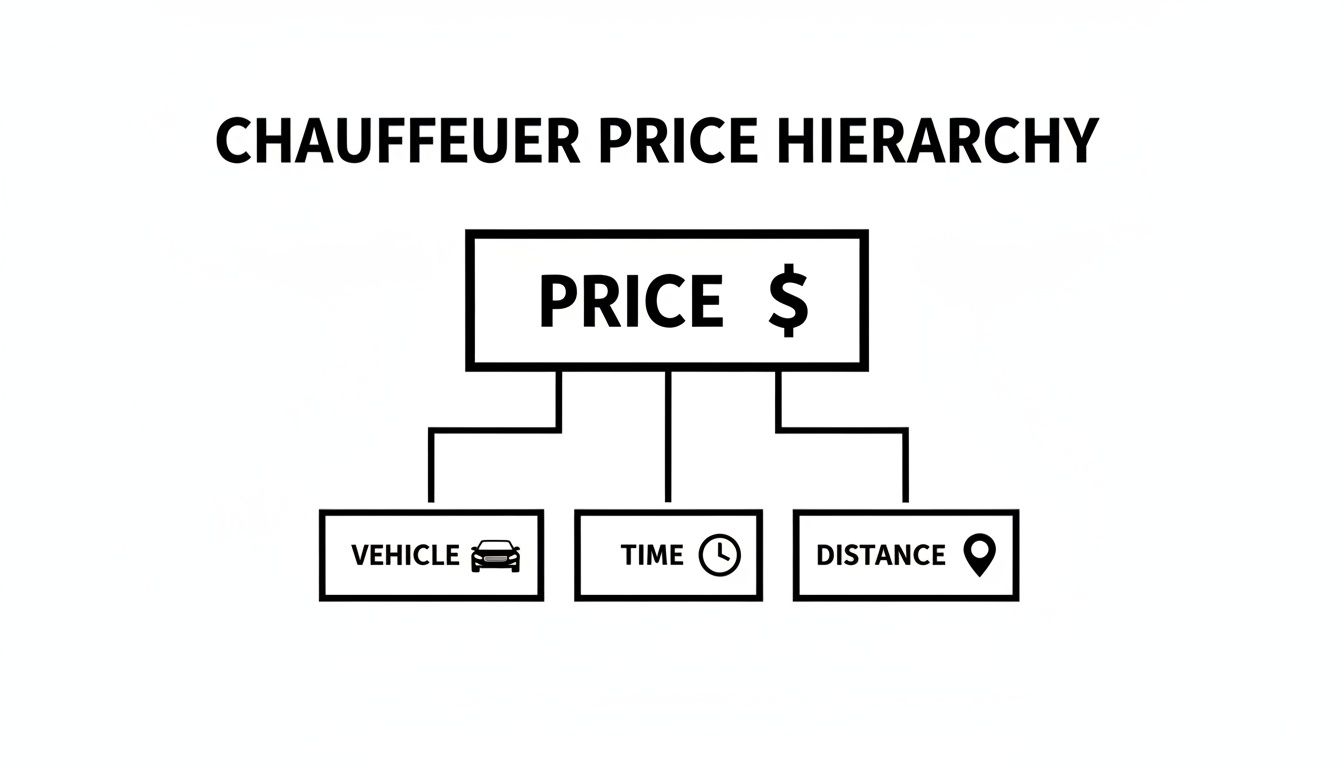
As you can see, the choice of car, the total hours, and the mileage covered are the fundamental building blocks of your quote.
Key Factors Shaping Your Quote
To budget properly, you need to know what goes into the number you’re given. Let's break down the main variables that a reputable company will use to build your quote.
Here’s a quick summary of the primary elements that determine the total cost of hiring a chauffeur service.
| Pricing Factor | How It Affects Your Bill | Typical Impact |
|---|---|---|
| Vehicle Type | The model you choose sets the foundation for the price. | Sedans are most affordable; SUVs, vans, and limousines cost more. |
| Service Duration | How long the chauffeur and vehicle are dedicated to you. | Charged hourly, with minimum booking times of 2-4 hours common. |
| Travel Distance | The total mileage from pickup to the final drop-off point. | Longer distances mean higher costs for fuel, time, and vehicle wear. |
| Base Rate | The company's starting price for a specific vehicle and service. | Varies significantly based on your city and the company's market position. |
Each of these components plays a crucial role. A quick airport transfer in a sedan will look very different on paper from an all-day winery tour in a luxury SUV.
Here’s a closer look at how each one works:
- Vehicle Type: This is your biggest decision. A classic luxury sedan like a Mercedes S-Class is a fantastic, cost-effective choice. But if you need more space for luggage or passengers, a premium SUV or a stretch limousine will naturally come with a higher price tag. The cost scales directly with the vehicle's size, amenities, and prestige.
- Service Duration: Are you booking a simple one-way trip, or do you need the car and driver at your disposal for an entire day? Most services operate on hourly rates and often have a minimum booking time (usually 2-4 hours) to ensure the trip is worthwhile for the chauffeur.
- Travel Distance: A short cross-town journey will cost less than a trip to a neighboring city. The farther you go, the more you’ll pay to cover fuel, the chauffeur’s time, and the general wear and tear on the vehicle.
- Base Rate: Every company has a starting point. This is their foundational charge, which covers the vehicle, the professional chauffeur, insurance, and basic operational costs. This rate can vary quite a bit depending on the city you're in and the company's reputation.
Choosing Between Hourly and Flat Rate Pricing

When you start looking into chauffeur services, you'll quickly run into two main ways companies charge: by the hour or a flat rate for the trip. Figuring out which one is right for you really just comes down to what your day looks like. I like to think of it like a cell phone plan—you can either "pay-as-you-go" for total flexibility or get a "fixed plan" when you know exactly what you need.
The hourly model is your "pay-as-you-go" option. It's built for those days when the schedule is more of a suggestion than a rule. If your itinerary involves multiple stops, meetings that might run long, or you just want the freedom to make a last-minute detour, this is your best bet.
When Hourly Rates Make Sense
Hourly pricing shines in situations where having flexibility is more important than sticking to a rigid timeline. You're essentially booking the car and driver for a block of time, putting you in complete control of your movements within that window.
Here are a few classic scenarios where booking by the hour just makes sense:
- Corporate Roadshows: When you have executives bouncing between meetings all over the city, an hourly service means their ride is always on standby. No need to book a new car for every leg of the journey or stress about one meeting running late.
- Special Events like Weddings: Let's be honest, a wedding day almost never runs perfectly on schedule. An hourly charter makes travel from the ceremony to the photo location and then to the reception completely seamless, taking one major stressor off your plate.
- City Tours or Shopping Sprees: For a relaxed day hitting the landmarks or a few different boutiques, having a chauffeur waiting is the height of convenience. You can leave your bags in the car and move at your own pace.
One thing to keep in mind is the minimum booking time. Most professional services, including our team here at Max's Luxury Rides Inc., will have a minimum of two to four hours. It's just what's needed to make the trip worthwhile for the chauffeur and the company.
When a Flat Rate Is Your Best Bet
Now for the "fixed plan"—the flat rate. This model is all about cost certainty for straightforward, point-to-point trips. You get one clear price upfront, and that's exactly what you pay. No meters, no surprises.
A flat rate is almost always the better choice for:
- Airport Transfers: This is the textbook example. A trip to or from Chicago O'Hare or Midway is a defined route. A flat rate bundles everything—tolls, potential traffic, you name it—into a single, guaranteed price.
- Concert or Sporting Event Drop-offs: If you just need a sophisticated and reliable ride to the United Center but don't need the chauffeur to wait, a flat-rate transfer is the way to go.
- Simple Point-A-to-Point-B Travel: Any direct trip, like from your hotel to a dinner reservation, is a perfect candidate for a flat fee. It takes all the guesswork out of budgeting for your transportation.
In the end, it’s all about matching the pricing model to your plans for the day. For direct, predictable trips, the flat rate offers valuable peace of mind. But for those dynamic, multi-stop days, the flexibility of an hourly rate is simply unmatched.
How Your Vehicle Choice Impacts the Final Cost
Let's be blunt: the vehicle you choose is probably the biggest factor in what you'll end up paying. Think of it like booking a flight. An executive sedan is your reliable business-class seat—comfortable, stylish, and gets the job done. A stretch limousine? That's the private jet experience, built to make a grand entrance.
Your choice really sets the stage for the entire trip, and it dictates the base price before we even talk about time or distance.
If you’re trying to be smart with your budget, the first thing to do is match the car to the occasion and your group size. A business traveler flying solo to a meeting has no need for a massive SUV, so a sleek luxury sedan is the obvious, cost-effective choice. That simple decision can shave a good amount off your base rate right from the start.
Matching the Fleet to Your Needs
Different cars are built for different jobs. Getting a handle on this helps you avoid paying for space or features you just don't need. Any good chauffeur company will have a range of vehicles ready to go, whether you need a quiet ride to the airport or a shuttle for a large group event.
Here’s a quick look at the common vehicle types and what they're best for:
- Executive Sedans: These are the bread and butter of corporate travel, perfect for one or two passengers. You get a premium, comfortable ride without any unnecessary frills.
- Luxury SUVs: A great fit for small groups of three to six, or for anyone traveling with a lot of luggage. They offer more legroom and storage, making them a go-to for family airport trips or executive teams.
- Sprinter Vans: When you've got to move a bigger group—up to 14 people for a corporate outing or a private city tour—these vans strike a great balance between space and luxury.
- Stretch Limousines: This is the classic choice for life's biggest moments. Think weddings, proms, or any high-profile event where you want to make an impression.
The vehicle you book is a direct reflection of your needs and your budget. A luxury sedan might start around $75-$95 per hour, whereas a premium SUV could run $95-$125 per hour. For larger groups, a sprinter van can range from $125-$175 per hour, which clearly shows how the price scales with capacity.
Understanding the Market Demand
What’s popular also plays a part in pricing. North America currently leads the private chauffeur market, holding a 39.1% global share, and within that, luxury cars are the most requested vehicle type at 40.2%.
This strong demand, especially for corporate travel and airport runs in major hubs like Chicago, means premium sedans and SUVs are always available but also priced competitively. You can dig deeper into these private chauffeur service market trends to see how what's popular in a region affects the cars on offer.
In the end, picking the right vehicle comes down to a simple balance of function, style, and cost. If you take a moment to think about your passenger count, luggage, and the vibe of your event, you can make sure the chauffeur service prices you're quoted are right in line with the value you’re getting. It’s the smartest first step to crafting the perfect ride.
Uncovering Potential Hidden Fees and Extra Charges
Nothing sours a premium experience faster than getting a final bill with a bunch of unexpected charges. It’s a classic bait-and-switch feeling. Think of it like a bill at a great restaurant—it’s never just the price of the entrees. Your chauffeur service invoice can have several line items beyond the base rate you were quoted.
Knowing what these potential extras are is the key to budgeting accurately and avoiding that end-of-trip surprise.
Most legitimate companies add these charges to cover real operational costs, which allows them to keep their base chauffeur service prices competitive. The mark of a truly professional service, however, is being completely upfront about what is and isn't included in your initial quote. No games, no gotchas.
Common Additional Charges to Look For
Before you lock in that booking, it’s always smart to ask about any fees that might not be obvious at first glance. These costs are pretty standard across the industry, but they can definitely add up if you aren't prepared for them.
Here are the usual suspects to keep an eye on:
- Gratuity: Many companies automatically add a 15-20% gratuity for the chauffeur. Always double-check if it’s included so you don’t end up tipping twice.
- Wait Time: Your quote usually comes with a bit of a grace period—say, 15 minutes for a pickup at home or maybe an hour for an airport arrival. Once that clock runs out, you’ll be billed for the extra wait time.
- Fuel Surcharges: When gas prices spike, you might see a small percentage tacked on to cover that fluctuating expense.
- Tolls and Parking: Any road tolls on your route or parking fees at the airport or an event venue are almost always passed on to you.
- Airport or Event Fees: Airports and big venues often charge commercial vehicles a fee just for pulling up to the curb. That fee will land on your bill.
The single best piece of advice I can give is this: always request an all-inclusive quote. This bundles all the predictable costs—tolls, gratuity, and standard fees—into one transparent number. The price you see is the price you pay.
Why Transparency in Pricing Matters
These extra charges aren't just made up; they reflect the real costs of running a high-end transportation service. The professional chauffeurs delivering this experience are highly skilled, and their compensation is a major part of the operational picture. In fact, drivers in the U.S. taxi and limousine sector earn an average annual wage of USD 39,210.
With costs always rising, clear, predictable pricing has become a huge deal, especially for corporate clients who need to stick to a travel budget. You can learn more about industry workforce and wage findings to get a better sense of the economics at play.
At the end of the day, a company that's transparent about its pricing is a company you can trust. By asking for that all-inclusive rate, you put yourself in control, allowing you to budget with total confidence—and for any corporate travel manager or event planner, that’s non-negotiable.
Why Chauffeur Prices Vary by Location

Ever wonder why the same service can cost so much more from one city to another? It’s a simple rule of economics. Just like a cup of coffee costs more in downtown Manhattan than it does in a small town, chauffeur service prices are deeply connected to their location.
Location is one of the biggest dials that sets the base price. You could book the exact same model of vehicle for the exact same duration, and find the bill looks surprisingly different depending on whether you're in Los Angeles or Des Moines. This isn't just companies being arbitrary; it’s a direct reflection of the local cost of doing business.
Key Regional Pricing Factors
Think about what it takes to run a high-end car service. A company based in a major city like Chicago or New York has a completely different set of expenses than one in a quieter suburb. Everything costs more, from the garage space to park the vehicles to the commercial insurance premiums and, of course, the chauffeurs' wages.
Several local factors come together to set the baseline rates for any given area. Getting a handle on these can help you know what to expect.
- Cost of Living: This is the big one. When local wages, fuel prices, and business taxes are higher, those costs are naturally passed on to the customer. A service has to cover its operational base to keep the doors open.
- Market Demand: A city with a major international airport, a buzzing financial district, and a steady stream of tourists will have constant, high demand. This allows companies to command higher prices, especially during busy seasons or city-wide events.
- Local Regulations: Every city and state has its own rulebook for commercial transport, covering everything from licensing fees to specific insurance requirements. A city with stricter, more expensive regulations will almost always have higher chauffeuring rates.
- Level of Competition: You might think more competition means lower prices, but in the luxury market, it often has the opposite effect. Fierce competition pushes companies to invest in newer fleets, better technology, and more rigorous chauffeur training, all of which supports a premium price point.
At the end of the day, when you book a chauffeur in a major city, you're paying for a service that's navigating a high-cost, high-demand environment. The entire infrastructure needed to deliver a reliable, premium experience in a dense urban area is simply more expensive to build and maintain.
Smart Strategies to Save on Your Next Booking
Getting a great deal on a premium chauffeur service isn't about finding the cheapest option—it’s about being a smart customer. With a little bit of planning, you can significantly lower your costs without sacrificing an ounce of the luxury experience. Think of it like booking a flight; your best tools are timing and foresight.
The single most effective way to save is also the simplest: book well in advance. Demand for high-end transportation spikes during peak seasons, which includes major holidays, city-wide conventions, and the prime wedding months from May to October. Booking several weeks or even months ahead locks in your rate before that last-minute rush sends prices soaring. It’s the easiest win you’ll get.
Optimize Your Timing and Itinerary
Beyond just booking early, when and how you travel can unlock some serious savings. A few small tweaks to your schedule can help you dodge the common surcharges that often inflate the final bill.
Being strategic with your itinerary is where you can really start to see the difference. Here are a few practical things I always recommend to clients:
- Travel During Off-Peak Hours: Try to schedule your pickups outside of the morning and evening rush. Most services have surcharges for peak traffic times (usually 7-9 AM and 4-7 PM on weekdays) and for those late-night or early-morning trips. Shifting your schedule by even an hour can sometimes eliminate these fees completely.
- Consolidate Your Trips: If you know you'll have several meetings or errands in one day, book an hourly charter instead of multiple point-to-point rides. It’s almost always more cost-effective, and you get the incredible convenience of having a chauffeur on standby. Your travel time suddenly becomes productive downtime.
- Minimize Extra Stops: While any good chauffeur will gladly accommodate extra stops, each one typically adds to the cost. If you can, plan your route to be as direct as possible. This keeps the final price clean and predictable.
Smart booking isn't just about finding the lowest price; it's about getting the most value from your investment. An informed client knows how to structure their booking to get a premium experience that perfectly fits their budget.
Inquire About Packages and Loyalty Programs
Finally, don't be afraid to just ask about special offers. Many companies have programs designed to reward repeat customers or those with specific needs, especially for larger or recurring bookings where they want to build a long-term relationship.
When you call to get a quote, make it a point to ask about:
- Package Deals: For events like weddings, multi-day corporate roadshows, or even a simple round-trip airport transfer, companies often bundle services. These packages usually offer a much better rate than if you were to book each leg of the journey separately.
- Loyalty Programs: If you travel frequently for business, ask if they have a corporate account or loyalty program. These can offer perks like discounted rates, priority booking, and other benefits that really add up over time and reward you for your repeat business.
Your Top Questions About Chauffeur Pricing, Answered
Let's be honest, figuring out the final cost of a luxury service can sometimes feel a bit murky. To clear things up and help you book with total confidence, we've put together answers to the most common questions we get from clients. Think of this as the practical stuff people wonder about right before they click "confirm."
Getting these details straight from the start means you can budget perfectly and enjoy a seamless ride, from the initial quote to your final destination. It's all about transparency, so you can just sit back and enjoy the journey.
Clarifying Common Pricing Questions
Every high-end service prices things a little differently, so it's always a good idea to ask a few questions upfront. It’s the easiest way to avoid any surprises down the road.
Here are the questions that come up most often, along with straight-ahead answers.
Is the tip already included in my quote?
This is a big one, and it really depends on the company. For your convenience, many services will automatically add a standard 15-20% gratuity to the initial quote. Others leave it up to you. To avoid an awkward double-tip situation, just ask if gratuity is already baked into the total. It’s a simple question that can save you money.
What counts as 'wait time' and when does the clock start?
Wait time is what we call the period a chauffeur has to wait for you beyond a complimentary grace period. For a typical pickup at your home or office, you usually have about 15 minutes before any charges kick in. For airport pickups, that window is much wider—often up to 60 minutes—to give you plenty of time to get off the plane and grab your bags. Always confirm the policy and the hourly rate for any extra wait time when you book.
Getting the Best Value from Your Booking
Knowing a few insider tips can help you make the most of your luxury transportation budget. By understanding how companies handle bigger or repeat bookings, you can often find better rates and more convenient options.
An all-inclusive rate is your best friend for transparent pricing. It should bundle the base fare, all taxes, tolls, fuel surcharges, and the standard tip into one clear number. Still, it's wise to double-check what's covered, especially if you have non-standard requests like extra stops.
Can I get a better deal if I book multiple cars or a round trip?
You bet. Most chauffeur companies are more than happy to put together a package deal for larger bookings. This is especially true for big events like weddings or corporate roadshows that need a whole fleet. And when it comes to airport travel, booking a round-trip transfer is almost always cheaper than two separate one-way trips. Don't hesitate to ask about any available packages.
Ready for a seamless, transparent, and luxurious travel experience in Chicago? At Max's Luxury Rides Inc., we provide clear, all-inclusive pricing with no hidden fees. Book your next ride with us today!