
You've got a wedding date, a conference schedule, or an airport pickup that can't slip. The passenger list keeps changing, luggage needs room, and someone has suggested booking a coach bus rental with driver. The first instinct is to compare seat counts and hourly prices. That's not enough.
The difficult part is rarely finding a vehicle. It's confirming that a qualified driver will be available and that the itinerary fits legal hours-of-service limits. Those two constraints shape the quote, the booking window, the number of drivers required, and sometimes the route itself.
What Coach Bus Rental With Driver Actually Means
A corporate coordinator once described the request this way: “We need one bus, one driver, and a simple transfer.” The itinerary included several hotel pickups, a conference venue, waiting time between sessions, and an evening return. That wasn't a simple transfer. It was a full charter operation with a vehicle, driver availability, staging requirements, and a schedule that had to work in the actual world.
Coach bus rental with driver usually means an operator supplies the motorcoach, a qualified commercial driver, fuel, and basic insurance under one agreement. The service is private, so your group controls the itinerary rather than sharing the vehicle with unrelated passengers. A typical charter may include the driver for the contracted service window, mileage within an agreed area, climate control, overhead lighting, and a public-address system.
The quote must define the boundaries clearly. Parking, tolls, restricted-access fees, driver gratuity, overnight lodging, meal allowances, ferry charges, and cleaning after an unusually messy event may be billed separately. “All-inclusive” only matters when the contract lists what it includes.
What it isn't
A scheduled intercity coach follows a published route and timetable. You're a passenger on that service, not the person directing every stop. A shuttle usually runs between defined locations, such as hotels and a venue, often with repeated loops. A school-bus hire may move students effectively but generally won't offer the luggage bays, reclining seats, or touring amenities expected from a motorcoach.
DIY rental creates a different problem. You're responsible for finding an appropriately licensed driver, managing fuel and parking, handling breakdowns, and complying with commercial vehicle requirements. For a closed-door group trip, timed pickups, or branded event transportation, that responsibility usually outweighs any apparent saving.
For planners comparing venue access and transport options, Venue Finder NZ transport options can help place group transportation alongside broader event logistics. Use it as a planning reference, then ask each operator to confirm the exact vehicle and service terms.
Practical rule: Ask whether the quote covers a dedicated vehicle for your group, a specific service window, and a named operating company. Those details prevent most booking misunderstandings.
Matching the Right Coach Size to Your Group
Seat count is only the starting point. A coach that technically fits your passengers may still fail once rolling luggage, equipment, mobility devices, or long travel times enter the picture.
Use three checks before requesting a quote:
- Headcount: Count passengers who are definitely attending, then identify how much the number could change.
- Luggage and equipment: A passenger with a small personal bag uses space differently from a passenger with a rolling case, sports kit, or event materials.
- Distance and access: Longer trips favor comfort and storage. Narrow venue roads favor maneuverability.
A 40-seat coach can feel crowded with 36 passengers and substantial luggage. A larger coach may be unnecessary for a short airport run with a small group, particularly if the pickup area has tight turning space. Restrooms, underfloor luggage bays, power outlets, Wi-Fi, and wheelchair accessibility also vary by vehicle, so never approve a bus based on seats alone.
A practical capacity guide
| Coach Tier | Seat Range | Best For |
|---|---|---|
| Minicoach | 23 to 29 seats | Executive shuttles, small wedding parties, private tours, and compact airport groups |
| Mid-size coach | 36 to 40 seats | Corporate off-sites, hotel transfers, and airport groups with moderate luggage |
| Full-size motorcoach | 47 to 56 seats | Conferences, athletic travel, school groups, and longer-distance moves |
| Double-decker or high-capacity coach | 56 plus seats | Large event shuttles, festivals, and high-volume venue transfers |
Match the bus to the route
A minicoach is easier to position at hotels with limited loading zones, but it may not provide the storage or onboard facilities needed for a long day. A full-size motorcoach offers more passenger space and luggage capacity, though the operator may need a larger staging area and a route review before confirming narrow or restricted roads.
Give the operator the maximum expected passenger count, not just the current RSVP total. Include luggage volume, accessibility needs, child seating requirements, and whether passengers will board and leave repeatedly. A good dispatcher can then recommend the smallest practical coach, not the largest vehicle available.
How Pricing Works and What Drives the Quote
Operators generally use one of two pricing structures. A local charter may carry a flat hourly rate with a minimum service period. A longer journey may use a per-mile rate combined with a dispatch or positioning fee. Neither structure is automatically cheaper.
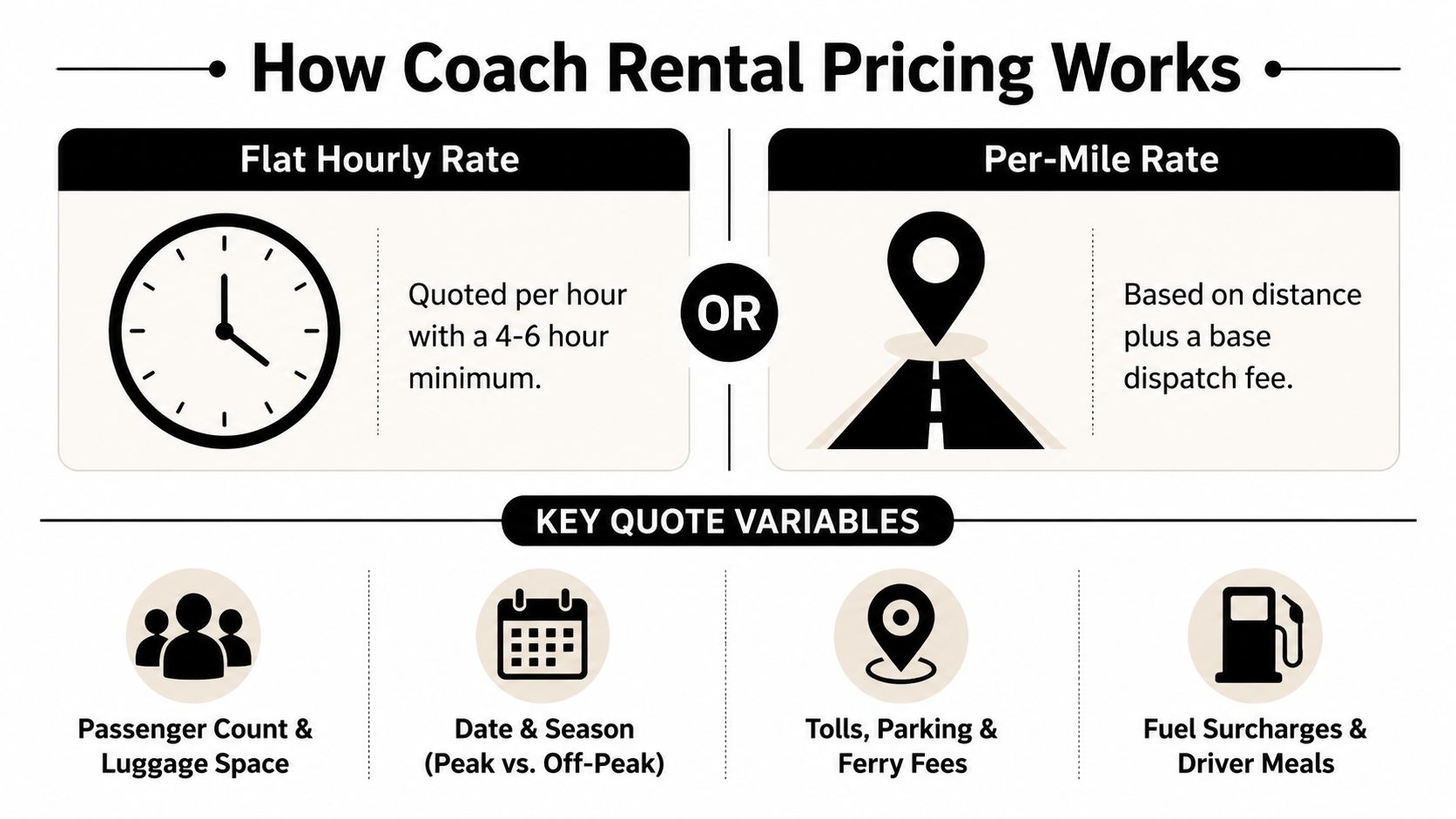
The quote usually responds to five operational variables:
- Distance: Total mileage may include deadhead travel from the garage, not only passenger-loaded miles.
- Duty time: The clock can run while the driver waits at a venue, hotel, airport, or dinner stop.
- Date: Weekends, wedding periods, conferences, and major events place more pressure on available vehicles and drivers.
- Pickup conditions: Urban congestion, limited loading zones, tolls, parking, and restricted roads add work and expense.
- Vehicle specification: Restrooms, premium interiors, accessibility equipment, power, and onboard connectivity can affect the rate.
Read the quote line by line
A short local trip can produce a surprisingly high effective hourly cost if the operator applies a minimum-day policy. A long-distance trip can appear inexpensive on a mileage basis until driver lodging, meals, tolls, parking, overnight staging, and a second driver are added.
The line many first-time bookers miss is garage positioning. The driver may need to travel from the operating base to the first pickup and return after the final drop-off. Some companies include that movement. Others bill it separately. Ask directly.
The U.S. charter bus industry had reported revenue of 4,226 in 2022, compared with 3,843 in 2018, on the FRED industry revenue series for NAICS 485510, the charter bus industry tracked by the Federal Reserve Bank of St. Louis. Independent market coverage also places the U.S. charter bus market at about $6 billion, with a 3.5% CAGR, according to charter bus industry market coverage. The figures show a substantial, institutionally tracked sector, but they don't produce a universal price for your trip.
Compare quotes by matching inclusions. The lowest bottom line often becomes the most expensive option after waiting time, positioning, tolls, and lodging are added.
Booking Timeline From Inquiry to Confirmation
A reliable reservation starts with a complete inquiry. Send the date, passenger range, exact pickup and drop-off addresses, requested vehicle type, luggage expectations, accessibility needs, stop schedule, and the time the bus must be released. “A coach for a wedding” isn't enough information for a dispatcher to verify availability.
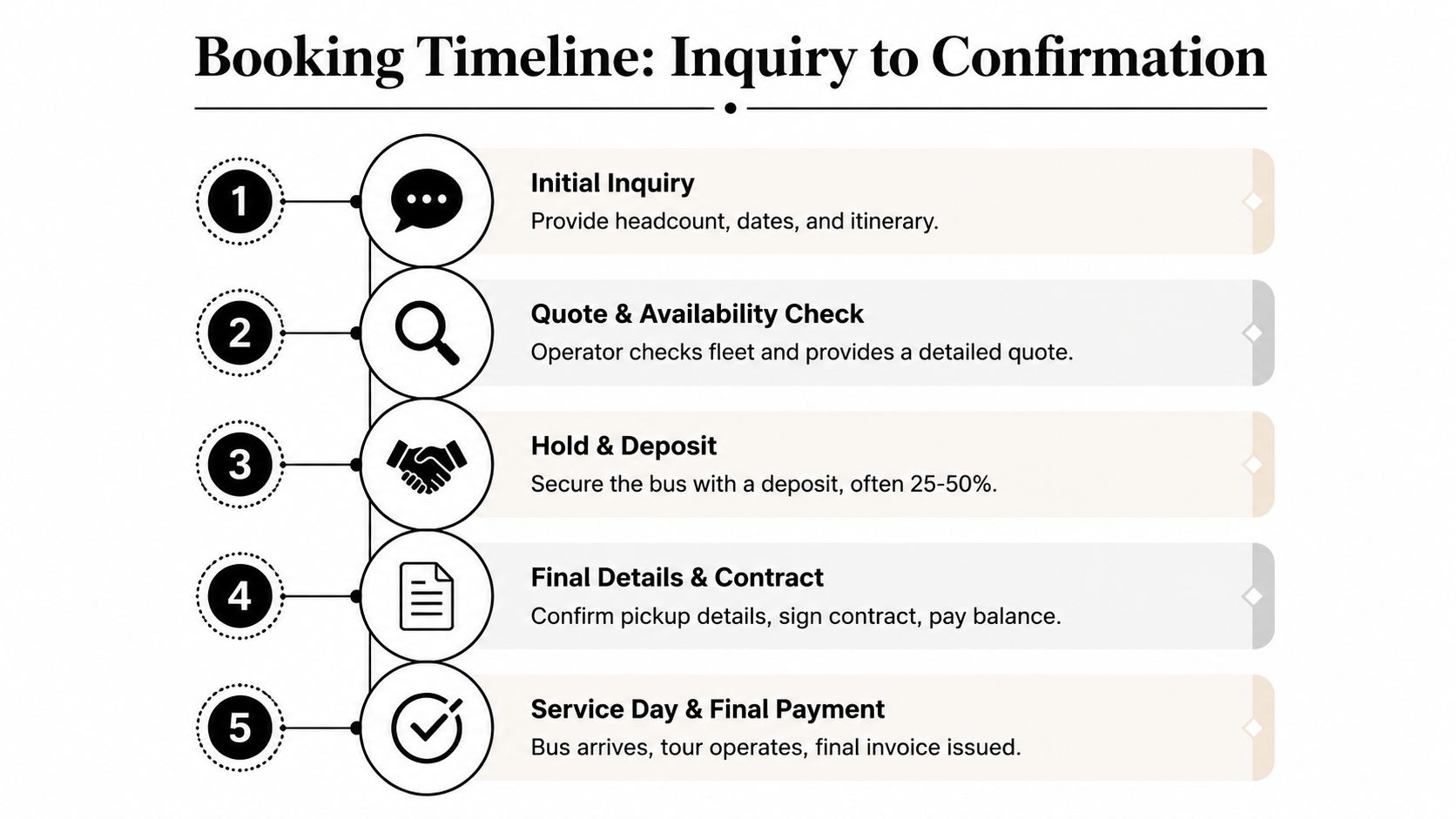
The reservation sequence
- Inquiry: The operator checks the itinerary, group profile, access points, and service window.
- Availability review: Dispatch checks both the fleet and the driver roster. A bus without a legally available driver is not a confirmed solution.
- Quote and hold: You review the inclusions, exclusions, cancellation terms, and any hold deadline.
- Contract and payment: The operator identifies the contracting company, documents the service, and collects the agreed deposit.
- Final confirmation: The itinerary, passenger contact, pickup signage, emergency protocol, and driver assignment are reviewed before service.
Driver availability deserves early attention. The IRU 2025 Global Driver Shortage Report preview describes the 2025 driver shortage as exceeding previous readings, while the UK passenger transport sector reported a 12.4% coach-driver shortfall, equivalent to more than 4,000 drivers, in CPT's operator recruitment guidance. Availability can be especially tight for wedding Saturdays, weekday mornings, convention periods, and holiday travel.
Warning signs include a company that promises a vehicle but won't identify the operating provider, unexplained last-minute substitutions, vague insurance documentation, and deposits requested to personal accounts. Keep the signed contract, quote revision history, payment receipts, itinerary, dispatch number, and all written changes in one file.
For hotels and event venues coordinating multiple passenger movements, a pre-order software system for group bookings can help organize guest details and transport requests before the operator receives the final manifest. It won't replace dispatch planning, but it can reduce preventable changes.
Safety, Insurance, and Driver Vetting Essentials
Leather seats don't make a long trip safe. Legal driver hours, commercial insurance, maintenance, and dispatch support determine whether the charter can operate responsibly.
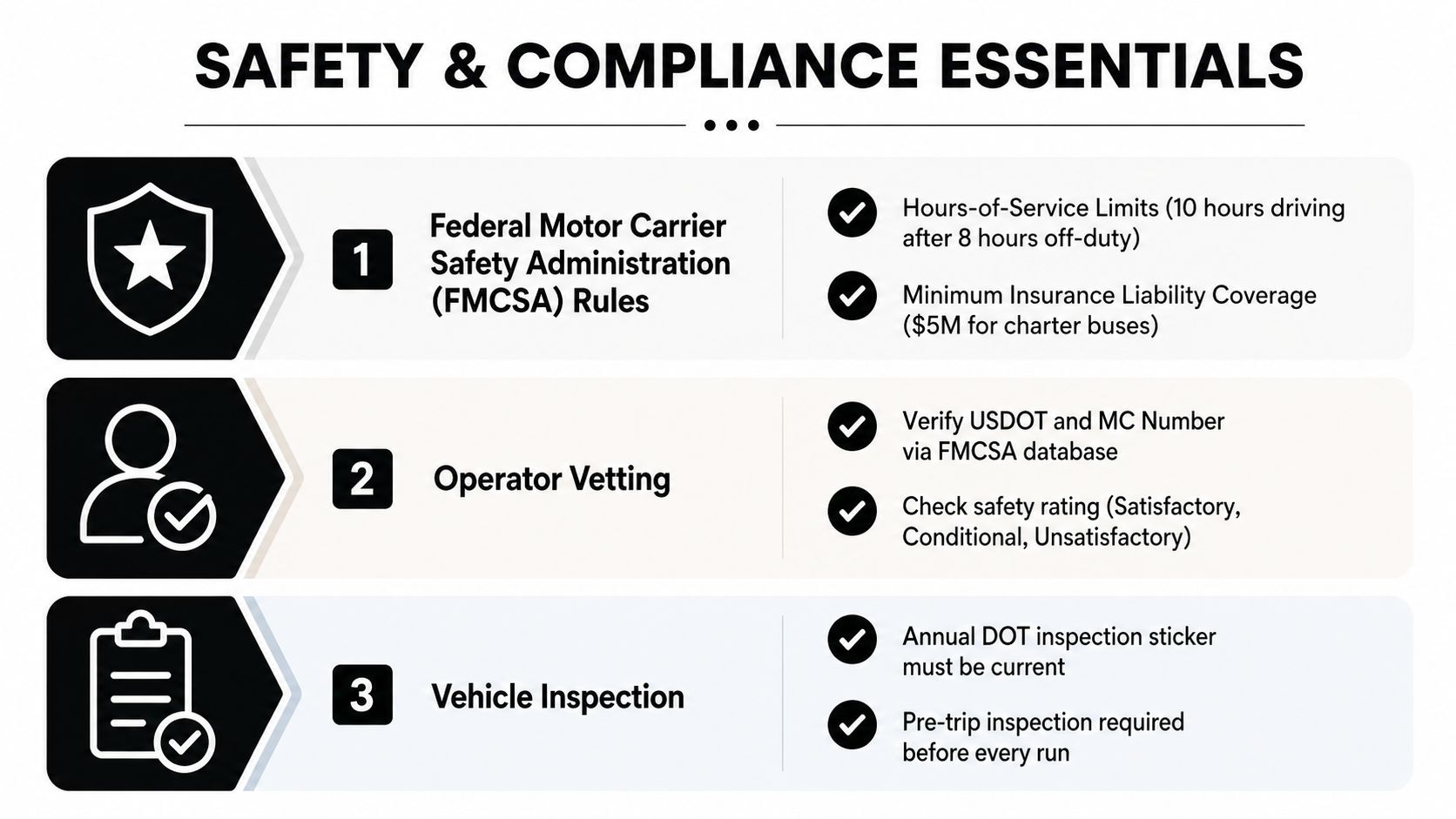
For U.S. passenger-carrying operations, the Federal Motor Carrier Safety Administration allows a driver to drive up to 10 hours after 8 consecutive hours off duty, prohibits driving after 15 hours on duty following that rest period, and applies weekly limits of 60 hours in 7 days or 70 hours in 8 days, according to the FMCSA safety planner. A long itinerary may therefore require a relief driver, an overnight layover, or a revised schedule.
Ask for evidence, not reassurance
Request the operator's legal business identity, USDOT information where applicable, insurance certificate, emergency contact process, and vehicle inspection documentation. Corporate clients should ask whether the certificate of insurance names the organization as an additional insured when their risk team requires it, rather than assuming basic coverage is enough.
The driver review should cover:
- Commercial licensing: Confirm the appropriate commercial driver's license and passenger qualification for the vehicle and jurisdiction.
- Medical qualification: Ask whether required medical certification is current.
- Screening: Confirm background checks, drug and alcohol testing, and company qualification procedures.
- Experience: Request verifiable motorcoach experience relevant to the route and group type.
- Dispatch backup: Learn who responds if the driver becomes ill, the coach develops a mechanical fault, or the schedule changes.
Federal rules require lap and shoulder belts for each passenger and driver seat on new motorcoaches and other large buses. NHTSA states that the requirement can reduce fatalities by up to 44% and moderate-to-severe injuries by up to 45%, as explained in its motorcoach seat-belt rule announcement. Ask whether the assigned coach is belt-equipped and how the operator handles passenger safety briefings.
For operations outside the United States, requirements differ. A PSV operator licence compliance guide provides a useful reference for evaluating licensing and compliance questions in the UK. In every market, ask the operator to explain who holds responsibility for the vehicle, driver, insurance, and roadside response.
Event, Wedding, and Airport Use Cases Compared
The same coach can serve very different operating plans. The vehicle matters, but the dispatch pattern matters more.
A corporate group may need repeated hotel loops, a fixed conference arrival, branded signage, and a dispatcher who can handle employees arriving in waves. A wedding requires patience around guest delays, multiple hotel loading zones, ceremony timing, and a late return window. An airport transfer depends on curb access, luggage volume, flight information, and a clear plan for delays.
Three practical examples
A company moving employees between hotel blocks and a conference venue should provide a route map, loading instructions, passenger communications, and a point of contact at each location. Wi-Fi and power may matter more than a restroom if passengers need to work during the ride.
A wedding planner should treat driver availability as a core planning issue. The late-night pickup is often the most difficult part to staff, particularly when guests leave at different times. Build a clear final departure window instead of promising unlimited waiting.
An athletic team traveling to an early airport pickup needs luggage-bay capacity, a precise curb location, and a return plan tied to the known flight details. The operator should receive equipment dimensions, not just the player headcount.
| Use Case | Group Profile | Key Service Needs | Booking Lead Time | Typical Add-Ons |
|---|---|---|---|---|
| Corporate shuttle | Employees moving between hotels, offices, or venues | Repeated loops, dispatch contact, signage, reliable staging | Book early for peak conference periods | Wi-Fi, power, branding, on-site coordinator |
| Wedding transportation | Guests traveling among hotels, ceremony, and reception | Multiple loading zones, flexible late return, coordinator communication | Reserve early for popular Saturdays | Ribbon detail, signage, extended standby |
| Airport transfer | Travelers with luggage and fixed flight timing | Curb instructions, luggage bays, flight monitoring, meet-and-greet plan | Earlier booking reduces availability risk | Greeter, flight tracking, return transfer |
A common mistake is to give every use case the same itinerary. Corporate planners should design around repeated cycles. Wedding planners should design around guest behavior. Airport planners should design around terminal rules and luggage flow.
Pre-Booking Checklist and Next Steps
A good inquiry looks almost like a dispatch sheet. If you provide the operator with complete details, the quote can reflect the actual vehicle, driver hours, route, and service conditions instead of a generic estimate.
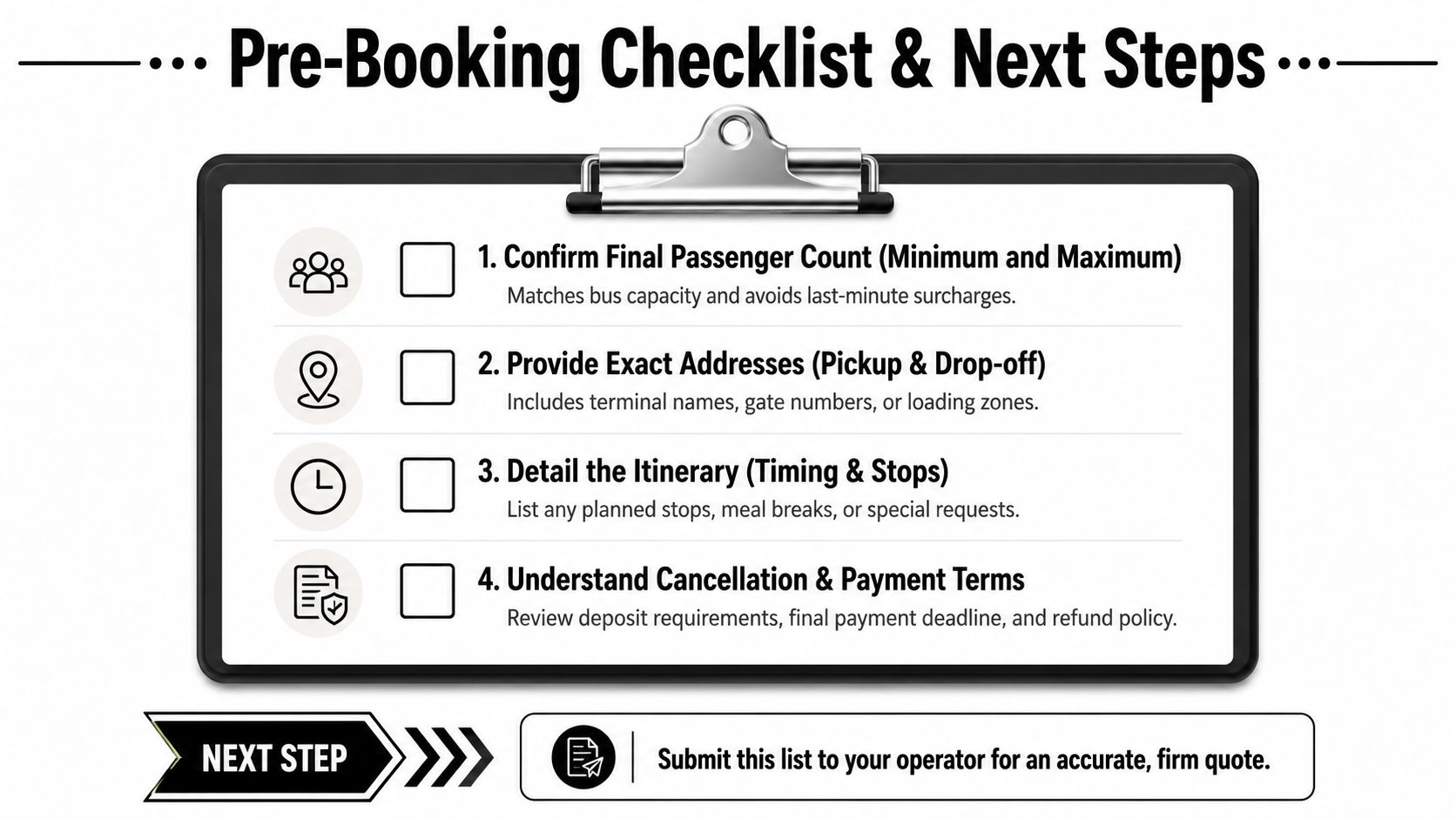
Send these details first
- Passenger range: Give the confirmed count and the highest realistic count.
- Addresses: Include exact pickup and drop-off locations, terminal names, loading zones, gate information, and venue instructions.
- Timing: State pickup time, required arrival time, stops, waiting periods, final release time, and any overnight staging.
- Luggage and equipment: Describe rolling bags, cases, sports gear, displays, or instruments.
- Access needs: Identify wheelchair spaces, lifts, service animals, child seating requirements, and other accommodations.
- Amenities: Request Wi-Fi, power outlets, a restroom, climate control, PA capability, or other features explicitly.
- Driver and route constraints: Ask whether the itinerary fits legal hours, whether a second driver is needed, and where the driver will begin and end duty.
- Day-of communication: Name one decision-maker and establish the dispatch number for changes.
Request proposals from several DOT-registered operators, but compare them on equal terms. Confirm the certificate of insurance if your organization requires it, and make sure the contracting entity matches the company named in the quote.
Put the deposit amount, balance deadline, cancellation window, rescheduling rules, overtime treatment, breakdown response, vehicle substitution policy, and driver lodging responsibility in writing. Then schedule a final itinerary and headcount call 72 hours before pickup so the operator can resolve changes before the service day.
The fastest path to a firm answer is a complete request, not a vague “How much is a bus?” Send the checklist, ask the operator to identify the vehicle class and driver-hours assumptions, and request a written quote tied to your exact date.
Frequently Asked Questions About Coach Bus Rental With Driver
How far ahead should I book?
Book as soon as the date is firm, especially for weddings, conferences, airport peaks, and weekends. Availability depends on both the vehicle and a qualified driver.
Is the quote all-inclusive?
Not automatically. Ask about tolls, parking, gratuity, fuel adjustments, driver meals, lodging, cleaning, positioning, and overtime.
What size coach fits my group?
Seat ranges commonly include 36 to 40, 47 to 56, and 56 plus capacity tiers. Luggage, equipment, accessibility, and route access may require a larger or different coach.
Can passengers eat or drink onboard?
Policies vary. Get permission in writing, and ask about alcohol restrictions, cleaning charges, and prohibited items.
Can the coach stay overnight at a venue?
Possibly, if the venue allows commercial vehicle staging and the operator approves the location. Confirm security, parking, and driver rest arrangements.
How are multi-day trips priced?
Operators may add driver lodging, meals, layover time, and a relief driver when hours-of-service rules require it. Request a day-by-day breakdown.
What happens if the driver is sick?
The operator should have a dispatch escalation plan and qualified replacement coverage. Ask for the emergency number before signing.
What if the bus breaks down?
Confirm whether the company provides roadside assistance, replacement transportation, passenger communication, and reimbursement terms. Don't rely on a verbal promise.
Max's Luxury Rides Inc. offers chauffeur-driven minibuses, mini coaches, and full-size coach buses for airport transfers, corporate travel, weddings, and special events. Visit Max's Luxury Rides Inc. with your date, passenger range, addresses, luggage needs, and full itinerary to request a quote that accounts for vehicle availability and driver-hours requirements.