
The dispatcher has a corporate quote open, a chauffeur waiting on an airport transfer, and a sales manager asking why the account went to a competitor. The rival's rate is lower, but nobody can say whether it includes meet-and-greet service, flight tracking, gratuity, parking, or the same vehicle class. The team is comparing numbers, not products.
That's the central problem with competitive pricing analysis in ground transportation. A sedan, SUV, Sprinter, or coach doesn't have one meaningful price. The price depends on distance, time, passenger count, vehicle availability, service obligations, airport or FBO costs, event conditions, and the margin required to deliver the trip reliably.
Most shoppers already compare prices before buying. One survey found that 96% of global shoppers planned to compare prices, while 63% used a quick Google search to check for a better price. The same research reported that 24% used mobile apps for price comparison and 31% considered price comparisons the most important part of shopping. A separate comparison-shopping survey found that 79% considered themselves bargain shoppers, 79% actively tried to find the lowest prices, and 78% compared prices across different stores or sources. These findings from Wiser's consumer price comparison research describe a broad buying habit, not a niche behavior.
Why Ground Transportation Pricing Breaks Without a Real Comparison
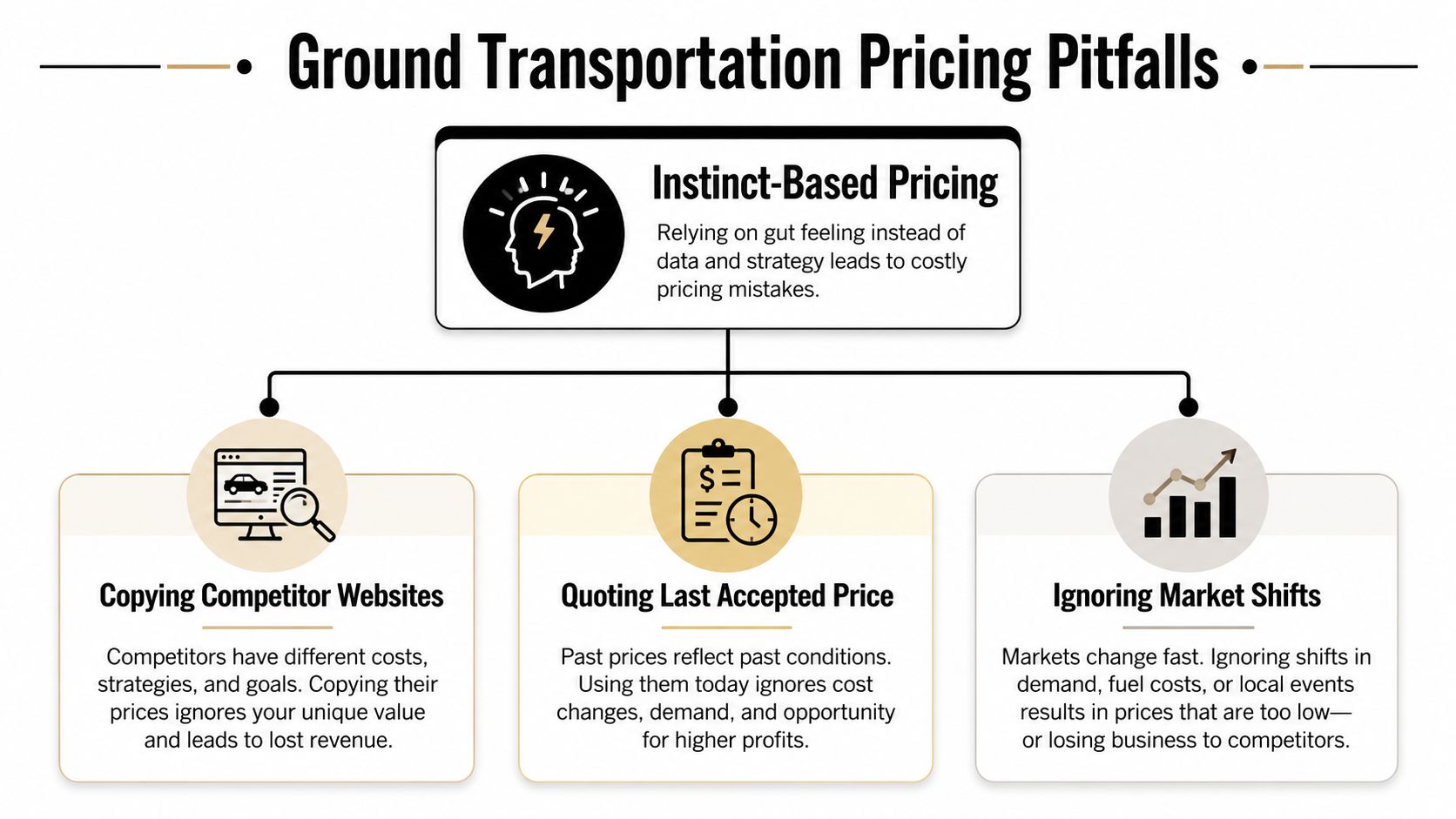
Monday morning usually exposes the weakness in a pricing process. A dispatcher sees that a corporate roadshow quote was lost, pulls up the winning provider's website, and finds a lower airport transfer rate. Someone suggests matching it immediately. Another person points out that the competitor may be using an older sedan, excluding waiting time, or pricing a one-way trip that doesn't resemble the requested service.
That reaction is understandable, but it confuses market information with pricing direction. A competitor's displayed rate tells you what that provider chose to publish under a particular set of conditions. It doesn't tell you whether the trip is profitable, whether the vehicle is available, or whether the customer received a different package through a sales representative.
Ground transportation makes this problem worse because the inventory is operationally uneven. A sedan assigned to an airport transfer has different economics from a Sprinter used for a wedding block. A limousine serving an event may be unavailable for another booking during the highest-demand period. A vehicle serving an FBO may require access coordination and additional handling that never appears in a public tariff.
Segment the work before comparing prices
Start by separating the trips that compete differently:
- Airport transfers: Customers usually care about punctuality, flight monitoring, pickup instructions, luggage capacity, and a clear all-in price.
- Corporate travel: Buyers often evaluate billing, reporting, service consistency, account support, cancellation terms, and vehicle standards.
- Roadshows: The schedule, standby requirements, routing changes, and chauffeur continuity can matter more than the lowest hourly quote.
- Weddings: Capacity, presentation, timing coordination, décor restrictions, waiting terms, and photo-ready vehicles influence the decision.
- Sporting events and concerts: Traffic planning, staging, event surcharges, return timing, and vehicle access can change the economics.
- FBO and private aviation work: Accuracy, discretion, curbside coordination, and facility-specific requirements deserve their own comparison set. Operators evaluating this niche can use a specialized resource on ground transfer for private jet clients to understand the service context buyers may expect.
For each segment, list the three to five providers your customers mention, encounter in search results, or see in RFPs. Don't build a national competitor list if your dispatch team only loses work to local operators on specific routes.
Then classify every competitor by the segment where it has real overlap. A large coach company may be relevant for convention transportation but irrelevant to executive airport transfers. A budget sedan operator may undercut a public rate while lacking the fleet or staffing to serve a corporate account. Your analysis becomes useful when it reflects the alternatives a buyer can realistically book.
Treat pricing as an operating decision
A one-time audit can reveal obvious gaps, but it won't protect the business from rate drift. Competitors change packages, event policies, minimums, and availability. Your own costs change as vehicles age, insurance renews, labor shifts, and demand moves between segments.
Practical rule: Never ask only, “What does the competitor charge?” Ask, “What service does the buyer receive, under what conditions, and can our operation deliver a stronger version profitably?”
The output should be a segment map with a short competitor shortlist, the routes or occasions being compared, and the service attributes that affect the quote. That document becomes the foundation for every later rate review.
Gathering Competitor Rates and Service Data the Right Way
Collecting rates starts with defining the exact service you're testing. Record the origin, destination, date type, pickup window, vehicle class, passenger requirement, luggage requirement, and whether the trip is one-way, round-trip, hourly, or a multi-stop itinerary. Without that scope, two salespeople can request “an airport transfer” and receive rates for entirely different products.
Use several sources, not one
Published rate pages are useful for identifying positioning, but they can be incomplete or stale. A quote request reveals how the provider handles real requirements. Mystery shopping can expose minimums, wait-time rules, and add-on charges that a website hides. Dispatchers, hotel concierges, corporate travel managers, and event planners can provide practical context about which providers win comparable work.
Capture the conditions beside every number:
- Vehicle and capacity: Record the class, passenger limit, luggage suitability, and stated model or age.
- Time rules: Note hourly minimums, included waiting, overtime treatment, and early-morning policies.
- Fees: Check fuel, tolls, parking, airport, FBO, meet-and-greet, cleaning, and event charges.
- Customer terms: Record gratuity treatment, cancellation windows, payment terms, and corporate billing options.
- Availability: Mark whether the quote was confirmed, estimated, or dependent on subcontracting.
When gathering event-related pricing, compare the structure of the package as carefully as the transportation rate. A resource such as PSW Events equipment rates illustrates why event buyers often assess bundled service terms rather than a single headline figure. Transportation quotes need the same discipline.
Build a reusable collection sheet
Use one row for each quote and columns for:
- Segment and service description
- Competitor and source
- Date and time checked
- Vehicle class and capacity
- Base rate and billing unit
- Included services
- Extra fees
- Minimums and cancellation terms
- Availability status
- Notes on sales response and positioning
Refresh the full comparison every 6–12 months, with quarterly spot checks on important competitors, as recommended in this pricing benchmarking guidance. In volatile segments, check specific lanes more often when a contract, event calendar, or new entrant changes the market.
Normalizing Rates to Per-Mile, Per-Hour, and Per-Passenger
A flat quote only becomes useful after you identify what it buys. A Sprinter package for a wedding block and a sedan airport transfer billed hourly aren't directly comparable. Normalize the rate into common units, then preserve the original quote so nobody mistakes a calculated measure for the customer-facing price.
Use three basic calculations:
- Per mile: Total trip price divided by billable miles.
- Per hour: Total trip price divided by billable service hours, including defined standby where the customer reserves the vehicle.
- Per passenger: Total trip price divided by the expected passenger count, not the vehicle's maximum capacity.
Suppose a provider quotes a flat airport transfer at $180 for a 30-mile route, with a planned service window of 1.5 hours and 3 passengers. The normalized results are:
- Per mile: $180 ÷ 30 = $6
- Per hour: $180 ÷ 1.5 = $120
- Per passenger: $180 ÷ 3 = $60
Those figures don't prove that the competitor is cheap or expensive. They show how the price behaves relative to the service requirement. A provider with a lower per-mile rate may carry a high hourly minimum. Another may appear expensive per passenger because the quote reserves a premium vehicle for a small group.
Keep the comparison basket consistent
Use the same route, passenger count, time window, vehicle category, and included services for every provider. If one quote includes airport fees and another excludes them, either add the known fee or label the comparison as incomplete. Don't force false precision when the source doesn't disclose the charge.
| Competitor | Per Mile | Per Hour | Per Passenger |
|---|---|---|---|
| Provider A | $6 | $120 | $60 |
| Provider B | Calculated from quoted route | Calculated from service window | Calculated from passenger count |
| Provider C | Not comparable until fees are confirmed | Not comparable until minimum is confirmed | Not comparable until capacity is confirmed |
Refresh the underlying observations on the same cadence as the rest of the review. A public rate sheet is a lead, not proof of the final transaction price. The most trustworthy records combine a direct quote, documented terms, and a clear timestamp.
Adjusting for Fleet Mix, Amenities, and Service Differences
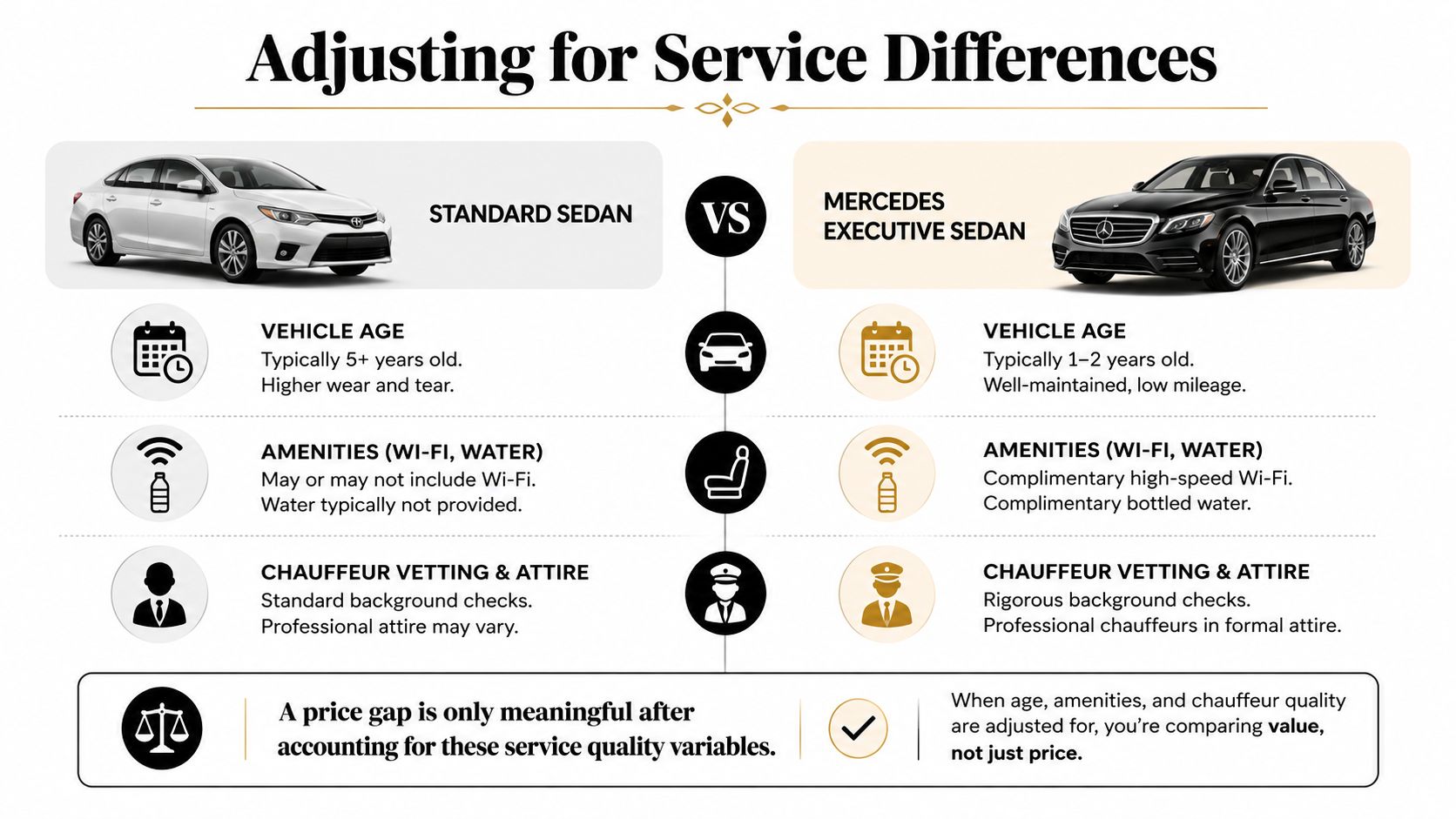
Normalization makes quotes easier to compare, but it cannot make unlike services equivalent. A newer Mercedes executive sedan with Wi-Fi, bottled water, flight tracking, and a vetted chauffeur carries a different cost and customer promise from an older standard sedan with limited amenities. The same airport flat rate can therefore hide a meaningful difference in value, capacity, and operating risk.
Build a feature basket for each vehicle and service segment. Define what the buyer receives, then record which competitors include each item, charge separately, or leave it unclear. The broader pricing lesson from Simon-Kucher's Global Pricing Study 2025 is useful here: competitor rates and customer price sensitivity matter, but operators also need to examine the other levers that shape a transaction. In chauffeur work, that includes vehicle assignment, FBO fees, wait exposure, recovery capacity, and event-related operating constraints.
Score what the customer can feel
Use a service score tied to observed terms and operating practice, not promotional wording. A practical matrix can include:
- Fleet condition: Vehicle age, cleanliness standard, luggage fit, and replacement procedure.
- Chauffeur quality: Vetting, training, attire, communication, and continuity for executive work.
- Airport and FBO handling: Flight tracking, pickup instructions, curb coordination, facility access, and wait procedures.
- Amenities: Wi-Fi, water, charging, child seats, climate control, and privacy features.
- Account administration: Central billing, receipts, traveler profiles, reporting, and after-hours support.
- Recovery capability: Backup vehicles, escalation contacts, and response procedures when a trip changes.
Weight those features by segment. Corporate buyers may value account administration and consistent execution. Wedding planners may prioritize presentation and coordinated timing. FBO clients may place more value on discretion, precision, and access handling.
Explain a premium instead of apologizing for it
A price gap becomes meaningful after the service difference is documented. If your offer includes a stronger vehicle, more reliable coverage, clearer communication, or greater recovery capacity, present the higher rate as a defined package choice. If a competitor provides the same features, reassess the price rather than defending it with vague quality language. If the competitor does not, matching the headline rate can cut margin without improving the chance of winning the trip.
A lower rate threatens the business only when the buyer sees both services as interchangeable.
Building Seasonality, Event, and Lead-Time Adjustments
A rate that works on a quiet Tuesday may fail on a major event night. Ground transportation demand moves with calendars, venue schedules, airport patterns, weddings, graduations, and corporate travel cycles. A competitor's public rate may be a base price, a limited-availability offer, or a dynamic quote generated after the buyer submits trip details.
Create three adjustment layers
First, build a seasonality index from your own operating history. Compare demand, acceptance patterns, vehicle utilization, and contribution margin by recurring calendar period. The index doesn't need to be complicated. Its job is to show when the base rate routinely understates the resources required to serve the work.
Second, create an event map. Mark venues, airports, hotels, convention centers, and recurring event periods. Identify the operational effects, such as road closures, staging restrictions, limited parking, delayed departures, or return-trip uncertainty. A surcharge should reflect the additional work and capacity commitment, not just the event's reputation.
Third, add a lead-time curve. A booking made well ahead of service may allow efficient vehicle assignment. A late request can require overtime coordination, repositioning, subcontracting, or the reservation of scarce capacity. The quote should reflect those conditions while remaining clear to the buyer.
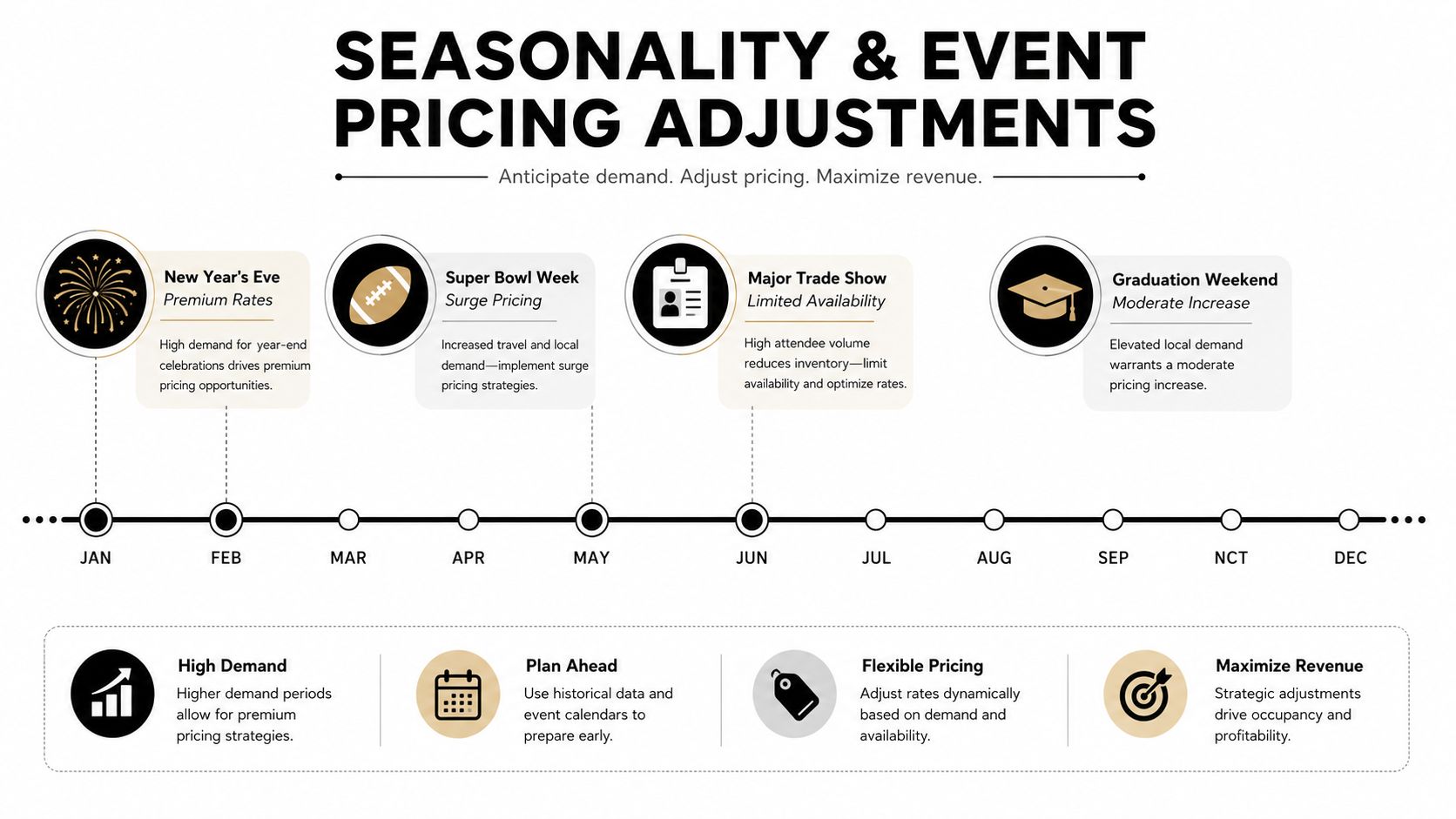
The timeline should distinguish events rather than apply one universal multiplier:
- New Year's Eve: Premium pricing may reflect concentrated demand and difficult staffing.
- Super Bowl week: Surge conditions can affect availability, traffic, and vehicle positioning.
- Major trade shows: Limited availability may make vehicle allocation the primary constraint.
- Graduation weekend: Moderate increases may apply across several days and service categories.
Benchmark a moving market
When rates change by hour, event, channel, or booking lead time, compare more than the displayed price. Record the spread between low and high quotes, how far ahead each price was available, and which terms came with it. Travel procurement commentary increasingly points toward dynamic pricing and hybrid contracts, including corporate models that may use rate caps, flexibility, and value-added terms instead of only the lowest headline rate, as discussed by Business Travel Executive's coverage of corporate hotel rates.
For transportation, the equivalent is a quote model that combines competitor signals, route demand, capacity, lead time, and a margin floor. Matching a competitor during a peak period may be irrational if that provider is underpricing scarce capacity. Holding a premium may be justified when your service removes operational risk the buyer can't easily replace.
Running the Break-Even and Margin Checks That Actually Matter
Competitor data tells you what the market appears to accept. Your cost model tells you what the business can sustain. Keep those two views separate until the final pricing decision.
For each vehicle class, calculate the minimum revenue required for a booking:
Break-even price = trip-specific variable costs + allocated fixed operating cost
Variable costs may include driver wages, fuel, tolls, parking, airport or FBO charges, cleaning, and payment processing. Allocated fixed costs can include insurance, financing, registration, maintenance planning, dispatch, technology, and administrative labor. Use actual internal costs rather than a generic industry assumption.
Check contribution by segment
A booking can cover its direct trip costs and still consume capacity that would earn more elsewhere. Review contribution margin by airport transfer, corporate work, weddings, events, roadshows, and group transportation. Track which segments produce reliable work, which require heavy coordination, and which create unpaid time around the booked service.
Run a sensitivity check against the costs most likely to move:
- Fuel: Test higher fuel consumption, longer deadhead, and traffic-related idling.
- Driver labor: Include overtime, split shifts, standby, and last-minute coverage.
- Insurance and fleet costs: Review renewal changes, vehicle downtime, and repair exposure.
- Capacity loss: Account for a vehicle reserved for a block that prevents another booking.
Set a margin floor for each segment and vehicle class. The floor should apply even when a large account asks for a special rate. If the quote falls below it, require an explicit commercial decision, such as a strategic contract commitment, predictable recurring volume, or a service scope reduction.
Margin discipline: Never call a trip profitable because it has revenue. Confirm that the booking covers direct cost, capacity usage, and the operational burden attached to delivery.
Turning Analysis Into Pricing Strategy and A/B Tests
A rate sheet matters only when it changes the quote a customer receives. After normalizing competitor prices, comparing service scope, applying demand conditions, and confirming your margin floor, assign a clear position to each segment and vehicle class.
You have three practical choices:
- Match selectively: Use this for transparent services where vehicle, inclusions, coverage, and booking terms are equivalent, and where the account fits your commercial plan.
- Hold a premium: Charge more when your vehicle condition, chauffeur standards, coverage, administration, or recovery capability removes a problem the cheaper provider leaves unresolved.
- Package the choice: Present good, better, and best tiers. Customers can trade features against price, while your team avoids discounting a package that cannot support its operating cost.
Build the decision into the quote template. Sales staff should not rely on memory to determine whether airport fees, wait time, FBO charges, event conditions, or recovery provisions are included. A Disputely price breakdown can help clarify the difference between a headline figure and a transparent cost structure, although chauffeur pricing still requires its own vehicle, route, and operating inputs.
Test comparable opportunities rather than random bookings. For corporate quotes, show one group a price-matched package and another a premium package that states the added service. For events, compare a bundled offer with an itemized structure. Keep route type, vehicle class, lead time, and buyer profile as consistent as practical, and record which version each buyer saw.
Judge the result using more than win rate:
- Win rate: Did the buyer accept the quote?
- Average ticket: Did the structure raise booking value?
- Gross margin per booking: Did the trip stay above the approved floor?
- Scope changes: Did the customer remove services after seeing the package?
- Operational outcome: Did the booking create excessive standby, deadhead, FBO fees, or recovery work?
Start with one segment and one vehicle class. First, clean the competitor sheet and verify internal costs. Then update quote templates and train sales and dispatch on the same service definitions. Run controlled package tests, review results with operations, and schedule spot checks for competitors connected to real lost bookings.
Prices change with demand, travel patterns, events, and lead time. Treat competitor signals as inputs, not automatic instructions. Review them alongside service scope, available capacity, booking timing, and the margin floor. A controlled test should end with a decision: keep the offer, revise it, or stop using it.
Max's Luxury Rides Inc. offers dependable airport transfers, corporate transportation, event packages, and group service with executive sedans, SUVs, Mercedes vans, Sprinter limousines, minibuses, and coaches. Visit Max's Luxury Rides Inc. to discuss a quote structure that matches your passengers, route, vehicle requirements, and service expectations.