
You've got tickets, the group chat is moving fast, and someone has already asked the question that usually comes too late, how are we getting there and who's handling the ride home? That question decides whether the night feels smooth or chaotic. In live-event work, concert transportation is never just a car booking, it's the part of the plan that controls arrival timing, curb access, and the entire post-show exit.
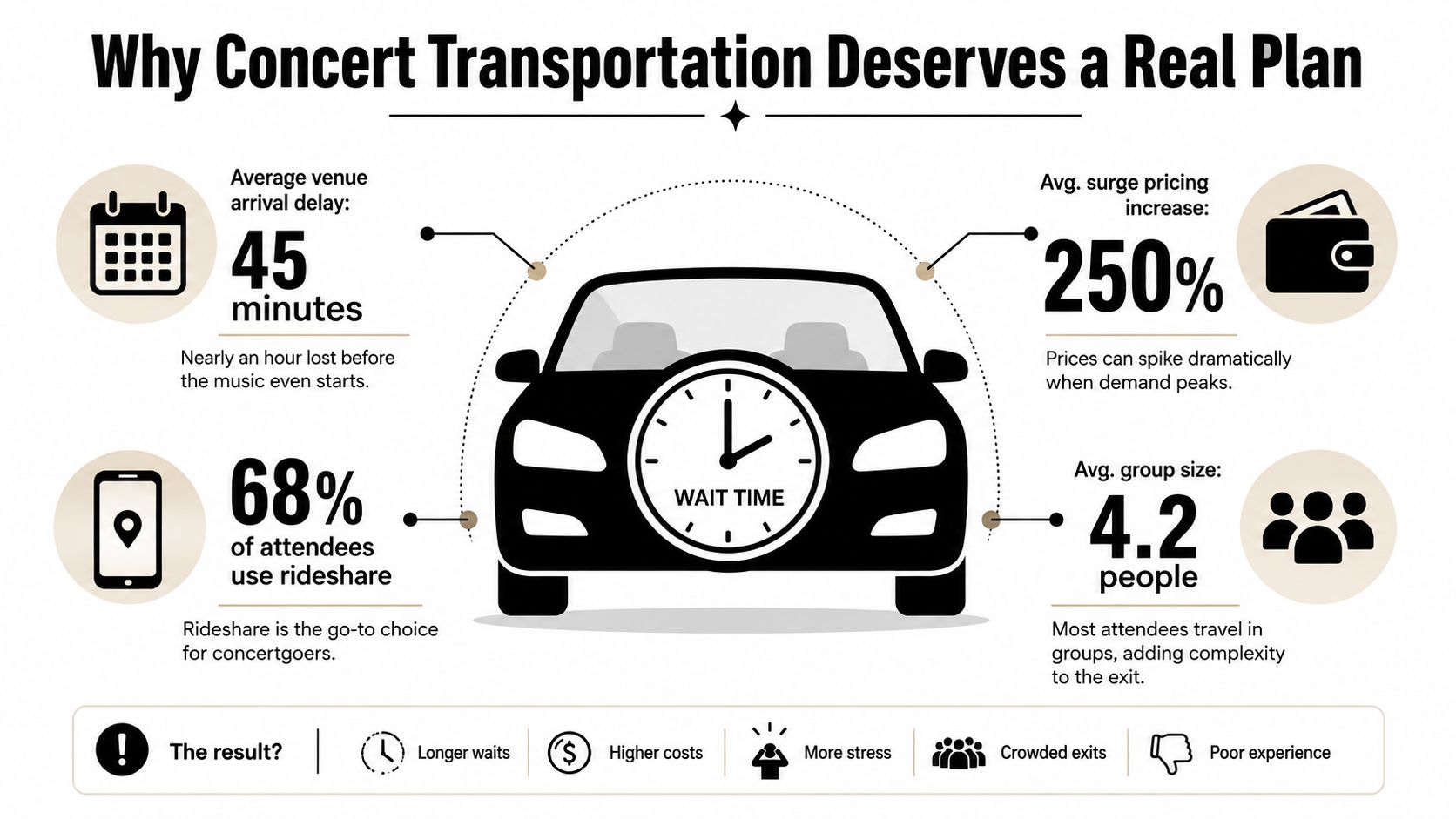
Why Concert Transportation Deserves a Real Plan
The first bad sign is familiar. You're a half-mile from the venue, brake lights are frozen, the opening act is already underway, and the group is split between a text thread, a parking app, and a rideshare estimate that keeps changing. The show is happening, but the experience you paid for is being eaten by traffic and confusion.
That's not a rare edge case. In REVERB's concert travel study, 80% of respondents said they traveled to shows by car, the average concert trip used 3,321 vehicles with about 2.5 passengers each, and the typical round trip was 144 miles; only 9% used public transportation, while 33% said they would use it if better options were available, and fan travel generated 38 times more emissions than the combined travel of artists and crew, hotel stays, and equipment transport. Those numbers show why transportation isn't a side issue, it's a central part of venue access and emissions planning. Billboard's summary of the REVERB study
What happens when transportation is treated as an afterthought
At stadium scale, the road system feels every arrival window. StreetLight Data's analysis of 62 concerts at 23 stadiums during Taylor Swift's Eras Tour found that average roadway delay hours near venues were 277% higher than comparable non-concert periods, and all but four venues saw delay hours at least double on average. The Technical University of Munich's traffic research also found that among concert-goers not using active modes, 51% arrived by private car, compared with 32% by Uber, 8% by metro, and 3% by bus. StreetLight Data's Eras Tour traffic analysis
That's why venue operators and transportation teams now treat event nights like demand spikes, not ordinary trips. The Federal Highway Administration says coordinated planning well in advance matters, including access strategy, information strategy, roles, and contingency planning, because traffic can jump sharply and still be managed if the instructions are clear. In one major special-event case, traffic volumes on key routes rose 100% to 400%, but proactive messaging prevented public complaints and the event was considered a transportation success. FHWA special-event planning guidance
Practical rule: if the plan doesn't address where the vehicle stops, when it leaves, and how the group reunites, it's not a transportation plan yet.
Assessing Your Group Size, Gear, and Timing Needs
The fastest way to ruin a concert pickup is to guess. A dispatcher can work with specifics, but “a few friends” and “some bags” don't tell anyone whether you need a sedan, a Sprinter, or two vehicles that can stage separately and arrive together. Under-counting riders is still the most common mistake because the group always grows after the tickets are bought.
Start with the hard facts
Before anyone books a vehicle, answer these questions in writing.
- How many riders are definite, not tentative. Count the people who are getting in the car, not the people who “might meet us there.”
- What gear is coming with you. Coats, merch, coolers, folding chairs, signage, and instruments change cargo needs fast.
- Does anyone need easier access. Mobility limits, sensory needs, or simple fatigue after a long night should shape vehicle choice and pickup timing.
- What time do you want to arrive. Early arrivals need a different dispatch window than a straight-to-door drop.
- What time can the group realistically leave. If one person always wants to stay for the encore and another wants to leave early, that has to be solved before the booking.
A clean headcount also protects the curb plan. If the group is larger than expected, the driver may arrive in the right place with the wrong amount of seatbelts, and that creates a delay before anyone even reaches the venue. The solution is to build a final confirmation checkpoint into the day-before message, then lock it.
Turn vague plans into a usable brief
Use a short prompt list when you request a quote or reserve a chauffeur:
- Group size: final number, plus one backup seat if someone might join late.
- Luggage and gear: anything that can't sit on a lap.
- Accessibility needs: boarding help, step height, room for mobility equipment, or quiet staging.
- Pre-show timing: dinner stop, hotel pickup, or direct-to-venue transfer.
- Post-show timing: immediate departure, wait-and-return, or split release windows.
That brief is what lets an operator decide whether one vehicle or a mixed fleet makes sense. It also cuts the back-and-forth that usually causes late-night friction, when everyone's already dressed and the venue is filling up.
A clear booking note saves more event-night stress than any last-minute app search.
Choosing the Right Vehicle From Sedan to Coach
Vehicle choice gets oversimplified all the time. People ask for “something nice” and then discover that nice can mean a quiet sedan for two, a Sprinter for a social group, or a full coach when the guest count and baggage turn a simple ride into a moving logistics problem. The right answer depends on how many people you're moving, how much they're carrying, and whether the ride is part of the experience or just transit.
Match the vehicle to the event shape
| Vehicle Type | Passenger Capacity | Best For |
|---|---|---|
| Executive sedan | 1 to 3 | Couples, VIP arrivals, clean point-to-point service |
| Luxury SUV | 3 to 5 | Small groups with bags, premium comfort, discreet arrivals |
| Mercedes Sprinter | 8 to 14 | Friend groups, pre-show dinners, coordinated arrivals |
| Stretch limousine | Small to mid-size party | Celebratory entrances, red-carpet style moments |
| Executive shuttle | Mid-size groups | Venue transfers, hotel loops, private event routing |
| Minibus | Larger group | Fan clubs, corporate outings, festival movement |
| Full-size coach | Very large groups | Structured transport, long guest lists, single-load movement |
Where each option wins
Sedans and SUVs work when you want clean timing and a polished arrival without extra staging. A Sprinter becomes the practical sweet spot when the group wants to ride together but still have room to talk, store bags, and avoid splitting up. Shuttles, minibuses, and coach buses make more sense once the ride becomes a coordinated movement plan instead of a simple transfer.
For larger groups, mixing vehicles is often smarter than forcing everyone into one oversized unit. A Sprinter plus a sedan can solve a split arrival, handle a VIP guest separately, or give the organizer a flexible backup if one part of the party runs late. That approach also helps when the venue has multiple access points or when one vehicle needs to stage off-site while another handles a tighter curb window.
The same logic applies across premium operators, from local chauffeur companies to large event fleets. Max's Luxury Rides Inc. offers executive sedans, luxury SUVs, Mercedes vans, Sprinter limousines, executive shuttles, stretch limousines, minibuses, mini coaches, and full-size coach buses, which is useful when the group size is known but the event format still needs flexibility. If the booking is for a small, polished arrival, a sedan or SUV does the job. If it's a group night with gear and a late finish, the larger formats win on simplicity.
Drop-Off, Pick-Up, and Routing Strategy
The published venue address is rarely the place you should use. On show day, what matters is the legal curb zone, the post-show flow, and whether your driver can get in and out without crossing the same bottleneck as every other car in the county. A clean route matters more than a fancy vehicle because a bad stop can make even a premium ride feel amateur.
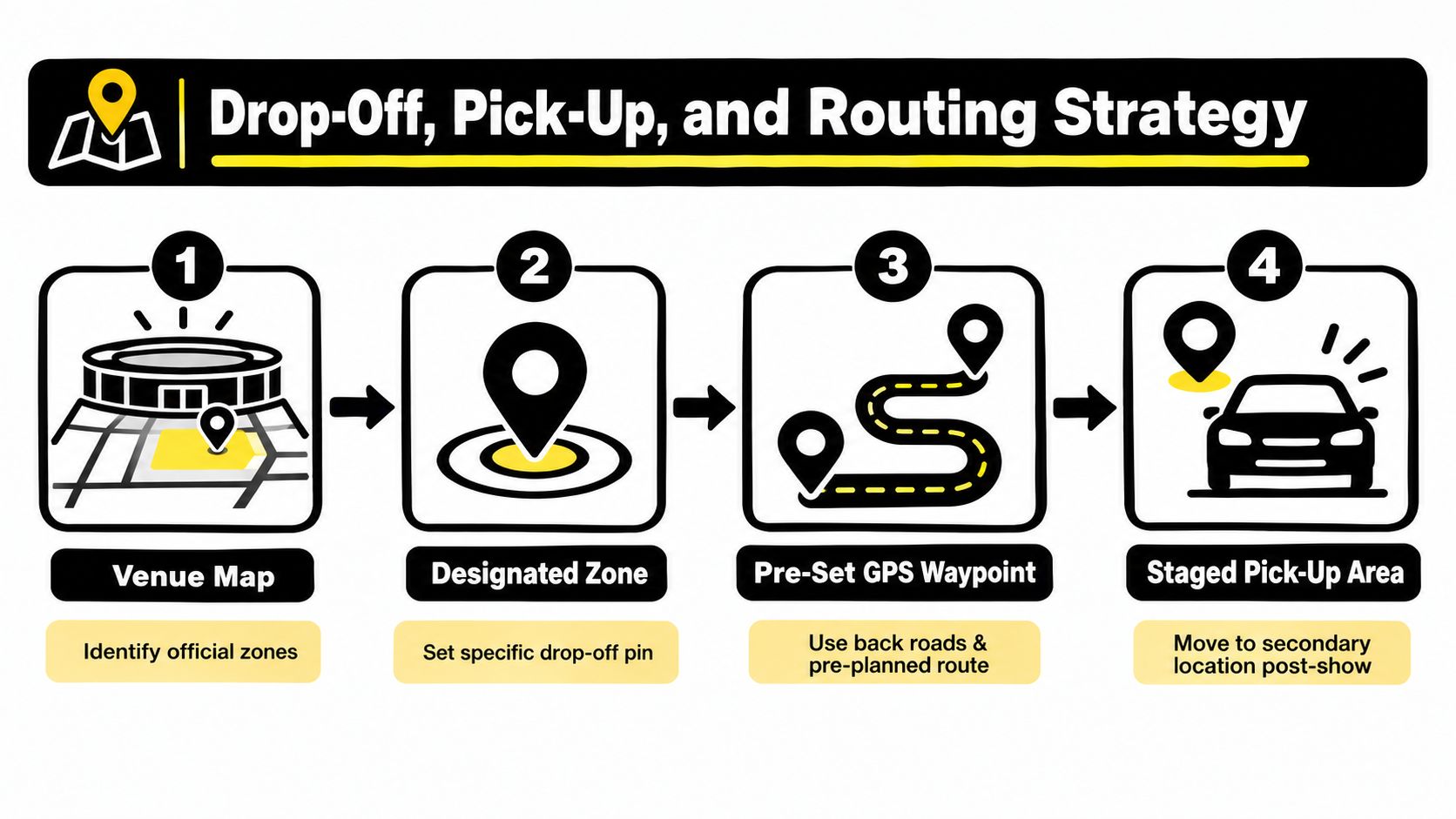
Build the stop around the venue, not the navigation app
A professional dispatcher starts with the venue map, then pinpoints the official loading or drop zone, not just the mailing address. From there, the driver gets a pre-set GPS waypoint and an alternate route in case the main approach clogs. If curb space is tight, the vehicle stages nearby and moves in only when the pickup window opens.
That staging step matters because post-show departures are where most complaints start. People leave at once, phones struggle, and everyone wants the car to be at the exact same corner at the exact same minute. The solution is a rendezvous plan that tells the group where to walk, what landmark to use, and when the driver will move from staging to the pickup point.
Use a geofence mindset
Think in zones, not addresses. Set a primary drop-off pin, a secondary pickup pin, and a fallback meeting point if the first one gets blocked. That's also where route discipline comes in, because the driver should know which back roads, side streets, or venue-adjacent access lanes are realistic before traffic builds.
For a practical model of route planning in a different transport context, the interstate removalists Melbourne to Sydney page is a useful reminder that long-distance movement succeeds when the route is planned before departure, not improvised at the curb. Concert nights work the same way, only faster and with less forgiveness.
The best pickup is the one the crowd never has to think about.
Driver checklist for show day
- Confirm the exact drop pin. Don't assume the venue name is enough.
- Share the backup access route. If one entrance locks up, the driver needs a second option.
- Set the pickup landmark. A sign, gate number, or lot marker beats “somewhere outside.”
- Stage the return. Decide whether the car waits nearby or returns after the encore.
- Send the group's contact point. One person should be reachable when the crowd spills out.
Pricing, Contracts, and How to Budget Honestly
Concert transport quotes can look simple until the line items start stacking up. The quote might seem low until you notice the minimum hours, deadhead, venue access, parking, and overtime terms that show up after the fact. A clean budget starts with understanding what is being sold, the vehicle, the time window, or the right to keep that vehicle available through the full night.
What you're really paying for
Hourly minimums are common because the operator has to hold a vehicle and a chauffeur for your event window, not just the minutes spent in motion. Deadhead miles matter too, because the vehicle has to travel to the pickup point and back after the event. If the venue charges for access or parking, that cost is usually part of the actual operating expense rather than a negotiable add-on.
Peak-event surcharges are the least glamorous line item, but they're also the easiest to misunderstand. They usually reflect the extra time and complexity of moving through a heavy event window. Overtime terms deserve close attention, especially if the show runs late, because the vehicle can't just disappear at encore time.
What to negotiate and what to accept
Negotiate the items that depend on structure. If your event time is flexible, ask whether the provider can adjust the pickup window or combine transfers. If the route is fixed, ask for a clean written scope so there's no confusion about stops or waiting time.
Accept the costs the operator can't avoid. Venue access, extended waiting, and late-night return time are real expenses, and trying to erase them just creates friction later. A better contract protects both sides by stating the pickup zone, the grace period, the replacement vehicle rule, and what happens if the show ends late.
For airport-style precision on ground transfers, the guide to JFK LGA EWR drop off is a useful reference point for how specific pickup and curb rules keep a ride from turning into guesswork. Concert work needs the same discipline, just with more noise and less margin.
Accessibility, Safety, and Contingency Planning
Accessibility isn't a side note to event transportation. If someone in the group can't board easily, can't hear the driver over the crowd, or can't handle a chaotic handoff at the curb, the service has already failed that rider before the music starts. The smartest bookings flag those needs early, then build the trip around them instead of improvising at the venue.
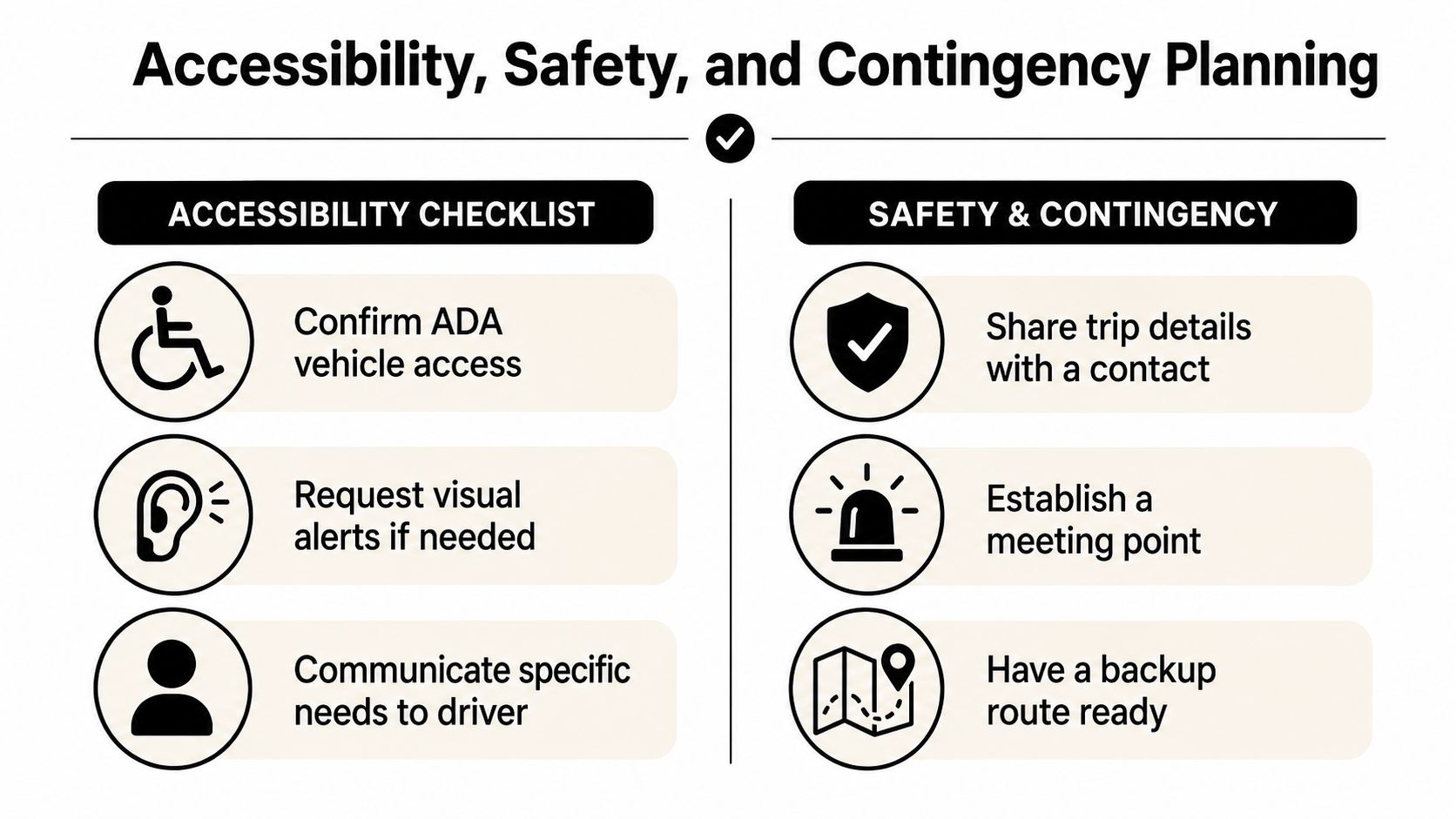
Make accessibility part of the booking note
Tell the operator whether the rider needs step-free access, extra boarding time, visual confirmation, or room for mobility equipment. If the group has sensory needs, a calm loading point and clear instructions matter as much as the vehicle itself. The recent University of Minnesota discussion on underserved transportation needs is a good reminder that mobility barriers are not just about fares or parking, they're about whether the trip is usable. University of Minnesota CTS on underserved transportation needs
The safest workflow is simple. One person sends the driver trip details, one contact stays reachable during boarding and exit, and the group agrees on a meeting spot before the lights go down. That prevents the common scenario where half the party is outside the gate, half is still inside, and nobody can find the vehicle.
Build in backup before something breaks
A backup vehicle plan is not paranoia, it's normal event operations. If a chauffeur is delayed, if weather changes the access pattern, or if the venue reroutes traffic, the organizer needs a second pickup point and a clear escalation path. For outdoor venues, weather should be part of the routing note, because heavy rain or wind changes where people gather and how long they linger.
Operational reliability also matters after the show, when late-night departures are at their messiest. In 2026, Live Nation and the Toronto Transit Commission expanded free post-concert subway rides from Rogers Stadium, using station selection informed by crowding patterns and accessibility data from 2025, which shows that major venues are now treating transit capacity as part of event planning. Live Nation Canada and TTC post-concert ride update
A good backup plan doesn't need drama, it needs a name, a location, and a phone number.
Sample Timeline, Organizer Checklist, and Final Tips
The smoothest concert nights are usually the ones that got boring early. By the time show day arrives, the details should already be locked, the pickup window should already be shared, and nobody should be trying to redesign the route from the passenger seat. If you want a format that keeps the whole thing organized, an event planning timeline template is a solid way to structure the work before the first car moves.
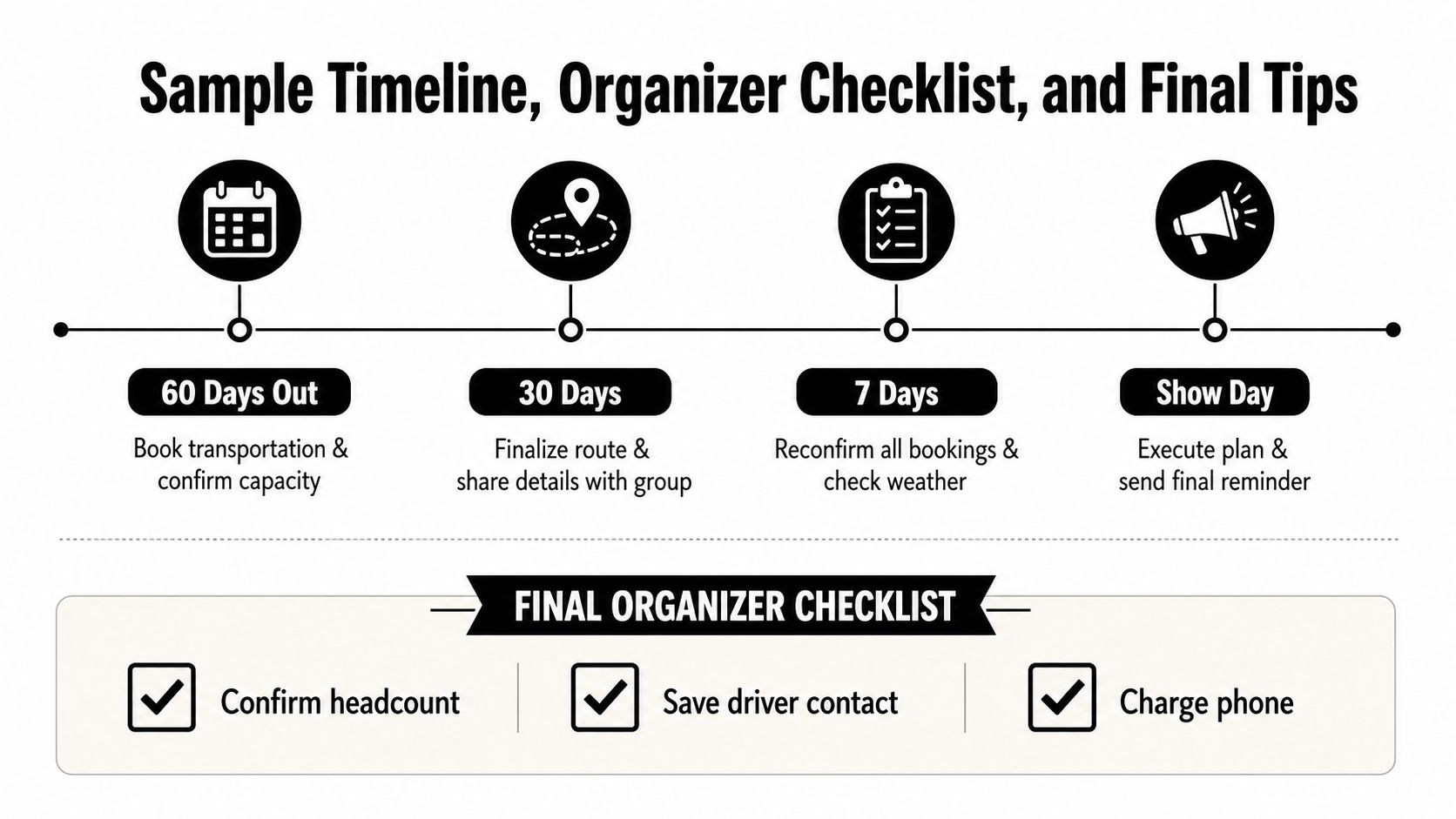
A practical timeline
- 60 days out: book transportation and confirm capacity.
- 30 days out: finalize route details and share them with the group.
- 7 days out: reconfirm bookings and check weather.
- Show day: execute the plan and send the final reminder.
The organizer checklist that actually matters
- Confirm headcount.
- Save the driver contact.
- Charge your phone.
The last three habits separate smooth nights from messy ones. Confirm the pickup window the morning of the show, pick one point of contact for the driver, and keep the route note short enough that anyone can read it at the curb. If the group can leave with one message and arrive with one stop, the rest of the night usually takes care of itself.
If you want a concert night handled with the same care you'd expect from a professional transport team, Max's Luxury Rides Inc. can provide event-ready vehicles and chauffeur service built around timing, routing, and group coordination. Visit Max's Luxury Rides Inc. to plan a ride that fits the show, the crowd, and the pickup window.