
Your phone starts buzzing before sunrise. One board member landed early at O'Hare. Another is stuck on the tarmac. The CEO wants a direct pickup to the office, not the hotel. Two clients are arriving separately and can't be kept waiting in a pickup zone while your team figures out who's in which car. By 8:30 a.m., this isn't “transportation.” It's an operations problem.
This defines Corporate Transportation Chicago. If you're managing executive movement in this city, you're not buying luxury for luxury's sake. You're buying schedule protection, cleaner handoffs, and fewer avoidable mistakes. A polished black vehicle means nothing if the routing is sloppy, the airport coordination is reactive, or the billing creates more admin work than the ride itself.
Chicago adds pressure because the travel environment is big, layered, and busy. The Chicago Transit Authority operates the nation's second-largest public transportation system, serving 35 suburbs and providing 87% of public transit trips in the six-county metropolitan area, with an average of 953,787 rides on a typical weekday according to CTA system data. That scale is useful for the city, but it also tells you what your ground plan is competing with every day.
Planners who handle this well usually treat transportation as part of the meeting strategy, not an afterthought. If you want a broader management lens on traveler stress, timing, and employee experience, Corporate Challenge on corporate travel is a worthwhile read.
Navigating Chicago Corporate Travel Without the Chaos
The first mistake I see is simple. Teams book vehicles the way consumers book rides. One trip at a time, one person at a time, one app notification at a time. That approach falls apart the second your day includes staggered arrivals, downtown meetings, client hospitality, and a hard return-to-airport deadline.
What reliable service actually looks like
Reliable corporate transportation in Chicago means someone has already thought through the details that usually break the day:
- Arrival timing: Flights rarely create clean curbside handoffs.
- Building access: Hotels, office towers, and event venues all have different pickup realities.
- Manifest control: Names, mobile numbers, luggage load, and stop order need to be confirmed before wheels roll.
- Backup logic: If one arrival shifts, the rest of the schedule can't collapse with it.
Practical rule: If the trip affects a meeting, a pitch, or an executive relationship, book transportation like an operations workflow, not like a casual errand.
Where planners lose control
Chicago punishes vague instructions. “Pickup at arrivals” isn't a plan. “Take them to the office” isn't a route strategy. “We may add a stop” isn't enough for a provider to stage the day properly.
Strong planners send a working brief. It should include the flight, final destination, passenger count, luggage notes, contact hierarchy, and who can authorize changes in real time. That alone cuts confusion more than any leather interior ever will.
Defining Your Corporate Transportation Service Needs
A CFO lands at O'Hare, one VP comes in through a private terminal, and the client dinner starts in 90 minutes in River North. If you book that like three simple rides, you create your own problem. Define the service around the itinerary, the risk, and who owns the day when timing shifts.
Start with the assignment. Corporate transportation in Chicago usually falls into four service categories, and each one solves a different operational problem. Choose the wrong model and you pay twice, once in avoidable cost and again in lost control.
Airport and FBO transfers
Airport and private aviation pickups need active trip management, not just a scheduled car. Chicago's air traffic volume alone should tell you why. The Chicago Department of Aviation reports current passenger activity and airport operating conditions for both O'Hare and Midway on its airport statistics and reports pages.
Use this service type when the pickup has a fixed business consequence. Executive arrivals, investor visits, legal teams, and client hospitality all fit here. The provider should track arrivals, stage the vehicle correctly, and manage the handoff from terminal or FBO to ground transport without making the passenger guess where to stand.
Private aviation adds another layer. You need a provider that understands access rules, tail-specific timing changes, and who is authorized to receive the passenger. That is a duty-of-care issue, not a luxury detail.
Point-to-point executive service
Point-to-point service works for clean schedules with defined stops and limited wait time. One executive going from a hotel to a board meeting, then to dinner, can often be handled efficiently this way if the timing is firm.
Planners overspend by booking hourly service for trips that only need disciplined timing and clear pickup instructions. If the windows are predictable, keep it simple and keep the billing tight.
Roadshows and multi-stop itineraries
Roadshows need a different setup. Book one dedicated vehicle and one chauffeur for the full block instead of stacking separate trips across the day.
That gives you continuity. One driver learns the principals, one dispatcher manages changes, and one vehicle holds the bags, materials, and timing assumptions. In Chicago traffic, that control matters more than polished branding.
Use dedicated service if the itinerary includes any of the following:
- Multiple offices or venue changes in one day
- Senior leadership with no tolerance for missed pickups
- Schedule updates that will happen in real time
- Security, confidentiality, or sensitive document handling
- A hard airport departure at the end of the chain
Hourly service costs more on paper. It often costs less in practice because it cuts recovery problems, duplicate minimums, and driver reassignment mistakes.
Group and event transportation
Group transportation is an operations project. Treat it that way.
A team shuttle, board dinner, site tour, or McCormick Place transfer needs manifest control, staging plans, and a communication chain that survives delays and no-shows. The vehicle is the easy part. The hard part is getting 20 people out of one venue and into the next without losing ten minutes at every curb.
Set the service model before you ask for pricing. Give the provider headcount, luggage assumptions, pickup window, venue constraints, and the name of the person who can approve changes. If your team cannot answer those five items, the quote is just a placeholder.
Here is the practical rule. Book the service that reduces failure points, not the one that looks nicest in a proposal. In Chicago corporate transportation, reliability, cost clarity, and accountability decide whether the day stays on schedule.
Matching the Right Vehicle to Your Corporate Itinerary
A bad vehicle choice breaks the day in quiet ways. The executive sedan that cannot hold luggage slows the curbside handoff. The extra SUV for a team that should have stayed together creates split arrivals, duplicate invoices, and a dispatcher problem you did not need. In Chicago, vehicle selection is an operations decision first and a comfort decision second.
Start with the movement pattern. Are you moving one person on a direct schedule, a small group with bags, or a team that must arrive together and stay together? That answer should drive the booking.
Match the vehicle to the job
Use the smallest vehicle that handles the passenger count, luggage load, and timing risk without forcing a backup plan. A sedan works for a clean executive transfer. An SUV covers added bags, winter coats, and last-minute passenger changes. A Sprinter keeps a working group on one timeline. A coach makes sense once you are managing a larger manifest, multiple pickup waves, or event staging.
Industry fleet references from the National Limousine Association buyer resources reflect the standard categories planners see across corporate ground transportation. Capacity still varies by vehicle configuration, so confirm seats and luggage assumptions before you approve the reservation.
| Chicago Corporate Fleet Guide | |||
|---|---|---|---|
| Vehicle Type | Typical Capacity | Best Use Case | Planning Advantage |
| Executive Sedan | 1 to 3 | C-suite airport transfer, confidential solo travel, client pickup | Fast loading, easy staging, lower cost for direct moves |
| Luxury SUV | 1 to 6 | Small teams, airport runs with luggage, suburban meetings | Better cargo space and more flexibility if the manifest shifts |
| Mercedes Sprinter | 8 to 14 | Team travel, conference shuttles, site visits | One vehicle, one ETA, one dispatch plan |
| Executive Coach | 20 to 55 | Board events, conferences, off-site strategy sessions | Fewer moving parts than managing several smaller vehicles |
Choose a sedan for clean, high-control moves
Sedans are the right call when the itinerary is simple and timing matters more than extra space.
Use one for a senior executive going from terminal to office, hotel to dinner, or office to office with minimal baggage. It loads quickly, stages easily in tight downtown zones, and avoids paying for capacity you will not use. For confidential travel, it also keeps the profile low.
Use an SUV when the manifest may change
SUVs solve practical problems. They give you room for luggage, presentation materials, winter gear, and one added passenger without rebooking the trip.
That matters in Chicago because corporate itineraries rarely stay neat. An executive assistant joins at the last minute. A client arrives with trade show materials. A cold-weather pickup turns into coats, boots, and carry-ons filling every inch of a sedan trunk. Book the SUV before that happens, not after.
Put the whole team in one Sprinter when arrival timing matters
For group movement, separate cars create separate failure points. One late driver, one missed text, or one wrong pickup door is enough to stagger the whole schedule.
A Sprinter is usually the better choice for sales teams, site tours, board dinners, and conference transfers where the group needs one arrival time. It simplifies dispatch, keeps billing cleaner, and cuts the common Chicago problem of people spreading across multiple curbs or exits and then trying to regroup by phone.
If the meeting starts together, transport the group together.
Book a coach earlier than you think
Corporate planners often wait too long to move up to a coach. That costs time and usually costs money too.
Once you are coordinating a larger attendee block, venue loop, or airport wave, one coach is easier to control than stacking sedans, SUVs, and vans into a convoy. You get one lead driver, one staging plan, and one communication chain. That is better for duty of care and better for budget visibility because you can see the actual transport structure upfront instead of piecing it together across several reservations.
One practical note on provider fit. Max's Luxury Rides Inc. offers sedans, SUVs, vans, minibuses, and coach options for Chicago corporate transportation, which is useful when one itinerary includes different group sizes instead of a single trip type.
Mastering Chicago Airport and Private FBO Logistics
Your CFO lands at O'Hare at 4:40 p.m. The board dinner is in the Loop at 6:00. On paper, that looks comfortable. In Chicago, it can fail fast. A late gate arrival, slow baggage, a crowded pickup zone, or a driver staged at the wrong terminal can burn 20 minutes before the passenger is even in the car.
Airport logistics need an operating plan, not a courtesy pickup.
What makes airport service work
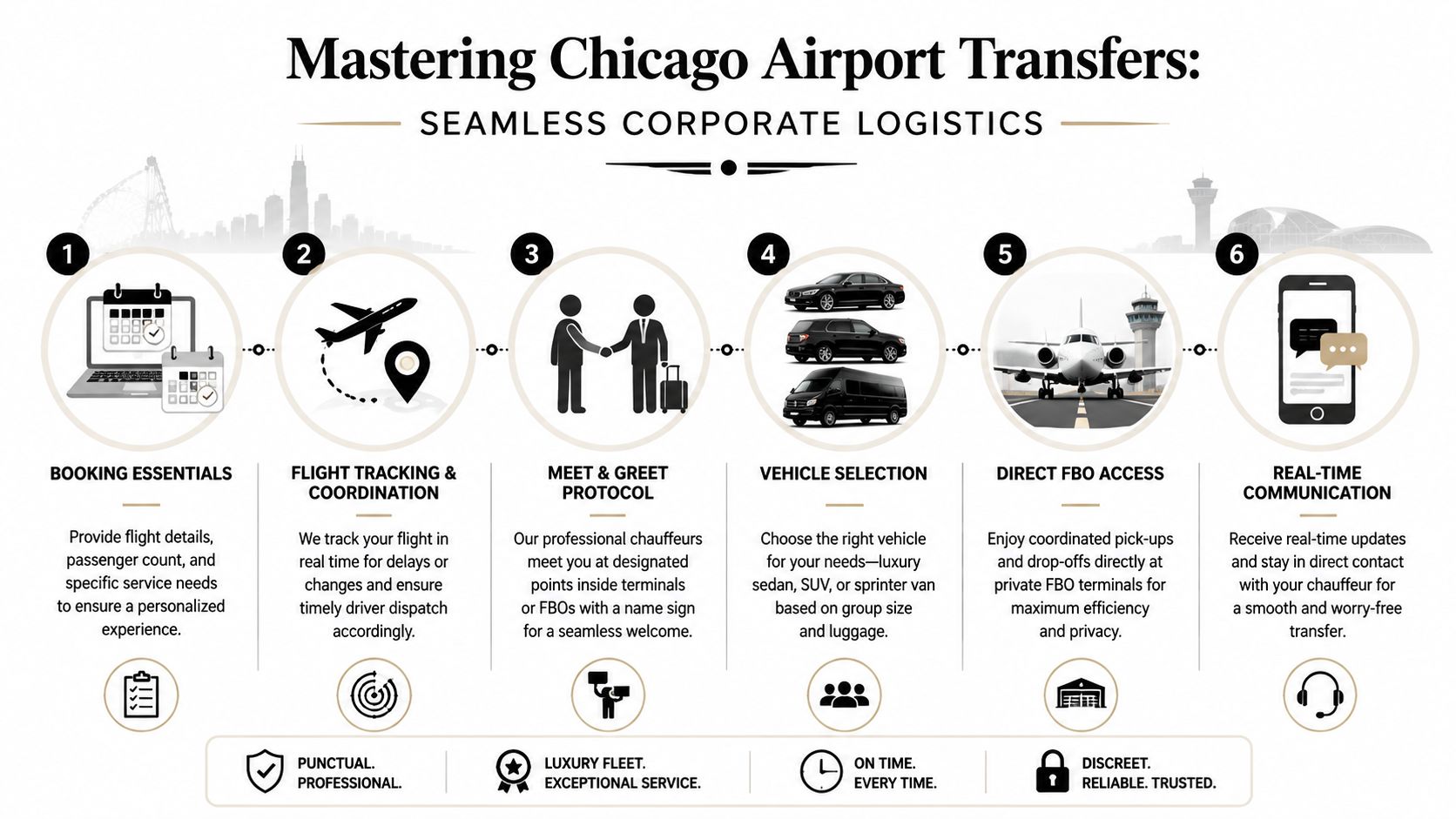
The difference between a reliable transfer and a missed meeting is usually dispatch discipline. Good providers track flights in real time, adjust release timing as arrival conditions change, and build pickup plans around actual airport flow instead of the scheduled landing time. The Federal Aviation Administration publishes current operating conditions, delays, and traffic management updates that affect Chicago arrivals, which is why serious airport service starts with active flight oversight, not passive reservations, according to the FAA airport status system.
For corporate planners, the practical checklist is simple:
- Track the flight status live and tie dispatch timing to actual arrival progress
- Set the pickup method in advance, curbside, meet-and-greet, or FBO ramp-side protocol where allowed
- Build time buffers for terminal exit, baggage, and roadway congestion
- Give the traveler one clear contact path so they are not sorting out texts from multiple numbers after landing
A provider that cannot explain that handoff process will create avoidable risk.
O'Hare and Midway require different handling
O'Hare punishes bad assumptions. The airport is large, terminal movement takes time, and pickup congestion can shift quickly. “Landed” does not mean “ready for curb.” If the traveler checks bags, changes terminals, or gets held in a crowded exit flow, your original pickup timing can be wrong by a wide margin.
Midway creates a different problem. Distances are shorter, so planners often schedule it too tightly. That is a mistake. Road access can clog fast, and short delays hit harder when the itinerary leaves no recovery room.
Use different planning rules for each airport. At O'Hare, protect for distance and terminal complexity. At Midway, protect for compression and sudden curb backups. In both cases, give the passenger realistic expectations and keep the dispatcher in control of timing adjustments.
For a quick visual on how corporate airport handoffs are typically managed, this walkthrough is useful:
FBO service is a different discipline
Private aviation ground handling is tighter, quieter, and less forgiving of confusion. The passenger expects the car to be tied to the exact operator, exact terminal, and exact release moment. If your team uses vague notes like “private airport pickup,” you are setting up a preventable miss.
Get specific before wheels down:
- Confirm the exact FBO location and operator name
- Verify passenger identity and direct contact details
- Set staging and release instructions so the driver moves at the right moment
- Match the service level to the traveler's profile, especially for executives, investors, and visiting clients who expect discretion
Good FBO coordination feels uneventful because the work was done early. The traveler exits, the vehicle is in place, and the schedule stays intact. That is the standard corporate planners should buy.
Understanding Pricing and Corporate Account Benefits
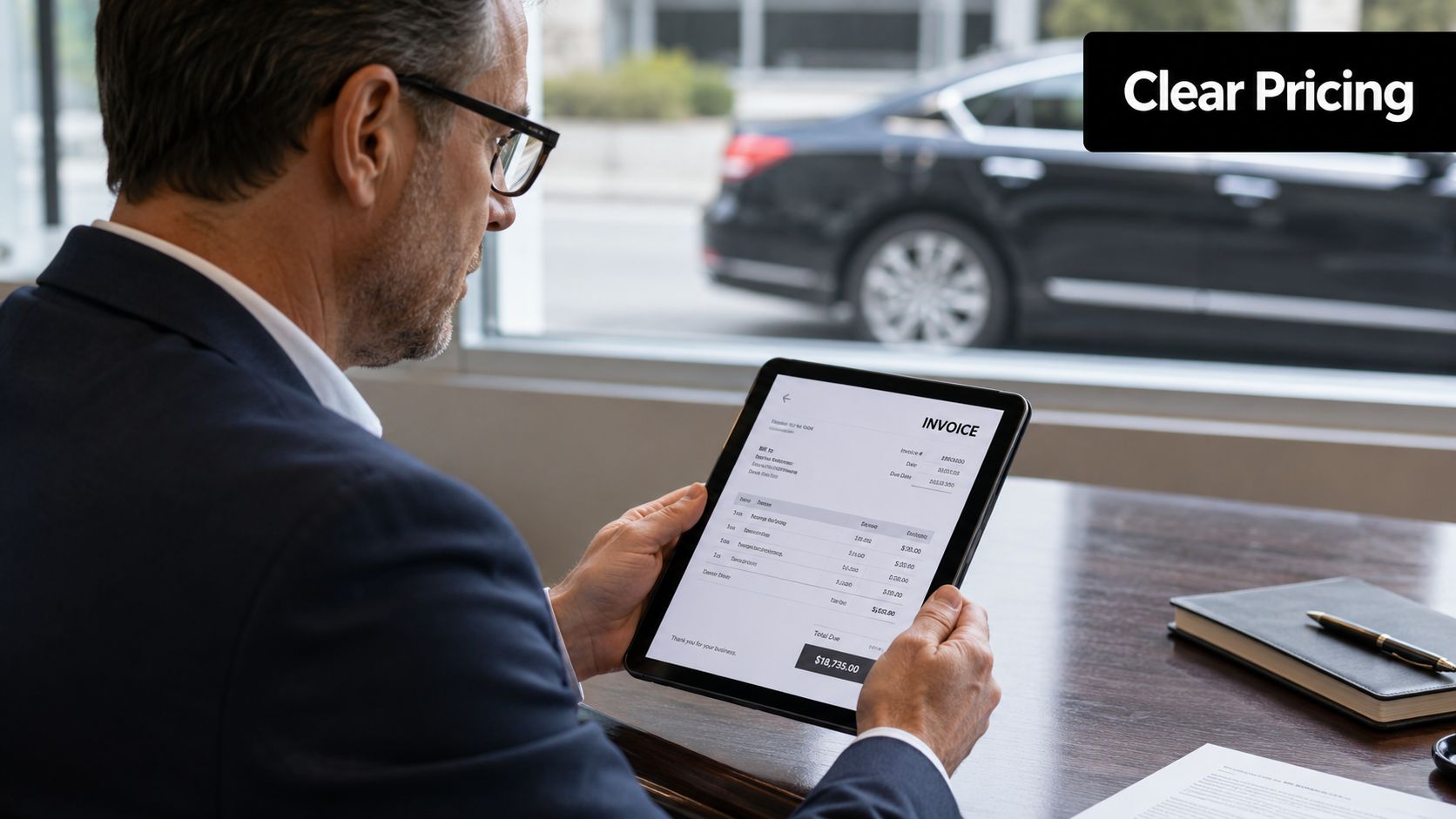
A Chicago ground program falls apart at the invoice stage more often than at the curb. The ride happened. The passenger got there. Then finance sees extra wait time, an unapproved stop, parking fees no one expected, and receipts scattered across three people. That is bad process, not bad luck.
What buyers should ask about pricing
Rate cards do not control cost. Rules do.
Business travel volume is rising again, which puts more pressure on travel managers to control approvals, reporting, and exception handling. The Global Business Travel Association projects U.S. business travel spending at $395.4 billion in 2025 in its GBTA Business Travel Index Outlook Annual Global Report and Forecast.
A useful quote should explain how the trip will be billed and where charges can change. If a provider cannot explain that in plain language, do not hand them executive travel.
Ask these questions before the first booking:
- Is this trip priced as point-to-point or hourly, and why?
- What triggers added charges, including wait time, parking, tolls, extra stops, early arrivals, or late changes?
- Who can approve itinerary changes once the ride is live?
- How will invoices be delivered, by trip, traveler, department, or monthly account summary?
- What reporting is available for spend tracking, policy compliance, and traveler history?
The goal is simple. Remove surprises before they hit accounts payable.
Why corporate accounts beat one-off booking
Ad hoc booking creates administrative drag. Executive assistants waste time re-entering passenger details, reconciling receipts, and explaining charges after the fact. A corporate account fixes that by standardizing who can book, how trips are approved, and how billing is grouped.
Do not choose an account program for perks. Choose it for control.
The practical benefits are easy to measure:
- Centralized billing reduces receipt chasing and reimbursement cleanup.
- Authorized booker settings keep approvals with the right people.
- Stored traveler preferences and profiles cut booking errors and repetitive data entry.
- Trip visibility gives operations and duty-of-care teams a clear record of who is riding, where, and when.
- Faster issue resolution comes from working through an account team instead of starting from zero on every trip.
If you want a benchmark for what account support usually includes, National Limousine Association members commonly advertise 24/7 reservation and dispatch access for corporate clients through their company service pages and member listings at the National Limousine Association. Setup speed varies by provider, so ask for the onboarding steps in writing instead of accepting vague promises.
Where transparency pays off
Cheap transportation gets expensive fast in Chicago. A low base rate means nothing if the provider pads the bill with preventable wait time, sends the wrong vehicle, or forces your staff to argue over charges after every airport run.
Good providers help you choose the billing structure that fits the itinerary. A simple office transfer may belong on a point-to-point rate. A roadshow with uncertain release times usually belongs on hourly service. A group move may cost less in one properly sized vehicle than in several separate sedans with duplicate wait charges.
That is the standard to hold. Clear pricing, clean approvals, and invoices that match the trip without a round of detective work.
The Critical Importance of Vetting and Safety Protocols
A black SUV pulls up on time at O Hare. That tells you almost nothing. However, the true test is what happens when the flight lands early, the pickup point changes, the principal adds a second stop in the Loop, and building security delays curb access. In Chicago, safety and vetting are operations issues, not image issues.
What vetting should mean
For corporate transportation, a qualified chauffeur is part driver, part risk manager. You need someone who protects the schedule, understands discretion, and stays steady when the itinerary changes under pressure.
Ask direct questions before you book:
- Are drivers background checked and motor vehicle records reviewed on a defined schedule?
- What training covers client confidentiality, service standards, and incident response?
- How are chauffeurs prepared for Chicago specifics such as downtown loading rules, hotel access patterns, McCormick Place traffic, and airport pickup procedures?
- Who monitors trips in real time when weather, protests, or road closures force a route change?
If the sales team answers in generalities, keep shopping. A serious provider can explain the process clearly.
Why insurance and operating standards matter
Duty of care starts before the ride. It starts in procurement. Your company is selecting a transportation operator that may carry executives, board members, clients, and event guests through one of the most delay-prone urban markets in the country.
Do not rely on a verbal claim about coverage. Ask for a current certificate of insurance and confirm that the provider is properly licensed for the service being sold. The City of Chicago's public vehicle licensing requirements give you a credible baseline for what a regulated operator is expected to maintain. Then verify the company's USDOT or FMCSA status when applicable through the Federal Motor Carrier Safety Administration Safety and Fitness Electronic Records system.
Insurance matters, but paperwork alone is not enough. You also want documented maintenance practices, a clear incident-escalation path, and dispatch coverage that does not disappear after business hours. Those are the controls that keep a routine transfer from becoming a duty-of-care problem.
For meeting planners coordinating the broader program, transportation vetting should sit alongside venue and staffing decisions. If that part of the event is still taking shape, this guide to find corporate event planners near me can help you tighten the rest of the operating plan.
Ask for proof, not assurances. Driver screening, licensing, insurance, maintenance records, and live dispatch accountability should all be easy for a serious Chicago provider to document.
Practical Applications and Frequently Asked Questions
A solid plan usually mixes vehicle types across the same program. For a three-day board meeting, I'd book individual airport arrivals separately for senior executives, use one group vehicle for a scheduled dinner, and assign a larger shuttle only when the full group needs to move together for a site visit or venue transfer. That keeps the expensive capacity where it's useful and avoids overbuilding every leg.
If your meeting itself is still taking shape, venue-side coordination matters just as much as transportation timing. For planners comparing support options, this guide to find corporate event planners near me is a practical companion resource.
Common booking questions
For a group of 10, should you book one Sprinter or multiple sedans?
Usually one Sprinter. It reduces handoff risk, keeps everyone on the same timeline, and simplifies communication. Split into sedans only if the passengers have different schedules or destinations.
How much advance notice do you need?
For simple airport or point-to-point work, earlier is always better. For multi-stop days, board programs, or conference moves, send the itinerary as soon as the skeleton schedule exists. The details can be refined later.
How should last-minute changes be handled?
Give one person authority to approve changes and one provider the full picture. That way dispatch can adjust without a chain of conflicting texts from travelers, assistants, and meeting hosts.
What's the most common planning mistake?
Underestimating dwell time. Flights may arrive on time and still produce late curb exits. Meetings may end at noon and still release passengers in waves. Build for real movement, not ideal timing.
When is premium ground transport worth it?
When the trip carries business consequence. If a missed pickup can damage a client relationship, delay a board session, or leave senior staff stranded between appointments, the operational control is worth paying for.
If you need a transportation partner for airport transfers, executive travel, multi-stop itineraries, or group movement in Chicago, Max's Luxury Rides Inc. offers a fleet that spans sedans, SUVs, Mercedes vans, minibuses, and coach options with 24/7 reservation support. For corporate planners, the prime value is having one team manage the moving parts so your schedule stays intact.