
You land late, the conference dinner is already over, and your traveler is standing outside the terminal with three apps open, trying to find a car that the “approved” booking tool never surfaced. The flight was managed. The hotel was booked. The ground leg, the one that decides whether the trip feels controlled or improvised, was left to chance.
That's the shape of corporate travel booking in 2026. It isn't just buying airfare and reserving a room, it's coordinating every leg of the trip so the request, approval, transportation, and reconciliation all stay inside one accountable workflow. With global business travel spending reaching USD 1.47 trillion in 2024 and projected at USD 1.64 trillion in 2025, while still expected to remain USD 134 billion, or 14%, below 2019 levels in real terms according to the Global Business Travel Association, the pressure is on to make every booking decision count (GBTA 2025 Executive Summary).
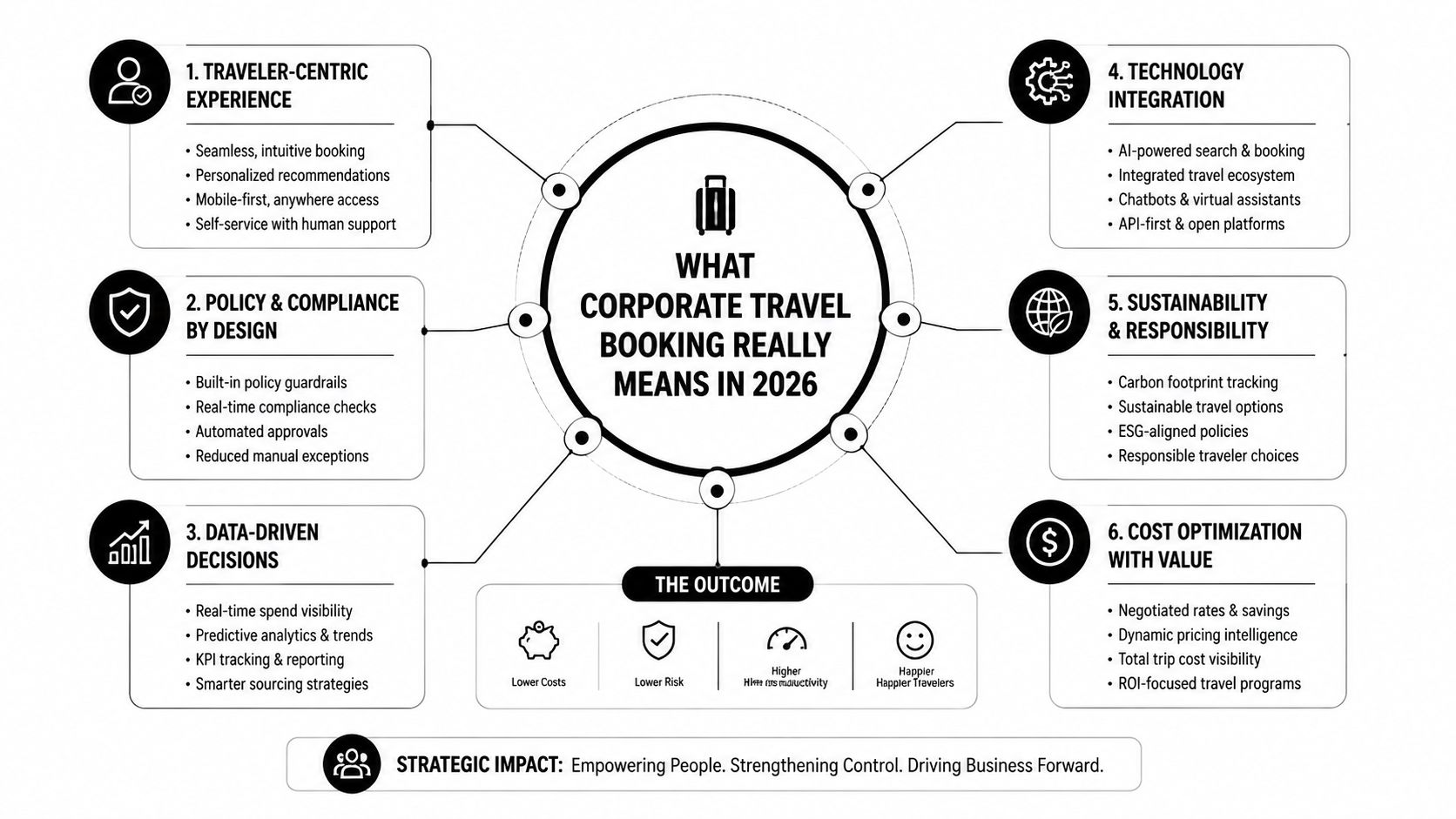
What Corporate Travel Booking Really Means in 2026
A traveler lands at O'Hare, checks the car queue, then checks whether the approved tool knows she is on the 11:10 p.m. arrival and needs a pickup at the right terminal. That moment tells you whether the program is doing its job. If the booking stack handled only the flight and hotel, the traveler still had to improvise the final mile, and that is where spend leaks, duty-of-care gaps, and frustration start.
The job changed from buying tickets to orchestrating trips
Modern corporate travel booking is a connected workflow, not a shopping cart. Travelers, travel managers, finance, suppliers, and travel management companies all touch it, but the system only works when the pieces share the same data and policy logic. A mature stack centralizes supplier content, applies policy at the point of sale, and connects approvals with expense data so the trip can be reconciled cleanly later (AltexSoft on corporate travel programs).
That is the practical shift. The old model asked, “Did we book the ticket?” The current model asks, “Did the approved channel capture the trip, enforce policy, include ground transport, and feed finance without manual cleanup?” When those answers are yes, procurement gets control, finance gets cleaner reconciliation, and travelers stop bypassing the system for convenience.
Practical rule: if a traveler still has to leave the approved channel to finish the trip, the booking stack is incomplete.
Business travel is back at near-record scale, but budgets have not fully recovered in real terms, which makes selective booking behavior more common and negotiated value more important than ever (GBTA 2025 Executive Summary). That is why the strongest programs do not just chase adoption. They make the managed channel broad enough to cover the actual trip.
The missing layer is often ground transport
Many teams still treat booking as flight plus hotel. In practice, the trip starts when the plane lands and ends when the traveler reaches the meeting, hotel, or home. If that ground leg is outside the program, the company has partial visibility and a partial audit trail.
Airport transfers, hourly charters, and group movement close that gap. A vetted execution partner such as Max's Luxury Rides fits into the program as the ground layer that turns separate reservations into one complete itinerary.
The Modern Booking Workflow From Request to Reconciliation
A sales VP asks for a Chicago-to-Austin trip, the manager approves it, the tool shops the fare, and finance expects a clean expense line after the return. That sounds simple until the pickup is missed, the traveler books outside policy to recover, and the expense team spends Friday chasing receipts. A good workflow prevents that mess before it starts.
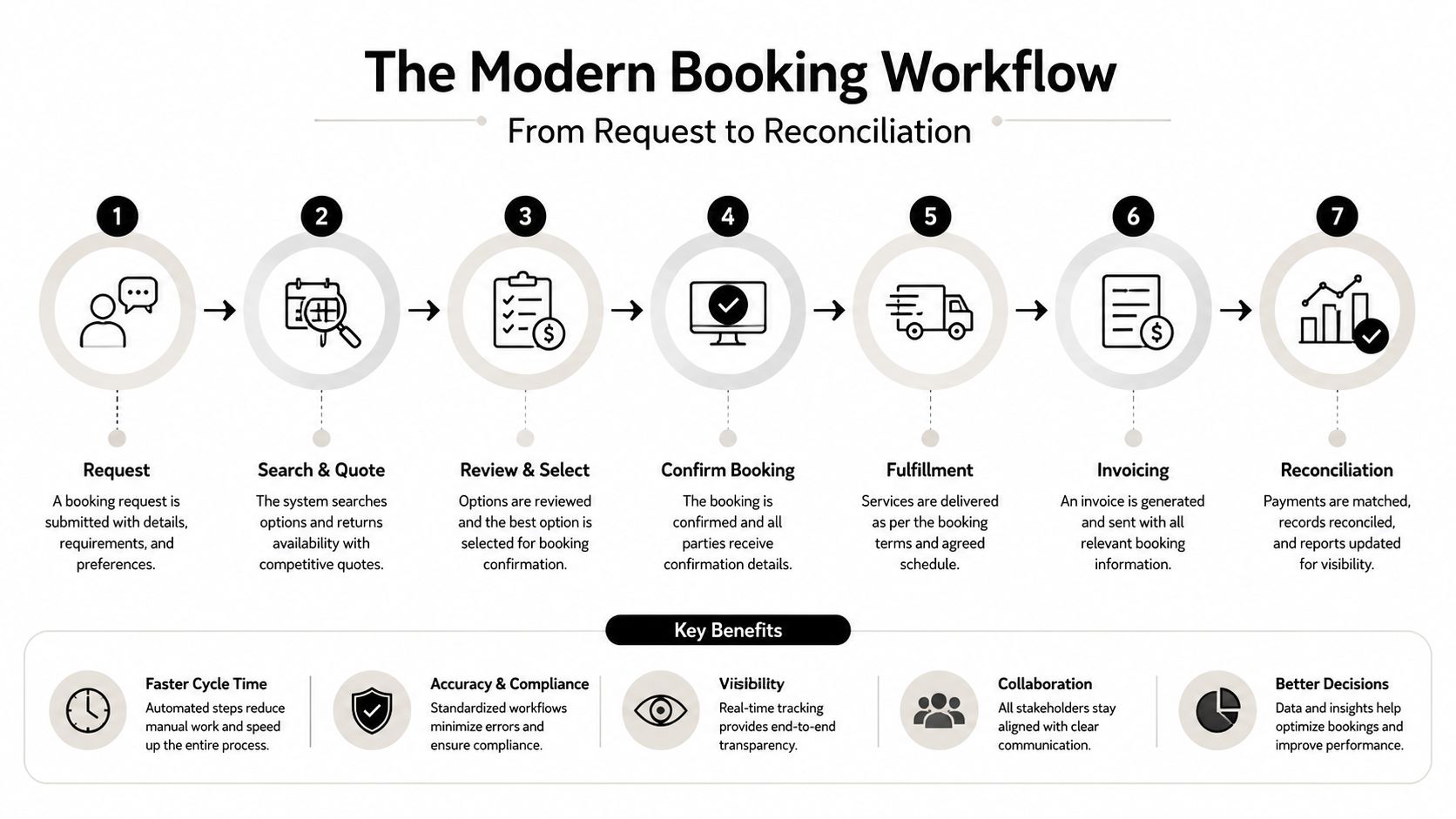
Request, search, and policy check
The workflow begins with a request that captures the trip purpose, date, destination, and whether the traveler needs ground transport at the other end. That first field set matters because incomplete requests create incomplete itineraries. If the traveler is flying into Austin at 7:30 p.m. and needs a car to a client dinner, the ground leg should appear in the same request, not as a later workaround.
Search comes next, but search without policy is just consumer shopping inside a corporate wrapper. Policy needs to show up before payment, not after the trip, because correcting violations later only creates admin work and weakens behavior. Mature booking stacks do this with an online booking tool or travel management system that enforces rules at checkout and passes traveler identity, spend, and reimbursement data into downstream systems like ERP and HR (AltexSoft).
Approval should be tied to actual cost, not to an inbox bottleneck. If every out-of-policy item sits waiting for a manager who's traveling, the traveler learns to circumvent the process. Automatic routing based on thresholds works better because it preserves speed without surrendering control.
Fulfillment and reconciliation
Fulfillment is where the trip either stays coherent or fragments. Flights, hotels, and ground transport should be visible in one itinerary, with the traveler receiving the right details at the right time. That matters most for airport transfers, because the best pickup time usually depends on the flight number and terminal, not on a guessed arrival window. A vetted execution partner such as Max's Luxury Rides can handle that ground layer, especially when the trip includes tight timing, client-facing arrivals, or group movement that needs one coordinated pickup plan.
Post-trip reconciliation closes the loop. Expense data should match booking data without manual rekeying, and finance should be able to see what was approved, what was booked, and what was used. When the data pipe is intact, the company spends less time fixing exceptions and more time managing policy.
The best workflow feels boring after implementation. That's the point. Travelers move through it without calling for help, and finance stops treating every trip like a special case.
Policy, Approvals, and Expense Automation Working Together
A travel policy that sits in a PDF gets ignored the moment booking becomes inconvenient. A policy built into the booking flow changes the decision while the traveler is still choosing, which is where control happens. For corporate travel booking, that means the rules need to show up on screen, not stay hidden in a handbook no one opens during a rushed trip.
Policy has to be enforced where the decision happens
Class-of-service limits, preferred suppliers, advance-purchase windows, and approval thresholds all need to be machine-readable inside the booking tool. If the system flags an out-of-policy fare before payment, the traveler can correct the booking before the violation happens. That matters because travelers respond to friction at the point of purchase, not to reminders sent after the trip is over.
The compliance gap is real. In a 2025 business-travel survey, only 16% of travel managers reported full compliance, while 46% of travelers said they booked off-platform to find a cheaper option (Navan travel booking statistics). That points to an enforcement problem and a usability problem. If the policy is clear but the booking path is awkward, people find a workaround.
Approval routing and expense need one data trail
A strong program connects three points. First, the policy rules live in the booking tool. Second, approvals route automatically when spend crosses a threshold or an exception appears. Third, the booking data flows into expense so reconciliation does not turn into a scavenger hunt. If those layers stay disconnected, travelers book wherever it is easiest and finance inherits the cleanup.
The approval experience also has to fit how people work. A 2025 summary reported that 72% of travel bookings in Q1 2025 were completed online and more than 45% were made via mobile devices (Navan travel booking statistics). That makes mobile approval flows and fast exception handling part of the program design, not extras. If a manager cannot approve quickly on a phone, the request sits, the traveler waits, and someone eventually books around the process.
Operational truth: policy that is easy to understand but hard to execute gets bypassed. Policy that is embedded in the tool gets used.
Expense automation is the final check. If a traveler books a car, a flight, and a hotel in one trip, the post-trip record should already know who traveled, what was approved, and which spend belongs to that trip. Ground transport matters here because airport transfers and group movement are often the first place the record falls apart. A vetted execution partner such as Max's Luxury Rides keeps that layer aligned with the rest of the itinerary, which makes reconciliation cleaner and reduces the number of exceptions finance has to sort out.
Booking for One vs Booking for Twenty
A single traveler wants speed, a clean receipt, and as little friction as possible. A group of twenty needs all of that, plus timing coordination, vehicle matching, passenger manifests, and someone who answers when the flight is delayed. The workflows look similar on a slide deck and completely different in practice.
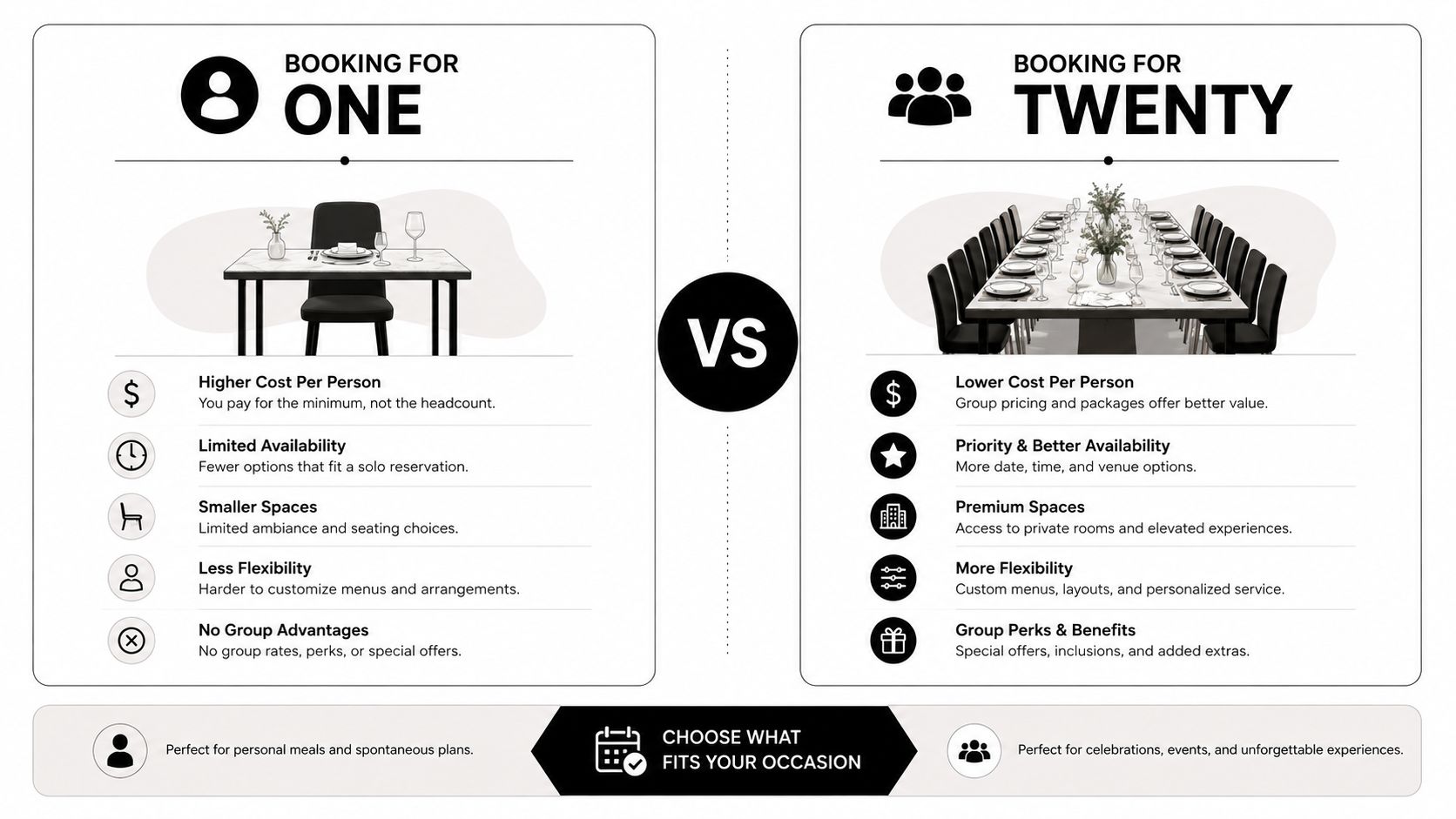
Single traveler booking is mostly a usability problem
For one traveler, the main goal is to keep the booking inside the approved channel. That means a clear choice set, obvious policy messaging, and a fast way to confirm the trip without opening a second tab. When travelers leave the platform, it's often because they're trying to fix a missing piece, not because they enjoy going rogue.
That missing piece can be anything from a fare gap to an absent ground option. Business Travel News has pointed to underserved ground transportation as a separate market gap, and the broader industry keeps running into fragmented journeys that don't fit neat booking silos (Business Travel News research on the state of play). In practice, that means the traveler may start inside the tool, then leave it when the last mile isn't there.
Group movement is a coordination problem
Once you move from one traveler to twenty, the operational math changes. You need the right mix of vehicles, one point of contact, and a plan for staggered arrivals. You also need named passenger visibility for duty of care, because a group that arrives in waves can't be managed like a single airport pickup.
That's where standard booking tools tend to fail. They were built around individual itineraries, not coordinated arrivals or event logistics. A corporate offsite, a roadshow, or an airport-to-hotel transfer for a team isn't really a booking problem, it's a movement problem.
A useful example is a 25-person offsite arriving at Midway. Three travelers land early, eight are delayed, and two have oversized bags. A provider that can stage a Sprinter van, a mini-coach, and a backup sedan can absorb that variation. A platform that only shows a point-to-point ride leaves the organizer to improvise.
Choosing a Ground-Transport Vendor You Can Actually Trust
Ground transport gets treated like a commodity until something goes wrong. Then everyone discovers that punctuality, fleet depth, after-hours support, and billing clarity matter more than a polished app. A vendor scorecard makes those trade-offs visible before you sign.
A five-part scorecard that actually predicts fit
Start with fleet depth and right-sizing. Ask whether the provider can handle executive sedans, SUVs, vans, mini-coaches, and larger group moves without forcing you to split the trip across multiple vendors. If they can't scale from one traveler to a team, the relationship breaks the first time your itinerary gets complicated.
Next, look at chauffeur vetting and professionalism. The question isn't whether the driver is friendly, it's whether the driver is punctual, discreet, and trained to work around executive schedules. For corporate road warriors, that consistency matters because the trip has to feel predictable even when the day doesn't.
Then check 24/7 operations and disruption response. The public-sector benchmark in EU travel tendering asks for 24/7 hotline support, detailed fare and service-fee breakdowns, and multiple quotations for the same travel class, while another EU specification sets performance expectations such as 99% monthly uptime, 90% of critical failures repaired within one hour, and MTTR no more than two hours (EU tender specifications). Those numbers are useful because they show how seriously resilience is judged when travel can't wait.
Finally, verify integration and billing. If a vendor can't support clean booking references, transparent invoicing, and credit-card settlement, the finance team ends up doing manual work later.
What to ask: can you cover a flight delay, a multi-car conference move, and a same-day executive change without handing the problem back to my team?
Where Max's Luxury Rides fits as a worked example
Max's Luxury Rides is the kind of ground partner that fits this scorecard in practical terms. Its fleet spans executive sedans, luxury SUVs, Mercedes vans, Sprinter limousines, executive shuttles, stretch limousines, minibuses, mini coaches, and full-size coach buses, which gives a program room to match vehicle type to trip shape. It also operates 24/7, accepts all major credit cards, and handles airport transportation through O'Hare, Midway, and any FBO worldwide, which is the sort of coverage a corporate team needs when itineraries change.
For teams coordinating international arrivals, a resource such as business car service for China travel can be useful when the trip extends beyond a domestic airport transfer and the program needs ground support in another market.
Ready-to-Use SOPs and Checklists for Travel Managers
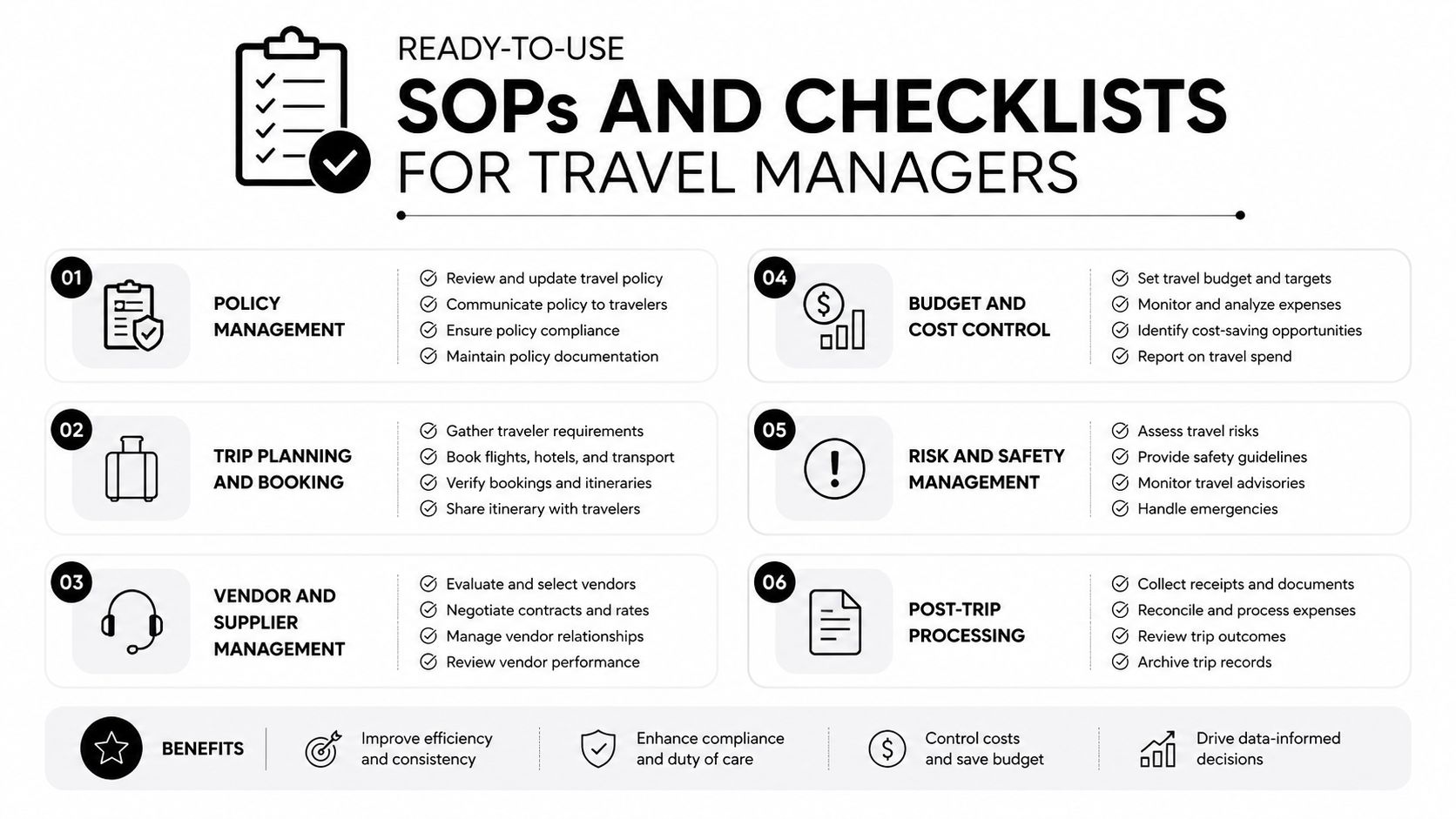
A travel program gets a lot easier to run once the team stops improvising. The point isn't to write a perfect policy document, it's to give coordinators and managers a repeatable way to handle trip requests, ground transport, and reconciliation without guessing.
Trip request SOP
- Require purpose, dates, destination, and traveler identity. No request moves forward without those fields.
- Confirm whether ground transport is needed. Capture airport, hotel, office, or event address at the same time.
- Route approval based on cost and policy exceptions. If the trip exceeds the threshold or uses a non-preferred option, escalate it before booking.
- Store the approval inside the booking record. Don't leave it in email.
Ground transport booking checklist
- Flight number and terminal: Book to the actual arrival, not a guessed landing time.
- Passenger count and luggage: Match the vehicle to the group size.
- Meet-and-greet need: Note whether the traveler needs curbside pickup or an inside meet point.
- Backup contact: Save the traveler's mobile number and the organizer's number.
- Special handling: Flag VIP, large-bag, or accessibility requirements.
Duty-of-care checklist
- Traveler visibility: Confirm who is on the move, when they land, and where they're headed.
- Delay response: Tell the ground partner who owns the change if the flight shifts.
- Exception log: Record missed pickups, reroutes, and no-shows in one place.
Monthly reconciliation SOP
- Match bookings to invoices. Look for trips that never hit the approved channel.
- Review off-platform spend. Find where travelers broke the process and why.
- Check supplier detail. Make sure fare, service fee, and trip reference are visible.
- Report recurring gaps. If the same issue appears twice, fix the process, not the person.
These standards also give you a way to pressure-test a vendor against public-sector expectations for transparency and recovery. If a provider can't support clean quoting, uptime, and a usable support desk, the risk shows up later in reconciliation and traveler complaints.
How to Maximize Value From a Chauffeur Partner
A chauffeur partner shouldn't sit in the budget as dead weight. When the provider is reliable, it can improve duty of care, cut missed pickups, and keep travelers productive between meetings. The value comes from using the service deliberately instead of treating every ride as a one-off.
Six moves that make the partnership pay off
Book airport transfers against the flight number, not a guessed pickup time. That lets the car stage correctly when the plane is delayed or early. For executives, that one adjustment removes a lot of avoidable stress.
Use an hourly charter when the day includes several meetings in one metro area. Stacking separate ride-hail trips burns time and makes the itinerary harder to manage. A single car with a single driver creates a cleaner schedule and fewer handoffs.
For roadshows or team movement, right-size the vehicle. A Sprinter van or mini-coach often beats splitting a group across multiple smaller cars, because the team stays together and the organizer has one contact point.
Request a primary and backup chauffeur for repeat executive patterns. That simple step helps continuity, especially when the traveler expects the same discretion and timing every time.
Ask for passenger-level billing detail on a single invoice. That makes expense review easier and cuts the back-and-forth finance teams usually face when they're matching multiple rides to one trip.
Brief the partner on VIP and recurring traveler patterns. Good operators can learn arrival habits, preferred pickup points, and meeting cadence, which makes the service feel less reactive and more controlled.
The real test isn't whether a chauffeur arrives. It's whether the traveler can stay focused on the meeting while the ground piece disappears into the background.
Your 90-Day Corporate Booking Improvement Plan
The fastest way to improve a travel program is to stop trying to fix everything at once. A 90-day rollout works better because it forces the team to find the leak, turn the policy into behavior, then measure whether the new process sticks.
Days 1 to 14
Pull three months of booking data and isolate the off-platform patterns. Ground transport is often the first place leakage shows up, because travelers will leave the managed channel to solve the last mile if the approved option feels incomplete. Document the top reasons and assign ownership for each one.
Days 15 to 30
Rewrite the policy so the booking tool can enforce it. That means moving paper rules into the OBT, including ground transport rules, approval thresholds, and preferred supplier logic. If the rule can't be applied in the tool, it'll be bypassed in practice.
Month 2
Consolidate vendors against a simple rubric. Keep the suppliers that fit your travel pattern, and onboard a vetted ground partner where the current stack has gaps. A provider like Max's Luxury Rides can sit in that gap for airport transfers, executive moves, and group transportation when the approved channel needs a more complete ground layer.
Month 3
Track three leading indicators, off-platform rate, booking lead time, and traveler satisfaction. Add a monthly view of ground spend per trip so you can see whether the process is getting cleaner or just shifting costs around. If the numbers don't move, the issue is usually the workflow, not the policy language.
If your corporate travel booking program still breaks at the ground leg, Max's Luxury Rides Inc. can help fill that gap with airport transfers, executive car service, and group transportation built for corporate schedules. Visit Max's Luxury Rides Inc. to review the service options and see how a vetted chauffeur partner can support your travel workflow.