
A solid corporate travel and expense (T&E) policy isn't just a rulebook; it's the very foundation of a well-run travel program. Think of it as the agreement that sets clear expectations for your team and gives your finance department the framework they need to maintain control. It’s all about creating a culture of financial responsibility that actually supports strategic business travel, rather than hindering it.
Building Your Corporate Travel Policy from the Ground Up
Before anyone on your team even thinks about booking a flight or a hotel, you need a crystal-clear travel and expense (T&E) policy. This document is the bedrock of your entire corporate travel expense management process. It takes the guesswork out of travel for employees and gives the finance department a clear, defensible framework to work from.
A strong policy is proactive. It’s designed to prevent problems before they start. Without these guidelines in place, companies almost always run into inconsistent spending, frustrated employees, and a major lack of visibility into what is often one of their biggest controllable expenses. It's the difference between structured, predictable costs and complete chaos.
Defining Your Policy's Non-Negotiable Components
The best T&E policies I've seen are detailed, unambiguous, and cover every single part of a business trip. Any gray area is an invitation for non-compliance, so your goal should be absolute clarity. Your policy needs to be the one-stop guide an employee can turn to for any travel-related question.
To get started, here's a quick look at the essential components every T&E policy should have. These aren't just suggestions; they're the core elements that will make or break your program's effectiveness.
| Policy Component | Key Consideration | Impact on Management |
|---|---|---|
| Booking Procedures | How should employees book? Through a specific tool, a travel management company (TMC), or directly? | This is your first and best opportunity to control costs and ensure compliance from the start. |
| Preferred Suppliers | Do you have deals with specific airlines, hotels, or car rental companies? | Directs spending to vendors where you have negotiated rates, maximizing your budget. |
| Expense Categories & Limits | What's reimbursable? Set clear per diems for meals and caps for hotels. | Prevents overspending and provides clear guardrails for what is considered a reasonable expense. |
| Receipt Requirements | What’s the process? Are digital copies okay? Is there a minimum amount that requires a receipt? | Streamlines the submission process and ensures you have the necessary documentation for audits. |
| Reimbursement Timeline | How and when will employees get their money back for out-of-pocket expenses? | A predictable and timely process is absolutely critical for keeping employee morale high. |
Getting these elements right from the beginning will save you countless headaches down the road. They form the operational backbone of your policy, ensuring everyone is on the same page.
Aligning Budgets with Real-World Business Needs
A great policy is only half the battle; it has to be backed by a realistic budget. There's often a major disconnect here. A recent global survey found that while over 90% of CFOs and travel managers expect budgets to stay the same or grow, a massive 81% of CFOs also admit that current budget limits are preventing their employees from traveling enough to be fully effective.
What does this tell us? Companies are often nickel-and-diming their travel programs—restricting flight options or baggage—instead of making strategic adjustments. This approach just creates friction and hurts productivity. A truly effective corporate travel expense management strategy ensures the policy and the budget work together, supporting the company's goals instead of getting in the way. You can explore more insights into business travel budget complexities to see just how deep this issue runs.
A policy isn't meant to restrict employees—it's meant to empower them. When people know the rules of the road, they can travel with confidence and focus on why they're on the trip in the first place, not on whether their expense report will get approved.
Ultimately, this alignment requires an ongoing conversation between finance, department leaders, and the C-suite. It's about shifting the perspective of travel from a simple cost center to a strategic investment. The policy you build is the first and most important step in creating that shared understanding.
Leveraging Technology for Smarter Expense Tracking
Let's be honest: manual expense reports are a nightmare. The endless paper receipts, the clunky spreadsheets—they’re a massive drain on everyone’s time. Your travelers are wasting valuable hours on administrative work, and your finance team is stuck in a reactive loop, trying to make sense of it all weeks after the money has been spent. To get a real handle on your corporate travel expense management, you have to ditch these archaic methods.
The right technology is what separates a well-managed travel program from a chaotic one. We're not just talking about digital spreadsheets here. I'm talking about integrated expense management platforms that automate the entire workflow, turning a painful administrative task into a strategic advantage.
Moving Beyond Manual Data Entry
The single biggest win from adopting dedicated software is waving goodbye to manual data entry. It’s slow, tedious, and a breeding ground for human error. Instead of your team spending hours typing up line items from a crumpled receipt, the technology captures and categorizes expenses the moment they happen.
This shift to real-time data is a total game-changer.
Picture one of your sales reps finishing a client dinner. Before they’ve even left the table, they can snap a photo of the receipt with their phone. The software reads the details, categorizes the expense, and instantly cross-references it with your company’s T&E policy. This isn't the future; it's the new standard for efficient operations.

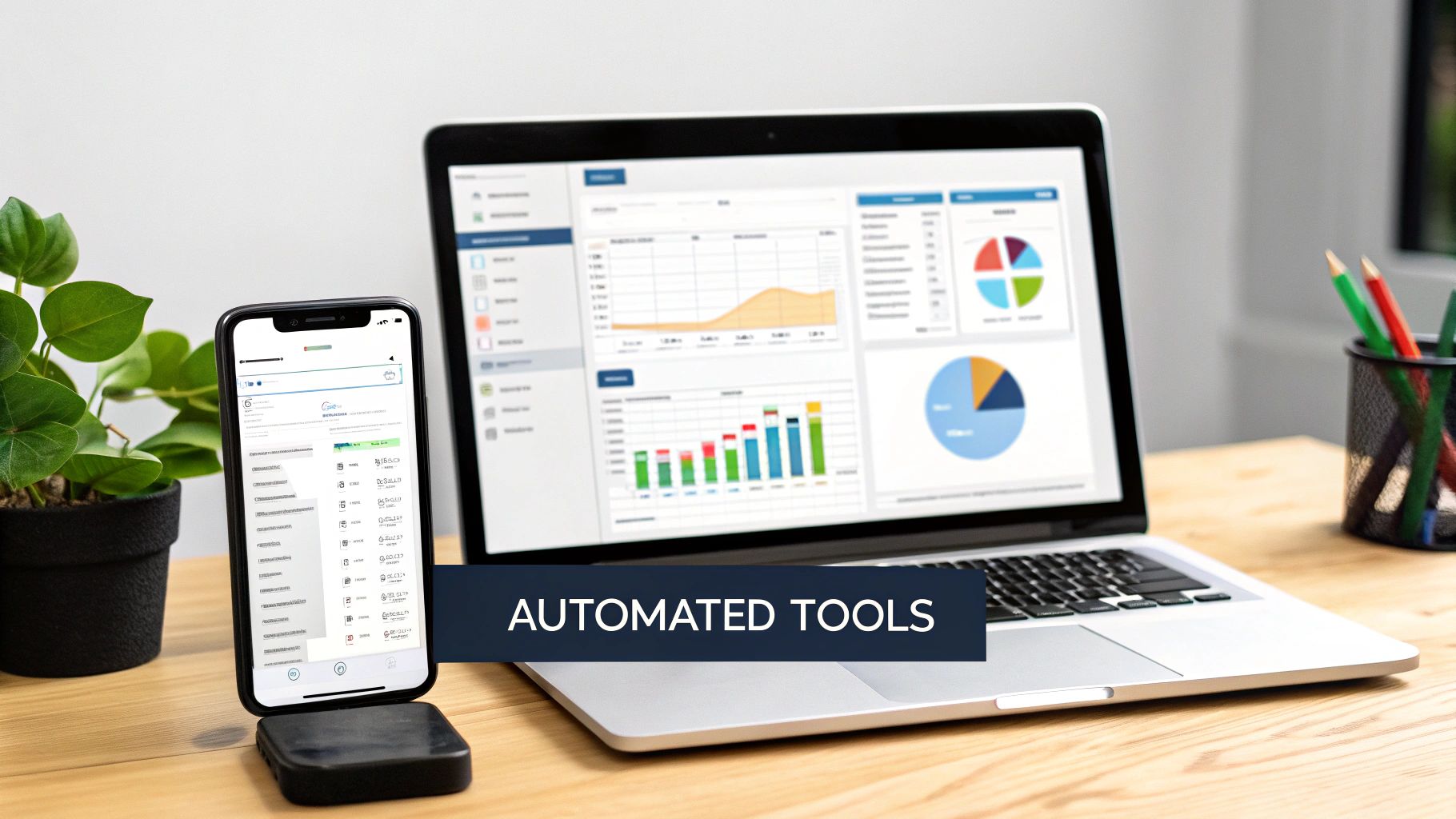
This kind of clean, intuitive dashboard gives employees an easy way to track their spending, while managers can review and approve reports with a single click. For your finance team, it means you’re no longer waiting until month-end to figure out where your travel budget stands. You can see spending as it occurs and make smart decisions based on live information.
Essential Features of Modern Expense Software
When you start looking at expense management platforms, you’ll quickly realize they aren't all created equal. To truly automate the process and get the insights you need, there are a few non-negotiable features you should be looking for.
Here are the capabilities I always recommend:
- Mobile Receipt Scanning: This is a must-have. Tools with Optical Character Recognition (OCR) technology let employees capture receipts on the go, automatically pulling key data like the vendor, date, and amount. No more manual input.
- Direct Corporate Card Integration: Linking your corporate cards directly to the platform is crucial. It automatically imports every transaction, which massively simplifies reconciliation and makes sure nothing falls through the cracks.
- Real-Time Policy Checks: The best systems flag out-of-policy expenses the moment they’re submitted. This puts an end to non-compliant spending before it’s even approved and saves managers from having those awkward "we can't approve this" conversations.
- Automated Approval Workflows: You should be able to build custom, multi-level approval chains that automatically send reports to the right manager based on criteria you set, like department, project, or spending amount.
These features all work in concert to create a fluid, end-to-end process. The benefits ripple through the entire organization, from the traveler on the road to the CFO in the boardroom.
The Growing Importance of Tech Adoption
As business travel bounces back, the conversation has shifted squarely to cost control and smarter technology. The data shows a fascinating trend: while 48% of corporate travel buyers expect to increase their number of trips, 57% are also forecasting higher overall travel spending. To manage this growth without costs spiraling out of control, companies are leaning heavily on technology.
For example, new airline distribution models are already delivering average savings of 11% through dedicated tech channels. It's a clear signal of the tangible ROI from adopting the right tools. To see how other finance leaders are preparing, you can read the full analysis on business travel trends.
The goal of technology isn't just to make things faster; it's to make them smarter. By automating the mundane, you free up your people to focus on high-value analysis and strategic decision-making.
This is where your T&E program transforms from a simple cost center into a source of powerful business intelligence. With a good platform in place, you can finally start analyzing spending patterns, identifying real opportunities for savings, and negotiating better rates with your preferred vendors. You're building a more agile, compliant, and cost-effective travel program that can actually keep up with the demands of modern business.
Integrating Your Systems for a Unified Financial View
Your expense management platform can't be an island. When it's disconnected from your core financial systems, you’re just creating extra work, inviting manual errors, and muddying the waters of your company's true spending picture. A solid corporate travel expense management strategy hinges on the smooth flow of information between all your tools.
The end goal is to create a single source of truth for every dollar spent. This means plugging your travel and expense (T&E) platform directly into your accounting software or ERP system. When these systems are talking to each other, the entire process gets faster, far more accurate, and genuinely insightful.
This isn't just some technical box to check; it's a strategic imperative. It's what turns your finance team from reactive data-entry clerks into proactive financial partners who can spot and act on spending trends as they unfold.
Breaking Down the Data Silos
Disconnected systems are a classic headache. We see it all the time: a company’s financial data is scattered across different platforms, creating frustrating "data silos." This usually happens over years of adopting new tools one by one, leaving you with a patchwork of systems that don't communicate.
This separation causes very real problems. Think inaccurate expense accruals, employee data that exists in one system but not another, and maddening delays in getting people their money back. Tying your T&E and financial data together solves these issues head-on, improving compliance and finally giving you a clear, consolidated view of spending. It's no wonder that data integration is shaping travel and expense trends and has become a major focus for finance leaders.
When your systems are in sync, the benefits show up almost immediately. An approved expense report can automatically post to your general ledger, already coded to the right accounts, without anyone having to lift a finger.
The Power of Automated Reconciliation
Let’s be honest, reconciliation is one of the most soul-crushing tasks for any finance team. Manually matching every corporate card transaction to an expense report is tedious, slow, and a breeding ground for human error. One misplaced decimal point can throw your books off for the entire month.
Integration completely automates this workflow. By linking your corporate card feed directly to your expense platform, transactions are pulled in automatically and matched against the receipts and reports your employees submit.
This delivers a few powerful wins:
- Drastically Fewer Errors: Automation gets rid of manual data entry, which means your financial records are consistently clean and accurate.
- A Faster Month-End Close: With reconciliation happening in near real-time, your team can close the books in a fraction of the time.
- Complete Spending Visibility: You get a live, up-to-the-minute view of all corporate card spend, which means no more nasty surprises when the statement arrives.
Instead of spending their days chasing down missing receipts, your team can finally focus on analyzing the data that’s flowing in seamlessly.
The real value of integration is transforming your T&E data from a historical record into a forward-looking analytical tool. It’s the difference between asking, "What did we spend?" and "Where should we be spending?"
This fundamental shift allows your finance department to become a much more strategic partner to the business, offering insights that can guide smarter budgeting and improve financial performance across the board.
Streamlining Reimbursements and Keeping Employees Happy
Integration also has a direct, positive impact on your people. Connecting your expense system to your payroll or accounts payable software makes the reimbursement process faster and way more transparent for everyone.
Once an expense report gets the green light, the reimbursement can be triggered automatically. This completely eliminates the long, frustrating waits that employees have to endure after paying for business costs out of their own pocket.
A fast, predictable reimbursement cycle is a simple but incredibly effective way to boost morale and build trust in your company’s processes. It shows you value your team's time and personal cash flow, turning what is often a point of friction into a smooth, positive experience. This is a critical—and often overlooked—part of any successful corporate travel expense management program.
Developing Effective Audit and Reporting Frameworks
Having a solid policy and the right software is a great start, but it's only half the battle. Real control over your corporate travel expense management comes from having a sharp, well-defined system for auditing and reporting. Think of this as your safety net—it’s how you check for compliance, see what’s working, and protect the company's bottom line without making life difficult for your travelers.
The point isn't to micromanage every receipt. It’s about empowering your finance team to shift from tedious manual checks to strategic oversight. A well-built framework helps you spot problems before they grow, uncover savings opportunities, and give leadership a clear, data-backed picture of the entire travel program.
Leveraging AI for Intelligent Audits
Manual audits, frankly, are a relic. Forcing your finance team to sift through every line item is a monumental waste of their talent, not to mention agonizingly slow and riddled with the potential for human error. These days, modern expense management platforms like Navan or SAP Concur use artificial intelligence to do the heavy lifting, creating a much smarter, more focused audit process.
These AI-powered tools can scan every single expense report the moment it’s submitted and check it against your T&E policy. They instantly flag anything that falls outside the rules—a hotel booking that’s over the nightly cap, a meal claim missing a receipt, you name it. This frees up your team to zero in on the exceptions and high-risk items instead of getting bogged down approving dozens of perfectly compliant reports.
An AI-driven audit doesn't just look for violations; it learns your company's spending patterns. Over time, it can identify anomalies that a human might miss, providing a deeper layer of protection against both accidental non-compliance and intentional fraud.
This completely changes the game for your finance professionals. They graduate from being rule enforcers to becoming strategic analysts, spending their valuable time investigating what really matters and refining the policy based on what the data tells them.
The difference between sticking with old-school manual checks and adopting an automated system is night and day.
Manual vs Automated Expense Auditing
| Feature | Manual Auditing | Automated Auditing |
|---|---|---|
| Speed | Extremely slow; audits take days or weeks. | Instantaneous; flags issues in real-time. |
| Accuracy | Prone to human error, fatigue, and oversight. | Highly accurate; consistently applies policy rules. |
| Scope | Often relies on random sampling; only 10-20% of expenses are checked. | 100% of expenses are audited against policy. |
| Cost | High labor costs for dedicated audit staff. | Lower operational cost; part of software subscription. |
| Focus | Reactive; catches issues long after they occur. | Proactive; prevents out-of-policy spend before it happens. |
| Employee Experience | Creates delays in reimbursement and frustration. | Faster reimbursements and clearer communication. |
Ultimately, automation gives your team the bandwidth to focus on strategy and analysis rather than getting lost in the weeds of receipt checking.
Key Metrics to Track on Your Dashboard
What gets measured gets managed. A central piece of your reporting framework should be a dashboard that keeps the vital signs of your travel program front and center. These metrics give you an immediate sense of the program’s health and point directly to areas needing a closer look.
Your goal here is actionable insight, not just a data dump. Here are a few of the most important metrics I always recommend keeping a close eye on:
- Policy Violation Rate: This is your canary in the coal mine. A high rate could mean your policy is confusing, too restrictive, or that people are just ignoring it.
- Average Reimbursement Time: This is a huge factor in employee morale. Slow reimbursements can cause genuine financial stress for your team members.
- Top Spending Categories: You have to know where the money is going—flights, hotels, meals, ground transport. This is the first step to finding cost-saving opportunities or negotiating better deals with vendors.
- Spend by Department or Project: This helps you track budgets at a more granular level, making sure spending is actually fueling strategic priorities.
- Advance Booking Rates: This one is a goldmine for savings. Tracking how far in advance trips are booked will quickly show you how much money is being left on the table with last-minute reservations.
Watching these KPIs lets you shift from a reactive to a proactive management style. You'll spot troubling trends before they become full-blown problems and be able to make smart, data-driven tweaks to your corporate travel expense management strategy.
The chart below shows just how significant the efficiency gains can be when companies move from manual processes to automated systems for auditing and reporting.
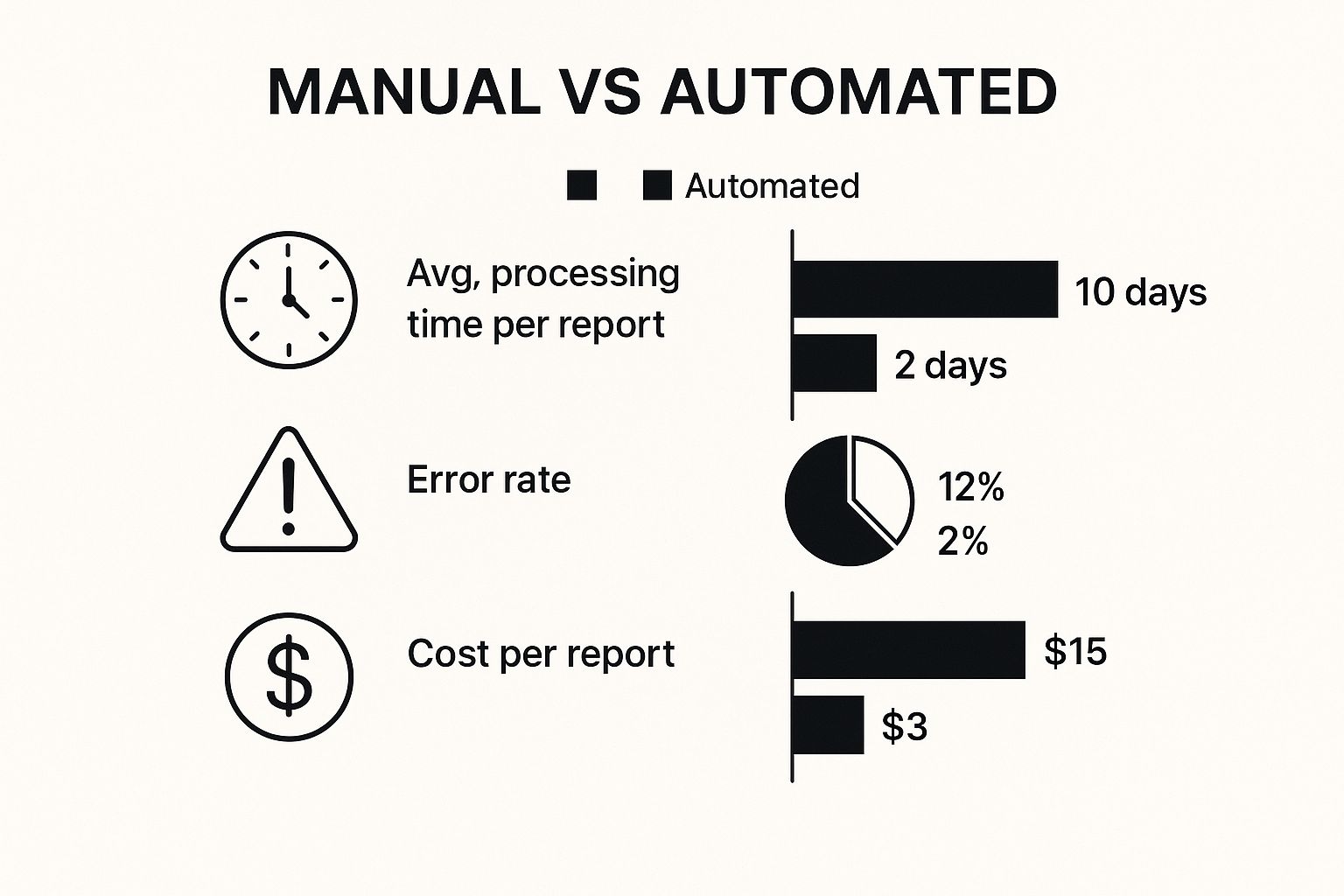
As the data makes clear, automation provides a massive leap forward in speed, accuracy, and overall cost-effectiveness. It’s no longer a "nice-to-have" but an essential part of any modern T&E program.
Optimizing Your T&E Program for Strategic Savings
Getting your corporate travel expense management right goes way beyond just approving reports and cutting checks. Once you've got a solid policy, the right tools, and a clear line of sight into your spending data, you can start turning your T&E program from a cost center into a real strategic asset. This is where the magic happens.
This is the optimization phase. It’s all about actively using that consolidated data to make smarter financial decisions. You’re looking for patterns, negotiating from a position of strength, and gently guiding employee spending habits. When you nail this, your T&E program starts adding tangible value back to the business.

Unlocking Savings with Consolidated Data
Your expense data is a goldmine, but only if you can see it all in one place. An integrated system gives you that complete picture of where every dollar is going, and that bird's-eye view is your most powerful negotiating tool.
For instance, your data might show your sales team is spending $500,000 a year on hotels in just Chicago and Los Angeles. Armed with that hard number, you can walk into a discussion with major hotel chains and negotiate a corporate rate that could easily save you 15-20%. Without that data, you're just another company. With it, you're a high-value client they don't want to lose.
The same logic works for air travel. By pinpointing your most frequent routes, you can negotiate preferred rates or perks like waived baggage fees. This is the core of strategic corporate travel expense management—it directly beefs up your bottom line.
The Financial Power of Corporate Card Programs
Rolling out a corporate card program is one of the smartest moves you can make. It immediately simplifies the entire T&E process by getting rid of most out-of-pocket expenses and the reimbursement shuffle. That alone is a massive win for your employees and your finance team.
But the real benefits are financial. A well-managed card program delivers advantages you just can't get with personal cards.
- Cash-Back Rebates: Many corporate card providers offer rebates on total annual spend. Even a 1% rebate on $2 million in travel spending is a cool $20,000 back in your budget.
- Simplified Reconciliation: Transactions flow automatically into your expense management software, slashing the time and hassle of reconciliation.
- Enhanced Spending Controls: You gain the ability to set specific spending limits by employee, category, or vendor, giving you proactive control instead of reactive clean-up.
These cards give you a level of visibility and control that's essential for any company serious about managing its travel budget.
Analyzing Trends to Influence Behavior
Your data doesn't just tell you what was spent; it reveals how it was spent. When you dig into these trends, you can spot behaviors that are needlessly costing you money and find ways to encourage more cost-effective choices.
Advance booking is a classic example. The data is clear: flights booked more than 14 days in advance are significantly cheaper. If your reports show that 40% of your team's flights are booked within a week of travel, you’ve found a huge opportunity. You can use this insight to show team leaders the financial impact and tweak policies to incentivize booking earlier.
True optimization isn't about slashing travel—it's about making every dollar spent on it work harder. By using data to guide behavior, you turn employees into partners in cost management and build a culture of financial responsibility.
You can apply this thinking to almost any spending category. Are people grabbing ride-shares for short trips when public transit is a perfectly good, cheaper option? Your data will tell you. From there, you can update your policy or send out guidance that saves money without slowing anyone down.
Case Study: Ground Transportation Savings
Picture a mid-sized tech company with a large sales force. Their T&E data showed that airport transfers in New York City were a major line item, with reps spending an average of $85 per trip on individual black car services.
By digging into this trend, the finance team spotted a clear path to savings. They reached out to a reliable local provider, like Max's Luxury Rides Inc., and set up a corporate account with a negotiated flat rate.
The results were immediate.
- Direct Cost Savings: The negotiated rate dropped the average trip cost to $65, saving the company over 23% on that one expense category.
- Simplified Invoicing: Instead of chasing dozens of individual receipts, the finance team received one itemized monthly invoice, freeing up hours of their time.
- Improved Employee Experience: The sales reps loved it. No more paying out-of-pocket or scrambling for a car. Their ride was pre-booked, professional, and billed directly to the company.
This is a perfect real-world example of how analyzing specific spending patterns leads to smart changes that benefit everyone. It’s how you shift from a reactive expense process to a proactive corporate travel expense management strategy.
Common Corporate Travel Expense Questions
When you're trying to nail down your company's approach to corporate travel expense management, a handful of questions pop up time and time again. These are the sticking points that can make the difference between a smooth, efficient system and one that causes headaches for everyone involved. Let's tackle them head-on.
How Can We Enforce Our T&E Policy Without Frustrating Our Travelers?
This is probably the most common hurdle. Nobody wants to be the "policy police," and employees certainly don't want to feel like they're being micromanaged. The secret isn't stricter rules; it's a blend of clear communication and smart technology.
Think of your policy less as a rulebook and more as a set of guardrails designed to make travel fair and straightforward. Modern expense management software is your best friend here. Instead of finding out about a mistake weeks later, the system can flag an out-of-policy booking the moment it happens.
A simple, real-time notification that explains why something is non-compliant feels like a helpful nudge, not a penalty. This proactive approach stops issues before they start and helps educate employees along the way.
How Should We Handle Out-of-Pocket Expenses?
This is a massive point of friction. I've seen firsthand how slow reimbursements can seriously damage employee morale. When your team has to float the company hundreds or thousands of dollars, waiting weeks to get it back feels disrespectful.
The best strategy is to get rid of out-of-pocket spending almost entirely with a good corporate card program. But for those few times it's unavoidable—like a cash-only taxi or a small tip—your reimbursement process has to be fast and painless.
Here’s a workflow that actually works:
- Snap and Send: Require travelers to use a mobile app to take a picture of the receipt right away. No more lost or crumpled paper.
- Quick Submission: The app should make it simple to submit the expense for approval in seconds.
- Fast Payout: Once approved, that money should hit their bank account via direct deposit.
Aim to get money back into your employees' hands within 5-7 business days of their trip. A quick, reliable reimbursement cycle shows your team you trust and value them, and that's invaluable.
What Is the Best Way to Manage International Travel Expenses?
Throwing international travel into the mix adds a whole new level of complexity. You've got currency conversions, foreign transaction fees, and different tax rules like VAT to worry about. Trying to manage this manually is a recipe for mistakes and wasted time.
Again, this is where a solid expense platform pays for itself. The right tool will automatically convert currencies based on the exact transaction date, taking all the guesswork out of it. This saves your finance team from a mountain of tedious work and ensures every expense is recorded accurately.
Some of the best systems go a step further and help with VAT reclaim. They can spot eligible expenses and help you pull together the necessary paperwork, recovering money that most companies simply write off. If your team travels globally, these automated features are an absolute must for effective corporate travel expense management.
Ready to simplify your team's travel and ensure every ride is professional, reliable, and billed directly? Max's Luxury Rides Inc. offers premium corporate transportation solutions that eliminate out-of-pocket expenses for airport transfers and client meetings. Book a corporate account with us today and experience seamless travel.