
A good corporate travel policy template does more than just list rules; it creates a solid framework for how your team books travel, manages spending, and handles business trips from start to finish. Think of it less as a rulebook and more as a strategic tool that supports both your employees and your company's financial health.
Why a Modern Travel Policy Is a Strategic Asset

Operating without a travel policy—or with an outdated one—is a genuine liability. When guidelines are missing, you open the door to inconsistent spending, compliance headaches, and genuinely frustrated employees. A modern, clearly defined corporate travel policy takes that chaos and turns it into a structured system that works for everyone.
And it’s not just about cutting costs on flights and hotels. A well-thought-out policy is a powerful tool for keeping your team happy and safe. It shows you care about their well-being, comfort, and time. When your people know what to expect and feel supported on the road, they can focus on why they're traveling in the first place, which always leads to better results for the business.
The Real-World Impact of a Clear Policy
Let's paint a picture. Imagine two employees are heading to a client meeting when their flight gets canceled at the last minute.
Company A (No Clear Policy): Panic sets in. One employee books a wildly expensive, last-minute flight on their personal credit card, crossing their fingers it will get approved. The other hesitates, waiting for instructions, and ends up missing a key part of the client meeting. Both are stressed, and finance is left with a messy, out-of-budget expense report to untangle.
Company B (With a Modern Policy): The policy has a section for travel disruptions. The employees immediately use the company's travel management platform to rebook the next available flight, which is directly billed to the company. They know exactly what the per diem is for the extra day's meals and that the hotel is covered. The whole situation is handled with minimal stress and zero financial surprises.
A well-crafted policy acts as a reliable guide during unexpected events, empowering employees to make smart, compliant decisions without hesitation. It replaces uncertainty with confidence and ensures operational continuity.
The way we build these policies is constantly evolving, influenced by everything from economic shifts to new technology. Business travel is roaring back, and with it comes the need for smarter management. In fact, global business travel spending is projected to hit a record $1.57 trillion in 2025, a 6.6% jump from the previous year. This growth just underscores how critical a robust policy is for managing costs and operations. You can read more about the state of corporate travel to get a handle on these trends.
The Essential Pillars of an Effective Policy
To really work, your travel policy needs to cover every single stage of a business trip—from the initial approval to the final expense report. It becomes the go-to resource for travelers, their managers, and the finance team. Throughout this guide, we'll walk you through the detailed steps and provide a customizable corporate travel policy template to help you build a document that addresses these core components.
Before we dive in, let’s quickly look at the essential pillars that make up a strong policy. The table below offers a quick summary of the essential pillars detailed throughout this guide, helping you focus on the key areas for building an effective policy.
Core Components Of A Modern Travel Policy
| Policy Component | Primary Goal | Key Considerations |
|---|---|---|
| Booking Procedures | To centralize travel arrangements and control costs. | Mandatory booking tools, approved vendors, advance booking requirements. |
| Expense Guidelines | To define what is reimbursable and set clear spending limits. | Per diems, expense categories (meals, ground transport), receipt requirements. |
| Safety & Security | To prioritize employee well-being while traveling. | Emergency contacts, risk management protocols, travel insurance details. |
| Approval Workflows | To ensure trips are necessary and align with budget. | Pre-trip approval process, manager responsibilities, budget checks. |
| Sustainability | To align travel practices with corporate responsibility goals. | Preferred "green" vendors, carbon offsetting options, travel alternatives. |
These pillars form the foundation of a policy that delivers clarity, control, and care—the three things every great travel program needs.
Building Your Policy's Foundational Elements
Let's get down to the nuts and bolts. A great travel policy is built on a strong foundation of clear, non-negotiable rules. This is where you define the core mechanics of how travel is booked, approved, and paid for. Getting this part right is crucial—it's what prevents the common friction points that frustrate both your travelers and your finance teams.
Think of these as the essential building blocks for a process that runs smoothly from start to finish.
This infographic gives you a snapshot of some key metrics you'll be managing, showing things like booking method adoption, approval times, and how quickly expenses get submitted.
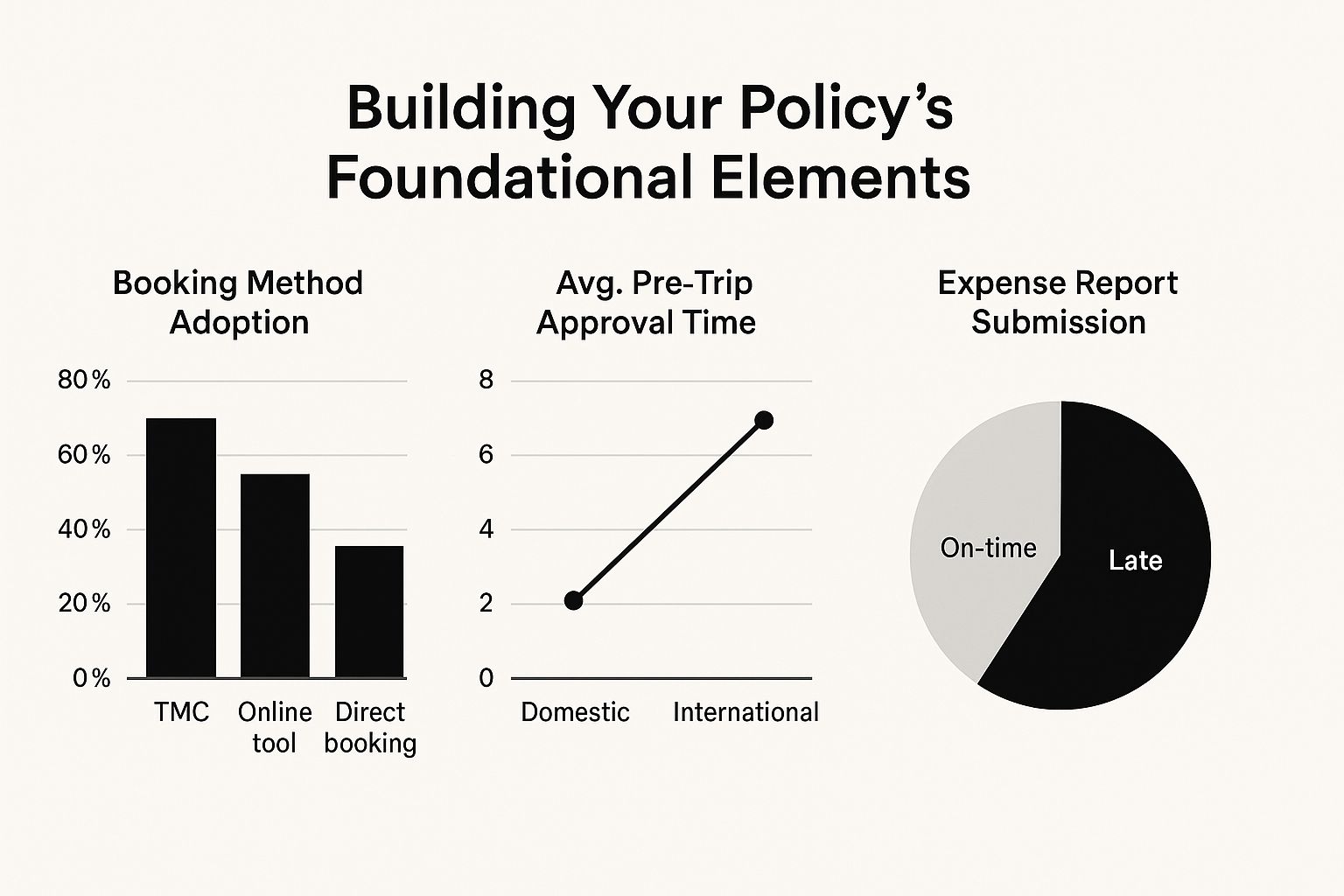
As you can see, the data often shows that while company-approved online tools see high adoption, direct bookings can lag in compliance. It also highlights how international travel can significantly stretch out those approval timelines.
Structuring Your Booking Procedures
First things first: you have to define exactly how employees should book their travel. A vague process is an open invitation for rogue spending and missed savings. Your policy needs to be explicit about the approved channels.
Generally, I've seen companies take one of three main approaches:
- Designated Travel Management Company (TMC): If you're looking for high-touch service and expert support, this is the way to go. Your policy should clearly name the TMC and state that all air, hotel, and car rental reservations must go through their agents or online portal. Simple.
- Mandatory Online Booking Tool (OBT): To give employees more control while keeping things streamlined, many businesses mandate a specific OBT. The policy should name the tool—like TripActions or SAP Concur—and make it clear that it's the sole channel for standard travel. This is the key to ensuring compliance and capturing all your travel data in one place.
- Controlled Direct Bookings: Some companies are comfortable letting employees book directly with airlines or hotels. If this is your approach, you absolutely must include strict guardrails. For example, require price comparisons against your OBT and mandate that all bookings fall within pre-approved budget limits.
Whatever method you choose, consistency is the goal. Mandating a single channel, like an OBT, has been shown to improve compliance by an average of 30-40% compared to unmanaged travel programs.
Designing Pre-Trip Approval Workflows
Here’s a rule I always recommend: no trip should be booked without formal approval. This step isn't just a box-ticking exercise; it confirms there's a real business need and ensures the estimated costs align with department budgets.
A simple approval process might just need a direct manager's sign-off. But for better control, a more robust system adds layers based on the cost and destination of the trip.
Differentiating Domestic and International Approvals
It’s just plain smart to have different approval paths for domestic and international trips. Their complexity and costs are worlds apart.
- Domestic Travel: A standard workflow works well here. An employee submits a travel request through your booking tool, which then routes directly to their manager for a quick approval.
- International Travel: These trips often benefit from a multi-step approval process. For instance, the request might go from the manager to the department head, and then finally to the finance or even security team for a final check on budget and potential risks.
A tiered approval system ensures you have the right level of oversight for every single trip. It empowers managers to approve routine travel quickly while looping in senior leaders for the higher-cost, higher-risk international journeys.
This structured approach avoids last-minute budget surprises and makes sure all travel is aligned with your company's bigger goals.
Outlining Expense Reporting Guidelines
The final piece of your foundation is a crystal-clear process for submitting expenses and getting reimbursed. From my experience, ambiguity here is one of the biggest sources of employee dissatisfaction.
Your policy needs to set firm, unambiguous expectations.
- Submission Deadlines: Be specific. A good rule of thumb is something like, "All expense reports must be submitted within 15 business days of the trip's conclusion." This little rule prevents a month-end pile-up for your finance team.
- Receipt Requirements: Don't leave this open to interpretation. Specify what needs a receipt. A common and effective rule is requiring receipts for any expense over a set amount, like $50. You should also clarify if digital photos or scans of receipts are acceptable (they should be!).
- Reimbursement Timeline: Give your employees peace of mind by setting a service-level agreement (SLA) for your finance department. Something like, "Compliant expense reports will be processed for reimbursement within 10 business days of submission," manages expectations and builds trust in the system.
These three elements—booking, approvals, and expensing—form the operational backbone of your entire travel program. By defining them with precision in your corporate travel policy template, you create a system that is efficient, compliant, and fair for everyone.
Drawing the Line: Clear Spending Guidelines and Limits

Once you’ve nailed down how travel is booked and approved, it’s time to get specific about the money. This is where you translate financial controls into tangible rules that eliminate guesswork for your team and prevent those dreaded budget overruns.
Leaving spending up to an employee's interpretation of "reasonable" is a recipe for inconsistency and difficult conversations. By setting clear boundaries from the start, you empower your team to make smart financial decisions while still ensuring their comfort and safety on the road.
Setting the Rules for Air Travel
Airfare is almost always the biggest line item on a trip's expense report, so it’s the natural place to start. Your policy needs to clearly outline the rules of the sky to keep costs down without grounding your team's productivity.
Most solid policies I've seen include a few key guidelines:
- Cabin Class Rules: Mandate economy or main cabin for all domestic travel. For long-haul international flights, you might consider allowing premium economy or business class for any trip over 8 hours. It’s a smart investment in your employee’s well-being and ensures they land ready to work, not ready for a nap.
- Preferred Carriers: If you've negotiated corporate rates or have a loyalty program with specific airlines, list them here. This is a simple way to consolidate your spending and rack up rewards that can be used to lower future travel costs.
- Advance Booking: This one’s a no-brainer. Requiring employees to book flights at least 14-21 days in advance can lead to significant savings. Of course, last-minute trips happen, but this should be the standard.
Accommodations and Per Diems
Hotel costs are tricky because they swing wildly from one city to the next. A one-size-fits-all spending cap just doesn’t work and can frustrate travelers.
A much better approach is to create a tiered system based on the destination. A flat $250 per night limit might be generous in Omaha but completely unrealistic in New York City. Adjusting the limit based on the city shows your team you understand the realities of travel.
Creating tiered spending limits for accommodations and meals shows your policy is grounded in reality, not just arbitrary numbers. This simple act of fairness and practicality goes a long way in getting employees to buy into the guidelines.
This kind of strategic thinking is becoming more common. As we look toward 2025, companies are getting smarter about managing travel costs. According to a recent Corporate Travel Study from Deloitte, larger companies are especially focused on maximizing the ROI of every trip, which translates directly into more thoughtful, detailed spending policies.
To give you a concrete idea of what this looks like, here’s a sample table outlining how you might structure tiered spending limits.
Sample Spending Limits By City Tier
| Expense Category | Tier 1 City (e.g., New York, London) | Tier 2 City (e.g., Austin, Dublin) | Tier 3 City (e.g., Omaha, Cardiff) |
|---|---|---|---|
| Hotel (per night) | $350 | $225 | $175 |
| Meals (per diem) | $90 | $75 | $60 |
| Ground Transport (daily cap) | $75 | $60 | $50 |
This structure provides clear, fair guidance that adapts to the real-world cost differences your travelers will face.
Managing Ground Transportation and Meals
While they may seem like smaller expenses, ground transportation and meals can add up incredibly fast. Your policy needs to offer clear, simple guidance here.
For Ground Transportation:
- Spell out the approved methods. This usually includes rental cars (stick to economy or mid-size), ride-sharing services, and public transit.
- It's also wise to clarify when a rental car makes sense versus using a ride-share, which is often far more cost-effective for getting around a single city.
For Meals:
- Per Diem Rates: This is the cleanest method. You provide a flat daily allowance for meals and incidentals, adjusted by city tier. No receipts, no fuss.
- Actuals with a Cap: The alternative is to reimburse the actual cost of meals up to a set daily maximum. This approach requires employees to submit itemized receipts for everything they eat, which means more admin work for everyone.
Clarifying What’s Not on the Company’s Dime
This might be the most important part of the entire section: a crystal-clear list of what the company will not pay for. Ambiguity here is a primary source of friction between employees and finance departments.
Don't leave any room for misunderstanding. Be explicit.
Common non-reimbursable expenses include:
- In-room movies or mini-bar purchases
- Gym, spa, or other hotel recreational fees
- Traffic violations and parking tickets
- Childcare or pet boarding
- Personal items like toiletries, magazines, or clothing
- Upgrades to first-class without prior executive approval
By clearly defining these boundaries, you manage expectations and ensure the corporate card is used strictly for business. It saves everyone from having an awkward conversation after the trip is over.
Integrating Traveler Safety And Well-Being

A truly modern corporate travel policy is about people, not just pennies. While cost controls are obviously important, the real strength of a great policy comes from its commitment to employee safety and well-being. This concept, often called duty of care, is your company’s core responsibility to protect your people when they're on the road for work.
Think of your policy as more than a rulebook—it should be a direct reflection of your company culture. It's how you show your team that you see them as valued individuals, not just numbers on a spreadsheet. Honestly, this isn't just the right thing to do; it’s a smart move that has a huge impact on employee satisfaction and retention.
Establishing Robust Safety Protocols
The bedrock of any solid duty of care program is a set of clear, actionable safety protocols. When an emergency strikes—whether it’s a medical issue, a natural disaster, or a security threat—your employees need to know exactly what to do and who to call. There can be no grey areas here.
To build a safety framework that actually works, make sure you include these fundamentals:
- Emergency Contact Information: A dedicated 24/7 hotline or a crystal-clear list of contacts (like a security advisor or HR partner) that travelers can reach anytime, anywhere.
- Travel Insurance Details: Don't just say you have insurance. Spell out what the policy covers, how to get medical help abroad, and the exact steps for filing a claim.
- High-Risk Destination Guidelines: If you have people traveling to areas with known security or health risks, your policy must have specific procedures, like mandatory pre-trip security briefings or required health checks.
Duty of care isn't just a legal checkbox; it's a moral one. A policy that clearly lays out emergency procedures gives your team the confidence to handle the unexpected, knowing the company has their back.
This proactive approach to safety is quickly becoming the standard. The future of corporate travel is being defined by this dual focus on safety and well-being, with smart companies embedding these protocols right into their policies. As you fine-tune your own program, you'll find that balancing these needs is key to creating a policy that's both effective and employee-friendly. For more on this, you can dig into the recent industry studies exploring the complexity of modern business travel.
Fostering Employee Well-Being on the Road
While safety protocols cover what might go wrong, well-being policies are about making the entire travel experience better. Let’s face it, business travel can be exhausting. Policies that ignore the human cost lead directly to burnout and fatigue. A thoughtful policy, on the other hand, can actively support a healthier work-life balance for your team.
It's often the small adjustments that make the biggest difference. Integrating clauses that prioritize comfort and cut down on travel-related stress can have a massive, positive impact on an employee's physical and mental health.
Practical Policies That Support Well-Being
Looking for high-impact ideas? Here are a few specifics you can build into your corporate travel policy template to show you're serious about well-being:
- Prefer Direct Flights: For any trip under a certain length, say 6 hours, make non-stop flights the default. This one rule can dramatically reduce travel time and the fatigue that comes with it.
- Ensure Safe and Comfortable Accommodations: Go beyond a simple price cap. Mandate that hotels must be in safe, well-lit areas and meet a minimum guest rating, like 4 stars or higher.
- Allow for 'Bleisure' Travel: Give your formal approval for employees to add a few personal days onto a business trip at their own expense. This flexibility turns a work trip into an opportunity, letting them decompress and explore a new city.
- Set Reasonable Travel Hours: Actively discourage red-eye flights or super-early departures. A well-rested employee is always going to be a more productive and engaged one.
By weaving these people-first elements into your policy, you do more than just set rules. You make a statement about your company's values, sending a clear signal that your team's health, safety, and happiness are just as important as the bottom line.
How To Implement And Communicate Your Policy
You’ve put in the hard work and drafted a solid corporate travel policy. That’s a huge step, but the job isn't quite finished. A brilliant policy is useless if it’s just collecting dust on a shared drive. Now comes the most critical part: rolling it out in a way that gets your team to understand, accept, and actually follow the new guidelines.
Success here all comes down to smart, multi-channel communication. You're not just dropping a list of rules on everyone. You're explaining the why behind the policy and showing how it makes life easier for both the company and the traveler. A well-thought-out launch plan heads off confusion, reduces pushback, and paves the way for great compliance from the get-go.
Kicking Off Your Strategic Rollout
First things first, you need to plan your official announcement. Whatever you do, don't just attach the policy to a generic email and call it a day. Frame the launch in a positive light. You can do this by highlighting the tangible improvements, like a simpler booking process, quicker expense reimbursements, or better duty of care features.
Think of the rollout as a small internal marketing campaign. A single email won't cut it; you need a few different touchpoints to make sure the message lands.
- The Big Announcement Email: Start with a company-wide email that introduces the new policy. Be sure to explain its purpose and state a clear effective date.
- A Quick-Reference Guide: No one wants to read a 20-page document to find a single spending limit. Create a visually engaging one-pager that covers the essentials—approved booking tools, key spending caps, and the deadline for submitting expenses.
- Live Q&A Session: Host a town hall, either in person or virtually, where employees can ask questions. This is your chance to clear up any gray areas and address concerns head-on.
This layered approach makes it easy for everyone to absorb the key information without feeling overwhelmed.
Training And Empowering Your Team
Communication gets the word out, but training makes it stick. Your goal is to give employees and their managers the practical know-how to follow the new procedures correctly.
Manager training is especially important. They’re on the front lines, approving trips and reviewing expenses, so they need to know the policy inside and out. Make sure they’re comfortable with the approval workflow, know what to look for in an expense report, and can answer common questions from their teams.
When it comes to training your travelers, keep it practical. A live demo of your new online booking tool or expense software is infinitely more valuable than a presentation full of policy jargon. Show them exactly what they need to do.
Enforcing The Policy And Managing Exceptions
For any policy to work, it has to be applied consistently. The rules need to be the same for everyone, from the newest hire to the C-suite. When someone books an out-of-policy flight or hotel, it needs to be addressed quickly and professionally. This sends a clear message that the guidelines are a firm company standard.
Of course, business travel can be unpredictable. There will always be legitimate reasons for exceptions. Your policy should outline a clear, formal process for requesting and approving them. This prevents a free-for-all where exceptions are granted based on who you know, ensuring they’re only made for valid business needs.
Finally, remember that your travel policy isn't set in stone. It’s a living document. The travel industry is always evolving, your company will grow, and new priorities will emerge. Plan to review the policy at least once a year. The best way to do this is by gathering feedback from your frequent travelers—they’ll tell you exactly what’s working and what isn’t. This real-world insight is what will keep your corporate travel policy template relevant and effective for years to come.
Your Customizable Corporate Travel Policy Template
Here’s the part you’ve been waiting for. We've put together a comprehensive, downloadable corporate travel policy template that you can use as the backbone for your entire travel program. But let's be honest—a template is just a starting point. The real magic happens when you make it your own.
Think of this less as a simple document and more as a practical toolkit. My goal here is to walk you through it, so you can confidently shape this framework into a policy that genuinely works for your company’s culture and goals.
The template is structured logically, mirroring the natural flow of a business trip. Here’s a quick look at a typical table of contents, which is similar to what you’ll find in our download.
This structure ensures you cover all your bases, from the initial booking right through to getting everyone reimbursed without a headache.
Nailing the Core Sections
First things first, let's get the foundational details plugged in. The template has several key placeholders that you’ll need to customize. These are the non-negotiables that turn a generic document into an operational guide for your team.
Here are the critical fields to tackle right away:
- [Company Name]: The easiest part. A quick find-and-replace will take care of this throughout the document.
- [TMC Provider / Online Booking Tool]: Be specific. Name your official TravelPerk or other Travel Management Company and designated booking tool. This immediately clarifies where employees must book their travel.
- [Per Diem Rates]: This is where you’ll input your daily allowances. I’ve seen it work best when companies use a tiered system based on the destination. A flat rate just doesn't make sense when you compare the cost of a meal in Zurich to one in Des Moines.
- [Expense Submission Deadline]: Don't leave this open-ended. Set a firm deadline, like 15 business days post-trip, to keep accounting happy and reimbursements timely.
- [Approver Name/Title]: Clearly state who has the final say on trip approvals and, just as importantly, any exceptions to the policy.
The best travel policies I've seen are living documents. They’re adapted to mirror the company’s reality—whether that’s a fast-paced startup that prioritizes flexibility or a large corporation where cost control is king.
For example, if you’re a smaller company, a simple manager sign-off is probably all you need. But if you’re a global enterprise, you'll likely need a multi-level approval process, especially for expensive international flights or C-suite travel. Our template is built to handle both, so just adjust the language to match how you actually operate.
Got Questions? We’ve Got Answers
Even the most carefully crafted travel policy is going to generate questions once it lands in your team's hands. Thinking through these common sticking points ahead of time will make the rollout much smoother and help people actually use the policy long-term. Here are a few of the most common questions that pop up, and how to handle them.
What’s the Deal With Blended Travel?
"Bleisure"—mixing business with a little personal time—is more popular than ever, so your policy needs to address it directly. The cleanest way to handle it is to make it clear that the company covers costs only for the business portion of the trip.
Let’s say an employee is heading to a three-day conference but wants to stay for the weekend. The company would pay for the round-trip flight and the three nights in a hotel for the conference. The employee is on the hook for their hotel rooms for Friday and Saturday night, plus any personal expenses. To keep everything above board, it’s a good idea to require pre-approval for any blended trip.
How Do We Handle Exceptions to the Rules?
Look, no policy can predict every single situation. That's why you need a formal process for handling exceptions. Your policy should name exactly who can sign off on out-of-policy spending—maybe it’s a department head or someone in the C-suite.
The key here is requiring a written business justification for any exception. This little step ensures people are deviating for legitimate work reasons, not just for personal comfort. For your leadership team, you might even consider an addendum that spells out specific perks, like flying business class on long-haul flights. It helps maintain fairness while still accommodating different needs.
A formal exception process isn't about being rigid; it's about creating a transparent system for when it makes sense to bend the rules. This approach keeps things fair and consistent for everyone.
Should We Have Different Rules for International Travel?
Absolutely. Flying across the country is one thing; flying across an ocean is another beast entirely. Your best bet is to build a separate section in your policy to tackle the unique challenges of international travel.
This section should cover details like:
- Visas and Passports: Spell out who is responsible for getting the right documents and how the company handles those fees.
- Health and Safety: This is where you’ll put information on required vaccinations, links to travel advisories, and what to do in a medical emergency.
- Spending and Per Diems: You’ll likely need higher per diem rates to account for currency conversion and the higher cost of living in many global cities.
- Flight Rules: Define when an employee can book a business class seat. A common threshold is for any flight lasting longer than 8 hours.
Getting this granular shows your team you've thought through the complexities and are prepared to support them, no matter where they're heading.
How Often Do We Need to Update This Thing?
A travel policy shouldn't be a "set it and forget it" document. Think of it as a living guide that needs to evolve. At a minimum, you should sit down and give it a thorough review once a year.
But don't wait for the annual review if something big changes. You’ll want to revisit the policy whenever there are major shifts in travel costs, if you roll out a new booking tool, or if the company expands into new markets. One of the best ways to keep it relevant? Regularly ask your most frequent travelers for feedback. They’re the ones on the ground and will have the best insights for practical, real-world improvements.
When it comes to corporate travel in Chicago, ensuring your team arrives safely and on time is paramount. For reliable, professional ground transportation that aligns with your duty of care, trust Max's Luxury Rides Inc.. From airport transfers to executive transport, our fleet is ready to provide a seamless travel experience. Book your next corporate ride with us today.