
A regional sales director misses her connection after a weather delay. She rebooks on her phone, while the travel manager checks the disruption dashboard, identifies an executive on the same route, and asks a preferred chauffeur partner to move both travelers from the airport to the client site. Nobody is debating whether the original booking was compliant. The team is managing a live business operation.
That distinction defines effective corporate travel management in 2026. The function coordinates policy, suppliers, booking channels, payments, expenses, traveler data, safety, reporting, and recovery when plans fail. Global business travel spending reached $1.47 trillion in 2024, was forecast to reach $1.57 trillion in 2025, and was later projected at a record $1.71 trillion in 2026, according to the GBTA 2025 Business Travel Index executive summary.
A booking tool alone can't control that system. A strong program moves people safely, controls total cost, supports revenue-generating work, and proves whether its decisions are producing value.
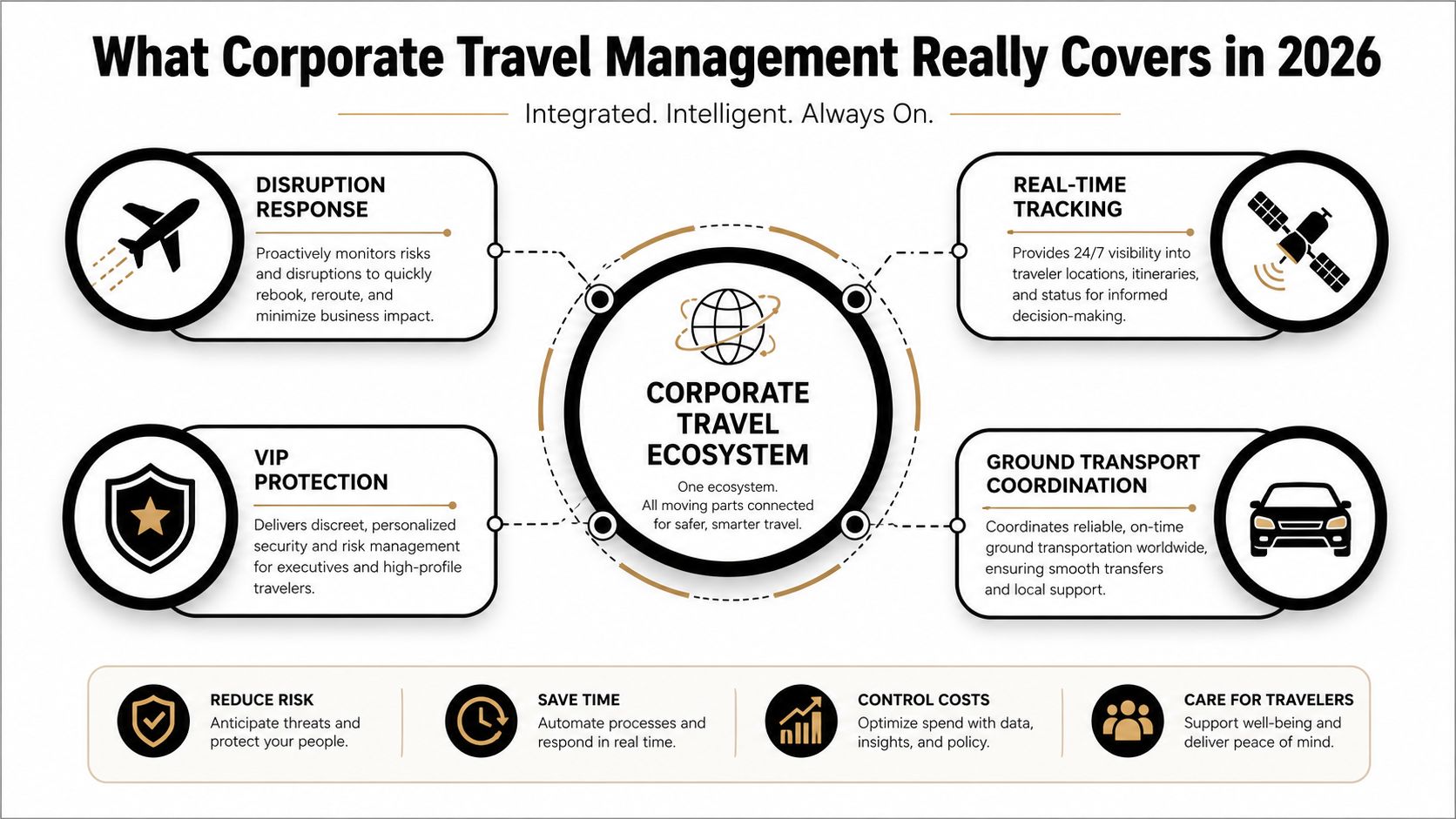
What Corporate Travel Management Really Covers in 2026
A traveler lands after a delayed connection, needs to reach a client site, and finds no approved ground option in the booking tool. The travel team must coordinate the route, payment, traveler details, risk response, and supplier support without losing policy control. That is corporate travel management in practice.
The function has four jobs: move people safely, control spend, support the business, and prove return on investment. Flights are one transaction within a larger operating system that must also account for hotels, ground transportation, expenses, disruptions, and traveler support.
A practical program connects six operating areas:
- Policy and approvals: Set booking limits, identify trips that need review, and define how exceptions are resolved.
- Supplier strategy: Evaluate airlines, hotels, ground operators, and travel management partners by service, risk, coverage, and total cost.
- Booking and payment: Link the online booking tool, agency support, virtual cards, lodge cards, and expense platform.
- Traveler intelligence: Keep itineraries, profiles, preferences, and contact details accurate enough for service and safety decisions.
- Duty of care: Assess itinerary risk, track travelers, communicate during disruption, and assign incident ownership.
- Reporting and optimization: Convert booking, payment, disruption, and expense data into decisions about policy, suppliers, and service.
As noted in the introduction, global business travel spending is projected to reach $1.71 trillion in 2026 according to the GBTA forecast. The operational lesson matters more than the headline. Companies need a system that scales while keeping cost, safety, and traveler experience visible.
Practical rule: If the travel manager cannot see the itinerary, payment path, policy decision, and ground plan in one operating picture, the program has a blind spot.
Ground transportation belongs in that picture. A reliable chauffeur partner can reduce missed-connection exposure, support executive and client-facing travel, and create measurable service and cost data instead of leaving the final leg to chance.
Building a Travel Policy That Gets Used
Set the policy around the decisions employees make under time pressure. A traveler heading to a client meeting, recovering from a cancellation, or booking a route missing from the system needs clear limits and a practical fallback. Long documents filled with legal language will be bypassed.
A usable policy makes key choices before the payment screen. It names the approved booking channel, sets acceptable cabin and hotel options, sends meaningful exceptions to the right approver, and defines how travelers can recover during disruption. Ground transportation belongs in the same workflow, especially when late arrivals, executive movements, or client-facing trips carry operational consequences.
Choose control points, not slogans
Mandatory approvals, narrow fare rules, and preferred suppliers can reduce discretionary spend. They can also create friction, encourage out-of-channel bookings, and leave travelers unsupported when inventory changes. Give employees discretion within defined limits, then require the booking and payment systems to capture the decision.
Use tiers based on trip purpose, traveler role, and operational consequence. A routine domestic meeting should not follow the same rules as a board event, roadshow, or trip involving a senior executive.
| Tier | Traveler / Trip Type | Booking Standard | Approval Threshold | Example Exception |
|---|---|---|---|---|
| Standard | Routine individual business trip | Approved booking tool and preferred suppliers | Auto-approve within policy | Client schedule requires a nonpreferred carrier |
| Priority | Senior leader, client-critical meeting, or tight itinerary | Approved channel with flexible change terms | Manager or travel desk review | Same-day change protects a revenue meeting |
| Group / Event | Roadshow, conference, team movement, or multi-stop trip | Managed booking with assigned coordinator | Budget owner approval | Group transport requires a dedicated vehicle |
| High-Risk | Sensitive destination, unusual activity, or traveler with specific security needs | Managed booking and documented risk review | Security or executive approval | Additional tracking and communication controls |
Assign exception ownership in the policy. The traveler requests the exception, the budget owner approves it, and the travel team records the reason for review. That record shows whether a rule is too restrictive or employees are avoiding it. Include ground transport exceptions as well, such as a dedicated vehicle for a time-critical itinerary or a traveler with specific security needs.
Put the rules inside the workflow
Connect the policy to the booking tool, approval routing, payment instrument, and expense reconciliation. During disruption, let approved agents or travelers rebook within defined limits while preserving the audit trail. A rule stored only in a PDF does not control spend or service.
Keep the main policy to two pages of operating rules, with an annotated appendix for edge cases, contacts, and examples. State who can approve a higher fare, when a chauffeur booking requires review, and how the related cost is recorded. If employees need a legal review to know whether they can book a hotel or vehicle, the document is too long.
Choosing Ground Transportation and When Chauffeur Services Win
Ground transportation is where many corporate travel programs lose visibility. Flights and hotels usually sit inside managed booking channels, while airport transfers, rideshare, taxis, and ad hoc rentals often appear later as scattered card charges or expense lines.
Compare options by total trip cost, not the displayed fare. Include waiting time, missed pickups, parking, fuel, tolls, driver time, rebooking effort, invoice quality, and the cost of a traveler arriving late to a meeting.
| Option | Total Cost Profile | Duty of Care | Reliability | Best Fit Use Case |
|---|---|---|---|---|
| Taxi | Variable meter or flat fare, limited reporting consistency | Depends on local licensing and provider controls | Strong in established markets, uneven elsewhere | Short, simple city trips |
| Rideshare | Attractive base fare, variable surge and cancellation exposure | Platform controls vary by market and service level | Convenient, but supply can change quickly | Routine individual travel in familiar markets |
| Rental car | Daily rate plus fuel, parking, insurance, and employee driving time | Employer carries more responsibility for driver and vehicle use | Useful when routes are dispersed | Multi-day regional work with flexible routing |
| Chauffeur service | Higher quoted rate, but predictable vehicle, driver, and billing control | Direct provider accountability and planned passenger records | Strong for scheduled, time-sensitive movements | Executives, groups, events, airport recovery, and multi-stop days |
Chauffeur services win when accountability matters more than app-based convenience. Mandate them for early airport departures, multi-stop executive schedules, VIP movements, roadshows, event transfers, and unfamiliar cities where a missed pickup could compromise the day. A preassigned vehicle, named dispatch contact, flight monitoring, and consolidated invoice can remove several failure points at once.
The common objection is that a chauffeur costs more. Sometimes it does on the initial quote. That comparison is incomplete if the alternative creates surge pricing, canceled pickups, idle time, parking expense, manual reconciliation, or a missed meeting. The right test is cost per completed movement with the required service level.
Apply a simple operating rule
- Mandate chauffeur: High-consequence itineraries, executives, groups, events, sensitive movements, and schedules with multiple stops.
- Allow rideshare: Routine solo trips where pickup supply, billing, and traveler tracking meet company standards.
- Use rental cars: Regional travel with dispersed meetings, where the employee needs control of the route and timing.
- Use taxis: Simple local movements in markets with reliable licensed networks and acceptable receipts.
Fleet operations also benefit from disciplined maintenance, dispatch visibility, utilization review, and documented responsibility. Travel leaders can use these best practices for fleet managers to strengthen the ground-transport part of the wider travel system.
Cost Control Levers That Move the Needle
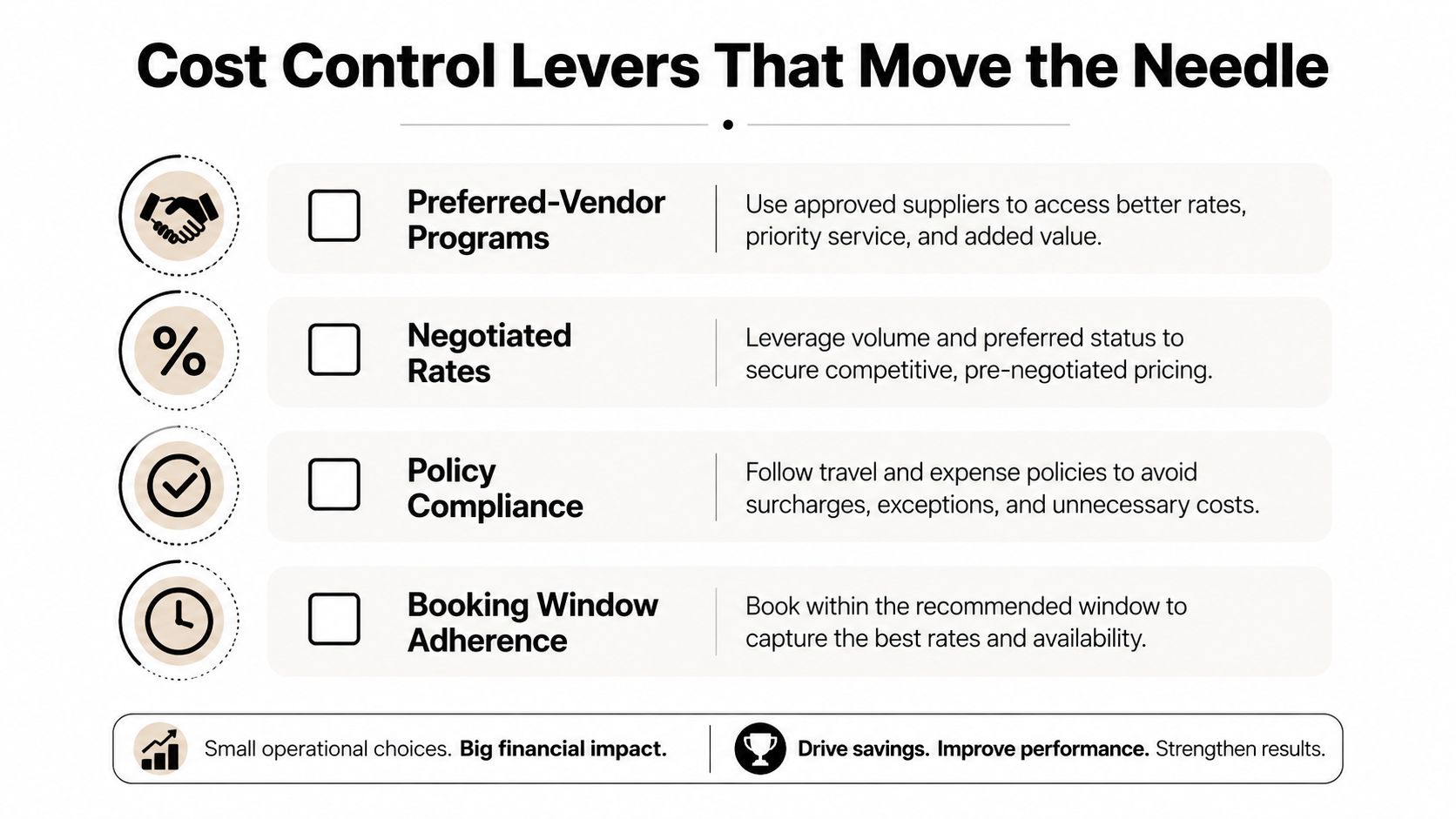
Cost control improves when the travel program treats each trip as an operating decision. Procurement, booking rules, approvals, supplier selection, and ground transportation should produce data that managers can review, not policies that exist only on paper.
Start with a preferred-vendor program. Negotiate where company demand is concentrated, then place approved options where travelers book. Compliance improves when the approved choice is easy to find and works for the itinerary. A long list of prohibitions rarely changes behavior.
Set booking windows by fare class and use dynamic thresholds. Ordinary trips within the approved budget can receive automatic approval. Higher-cost routes, unusual cabin selections, and expensive hotel choices should reach a human approver. The control should reflect business context, not apply the same obstacle to every traveler.
The largest savings often sit outside the booking screen:
- Shift suitable short-haul flights to rail: Move a portion of short-haul trips to rail where the route and schedule support it. Treat the target as a policy decision, not a guaranteed saving.
- Control surge exposure: Limit rideshare surge use. Shift predictable airport and executive movements to pre-booked chauffeur service when a fixed, managed cost is more reliable.
- Concentrate hotel demand: Direct stays toward two preferred properties per city when location and service meet traveler needs. Use the resulting volume in rate negotiations.
- Measure leakage: Compare card data, expense reports, agency bookings, and out-of-channel reservations. Employees cannot follow a channel the company does not monitor.
- Review on a cadence: Run leakage dashboards weekly, supplier variance monthly, and contract negotiations annually.
Apply one practical rule: approve the lowest-cost option that meets the required service level. A cheap booking that causes a missed meeting, unsafe transfer, or manual reconciliation is not a saving. Ground transport belongs in that calculation because pre-booked service can reduce surge exposure and invoice complexity on predictable movements.
Corporate travel operates at significant market scale, so small process failures deserve attention. Reduce avoidable variation while protecting trips where timing, safety, and traveler experience carry a higher business cost.
Duty of Care, Risk, and Traveler Safety
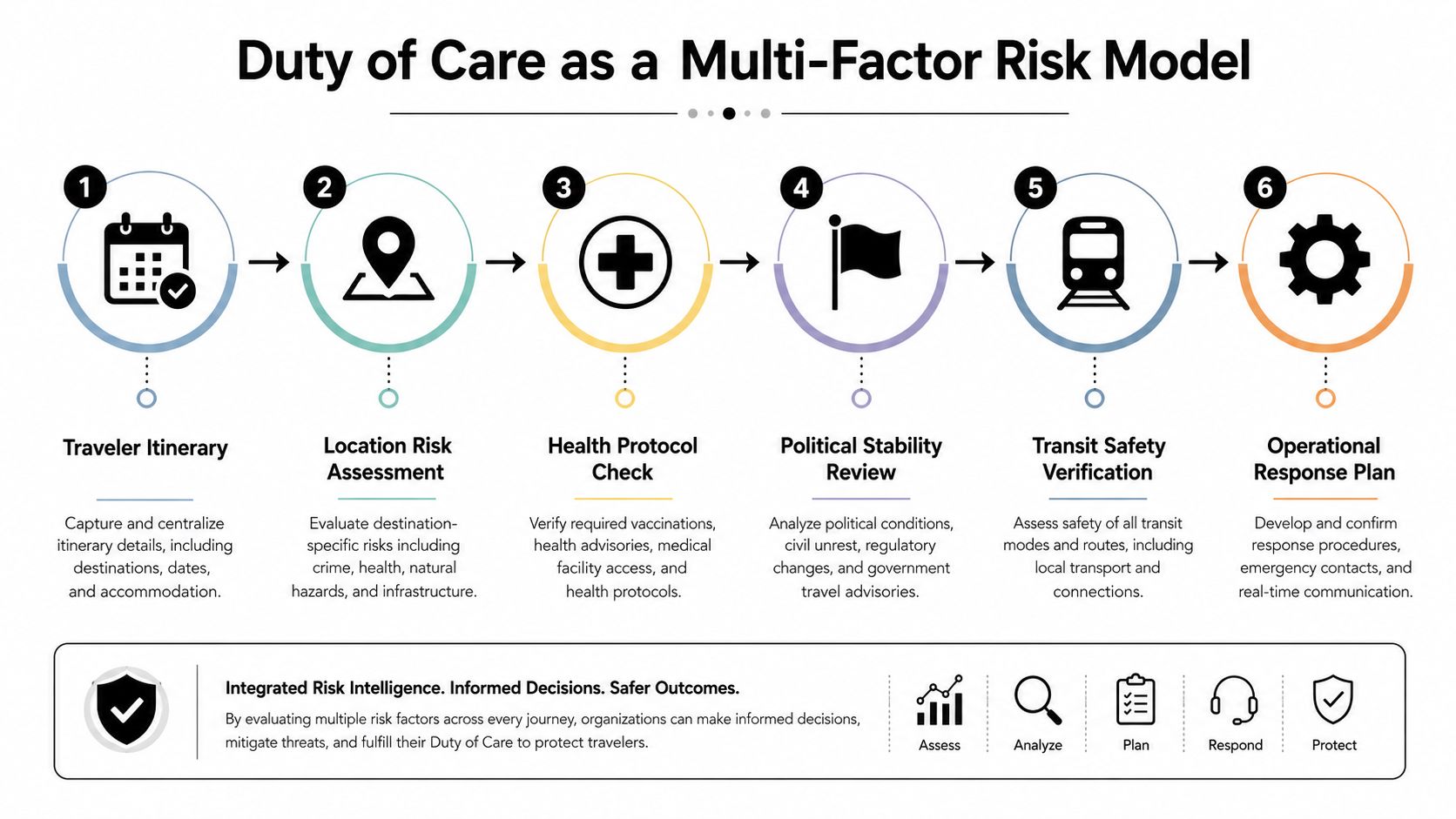
A traveler is delayed after landing, the assigned vehicle is unavailable, and the manager cannot identify who owns the response. That failure reflects an operating gap, not bad luck. Duty of care requires a live process that evaluates the destination, itinerary, traveler, and activity together.
Risk controls should account for health, political conditions, transport, natural hazards, crime, technology exposure, and kidnap risk. They should also reflect trip length, travel mode, planned activities, traveler experience, and profile. An experienced traveler taking a short airport-to-hotel route may need different controls from a new traveler facing extended ground travel. The research on corporate travel risk assessment and duty of care supports this multi-factor approach.
Build the response around clear ownership:
- Before departure: Assess destination and itinerary risks, provide relevant guidance, and secure required approvals.
- During travel: Use booking data for visibility, maintain current contact details, and monitor meaningful changes.
- During disruption: Provide a two-way communication channel so travelers can report conditions and receive instructions.
- During escalation: Name owners for security, travel operations, communications, and executive decisions.
- After an incident: Record actions, identify gaps, and update procedures before the next trip.
Ground transportation needs its own controls. An unmanaged pickup can strand a traveler even when airline and hotel details are visible. For scheduled movements, require provider records, dispatch contact details, vehicle information, and a documented escalation route. Pre-booked chauffeur service can also give the travel team clearer records and a defined contact point, making safety performance measurable rather than assumed.
Response test: Give a manager a disrupted itinerary and ask who contacts the traveler, who approves a reroute, who confirms the vehicle, and who briefs leadership. If the answer depends on finding the right person by chance, the program isn't ready.
Vendor Selection Criteria for Airlines, Hotels, and Ground Partners
A supplier's lowest list rate rarely represents its real cost. An inexpensive provider that fails during disruption, issues unclear invoices, or cannot produce traveler records can create more expense than a dependable partner with a higher quoted price.
Set the scorecard before meeting suppliers. Evaluate service levels, financial stability, geographic coverage, technology integration, safety controls, sustainability evidence, billing quality, and total cost. Ground partners require extra scrutiny: identify who owns a delay, how dispatch communicates, and what happens when the assigned vehicle is unavailable. Pre-booked chauffeur services can add a defined contact point, clearer trip records, and measurable performance.
Select suppliers through evidence
Start with requirements, then test them in operation.
- Define requirements: Separate required controls from preferences. Specify routes, traveler profiles, service windows, reporting fields, and escalation expectations.
- Build a long list: Use an RFI to check coverage, systems, insurance, references, and operating capacity.
- Run a paid pilot: Measure completion, punctuality, complaint handling, invoice accuracy, booking-channel adoption, and disruption response.
- Negotiate with evidence: Apply pilot results and route concentration to secure service levels, pricing, credits, and clear contractual responsibility.
For airlines and hotels, reliability can justify a higher fare when a missed connection or poor property location threatens the trip's purpose. Ground providers should document driver vetting, vehicle maintenance, real-time dispatch visibility, insurance limits, accessibility, backup capacity, and data retention.
| Criterion | Airlines | Hotels | Ground Transport | Weight |
|---|---|---|---|---|
| Service reliability | Schedule integrity and recovery support | Room availability and service consistency | Pickup completion and escalation | High |
| Safety | Operational and security controls | Property security and emergency procedures | Driver vetting, vehicle condition, insurance | High |
| Technology | Inventory, disruption feeds, traveler data | Booking, cancellation, and billing integration | Dispatch visibility and status updates | High |
| Coverage | Required routes and alliances | Required cities and suitable locations | Airports, cities, events, and group capacity | Medium |
| Total cost | Fare, flexibility, and change exposure | Rate, taxes, breakfast, parking, cancellation | Quote, waiting, tolls, idle time, reconciliation | High |
| Sustainability evidence | Documented reporting | Verified operating practices | Fleet composition and utilization data | Medium |
Review the stack against three tests: an audit, a complaint spike, and a major disruption. Suppliers should explain their controls, ownership, records, and recovery process without relying on optimistic assumptions. If they cannot, exclude them or restrict their role until the gap is corrected.
Booking Workflows, Approvals, and Reporting That Drive Decisions
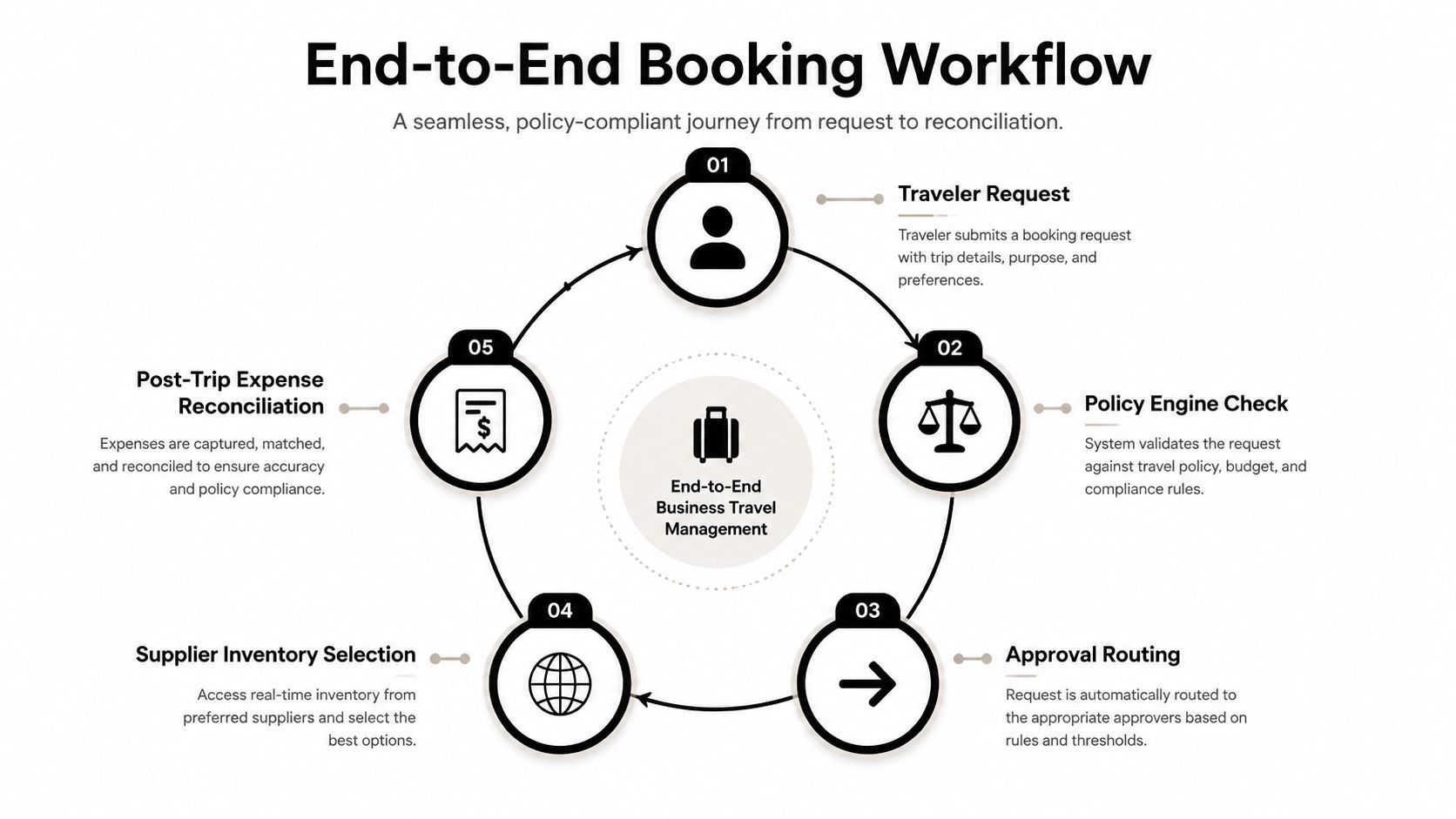
A sound booking workflow creates one auditable loop from request to reconciliation. The traveler submits the purpose, dates, destination, traveler profile, and required service level. The policy engine checks the request, the approval route evaluates exceptions, the booking channel displays compliant inventory, and the expense system closes the loop after travel.
The online booking tool should enforce practical rules, not merely display them. It can block out-of-class fares, hide nonpreferred options, flag missing approvals, and require a business reason for exceptions. Human approval belongs on decisions that deserve judgment, such as unusually expensive itineraries, sensitive destinations, executive travel, or group movements. Routine compliant trips should move without needless delay.
During airline disruption, define who can rebook and within what limits. The rule should cover cancellations, weather, security events, missed connections, and other irregular operations. Preserve the original itinerary, the approval record, the new booking, and any ground-transport change so finance and security can reconstruct the event.
Match payment to the operating model
- Virtual cards: Useful for controlled supplier payments, merchant restrictions, and clean allocation to a traveler or trip.
- Lodge cards: Suitable for centralized air or hotel settlement where the company wants consolidated billing.
- Per diem: Simple for predictable allowances, but it gives finance less detail about the actual purchase.
- Reimbursement: Flexible for travelers, but it needs receipt rules, review, and consistent coding.
Phocuswright's corporate travel analysis says nearly 80% of U.S. business travel spending occurs online and describes AI as increasingly central to planning, compliance, and back-office work. That makes governance essential, not optional. SAP Concur's 2025 global business travel survey identifies cybersecurity, AI-era expense fraud, generational behavior differences, and air-travel anxiety as active concerns.
Turn reports into management actions
Run a weekly leakage dashboard, monthly supplier scorecard, and quarterly policy review. Track policy adherence, average ticket price, unused booking percentage, and ground-transport cost per trip. Each metric needs an owner and a decision rule. A dashboard that never changes a supplier, policy threshold, or traveler communication is decoration.
A 90-Day Action Plan and Common Questions
A travel manager can reset a weak program without adding headcount by sequencing the work. Start with facts, then change controls, then embed measurement.
Days 1 to 30
Audit card spend, agency data, expense reports, hotel concentration, ground movements, unused bookings, and out-of-channel activity. Map traveler groups, trip types, approval owners, emergency contacts, and supplier responsibilities. Establish a baseline for the KPIs the program will use later.
Days 31 to 60
Rewrite the policy into practical tiers. Set approval thresholds, exception documentation, and disruption permissions. Renegotiate concentrated hotel and ground routes, test chauffeur coverage for high-consequence movements, and create a duty-of-care registry with named owners.
Days 61 to 90
Launch dynamic approval rules, publish the first leakage and supplier dashboards, and survey travelers about booking friction, support quality, and ground reliability. Review the results with finance, security, HR, executive assistants, and business leaders. Make one visible policy adjustment based on the evidence.
Questions leaders actually ask
Who owns corporate travel? Finance should own spend controls, travel operations should own workflow and suppliers, security should own risk escalation, and business leaders should own trip necessity. One executive sponsor must resolve conflicts.
How is AI changing travel management? AI can assist with itinerary planning, compliance checks, expense review, and risk detection. Set guardrails around approved inventory, human approval for sensitive decisions, data access, fraud review, and traveler communication. The question isn't whether to use AI. It's whether the company can explain and audit its decisions.
What budget reduction target is realistic? Don't promise a percentage before establishing the baseline. Set targets after measuring leakage, supplier concentration, unused bookings, disruption costs, and ground-transport variance.
How should remote and bleisure travel work? Define the business portion, approval boundary, personal-cost responsibility, insurance treatment, traveler tracking, and change rules. Flexibility is acceptable when the company can separate business obligations from personal choices.
Deloitte's 2025 corporate travel survey reports that the share of professionals traveling for work fell from 36% in 2024 to 31% in 2025, while 75% of travel managers reported budget expansion. That combination points to a sharper operating model, fewer but more intentional trips, and stronger service around high-stakes movements.
Max's Luxury Rides Inc. provides corporate chauffeur transportation for airport transfers, hotels, conferences, meetings, executive movements, and group travel, with vehicles ranging from executive sedans and SUVs to Sprinter vans, minibuses, and coaches. Review the service options and request coordinated ground transportation through Max's Luxury Rides Inc. when reliability, traveler support, and accountable dispatch need to be part of your corporate travel program.