
You're probably dealing with one of these situations right now. A team needs to get to the airport before dawn. A wedding party has to move between hotel, ceremony, and reception without losing half the group. Or an event planner is trying to move ten people with rideshare apps, only to watch ETAs drift, prices jump, and arrivals scatter.
That's where most transportation decisions go wrong. People compare the visible fare and ignore the operational mess attached to it. A cheaper ride isn't cost effective transportation if it causes late arrivals, idle staff, missed check-ins, confused guests, or a poor client impression.
In practice, the right question isn't “What's the lowest price?” It's “What's the lowest total cost for a trip that needs to succeed?”
Rethinking Cost Effective Transportation
A travel manager booking three separate rideshares for a small airport team usually thinks the math is obvious. Split the group, take the lowest live fare, and move on. On paper, that looks efficient. In the field, it often turns into staggered pickups, one driver taking a wrong terminal route, another canceling, and a team arriving in pieces.
That's not a minor inconvenience. It creates handoffs, extra calls, stress, and schedule risk. If one person is carrying documents, presentation gear, or group credentials, the entire trip can slow down because transportation was purchased by fare instead of managed by outcome.
Cheap and cost effective are not the same
Cost effective transportation is about total trip performance. The ride has to be reliable enough for the purpose of the trip. That standard changes based on context.
A solo traveler going to dinner can tolerate some variability. A CFO going to an airport, a wedding party on a hard ceremony schedule, or a client delegation arriving for a site visit usually can't.
Practical rule: The more expensive the consequence of being late, the less useful the cheapest fare becomes.
The broader transportation economy tells the same story. Between 1965 and 2020, global transportation usage per unit of real output more than doubled while transportation costs decreased by one-third, a shift that helped make logistics a core driver of economic integration and growth, according to NBER research on long-run transportation costs. In plain terms, efficient transportation doesn't just save money. It enables more activity, more coordination, and better economic results.
What practitioners actually watch
When I evaluate a transportation plan, I look at a short list before I look at the quoted fare:
- Trip criticality: Is this a flexible trip or one with a hard deadline?
- Group cohesion: Do these people need to arrive together?
- Luggage complexity: Are we moving carry-ons, trade show materials, or formalwear?
- Pickup risk: Will drivers struggle to find guests, terminals, or venues?
- Failure cost: What happens if one leg breaks?
Those questions usually change the answer fast. For many group movements, especially airport and event transfers, the “affordable” option is the one with fewer moving parts, not the one with the lowest initial quote.
Calculating the Total Cost of Your Trip
Most buyers price transportation too narrowly. They count the fare, then stop. That's useful only if the trip has no deadline, no service standard, and no downside when something slips.
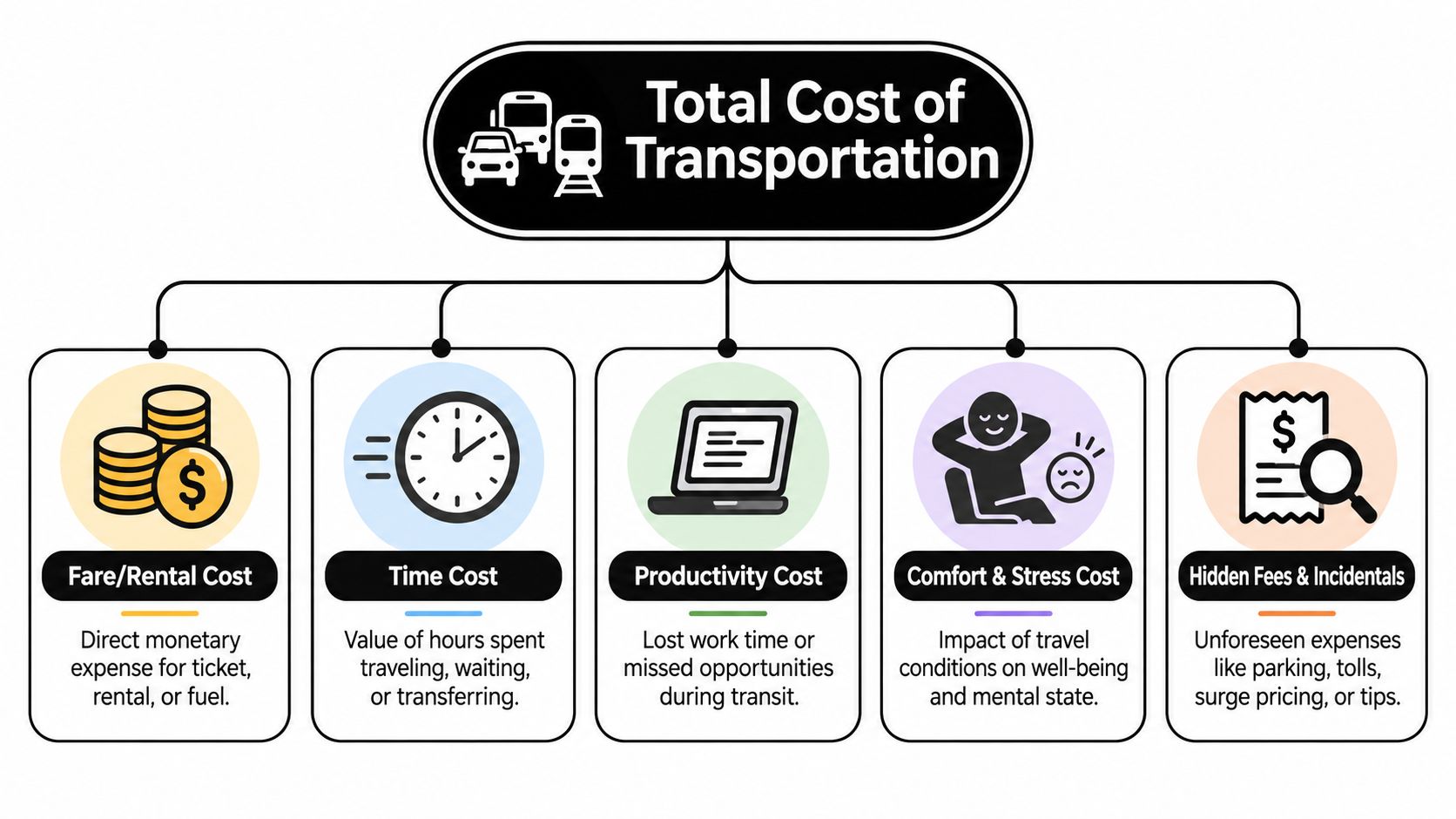
A better model is total cost of transportation. It treats the ride as an operating decision, not just a purchase.
The five cost layers
The fare is only the visible part of the trip. The hidden part is what the trip disrupts.
Fare or rental cost is the simplest line item. It's the quoted ride, rental, fuel, or service charge. This matters, but it rarely tells the whole story.
Time cost shows up when travelers wait, coordinate multiple pickups, correct driver errors, or lose time to indirect routing. For executive and event transportation, wasted time often costs more than the transport itself because it pulls higher-value people into low-value coordination.
Productivity cost matters when passengers could be preparing for a meeting, taking calls, reviewing an agenda, or arriving composed instead of frazzled. If a transport setup creates fragmentation, people lose usable travel time.
Comfort and stress cost sounds soft until you manage real passengers. A tense airport transfer before an international flight, or a cramped multi-stop run before a wedding, affects behavior, punctuality, and service perception.
Hidden fees and incidentals include parking, toll uncertainty, surge pricing, extra stops, waiting time, and the extra spend that comes from fixing a bad initial choice.
A quick way to use the framework
When comparing options, write down:
- Direct quoted cost
- How many vehicles are involved
- Who has to coordinate the trip
- What a delay would break
- Whether the group must arrive together
If the failure of any one vehicle creates a chain problem, consolidation usually deserves serious attention.
This logic applies at every level of travel spend. The same mistake people make with ground transportation also shows up in private aviation. The aircraft hourly rate never tells the full story by itself. Positioning, airport fees, and schedule realities shape the total bill. That's why Haute Jets' guide to private jet expenses is useful reading even if you're focused on ground transport. It reinforces the same discipline: evaluate the mission, not just the headline number.
What buyers miss most often
I see three repeat mistakes:
- Treating every passenger as independent: That works poorly when one traveler's delay affects everyone else.
- Assuming flexibility that doesn't exist: Airport check-ins, ceremony starts, and client arrivals don't move because a driver got lost.
- Ignoring coordination labor: Somebody always pays for the extra calls, texts, and replanning. If it's your assistant, dispatcher, planner, or traveler, it still counts.
Buy transportation based on the cost of success, not the price of access.
Comparing Transportation Options by Group Size
A six-person airport team can look cheap on paper if you book two rideshares. Then one driver cancels, one car cannot fit the luggage, and half the group reaches the hotel 25 minutes late. The extra $90 you saved disappears the moment an assistant starts reworking dinner reservations or a client waits in the lobby.
Group size changes the buying decision because failure gets more expensive as more people depend on the same move.
| Group size | Usually most cost effective | What commonly goes wrong with the cheaper-looking alternative |
|---|---|---|
| 1 person | Sedan, rideshare, or standard pre-booked car | Pickup inconsistency matters more than fare savings on airport runs or client meetings |
| 4 to 7 | Large SUV or van, depending on luggage and route | Two smaller vehicles often split the group, create uneven baggage capacity, and produce separate arrival times |
| 8 to 20 | Sprinter, executive van, or mini-coach | Multiple solo rides add waiting time, no-show exposure, routing errors, and more coordination work |
| 21+ | Minibus or coach with a named transport lead | Self-managed arrivals create late starts, missed headcounts, and venue access problems |
One traveler and small groups
For one traveler, the lowest quoted fare can still be the wrong buy if the trip has a hard deadline. A standard sedan or pre-booked car usually makes sense for an airport transfer, client meeting, or early departure because it reduces uncertainty without adding much cost.
For four to seven passengers, the decision usually turns on luggage, timing, and how important it is for everyone to arrive together. Two sedans may price lower than one SUV or van in some markets. They also create two pickup points, two driver communication threads, and two chances for delay.
I usually advise clients to price the larger vehicle first if the group is carrying checked bags, sample cases, trade show materials, or formalwear. Once the trip includes real baggage volume or a fixed arrival time, one vehicle is often cheaper in total trip cost even if the quote is slightly higher.
Medium groups are where the math changes
The 8 to 20 range is where buyers make the most expensive mistake. They compare a single van quote against the fare for one solo ride, instead of comparing it against the full cost of moving the entire group.
Analysts at DataBrain note that transportation teams often track efficiency by cost per mile and asset use in addition to raw spend, as explained in their overview of transportation KPIs. That same discipline applies here. A half-filled mix of sedans and SUVs can look flexible, but it usually raises the cost per moved passenger once waiting time, duplicate pickups, and underused seats are included.
For a 10-person group going 20 miles, the quote often comes down to a simple comparison. Five solo rides at $45 to $70 each puts the direct fare around $225 to $350 before surge pricing, wait time, or misroutes. One Sprinter at $180 to $260 can look like the premium choice, yet the per-passenger cost lands around $18 to $26 if everyone rides together.
That is before counting failure costs.
If even one separate car arrives late and delays a restaurant buyout, site visit, wedding photo schedule, or executive meeting, the cheaper booking stops being cheap.
Cost per passenger comparison
The exact numbers change by city, season, service level, and dwell time. The pattern does not.
| Transport Mode | Vehicles Needed | Estimated Total Fare | Cost Per Passenger |
|---|---|---|---|
| Multiple solo rideshares for 10 passengers | 4 to 5 | Often $225 to $350 before surge and wait charges | Roughly $23 to $35, with higher execution risk |
| Large SUV mix for 10 passengers | 2 to 3 | Often moderate, but depends heavily on luggage and staging time | Reasonable for short, casual trips, less efficient if the group must stay together |
| Sprinter or executive shuttle for 10 passengers | 1 | Often $180 to $260 in many markets | Roughly $18 to $26, usually with fewer failure points |
The hidden cost is coordination labor. Someone has to monitor ETAs, answer traveler calls, match people to the right cars, and fix mistakes at curbside. For corporate travel, event operations, and family groups heading to the airport, that labor is part of the trip cost whether it sits on an invoice or not.
Large groups require operating discipline
Once the manifest goes past twenty passengers, transportation behaves like event logistics. Vehicle count still matters, but control points matter more. Pickup windows, passenger lists, venue loading rules, ADA needs, and who has authority to make live changes all affect cost.
Three practices usually keep large-group spend under control:
- Assign one transportation lead: one person owns the schedule, manifests, and vendor communication.
- Reduce vehicle count where practical: fewer moving parts usually means fewer billing surprises and fewer missed pickups.
- Write precise pickup instructions: terminal, door, contact number, luggage assumptions, and buffer time should be confirmed before day of service.
The common failure pattern is easy to spot. Too many booking channels, too many drivers receiving partial information, and no single person managing the run sheet.
Large groups do not get expensive because buses cost money. They get expensive when avoidable mistakes spread across thirty people at once.
When Luxury Ground Service Delivers Higher Value
Luxury transportation gets dismissed too quickly because buyers confuse premium presentation with unnecessary cost. In reality, some premium ground services are the most financially disciplined choice available.
The key is to separate luxury as appearance from luxury as risk control. A professionally managed sedan for a client roadshow, or a Sprinter for a ten-person airport team, isn't just about style. It's about reducing the number of things that can go wrong.
The strongest case is group consolidation
This is the gap most generic transportation advice misses. Existing transportation analysis often ignores that group luxury shuttles such as Sprinter vans and mini-coaches can reduce per-person costs by 40 to 60 percent compared with multiple solo rides for groups of 8 to 20, while also improving safety, punctuality, and brand presentation, as discussed in this transportation equity document.
That matters because group travel failure is expensive in ways that don't fit neatly into a ride receipt.
If one premium vehicle replaces four uncertain ones, you're not only buying seats. You're buying fewer failure points.
Where premium service pays for itself
Client-facing trips are the clearest example. If a partner or executive arrives late, disoriented, or through a chaotic pickup process, the trip has already created friction before the meeting starts.
Wedding and special-event moves are another. The cost of a delayed couple, missing family member, or split bridal party is never measured accurately when people compare only base fares.
Corporate airport transfers often justify premium service because airport trips are deadline trips. The cost of failure includes missed flights, rebooking stress, lost prep time, and a chain reaction for the rest of the itinerary.
A short video like this captures why service design matters more than raw vehicle count when the trip has to run cleanly:
What works and what doesn't
What works in high-stakes transport:
- One vehicle for one group movement
- Professional dispatch and pre-set pickup details
- Vehicles matched to passenger count and luggage reality
- A service level that matches the importance of the trip
What doesn't:
- Booking piecemeal and hoping timing lines up
- Choosing the cheapest visible option for VIP movement
- Using too many small vehicles for a medium-size group
Premium ground service is worth it when the trip's downside is expensive. That includes reputation, delay exposure, and the simple operational value of getting everyone where they need to be, together and on time.
Actionable Booking Strategies for Your Needs
A poor booking decision rarely shows up as one bad fare. It shows up as two extra cars, a late VIP, overtime for staff waiting at the venue, or a flight change that costs more than the original ride.
The right booking strategy depends on who is carrying the risk. A corporate travel manager is protecting schedules and traveler productivity. An event planner is protecting the run of show. A family traveler is protecting time, energy, and the odds of a stressful day turning into a missed connection.
For corporate travel managers
Start with failure points, not rates.
If a provider cannot explain how they handle flight delays, driver reassignment, after-hours support, and missed pickup disputes, the quoted price is incomplete. In practice, airport transfers and executive movements deserve a different standard than routine local rides because the cost of a mistake is higher. A $40 to $60 savings disappears fast if one missed airport pickup leads to a rebooked ticket, lost prep time, and an hour of paid employee time.
Use this checklist before you approve a supplier:
- Set service rules before pricing. Define pickup windows, live contact procedures, wait-time policy, and who gets called if something slips.
- Tier your trip types. Reserve higher-control service for airport runs, client meetings, roadshows, and executive travel.
- Price by movement, not by ride. If six employees land within 20 minutes of each other, compare one coordinated vehicle plan against several separate bookings.
- Review the monthly exception log. One repeated failure pattern matters more than a handful of cheap invoices.
I usually advise clients to calculate the replacement cost of a failed trip in advance. For many corporate teams, that number is far higher than the ride itself.
For event planners
Event transport needs one owner and one operating plan. Shared responsibility is where timing breaks down.
A wedding party, conference speaker group, or sponsor shuttle run should be booked from a single movement sheet that covers names, phone numbers, pickup sequence, luggage or prop notes, and drop order. That document prevents the expensive mistake of treating transportation like a loose collection of one-way rides.
This same logic shows up in other event operations. ABC Hire's article on same day event furniture delivery makes the point clearly. Once one supplier misses a window, everyone else starts paying for it.
For event bookings, use this approach:
- Build one final manifest. Include roles, mobile numbers, pickup addresses, and who must arrive first.
- Separate VIP and general guest transport. The couple, keynote, or principal family members should have dedicated protection against delays.
- Book for load reality. Formalwear, floral pieces, signage, instruments, and gift bags all change vehicle choice.
- Set one communication chain. Planner, transport lead, venue contact, and driver team should all work from the same final schedule.
A cheaper transport plan often becomes the expensive one once delay fees, vendor waiting time, and schedule compression hit the event budget.
For families and leisure travelers
Families should book for friction reduction. That has real financial value.
A larger pre-booked vehicle may cost more than the lowest visible fare, but it can still be the better buy. If two parents, two children, four checked bags, and a stroller need two small rides instead of one properly sized vehicle, total spend climbs quickly. A single van at $120 can cost less than two cars at $70 each, especially if one arrives late and extends the pickup.
Use a simple filter:
- Confirm passenger count and luggage count together.
- Arrange child seats before travel day.
- Keep the group in one vehicle when possible.
- Use pre-booked direct service for very early or late airport trips.
The cheapest booking works only if it gets everyone there without extra vehicles, confusion, or delay.
Frequently Asked Questions on Transportation Costs
Is a private shuttle really worth it for a rural airport trip
Often, yes. 35 percent of rural U.S. residents lack reliable transit, and for time-sensitive trips like airport access, a pre-booked private shuttle can have a lower total cost of failure than unreliable alternatives because it reduces the chance of missed flights and cascading delays, according to this report on transportation options for remote communities.
If the airport is far, the pickup window is early, or the route has limited fallback options, reliability should outrank the lowest initial fare.
What's the most economical way to travel with bulky luggage or equipment
Use the smallest vehicle that can carry the passengers and the gear without forcing a second car. That's usually more cost effective than booking a cheap ride first and then solving the overflow with another vehicle.
Skis, golf clubs, trade show materials, strollers, garment bags, and wedding items all change the actual trip design. Always ask for capacity based on both people and items.
How far ahead should I book group transportation
Book as early as you can once the group size, timing, and pickup points are stable. Earlier booking usually gives you more vehicle choice and more time to catch planning mistakes.
For group moves, the main value of booking ahead isn't just price. It's control. You get time to verify the route, the luggage plan, and the service details before the trip becomes urgent.
Are rideshares ever the right answer
Yes, for flexible and low-consequence travel. A solo diner, a casual local trip, or a non-critical movement can fit that model well.
They're a weaker choice when the trip has hard timing, multiple passengers who must stay together, complex luggage, or a visible client-facing component. In those situations, the cost of failure matters more than the convenience of instant booking.
If you need transportation that prioritizes reliability, group coordination, and a smoother airport or event experience, Max's Luxury Rides Inc. offers professionally managed options for corporate travel, special occasions, airport transfers, and group shuttle service. When the trip has to work the first time, having the right vehicle, the right chauffeur, and the right plan makes all the difference.