
You're at the curb with a traveler who expects to pay the same way they booked, and the whole trip can hinge on a few seconds at the terminal. If the card works, the ride moves on. If it doesn't, the driver is waiting, the passenger is confused, and your back office is already dealing with a service recovery problem that started long before anyone mentioned a receipt.
For transportation operators, credit card acceptance isn't a single checkout step. It's a network of choices across the vehicle, the phone line, the booking page, and the billing desk. The right setup has to handle a fast airport pickup, a corporate account, a wedding deposit, and a no-show fee without forcing staff to improvise every time.
A Ride That Starts With a Card Swipe
A black car rolls up at O'Hare, the traveler steps outside with a carry-on, and the first question is simple. Can I pay by card? That question sounds ordinary, but it sits on top of a chain of decisions you've already made, or avoided making, about terminals, processors, receipts, and dispute handling.
For a passenger, card acceptance feels like a promise that the ride will be easy to finish. For an operator, it's a promise that the payment can be captured in the right place, on the right device, with the right paperwork behind it. If that promise breaks at the curb, the service still happened, but the payment workflow is now messy.
A transportation business also has to account for how the trip was booked. One reservation may begin with a phone call, get confirmed online, happen in a vehicle, and end with an emailed invoice. Each step can require a different capture method, and the operator has to know which ones are live, which ones are fallback options, and which ones create extra risk.
That's why acceptance decisions matter before the ride starts. A strong setup doesn't just say yes to cards, it makes sure the yes can survive real-world conditions like moving vehicles, corporate billing, late-night pickups, and travelers who expect the same experience across every channel.
What Credit Card Acceptance Really Means
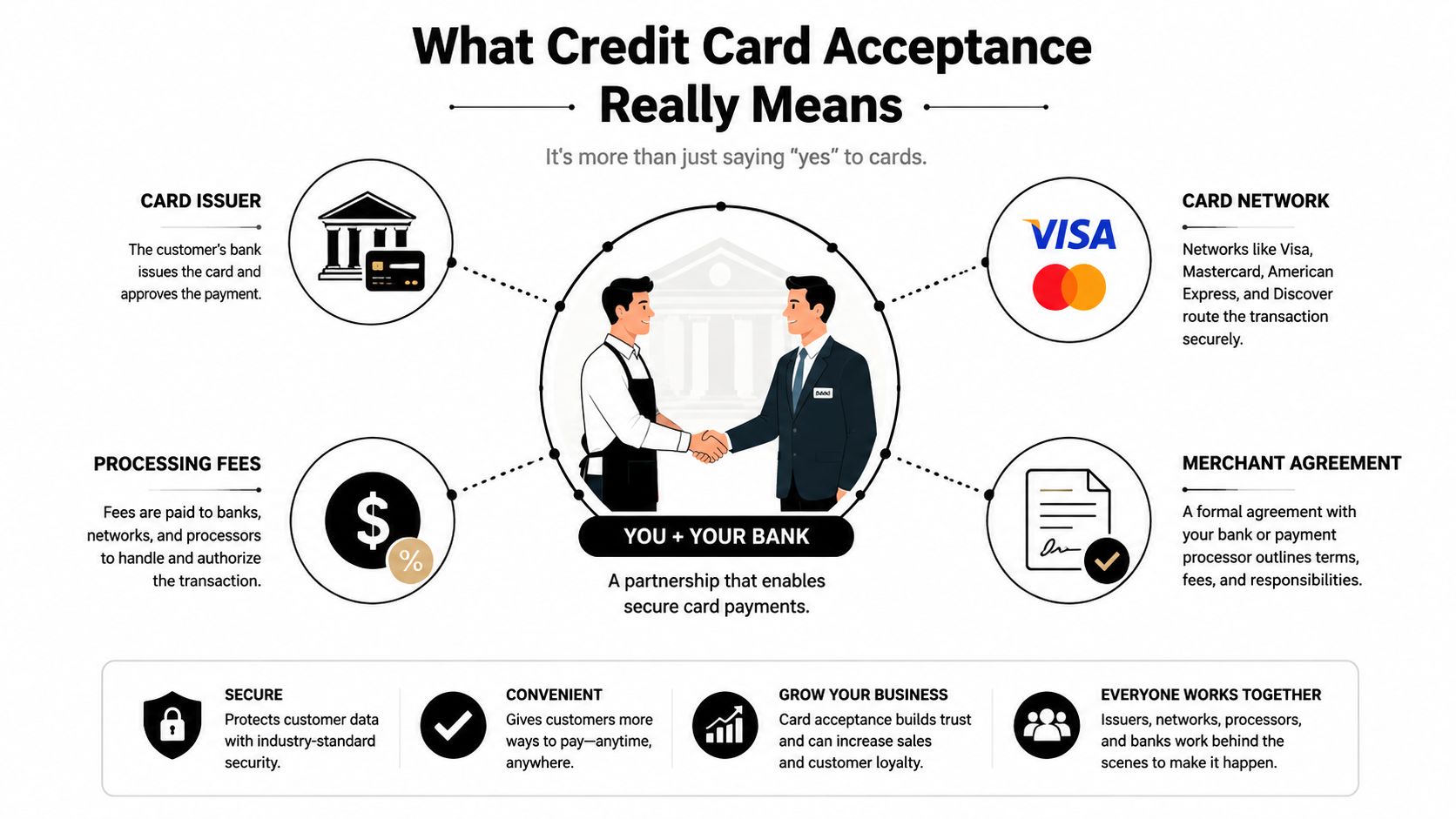
At its simplest, credit card acceptance is a merchant's agreement to take payment from a card issued by someone else. The merchant doesn't control the card, the bank, or the network rules, but it does agree to follow the system's requirements in exchange for getting paid.
The payment usually involves four parties. The cardholder is the traveler or corporate buyer. The issuing bank gave them the card. The card network routes the transaction. The acquiring bank or processor sits on the merchant side and moves the money into the business account.
Core idea: credit card acceptance means your business is set up to receive card payments through a network of banks and processors, not just to “swipe a card.”
That distinction matters because acceptance is not the same as approval or deposit. Authorization is the yes or no response that tells you whether the card can be charged. Settlement is the later movement of money into your account. A driver can successfully run a card and still leave you waiting for funds, or worse, give you a false sense that the transaction is finished when it's only authorized.
For transportation operators, that separation affects deposits, no-show rules, and corporate billing. A pre-ride deposit can authorize the card before dispatch, while the final capture may happen after the ride. If the back office doesn't understand that flow, a “successful” transaction can still turn into a reconciliation problem.
A useful way to think about it is this. Acceptance is the doorway, authorization is the guard at the door, and settlement is the package arriving later. If you run airport transfers, charter work, or event transport, you need all three to line up cleanly, especially when the same booking crosses phone, web, and vehicle touchpoints.
The Four Acceptance Channels Operators Actually Use
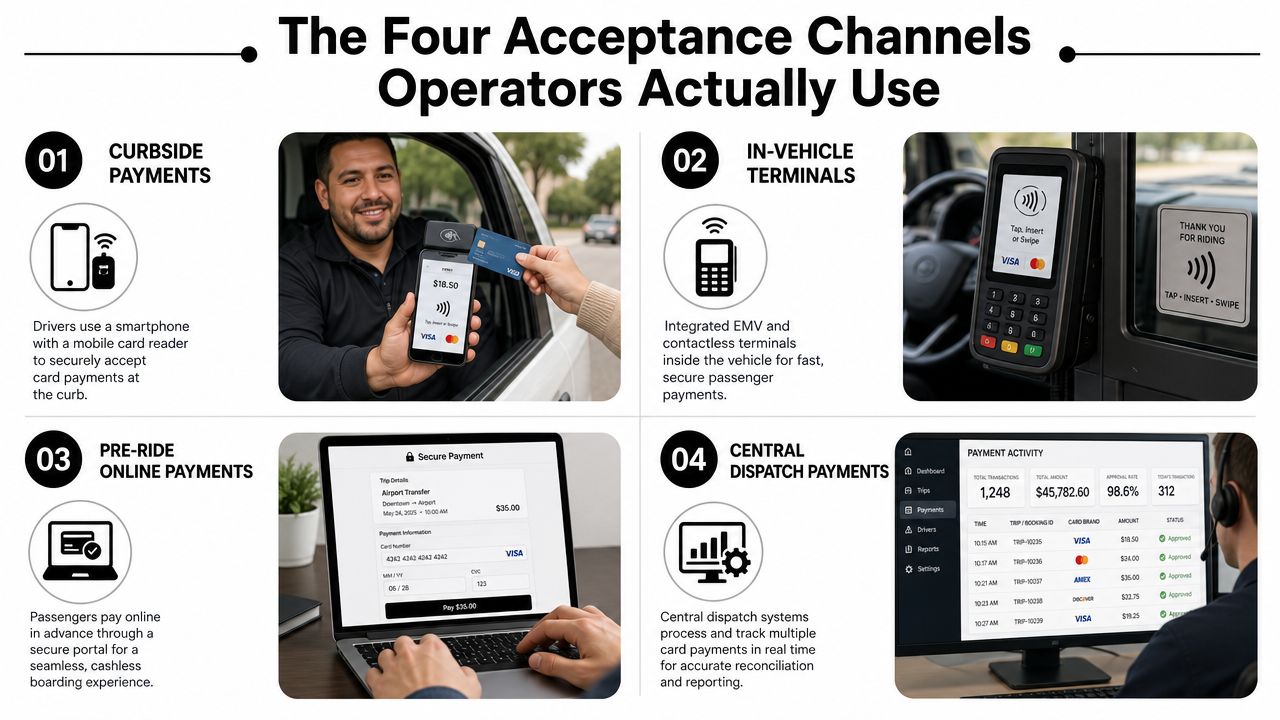
Transportation companies rarely rely on one payment path. They usually run several in parallel, because the customer journey changes depending on whether the card is present, the trip is prebooked, or the passenger is standing on a curb with luggage in hand.
In-vehicle terminals
An EMV or contactless terminal in the car works best when the passenger expects a quick handoff at the end of the ride. It fits hotel pickups, airport drop-offs, and any booking where the traveler wants to tap, insert, and leave without opening an app or waiting for an invoice.
Mobile readers for curbside collection
A mobile reader paired with a phone or tablet is useful when the payment has to happen outside the standard vehicle flow. Think meet-and-greet pickups, event transportation, or a backup option when a fixed terminal isn't available. It gives the dispatcher or driver a way to capture payment close to the customer without dragging the whole office into it.
Virtual terminals for phone and email bookings
A virtual terminal is the right tool when the card is not physically present. That fits corporate assistants calling in a bus reservation, a travel manager booking a shuttle, or a family paying over the phone for an airport transfer. The processor in the Stripe guide calls out virtual terminals and PCI DSS compliant manual entry as the right pattern for phone payments, because the business is handling card data outside a chip or tap environment (Stripe's overview of accepting credit card payments).
Online checkout in the reservation flow
Online payment is the cleanest option for deposits, wedding packages, and recurring event logistics because the customer pays while booking. It also keeps the reservation tied to the transaction record from the start, which makes reconciliation easier for back office teams and cleaner for disputes.
Rule of thumb: if the card is physically present, use a card-present flow. If it isn't, move the transaction into a controlled manual-entry or online path instead of improvising at dispatch.
Fees, Interchange, and Where the Money Goes
Operators often hear one percentage and assume that's the full cost. It usually isn't. The charge has layers, and once you can name them, you can ask better questions when a processor tries to bundle everything into one number.
Interchange is the issuer's share for bringing the cardholder into the transaction. The network assessment is the toll for using the card rails. The processor markup is the part billed by the company handling your payments. Manual-entry and card-not-present payments usually sit under more scrutiny, so they often cost more to process. For a practical overview of how those pieces fit together, Stripe's credit card acceptance resource is a useful starting point, and choosing a payment provider also helps frame the decision from the operator side.
For transportation companies, the mix of transactions matters. A card-present ride at the curb has a different cost profile from a phone-booked luxury SUV, and both can differ again from a corporate purchase card used for a shuttle contract. If your business serves travel managers or procurement teams, Level 2 and Level 3 data can help because it adds structured fields like tax, invoice numbers, ship-to details, product codes, quantity, freight, and duty. Checkout.com notes that these enriched data sets are commonly used in B2B and B2G flows and can improve approval handling or reduce interchange costs because issuers get more commercial context (Checkout.com on Level 2 and Level 3 data).
A simple sample cost stack for a $500 corporate ride can look like this.
| Component | Approx. Share | What It Pays For |
|---|---|---|
| Interchange | Largest part of the fee | Issuer compensation for the transaction |
| Network assessment | Smaller portion | Card network routing and rules |
| Processor markup | The part you negotiate | Gateway, support, reporting, and service |
Practical question: ask whether the quote changes by card-present, card-not-present, and corporate card type, because that tells you where the hidden spread lives.
Before you sign, ask three direct questions. What portion is interchange pass-through, what portion is markup, and what fee changes when a transaction moves from terminal, to phone, to online checkout? Those answers tell you more than a sales deck ever will.
PCI-DSS, EMV, and Tokenization Without the Jargon
Security is where many operators lose time later because they tried to make the setup look simpler than it really was. The cleanest way to understand PCI DSS is to treat it as a rule about who is allowed to touch raw card data and how long they're allowed to touch it.
The safest setup is to reduce your exposure first, not to add more paperwork later. Tokenization replaces the card number with a substitute value, and hosted payment fields keep the booking site from ever storing the primary account number in the first place. That doesn't remove your responsibilities, but it shrinks the amount of sensitive data your team and systems can touch.
For in-vehicle payments, EMV chip and contactless acceptance matters because the liability often shifts when a business could have taken a chip or tap and didn't. In plain terms, if your fleet can accept the more secure method and staff bypasses it, counterfeit fraud costs can land on your side instead of the issuer's side.
Best investment: move every possible card capture point into tokenized, PCI-scoped flows before you polish anything else.
That advice applies to booking forms, reservation portals, and manual phone entry. The processor or gateway may handle the sensitive data, but that doesn't erase your own PCI obligations. It does, however, dramatically reduce the audit surface your business has to manage.
Operators who want a technical implementation guide can look at resources on how to integrate payment gateway seamlessly, then map the recommendations back to their own reservation and dispatch setup. The goal isn't to become a security team. The goal is to make sure card data doesn't bounce around your operation longer than necessary.
Fraud Prevention for Bookings and Rides
A common headache looks like this. An airport transfer goes out, the ride is completed, and later the cardholder disputes the charge by saying the trip never happened. The car was there, the passenger was there, and the service was delivered, but the payment record may be too thin to win the dispute.
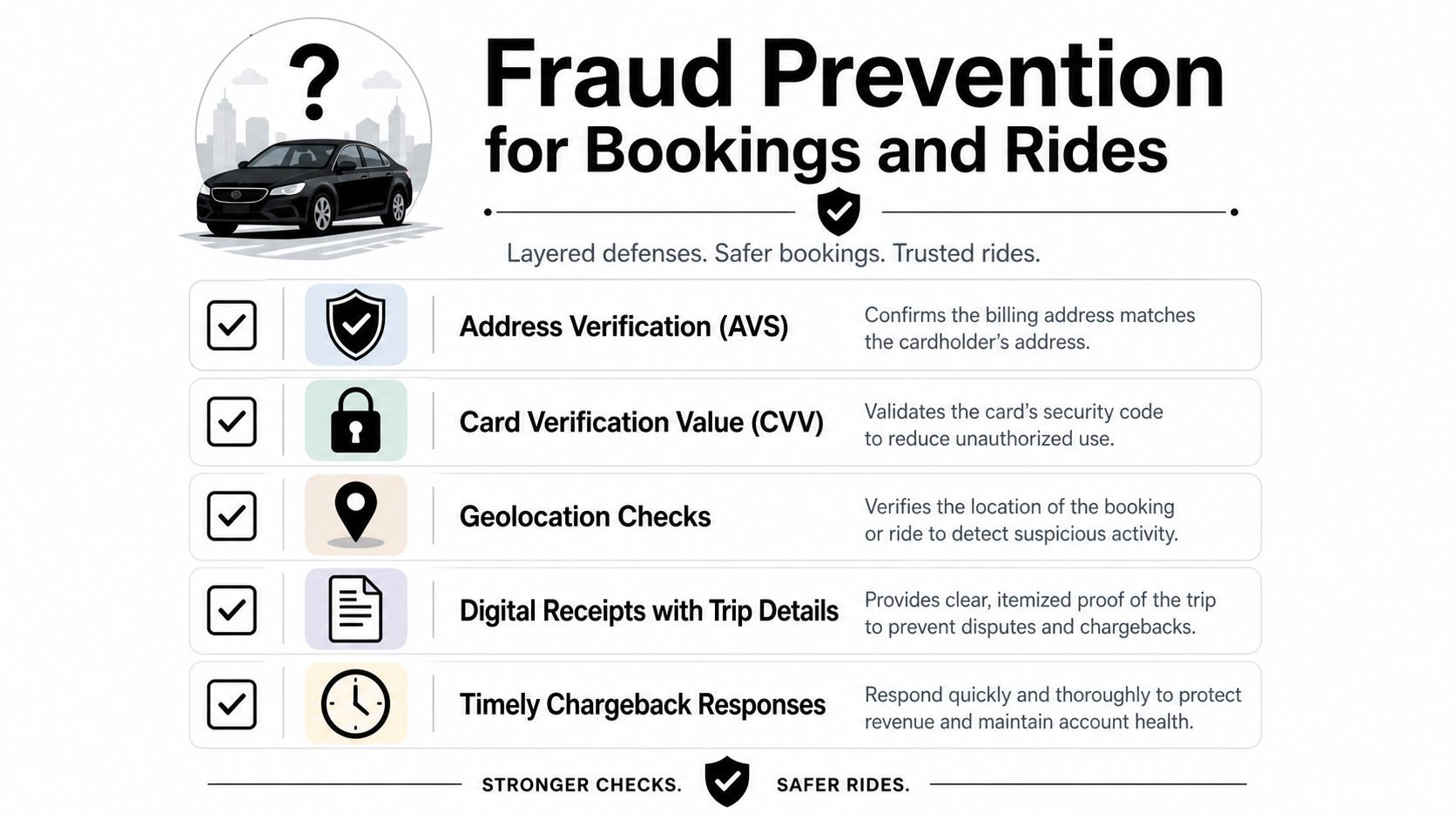
The fix is usually not one tool. It's a stack of small controls that match the channel where the risk starts.
Online booking safeguards
For web reservations, AVS and CVV checks help verify that the card details line up with the billing data the customer entered. 3-D Secure adds another layer for certain online transactions, which can help with authentication when the booking path is higher risk. These checks are especially useful when the customer books a ride late at night, from a device you've never seen before, or for a one-off event transfer.
Ride-specific controls
A pre-authorization hold works well for luxury vehicles, long-distance charters, or rentals that could accumulate additional charges during the trip. It gives the operator room to capture the final amount without starting from zero if the customer changes the itinerary, runs late, or adds stops.
Evidence that wins disputes
Digital receipts should include the trip details your dispatcher can defend. Keep booking time, pickup location, drop-off, and cancellation terms in the record. When a chargeback lands, the card network and processor want a timeline, not a story.
The YouTube resource below is useful as a visual refresher for staff who handle exceptions and disputes.
Operating rule: capture more transaction detail, not less. Richer records usually give you a stronger position when a passenger, assistant, or corporate cardholder challenges the charge.
Choosing a Processor That Fits a Moving Fleet
Pricing models look simple until you try to reconcile them across terminals, mobile readers, phone bookings, and online deposits. The main three are flat-rate subscription pricing, interchange-plus, and tiered bundles, and they do not behave the same once your fleet starts processing steady volume across multiple channels.
Interchange-plus is often the easiest model for established operators to audit because you can see the pass-through cost and the markup separately. That matters when you're handling airport transfers in the morning, corporate rides during the day, and event transportation at night. A vague bundle can hide the total cost of moving from card-present to card-not-present acceptance.
Red flag: if the processor won't explain what part of the fee is pass-through and what part is markup, you're buying opacity, not service.
For transportation-specific selection, I'd look at four things first. Level 2 and Level 3 support matters if you serve corporate and government accounts. Mobile terminal availability matters if your drivers need to take payments outside a fixed desk. Reservation and dispatch integration matters if you want one transaction record instead of scattered manual entries. And 24/7 support matters because your revenue doesn't stop at office hours.
That same lens is why some operators, including Max's Luxury Rides Inc., keep a broad acceptance footprint across airport transfers, corporate travel, weddings, and events while accepting all major credit cards and operating around the clock. The key operational lesson is not the brand name, it's the discipline of matching payment tools to how the fleet works.
A good processor for a moving fleet should make card capture predictable across shifts, easy to reconcile at the close of business, and flexible enough to handle both prebooked and on-the-spot payments. If it can't do that, it's not really supporting the operation, it's just sitting beside it.
A Practical Launch Checklist and an Inclusion Note
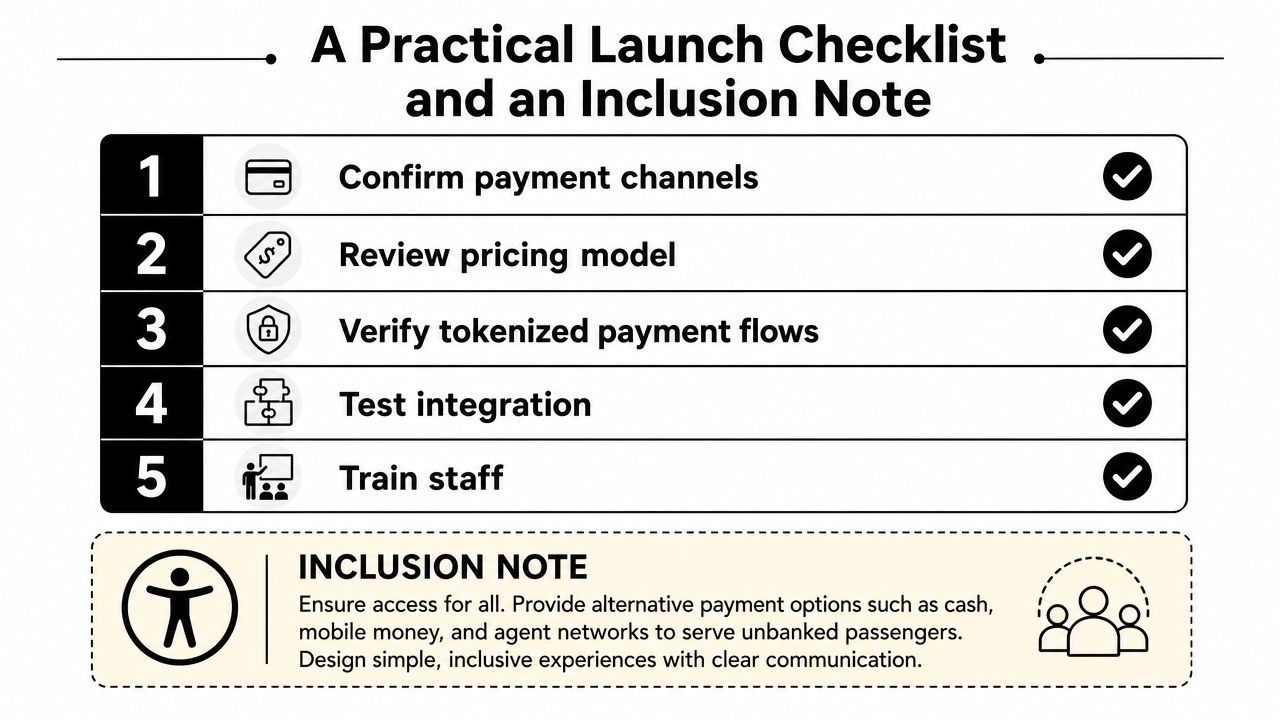
A clean rollout starts with a short checklist, not a long policy memo.
- Confirm payment channels. Make sure you know which rides are paid by terminal, mobile reader, virtual terminal, or online checkout.
- Review the pricing model. Separate pass-through fees from markup so the finance team can audit what's real.
- Verify tokenized payment flows. Keep raw card data out of systems that don't need to touch it.
- Test the integration. Run bookings, cancellations, deposits, and refunds in the same path your staff will use.
- Train staff. Drivers, dispatchers, and reservation agents should know which channel to use when the customer changes the script.
A final note matters just as much as the checklist. Accepting all major credit cards does not automatically mean every customer can use your payment process equally well. Accessibility shows up in card orientation, checkout clarity, and whether a passenger can complete payment without help or confusion.
Inclusive acceptance is not only a compliance question, it's a conversion question.
Transportation operators that serve corporate travelers, families, seniors, and group events need payment flows that stay usable when the trip gets complicated. As card acceptance keeps expanding into less obvious use cases, the operators who treat payments like infrastructure instead of a checkout afterthought will keep their booking experience smoother.
If your fleet needs card acceptance that works across airport transfers, corporate accounts, and special events, visit Max's Luxury Rides Inc. to see how its 24/7 transportation services and major card acceptance fit into a real-world booking flow.