
You're running a luxury fleet, the vehicle is spotless, the route is planned, and the client is already on the way to a meeting or the airport. Then a chauffeur glances down for a second, traffic compresses, and a hard brake turns a smooth ride into a jolt that everyone remembers. That's the primary risk with driver monitoring technology in high-end transport, not a dramatic crash scene, but a small lapse that damages comfort, confidence, and the brand you've spent years building.
That's why this technology matters now. The global driver monitoring system market is valued at USD 3.03 billion in 2024 and is projected to reach USD 8.10 billion by 2033, with a 11.7% CAGR from 2025 to 2033, driven in part by stringent regulatory mandates that are making DMS a core safety feature rather than a nice-to-have add-on (Grand View Research).
The Unseen Risk in Every Luxury Journey
The most expensive mistake in chauffeured service usually isn't the accident itself. It's the moment before it, the slight distraction, the late reaction, the uncomfortable brake that makes a polished ride feel careless. In luxury transportation, clients don't judge you only on arrival time, they judge you on composure, and one rough incident can undo the calm they paid for.
That's why driver monitoring technology belongs in a serious fleet strategy. It acts like a silent safeguard, watching for signs that a chauffeur's attention is fading before the situation becomes visible to the passenger or a liability report. The point isn't punishment, it's prevention, because a brand built on discretion can't afford preventable lapses.
Why this matters more in luxury service
Luxury clients expect the cabin to feel controlled, quiet, and predictable. A system that helps prevent distraction, fatigue, or missed cues protects that expectation and reduces the odds that a client will equate a single driving error with the entire company.
There's also a market signal you shouldn't ignore. What used to be a niche feature is now being pushed by regulation and buying pressure across the industry, which is exactly how safety tech becomes standard practice. If you run premium transport, waiting too long means you'll be treating a baseline expectation like a future upgrade.
Practical rule: if a technology can preserve ride quality, reinforce trust, and reduce avoidable risk at the same time, it's not an accessory, it's operating infrastructure.
The strongest reason to adopt it is simple. In a luxury fleet, the chauffeur isn't just operating a vehicle, they're representing a promise, and driver monitoring technology helps keep that promise intact when attention starts to drift.
What Is Driver Monitoring Technology
Driver monitoring technology is a digital co-pilot built for one job, tracking the driver's state of attention so the vehicle can respond before a small lapse turns into a safety event. It does not replace the chauffeur, and it should not try to. It adds an objective layer that does not get tired, distracted, or overconfident.
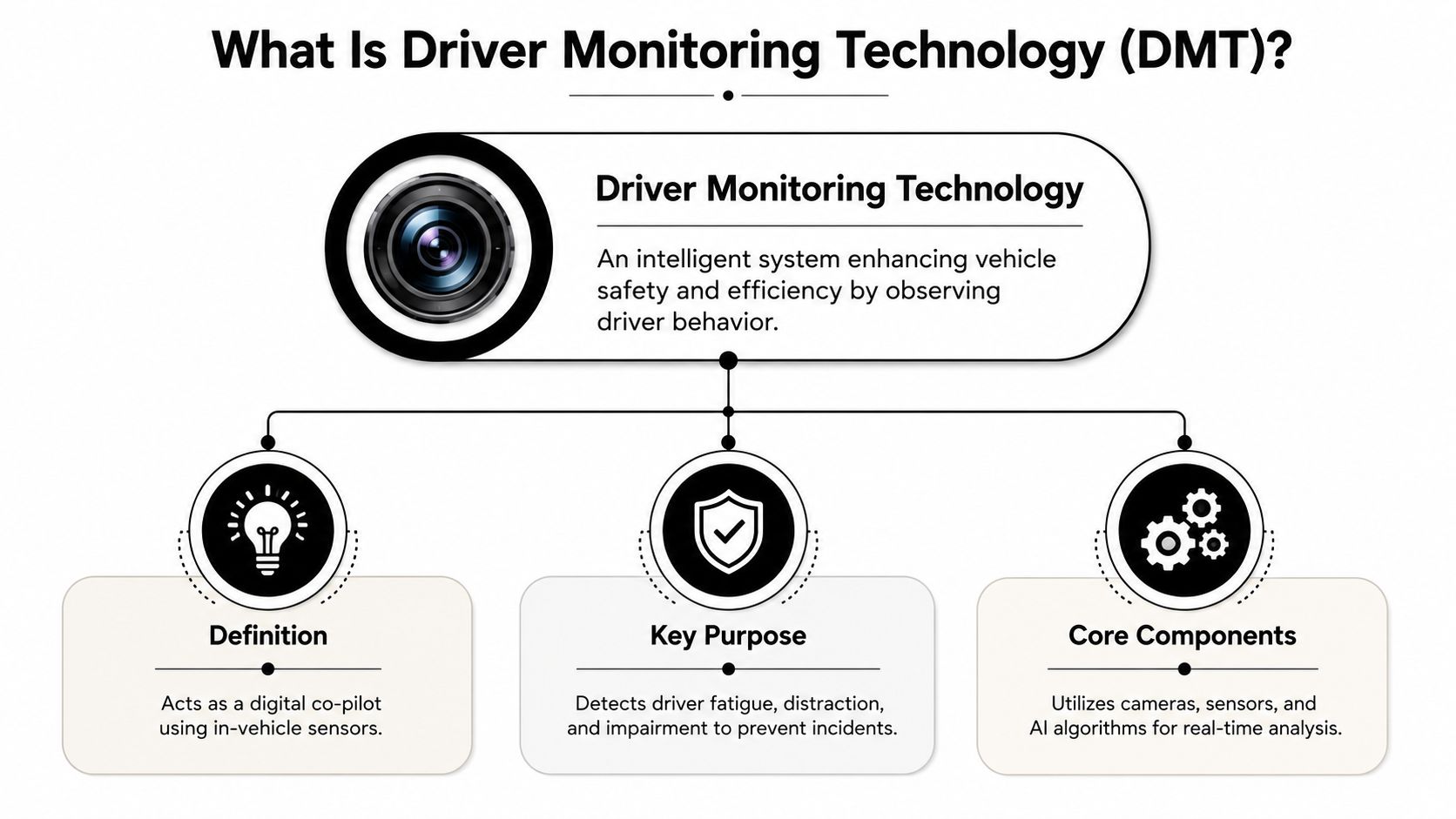
At a practical level, the system combines in-cabin sensors, a processing unit, and an alert interface. The sensors observe the driver, the software interprets patterns, and the alert layer delivers a warning or escalation when needed. For a fleet owner, that means a safety tool that reacts in real time instead of waiting for a dispatch review after the fact.
The core job of the system
The purpose is narrow and important, detect drowsiness, distraction, and other signs of reduced attention. In a luxury environment, that can mean watching for a prolonged off-road glance while a chauffeur completes an airport pickup, or a slow loss of alertness during a late-night transfer. The system is not there to judge driving style. It is there to catch risk early enough to matter.
Modern systems often use an in-cabin infrared camera plus an ECU or SoC running computer vision to estimate gaze, blink rate, head pose, yawning, and phone use in real time (LiveViewGPS). Transports Canada notes that direct camera-based monitoring can detect eye closure longer than a blink, head position, and prolonged off-road attention, then escalate from visual or audio warnings to haptic alerts such as seat vibration or a brake pulse if the driver does not respond.
What it is not
It is not a nanny system. It is not a black box that replaces judgment. It is a practical layer of visibility that gives you earlier warning and better documentation when a chauffeur needs support.
The best systems do not try to prove perfection. They try to catch dangerous drift early and correct it without making the cabin feel hostile.
That is the right frame for premium transport. You want a system that supports professional drivers, protects passengers, and helps the fleet stay consistently polished under pressure.
How the Technology Works in Practice
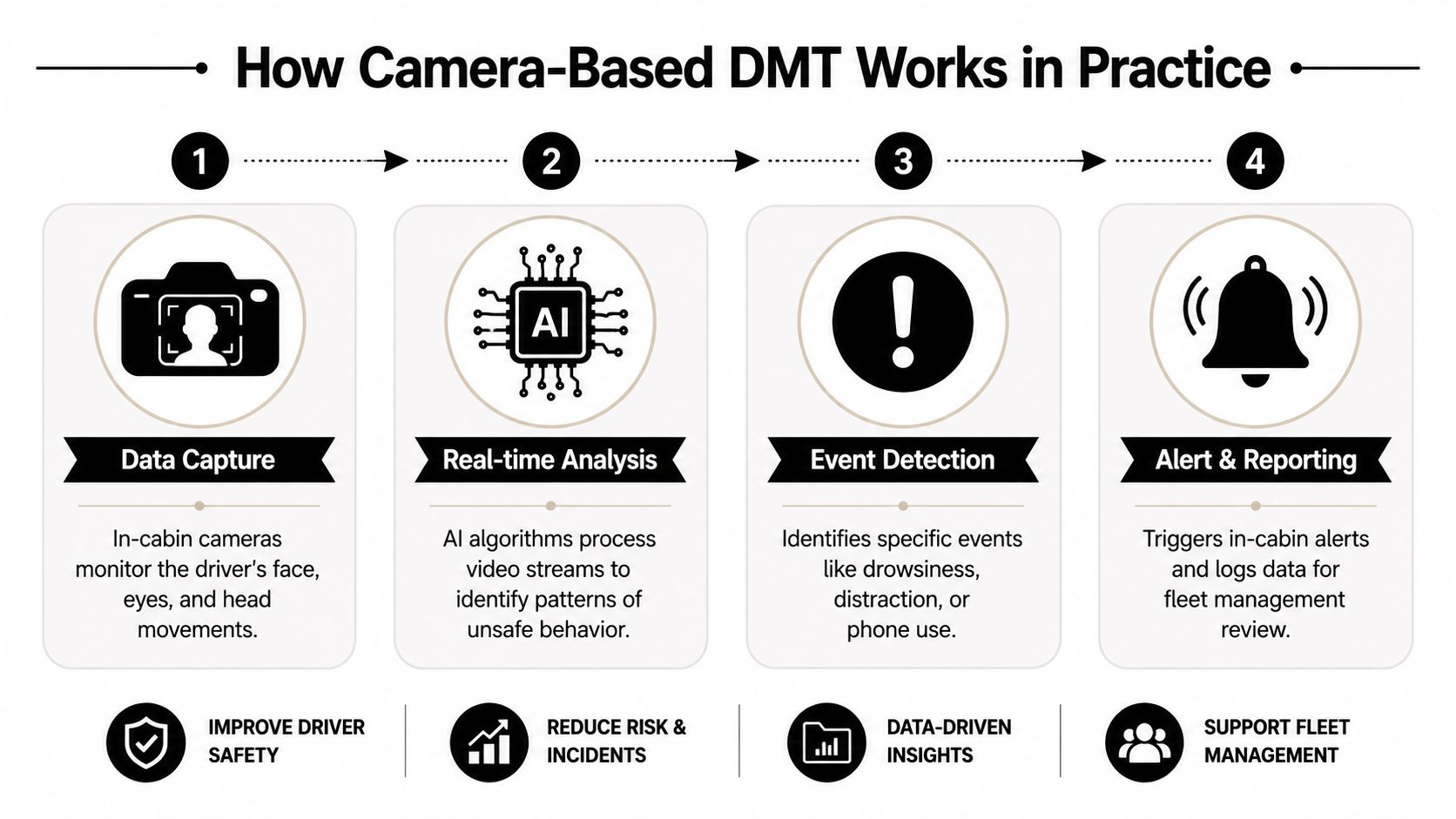
A good DMS starts with a small camera, usually mounted to watch the driver's face without getting in the way. In a luxury operation, that setup matters because the system should protect the passenger experience, not distract from it. The point is fast interpretation of what is happening in the cabin, not building a record of private trips for later review.
From image capture to decision
The camera captures live frames of the driver's face, then software looks for the signals that matter, eye position, blink patterns, head angle, and signs of phone use or distraction. A real-time DMS study used YOLOv7 on infrared images for face detection, then extracted facial landmarks for head-pose estimation with solvePnP and eye-closure detection (PMC). That pipeline shows the core job clearly. Take imperfect cabin images, identify risk fast, and turn that into an action before the ride goes off course.
The engineering challenge is easy to describe and hard to execute. The system needs high frame-rate sensing and low-latency inference so it can catch fatigue early enough for intervention, and it still has to work under occlusion, changing light, and the messiness of a live cabin. Direct camera-based monitoring is built for that environment, which is why it outperforms simple guesswork.
Why direct monitoring beats indirect signals
Indirect methods, like steering behavior or lane-keeping alone, are useful but incomplete. A direct camera-based system can identify specific behaviors, such as eye closure or a prolonged off-road glance, which gives the alert logic a much clearer trigger point (LiveViewGPS). In luxury service, that precision matters. You want the system to catch the right issue quickly, before a passenger notices a lapse in attention or composure.
The alert sequence should stay discreet. A soft chime, a visual cue, or a seat vibration is enough in many cases. If the driver does not respond, the escalation can become more assertive, but the first response should feel professional, not theatrical.
Operational truth: the goal is intervention, not embarrassment. If the alert startles the chauffeur or unsettles the passenger, the system is doing its job badly.
For fleet operators, that distinction matters. You are buying a tool that reduces risk in the moment and supports a higher standard of service, not a dashboard that creates noise for managers later.
Key Benefits for Luxury Chauffeured Fleets
The first benefit is brand protection. Luxury transport sells confidence, and confidence collapses fast when a passenger feels a driver is tired, distracted, or mentally elsewhere. Driver monitoring technology lowers the odds of those visible mistakes and helps keep the cabin experience smooth, which is exactly what clients remember.
Safety that clients can feel
In a chauffeured setting, safety isn't abstract. It shows up in the way the vehicle accelerates, brakes, merges, and handles long or late trips. A system that helps catch fatigue or distraction before the chauffeur makes a visible error protects the passenger's sense of calm, and that calm is part of the product.
Better coaching without guesswork
The second benefit is operational clarity. Instead of relying on anecdotes or one-off complaints, fleet leaders can use alerts and patterns to coach individual chauffeurs where attention slips most often. That creates targeted improvement, which is a better use of time than broad, generic retraining.
Stronger commercial discipline
There's also a broader business case. Regulatory compliance reduces exposure, and industry commentary ties advanced safety features to reduced insurance premiums, fewer accident-related costs, and stronger brand reputation in commercial vehicles (Visteon). For a luxury fleet, those aren't side benefits, they're part of the margin story.
A few practical wins matter most:
- Smoother rides: fewer sharp corrections, fewer passenger complaints.
- Cleaner handoffs: less chance of a distracted moment during airport pickups, hotel drop-offs, or event traffic.
- Better accountability: managers can coach from evidence, not memory.
- Reputation control: one preventable incident can do more damage than a year of polished service can offset.
A key advantage is consistency. Luxury clients don't just want a great ride once, they want the same standard every time, and driver monitoring technology helps you deliver that standard when the day gets long and the route gets messy.
Implementing DMS in Your Fleet
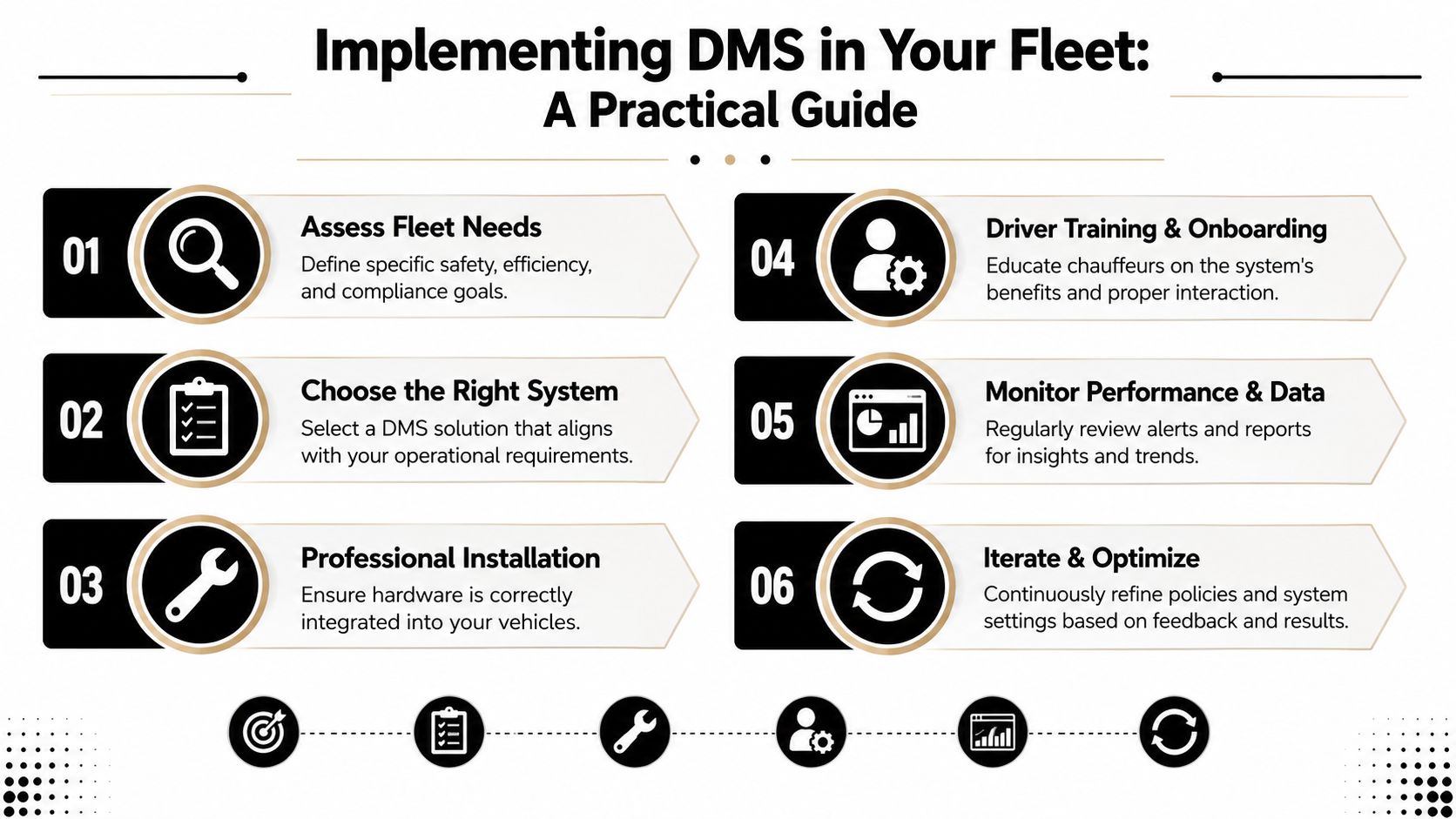
Start with the hardware decision. OEM-integrated systems are usually the cleaner option when you're ordering or spec'ing vehicles from the beginning, while aftermarket units make more sense when you need to upgrade an existing fleet quickly. Don't pick based on price alone, pick based on fit, integration quality, and how visible you want the system to be in the cabin.
Match the system to the job
A luxury chauffeur vehicle needs a different implementation than a delivery van. You want a camera placement that doesn't distract the passenger, alert settings that respect the premium cabin, and a reporting layer that doesn't overload dispatch with noise.
Integrate it with the systems you already use
The best installations connect with telematics or fleet dashboards so you can see alerts alongside trip history, idle time, and route data. That way, you're not asking managers to jump between disconnected tools just to understand one event.
Train chauffeurs like professionals
Ensure drivers understand the system exists to support them, protect passengers, and document good conduct when a complaint is unfair or incomplete. If you frame it as surveillance, you'll get resistance, if you frame it as professional backup, you'll get better adoption.
Keep the system healthy
Sensors get dirty, alignment shifts, firmware ages, and false alerts creep in when maintenance gets ignored. Set a routine for checks, calibration, and software updates, because a DMS that drifts out of spec can lose trust quickly.
The implementation process should be boring in the best way. Choose the right hardware, wire it cleanly, train the team, monitor the output, and refine the settings until alerts feel helpful instead of intrusive.
Analyzing Cost Versus Return on Investment
The upfront cost of DMS usually breaks into hardware, installation, and ongoing software or service fees. That's the easy part of the math. The harder part is recognizing that a luxury fleet loses money in quieter ways, through damaged client trust, avoidable incident costs, and time spent managing preventable problems.
The regulatory environment has already changed the economic argument. The EU General Safety Regulation 2019/2144 mandated driver drowsiness and attention warning systems for new vehicles from July 2022, and extended the rule to all new registrations from July 2024 (GMI Insights). That matters because regulation tends to raise the standard of care, and insurers often follow that standard with a sharper view of risk.
What return really looks like
In luxury transport, return on investment isn't just fewer incidents. It's fewer passenger complaints, fewer rough rides, better retention of premium clients, and a stronger story when you compete for corporate accounts. If the system helps a chauffeur stay focused during complex urban driving or long overnight transfers, it protects both the trip and the relationship.
There's also a practical operations angle. If alerts help managers spot repeated distraction patterns, they can coach before a small issue becomes a recurring cost. That's a more intelligent use of fleet oversight than waiting for a repair bill or a client escalation.
How to think about the investment
Use a simple internal test.
- Does it reduce avoidable risk?
- Does it support better driving behavior?
- Does it strengthen the brand promise of calm, premium service?
- Does it give you documentation when safety is disputed?
If the answer is yes across those four questions, the spend isn't just defensible, it's strategic.
For a luxury operator, the ROI is partly financial and partly reputational. In this category, reputation is revenue, and driver monitoring technology protects both.
Navigating Privacy and Building Trust
Privacy is the issue that decides whether DMS feels responsible or invasive. The wrong rollout makes chauffeurs defensive and clients uneasy, while the right rollout makes the system feel like a safety tool that respects everyone in the vehicle. That's why you need a clear policy before you need a dashboard.
Recent technical literature emphasizes that adoption depends on public acceptance and data governance, including who controls the data, where it goes, and what secondary uses are permitted, especially when insurers or other third parties could misuse it (PMC). That warning should shape your policy from day one.
Set the rules before the hardware goes live
Keep the policy simple and specific. State whether the system stores video, what is retained, who can review alerts, and whether any data leaves the vehicle. Chauffeurs should know whether the system is used for coaching, incident review, or both, and clients should know that the goal is safer transport, not hidden surveillance.
Use privacy as a trust signal
A system that processes attention data locally and limits access is easier to defend than one that creates unnecessary exposure. Buyers and passengers are more comfortable when you can explain the boundary clearly, especially in a premium environment where discretion is part of the service.
If you want a broader legal perspective on biometric and facial analysis issues, By Design Law's facial recognition legal insights from By Design Law Firm & Legal Consultancy, PLLC are worth reviewing alongside your internal policy.
Communicate the purpose plainly
Don't oversell the tech. Say what it does, say what it doesn't do, and say how it protects both staff and passengers. When chauffeurs understand that the system can exonerate them after a disputed complaint, trust rises quickly.
The best privacy posture is disciplined and transparent. If you can answer where the data goes, who sees it, and how long it stays, you've already solved the biggest objection to adoption.
A CTA for Max's Luxury Rides Inc.. If you're ready to make client safety, brand trust, and chauffeur accountability part of the same operating standard, evaluate driver monitoring technology now and build it into your fleet policy before the next preventable incident does the deciding for you.