
When it comes to executing a successful event, your single most critical tool isn't the flashy tech or the A-list speaker. It's your event budget planning template. Think of it as your financial roadmap, guiding you from the initial brainstorm all the way through to the post-event debrief. It turns a chaotic mess of numbers into a clear, actionable plan that keeps you from overspending and helps you get the most out of every dollar.
Why a Solid Budget Is Your Event's Foundation
Let's be real—event planning is a high-stakes game. One wrong financial move can have a ripple effect that impacts everything. A well-built budget isn't just a spreadsheet; it's your command center. It’s the foundation that supports every decision you make, whether you're planning a small corporate retreat or a massive, multi-million dollar conference.
Instead of seeing it as a restriction, start looking at your budget as a source of empowerment. It brings clarity to your planning, helps you put resources where they matter most, and protects you from the common financial traps that can derail even the most brilliant event concepts. With a solid budget in hand, you can move forward with confidence, knowing your event is on solid financial ground.
Navigating a High-Stakes Industry
The pressure on event planners is definitely not letting up. The global events industry was valued at a staggering $1.1 trillion back in 2019 and is expected to nearly double by 2032. That kind of growth means the need for airtight financial planning is more intense than ever.
Consider this: event costs are projected to climb by 12%, while budgets might only see an 11% bump. When you learn that nearly 29.6% of organizers are managing budgets between $1 and $2 million, you realize there's practically no room for error. You can dig into more of these fascinating event marketing statistics on Bizzabo.com.
That tight margin means every single dollar has a job to do. A detailed budget empowers you to:
- Make Smarter Decisions: Should you splurge on that big-name keynote speaker or invest in an upgraded catering package? Your budget gives you the data to decide, not just guess.
- Justify Every Penny: When stakeholders ask where the money is going, you can show them a clear breakdown, demonstrating why each expense is crucial for hitting your event goals.
- Track Performance as You Go: A good budget helps you spot potential overspending early on, giving you time to make adjustments before a small issue becomes a major crisis.
A budget isn't just a financial document; it's the strategic narrative of your event. It tells the story of what you truly value, from the attendee experience to stakeholder ROI.
At the end of the day, mastering your event budget planning template is what separates the pros from the amateurs. It’s what keeps you in control, prepares you for the unexpected, and positions you to deliver incredible results, time and time again. It’s the bedrock on which every great event is built.
Building Your Budget Template From the Ground Up
Alright, let's get practical. Moving from theory to a working budget is where the magic really happens for an event planner. Creating your own event budget planning template isn't just about listing expenses; it's about crafting a dynamic financial tool that’s perfectly suited to your event, whether it's a corporate conference, a nonprofit gala, or a client's dream wedding.
The goal here is a living document that gives you complete control and foresight, not a static spreadsheet you set and forget.
First things first, you have to understand the two fundamental types of costs you'll be dealing with. Fixed costs are the non-negotiables—the expenses that stay the same whether 50 or 500 people show up. This is your venue rental fee, the flat rate for your keynote speaker, or the annual subscription for your event management software. These are the financial bedrock of your event.
Then you have your variable costs, which are a moving target. These costs ebb and flow directly with your attendee count. Catering is the classic example, as it’s almost always priced per head. Other items like printed name badges, welcome kits, or even table centerpieces fall into this category. Getting a handle on both is absolutely critical for accurately forecasting your financial position at different attendance levels.
This image lays out the core components that make up a really solid event budget.
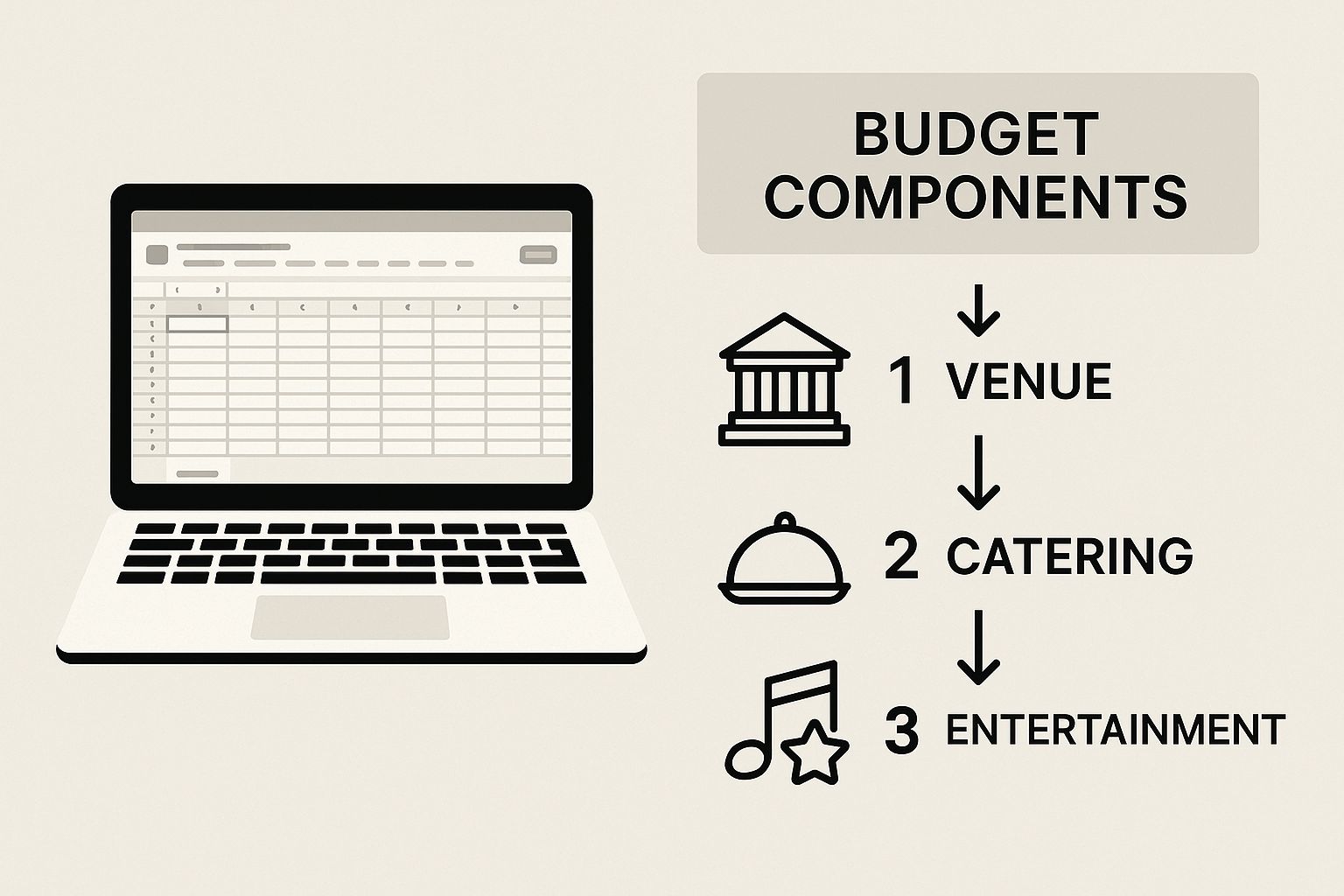
Thinking about your budget this way helps you see it as an interconnected system, not just a daunting list of numbers. Each piece influences the others.
Structuring Your Spreadsheet for Maximum Clarity
To make your template genuinely useful, it needs more than just two columns for items and costs. A powerful budget spreadsheet should be structured to give you deep insights with a quick glance. I’ve found a few columns to be absolutely essential over the years.
Here’s what you need to include:
- Line Item: Get specific. Don't just write "Venue." Write "Main Ballroom Rental" or "AV Package – Breakout Room A."
- Estimated Cost: This is your initial, well-researched projection for that item.
- Actual Cost: The final, real-world number you paid after all the invoices are in.
- Variance: The difference between your estimated and actual costs. This is where the real learning happens, showing you exactly where you saved or overspent.
- Notes: This is your brain dump. Use it for vendor contact info, payment deadlines, or why a specific cost was way off. Trust me, your future self will thank you for this.
The "Variance" column is your best teacher. It's not about being right or wrong with your initial guess; it's about getting smarter for the next event. A big positive variance means you scored a great deal, while a negative one highlights an area you need to budget more for next time.
Grouping Expenses Into Logical Categories
A long, disorganized list of expenses is a recipe for overwhelm. The final—and most important—step in building your template is to group related line items into logical categories. This gives you a bird's-eye view of where your money is going and helps you spot which areas are eating up the biggest slice of the pie.
Categorizing expenses turns a simple tracker into a strategic dashboard. Here's a breakdown of some core categories every event planner should start with in their budget template.
Core Expense Categories for Your Event Budget
| Category | Example Line Items | Budgeting Tip |
|---|---|---|
| Venue & Logistics | Venue Rental, Insurance, Security, Permits, A/V Equipment, Wi-Fi Access | A/V is often a hidden cost. Get a detailed quote from the venue's in-house provider and a third-party vendor to compare. |
| Food & Beverage | Catering (per head), Bar Service, Staff Gratuity, Coffee Breaks, Linens | Always budget for a 5% buffer on F&B. Final guest counts can shift, and you don't want to be caught short. |
| Marketing & Promotion | Social Media Ads, Graphic Design, Website Hosting, PR Agency Fees, Email Marketing Software | Track your marketing spend against ticket sales or registrations to see which channels are delivering the best ROI. |
| Speakers & Entertainment | Keynote Speaker Fees, Performer Contracts, Travel & Accommodation, Emcee/Host | Remember to include travel, lodging, and a per diem for any talent you're flying in. These costs add up fast. |
| Staffing & Admin | Event Staff Wages, Volunteer Expenses (food, t-shirts), Project Management Software | Even if you're using volunteers, they aren't "free." Account for the cost of managing, training, and appreciating them. |
| Miscellaneous | Contingency Fund (10-15%), Signage, Office Supplies, Badges, Swag Bags | Your contingency fund is non-negotiable. It's your safety net for unexpected costs, and you will always have them. |
By organizing your event budget planning template with these categories, you move beyond just tracking what you've spent. You create a powerful tool that brings clarity, helps you make smarter decisions on the fly, and sets the stage for a financially successful event.
Uncovering the Hidden Costs That Catch Planners Off Guard
A solid event budget planning template is a great start, but it's the expenses you don't see coming that can really derail your finances. I’ve seen it happen time and again—even seasoned pros get blindsided by costs that weren't obvious at first glance. These "hidden" fees are often tucked away in the fine print of a vendor contract or stem from small logistical details that add up fast.
It’s easy to budget for the big stuff like the venue and the food. The real trick is learning to anticipate the expenses that tend to hide in plain sight. For example, that gorgeous hotel ballroom might look like a great deal until you realize it comes with mandatory fees for their in-house security, union labor for setup, and a hefty post-event deep cleaning charge. Overlooking just those three items can easily blow a hole in your budget.
Thinking Beyond the Venue Walls
The pressure to pull off a perfect event, especially in the corporate space, is intense. It's no surprise that 47% of planners point to event costs as their biggest headache. With 95% of event teams needing to prove a clear ROI, there's simply no room for budget overruns. This gets even trickier when you're managing logistics in unfamiliar places—a common scenario since 52% of corporate events are held in hotels and 36% in non-traditional venues. You can dive deeper into these challenges with the latest event industry statistics from Bizplanr.ai.
To truly protect your budget, you have to start thinking like a forensic accountant, digging into every potential line item.
- Insurance Riders: Your general liability policy probably doesn't cover everything. Serving alcohol? Planning a unique activity like a climbing wall? You'll likely need to purchase a special insurance rider, and they aren't cheap.
- Permits and Licenses: If your event is in a public park, requires a street closure, or even involves playing copyrighted music, you'll need permits. These come with application fees and, more importantly, can take weeks to get approved.
- Taxes and Gratuities: Never assume the price you're quoted is the final number. Catering and staffing contracts almost always include automatic gratuities (often 18-25%) and local taxes on top of their base rate.
Pro Tip: Always ask vendors for an "all-in" or "out-the-door" quote. Make it clear you want to see every single fee, tax, and service charge included. This one question has saved me from major budget headaches more times than I can count.
The Sneaky Tech and Marketing Spend
Technology is another minefield for unexpected costs. The venue’s "free Wi-Fi"? It's rarely strong enough to handle hundreds of people streaming at once, which can force you into a last-minute—and very expensive—upgrade. That standard A/V package might cover the basics, but what happens when your keynote speaker runs late? You’ll be paying the technician for overtime. It’s these small details that make the difference between a controlled budget and a chaotic scramble.
Your marketing budget needs the same level of scrutiny. It's never just about running a few ads. Think about these often-overlooked expenses:
- Content Creator Fees: Are you paying influencers or industry voices to help promote the event?
- Software Subscriptions: Don't forget the monthly costs for your email platform, social media scheduler, or the event registration app you’re using.
- Graphic Design Assets: Unless you’re a designer yourself, you'll need to pay someone to create social media graphics, email banners, and other digital creative.
Getting ahead of these hidden costs is what turns a budget from a rough guess into a reliable financial plan. It’s all about asking the right questions upfront and building in a buffer, so your final numbers stay right where you planned them.
Smart Strategies for Budget Management and Savings
Having a solid event budget planning template is a fantastic start, but it's the active, intelligent management of that budget that ultimately determines your event's financial success. In the current climate, just tracking what you spend isn't going to cut it. You have to be a savvy financial steward, constantly on the lookout for ways to save money without compromising the attendee experience.
This is all about shifting from a reactive mindset to a proactive one. Instead of just paying bills as they come in, you're negotiating smarter deals, choosing locations with a strategic eye, and using every tool available to make each dollar go further.
Let's be real—planners are facing a tough financial landscape right now. Budgets for 2025 are projected to go up by about 11%, but the actual costs of running an event are expected to climb by 12% or more. To handle this squeeze, 23% of planners say they'd cut optional offsite activities first, while 20% would shorten lodging stays if their budget got trimmed. This really underscores the need for creative savings, like looking at second-tier cities for your venue. You can dive deeper into these event planning trends for 2025 from Encore Global.
Master the Art of Vendor Negotiation
Think of your vendors as partners, but remember that everything is negotiable. Never accept the first quote you get. I always make it a rule to come to the table with at least two other competitive bids—it instantly gives you a stronger position.
But negotiation isn't just about hammering down the price. Look for value-adds. For example, you could ask a venue to throw in their standard A/V package for free or see if a caterer is willing to upgrade the dessert selection at no extra cost. Building strong, long-term relationships with a core group of vendors can also lead to some serious loyalty discounts down the road.
A contingency fund isn't a slush fund for cool new ideas; it's a critical safety net. I always set aside 10-15% of the total budget for genuine, unforeseen emergencies—think a last-minute equipment failure or a sudden spike in gas prices that hits your transportation costs.
Use Technology as a Cost-Saving Ally
Modern event tech is so much more than a way to engage attendees; it’s a powerful tool for keeping your finances in check.
- Event Management Software: Using a centralized platform for registration, budgeting, and attendee tracking is a game-changer. It eliminates costly data entry mistakes and gives you a real-time dashboard of your spending.
- Virtual and Hybrid Elements: Adding a virtual component is a brilliant way to cut down on your physical footprint. This translates directly to lower costs for venue space, catering, and on-site staff, all while opening up your event to a much larger audience.
- Local Partnerships: Don't forget about free resources! Get in touch with the local Convention and Visitors Bureau (CVB). They can often offer complimentary marketing help, welcome materials, or connect you with local suppliers who might have better rates.
By putting these strategies into play, you turn your budget template from a static document into a dynamic playbook for financial victory.
Once the last guest has departed and the cleanup is done, the most crucial part of your job begins. This is the moment that separates the pros from the amateurs: the post-event analysis. It’s where you dig into the numbers from your event budget planning template and pull out the kind of insights that will make your next event a runaway success.
Your first order of business is a detailed budget reconciliation. You need to sit down and compare every single estimated cost with the final, actual invoice. This isn't about patting yourself on the back or beating yourself up over variances; it's about uncovering the 'why' behind the numbers. Where did you find savings? More importantly, where did you overspend, and what story does that tell?
From Variance to Value
That variance column in your budget sheet is pure gold. For example, let's say you came in $2,000 under budget on catering. That sounds great on the surface, but you need to know why. Did your vendor give you an unexpected discount, or did fewer people show up than you planned for? One is a win you can try to replicate; the other is a sign of a potential marketing or attendance issue.
This is where the "notes" section of your template becomes your best friend. Document every detail. Seriously, write it all down. This practice builds a rich historical record that transforms future budget forecasting from guesswork into a science.
The real goal of post-event analysis isn't just to close the books. It's to mine your financial data for strategic intelligence that gives you a competitive edge for future events.
By treating every financial outcome as a lesson—good or bad—you build the foundation for proving the true value of your work.
Calculating Your Event's ROI
Ultimately, you need to show your stakeholders that the event was a success, and the best way to do that is by speaking their language: Return on Investment (ROI). The formula itself is straightforward, but you have to adapt it to fit the specific goals of your event.
For an event designed to generate sales leads, the math would look something like this:
- Find the Total Value of Leads: Take the number of qualified leads and multiply it by your company's average value per lead. For instance, 50 leads x $500/lead = $25,000.
- Calculate Net Profit: Subtract your total event cost from the total lead value. So, $25,000 – $15,000 cost = $10,000.
- Determine the ROI: Divide that net profit by the event cost, then multiply by 100 to get a percentage. In this case, ($10,000 / $15,000) x 100 = 66.7% ROI.
If you were running a fundraiser, the logic is similar, but you’d use the total funds raised as your "gain." This final number is more than just a metric; it's the definitive proof of your event's impact and your prowess as a strategic financial planner.
Common Event Budgeting Questions
Even with the best event budget planning template in your hands, you're going to have questions. It’s just the nature of the beast. Being able to confidently navigate those tricky financial spots is what separates a smooth planning process from a stressful one.
Let's walk through some of the most common questions I hear from planners, whether they're just starting out or have been in the game for years.

Think of this as your go-to cheat sheet for those "what do I do now?" moments. The goal here is to give you clear, actionable advice you can put to use right away.
How Much Should I Set Aside for a Contingency Fund?
The industry standard is to allocate 10-15% of your total budget to a contingency fund. I can't stress this enough—this isn't just padding; it's your financial lifeline.
If you're dealing with a lot of unknowns, like a first-time conference or an outdoor festival where the weather is a huge factor, pushing that closer to 20% is a smart, conservative move.
This fund is strictly for genuine, unforeseen problems. Think of a last-minute generator failure or a sudden spike in fuel surcharges for transportation. It’s not for accommodating cool new ideas that pop up midway through planning. Be disciplined and document every single time you tap into it. That data is gold for your next event.
How Can I Estimate Costs for a Brand New Event?
Budgeting for a first-time event is all about diligent research, not guesswork. You have to do your homework. Start by looking for benchmarks from similar events in your area or industry. This will give you a realistic ballpark for your major line items.
Next, get on the phone or send out detailed RFPs (Requests for Proposal) to at least three different vendors for each big-ticket category—venue, catering, A/V, you name it. The more specific your request, the more accurate the quote you'll get back.
Don't be shy about asking for advice. Tap into your professional network or jump into industry forums. I’ve always found it’s far better to overestimate your costs slightly and come in under budget than to face a stressful shortfall later.
Every dollar you track for this first event becomes an invaluable blueprint for the next one. Meticulous record-keeping now will pay off massively down the road.
What Is the Best Software for Managing My Event Budget?
Honestly, the "best" software really depends on the scale and complexity of your event. For a surprising number of events, a well-structured spreadsheet in Google Sheets or Microsoft Excel is perfectly sufficient. They're free (or already paid for), incredibly flexible, and easy to share with your team.
However, once you get into large, multi-day conferences or massive trade shows, dedicated event management platforms become a lifesaver. Tools like Cvent, Bizzabo, or Aventri are built for this. They integrate budgeting directly with things like registration, marketing, and attendee analytics. This gives you a central dashboard to track revenue against expenses in real-time—a level of insight a simple spreadsheet just can't provide.
Planning transportation for your next big event? Let Max's Luxury Rides Inc. provide a seamless and professional experience for your speakers, VIPs, and attendees. From airport transfers to executive black car service, we ensure everyone arrives in comfort and style, reflecting the quality of your event.
Discover our reliable transportation solutions at https://www.maxsluxuryrides.com.