
You're coordinating an airport pickup schedule when a driver calls to report heavy traffic, a nearly empty fuel gauge, and an arrival delay that could affect the next transfer. The van has enough passenger space, but its fuel consumption, idling time, and route demands are making every booking harder to predict. For airport and event fleets, choosing a fuel efficient van isn't only about finding the highest MPG figure. It's about matching vehicle size, drivetrain, passenger capacity, luggage space, route profile, and daily operating discipline.
Why Fuel Efficiency Matters for Van Fleets
A fleet manager may see fuel efficiency as a line item, but passengers experience its consequences through service reliability. A van that spends too much time refueling, idling in airport queues, or returning to a depot between event runs creates scheduling pressure. One delayed vehicle can affect a chauffeur, a group transfer, and the next reservation.
Airport operations make this especially visible. Drivers often move between terminals, hotels, parking areas, and fixed-base operators while carrying passengers and luggage. Event transport adds different demands, including concentrated departure times, repeated short trips, waiting outside venues, and heavier passenger loads. A vehicle that performs well on an open road may be less economical when it spends much of the day in stop-and-go traffic with climate control operating.
Operational principle: Fuel economy only creates value when the van can complete the assigned work without compromising passenger capacity or schedule reliability.
The right choice can reduce unnecessary fuel stops and make route costs easier to forecast. It can also help managers decide whether a smaller hybrid, a full-size diesel, or an electrified van fits the service pattern. Efficiency supports competitiveness, but it shouldn't override the practical requirements of luggage volume, accessibility, comfort, or group size.
The U.S. Environmental Protection Agency's Automotive Trends Report places average van fuel economy at 26.1 mpg for model year 2024, part of a broader improvement across vehicle classes (EPA Automotive Trends Report). That segment-wide figure is useful context, but a fleet still needs route-specific testing before treating it as a planning assumption.
Understanding Fuel Efficient Van Concepts
A van's advertised efficiency is a starting point, not a complete operating forecast. Managers should separate the rating into the conditions it represents, then compare those conditions with actual airport and event routes.
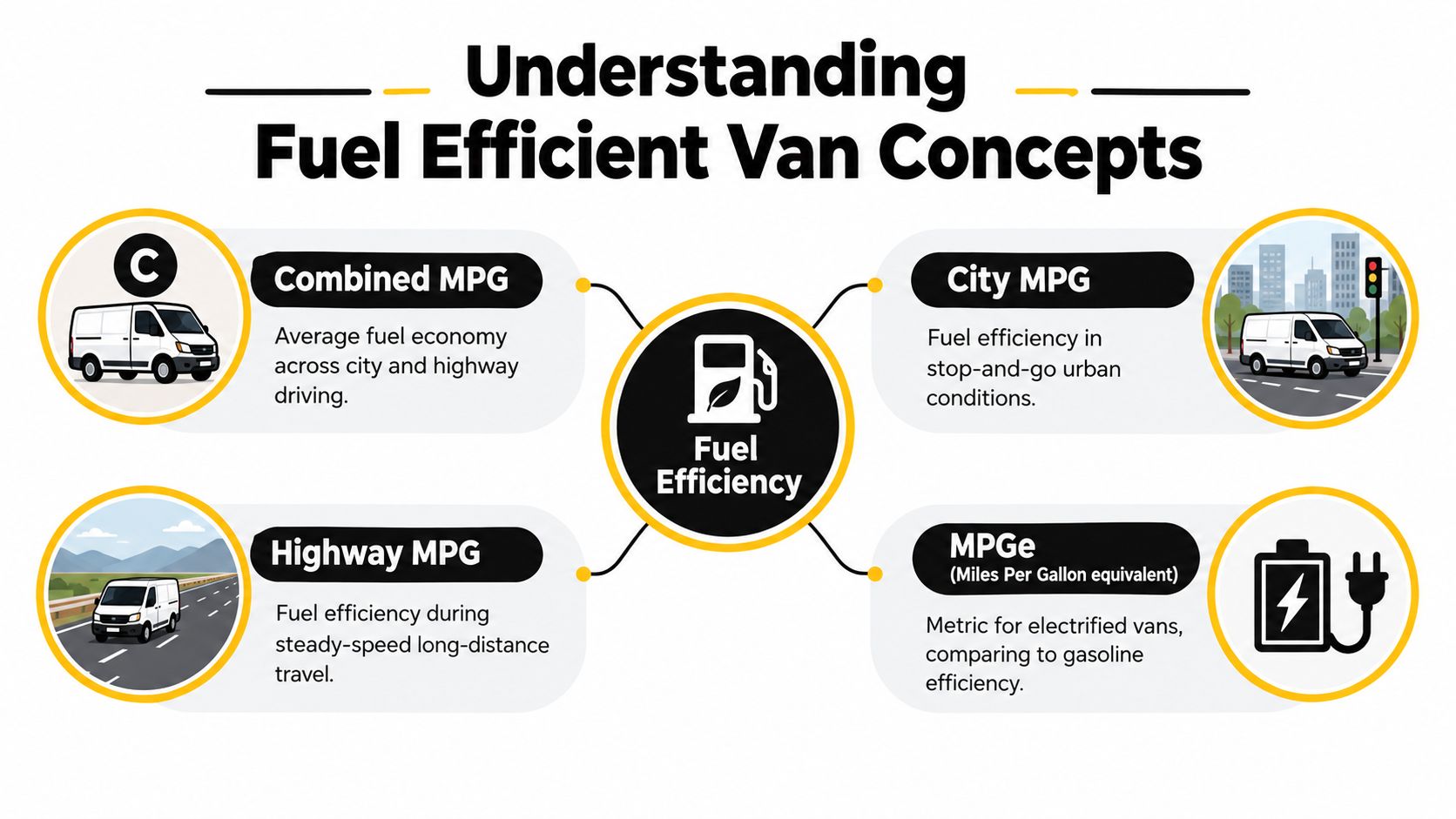
Reading MPG correctly
Combined MPG blends city and highway driving into one figure. It's useful for a mixed schedule, such as airport transfers during the day and regional corporate trips later, but it may hide important differences between the two environments.
City MPG reflects stop-and-go travel. It matters when a van runs hotel loops, terminal approaches, venue queues, and short urban transfers. Frequent acceleration, braking, and idling can make city performance more relevant than the combined rating.
Highway MPG represents steadier travel. It deserves more attention for event transfers between cities, longer corporate journeys, and airport service that covers substantial highway mileage.
Think of these ratings like energy labels on a building. A household may have an efficient appliance, but the monthly bill still depends on how often the appliance runs. A van's rating works the same way. Passenger load, luggage, speed, traffic, weather, and HVAC use determine how much energy the vehicle consumes.
Using MPGe for electrified vans
MPGe, or miles per gallon equivalent, gives electric vehicles a comparison language familiar to gasoline buyers. It doesn't mean the van burns gasoline. Instead, it expresses electric energy use against a standardized gasoline-energy equivalent.
For fleet decisions, MPGe shouldn't replace an electricity-cost calculation. Record the energy used for a completed route, the applicable charging rate, and the distance traveled. Then compare that operating cost with the fuel consumed by a conventional van on the same duty cycle. The result is more useful than comparing a gasoline MPG number with an electric MPGe number in isolation.
A similar approach applies to cost per mile. Divide the fuel or electricity cost for a route by the miles completed, then track the result by vehicle, driver, route type, and passenger load. Fuel prices and electricity rates can change, so a fleet should monitor actual invoices and charging records rather than rely on a fixed assumption.
Historical context also matters. EPA data shows the sedan and wagon class improving from 13.5 mpg in 1975 to 31.7 mpg in 2021, illustrating how regulation and powertrain development have changed vehicle efficiency over time (U.S. Department of Energy fuel economy history). Modern van buyers can apply the same lesson without assuming that every vehicle class advances at the same pace.
Comparing Drivetrains and Fuel Types for Vans
Different drivetrains solve different fleet problems. A hybrid can be highly effective in repeated urban transfers, while a diesel may suit a full-size van carrying passengers and luggage across longer routes. Gasoline remains practical where purchase simplicity, broad refueling access, and flexible use matter more than peak efficiency.
Reported comparisons put a hybrid minivan such as the Toyota Sienna Hybrid at around 36 mpg combined, while full-size diesel cargo vans such as the Mercedes-Benz Sprinter typically return 17 to 22 mpg, and gas vans commonly fall within 14 to 18 mpg (van fuel economy comparison). These figures describe broad vehicle categories, not a guarantee for a particular passenger configuration or route.
| Drivetrain | Fuel type | Avg efficiency | Best use case |
|---|---|---|---|
| Hybrid | Gasoline and electric assistance | Around 36 mpg combined for a Sienna Hybrid | Urban airport loops, family transfers, light passenger duty |
| Diesel | Diesel fuel | 17 to 22 mpg for typical full-size diesel cargo vans | Longer highway transfers, heavier loads, high-mileage work |
| Gasoline | Gasoline | 14 to 18 mpg for common full-size gas vans | Mixed routes, accessible refueling, flexible commercial use |
| Plug-in hybrid | Gasoline and grid electricity | Compare route energy use with both fuel and electric charging | Predictable short routes with dependable charging access |
| Battery electric | Electricity | Use MPGe and route energy records | Fixed routes with depot charging and controlled mileage |
Matching the powertrain to the service
Diesel offers a logical fit when the van regularly carries substantial loads over sustained highway distances. It may be less attractive for short urban work with frequent idling, where the operating pattern doesn't allow the drivetrain to show its strongest advantage.
Gasoline simplifies refueling and can suit mixed schedules. It's often easier to deploy across a varied fleet because drivers can use widely available stations without coordinating charging windows.
Hybrid technology fits stop-and-go airport work particularly well because regenerative braking can recover energy during repeated deceleration. A hybrid minivan may be economical for smaller groups, but it won't replace a full-size shuttle when luggage, accessibility equipment, or passenger capacity demands more interior room.
Plug-in hybrids can make sense when a fleet can charge consistently and routes are predictable. Their value depends on using electric capability regularly, not merely having it available.
Battery-electric vans require the most disciplined planning. Charging access, route length, dwell time, weather, HVAC demand, and backup vehicles all affect suitability. Managers comparing family-oriented hybrid choices can also review this guide to family hybrid options for UK drivers for broader context on how hybrid systems fit passenger transport.
Operational Factors That Impact Van Efficiency
At an airport, one van may carry two travelers and light luggage, while another handles a full hotel transfer or an event group with equipment. The vehicles may be identical, yet their fuel or energy use can differ because the assigned work changes the operating profile. Matching each van to its recurring duty cycle is more useful than judging efficiency from a model name alone.
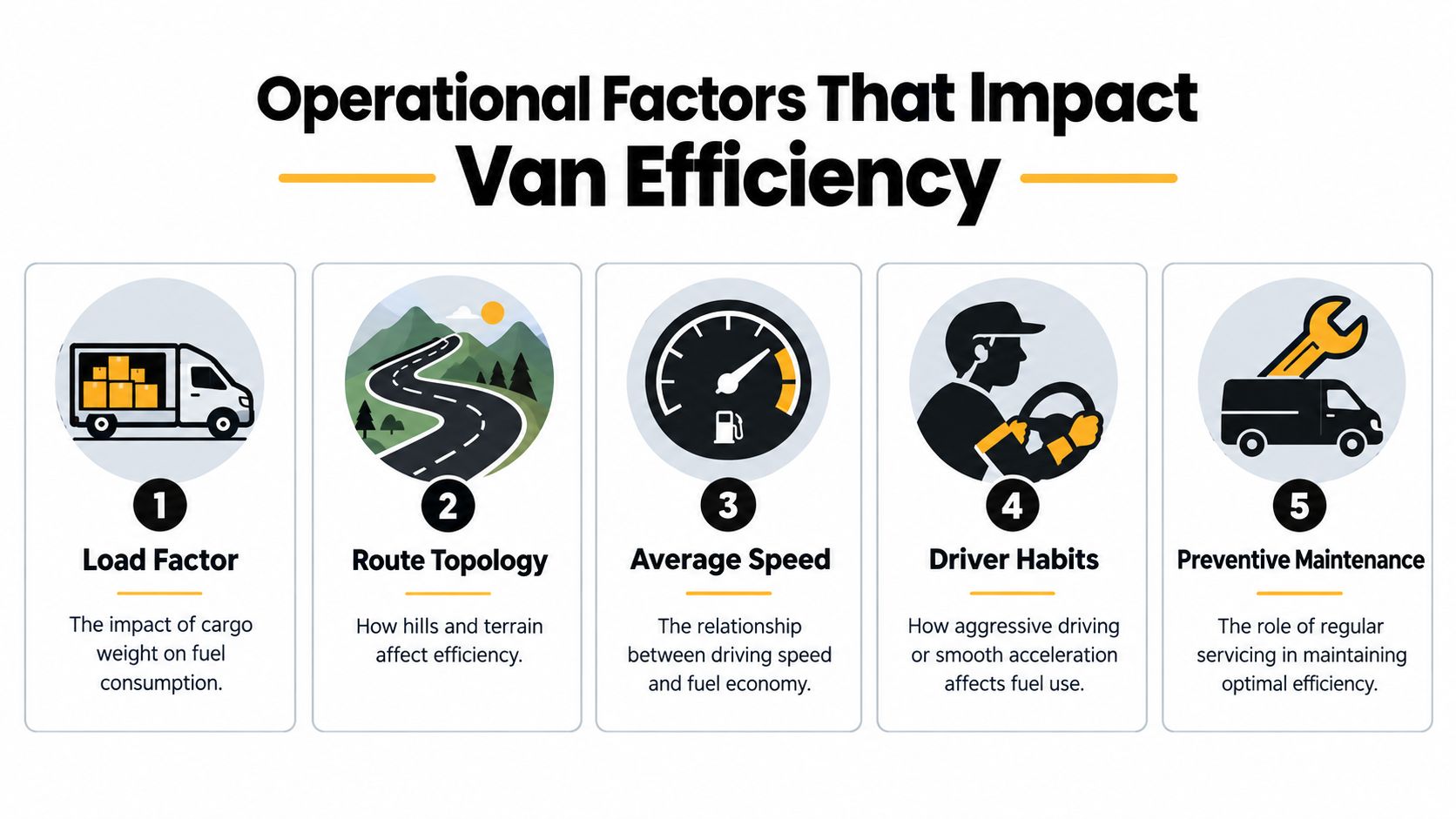
The load and route relationship
Load factor affects acceleration, braking, tire demand, and hill climbing. Passenger numbers are only part of the calculation. Airport cases, conference materials, and event equipment take different amounts of space and add different weight. A lightly loaded van can suit a short airport loop, while a full passenger load with luggage may need greater capacity and a powertrain that handles sustained demand without repeated strain.
Route topology covers hills, terminal ramps, tunnels, intersections, and road surfaces. A route with frequent climbs can use more energy than its distance suggests, just as a staircase requires more effort than a level walkway. Compare assignments by their actual duty cycle, not mileage alone.
Average speed changes the result as well. Steady highway travel can suit a drivetrain intended for longer runs, while higher speeds may reduce electric range and increase energy use. Airport queues create another pattern, with low-speed movement, repeated stops, and waiting. Event transfers may add longer periods of highway travel followed by congestion near venues.
Driver habits affect every route. Smooth acceleration, early anticipation of traffic, limited idling, and sensible speed selection reduce wasted energy without lowering passenger service. Coaching is more effective when managers pair feedback with route data, so drivers can see how a particular behavior affects their assigned work.
Maintaining the vehicle and the service environment
Preventive maintenance supports efficiency and reliability. Correct tire pressure, timely servicing, wheel alignment, clean filters, and a working HVAC system all matter in passenger transport. Poorly maintained cooling equipment can require harder climate-control operation, while neglected tires increase rolling resistance.
A regular cleaning routine also supports inspections. While preparing passenger-facing vans, teams can check exterior damage, lights, tires, and body panels. Managers reviewing repeatable maintenance support can consider Nanak's fleet vehicle washing as one resource.
Record fuel or energy use with vehicle assignment, passenger load, weather, route type, and driver. This route-level record helps separate a drivetrain problem from the demands of a steep airport approach or a crowded event transfer.
A comparison reported the 2026 Ford Transit 3.5T at 16 to 17 mpg in 75-mph highway testing and noted that full-size vans are exempt from EPA fuel-economy standards, which makes real-world benchmarking important (fleet data and van suitability analysis).
How to Choose Fuel Efficient Vans and Optimize Operations
A two-passenger airport transfer and a wedding party require different efficiency decisions. A small hybrid may use less fuel on repeated airport loops, while a full-size van may complete a large event booking in one trip. The lower fuel use per mile is not always the lower cost for the whole assignment. Capacity, luggage space, scheduling, and passenger comfort determine whether the vehicle is working efficiently or making extra trips.
Start with the service profile
Describe the work before comparing models.
Count passenger demand by booking type. Separate individual airport travelers, family groups, corporate teams, wedding parties, and event crowds. Choose capacity around regular bookings, while allowing for realistic peaks.
Measure luggage and equipment needs. Airport cases need accessible storage, while conference materials and event gear may require a different cargo layout. A van with enough seats but too little luggage space can force a trailer, a second vehicle, or an uncomfortable cabin arrangement.
Map route patterns. Identify short urban loops, airport approaches, regional transfers, and longer highway journeys. A hybrid can fit frequent stop-and-go airport work, whereas a diesel full-size van may suit sustained highway service with a larger passenger group.
Check refueling and charging access. Gasoline and diesel vehicles can generally refuel during normal operations. Plug-in hybrid and battery-electric vehicles need assigned charging locations, predictable dwell periods, and a contingency plan for tight event schedules.
Test the loaded vehicle. Drive representative airport and event routes with the passenger and luggage configuration the van will carry. Compare cost per mile, schedule performance, cabin comfort, and usable storage. A vehicle that performs well empty may feel very different with a full passenger load and luggage.
The operating-cost comparison supports a practical rule: route alignment matters more than a headline MPG ranking (commercial van operating-cost comparison). A compact hybrid can fit urban duty cycles, while a larger diesel vehicle may make better financial sense on longer highway assignments. Evaluate the complete trip, not only the dashboard fuel figure.
Build a measurement system
Telematics connects energy use with the conditions behind it. Track idling, hard acceleration, route duration, average speed, charging behavior, and vehicle utilization. Managers can then distinguish a scheduling problem from driver technique, excessive payload, or a vehicle that does not match the assignment.
A useful dashboard shows cost per mile by vehicle and service type. It can also flag repeated idling, underused capacity, and routes that repeatedly require unexpected refueling or charging. Teams turning operational records into planning insight may find Python data analytics for logistics useful for building a more structured analysis process.
Charging requires a schedule rather than an available outlet. Assign vehicles with predictable overnight or between-trip dwell time. Avoid dispatching a vehicle on a demanding airport or event route after an incomplete charge, and keep a backup vehicle or alternative charging arrangement for peak periods.
Protect efficiency after procurement
Driver training should cover smooth acceleration, sensible idling, route awareness, tire checks, and passenger comfort. The aim is not unusually slow driving. It is removing waste that passengers do not value, such as unnecessary idling or abrupt acceleration.
Procurement teams should compare purchase price, maintenance requirements, expected utilization, charging or fueling infrastructure, downtime, and resale considerations. Electrified vans may suit routes that regularly use their electric capability. Conventional vans may remain practical where charging access, dwell time, or route control is limited.
Max's Luxury Rides Inc. operates a varied transportation fleet, including executive vans, Sprinter vehicles, shuttles, minibuses, mini coaches, and full-size coaches for airport, corporate, and event transportation. This range shows why selection should begin with the passenger assignment, luggage profile, and route, rather than one universal definition of a fuel efficient van.
Conclusion and Actionable Next Steps
A fuel efficient van decision starts with the job it must perform. Use MPG, MPGe, and route-level cost per mile together, then match drivetrain and vehicle size to passenger count, luggage, terrain, speed, and refueling or charging access.
For electric vans, plan conservatively. Real-world fleet data puts average use at 82% of WLTP range overall, 68% in slower urban driving, and 61% at higher motorway speeds, so operators should build an 18% to 39% planning buffer (real-world electric fleet range study).

Select representative vehicles, test loaded routes, record telematics data, train drivers, and review performance regularly. For dependable airport transfers, corporate travel, and event transportation matched to group size and service requirements, visit Max's Luxury Rides Inc. to explore vehicle and booking options for your next trip.