
You've probably been in this spot already. Guests are landing at different times, a venue wants everyone on-site by a fixed hour, half the group is asking where they should park, and someone assumes rideshares will “sort themselves out.” That plan usually holds until the first delay, the first missed pickup, or the first text that says, “We're at the wrong entrance.”
That's where group transportation services stop being a convenience and start becoming operations.
Good group transport doesn't just move people. It controls arrival flow, protects the schedule, reduces confusion, and gives the organizer one coordinated system instead of a dozen separate travel decisions. If you're planning a corporate outing, wedding weekend, airport transfer, school trip, or event shuttle, the primary job is matching the service to the outcome you need. Productivity, guest experience, curbside efficiency, accessibility, and cost control don't all point to the same vehicle or the same routing plan.
What Are Group Transportation Services
Group transportation services are organized passenger movements for more than one traveler under a single plan. In practice, that can mean an airport transfer for a leadership team, a wedding shuttle between hotel blocks and the venue, or a coach program moving attendees on a repeating event route.
The service matters because unmanaged group travel breaks down fast. Individual arrivals create timing drift. Separate drivers choose separate routes. Guests call the planner instead of the transportation provider. Parking becomes its own project. One late arrival then ripples into catering, check-in, photo timelines, or meeting starts.
The problem they actually solve
A professional group transportation plan solves four operational problems at once:
- Arrival control: People reach the right place, at the right entrance, in a tighter time window.
- Communication control: The group gets one itinerary and one point of coordination instead of scattered instructions.
- Risk reduction: Fewer moving parts means fewer missed pickups, wrong turns, and last-minute improvisations.
- Experience management: Guests spend less time figuring out logistics and more time focused on the event itself.
That's why buyers use group transportation services for more than “big groups.” They use them when timing, presentation, and coordination matter.
Practical rule: If the event depends on people arriving together, leaving together, or making multiple scheduled stops, treat transportation as part of the event plan, not an afterthought.
The market behind this category is large and growing. The global transportation services market was valued at USD 9.23 trillion in 2025 and is projected to reach USD 19.96 trillion by 2035, with a forecast CAGR of 8.02% from 2026 to 2035, according to Precedence Research's transportation services market outlook. For planners, the takeaway is simple. Demand for organized passenger movement is expanding, and expectations around reliability are rising with it.
What separates a real service from just booking vehicles
Booking vehicles is the easy part. The harder part is building a movement plan that works under real conditions.
A useful provider helps with:
- Pickup sequencing
- Buffer time between stops
- Vehicle-to-purpose matching
- Luggage and boarding assumptions
- Day-of communication
That's the difference between transportation that looks fine on a quote and transportation that performs on event day.
Choosing the Right Vehicle for Your Group
Most planning mistakes happen here. People choose the vehicle by headcount alone, then discover too late that the luggage doesn't fit, the boarding process is slow, or the atmosphere is wrong for the occasion.
A better approach is to choose by trip purpose first, then check capacity, comfort, maneuverability, and storage.
Start with the outcome, not the fleet list
If the goal is corporate productivity, an executive sedan, luxury SUV, Mercedes van, or executive shuttle often makes more sense than the largest vehicle available. If the goal is wedding guest flow, the vehicle needs easy boarding, simple staging, and enough consistency that guests know exactly what to look for when it's time to leave. For event shuttles, reliability and loading speed usually matter more than premium trim.
Capacity planning also needs restraint. PTV Group's public transport planning guidance notes that a target load factor of 65% is recommended to preserve comfort, accessibility, and on-time performance, and that an articulated bus carries about 100 passengers while a standard 40-foot bus carries about 70 passengers, as outlined in PTV Group's planning guidance. The operational lesson applies directly to private group transportation services. Filling seats to the limit often slows boarding, increases baggage congestion, and creates timing problems.
Group Transportation Vehicle Comparison
| Vehicle Type | Capacity | Best For | Key Feature |
|---|---|---|---|
| Executive Sedan | Small group | VIP airport transfers, executive travel, client pickups | Privacy and polished presentation |
| Luxury SUV | Small group | Families with luggage, executives, hotel transfers | Extra cargo space and flexible comfort |
| Mercedes Van or Sprinter | Medium group | Corporate teams, airport runs, wedding parties | Strong balance of comfort and maneuverability |
| Executive Shuttle | Medium group | Repeating hotel-to-office or venue loops | Fast group boarding and simple routing |
| Minibus | Larger group | Wedding guest movement, local event shuttles, school outings | Efficient short-range transport |
| Mini Coach | Larger group | Multi-stop itineraries, regional transfers, conference movement | Better ride quality for longer trips |
| Full-Size Coach Bus | Large group | Major events, long-distance charters, high-volume shuttles | Throughput and luggage capacity |
What works for different use cases
- Corporate travel: Choose for quiet, punctuality, and easy loading. Overly large vehicles can feel inefficient for small executive groups.
- Weddings: Prioritize guest legibility. One vehicle type for guests is often easier to manage than a mixed patchwork unless the bridal party has a separate plan.
- Airport groups: Don't size only for passengers. Size for passengers plus bags, carry-ons, and delayed arrivals.
- Event loops: Pick vehicles that can load quickly and repeat the route cleanly.
A vehicle that is technically big enough can still be operationally wrong.
What doesn't work
Three mistakes show up repeatedly:
- Overbuying luxury for shuttle work: Plush interiors don't fix poor staging or bad route design.
- Using max seated capacity as the planning target: That usually creates slower boarding and less schedule protection.
- Ignoring access conditions: A coach may be ideal on paper and awkward at a tight hotel driveway, venue loop, or airport pickup point.
The right vehicle is the one that supports the event goal with the fewest friction points. That's not always the smallest option, and it's not always the biggest.
Popular Scenarios for Group Transportation
A good transportation plan looks different depending on what the group is trying to accomplish. The same van, shuttle, or coach can feel either efficient or badly chosen based on the setting.
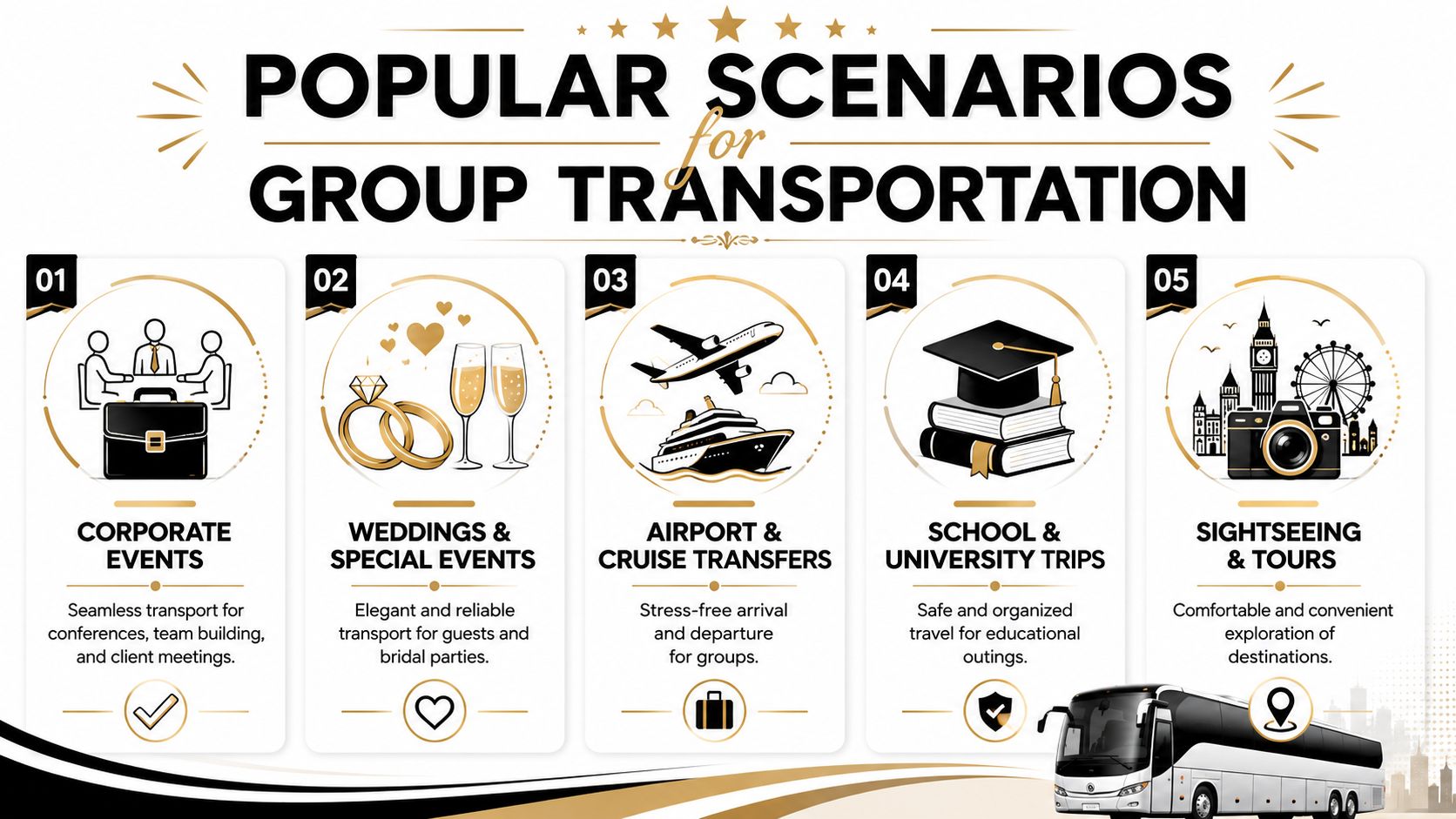
Corporate events and airport transfers
For business travel, the transportation job is to keep the day on schedule. That means clean pickups, realistic transfer times, and a vehicle that lets people settle in without fighting for space. If a team is heading to a conference, roadshow, plant visit, or dinner meeting, the most useful outcome is predictability.
The best plans also reduce decision fatigue. One pickup point, one driver assignment, one arrival window. That's what keeps the organizer from becoming the dispatcher.
Weddings and special occasions
Wedding transportation is less about mileage and more about timing discipline. Guests need to know where to stand, when to board, and what vehicle they're looking for. The couple usually needs a separate flow from the guest shuttle, and the return leg needs just as much planning as the arrival.
The common failure isn't luxury. It's vagueness. If guests hear “there will be a shuttle,” but don't know the boarding point and departure pattern, you'll still get late arrivals and stranded guests.
Concerts, sports, tours, and social groups
These trips are often sold on convenience, but convenience depends on pickup discipline and post-event recovery. The hard part is the return, when everybody leaves at once and the curb gets messy.
For sightseeing and social outings, comfort matters more over time than it does in the first ten minutes. Easy entry, legroom, and a clear meeting point usually matter more than cosmetic upgrades.
Accessibility and assistance needs
One of the most overlooked uses of group transportation services is support for older adults and disabled passengers. In that segment, riders often care more about reliability, assistance, and continuity than vehicle class, as reflected in Molly's Angels transportation program information.
That changes how you plan. You may need extra boarding time, companion seating, first-ride support, or a route with simpler pickup conditions.
When accessibility is part of the job, speed isn't the only metric. A smoother boarding process and a more understandable trip can be the better outcome.
Key Logistics for Planning Group Transportation
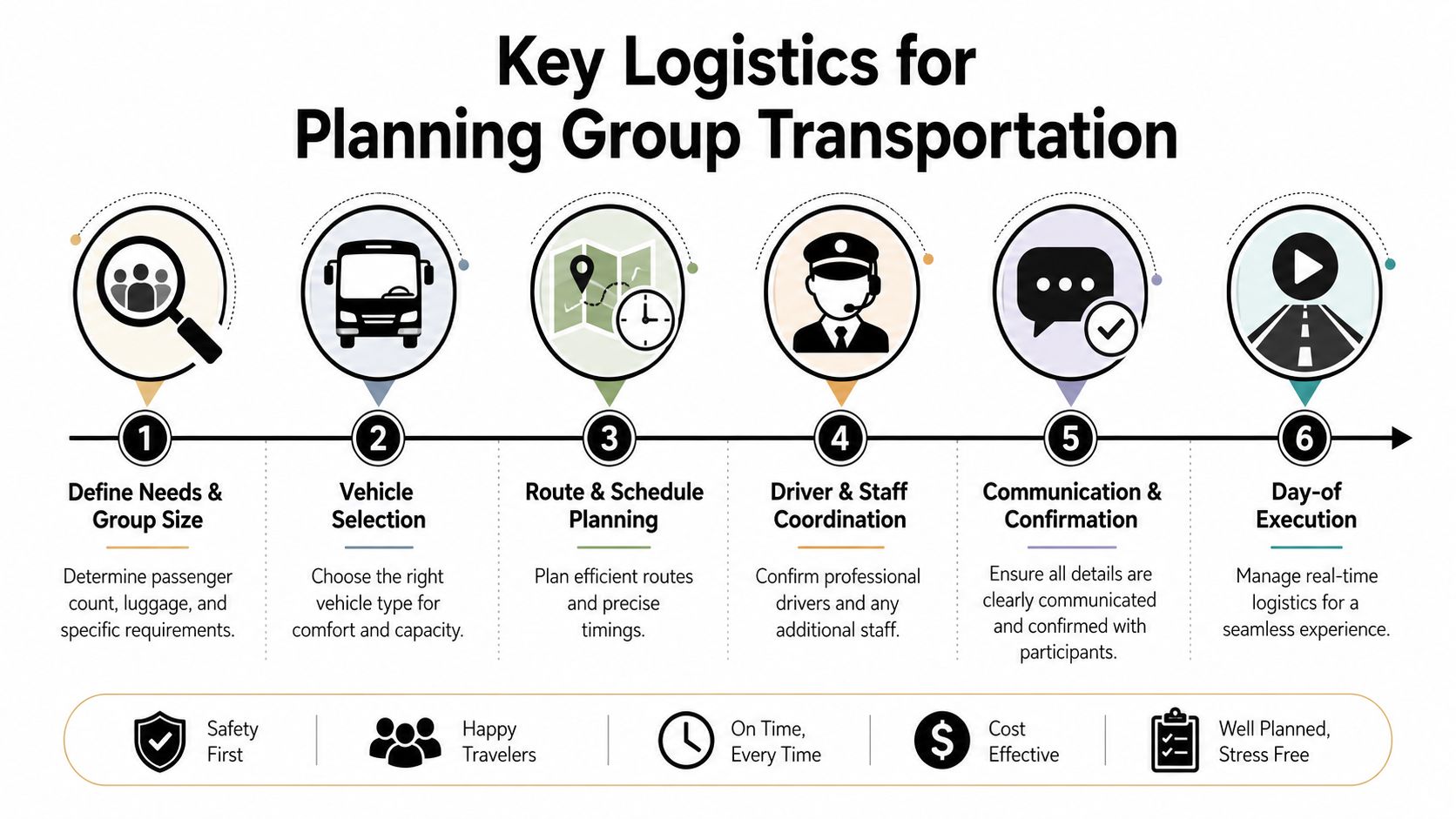
The strongest transportation plans are built backwards from the day-of movement. Start with the fixed points. Then shape the vehicle, route, communication flow, and staffing around those constraints.
Build the operating brief first
Before you request quotes, write a one-page operating brief. It should include passenger count, event type, exact pickup and drop-off addresses, luggage assumptions, accessibility needs, on-site contacts, and whether the trip is one-way, round-trip, or a repeating loop.
That brief does two things. It improves quote quality, and it exposes gaps in your own plan before they become problems on the road.
A simple checklist helps:
- Passenger reality: Use the actual likely ridership, not the invited count.
- Address precision: Include exact entrances, not just venue names.
- Contact structure: Name one decision-maker and one backup.
- Loading assumptions: Note luggage, signage, wheelchair access, or special handling.
- Return plan: State whether the group leaves in one wave or staggered departures.
Plan around bottlenecks, not ideal travel times
The U.S. Department of Transportation's transportation performance management guidance emphasizes data sharing across planning and performance functions so teams can detect bottlenecks and adjust before delays cascade, as discussed in the DOT data-sharing practice document. For event planners, that means transportation should never be scheduled on best-case timing alone.
If a route includes hotel pickups, airport terminals, venue security, or multiple stops, the risk doesn't sit in the miles. It sits in the handoffs.
Day-of execution needs a ground plan
This video gives a useful visual sense of how organized passenger movement depends on coordination, not just vehicles.
A clean day-of plan usually includes:
- A designated boarding lead who knows the passenger list and pickup sequence
- Visible signage at hotels, venues, or airport meeting points
- A communication channel for real-time updates between planner and operator
- A missed-passenger rule so the team knows whether the vehicle waits, loops back, or departs
The planner who controls the curb controls the schedule.
If you're moving passengers by bus or shuttle, regulations matter too. For a practical primer on operating requirements, driver rules, and vehicle compliance issues that can affect planning, My Safety Manager's guide to bus regulations is worth reviewing before you finalize a multi-vehicle program.
Protect the return trip
Outbound trips get most of the attention. The return trip is where plans usually crack.
People leave in uneven waves. They forget instructions. Venues release crowds through different exits than expected. A return plan should answer four questions in advance:
- Where is the exact pickup point
- How will vehicles be identified
- Who tells passengers when to board
- What happens if someone misses the assigned departure
If you solve those four items early, most group transportation services become much easier to manage.
Decoding Group Transportation Pricing and Contracts
Pricing gets misunderstood because buyers focus on the visible number and miss the operating assumptions underneath it. A quote can look lower and still cost more once the trip runs.

How pricing is usually structured
Most group transportation services are quoted in one of three ways:
- Hourly service: Common for weddings, event shuttles, roadshows, and open-ended schedules.
- Per-trip pricing: Useful for clean one-way or round-trip transfers with fixed addresses.
- Day-rate service: Often used when the vehicle and driver are committed for a long operating window with multiple moves.
None of these is automatically better. The right model depends on how predictable your timeline is. If your event has hard pickup times and a simple route, a per-trip quote can be easier to control. If your schedule may drift, hourly service often gives more flexibility.
What the base quote may not tell you
Buyers often optimize for headline price, while the actual cost is affected by parking, driver hours, deadhead miles, and compliance risk, as explained in EZ Vans' discussion of group transportation cost factors. That's why the cheapest quote can end up being the least efficient choice.
Look for these contract points before you sign:
- Wait-time terms: How long can the vehicle hold before extra charges apply?
- Parking and toll responsibility: Don't assume these are included.
- Cleaning and damage clauses: Especially important for wedding and party movements.
- Cancellation terms: Know the cutoff and the penalty structure.
- Itinerary change rules: Ask how added stops or timing changes are billed.
A transportation contract is an operating document. Read it like one.
Insurance is part of that risk picture too. If you're managing transportation for a company fleet or event-related vehicle exposure, broader coverage issues can affect how you evaluate providers and your own obligations. For a practical overview, commercial auto insurance North Carolina is a useful reference on the kinds of coverage questions businesses should understand.
Smarter questions to ask before booking
Ask these before approving the quote:
- What exactly starts the billing clock?
- What triggers overtime or overage charges?
- Who pays for venue parking and airport access fees?
- Is the quoted vehicle the assigned vehicle, or a category subject to substitution?
- How are same-day changes handled?
Those questions won't make the quote cheaper. They will make it clearer, which matters more.
The Max's Luxury Rides Advantage for Group Travel
When a planner needs one provider that can cover different trip types under one umbrella, fleet range matters. That's especially true for organizations that may need an executive sedan for one movement, a Mercedes van for another, and a larger shuttle or coach setup for event-day transport.
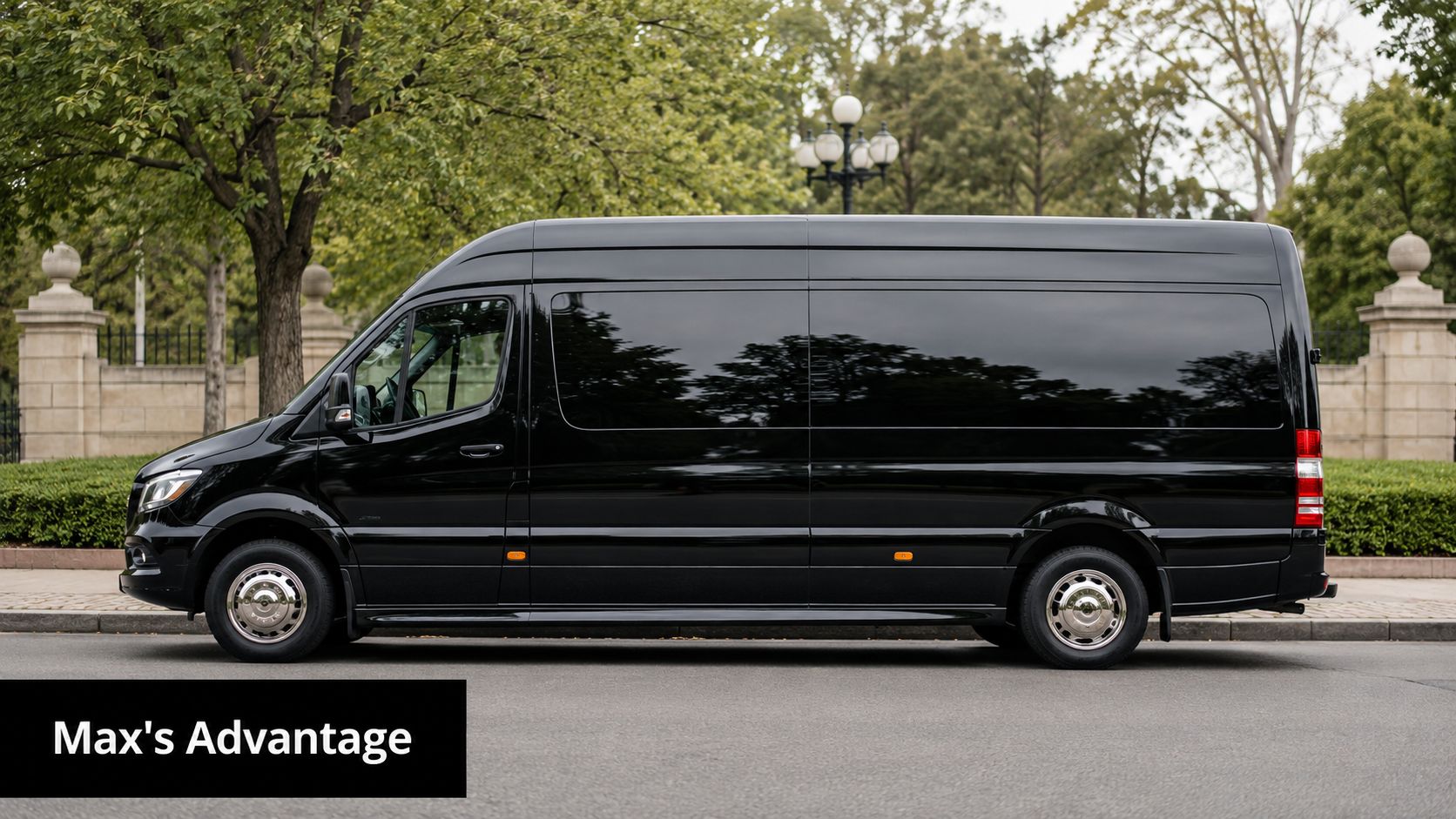
Max's Luxury Rides Inc. offers executive sedans, luxury SUVs, Mercedes vans, Sprinter limousines, executive shuttles, stretch limousines, minibuses, mini coaches, and full-size coach buses. That range is useful for planners who don't want to split transportation across multiple vendors just because the group includes VIP airport arrivals, guest shuttles, and a larger event transfer.
Where that matters in practice
For Chicago-area transportation, the practical value is in service fit:
- Airport movements: O'Hare, Midway, and FBO transfers often require tight coordination and clear arrival handling.
- Corporate travel: Business groups usually need punctuality, clean presentation, and vehicles matched to team size.
- Special occasions: Weddings, concerts, and sporting events need simple guest movement and reliable return plans.
The company also operates 24/7, accepts major credit cards, and describes its chauffeurs as vetted with a focus on punctuality, cleanliness, and guest comfort. Those details matter because group transportation services succeed on consistency more than on marketing language.
What to look for in any provider
Whether you book this company or another, judge the provider on operational fit:
- Can they match vehicle type to trip purpose?
- Can they handle airport, corporate, and event work without changing standards?
- Can they support clear communication before and during service?
Those are the questions that protect the planner.
Common Questions About Group Transportation Services
How far in advance should I book?
Book as soon as your date, rough headcount, and trip purpose are stable. Large events, wedding weekends, and airport programs with multiple vehicles usually need more lead time than a single-point transfer. Early booking gives you better fleet choice and more time to fix itinerary problems.
What information should I send a provider first?
Send the essentials in one message: event date, passenger estimate, pickup and drop-off addresses, trip type, number of stops, luggage assumptions, accessibility needs, and your on-site contact. If you send partial information in five separate emails, you increase the chance of a quote that doesn't match the job.
Can I make last-minute itinerary changes?
Usually yes, but you should expect limits. A provider may be able to adjust pickup timing, stop order, or passenger assignments, but major changes can affect driver hours, route feasibility, and cost. The earlier you flag a change, the easier it is to absorb without disrupting the whole movement plan.
Who handles parking, tolls, permits, and venue access?
Never assume. Some providers include certain items. Others bill them separately. Ask specifically who is responsible for parking, tolls, airport fees, venue permits, and any staging requirements. This belongs in writing before the trip.
Is alcohol allowed on board?
That depends on the vehicle type, the provider's policy, local rules, and the nature of the trip. Ask directly before booking. If alcohol is permitted, get the rules in writing so there's no confusion about cleanup, behavior expectations, or liability.
What's the biggest mistake planners make?
They treat transportation like a purchase instead of a live operation. The vehicle gets booked, but the curb plan, return plan, signage, and passenger communication never get finished.
How do I keep guests from getting confused on the day?
Use one pickup location whenever possible. Label the vehicle clearly. Send guests a short instruction message with the exact boarding point, time window, and a day-of contact. If the trip has multiple waves, assign people before they reach the curb.
Should I choose one big vehicle or several smaller ones?
It depends on your route and your goal. One larger vehicle can simplify communication and arrival flow. Several smaller vehicles can help with tighter access, staggered schedules, or separate groups such as VIPs, family, staff, and guests. Choose the format that reduces friction, not just the one that looks neat on paper.
What matters most for airport group transfers?
Three things. Correct terminal planning, luggage assumptions, and a realistic late-arrival process. Airport transportation fails when the passenger count is right but the baggage count is ignored, or when nobody knows what to do if one traveler lands behind schedule.
If you're planning airport transfers, corporate travel, wedding transportation, or event shuttles in the Chicago area, Max's Luxury Rides Inc. can be part of the conversation when you're comparing providers. The useful next step is simple: send your date, passenger count, route, and trip purpose, then evaluate whether the vehicle options and operating approach fit the job.