
The most popular advice about guest satisfaction measurement is to track one clean number and call it a management system. That sounds tidy. It also hides the differences that decide whether a guest books again, because an airport transfer, a weekly corporate ride, and a wedding shuttle are not the same job at all.
In premium ground transportation, satisfaction only becomes useful when it reflects trip purpose and operational recovery. A corporate traveler cares about punctual pickup, billing accuracy, and whether the provider fixed a mistake without wasting their time. An event client cares about presentation, chauffeur professionalism, and whether the group moved smoothly when the schedule changed.
If you average those experiences into one dashboard, you can look healthy while important accounts drift away. The better approach is to measure what each service line is supposed to deliver, then tie the score to the moments where service breaks, gets repaired, or gets repeated.
Why Your Overall Satisfaction Score Is Misleading
A single satisfaction score feels objective because it's easy to report. In practice, it often blends together incompatible expectations and makes the right problems harder to see. The industry already treats NPS, CSAT, and review ratings as the core measurement tools, and it's common to use standardized scales like 0–10 for NPS, 1–5 or 0–100% for CSAT, and 1–5 or 1–10 for reviews because that structure supports benchmarking across touchpoints and markets (guest satisfaction metrics).
Trip purpose changes the meaning of “good”
An airport guest judges the experience differently from a corporate travel manager. If the car arrives on time, the luggage fits, and the pickup is smooth, the transfer may be a success even if the ride itself was uneventful. A wedding party, by contrast, may treat vehicle presentation and chauffeur presence as part of the product, not a nice extra.
That's why one blended score can mislead. The average might rise because one segment is happy while another segment is slipping. A luxury transport operation needs the same logic hospitality uses, where repeat behavior is treated as a validation signal and satisfaction is tied to whether the guest would return or recommend the service (guest satisfaction metrics).
Service-line averages hide the accounts that matter
Corporate travel is usually the clearest example. A weekly booker can tolerate a minor inconvenience once, but not recurring friction in dispatch, invoicing, or communication. Event transportation has different failure points, because a perfectly comfortable ride won't erase confusion around timing or pickup coordination.
Practical rule: don't ask whether guests were satisfied in general, ask whether they were satisfied with the specific trip they took and the reason they took it.
That shift matters because modern satisfaction measurement has moved from broad opinion surveys to actionable operational KPIs like response time, service recovery rate, and repeat guest rate (guest satisfaction measurement shift). When you segment by purpose, the dashboard stops being decorative and starts showing where service breaks cost you future bookings.
Choosing the Right Metrics for Each Service Type
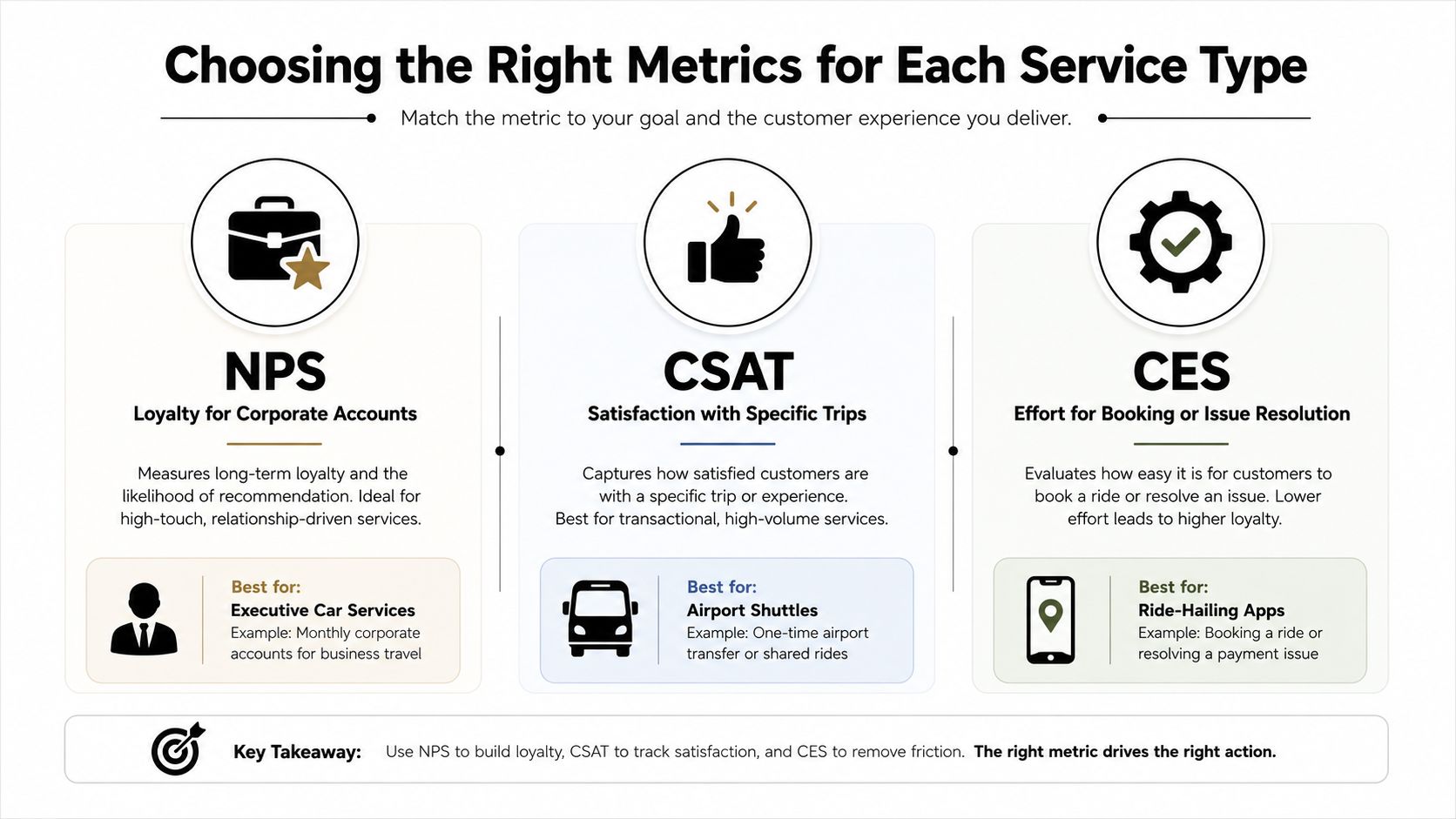
The strongest programs don't use one metric everywhere. They use the right metric for the decision being made. In hospitality and service measurement, CSAT measures satisfaction with a specific experience, NPS measures loyalty and recommendation intent, and CES measures how much effort the guest had to expend to complete a task (customer satisfaction metric definitions). That distinction matters in ground transportation because booking, riding, billing, and recovery are different moments.
CSAT for the ride itself
Use CSAT when you want a direct read on one trip. A post-ride airport transfer survey can ask whether the guest was satisfied with punctuality, cleanliness, and chauffeur professionalism, because those are observable, immediate, and easy to judge while the experience is fresh. CSAT is also the best fit when you need to compare touchpoints like check-in, pickup coordination, or ride comfort over time.
A practical CSAT setup is simple. Keep the score question about the specific trip, then use one follow-up to isolate what drove the score. For a short transfer, that's enough to expose patterns without turning the survey into admin work.
NPS for recurring accounts
Use NPS when the question is loyalty. Corporate travel managers aren't just reacting to a ride, they're deciding whether to keep sending volume your way. A recommendation score is more relevant there because repeat business is the outcome that matters.
This is also where benchmark thinking helps. For a recurring account, you care less about whether one ride was pleasant and more about whether the account would continue to trust you after a service issue. NPS fits that relationship view much better than a one-off satisfaction check.
CES for friction points
Use CES for booking and resolution. If an event coordinator has to chase confirmations, correct passenger lists, or clarify pickup logistics, the issue is effort, not ride comfort. That's exactly the kind of friction CES is meant to expose.
For a deeper framework on this metric, the customer effort score survey guide is useful because it focuses on where effort shows up and how to ask about it without muddying the result. In premium transport, CES belongs around complex reservations, changes, and service recovery, where an easy process can save the account even when the itinerary changes.
Designing Surveys That Guests Actually Complete
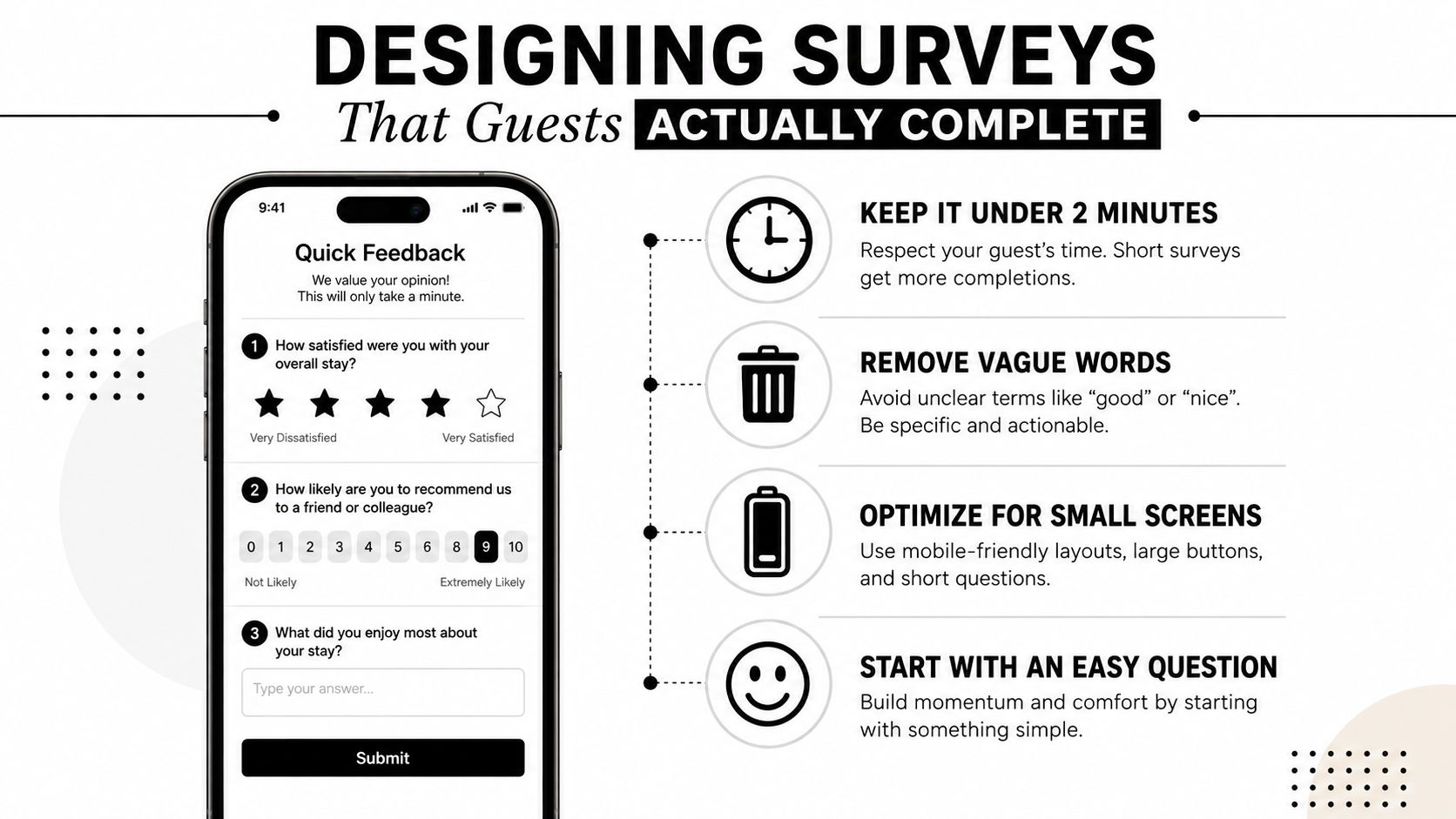
A long survey is a self-inflicted data problem. Time-pressed guests on mobile devices won't tolerate multiple rating scales, mixed topics, or awkward wording. Industry guidance consistently favors short, neutral questions, at least five response points for closed-ended items, and delivery in the 24-48 hour post-checkout window while recall is still fresh (measurement guidance).
Keep the sequence tight
The most workable structure is one score question, one diagnostic follow-up, and one open comment box. That sequence gives you a signal, a reason, and a place for the guest to tell you what the numbers missed. It also aligns with hospitality measurement advice to keep surveys focused on one touchpoint and avoid mixing multiple issues in one question (survey design guidance).
For example, after an airport transfer you might ask, “How would you rate your ride today?” followed by, “What affected that rating most?” Then leave one space for anything else the guest wants to add. That's enough to reveal whether the issue was timing, cleanliness, or communication.
Ask about one thing at a time
Bad survey design usually starts with a combined question. “Was the vehicle clean and was the chauffeur professional?” sounds efficient, but it makes root-cause analysis messy. If the guest says no, you still don't know which issue drove the response.
Use separate wording for separate behaviors.
- Chauffeur professionalism: “How would you rate your chauffeur's professionalism during this trip?”
- Vehicle cleanliness: “How would you rate the cleanliness of the vehicle?”
- Booking ease: “How easy was it to complete your booking?”
A clean survey is not a short survey with fewer words. It's a survey where each answer tells you something you can act on.
Timing matters more than length
Send the survey while the experience is still vivid. A 24 to 48 hour delay is short enough to preserve detail and long enough to avoid interrupting the ride itself. After that, memory starts to blur the difference between the ride, the booking, and whatever happened later in the day.
The best surveys don't feel like a questionnaire. They feel like a quick check on one trip, which is exactly what they are.
Selecting Feedback Channels for Different Guest Profiles
The channel you choose shapes who responds. Airport guests are usually easy to reach quickly. Corporate managers are harder to catch in the moment, but more likely to engage with a structured summary. Event guests often sit somewhere in between, because the person who booked the ride isn't always the same person who experienced it.
Channel fit depends on the service context
SMS works well when the trip ends and the experience is still top of mind. Email is better when the audience needs a fuller trend view or when the decision-maker reviews service on a schedule. In-app prompts matter when the ride was booked digitally and the guest is already inside the platform. Driver tablet collection can work in controlled event settings, but it's weaker when the guest is in a hurry or trying to leave.
| Channel | Best For | Timing | Expected Response Rate |
|---|---|---|---|
| SMS | Airport transfers, short rides, immediate trip feedback | Within hours of drop-off | Qualitatively stronger than delayed outreach because recall is fresh |
| Corporate travel managers, account reviews, trend summaries | Weekly, monthly, or quarterly review cycles | Lower than immediate prompts, but better for reflective feedback | |
| In-app prompt | Repeat digital bookers and guests who manage their own reservations | Right after booking or trip completion | Stronger when the guest is already engaged in the app |
| Driver tablet collection | Event shuttles and managed group movements | On site, after the service concludes | Useful in controlled settings, but dependent on guest availability |
Silent guests still tell you something
The biggest blind spot is the guest who never answers. That doesn't mean the guest has no opinion. Repeat booking behavior, complaint frequency, and direct referrals all carry satisfaction signals even when no survey is returned. The practical gap is that many operators overvalue the people who fill out forms and underweight the people who just come back.
That's why a multi-channel stack matters. Online reviews, direct feedback, and operational observation catch different slices of the experience, and a single channel won't show all of them. Research on service quality measurement also notes that some organizations collect feedback without using it effectively, which makes channel choice only part of the problem (guest satisfaction measurement gap).
Build by guest profile, not by convenience
If a channel is easy for your team but awkward for the guest, it's the wrong channel. Airport passengers need speed. Corporate clients need clarity. Event coordinators need a view of the whole job, not just the last leg.
A good collection system respects that difference. It doesn't force every guest into the same inbox or every account into the same form.
Connecting Satisfaction Scores to Operational Reality
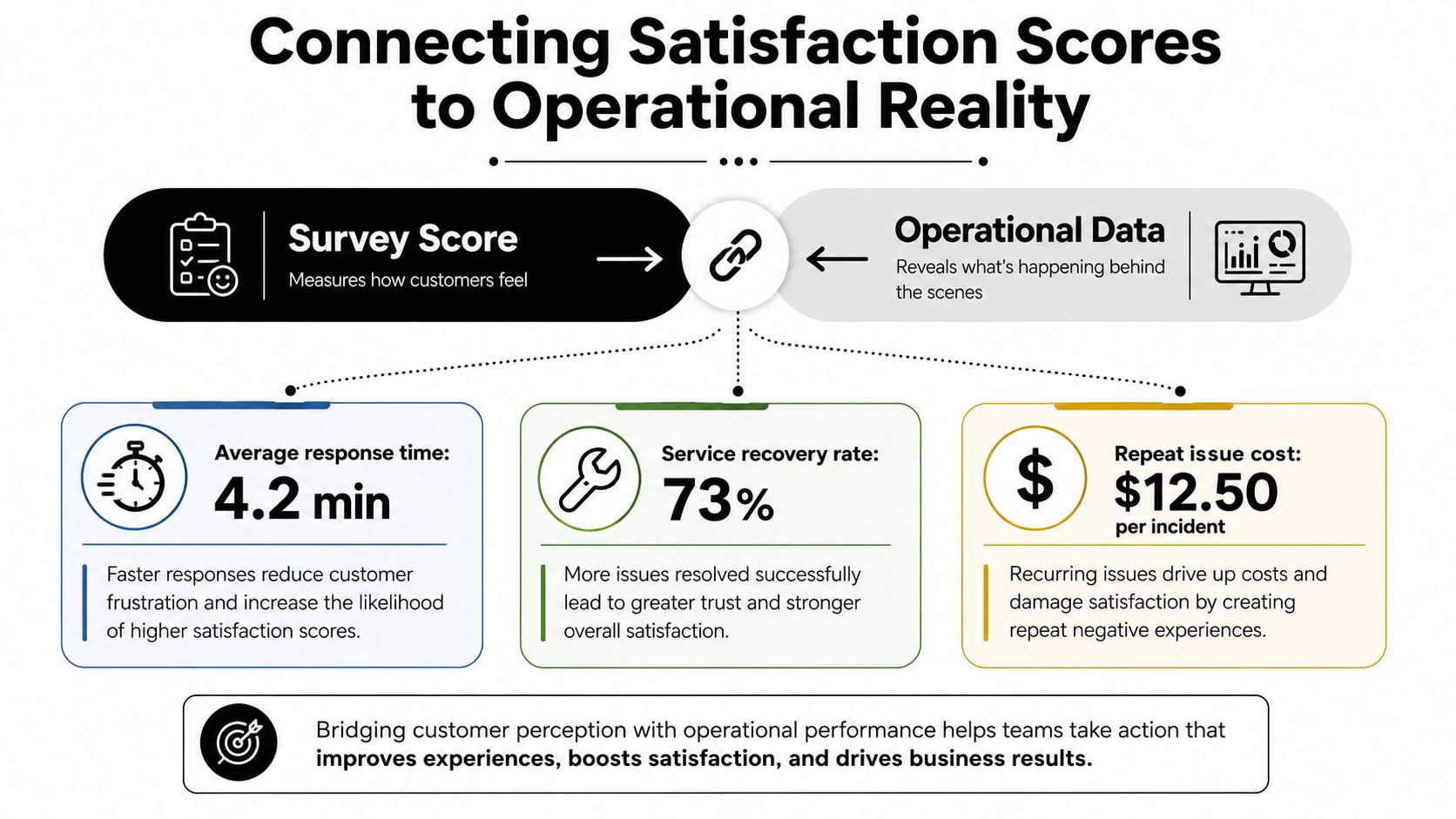
Survey scores tell you how a guest felt. They do not tell you whether the feeling came from a late pickup, a slow resolution, or a billing correction that took too long. The better read comes from pairing satisfaction with response time, service recovery rate, and repeat guest rate, the same operational signals used in measurement guidance.
Score plus behavior beats score alone
A high score can still hide trouble if repeat bookings start slipping after a service issue. A modest score can still be acceptable if the account keeps booking because problems are handled quickly and cleanly. That is the value of combining sentiment with behavior.
The practical test is simple. A guest may forgive one bad ride if the fix was fast and respectful. They are much less likely to forgive a slow, unclear recovery, even if the original service failure was minor.
Operational rule: if the score drops, check the recovery path before you blame the driver, dispatcher, or vehicle.
Segment the dashboard by trip purpose
Airport, corporate, and event results should not sit in the same bucket. Each one has its own success definition and its own failure pattern. When those are mixed together, the dashboard rewards average performance instead of operational clarity.
An operations manager should care about the smallest differences. A corporate traveler who keeps booking after a minor inconvenience is giving a very different signal than a wedding planner who never rebooks after one coordination problem. Those differences matter more than a polished composite score.
Trip purpose also changes what “good” looks like after a miss. Airport work usually depends on fast recovery and clear communication. Corporate accounts tend to care about billing accuracy and consistent service. Event work depends on coordination across the whole movement, not just the last pickup.
Use the right tool on the right channel
If guests prefer mobile messaging, a live digital feedback path can shorten the distance between a problem and a fix. Tools that support real-time digital CX collection, including WhatsApp-style workflows, are useful when the guest is still in the journey and not willing to open a separate survey form. For that reason, a guide like AI-powered CX for WhatsApp can help when you are choosing a response path that keeps issue capture low-friction.
Operational reality is the part that scorecards often miss. When you see feedback next to response times, repeat issues, recovery outcomes, and trip-purpose splits, you stop guessing which service fix will matter most.
Closing the Feedback Loop and Driving Action
Feedback only matters when someone is accountable for what happens next. If a guest raises a problem and nothing changes, the survey turns into paperwork. The better operating model treats each poor score as a service event, because that is where the recovery starts, and it keeps recurring themes on a weekly review cycle so fixes do not wait for a monthly report.
Make the review process operational
Start with three questions: what happened, who owns it, and what changes next. That keeps the meeting tied to action instead of commentary. Separate one-off incidents from repeat patterns, because they need different responses and different owners.
A practical review meeting should include the dispatcher, the account lead, and the person responsible for service quality. The point is not to argue whether the guest was “right.” The point is to decide whether the workflow failed, where it failed, and how to stop the next repeat.
Close the loop differently by scenario
A corporate travel manager who reports recurring billing problems needs a direct follow-up and a clear fix path. A generic apology does not resolve that kind of issue. A correction, a confirmation, and a check that the same mistake will not return do.
An airport guest who experienced a delay needs a shorter loop. Acknowledge the miss, explain the cause if you can do so, and note what changed in dispatch or communication. Recovery matters as much as the apology, because airport trips are judged heavily on speed of response after things go wrong.
An event client who liked the ride but found booking confusing needs process simplification, not reassurance. That feedback usually points to friction that can be removed before the next event, and it often shows up in the booking path rather than in the vehicle ride itself.
Build accountability into the scorecard
If no one owns the follow-up, the same complaints will keep returning. Tag each issue by trip purpose, assign a person to resolve it, and check the next batch of scores for movement. That is how guest satisfaction measurement becomes a management process instead of a reporting habit.
For additional practical ideas on service recovery and customer experience habits, the guest satisfaction tips resource is useful because it keeps the focus on action, not theory. Use it as a reminder that feedback works best when it changes what guests feel on the next trip.
The loop is closed when the guest sees the fix, not when the spreadsheet is updated.
If you are building a guest satisfaction measurement system for airport, corporate, or event transportation, contact Max's Luxury Rides Inc. for a practical conversation about reliable service, clear communication, and repeat bookings.