
Deciding how early to get to the airport feels like a high-stakes guessing game, doesn't it? We’ve all been told the standard rule: two hours for a domestic flight and three hours for international. But let’s be honest, that’s just a baseline. The real answer is a bit more personal and depends entirely on your specific travel day.
Your Guide to Perfect Airport Arrival Timing
The old wisdom of showing up two hours early, no matter what, is pretty outdated. It’s better to think of your arrival time as a flexible calculation rather than a hard-and-fast rule. The goal here is to build a personalized timeline that saves you from both a mad dash to the gate and those long, tedious hours spent waiting at the terminal.
So, how do you figure out your magic number? You just need to weigh a few key variables:
- Flight Type: Are you flying within the country or heading abroad?
- Airport Size: Is it a small regional airport or a massive international hub like Chicago O'Hare?
- Time of Day: Are you flying on a sleepy Tuesday afternoon or a chaotic Monday morning? Holiday weekends are a whole different beast.
- Personal Needs: Checking bags? Traveling with kids? Do you have the golden ticket of TSA PreCheck?
Moving Beyond the Two-Hour Myth
That classic two-hour recommendation was always more of a buffer than a precise science. In reality, for a lot of domestic travelers, it’s often overkill. A recent analysis of over 800 flights found the sweet spot for domestic travel was closer to 1.5 hours. International flights, on the other hand, still demand that more generous 2.5 to 3-hour window. You can discover more insights about these airport arrival findings and see just how much timing can vary by location.
This really drives home the point that a one-size-fits-all approach just doesn't cut it anymore.
The best strategy is to start with a baseline—say, 90 minutes for domestic or three hours for international—and then pad that time based on your situation. This guide will walk you through exactly how to build that custom timeline.
Recommended Airport Arrival Times At a Glance
Before we get into the nitty-gritty, here’s a quick summary you can use as a starting point for planning your airport arrival.
| Travel Scenario | Recommended Arrival Time Before Departure |
|---|---|
| Domestic Flight (No Checked Bags) | 90 Minutes |
| Domestic Flight (with Checked Bags) | 2 Hours |
| International Flight | 3 Hours |
| Major Hubs (e.g., ORD) during Peak Hours | Add 30-45 Minutes |
Think of this table as your foundation. In the following sections, we’ll break down how to fine-tune these times based on your unique trip.
Domestic vs. International: Setting Your Time Foundation
The first question I always ask a client is, "Are you flying domestic or international?" This is the fundamental starting point for your entire airport timeline, and the difference is bigger than most people think.
Think of it this way: a domestic flight is like driving a few hours to a neighboring city. The process is familiar, you know the rules of the road, and it's relatively straightforward. An international flight? That's more like crossing a national border by car. It brings a whole new level of mandatory checkpoints and official procedures into play.
For domestic trips, the path is linear. You check in, drop your bags, clear security, and head to the gate. The whole operation is run by the airline and the TSA—it's a well-oiled machine designed for getting you from one part of the country to another.
International travel, on the other hand, adds layers of complexity that demand a lot more time.
The International Travel Gauntlet
When you’re flying internationally, you’re not just dealing with the airline and security. You’re also dealing with government agencies from two different countries, and that’s where the timeline really stretches out. Before you even get close to the security line, the airline has to perform a thorough document verification.
This isn't a quick glance at your ID. This critical step involves:
- Passport Verification: An agent has to confirm your passport is valid, unexpired, and actually belongs to you.
- Visa Checks: They must ensure you have the proper visa for your destination. Airlines face massive fines for flying passengers with incorrect documents, so they don’t take this lightly.
- Destination Requirements: They might also need to see proof of a return ticket or other specific entry requirements for that country.
This meticulous process can create surprisingly long lines at the check-in counter, even if you don't have a bag to check. Then, of course, you have customs and immigration to deal with when you land—and sometimes, you even go through pre-clearance checks before you depart.
The core difference isn't the flight distance; it's the administrative and legal hurdles required to cross a border. Each one of these steps is a potential bottleneck that eats up your time.
Establishing Your Baseline Arrival Time
Because of all these extra procedures, the starting point for when you should show up is wildly different. For a domestic flight, a baseline of 90 minutes to two hours is a safe bet. This gives you a comfortable cushion for check-in, bag drop, and the standard security screening without feeling rushed. It’s built for moderate crowds and typical airport operations.
For an international flight, your non-negotiable baseline has to be three hours. This larger window is absolutely essential. It’s designed to absorb the time you’ll spend at the check-in counter for those document checks and to navigate what are often much longer security lines in international terminals.
Show up any later, and you're gambling. Airlines often close check-in for international flights 60 to 90 minutes before departure, and there are no exceptions. In the next section, we’ll take these baseline times and start layering on other real-world factors.
Adjusting Your Timeline for Key Travel Variables
Think of the "two hours for domestic, three for international" rule as your starting point—a solid foundation, but not the final answer. The reality of air travel is that no two trips are the same. A handful of key variables can turn that simple rule on its head, so let's walk through how to build a realistic timeline for your specific travel day.
One of the biggest time-sinks is checking a bag. It seems simple enough, but it introduces a whole new queue to your journey. If you're traveling light with just a carry-on and have your boarding pass ready on your phone, you can walk straight to the security line. But if you have luggage to check, you're at the mercy of the airline's counter, which can easily add 15 to 45 minutes to your schedule, especially if you hit a rush.
Fine-Tuning Your Arrival Calculation
The time and day you fly are just as important. Trying to get through an airport during peak hours feels a lot like sitting in rush hour traffic; you just have to plan for it. The terminals get especially crowded during a few key windows:
- Early Mornings (5:00 AM – 8:00 AM): This is a huge wave for business travelers getting a jump on the week.
- Late Afternoons (4:00 PM – 7:00 PM): You'll see a mix of people heading home from work and others starting a long weekend getaway.
- Holiday Weekends: Any major holiday, from Thanksgiving to the Fourth of July, brings a surge of travelers. I always recommend adding an extra hour during these times, just to be safe.
This is where the basic decision tree comes into play, starting with your flight type.
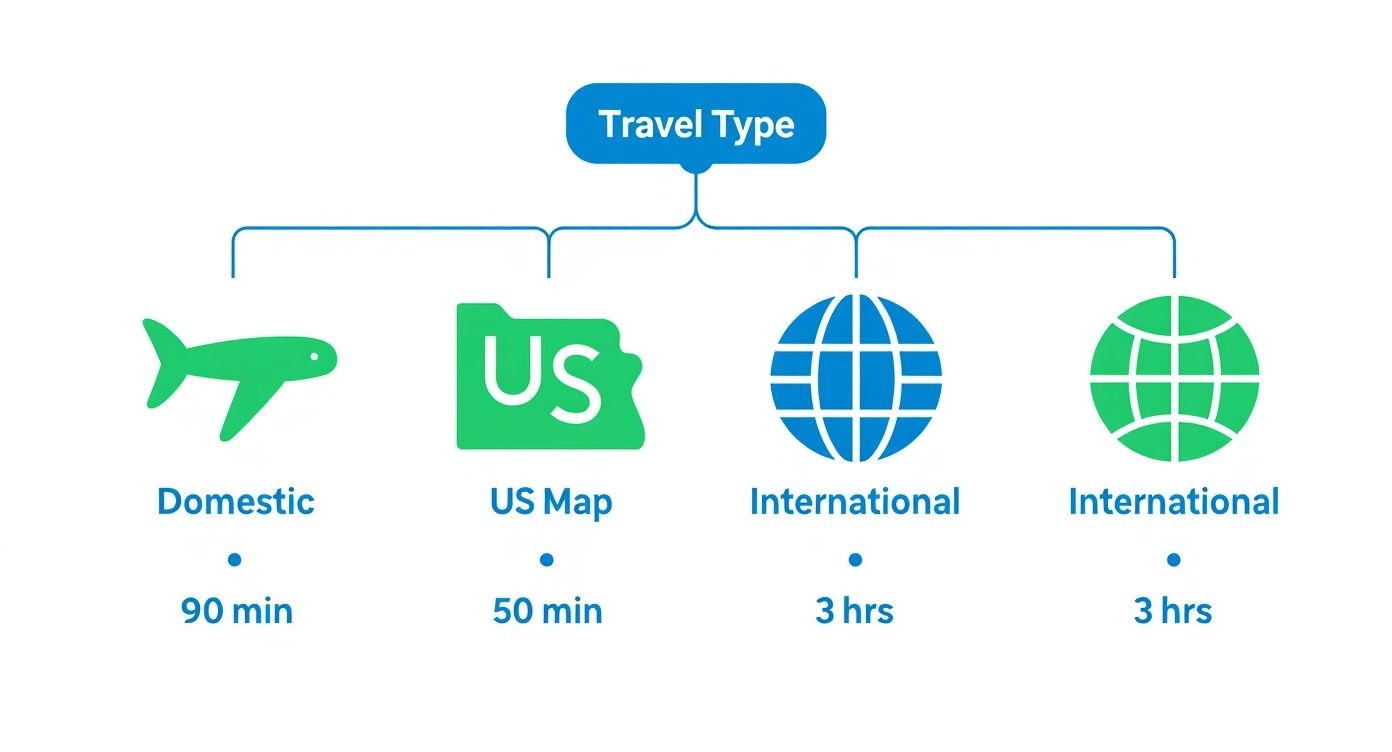
As you can see, international travel automatically requires a much larger time commitment. That isn't just a suggestion; it’s because of mandatory passport checks, visa verification, and other customs procedures that simply take longer. Once you've got that baseline, you can start layering your own travel details on top.
The TSA PreCheck Advantage
If there's one "cheat code" for getting through the airport faster, it's TSA PreCheck. This trusted traveler program gives you access to an expedited security line where you don't have to take off your shoes or unpack your laptop and liquids. It's a game-changer. When the standard security lines are snaking through the check-in hall with a 45-60 minute wait, I’ve often breezed through the PreCheck lane in under ten.
If you have TSA PreCheck, you can generally subtract a solid 30-45 minutes from your planned arrival time. Just remember, it only helps you at the security checkpoint—it won't get you to the front of a long bag-drop line.
The best way to figure out your ideal arrival time is to stack these factors. Start with the baseline (domestic or international). Add time if you're checking a bag or flying on a Monday morning. Then, subtract a little if you have PreCheck. This layered approach takes the guesswork out of the equation and is your best bet for a smooth, stress-free start to your trip.
Navigating Special Travel Scenarios
Life rarely fits into a neat little box, and the same goes for travel plans. The standard two-hour rule can fall apart the moment you add children, pets, or travelers who need a bit more help getting around. These aren't just minor adjustments; they require a completely different strategy for your airport arrival.
Think of your normal arrival time as your starting point. Every special circumstance adds another layer of complexity—and time. Underestimating these can easily turn a smooth departure into a frantic sprint to the gate.
Each of these situations creates its own unique set of checkpoints and potential bottlenecks, so building them into your timeline from the very beginning is the secret to a stress-free start.
Traveling with Children or Infants
Anyone who has flown with little ones knows it's an adventure. It’s also a logistical puzzle. Juggling car seats, strollers, diaper bags, and the kids themselves means every single step, from curb to gate, simply takes longer. Unexpected bathroom breaks are a given, not a maybe.
- Car Seats and Strollers: You'll either need to check these at the main counter or gate-check them. Both options involve waiting in line and talking to airline staff, which adds time you might not have planned for.
- Security Screening: Getting through TSA with kids is its own special dance. You’ll be managing liquids like formula or milk, taking a wriggling toddler out of a carrier, and folding up strollers, all while trying to get your own shoes back on.
Do yourself a huge favor: add at least 30 to 45 extra minutes to whatever you were originally planning. That buffer is your best friend.
Requesting Special Assistance
Airports have great accessibility services, but they don't happen automatically. If you or a family member needs wheelchair assistance or other mobility support, you absolutely must arrange it with the airline ahead of time.
Showing up early is key. It gives the airline staff the time they need to coordinate everything without rushing. Keep in mind, you’ll likely have to wait for an attendant to become available, and that can take a while during peak times. Plan on adding a minimum of 30 additional minutes.
Flying with Pets or Oversized Baggage
Thinking of bringing your furry friend or your golf clubs? Get ready for a different check-in process. These items can't be handled at a self-service kiosk and require a trip to a special check-in counter.
You'll have to find the oversized baggage or special services desk, which almost always has its own line. If you're traveling with a pet, the airline has a strict checklist for paperwork and carrier inspections. It's a detailed process with no room for error.
To be safe, give yourself an extra 45 to 60 minutes. These items also take longer for the ground crew to load, so airlines often have earlier check-in cutoff times for them. Planning ahead ensures both you and your precious cargo make it onto the plane.
To help you visualize these adjustments, here’s a quick reference guide for adding time to your baseline arrival plan.
Time Adjustment Cheat Sheet for Common Scenarios
| Travel Situation | Suggested Additional Time |
|---|---|
| Traveling with children or infants | + 30 to 45 minutes |
| Requesting wheelchair/mobility assistance | + 30 minutes (minimum) |
| Traveling with a pet | + 45 to 60 minutes |
| Checking oversized or specialty baggage | + 30 to 45 minutes |
Remember, these are just starting points. If you have more than one of these situations—say, you're flying with two kids and checking a car seat—it's always smart to add even more time.
How to Navigate Chicago O'Hare and Midway Airports
All this planning is great in theory, but putting it into practice at a real airport is where it counts. When you’re flying through Chicago, the airport you choose makes a huge difference. O’Hare (ORD) and Midway (MDW) might share a city, but they are worlds apart in size and layout, demanding entirely different arrival strategies.
O'Hare is a massive, sprawling global hub—less like an airport and more like a small city. Simply getting from the curb to your gate can feel like a journey in itself. For domestic flights, especially if you have bags to check, a two-hour cushion is the absolute minimum. If you're heading out of Terminal 5 for an international trip, you need to budget at least three hours. No exceptions.
O'Hare: The Sprawling Behemoth
One of O'Hare's defining features is its sheer scale. To get between terminals, you'll often need to use the Airport Transit System (ATS), also known as the "people mover." It’s a convenient train, but it adds an extra leg to your trip that you have to account for. Even after you clear security, you could be facing a 15-minute walk to a gate at the far end of Concourses B or C.
At O'Hare, the biggest wild card isn't always the security line; it's the marathon you might have to run after security. Plan for the walk, not just the wait.
Here are a couple of insider tips to shave off some time:
- Terminal Connections: After you clear security, you can actually walk between Terminals 1, 2, and 3. So, if the security line in your terminal looks impossibly long, you might be able to pop over to the checkpoint in an adjacent terminal and then just walk to your gate.
- Checkpoint Options: Terminals 1 and 3 usually have several security checkpoints open. Before you jump into a long queue, pull up the official airport website on your phone to check the live wait times.
Midway: The Compact Powerhouse
Midway is the complete opposite of O'Hare. It’s much smaller and more manageable, with a single-terminal layout that means you’ll never need a train to get to your gate. But don’t let its size fool you.
Because it's a major hub for budget-friendly airlines like Southwest, Midway can get incredibly congested. The choke point is almost always the security checkpoint. During peak travel times, like early mornings or late Sunday afternoons, the security lines can snake all the way back to the ticketing counters, rivaling the queues at much larger airports.
With all passengers channeled through one main security area, you don’t have many alternative routes if the line is barely moving. For Midway, your entire timeline hinges on that security queue. A 90-minute arrival might be perfectly fine for a flight on a Tuesday afternoon. But for a 7 a.m. flight on a Monday? Giving yourself a full two hours is just smart planning. The short walk to your gate won't do you any good if you spend the first 75 minutes just waiting to be screened.
Make Your Airport Arrival a Sure Thing with a Professional Chauffeur
Let’s be honest, your airport timing plan doesn’t really start when you get to the terminal. It starts the second you close your front door. That trip to the airport? It’s a wild card, the one variable that can completely upend even the most perfectly planned schedule. This is exactly where a professional chauffeur service stops being a luxury and starts becoming a smart, strategic move for a smooth departure.
When you book a black car service like Max's Luxury Rides Inc., you're not just getting a ride; you're eliminating the biggest headaches of travel day. Forget about tacking on an extra 20-30 minutes to circle a massive parking garage and then haul your luggage onto a shuttle. Instead, you get a seamless, door-to-door experience.
Lock In Your On-Time Departure
The real game-changer here is handing over the stress of navigating Chicago traffic to an expert. A professional chauffeur's entire job is to watch the traffic patterns in real-time. They know the best routes to O'Hare and Midway, and they’re already planning for that inevitable congestion on the Kennedy or the Stevenson. It's their problem to solve, not yours.
Think of it this way: booking a chauffeur is like buying travel insurance for your schedule. It’s an investment that pays off by getting you to the curb calm, on time, and ready to actually start your trip.
At the end of the day, what you're really getting is peace of mind. You're sidestepping the risk of a last-minute rideshare cancellation, the nightmare of finding a parking spot, and the anxiety of misjudging traffic. The advantages are clear:
- Punctuality is Paramount: Professional drivers live by the clock. They build buffer time into every trip, so an on-time pickup is a guarantee.
- Total Efficiency: You'll get dropped off directly at your airline's terminal door, saving you precious minutes of walking and confusion.
- A Stress-Free Ride: Instead of gripping the steering wheel in frustration, you can use that time to relax, check emails, or make a final call.
By taking control of the first part of your journey, you set a calm, organized tone for everything that follows.
Answering Your Top Airport Arrival Time Questions
Even after you've made a plan, a few specific "what-if" scenarios can cause a little uncertainty. Let's tackle some of the most common questions head-on so you can walk into the airport completely confident and stress-free.
Think of this as dialing in the details. You have the general timeline; now let's make sure it's foolproof for your specific situation.
If I Have TSA PreCheck and a Checked Bag, How Much Time Do I Really Save?
It's a great question, and the answer trips up a lot of travelers. While TSA PreCheck is a lifesaver for getting through security screening, it does absolutely nothing to speed up the bag-drop process.
You’ll still have to stand in the same line as everyone else to check your luggage with the airline. Because of that, you can't just subtract a full hour from your arrival plan.
A good rule of thumb for domestic flights with PreCheck and a checked bag is to get to the airport about 1 hour and 45 minutes before your flight. This builds in plenty of time for the bag drop before you get to breeze through the much faster PreCheck security line.
Do I Really Need to Arrive Three Hours Early for International Flights?
Yes, you really do. Even if you're flying out of a smaller, quieter airport, that three-hour rule for international travel is your best friend. The reason has less to do with security lines and more to do with the airline's own strict procedures.
Airlines are required to physically verify your passport, visas, and other international documentation. This is a non-negotiable step that takes time. More importantly, international check-in and baggage drop counters often close 60 to 90 minutes before the plane is scheduled to take off—way earlier than for domestic flights.
Think of the three-hour window as a safety net. It protects you from those hard cut-off times and ensures the airline doesn't deny you boarding simply because they ran out of time to process your paperwork.
Isn't It Better to Be a Little Too Early Than a Second Too Late?
Without a doubt. The stress, cost, and chaos of missing a flight and having to rebook is a travel nightmare. Compare that to the minor inconvenience of sipping a coffee at your gate for an extra half hour, and the choice is obvious.
Arriving early is your personal insurance policy against the unpredictable. It accounts for that surprise traffic jam on the expressway, the unexpectedly long line at the check-in counter, or the random secondary security screening. It lets you begin your journey feeling calm and in control, not frazzled and sprinting through the terminal.
Ensure your trip to the airport is as smooth and predictable as your flight plan. With Max's Luxury Rides Inc., you can leave the traffic headaches and parking frustrations to a professional, guaranteeing you arrive at the curb right on time. Book your professional chauffeur service today and start your trip with confidence.