
You’ve probably heard the old standby: arrive two hours before a domestic flight and three hours before an international flight. It's solid advice and, for most travelers, serves as a great starting point for a stress-free trip.
Your At-a-Glance Airport Arrival Timeline
Figuring out exactly when to leave for the airport can feel like trying to solve a complex puzzle. But that classic “two-hour domestic, three-hour international” rule is the foundation you can build on. Think of it as your baseline—from here, we can adjust based on your specific travel plans.
After all, that general guidance is a one-size-fits-all suggestion, and travel is anything but. Are you flying out of a massive hub like JFK on the Friday before a holiday weekend, or are you leaving from a small regional airport on a quiet Tuesday? Do you have TSA PreCheck? Each of these variables can drastically change how much of a time cushion you really need.
Recommended Airport Arrival Times
To cut through the guesswork, I've put together a simple reference table. Use this as your cheat sheet for the most common travel scenarios so you can get to the gate on time, every time, without spending hours just waiting around.
| Travel Scenario | Recommended Arrival Time Before Departure |
|---|---|
| Domestic Flight (No Checked Bags) | 90 Minutes |
| Domestic Flight (With Checked Bags) | 2 Hours |
| International Flight | 3 Hours |
| Domestic Flight with TSA PreCheck | 60-75 Minutes |
| International Flight with Global Entry | 2.5 Hours |
These times should give you a more tailored starting point for your own trip. From here, you can add a little extra time for things like holiday crowds or traveling with kids.
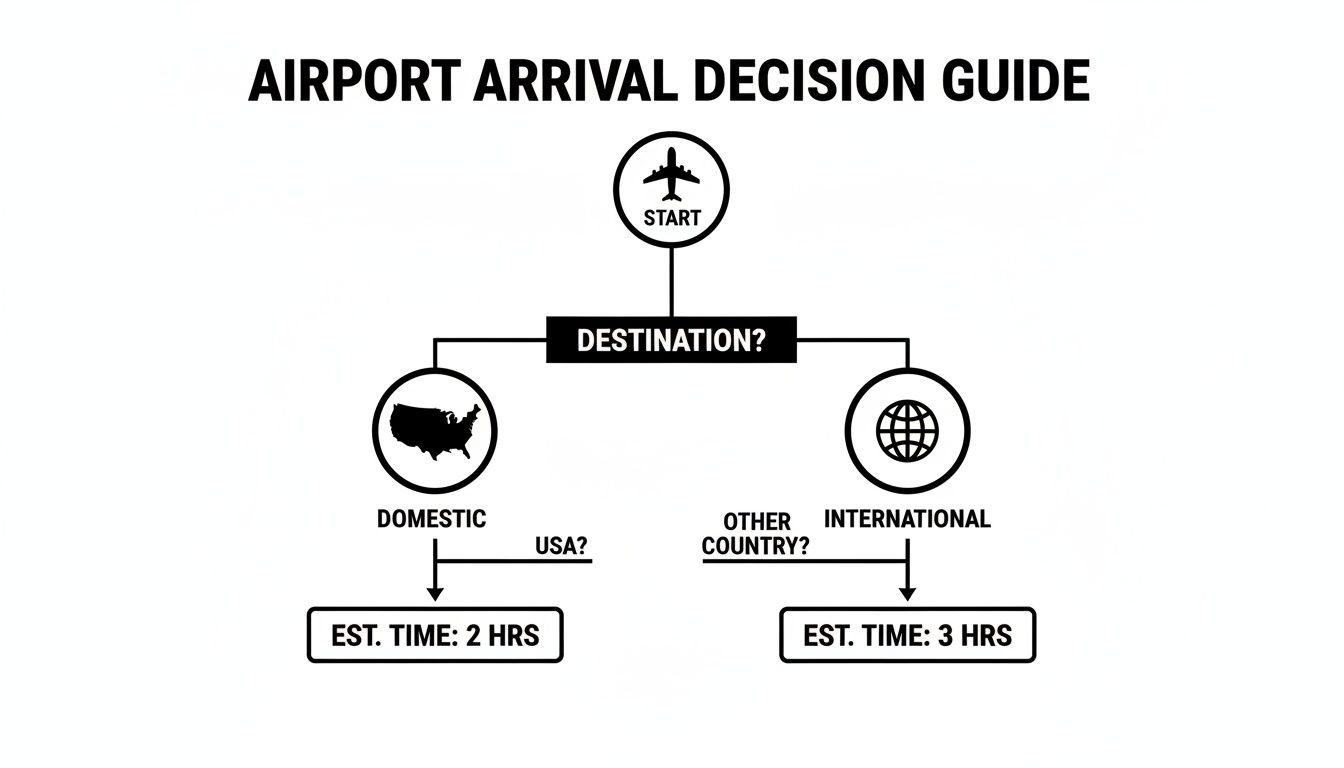
As the flowchart shows, the core principle holds true: international travel just takes more time. You're dealing with extra steps like passport control and customs, which adds a layer of complexity you don't have on a domestic flight. These timelines are all about getting you to your gate with enough time to grab a coffee and relax, not sprint to the boarding door.
The Hidden Factors That Shape Your Airport Arrival
The standard arrival times are a great rule of thumb, but they are just that—a starting point. An airport is a living, breathing place. A long line at the baggage drop can quickly spill over and jam up security, throwing your perfectly timed plan out the window.
To really get your timing right, you have to look past the generic advice and consider the specifics of your own trip. The real answer to how early to arrive at the airport is always "it depends," and it changes with every flight you take.
Your Travel Style and Luggage
The first, and most obvious, factor you control is what you’re bringing. The simple decision to check a bag versus sticking with a carry-on can completely change your timeline, adding a big chunk of waiting time or letting you breeze right through.
- Carry-On Only: This is the airport express lane. If you’ve checked in online and have your boarding pass ready, you can walk straight to the security checkpoint. No need to even glance at the airline counter.
- Checked Luggage: This is where you add a mandatory pit stop. You’ll have to get in line, wait for an agent, and get your bags weighed and tagged. Airlines are serious about their cutoff times for checked bags—usually 45-60 minutes before departure—which makes this a hard deadline you simply can't miss.
An airline’s bag drop cutoff is absolute. Show up 44 minutes before your flight when the cutoff is 45 minutes, and your bags—and probably you—aren't getting on that plane.
This is the first and most important adjustment you’ll make. If you’re traveling light with just a carry-on, you might shave a good 30 minutes off your arrival plan. Checking bags? Stick firmly to that two-hour domestic window.
Special Considerations for Your Travel Party
Next, think about who you’re traveling with. A solo business traveler can zip through the terminal in a fraction of the time it takes a family with young kids or someone who needs a little extra help.
Bringing children, pets, or bulky items like skis or golf clubs adds time at every step. You'll need more time to get through check-in, handle strollers or pet carriers at security, and finally get everyone settled at the gate.
A good rule of thumb is to add at least 30 extra minutes to your plan for each of these special cases. If you’re a family with two toddlers and checked bags, for instance, you’ll want to build in a healthy buffer on top of the standard arrival time to handle the slower pace and any surprises along the way.
Domestic vs. International Flights: A Tale of Two Timelines
The old rule of thumb—arrive two hours early for a domestic flight—is still a pretty solid starting point. For most domestic trips, you’re navigating a familiar and relatively streamlined process: check your bags, clear security, and find your gate. It’s a well-oiled machine.
Think about a standard flight from Chicago to Miami. The hurdles are predictable. You drop your bags, show your ID to a TSA agent, and make your way to the gate. It’s a linear path designed to handle a high volume of passengers moving within the same country’s borders.
But if you apply that same two-hour logic to an international flight, you're rolling the dice. International travel adds layers of complexity that just aren't there when you're flying domestically. This is why the three-hour rule isn't just a recommendation; it's practically a necessity.
The International Travel Gauntlet
The moment you step up to the check-in counter for an international flight, everything changes. The airline agent isn't just weighing your suitcase; they're meticulously verifying your documents.
- Passport and Visa Checks: They have to confirm your passport is valid for your entire trip and that you have the right visas for your destination. A single issue here can bring your journey to a screeching halt.
- More Intensive Screening: Security protocols at international terminals are often a notch higher, reflecting the complexities of global travel regulations.
- Customs and Immigration Preclearance: At certain airports, like those in Dublin or Toronto with U.S. Preclearance facilities, you’ll clear U.S. customs and immigration before you even board the plane. This adds a whole other government checkpoint to your pre-flight checklist.
When you fly internationally, you’re not just dealing with an airline and the TSA. You’re navigating the rules and regulations of at least two different governments, and each one adds time and potential for delay.
Let's say you're flying from O'Hare to London. Beyond the usual bag drop and security, your documents get a much closer look. Boarding for the larger, wide-body planes typical for long-haul routes also tends to start much earlier, cutting down your buffer time.
The three-hour window isn't arbitrary padding. It's a crucial buffer built to absorb these extra, often unpredictable, steps. It’s the difference between a frantic, stressful sprint to the gate and a calm, controlled start to your journey.
Factoring in Traffic and Airport Headaches
Getting to the airport isn't just about the flight; it's about the journey to the flight. The moment you lock your front door, you're at the mercy of traffic, unexpected construction, and the general chaos of city life. The real art of arriving on time is planning for the world outside the terminal doors.
Airlines can have fantastic on-time departure stats, but that means nothing when a freeway is shut down or the security line is backed up to the check-in counters. These are the wild cards that can wreck your schedule. A drive that should take 30 minutes can easily balloon to 90 minutes during rush hour, especially if you're headed to a major hub.
This is exactly why building a buffer into your travel time is non-negotiable. It’s not about being excessively early; it’s about giving yourself a cushion to absorb the delays you can't predict. Think of it as travel insurance for your schedule.
Why Airline Stats Don't Tell the Whole Story
It's tempting to see an airline’s great performance record and feel a false sense of security. But that data only shows one piece of the puzzle. Take a massive airport like Chicago's O'Hare. An airline might proudly report a high on-time arrival rate, but that number only reflects the plane touching down—it says nothing about your personal journey to get to the airport in the first place.
O'Hare, like many major airports, frequently deals with its own departure delays from air traffic congestion, weather, and the sheer number of flights. Even the best airlines get caught in the airport's operational web. In fact, a recent report showed that global airports averaged just a 77% on-time departure rate. That means nearly one in four flights leaves late, often due to a chain reaction that started with passengers getting stuck in traffic. You can dig into more of these global on-time performance insights on Frommers.com.
The takeaway here is simple: showing up "just in time" is a high-stakes bet you're likely to lose.
A sudden traffic jam on Chicago’s I-90 during rush hour can easily tack on an extra 45-60 minutes to your drive. That’s the kind of unexpected delay that makes a generous time buffer an absolute necessity for a stress-free trip.
Building a Realistic Time Buffer
So, how do you actually build a buffer that works? Start with your standard arrival time (two hours for domestic, three for international) and then start layering on extra time based on the day's specific challenges.
- Time of Day: Driving to the airport during morning or evening rush hour (7-9 AM and 4-7 PM)? Add at least 30-45 minutes to what your GPS tells you.
- Holidays and Peak Season: Traveling around Thanksgiving, Christmas, or spring break? Add another 30 minutes on top of everything else. The roads will be just as jammed as the terminals.
- Airport Reputation: Flying out of an airport known for being a nightmare (you know the ones)? Treat it like a peak holiday, even if it's a random Tuesday in April.
This is where a reliable airport transfer service becomes your secret weapon. A professional chauffeur, like those at Max's Luxury Rides, knows the local traffic patterns inside and out. They use real-time data to dodge gridlock and find the best route, making sure you arrive with time to spare. It turns the most stressful part of your journey into a calm, controlled experience.
Actionable Strategies to Shave Time at the Airport
Knowing what can go wrong is one thing; actively getting ahead of those problems is another. Thankfully, you can take control of your airport experience long before you even step out the door. Think of these strategies as your personal toolkit for turning potential chaos into a smooth, predictable process.
The single biggest time-saver at your disposal is checking in online. Airlines typically open check-in 24 hours before departure, and jumping on this is a must. Not only does it lock in your seat (especially crucial on oversold flights), but it also lets you get that mobile boarding pass right on your phone.
With your boarding pass ready and no bags to check, you can completely sidestep the long lines at the airline counter. That one simple move lets you walk straight to security, easily saving you 20-30 minutes right off the bat.
Get Through Security Faster
For anyone who flies regularly, an expedited screening program isn't a luxury—it's essential. These services dramatically cut down the time and hassle of the security line, making your whole airport schedule far more reliable. It’s worth knowing the difference.
- TSA PreCheck: This is a fantastic option for domestic travel. Members get access to special lanes where you don’t have to take off your shoes, belts, or light jackets, and you can leave laptops and liquids in your bag. The average wait is usually under five minutes.
- Global Entry: If you travel internationally, this is the one to get. It includes all the perks of TSA PreCheck plus expedited U.S. customs screening when you fly back into the country.
- CLEAR: This service uses biometrics (your eyes or fingerprints) to verify your identity, allowing you to bypass the initial ID check queue entirely. Pair it with TSA PreCheck, and you’re on the fastest track through security.
Enrolling in one of these programs fundamentally changes your airport math. You're not just saving a few minutes here and there; you're buying predictability, which lets you trim your arrival buffer with confidence.
Smart Packing and Pre-Planning
Beyond the big programs, a few small habits can make a huge difference. Packing smart and planning ahead are the keys to avoiding those little hiccups that snowball into major delays. For instance, make sure your liquids are all under 3.4 ounces (100ml) and packed in a single, clear quart-sized bag. This tiny step can prevent a time-consuming manual bag search at the scanner.
Another great tip is to pre-book your airport parking online, which saves you from circling the lots looking for a spot. And if you have to check bags, see if your airline offers curbside check-in. It’s often much quicker than hauling your luggage inside to the main terminal counter. Each of these small actions chips away at the stress, making your departure feel seamless.
Control Your Arrival with a Professional Car Service
Let's be honest: the biggest variable in your airport timeline often has nothing to do with the airport. It's the journey to the airport. Unexpected traffic, confusing directions, or a last-minute rideshare cancellation can completely derail an otherwise perfect plan, turning your departure into a frantic race against the clock.
This is exactly where you can take back control.
Choosing a professional car service like Max's Luxury Rides isn't just about arriving in style; it's a strategic move to lock in your timeline. Think of it less as a luxury and more as an insurance policy against chaos. A professional chauffeur is more than a driver—they're a logistics partner who knows the city's traffic patterns inside and out, guaranteeing you get to the terminal predictably and on time.
Eliminate the Guesswork and Travel with Confidence
By handing over the reins to an expert, you effectively remove the most volatile part of the "how early to arrive" equation. A dedicated car service brings a level of precision that you just can't get from a standard taxi or app.
For instance, a great chauffeur service monitors your flight status in real-time. If there’s a delay, they adjust your pickup automatically. You won’t be left waiting, and you won’t be rushed. It’s a seamless, proactive approach that keeps your schedule perfectly synched with the airline's.
A reliable car service is a strategic tool. It guarantees that external factors like rush hour traffic or unexpected road closures don't dictate whether you make your flight. It’s about building a foolproof buffer into your schedule.
Ultimately, the goal is to walk into that terminal calm, collected, and with time to spare. Using a professional car service provides a controlled, seamless experience from your doorstep to the curb. It lets you focus on the trip ahead, turning what's often the most stressful leg of the journey into a moment of relaxation.
Your Airport Arrival Questions Answered

Even the most seasoned travelers have those last-minute questions that can throw a wrench in an otherwise perfect travel plan. Let's dig into some of the most common airport timing scenarios so you can walk into the terminal with confidence.
Do These Rules Apply to Small Airports?
That's a great question. For smaller, regional airports, you can definitely afford to be a bit more relaxed. The walks are shorter, the crowds are thinner, and there are far fewer flights jockeying for position. The standard two-hour domestic buffer is almost always overkill here.
In most cases, arriving 75-90 minutes before a domestic flight gives you plenty of breathing room, even if you're checking a bag. Just a word of caution: always give the airport's website a quick look. Some smaller hubs have limited TSA staff, which can create surprisingly long lines during peak moments, like the first wave of morning flights.
How Much Extra Time for Holiday Travel?
Traveling during the holidays is a whole different ballgame. Airports become flooded with families and infrequent travelers, which slows everything down—from the check-in counter and security lines all the way to the Starbucks queue.
Think of it this way: for a major holiday like Thanksgiving or Christmas, pad your usual arrival time by at least 30-45 extra minutes. If you're heading overseas during that peak season, adding a full hour is an even wiser move to absorb the inevitable delays and congestion.
Does TSA PreCheck Guarantee a Fast Security Line?
TSA PreCheck is an absolute game-changer, with average wait times often clocking in under five minutes. But it's not a golden ticket. During the busiest travel rushes, I've seen even the PreCheck lane get backed up.
So while you can bank on a much faster, less stressful security experience, it’s not an excuse to show up right before boarding. It's better to view PreCheck as a tool that creates consistency and predictability, not a hall pass to cut your timing to the bone.
Eliminate travel day uncertainty and ensure a punctual, stress-free arrival every time with Max's Luxury Rides Inc. Book your professional chauffeur service today.