
You're usually reading a guide like this after the easy version of the trip has already failed.
A corporate offsite has attendees landing on different flights. A wedding party needs airport pickups, hotel shuttles, and a tight ceremony timeline. A client event has VIP guests, presenters, luggage, signage, dietary needs, and no tolerance for missed transfers. One late booking decision turns into split arrivals, uneven rates, and a flood of text messages nobody can track.
That's the point where group travel stops being “travel planning” and becomes operations.
Effective group travel planning is more critical than most casual advice acknowledges. Group travel for business events, leisure tours, and live entertainment generates $319 billion in annual economic impact and supports over 3 million jobs in the United States, according to the U.S. Travel Association's business and group travel overview. When trips operate at that scale, the difference between smooth and chaotic usually comes down to process, not enthusiasm.
For event planners, executive assistants, wedding coordinators, and operations teams, the answer isn't more messages or more opinions. It's a repeatable system. If you're already building a broader event plan, start with a strategic event roadmap and treat travel as one of the critical workstreams, not a side task that gets handled later.
Mastering the Group Travel Blueprint
The common failure pattern is predictable. Someone picks dates before checking traveler availability. Another person prices hotels without confirming the budget. Flights get booked in batches. Ground transportation gets handled last. Then the event week arrives and everyone acts surprised that the group is fragmented.
Professional group travel works the other way around. You lock the immovable pieces first, define ownership early, and build the plan from the outside in. For a corporate retreat, that usually means meeting dates, attendee list, budget guardrails, arrival windows, and transfer requirements. For a wedding, it means ceremony timing, hotel blocks, airport flow, rehearsal obligations, and guest tiers.
Treat travel like an event operation
If a trip includes executives, clients, family members, vendors, or guests with different priorities, you need a planning model that assumes variation from the start. Not everyone lands at the same time. Not everyone needs the same vehicle. Not everyone should have access to every decision.
That's why experienced planners create structure before they create bookings.
Practical rule: Group travel gets easier when fewer decisions are left open after money is committed.
A workable blueprint has four traits:
- One owner: One person holds the master plan, even if others help.
- One document set: Itinerary, traveler list, payment status, and vendor details live in one shared system.
- One booking sequence: Flights or core transport first, lodging second, activities third.
- One escalation path: If plans change, everyone knows who decides and who gets informed.
What works and what doesn't
A lot of planners try to keep everyone happy by keeping every choice open. That sounds collaborative. In practice, it produces late bookings, uneven pricing, and weak accountability.
What works is narrower and more disciplined:
| Approach | What happens |
|---|---|
| Open-ended group chat planning | People respond late, miss updates, and assume someone else handled it |
| Centralized planning with deadlines | Decisions move on schedule and vendors get clear instructions |
| Booking transport last | Arrival flow breaks down and vehicle options narrow |
| Building from fixed dates and movement windows | Rooms, transfers, and activities align with the real schedule |
Establishing Your Core Travel Framework
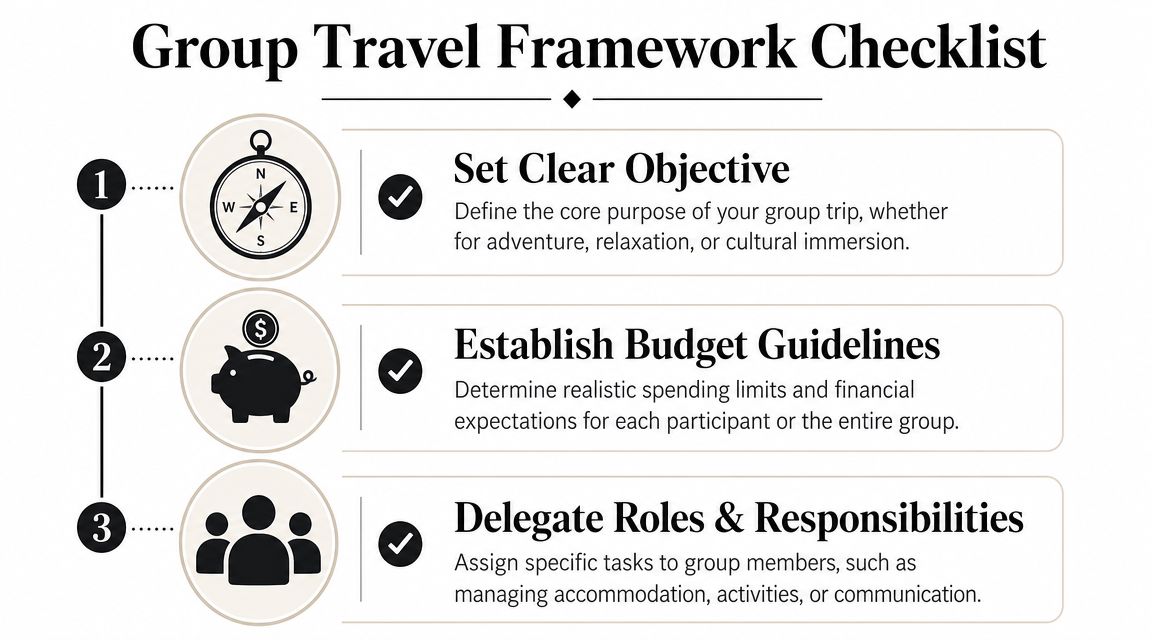
Most group travel problems start before any reservation is made. The trip fails at the alignment stage, not the checkout page. If you want to know how to plan group travel for a corporate event, destination wedding, or VIP occasion, start by fixing three things early: objective, budget, and control.
Define the trip objective before discussing options
A retreat, wedding weekend, and incentive trip may all involve flights, hotels, and vans. They should not be planned the same way.
If the trip objective is client hospitality, convenience matters more than squeezing every cost. If it's a wedding, timing reliability matters more than personal preference. If it's an internal offsite, the schedule has to protect attendance at key sessions, meals, and team moments.
Write the objective in a single sentence. Keep it visible in the shared document. It becomes the filter for every later decision.
Examples of useful objectives:
- Corporate retreat: Bring the full team on-site and on-time for scheduled programming with minimal admin friction.
- Wedding weekend: Move family and guests smoothly between airport, hotel, rehearsal, ceremony, and reception.
- Special event: Deliver a polished guest experience with controlled arrivals, clean handoffs, and no missed milestones.
Lock a consensus budget early
One of the most practical planning workflows is to lock in a consensus budget and assign one point person first, then use a shared document for all logistics. Planning guides commonly recommend starting 3 to 6 months in advance, while larger groups may need longer, as noted in this group trip planning guide.
That budget discussion needs to answer real questions, not vague ones:
- What is fixed by the organizer: room block, shuttle service, event meals, hosted activities
- What is traveler-paid: flights, incidentals, optional add-ons
- What is shared: charter transport, villa rental, welcome event, luggage handling
- What happens if costs change: organizer absorbs, cost gets reallocated, or scope gets reduced
Don't ask, “Is everyone okay with the budget?” Ask, “Can each traveler commit to this range by this date?”
A weak budget creates strong opinions later.
For social events, this matters just as much. If you're coordinating a bridal group and evaluating shared-house options, a page like hen party accommodation can help you compare lodging styles early, before people assume they're all paying for a different standard of stay.
Name one point person and define their authority
Groups don't need democracy. They need coordination.
The point person should control:
- Booking deadlines
- Vendor communication
- Version control for the itinerary
- Payment tracking
- Final decision rights when the group stalls
That doesn't mean doing every task personally. It means owning the plan.
A simple delegation model works well:
| Role | Owns |
|---|---|
| Point person | Timeline, approvals, vendors, master itinerary |
| Finance support | Collections, reconciliations, deposit tracking |
| Guest liaison | Traveler questions, rooming issues, arrival details |
| On-site lead | Day-of check-ins, transfer coordination, issue escalation |
Build one source of truth on day one
Use a shared spreadsheet, Airtable, Google Sheet, or event platform. The tool matters less than discipline. Every traveler record should include full name, mobile number, airline details if applicable, room assignment, payment status, and special notes.
What doesn't work is mixing details across text threads, personal inboxes, and screenshots.
What does work is a live tracker with tabs for:
- Travel roster
- Rooming list
- Transfer schedule
- Vendor contacts
- Payment status
- Open issues
If your framework is loose, every later booking becomes harder. If it's tight, the logistics start to stack cleanly.
Building a Seamless Itinerary and Timeline
A strong itinerary isn't a list of activities. It's a movement plan. It tells you where people need to be, when they need to move, and what has to be protected from delay.
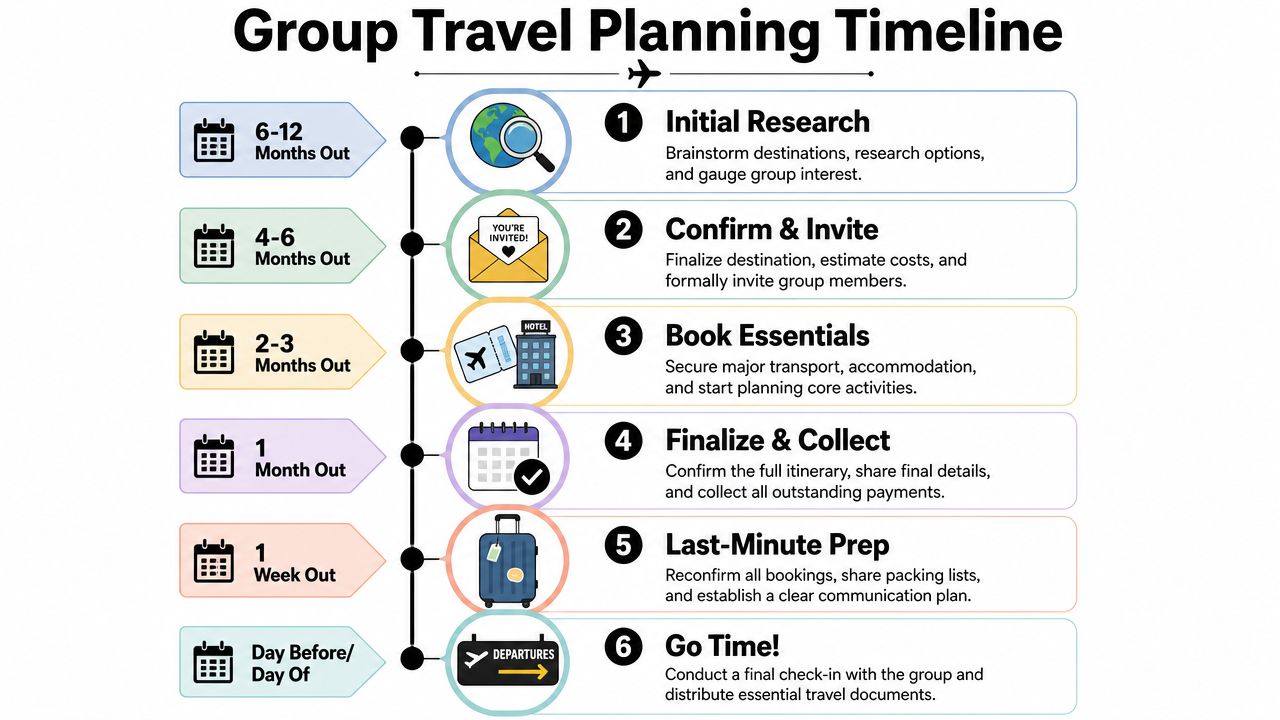
The simplest way to break group travel is to book in the wrong sequence. Secure activities before flights. Confirm dinner before transfer times. Ignore buffer windows between airport arrival and first scheduled obligation. That's how people miss welcome sessions, rehearsal calls, and opening meetings.
Start with this visual timeline, then build your own working version around fixed dates and movement windows.
Book the immovable pieces first
A practical benchmark is to book domestic trips about 60 days in advance and international trips about 80 days in advance, according to AAA travel statistics. That same guidance also supports a principle experienced planners already follow: once dates are fixed, flights come first.
For larger groups traveling to the same destination, Princeton's travel guidance notes that “group air” may apply for groups of 10 or more, and it places flights as the first priority once departure and return dates are set. The reason is straightforward. Air inventory, arrival timing, and route options shape every downstream choice.
After flights, move in this order:
- Accommodation
- Airport and local transportation
- Core event activities
- Meals and optional experiences
- Final documents and contact sheets
Build the itinerary around friction points
The best itineraries focus less on the “fun” items and more on the transfer points where delays compound.
For a corporate event, those friction points usually include airport arrivals, hotel check-in windows, off-site dinners, and return departures. For a wedding, they include rehearsal timing, hair and makeup movement, ceremony call times, and guest return transport after the reception.
Use a day sheet format that includes:
- Location
- Required arrival time
- Travel time
- Boarding or load time
- Named responsible party
- Backup instruction if the group is late
If a transfer matters, the load time should appear on the itinerary, not just the departure time.
This video offers a useful visual overview of trip-planning flow before you adapt it to an event-level schedule.
Leave room for real-world movement
Tight schedules look efficient on paper and fail in real life. Airports run late. Guests arrive early and need holding space. Hotel elevators slow down group departures. One missing bag can push an entire shuttle cycle.
That's why strong itineraries include buffer time at every point where people, luggage, credentials, or room keys are involved.
Here's a practical event planning view:
| Itinerary element | Common mistake | Better approach |
|---|---|---|
| Airport pickup | Matching one vehicle to one flight | Group arrivals by window and purpose |
| Hotel check-in | Assuming rooms are ready on arrival | Plan bag hold, early arrivals, and staging |
| Dinner transfer | Scheduling departure at true drive time | Add loading and guest-gathering time |
| Ceremony or meeting start | Backing travel right up to start time | Build an arrival cushion before required attendance |
Mix structure with breathing room
For business travel, not every minute should be free. For weddings and special events, not every minute should be scripted. The itinerary needs enough structure to protect key moments and enough flexibility to absorb normal variation.
That usually means anchor the mandatory events, then leave selected windows open. Guests feel taken care of without feeling trapped, and operators have room to recover if one segment shifts.
Selecting the Ideal Group Transportation
The transportation plan gets judged in real time. A late shuttle, a driver who cannot find the venue entrance, or a coach that has no room for garment bags will undo a lot of careful planning. For corporate events, weddings, and special occasions, vehicle selection is an operations decision first and a comfort decision second.
Seat count is only the starting point. Key questions are practical. How much luggage is coming? Are guests arriving in one wave or six? Does the venue have room for a coach to turn around? Do older guests need low-step boarding? Will a speaker, bride, or executive need private direct service while the rest of the group uses shared transport?

Match the vehicle to the movement pattern
Event planners get into trouble when they book by status or appearance instead of trip design. A full-size coach can be perfect for moving a conference group from one hotel to one venue. That same coach becomes inefficient if arrivals are scattered across terminals, hotels, and different times. A luxury SUV feels appropriate for VIPs, but it fails quickly if two travelers each bring large checked bags and a carry-on.
Use this working standard:
| Vehicle type | Best fit | Watch-outs |
|---|---|---|
| Executive sedan | Individual VIP airport pickups, speakers, senior leadership | Limited luggage space, poor fit for multi-passenger airport loads |
| Luxury SUV | Small executive groups, family units, airport transfers with moderate baggage | Easy to overload with large suitcases or garment bags |
| Mercedes van or Sprinter | Wedding party transfers, small corporate teams, site inspections | Boarding and luggage flow need active coordination |
| Executive shuttle | Hotel-to-venue loops, mid-size event transfers | Requires manifests, pickup windows, and clear dispatch control |
| Mini coach | Guest blocks, conference breakouts, structured group moves | Too large for narrow urban access points or fragmented arrivals |
| Full-size coach bus | Single-wave conference moves, large guest transfers, long-distance segments | Slow loading, limited flexibility, difficult at tight curbs or small venues |
Build airport service like an operations schedule
Airport transportation fails when no one owns the handoff from flight arrival to curb departure. That is why I build airport moves from a live manifest, not a rough headcount. Corporate groups often need tiered service. Executives may require direct vehicles. Staff may be grouped by arrival window. Wedding guests usually need simpler instructions, but they still need clear pickup points, driver contact details, and a backup procedure if phones die or bags are delayed.
A usable airport transfer plan includes:
- flight-by-flight arrival manifest
- terminal or pickup zone assignment
- luggage assumption by traveler type
- greeter or meet-and-greet instructions where needed
- dispatcher and driver contact chain
- delay procedure for missed, late, or rebooked arrivals
Max's Luxury Rides Inc. is one example of a provider that handles airport transfers, executive vehicles, Mercedes vans, minibuses, and coaches for event transportation with mixed traveler types and staggered arrivals.
One question should be answered before anyone boards a plane: what exactly happens after landing?
Use shared and private service on purpose
Multi-stop transport is where budgets and timing usually collide. Weddings often need separate movement for the couple, wedding party, immediate family, and guest shuttles. Corporate events have the same split in a different form. Speakers, executives, and clients often need tighter routing than the general attendee group.
The fix is not booking everything private or everything shared. It is assigning each tier to the right service level.
- Use private direct vehicles for VIPs, presenters, bridal party members on a fixed photo schedule, elderly guests, and any traveler tied to a hard arrival time.
- Use shared shuttles for hotel blocks, venue loops, and larger guest movement where a pickup window is acceptable.
- Use separate luggage moves if wardrobe, signage, gift bags, or production materials would slow passenger loading.
That split protects the moments that cannot move and keeps costs under control elsewhere.
Choose comfort based on consequence
Comfort affects behavior. A cramped 45-minute ride before a board meeting creates a different arrival than a calm direct transfer. A delayed wedding shuttle changes the mood before guests even reach the ceremony. That does not mean every leg needs luxury. It means the visible parts of the event need the right standard.
I usually sort transportation into three classes. Guest-facing and VIP-facing segments get the cleanest equipment and the simplest routing. Staff and vendor movement gets practical vehicles with less sensitivity to presentation. Overflow or contingency vehicles get booked for flexibility, not polish.
That same discipline helps on the budget side. Planners who overspend on low-visibility transport often create payment headaches later, especially when reimbursements or split charges are still unresolved. The same logic behind efficient payment collection for sports organizations applies here. Set up clean collection and approval rules early so transportation decisions are based on operational need, not last-minute cash confusion.
Managing Group Communication and Payments
Communication and money cause more stress than route planning. The route is objective. People are not.
A group can survive a delayed pickup if the update is clear. It usually can't survive vague instructions, last-minute payment surprises, or three different versions of the same itinerary circulating at once.

Build one communication channel and one record channel
These should not be the same thing.
Use a fast channel for updates. WhatsApp, Slack, or a dedicated SMS thread can work. Use a separate record channel for confirmed information. That could be a Google Drive folder, a trip portal, a locked PDF itinerary, or an event app.
Here's the split that works in practice:
- Fast channel: real-time updates, pickup notices, meeting reminders
- Record channel: final itinerary, transfer list, hotel details, emergency contacts, FAQs
When planners merge both into one scrolling chat, details get buried and people ask the same questions repeatedly.
Set a payment model before anyone pays a vendor
Many group trips become awkward at this stage: One person fronts a deposit. Another traveler hesitates. Someone backs out. Suddenly the organizer is chasing money while trying to keep the event moving.
Use one of these payment models and state it in writing:
| Model | Best for | Main risk |
|---|---|---|
| Organizer-paid, traveler reimburses | Small trusted groups, company-funded travel | Organizer carries exposure if people delay |
| Individual direct pay | Simple hotel or air bookings | Hard to keep booking pace aligned |
| Central collection before booking | Weddings, retreats, shared houses, charter transport | Requires firm deadlines and admin discipline |
| Staggered deposits | Larger groups with longer lead times | Needs strong tracking and clear refund terms |
For organizations that need cleaner workflows, lessons from systems built for efficient payment collection for sports organizations are useful here too. The principle is the same. Payment collection works better when reminders, statuses, and follow-up aren't being handled manually in scattered messages.
Reduce repetitive questions with a short FAQ
Every group asks the same things:
- When do I need to arrive?
- Who's sharing my transfer?
- What if my flight changes?
- Can I join only part of the itinerary?
- What's included versus optional?
- Who do I contact day-of?
Answer those once in a one-page FAQ and attach it to your record channel. That cuts noise and protects the point person from spending the week repeating logistics.
Clear communication doesn't mean sending more messages. It means sending fewer messages that answer the right questions.
Use a message cadence
Silence makes travelers anxious. Too many updates make them stop reading.
A simple cadence works well:
- Initial confirmation after commitment
- Booking deadline reminder
- Itinerary release
- Final logistics message in the week before travel
- Day-of movement updates only as needed
For executive and client-facing trips, keep the public messaging concise and save operational notes for the internal team. Guests shouldn't have to sort through backend detail to find pickup instructions.
Finalizing Contracts and Contingency Plans
At this point, amateur planning ends and professional planning begins.
Most group travel advice spends plenty of time on destinations, room types, and ideas for activities. It spends far less time on the hardest operational question: what happens when the plan changes after commitments are made. That gap matters. One of the biggest weaknesses in common advice is how to handle cancellation risk before deposits are paid, as noted in this practical guide on large-group travel stress points.
Read contracts for exit terms, not just service details
Planners often skim the front half of a contract and ignore the back half until there's a problem. That's backwards.
For transportation, lodging, and event vendors, review these items carefully:
- Cancellation terms
- Deposit schedule
- Final payment deadline
- Change fees or date-shift terms
- Overtime and waiting time rules
- Passenger count assumptions
- Liability and insurance language
- Weather or force majeure provisions
- Refund process and timeline
- Name change or substitution rules
If a contract doesn't clearly state what happens when a traveler drops out, ask before signing. Don't rely on verbal assurances.
Build a cancellation framework before collecting money
This is the part most groups avoid because it feels negative. It isn't negative. It's basic risk control.
Your framework should answer:
- When is a traveler considered committed
- Which payments are refundable
- Which costs are shared no matter what
- Whether a replacement traveler is allowed
- Who absorbs unrecoverable vendor charges
- How changes are documented
For example, a shared coach booking and a private house rental carry different risk. If one traveler leaves a coach group, the vehicle still runs. If one traveler leaves a shared house plan, the remaining group may have to absorb the difference unless you already agreed on a replacement or forfeiture rule.
Hope is not a cancellation policy.
Prepare for the predictable disruptions
Most contingency planning isn't about rare disasters. It's about ordinary disruptions that hit event schedules hard.
The main ones are familiar:
- Flight delays
- Lost luggage
- Weather shifts
- Late hotel room availability
- Driver access restrictions
- Last-minute attendee changes
- Venue timing changes
A real contingency plan includes named responses. Who monitors inbound flights. Who updates guests. Who can authorize an extra vehicle. Which events can shift without damaging the day. Where guests wait if rooms aren't ready. What the backup pickup point is if curb access changes.
For weddings and corporate programs, I like a simple red-amber-green system on the operating sheet. Green means the plan is intact. Amber means a delay is active but contained. Red means the event flow has changed and all key stakeholders need a revised instruction.
Protect the guest experience while solving the problem
When things move off plan, the worst response is broadcasting panic. Guests don't need every internal detail. They need the next instruction.
That means your public-facing message should stay short:
- where to go
- who to contact
- what time to expect the update
- whether anything they care about has changed
Your internal team can handle the detailed recovery behind the scenes.
The strongest group travel plans don't eliminate every problem. They prevent small problems from turning into visible failures.
If you're coordinating airport transfers, executive movement, wedding transportation, or guest shuttle service and need the vehicle side of the plan handled professionally, Max's Luxury Rides Inc. can support group transportation with options ranging from executive sedans and luxury SUVs to Mercedes vans, shuttles, minibuses, and coach buses. For planners managing tight schedules and multiple traveler types, having a transportation partner that can align with the itinerary, pickup windows, and guest flow makes the rest of the event easier to control.