
You're probably trying to solve the same problem a lot of planners face right now. The group is ready, the date is picked, and someone has said, “Let's just get a party bus.” That's where people usually make the first expensive mistake, because renting a party bus isn't a casual add-on, it's a chartered transportation purchase with hours, routing, minimums, and contract terms that can swing the final bill hard.
If you want to rent one without getting trapped by the headline hourly rate, treat it like operations work, not nightlife planning. The smart move is to lock the trip details first, pressure-test the operator, and compare the all-in cost before you put down a deposit.
What Renting a Party Bus Involves
A party bus is not a glorified rideshare. It is a chartered service, which means the operator is pricing time, vehicle class, route complexity, and availability, not just a lift from one address to another. The same bus can swing wildly in cost depending on the city, the date, the itinerary, and the minimum booking window.
That is why party buses make sense for events where timing and coordination matter. Weddings, proms, corporate outings, concert runs, and airport-adjacent group transfers all justify the format because they need one vehicle, one schedule, and one point of accountability. Amenities still matter, but they come after the main cost drivers, which are headcount, route design, and how long the bus has to stay reserved.
The market is not a tiny side niche. The charter bus industry sits inside a $6 billion annual U.S. sales sector with more than 35,000 private charter buses available for hire. That scale is the reason early booking pays off, especially around event-heavy dates and weekends that fill fast.
A party bus rental works best when you approach it like an operations problem, not a passenger upgrade. If you cannot state the exact trip and the exact timing, you are not ready to compare quotes.
Practical rule: if the itinerary is not written down yet, the quote is not real yet.
Lock Down the Four Booking Variables First
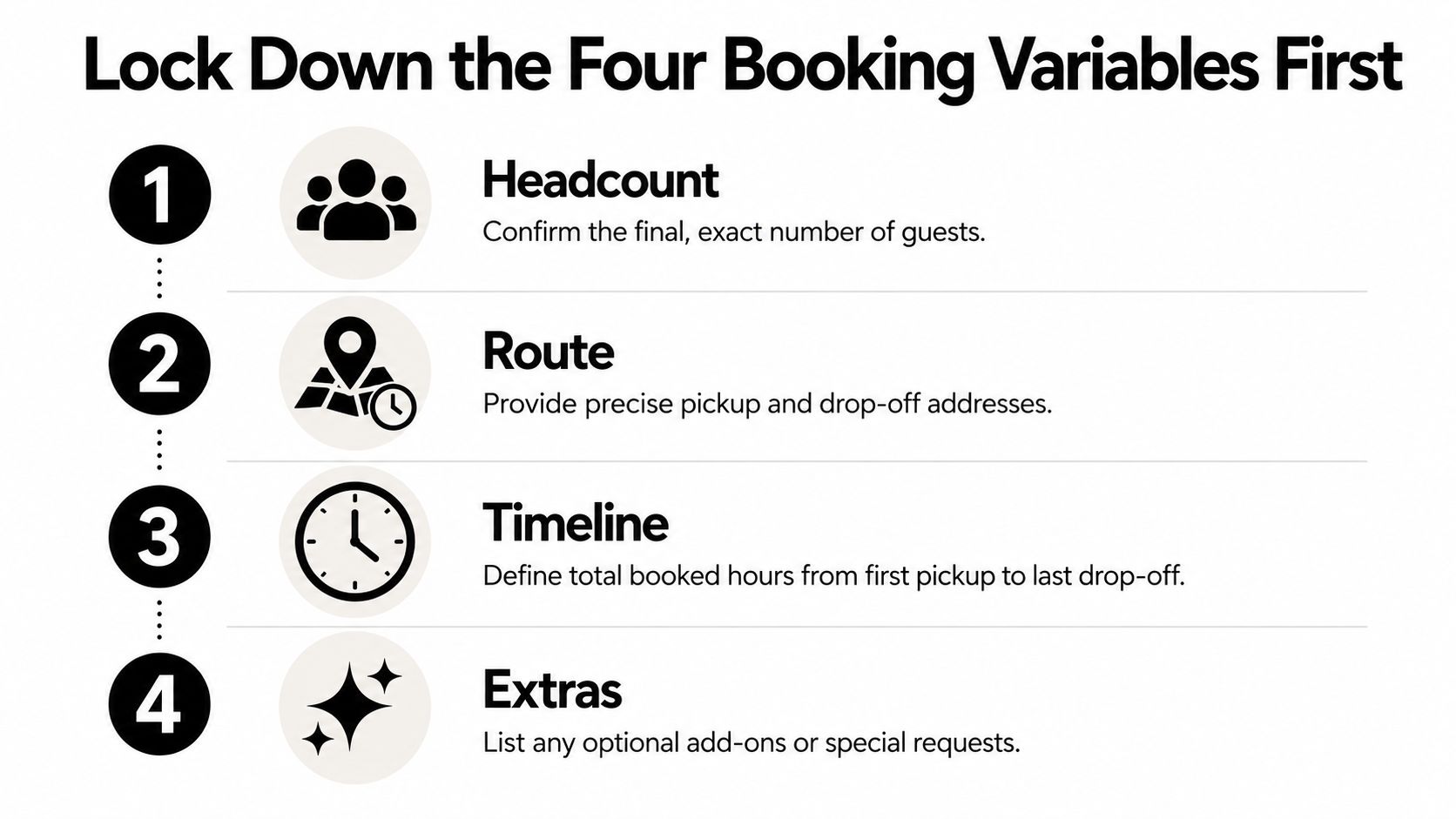
The fastest way to get a clean quote is to stop being vague. Operators price by vehicle type, time, and route complexity, so if you send a message that says “a few hours for a big group,” you're forcing them to guess. Guessing creates quote drift, and quote drift kills comparability.
Headcount and route are not optional
Start with the final headcount, not the rough estimate. One extra wave of guests can push you into a different vehicle class, and that changes the math immediately. The same goes for the pickup and drop-off points, because exact addresses tell the operator whether the route is straightforward or full of constraints.
If you're planning photos before a wedding or dinner before a show, add that into the timeline instead of assuming it'll fit later. A 30-minute cushion can change the vehicle choice, especially if the bus needs to wait in place while the group is outside taking pictures or gathering stragglers.
Hours and curb access decide the quote
The total booked hours need to run from first pickup to last drop-off. “A few hours” is not a usable planning input, and it usually leads to uncomfortable surprises when the trip runs long. If you're using a hotel, venue, or loading dock with access restrictions, note that too, because curb access can alter routing and pickup efficiency.
Clean input gets clean pricing. If the operator knows the headcount, the exact addresses, the real time window, and the loading-zone limits, the quote gets much tighter.
Ask for written quotes only
Once those four variables are locked, ask at least three providers for written quotes. Then compare the contract language, not just the total number, because overtime rules, included fees, and cancellation terms are where the differences hide.
Budget for the Real Total Cost
Thumbtack's 2025 nationwide data puts the most common total price for a party bus at $745, with typical rentals ranging from $517 to $1,073, and hourly rates commonly landing between $130 and $235 Thumbtack party bus pricing. That's the number that should anchor your budget, not the cheapest hourly quote you see in an ad.
The reason is simple. Most operators price by the hour but also require a minimum booking block, so the final bill reflects both the rate and the minimum duration. In major markets, the total can climb further because urban taxes, tolls, congestion charges, gratuity, and cleaning fees often sit on top of the base fare. If you don't ask for those upfront, you're not comparing real offers.
Use the all-in math, not the headline rate
A low hourly rate can still produce a higher final bill if the contract includes a long minimum block or heavy add-ons. A higher hourly rate can be the better value if the operator quotes everything clearly and doesn't bury required fees. That's the contrarian truth most pricing pages avoid.
For event planning, this is exactly the same budgeting mistake people make in other categories too. A broad wedding budget guide for Central Texas is a useful reminder that transportation should be priced as a line item in the full event budget, not treated as an afterthought.
Sample All-In Cost Calculation for a Party Bus Rental
| Line Item | Low Estimate | High Estimate |
|---|---|---|
| Hourly base rate | Lower quoted rate | Higher quoted rate |
| Minimum booking block | Required minimum hours | Required minimum hours |
| Gratuity | Added if not included | Added if not included |
| Tolls and urban charges | Route-dependent | Route-dependent |
| Cleaning fee | If charged | If charged |
| Overtime | If trip runs long | If trip runs long |
| Total trip cost | Compare the all-in total | Compare the all-in total |
A “$150 per hour” quote can end up much more expensive than a “$200 per hour” quote if the first one has a strict minimum and a pile of add-ons. Compare the full bill, not the ad.
Research and Vet Operators Like a Pro
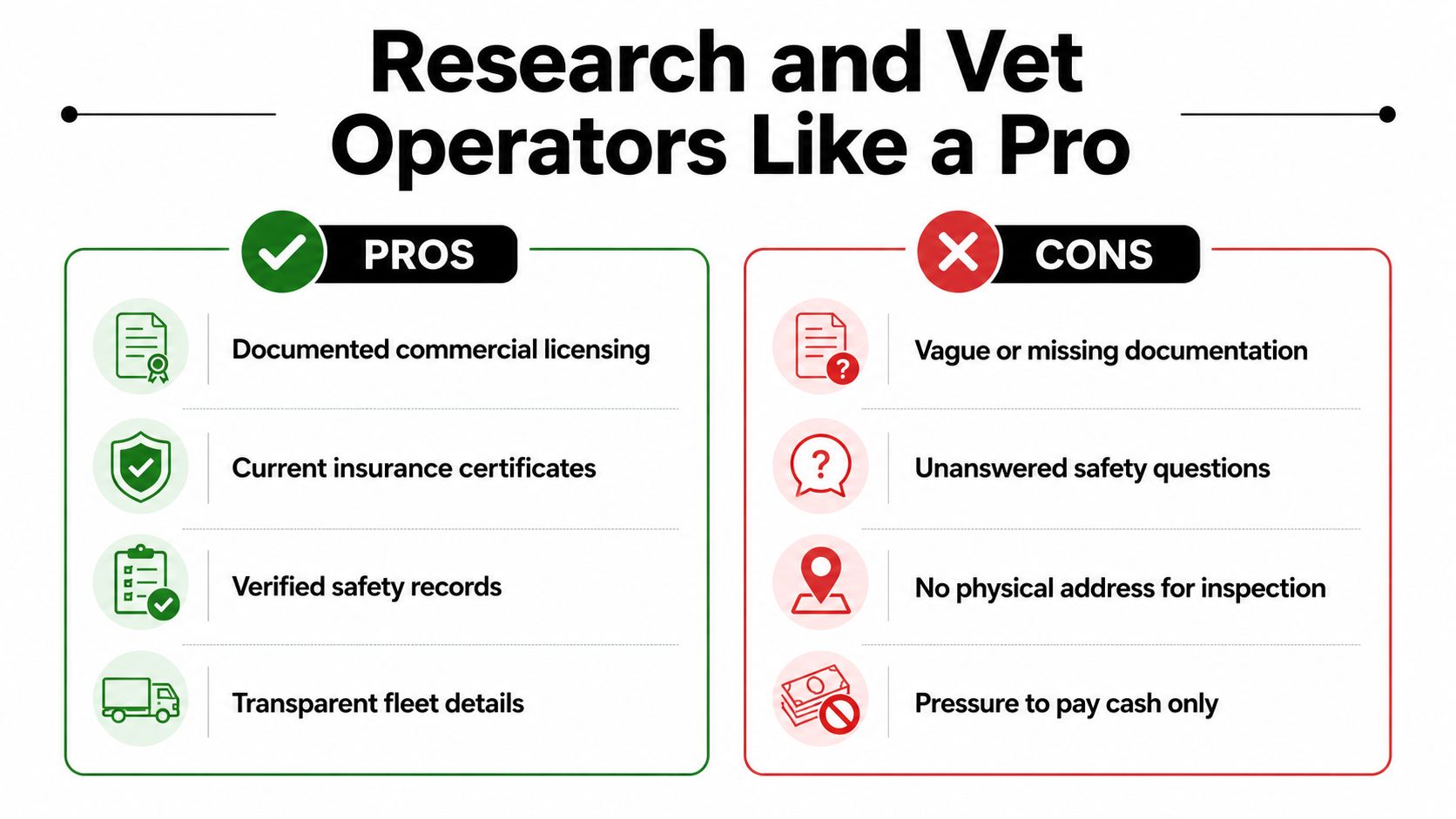
A good operator should be easy to verify. If the company gets weird about documents, payment methods, or basic identity questions, walk away. You're not buying a vibe, you're buying a regulated transportation service.
What you need to see
Ask for commercial licensing, current insurance certificates, and the operator's carrier number or state registration details. You also want clarity on fleet condition, maintenance standards, and driver vetting. If the company can't tell you who is running the trip, that's a problem.
The most useful questions are blunt ones. Ask, “Who is the actual operator on the contract?” Ask, “Is the vehicle I'm quoted the vehicle that arrives?” Ask, “What is your DOT or state carrier number?” Weak operators hate those questions because they expose gaps fast.
Red flags you should not ignore
Refusal to share insurance paperwork is a hard stop. So is pressure to pay cash only or a failure to name the assigned driver before service day. If there's no physical address for inspection or the company gives vague answers about safety records, don't rationalize it away.
A strong shortlist should only have two or three real candidates. Anything more turns into noise, and anything less leaves you without negotiating power. The point is to compare serious operators on price, vehicle fit, and reliability, not to reward the one with the slickest landing page.
Operational truth: the quote is only as good as the company behind it. If the paperwork is thin, the service usually is too.
For corporate groups and airport work, I'd also look at operators like Max's Luxury Rides Inc., which offers airport transfers, corporate travel, and special occasion vehicles, including party bus options, alongside other group-transport formats. It's one option among many, but it shows the kind of service range you should expect from a serious provider.
Time Your Booking Around Peak Demand
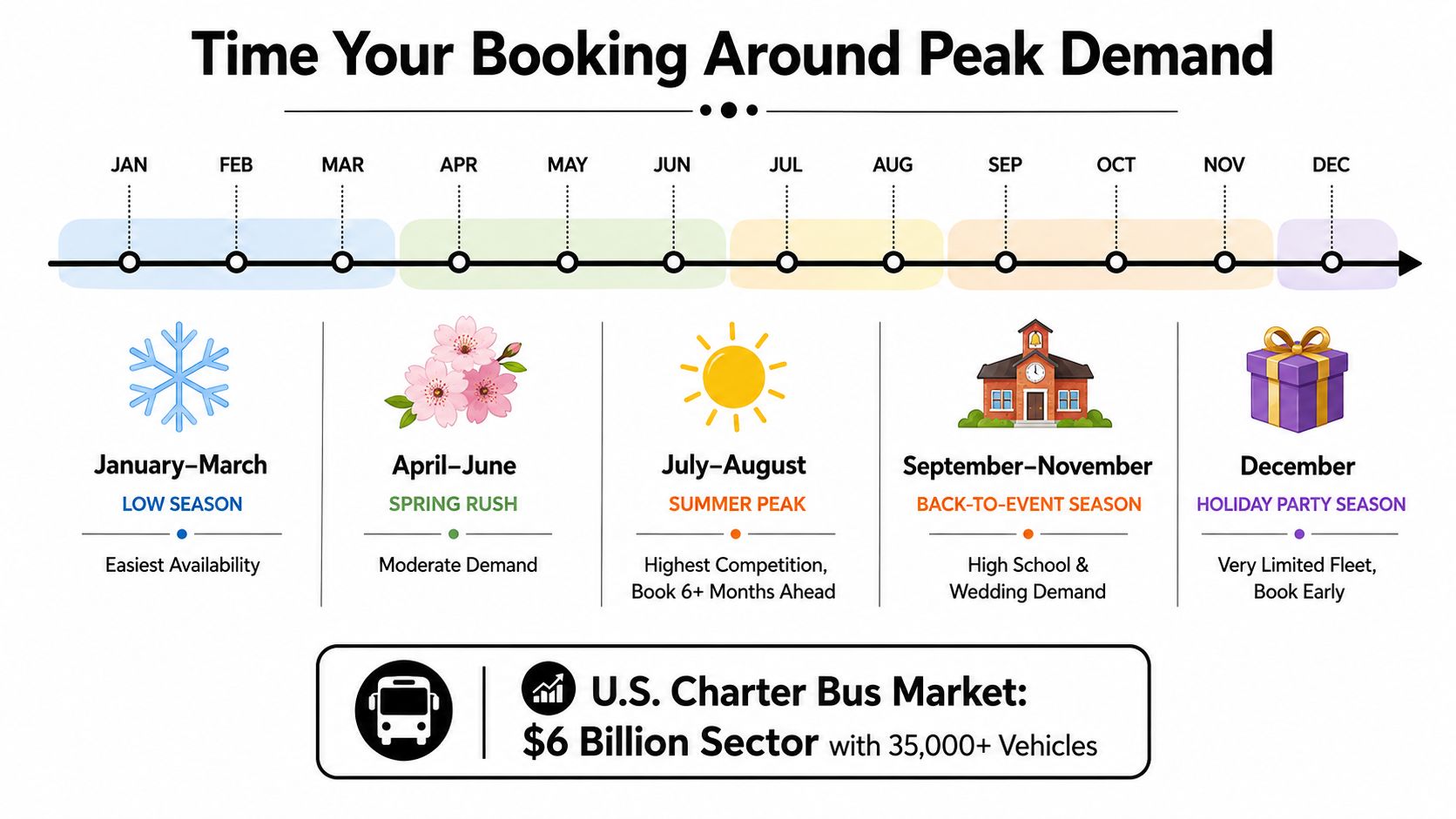
The vehicle is only half the equation. The booking date decides what is available, what it costs, and how much influence you still have when the operator sends the contract. Party bus demand surges in the same stretches every year, so if you book late, you are buying whatever is left, not what you wanted.
Peak demand follows event season. Search interest for party bus rentals spiked in late March and late August in 2025, which aligns with prom season, summer weddings, and late-summer events. That kind of spike is exactly why the quoted rate on a Friday afternoon can turn into a worse deal by Monday morning industry tracking cited by Indian Trails.
Book by event type, not by hope
Lead time should match the event, not your comfort level. For off-peak dates, a 1 to 2 month window is usually workable. For peak-season weddings and proms, 3 to 6 months is the safer range. For major holidays or citywide events, 6 to 12 months is the right planning window if you want steadier pricing and better vehicle choice lead-time guidance from Larry's Limo.
Fast quote tools make people sloppy. An instant quote is not a reserved bus, and a promised rate is not locked inventory. Availability can disappear while your group is still arguing over guest count, pickup times, and whether the after-party is happening.
Book earlier if the event is public-facing, date-sensitive, or tied to a one-night venue window. Those trips get squeezed first, and operators know it.
The market behaves like a sold-out calendar
The charter bus supply is broad, but event demand piles up in the same weeks every year. That creates the ugly tradeoff operators rarely advertise. On high-demand weekends, you may have to choose between vehicle size, onboard amenities, and the price you were hoping to hold.
Wait too long and you usually get the scraps. That means a smaller vehicle, a weaker interior, a worse pickup time, or a higher rate with less flexibility on the contract. The cost of late booking is not just the quoted price. It is the loss of options.
If your group is planning event content, digital promotion, or travel coordination around the trip, a service like leisure content creation services can help organize the surrounding communications, but the transportation reservation itself still needs to be secured early. Treat the bus as a scarce asset first, and the rest of the planning becomes easier.
Read the Contract Before You Sign
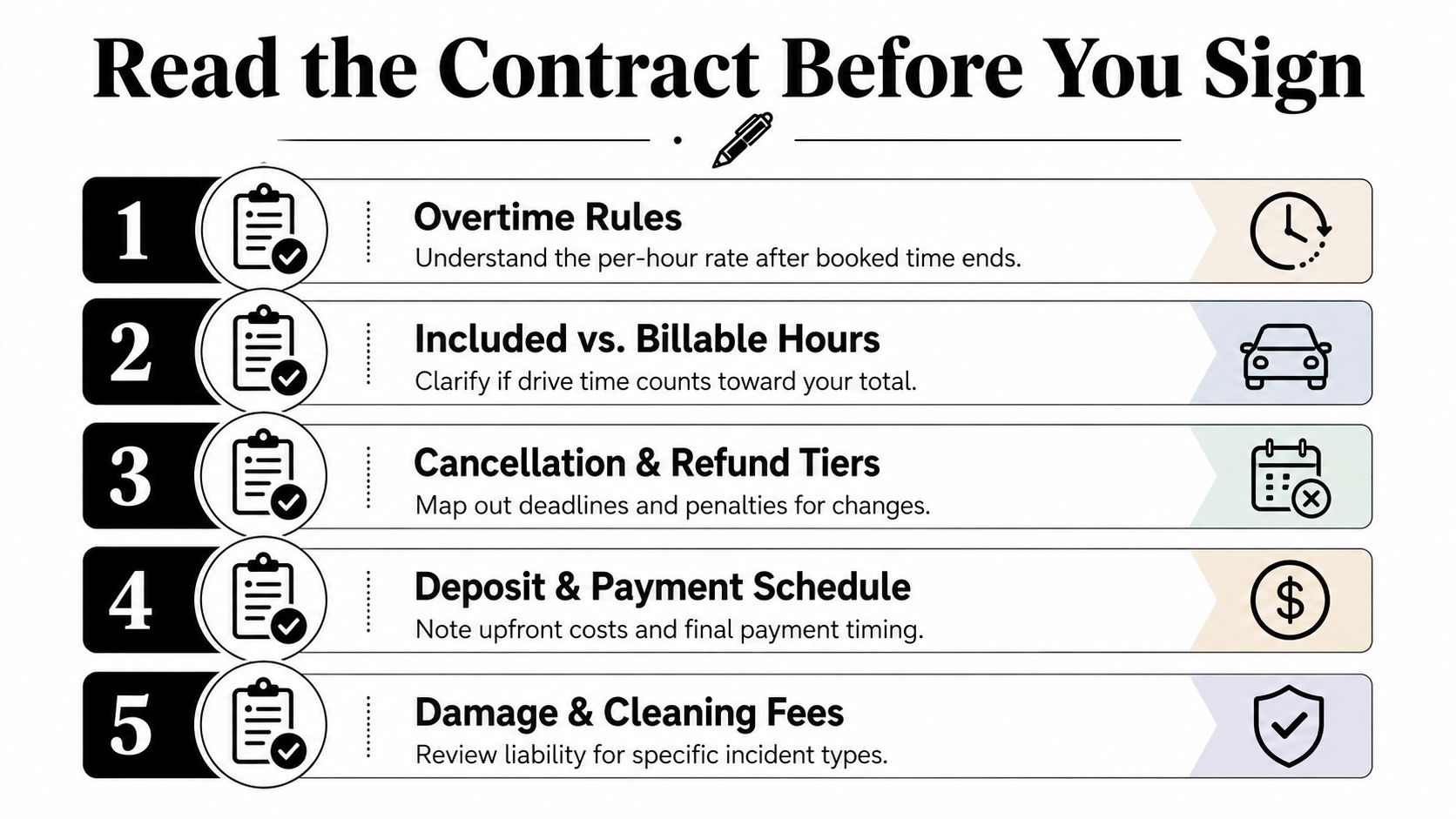
The contract is where a cheap quote stops being cheap. Read every line before you pay a deposit, because the wording on overtime, cancellation, cleaning, and damage can change the final bill fast. A short contract review costs far less than a long argument after the trip.
Compare the clauses that move money
Use the deposit, payment, and dispute terms as your first filter. The booking guidance from Larry's Limo booking guidance points to a 25% to 50% deposit range and recommends paying by credit card for dispute protection. Start there, then check how the operator treats included hours, billable hours, and the point where overtime starts.
Look hard at these five items:
- Overtime rules. Know the hourly rate once booked time ends.
- Included versus billable hours. Confirm whether drive time counts.
- Cancellation and refund tiers. Read the penalties before you commit.
- Deposit and payment schedule. Note when the balance is due.
- Damage and cleaning fees. Read the liability terms line by line.
Two contracts can look similar and cost very differently
One operator gives a short grace period and then charges hard the moment the bus runs long. Another quotes a slightly higher base rate but uses cleaner timing rules and more practical payment terms. The second contract usually wins because the final bill is easier to predict.
Reconfirm the trip 1 to 2 weeks before the event. Lock the pickup point, route, driver contact details, and any access changes before the day gets hectic. If the venue moved a loading zone or your hotel changed its curb policy, catch it then.
Best practice: if the contract does not clearly explain how overtime and cleaning are charged, assume those items will be expensive.
Tailor the Booking to Your Event Type
Weddings, corporate outings, airport transfers, and concert nights all use the same basic booking logic, but the priorities shift. If you treat every trip the same, you'll miss the details that matter most for your event. The smart move is to keep one core checklist and adjust the emphasis by use case.
Weddings need timing discipline
For weddings, the main stress point is the gap between ceremony and reception. Bride and groom logistics, bridal party separation, and photo timing all affect how many hours you need. Don't book a pretty bus and hope the schedule works itself out.
Wedding rule: build the timeline around photography, traffic, and guest movement, not around the ceremony start time alone.
Corporate, airport, and concert trips have different pressure points
For corporate events, presentation matters. The vehicle should arrive clean, the pickup should be on time, and the itinerary should support conference schedules and executive movement without drama. For airport-adjacent transfers, curb access and flight-delay flexibility matter more than onboard flair, because the primary risk is missed timing at the terminal or FBO.
For concert and sporting event nights, the issues are pickup zones and post-event congestion. You want a staging plan, a clear meeting point, and enough time in the contract to cover the return without improvising when the crowd spills out. Multi-stop group nights also need tighter routing, because every extra pickup adds friction.
Good event transport does one thing well, it removes logistics from the night. If the bus forces you to think about the schedule every ten minutes, the operator didn't do the job right.
For a direct quote on a party bus, corporate transfer, airport run, or special event itinerary, visit Max's Luxury Rides Inc. and request the exact vehicle, hours, and route you need. Book early, ask for the all-in price, and don't pay until the contract matches your trip.
If you want transportation that's planned the right way, Max's Luxury Rides Inc. handles airport transfers, corporate travel, special occasions, and group trips with party bus options included in its fleet mix. Visit Max's Luxury Rides Inc. to request a quote that matches your headcount, route, and event timing before your date fills up.