
A mini coach bus typically seats 24 to 35 passengers on a roughly 28 to 32 foot body, bridging the gap between a Sprinter van and a full-size 50 to 56 seat motorcoach. That middle size can keep a group together without forcing you to maneuver a full coach through every hotel entrance, venue loop, or airport curb.
You may be arranging transportation for a wedding, a corporate program, or an airport pickup and facing an awkward choice. Your group is too large for one comfortable van, yet a full-size coach seems excessive. The vehicle decision isn't only about seats. Luggage, turning space, boarding access, and the physical shape of the route can determine whether the booking works smoothly or creates problems at the curb.
Why the Mini Coach Bus Solves the Middle-Size Group Problem
Your group has 28 people, several suitcases, and a venue reached through a narrow hotel driveway. Several vans could carry everyone, but you would need multiple vehicles, chauffeurs, and a way to keep the group together. A full-size motorcoach would provide plenty of seats, yet its larger body could make the final approach difficult while leaving much of its capacity unused.
A mini coach bus fits this operating gap. One shared vehicle keeps the group together, while its smaller footprint generally makes hotel loops, city streets, and event entrances easier to handle than a full-size coach. Minibuses and minicoaches developed as a category between vans and full-size coaches, supporting urban shuttles, airport transfers, tours, and special-service routes. The historical background on the minibus segment describes the market's growth in the early 1960s, as interest in small buses expanded in major U.S. cities.
Seat count is only the first check. Before booking, assess:
- How many people will ride, including staff or guides?
- How much luggage or equipment must travel inside the cabin or in storage compartments?
- Can the vehicle reach each pickup and drop-off point without difficult turns or tight approaches?
- Does anyone need a lift, ramp, or wheelchair securement?
- Would one coordinated vehicle be easier to manage than a van caravan?
These questions explain why a 30-person trip can be more demanding than a 30-seat calculation. A wedding venue may have a tight circulation loop. An airport may limit curb dwell time. A tour group may bring enough baggage to exceed the available storage, even though every traveler has a seat.
Route geometry matters as much as the passenger manifest. A vehicle that fits the group on paper can still create delays if its turning radius, approach angle, or loading position does not suit the property.
Operational rule: Choose the vehicle for the whole trip, not just the passenger manifest.
A mini coach earns its place by balancing group cohesion, access, and capacity. It usually offers less luggage volume and fewer seats than a full-size motorcoach, while a van may reach smaller streets more easily. The practical choice depends on how those trade-offs fit the complete route, boarding needs, and equipment load.
What Exactly Is a Mini Coach Bus
Think of passenger vehicles as a ladder rather than a collection of unrelated categories. At one end sits a small Sprinter-style van, useful for a compact group. Above it are minibuses and mini coaches. At the upper end is the full-size motorcoach, built for larger passenger loads and substantial luggage.
A mini coach is commonly treated as a minibus designed to carry 16 or more passengers including the driver, usually built on a small truck chassis, according to Federal Motor Carrier Safety Administration guidance for bus, motorcoach, and minibus operators. That chassis choice matters. A lighter truck-based platform can make low-speed maneuvering more manageable and procurement or maintenance less complex than a full-size motorcoach, but it generally provides less luggage capacity and less long-haul baggage space.
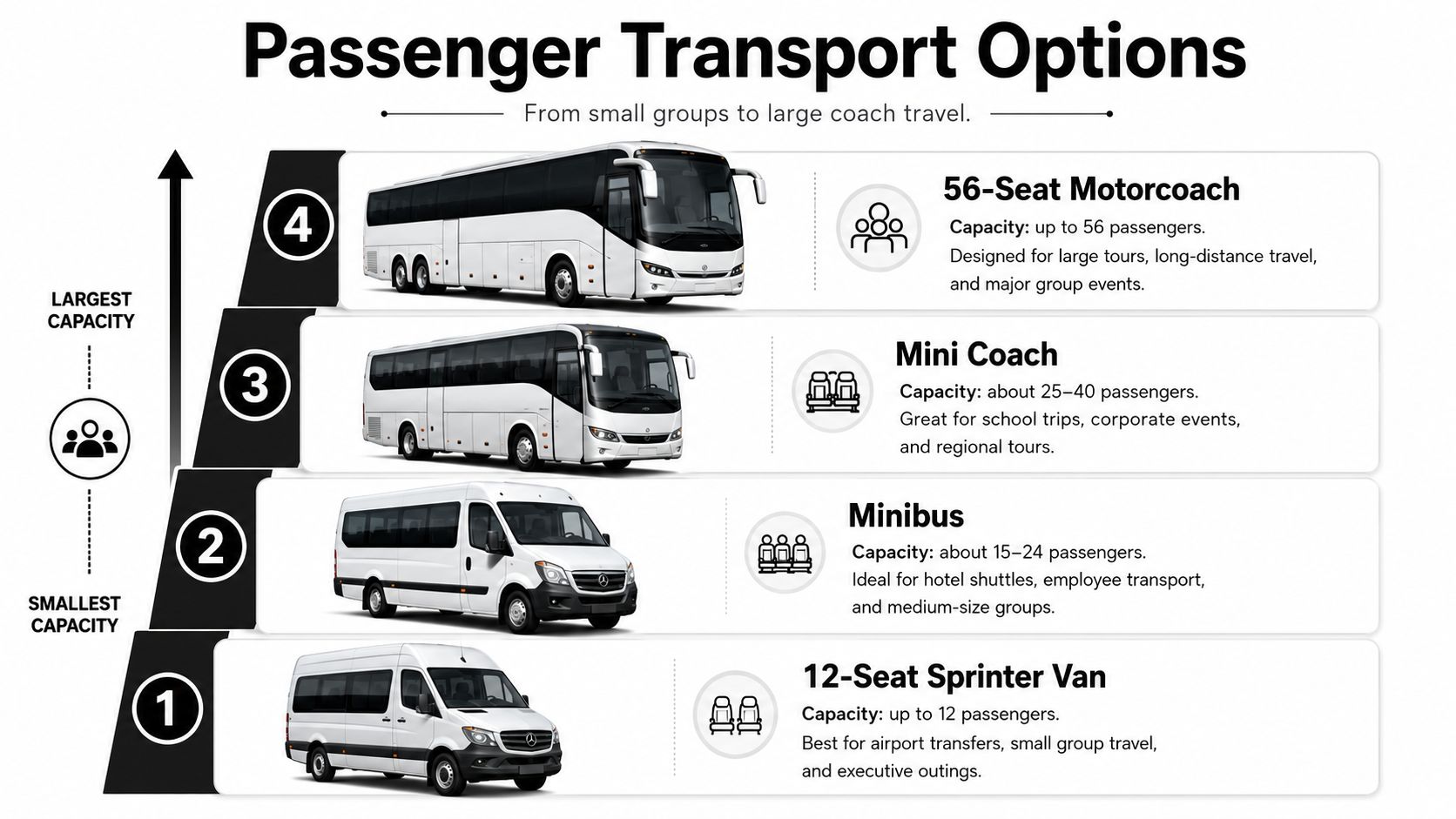
The vehicle ladder in plain language
A Sprinter van is the compact option. A minibus moves more passengers while remaining suited to local circulation. A mini coach adds a more coach-like passenger environment and group capacity. A full-size motorcoach provides the greatest passenger and baggage capability, but it also demands more room at turns, curbs, and loading areas.
The labels aren't perfectly uniform across manufacturers. One operator may call a particular vehicle a minibus, while another calls a similar configuration a mini coach. That's why you should request the actual passenger capacity, floor plan, body length, luggage arrangement, and accessibility equipment, rather than relying on the category name alone.
A mini coach bus is a mid-size, truck-chassis passenger vehicle that carries more people than a van while offering a smaller operating footprint than a full-size motorcoach.
The design tradeoff is straightforward. The smaller platform can help a driver approach dense venues and complete low-speed maneuvers with less difficulty. In return, passengers and planners may have to accept more limited storage, fewer long-distance coach features, or a cabin layout that changes the usable space.
For a short event transfer with light luggage, that compromise may be ideal. For a multi-day tour where each passenger brings substantial baggage, the same vehicle may feel constrained even if the advertised seating number appears sufficient.
Mini Coach Capacities and Specifications Explained
Most industry guides place mini coach seating at 24 to 35 passengers, with typical body lengths of approximately 28 to 32 feet. A full-size charter coach generally seats 50 to 56 passengers, so a mini coach carries roughly 43% to 70% of a full-size coach's passenger capacity, depending on the configuration. These figures are summarized in this coach seating capacity comparison.
| Vehicle Type | Typical Seating | Approx. Length | Best Fit |
|---|---|---|---|
| Sprinter van | Varies by configuration | Varies by configuration | Small teams, executive transfers, compact airport groups |
| Minibus | 24 to 35 | Varies by configuration | Local shuttles, weddings, tours, event circulation |
| Mini coach | 24 to 35 | 28 to 32 feet | Mid-size groups needing one coordinated vehicle |
| Full-size coach | 50 to 56 | Larger than a mini coach | Large groups, extensive baggage, longer journeys |
The table is a starting point, not a booking confirmation. A 30-person corporate team may fit within a 35-seat mini coach, but the final decision depends on equipment, luggage, and whether the operator's stated capacity includes the chauffeur. A 25-person wedding party may have plenty of passenger space but still need a storage check for formalwear bags, overnight luggage, and personal items.
A group of 32 is closer to the upper end of the standard mini coach range. That doesn't automatically rule the vehicle out, but it makes the floor plan and luggage arrangement more important. Ask whether all seats face forward, whether any seats are removed for accessibility equipment, and where bags will go during a full vehicle movement.
Seat count doesn't describe the interior
Forward-facing rows use space differently from perimeter or lounge seating. A vehicle can have a generous headline capacity but offer less practical room when passengers need aisle access, mobility-device space, or unusually large belongings.
Request these details before paying a deposit:
- Exact seat count: Confirm whether the quoted number includes the driver.
- Body dimensions: Check the vehicle's actual length and height against the route.
- Luggage arrangement: Ask whether bags use a rear compartment, underbody storage, overhead racks, or cabin space.
- Floor plan: Look for wheelchair positions, aisle width, seat pitch, and restroom placement if applicable.
- Amenities: Confirm WiFi, power outlets, climate control, and other features rather than assuming they're standard.
The most useful comparison isn't “Does it have 35 seats?” It's “Can this specific vehicle carry our people and belongings through this specific itinerary without sacrificing safe boarding or usable aisle space?”
Common Uses for Mini Coach Buses
A mini coach bus makes sense when the operating pattern matches its limits. It can handle a shared airport transfer, a repeated corporate shuttle, or a wedding movement efficiently. The same vehicle may be a poor choice for a tour with heavy luggage or a route built around narrow turns.

Airport transfers
A corporate group arriving at O'Hare or Midway may need one pickup, one chauffeur, and one destination schedule. A mini coach keeps the group together while presenting a smaller approach profile than a full-size coach at an airport loading area or hotel entrance.
Luggage determines whether that arrangement works. Carry-ons and a modest amount of personal baggage may fit comfortably, while a long program can create more storage demand than the passenger count suggests. Give the operator the number and type of bags, including suitcases, equipment cases, and personal items, before confirming the vehicle.
Corporate shuttle loops
A weeklong program may move employees between a hotel, office, meeting venue, and dinner location. Because the route repeats, the operator can review the loop in advance and confirm where the bus can wait, turn, and load passengers safely.
The main benefit is coordinated movement. One vehicle supports a common departure time and shared arrival, while its interior offers a more consistent setting than several small vans. Route geometry still matters. Check height restrictions, curb access, turning space, and the actual stopping locations before the first service day.
For broader planning ideas, these tips for event guest transport can help coordinators organize timing, guest movement, and pickup communication.
Weddings
A 28-person wedding party may travel between the ceremony, photography location, and reception. Keeping everyone together reduces the risk that one vehicle misses a departure or arrives late after following a separate route.
Seat count is only the starting point. Long dresses, garment bags, floral items, overnight bags, and personal belongings can compete for limited storage. Ask where each category will ride, whether the compartment can accept garment bags, and whether guests can board without crowding the aisle.
City tours and sporting events
For a city tour or sporting event, parking and venue approach can matter as much as capacity. A mini coach preserves group cohesion while requiring less physical space than a full-size motorcoach, though the driver still needs a legal, practical loading point.
Inspect tight intersections, restricted streets, event traffic patterns, and venue instructions. Transit guidance describes bus turning needs through substantial curb-radius requirements, including approximately 50 feet for a single-lane turn without encroachment and a desirable 30-foot curb radius when turning into two or more lanes. The transit-planning design reference provides the underlying geometry. A mini coach may fit a route that challenges a larger coach, but the operator should verify the turns, clearances, and stopping areas instead of relying on vehicle labels.
The market also includes changing demand for flexible shuttle and feeder vehicles. UK minibus registrations have shown volatility, so planners should judge a vehicle by the current trip requirements, not by broad market direction.
Mini Coach vs Sprinter Vans and Full-Size Coaches
The central comparison is not small versus large. It is coordination versus flexibility, access versus storage, and capacity fit versus unused space.
For a group of 28, a van caravan could mean three vehicles, three chauffeurs, and three separate loading experiences, depending on the selected van configuration. That arrangement may work when stops split in different directions, but it creates more coordination work. A full-size coach keeps everyone together and usually handles baggage better, yet its larger body can make hotel loops, event entrances, and constrained urban approaches more difficult.
A mini coach often occupies the practical sweet spot for groups in the roughly 20 to 35 passenger range, provided luggage and accessibility needs match the vehicle. That isn't a universal rule. A baggage-heavy tour may need a full coach even with fewer passengers, while a group approaching the upper end of the mini coach range may need another option.
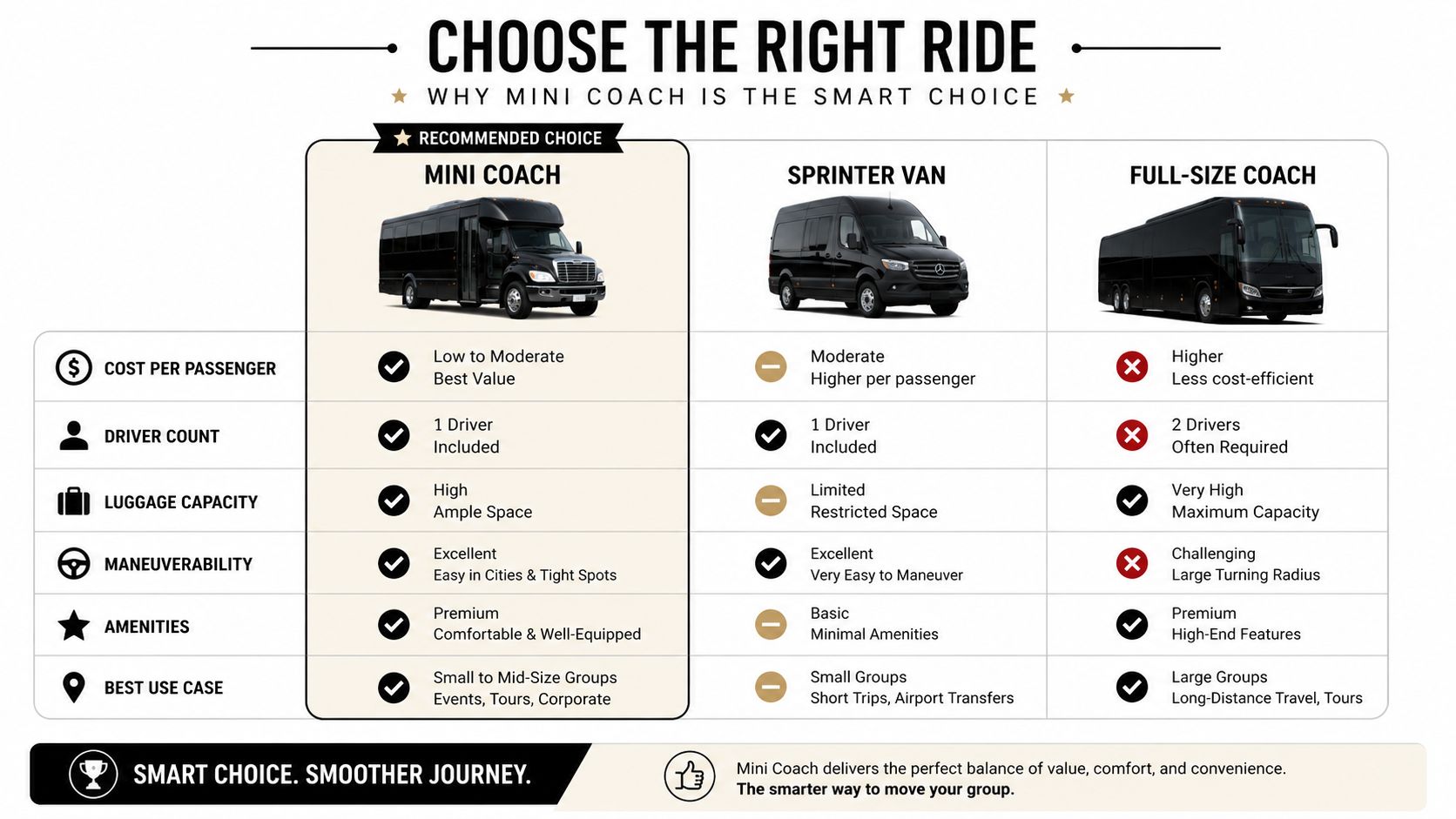
Compare the operating tradeoffs
| Planning factor | Sprinter vans | Mini coach | Full-size coach |
|---|---|---|---|
| Passenger fit | Best for smaller groups or split movements | Strong fit for mid-size groups | Best for large groups |
| Driver coordination | Multiple vehicles may require multiple chauffeurs | Usually one vehicle and one chauffeur | Usually one vehicle and one chauffeur |
| Route access | Most flexible on narrow approaches | More accessible than a full coach | Needs the most turning and curb space |
| Luggage | Limited to moderate, depending on layout | More limited than a full coach | Strongest baggage capability |
| Comfort | Executive or van-style comfort | Mid-size group comfort | Coach-style comfort and amenities |
| Best use | Small groups, VIP trips, split itineraries | Weddings, shuttles, events, tours | Large groups or baggage-heavy travel |
For a broader operational perspective on keeping groups coordinated, Another Side Of Los Angeles Tours insights offer useful context about group movement and communication.
Use these signals when narrowing the choice:
- Choose a Sprinter van when the group is compact, luggage is light, or different passengers need different destinations.
- Choose a mini coach when one mid-size group needs one schedule, one pickup, and a route with urban access constraints.
- Choose a full-size coach when the group is large, baggage volume is substantial, or long-distance coach amenities outweigh route flexibility.
- Ask for two vehicle options when the group size is near the mini coach's ceiling or the luggage estimate is uncertain.
Market conditions also support a more flexible planning mindset. The UK bus, coach, and minibus market fell 17.0% in Q3 2025, while year-to-date registrations rose 26.9%. The same reporting identified minibuses as the main source of quarterly volatility, and wider market commentary points to flexibility, shuttle demand, electric minibuses, and smart fleet systems as important considerations. Current UK market coverage provides that context.
How to Book the Right Mini Coach for Your Group
Start the booking call with an itinerary, not a vehicle name. An operator can recommend a mini coach, minibus, or full-size coach more accurately when you provide the passenger count, luggage profile, addresses, timing, and access needs together.
Confirm the passenger and luggage picture
Count every passenger who will ride, including event staff, guides, and coordinators. Then describe luggage accurately. “One bag per person” can mean different things depending on whether the group has backpacks, rolling carry-ons, large suitcases, equipment cases, garment bags, or mobility devices.
Ask the operator:
- What is the exact passenger capacity of the proposed vehicle?
- Does that capacity include the driver?
- Where will all luggage go when every seat is occupied?
- Can the operator send the floor plan or a current vehicle specification sheet?
- What amenities are installed, such as WiFi, power outlets, climate control, or a restroom?
Check the route before the quote becomes a contract
Provide every pickup, drop-off, hotel entrance, venue loop, and planned stop. A vehicle can have enough seats and still be unsuitable for a driveway, low-clearance entrance, restricted curb, or tight turn.
Ask whether the operator will review the route and identify a safe loading point. For a repeating corporate shuttle, confirm where the vehicle can wait between runs. For an airport transfer, clarify the terminal pickup procedure and how the group will identify the chauffeur.
Treat accessibility as an operating requirement
A “wheelchair-friendly” description doesn't automatically prove that the service will work for a particular passenger. Federal guidance for over-the-road buses addresses lifts or other boarding assistance and requires wheelchair securement locations, while the MBTA bus accessibility guide illustrates why boarding and restraint procedures require practical coordination.
Ask specific questions:
- What boarding equipment is installed, a lift or ramp?
- How many securement positions are available?
- What wheelchair dimensions and weights can the equipment accommodate?
- Will the chauffeur assist with boarding and securement?
- Can the accessible vehicle serve every stop on the itinerary?
Accessibility planning should happen before the vehicle arrives. A lift at the curb isn't enough if the stop has no usable boarding area or the interior lacks proper restraint space.
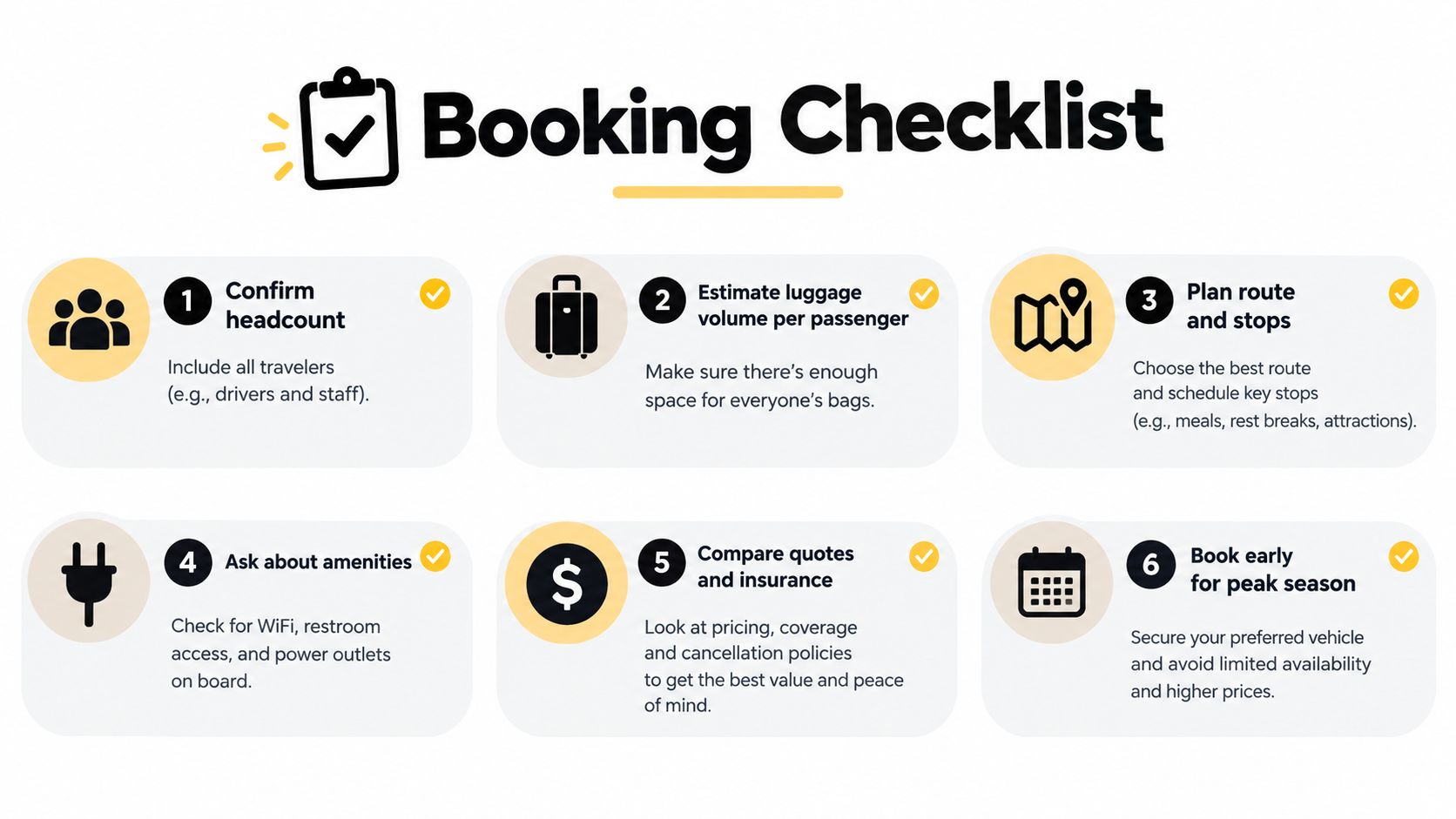
Vet the operator, not only the vehicle
Compare maintenance practices, chauffeur screening, insurance documentation, communication procedures, and after-hours support. Ask who handles itinerary changes and what happens if a vehicle issue affects the assignment.
Max's Luxury Rides Inc. offers chauffeur-driven minibuses, mini coaches, and full-size coach buses, along with airport, corporate, and event transportation, and states that it operates 24/7 and accepts major credit cards. Treat those as booking details to verify against your own trip requirements, not as substitutes for asking about the assigned vehicle, accessibility, and route.
Key Takeaways for Choosing Your Mini Coach Bus
A strong mini coach decision starts with an honest headcount, but it doesn't end there. Match the vehicle to the number of people, the luggage they will bring, the streets and entrances they must use, and the boarding support any passenger requires.
The mini coach's advantage is fit. It can keep a mid-size group together without automatically committing you to the physical footprint of a full-size motorcoach. It can also reduce the coordination burden that comes with multiple vans, particularly when everyone follows the same schedule and destination pattern.
Use this short decision filter:
- Size the group accurately. Include staff, guides, and anyone else who will ride.
- Describe luggage realistically. Storage limitations can change the correct vehicle even when the seat count looks right.
- Review route geometry. Check turns, curb space, clearances, loading zones, hotel loops, and venue access.
- Verify accessibility early. Confirm lifts or ramps, securement points, restraint procedures, and usable boarding locations before the travel day.
- Compare the actual vehicle. Request its capacity, dimensions, floor plan, amenities, and luggage arrangement.
- Vet the operator. Review maintenance, chauffeur standards, insurance, communication, and support for itinerary changes.
The market's continued movement toward smaller, more flexible passenger vehicles doesn't eliminate the need for careful planning. It makes the fit conversation more important. A diverse fleet gives the operator room to recommend a better match instead of forcing every mid-size group into an undersized van or an oversized coach.
Contact an operator with your full itinerary and ask for a vehicle recommendation based on passengers, luggage, route geometry, and accessibility. For chauffeur-driven minibuses, mini coaches, and full-size coaches supporting airport transfers, corporate travel, weddings, and events, visit Max's Luxury Rides Inc. to review the available transportation options and request a booking conversation.