
Oak Park isn't just a suburb of Chicago; it's a living museum and the single best place to immerse yourself in the world of Frank Lloyd Wright. Here you'll find the largest single collection of his buildings anywhere, all clustered within a few walkable blocks. This is where he lived, worked, and gave birth to the Prairie School, a style that would fundamentally reshape American architecture.
Discovering America's Architectural Treasure
A visit here is a walk through history. You get to see Wright's genius unfold right before your eyes, from his own family home to the groundbreaking structures that dot the surrounding streets. Forget stuffy museums—this is where architecture comes alive.
We’re not here to give you generic travel tips. Instead, think of this as your practical guide to crafting a truly memorable experience. We'll cover everything from which tours to book to how to find those hidden architectural gems, ensuring your visit is as seamless as it is inspiring.
The Cradle of American Architecture
It all started when a 22-year-old Wright, armed with a $5,000 loan, decided to build his home in Oak Park. This wasn't just a house; it was a creative laboratory where he would raise six children and refine the revolutionary ideas that became his signature.
For 20 years (from 1889 to 1909), the Frank Lloyd Wright Home and Studio in Oak Park served as his personal residence and the epicenter of his burgeoning architectural practice. It was within these walls that he pioneered the Prairie School design philosophy.
This dual-purpose building was the launchpad for a movement. You can dive deeper into its history and significance by visiting the Frank Lloyd Wright Trust's official page.
Why This Tour Is a Must-Do
Walking through Oak Park is more than just a sightseeing trip; it’s like stepping into an architectural textbook. You get a tangible sense of how one of history's most creative minds worked and evolved.
- Witness the Evolution of an Icon: See Wright's style mature, from his early Shingle-style Home to the pure, geometric forms of the groundbreaking Unity Temple.
- Experience a Living Exhibit: The entire neighborhood is the main attraction. Over two dozen Wright-designed structures are woven into the fabric of a real, vibrant community.
- Get the Inside Story: A good guide can share the context and anecdotes behind the designs, bringing the buildings—and their creator—to life in a way you just can't get from a book.
This guide will walk you through the practical steps to plan your visit, helping you choose the right tour and make the most of every moment in this incredible historic district.
Finding the Right Frank Lloyd Wright Tour for You
Picking the right Frank Lloyd Wright tour in Oak Park is probably the most important decision you'll make for your visit. It’s not a one-size-fits-all situation. The best choice really comes down to your schedule, your level of interest, and how deep you want to go into Wright's world of Prairie School architecture.
For most people, the can't-miss experience is the Frank Lloyd Wright Home and Studio Interior Tour. This is where you get to walk through the very spaces where Wright lived with his family and kicked off his legendary career. It's a genuinely fascinating look at his early design philosophies and personal life, all wrapped up in the building he considered his first real masterpiece.
Guided Tours vs. Self-Guided Exploration
The guided interior tour is perfect if you love hearing the stories behind the designs from an expert. You'll get the context behind the iconic furniture, the beautiful stained glass, and the design choices that made the home a creative laboratory. It's a structured experience that guarantees you won’t miss the important details.
On the other hand, if you're someone who prefers to wander at your own pace and just soak in the atmosphere of the neighborhood, the Outdoor Historic Neighborhood Audio Tour is an excellent option. This lets you explore the exteriors of dozens of Wright homes and other important buildings on your own time. It offers total flexibility and gives you a much broader sense of his impact on the entire community.
Oak Park has a few different tour combinations, but the most popular is easily the guided Home and Studio Interior Tour, which takes about an hour. For anyone with mobility concerns or who's short on time, the self-guided audio tour is a great alternative that also runs about an hour. Of course, you can always combine them for a comprehensive two-hour journey that gives you both the interior access and the neighborhood walk. For a deeper dive on what to expect, you can plan your Oak Park architectural visit with more detailed reviews.
To help figure out what’s best for you, this little decision tree might help clarify things.

It really just boils down to whether you're here for a deep architectural dive or a broader historical overview.
Oak Park Frank Lloyd Wright Tour Comparison
To make it even simpler, here’s a quick breakdown of the main tour options. I find that seeing it laid out like this really helps people pinpoint the right fit for their trip.
| Tour Type | Typical Duration | What You See | Best For |
|---|---|---|---|
| Home & Studio Interior | 60–75 minutes | Wright's personal residence, his studio, and original furnishings. | First-time visitors and anyone who wants expert-led stories. |
| Neighborhood Audio Tour | 60 minutes | Exteriors of 20+ Wright-designed structures and other historic homes. | Visitors on a tight schedule or those who prefer self-paced exploration. |
| Combined Tour | ~2 hours | The full interior experience plus the highlights of the surrounding neighborhood. | Architecture enthusiasts who want the complete, in-depth experience. |
Ultimately, choosing your tour is a balance between how much time you have and what you're most interested in. If you want a focused, powerful experience, the Home and Studio tour is unmatched. But if you have a bit more time and want to see how his vision truly shaped a community, the combined tour gives you the most complete picture.
Key Considerations Before You Book
No matter which tour you’re leaning toward, book your tickets in advance. I can't stress this enough, especially if you're visiting during the peak season from late spring through early fall. Tours sell out all the time, particularly on weekends.
Insider Tip: Keep an eye out for special events like the Wright Plus Housewalk. Held every May, this incredible event offers a rare chance to see the interiors of privately-owned Wright homes. Tickets are extremely limited and often sell out months ahead of time, so plan accordingly
Planning Your Perfect Day in Oak Park
A great trip to see Frank Lloyd Wright’s work in Oak Park all comes down to planning. The good news is you don’t need an entire day to get a real feel for his architectural genius; even a couple of well-spent hours can leave a lasting impression. The trick is to match your available time to the right activities.
Whether you're squeezing in a quick visit between meetings or making a dedicated pilgrimage, having a loose schedule in mind before you arrive makes all the difference. It lets you relax and simply absorb the stunning Prairie School designs all around you.
Here are a few sample itineraries, based on years of visiting, that you can use as a starting point.
The 2-Hour Express: Quick Immersion
This is for anyone tight on time who wants to hit the absolute highlights. The goal here is maximum impact, focusing on the single most important site.
- Total Time: Around 2 hours.
- Must-Do: Book the 60-minute guided interior tour of the Frank Lloyd Wright Home and Studio. If you only do one thing, this is it. It’s the origin story of the Prairie School.
- Next Steps: With your remaining hour, take a brisk walk down Forest and Chicago Avenues. This isn’t just a random stroll—you'll see the stunning exteriors of icons like the Arthur B. Heurtley House and the Nathan G. Moore House, getting a real sense of the neighborhood Wright created.
This whirlwind tour is perfect for business travelers with a free afternoon or tourists trying to pack a lot into a Chicago visit. You’ll leave having seen the very place where American architecture was redefined.
The Half-Day Deep Dive: For the Architect's Dream
If you've got a bit more breathing room, this itinerary lets you soak in the atmosphere of the neighborhood and truly appreciate Wright's vision. It combines the essential interior tour with a more relaxed exploration of the historic district.
This approach is about more than just looking at houses. It's about understanding how these incredible structures talk to each other and create a cohesive, groundbreaking architectural landscape.
Start with the foundational Home and Studio Interior Tour. Once you’re done, grab a map for the self-guided audio walking tour and give yourself a good 90 minutes to two hours to wander the surrounding streets. This pace gives you time to actually listen to the history, take great photos, and notice the intricate details on each home's exterior.
Round out your visit with a late lunch or a well-deserved coffee at one of the great local spots in downtown Oak Park. It’s a deeply satisfying experience for any architecture buff, and you won't feel rushed at all.
The Family-Friendly Adventure
Let’s be honest, historic home tours can be tough with kids. This plan is designed to keep everyone happy by mixing in some fun and freedom.
- Start with a Walk (1.5 hours): Begin with the Outdoor Historic Neighborhood Audio Tour. The self-guided format is a lifesaver—you can move at your own pace, linger where the kids show interest, and skip a few stops if you feel a meltdown coming on.
- Take a Break (1 hour): Right nearby is Scoville Park. It’s the perfect spot for a picnic or to just let the kids run wild for a bit. A little playground time can make all the difference.
- A Different Kind of Beauty (1 hour): End your day at the Oak Park Conservatory. The lush plants and flowers offer a completely different kind of visual wonder that tends to captivate all ages, making for a calm and beautiful finish to your day.
This itinerary ensures the adults get their architecture fix while the kids have a genuinely good time, making your Oak Park trip a win for the whole family.
Getting to Oak Park and Navigating Like a Local
Your architectural pilgrimage to Oak Park starts with a simple choice: how to get there. Located just west of downtown Chicago, this historic village is remarkably easy to reach, but your mode of transport can genuinely shape your experience for the day.
The big decision usually boils down to taking public transit or driving yourself. Chicago's public transportation is a fantastic, budget-friendly option that drops you right in the middle of the action, connecting you effortlessly from the Loop.
Riding the Rails to Wright's Neighborhood
For an authentic Chicago experience, hopping on the train is my top recommendation. It's the best way to skip the infamous city traffic and the often-frustrating hunt for a parking spot. You can just sit back and watch the urban landscape melt into the leafy, historic streets of Oak Park.
- CTA 'L' Train (Green Line): This is your most direct link from downtown. When you get off at the Oak Park stop, you're looking at a pleasant 15-minute walk—less than a mile—to the Frank Lloyd Wright Home and Studio.
- Metra (UP-W Line): The Metra is a comfortable commuter train that also stops in Oak Park. The walk from this station is a touch shorter, only about 12 minutes, making it another excellent choice.
Both train lines are efficient and put you on your feet, ready to explore, which is exactly what an Oak Park Frank Lloyd Wright tour is all about.
Driving and Parking Considerations
If you need the flexibility of a car, Oak Park is a straight shot from the city on the I-290 expressway. Be warned, though: parking can be tricky, especially on a beautiful weekend day when everyone has the same idea.
Most of the street parking in the historic district has a two-hour limit, which is almost never enough time to fully appreciate the Home and Studio, let alone wander the neighborhood.
My advice? Plan on using a public parking garage. The Holley Court Garage is a reliable spot, but don't forget to account for the walk from there to the Home and Studio when planning your schedule.
The Ultimate Stress-Free Arrival
For a truly seamless and elevated experience, especially for groups, corporate outings, or anyone flying into O'Hare or Midway, a chauffeured service is the way to go. Think about it: you step off the plane and a professional driver is waiting to whisk you away in a luxury vehicle, directly to the heart of Oak Park.
Arranging a pickup with a company like Max's Luxury Rides takes all the guesswork out of the equation. No train schedules to decode, no parking to worry about, no unfamiliar streets to navigate. Your driver handles it all, ensuring you arrive relaxed and ready to dive into Wright's world. It’s the perfect way to make the journey itself part of a premium, memorable day.
Exploring Beyond the Frank Lloyd Wright Trail
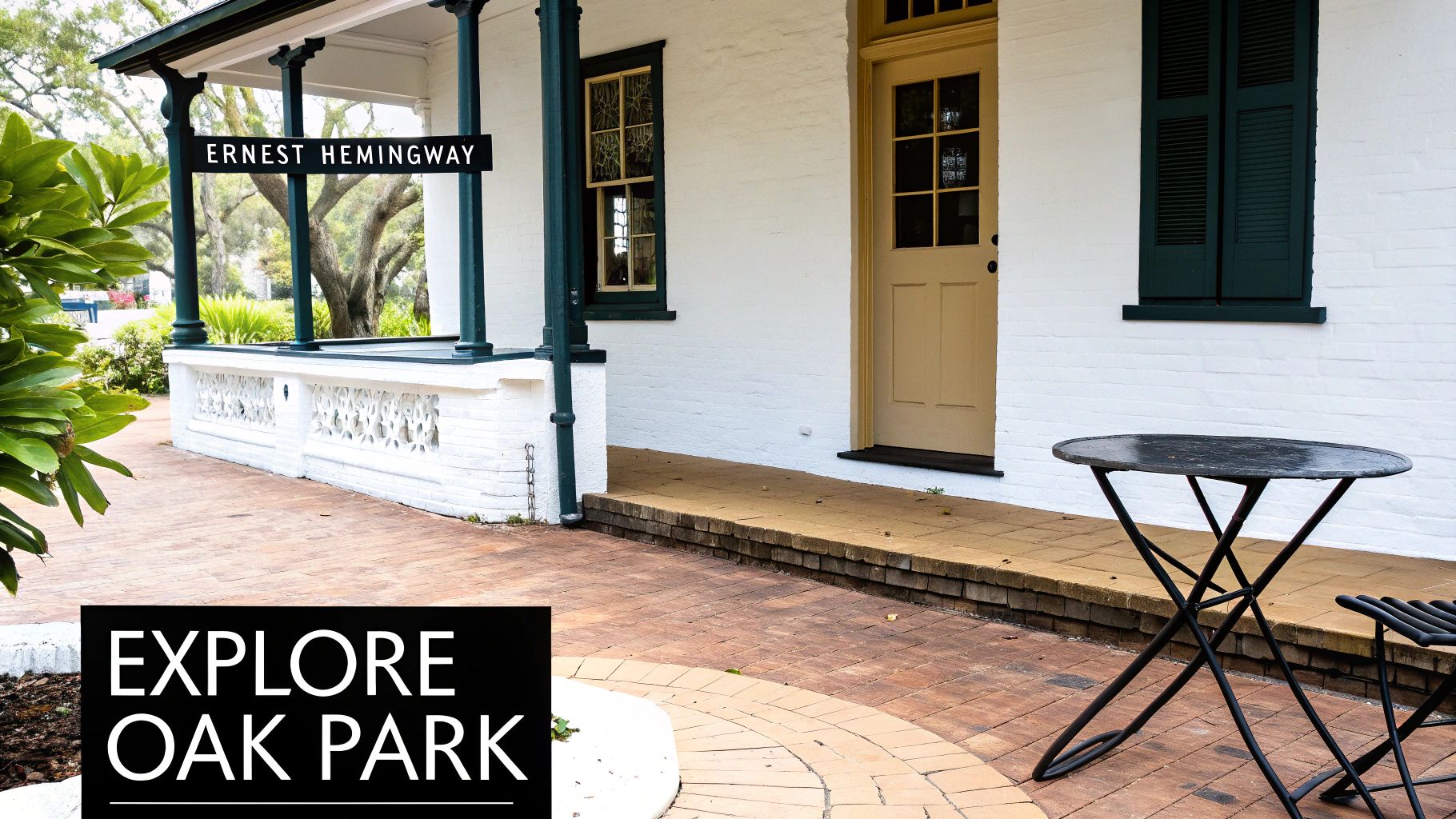
Once you’ve had your fill of Prairie School architecture, don’t rush off. Oak Park’s cultural roots run deep, and Frank Lloyd Wright, as central as he is, is only part of the story. You’ll find that the village that nurtured his genius was also home to other creative giants, making it easy to turn your Oak Park Frank Lloyd Wright tour into a full-day experience.
It often surprises people to learn that just a few blocks from Wright’s iconic Home and Studio, another American legend was growing up. The Ernest Hemingway Birthplace Museum offers a completely different, yet equally fascinating, look into the turn-of-the-century world that shaped one of America’s greatest writers.
A Literary Detour
A short, pleasant stroll will take you to the meticulously restored Queen Anne-style home where Ernest Hemingway was born in 1899. Stepping inside is like stepping back in time, offering a window into the conservative Victorian world that the future Nobel Prize winner would famously reject in his life and work.
- What You’ll See: The museum is filled with original family furnishings, photos, and artifacts that paint a vivid picture of Hemingway’s early years and the influences that would later appear in his writing.
- Why It’s Worth It: The home provides a compelling contrast to Wright's modernism. Seeing both gives you a much richer understanding of the creative currents—and counter-currents—that defined Oak Park at the dawn of the 20th century.
Frank Lloyd Wright's legacy in Oak Park is staggering. During his two decades here from 1889 to 1909, he designed over 100 buildings in the Chicago area, transforming the village into a living museum of early modern American architecture. To see inside some of the privately-owned homes, keep an eye out for special events like the annual Wright Plus Housewalk.
Other Architectural Marvels
While Wright is the undisputed main attraction, he wasn't the only architect making waves in Oak Park. If you have time, make a point to see Pleasant Home, a magnificent Prairie-style mansion designed by Wright's contemporary, George W. Maher.
This 30-room estate, now a National Historic Landmark, is a masterclass in craftsmanship, boasting incredible woodwork, stunning art glass, and a grandeur all its own. It's a fantastic point of comparison, showcasing how another brilliant mind interpreted the Prairie School ethos.
Curated Dining and Refreshments
A day spent on your feet exploring history and architecture definitely earns you a great meal. Thankfully, Oak Park’s dining scene is more than up to the task.
- For a Quick Bite: Downtown Oak Park is dotted with fantastic cafes and bakeries, perfect for grabbing a coffee and a pastry to refuel between tours.
- For a Memorable Dinner: To cap off your day, settle in at one of the area's more upscale restaurants. It’s the perfect setting to relax and reflect on all the history and beauty you've just taken in.
From literary landmarks to architectural gems and fantastic food, sticking around after your Wright tour reveals the true depth and character of this remarkable village.
Your Oak Park Visit: Answering Your Top Questions
To make sure your visit goes off without a hitch, I've put together answers to the questions I hear most often from people planning their Frank Lloyd Wright tour. Getting these practical details sorted out ahead of time means you can just relax and soak in the architectural genius when you arrive.
From the first glimpse of a Prairie-style roofline to the intricate art glass, you'll want to be completely present. Let’s get the logistics out of the way so you can focus on the experience.
Is the Frank Lloyd Wright Home and Studio Tour Accessible?
This is a really important question, and the answer has a few parts. Because the Home and Studio is a historic structure built way back in 1889, there are some built-in limitations. The good news is that the first floor is accessible for guests using wheelchairs, so you can still get a fantastic look at the primary living spaces.
The second floor, however, which includes that incredible playroom, can only be reached by a staircase. The outdoor neighborhood walking tour is generally accessible, as it follows the public sidewalks through the historic district.
My Advice: I always recommend calling the Frank Lloyd Wright Trust directly before you book. Their staff is wonderful and can give you the most up-to-date details on accessibility to make sure your visit is comfortable and works for you.
Can I Take Photos Inside the Home and Studio?
Everyone wants to capture the incredible details inside, and for the most part, you can. The rules are there to protect the historic interiors and make sure the tour is enjoyable for everyone.
Typically, you can take personal photos without a flash. This is perfect for getting shots of the furniture, art glass, and the overall feel of the rooms. Just know that there are a few things they don't allow:
- Video recording of any kind
- Tripods and monopods
- Selfie sticks (the spaces can be a bit tight for those)
The best practice is to just double-check with your guide when you start the tour. They’ll give you the final word, as policies can sometimes change for special events or preservation work.
What Is the Best Time of Year to Visit?
You can't really go wrong, but some seasons definitely have an edge. For the perfect blend of great weather and beautiful scenery, I’d aim for late spring (May-June) or early fall (September-October). The temperature is ideal for the walking tour, and the neighborhood gardens are either in full bloom or showing off their gorgeous autumn colors.
Summer is popular, of course, but you'll be dealing with bigger crowds and Chicago's famous heat and humidity. On the flip side, winter offers a much quieter, more intimate tour, but you'll definitely need to bundle up for the outdoor parts. No matter when you go, booking your tickets ahead of time is a must, especially if you’re planning a weekend trip.
Are Tours Available in Other Languages?
This comes up a lot, especially for international visitors. The main guided tours inside the homes are conducted in English.
However, the Frank Lloyd Wright Trust does a great job of welcoming a global audience. For the self-guided neighborhood audio tour, you'll find options in several languages, often including Spanish, French, German, Japanese, and Mandarin. For any of the guided tours, your best bet is to check their official website or call visitor services to see what materials or special arrangements might be available.
For a truly seamless visit, from airport pickup to your hotel and a comfortable ride to Oak Park, consider the bespoke service offered by Max's Luxury Rides Inc. Let our professional chauffeurs handle the logistics so you can fully immerse yourself in the architectural wonder of the day. Learn more about our premium Chicago transportation services.