
Off-peak pricing means you pay less when demand is lowest, and for luxury rides that usually means mid-morning weekdays, mid-afternoon between rushes, and dates outside major events. The savings usually land around 10% to 25% versus peak rates, which is why a Tuesday airport transfer is often a smarter buy than a Friday night concert run.
That's the simple version. You're not shopping for a mysterious discount, you're buying into a pricing pattern that rewards flexible timing, lighter traffic, and quieter fleet schedules.
What Off-Peak Pricing Means for Luxury Ground Transportation
You probably don't need a lecture on utility bills. You need to know what off-peak pricing means when you're booking a black car, an SUV, or a Sprinter.
In transportation, off-peak pricing is straightforward. Operators charge less during hours and dates when the demand curve is softer, which usually means fewer corporate departures, thinner airport banks, and less event traffic. That is the same logic behind electricity time-of-use rates, where prices change by time because usage changes by time, and the broader shift from flat rates to time-varying rates has moved from the edge to the mainstream in U.S. electricity pricing, according to a 2023 Brattle Group case study (Brattle Group case study).
For luxury ground transport, the reason is operational. Fleets run on chauffeur hours, vehicle availability, and the need to keep premium equipment moving instead of sitting idle. A Wednesday morning airport pickup is easier to price than a Friday night concert exit because the first one fits a quieter schedule, while the second one competes with everyone else leaving at the same time. If you're comparing service levels and rate structures, it helps to see our pricing options and look for the same pattern, a lower price tied to flexible timing rather than a vague promise of a bargain.
Practical rule: if the quote changes only because the clock changed, you're looking at true off-peak pricing. If the operator won't explain the timing, assume the discount is smaller than it looks.
The infographic below is the cleanest way to translate the electricity concept into transportation terms.
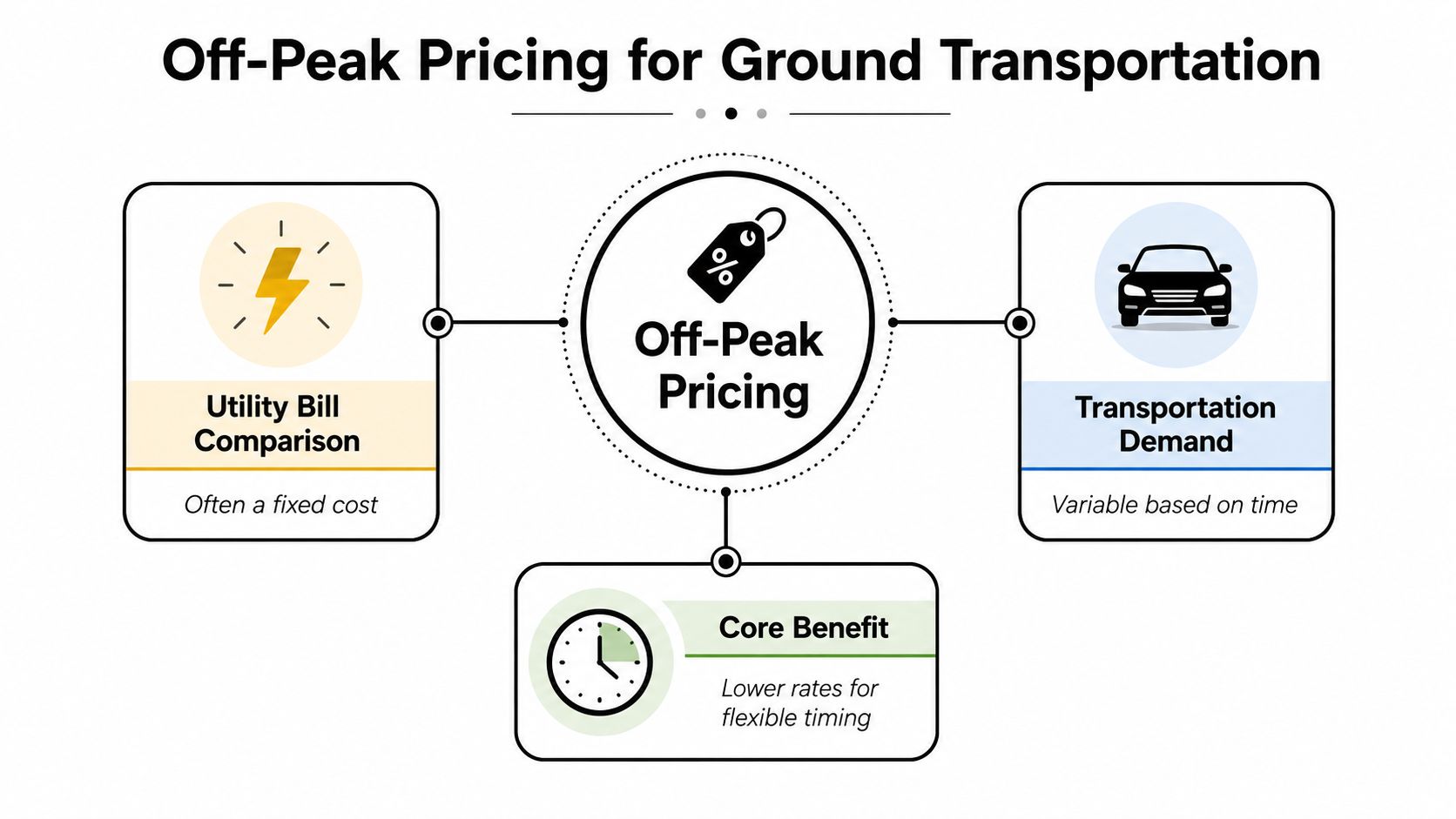
The working definition is simple. Off-peak pricing is a demand signal, not a marketing gimmick. If the schedule is flexible, the rate should improve. If the time is fixed and everyone wants it, the price should go up. That's the whole game.
When Off-Peak Hours Actually Fall for Chauffeur Services
Off-peak for ground transportation does not mean “late at night” in the electricity sense. It means the hours and dates when the travel calendar is least congested, which usually sits in the middle of the day on weekdays, after evening event exits have cleared, and on quieter Sundays.
The hours that usually work
Mid-morning through mid-afternoon is often the sweet spot. Think 10 a.m. to 3 p.m. on weekdays, when airport banks have loosened, office departures have already happened, and the next rush hasn't started. Late evening can also open up once the concert crowd, dinner crowd, and sports crowd are gone.
Sunday daytime is another opening, but only when there isn't a big citywide event or a packed holiday return window. That's where a lot of travelers get tripped up. They assume Sunday equals cheap, but a Sunday tied to a major convention or playoff game is not a real off-peak window.
The dates that erase the discount
Monday and Friday are still the worst days for flexibility because they stack business travel on top of airport pressure. Concert nights, sporting events, graduation weekends, and holiday travel weeks all crush the lower-priced windows. A Tuesday can even behave like a peak day if it sits inside a major festival week or a conference spillover.
The electricity world shows the same principle. Peak hours are often tied to routine human behavior, while off-peak rates kick in when demand softens, including overnight and weekends in many utility plans (Aurora Solar explanation of peak and off-peak hours). Transportation just has a messier calendar because people don't move in neat utility blocks.
Don't anchor your booking on the day alone. Anchor it on the day plus the event calendar, because the event calendar is what turns an ordinary Tuesday into a bad price.
Season matters too. Wedding season, sports weekends, and citywide convention periods all narrow the available off-peak space. If you're booking a chauffeur service, the winning move is to think like a dispatcher, not a passenger. Ask yourself when the city is moving lightly, not when the clock looks convenient.
Peak vs Off-Peak Rates Compared by Trip Type
For luxury rides, the same trip can price very differently depending on when you move it. The size of the gap depends on the route, the vehicle, and how much slack the operator has in the schedule, but the pattern is consistent. Flexible timing gets you a better quote, rigid timing pushes you toward the peak side.
| Trip Type | Peak Rate Window | Off-Peak Rate Window | Typical Savings |
|---|---|---|---|
| Airport transfer | Friday evening arrival banks, Monday morning departures | Midweek late morning or early afternoon | Usually lower when the flight avoids rush windows |
| Single-event ride | Concert start times, sports pregame departures | Arrivals after the main crowd has already moved | Usually lower when you miss the crowd build |
| Group booking | Same-hour pickups for multiple passengers | Staggered or midday departures | Usually lower when vehicle demand is not compressed |
Airport rides are the easiest place to save because the airport itself creates predictable waves. A Tuesday 11 a.m. pickup is usually easier to price than a Friday 6 p.m. arrival because the latter collides with commuter traffic, heavier hotel demand, and a tighter chauffeur pool. Event rides behave the same way. A ride that drops guests after the initial rush has passed is often cheaper than one that lands them exactly when everyone else wants to arrive.
Group bookings are where people overpay without noticing. If you need a Sprinter or minibus for the same window as a concert or wedding block, you're buying scarce capacity. If you can move the group earlier in the day or outside the main departure wave, you're suddenly in a better negotiating position.
For a more structured pricing comparison, it helps to compare Expressify AI packages and notice how clearly time and usage shape the final rate in any service with scarce capacity.
Bottom line: the quote is rarely just about distance. It's about whether your trip makes the operator fight for the same vehicle at the same time as everybody else.
Smart Booking Tactics That Unlock Off-Peak Savings
If you want the lower rate, stop asking for “the cheapest car” and start controlling the variables you own. Timing, notice, and flexibility matter more than you might think.

Move the clock, not the vehicle class
The easiest savings come from shifting departure or pickup time by even a couple of hours. A 5:30 p.m. concert pickup and a 6:00 p.m. pickup can land in different pricing territory if the first time collides with the main arrival wave and the second one misses it. The same logic applies to airport transfers, where a mid-morning arrival can be easier on the budget than a flight that lands just as the evening rush starts.
Don't downgrade the vehicle first. Move the time first.
Book earlier when you know the schedule
The more predictable the trip, the earlier you should lock it in. That matters for weddings, corporate teams, and airport runs tied to fixed itineraries. Waiting for last-minute availability gives the operator less room to place your ride into a quiet window, and that usually means you lose the better rate.
Use routing and event awareness
If you're sending a corporate group into O'Hare on a Wednesday morning, ask about flight-bank timing before you lock the pickup. If you're moving guests to a wedding, look at whether the ceremony and reception times force you into the same compressed block that every other event uses. If it's a concert drop-off, accept a slightly earlier or later arrival instead of demanding the exact moment the crowd peaks.
- Shift by two hours when you can. Small time changes often produce the cleanest savings.
- Choose Wednesday over Friday whenever the itinerary allows it. Friday carries more built-in pressure.
- Avoid event choke points. A flexible pickup around a major game or concert is easier to price.
- Reserve Sprinters and minibuses early. Group vehicles disappear fastest when multiple parties want them at once.
Off-peak pricing rewards customers who plan like dispatchers. The earlier you present a flexible window, the easier it is for the operator to place your ride into cheaper capacity.
Corporate Accounts and Event Packages as Off-Peak Shortcuts
Individual booking tricks help, but they don't solve the whole problem. If you move people often, the better answer is structural. Corporate accounts and event packages turn timing from an afterthought into a negotiated part of the relationship.
Corporate travel managers should care about this because account pricing creates consistency. Instead of chasing a different rate for every airport run, meeting transfer, or client pickup, you set a framework that makes off-peak economics easier to apply across the board. That matters when teams travel on repeat schedules and need predictable service without haggling every time.
Event planners should look at packages the same way. Weddings, conferences, and group outings are easier to price cleanly when the operator knows the date, the headcount, and the vehicle mix in advance. That gives the fleet a chance to build around the demand window instead of reacting to it. If your event is flexible, or at least not competing with the city's biggest squeeze, you're in a much stronger position.
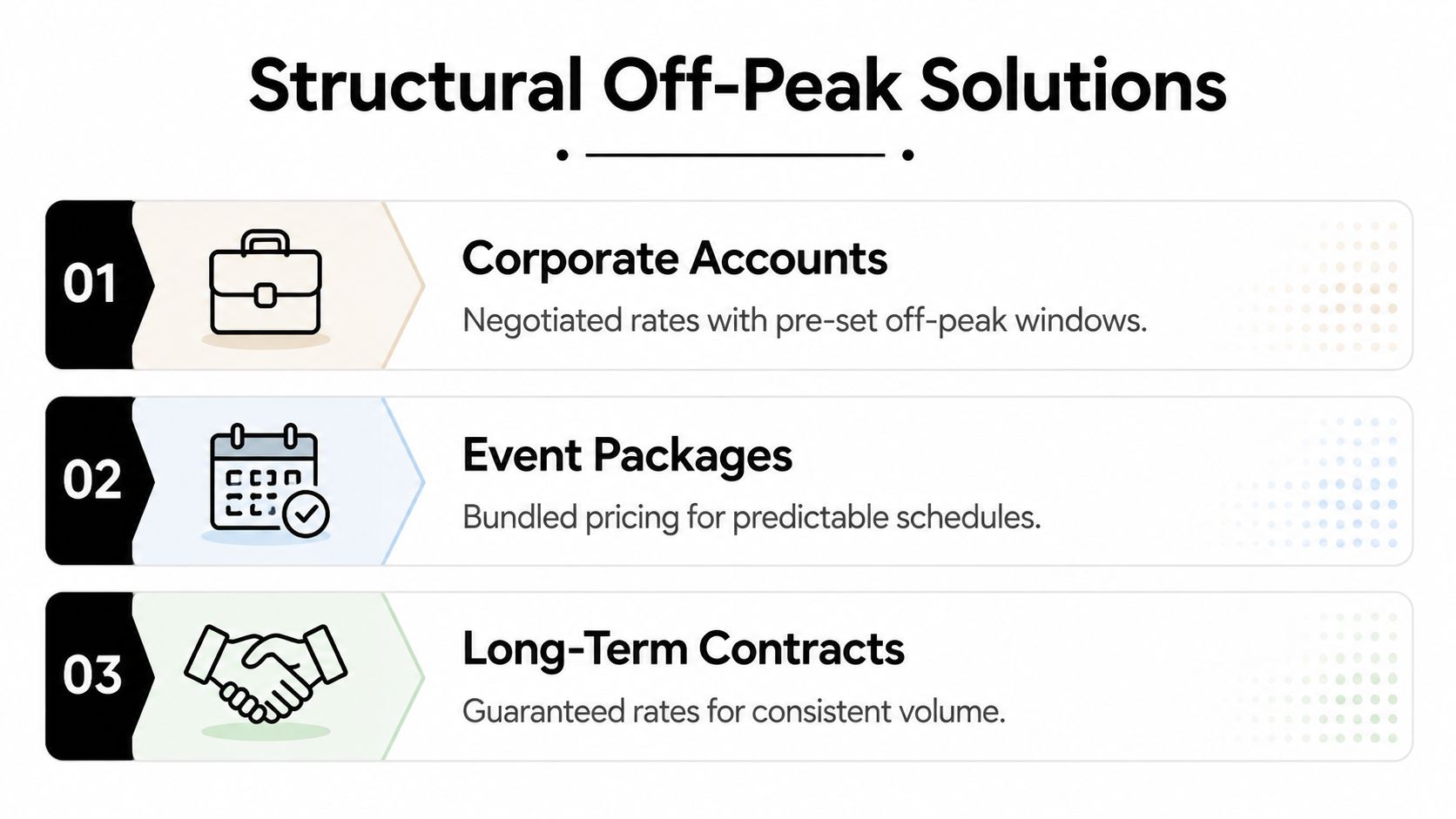
A long-term contract goes one step further. It gives repeat users a rate structure they can plan around, which is more useful than chasing isolated discounts. That's especially true for companies with regular airport traffic or event teams that move people on a recurring calendar.
Best use case: if the same travelers keep showing up at the same times, stop booking trip by trip. Put the pattern into an account structure and let the pricing follow the pattern.
The point isn't to get the lowest possible number on one ride. The point is to stop paying peak premiums for predictable movement.
When Off-Peak Pricing Is Not Actually a Deal
Cheap isn't always cheap. Off-peak pricing loses its appeal when the lower rate comes with thinner vehicle choice, slower response, or a schedule that no longer fits the trip.
That trade-off matters most for special occasions and group moves. If you need multiple vehicles, if the trip has a hard start time, or if the event itself creates a surge, the cheaper slot can become the worse deal. A Tuesday during a major festival week is not “off-peak” in any meaningful sense, no matter what the clock says.
The utility world has a useful warning here. The MIT review on time-varying electricity rates points out that voluntary enrollment is uneven and that consumers often lack clear incentives or information to choose the cheapest times or automate load shifting (MIT CEEPR review of time-varying electricity rates). That same problem shows up in transportation, where a theoretical discount can disappear once you account for inconvenience, narrower availability, or the cost of reshuffling your whole day.
A lower price is only a win if the ride still does the job.
For travelers, the smartest move is to pay the peak premium when certainty matters more than savings. Weddings, airport connections with no margin, executive arrivals, and tight event logistics all justify paying up if the alternative is stress or missed timing. Off-peak pricing is a tool. It's not a rule you obey at all costs.
Putting It All Together on Your Next Booking
Use a simple checklist before you accept the first quote. First, identify the trip type, airport, event, or group move. Second, check the day and hour against the off-peak window, not just the calendar date. Third, compare the quote against a peak-time alternative so you can see whether the timing really moved the rate.

If the ride is recurring, open a corporate account or event package and stop renegotiating the same trip every time. If the ride is one-off, move it by a couple of hours or away from the event rush before you book. And if the schedule is fixed, pay the premium without guilt, because certainty is part of the product.
The smartest booker doesn't chase the lowest number. The smartest booker buys the right window.
If you want chauffeur service that treats timing like part of the strategy, not an afterthought, Max's Luxury Rides Inc. can help with airport transfers, corporate travel, event packages, and group transportation that fits real schedules. Visit Max's Luxury Rides Inc. to plan your next ride with a team that knows how to book smart and move on the right terms.