
Welcome to Chicago O’Hare International Airport (ORD). As one of the busiest aviation hubs on the planet, O'Hare is more than just a place to catch a flight—it’s a city within a city, buzzing with its own rhythm, transportation, and logic. This guide is your insider's map to navigating it like a pro.
Making Sense of O'Hare
First-timers can find O'Hare a bit overwhelming, but once you understand its layout, it all clicks into place. Think of it as a massive, finely tuned machine built to move millions of people and planes as smoothly as possible. It’s a primary hub for both United Airlines and American Airlines, anchoring it as a critical piece of the global travel puzzle.
Just how busy is it? The scale is hard to wrap your head around. O'Hare recently shattered its own records in July 2025, serving an incredible 8,263,448 passengers in a single month. That staggering number was fueled by a 13.2% jump in flight operations from the previous year, cementing its reputation as a major transportation artery. You can read more about O'Hare's recent passenger records and what it means for global travel.
This diagram offers a high-level look at how the airport’s key pieces fit together.
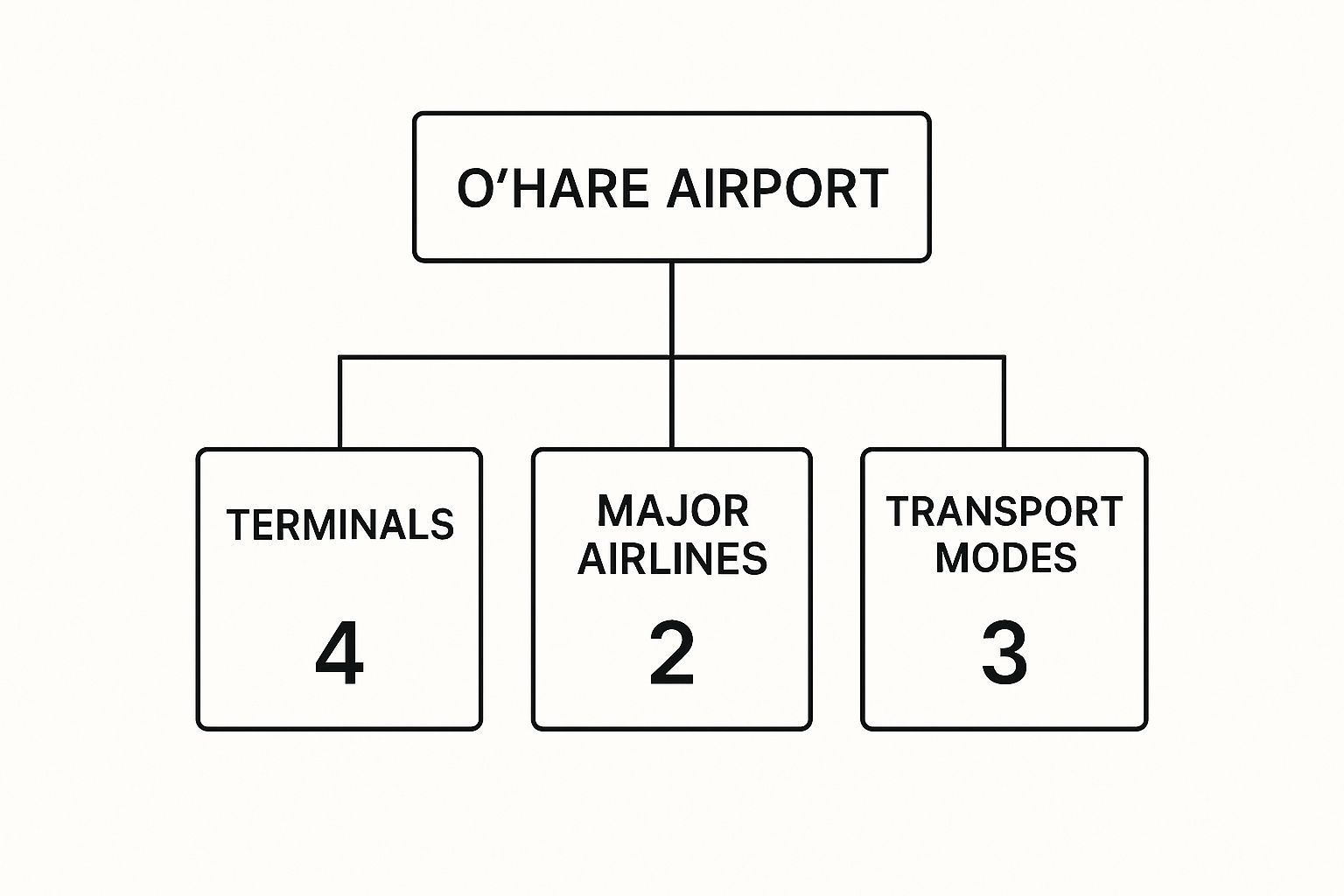
As you can see, the airport's operations are built on three core pillars: the terminals, its major airline hubs, and the web of ground transportation that connects it to the outside world.
What Sets O'Hare Apart
O'Hare operates on a completely different scale than your average regional airport. Everything from its layout to its services is designed for a constant, massive flow of international and domestic travelers. To get your bearings, it helps to know a few key things:
- Four Distinct Terminals: The airport is split into four terminals—1, 2, 3, and 5. Terminals 1, 2, and 3 are your go-to for domestic flights, while Terminal 5 serves as the primary international gateway.
- Getting Between Terminals: The Airport Transit System (ATS), or "people mover," is a free train that connects all terminals before you go through security. It makes hopping between them simple and fast.
- Direct Link to the City: O'Hare is plugged directly into downtown Chicago via the CTA's Blue Line train. It’s an easy, affordable way to get to the city center, and it runs 24/7.
O'Hare isn't just an airport; it's a logistical masterpiece. With four terminals, nine concourses, and over 200 gates, its sheer size is a testament to its role as a global aviation powerhouse.
In this guide, we'll dive into every aspect of the airport experience. We'll cover everything from terminal maps and the best places to eat to smart parking strategies and tips that seasoned travelers swear by. By the time you're done reading, you'll have everything you need for a smooth, stress-free trip.
Mastering O'Hare's Terminals: A Traveler's Guide
Stepping into an airport as sprawling as O'Hare can be intimidating. With four terminals, nine concourses, and over 200 gates, it feels more like a small city than a single building. But don't let the scale fool you—once you understand the layout, getting around is surprisingly straightforward.
The easiest way to think about O'Hare is as two separate islands. The first island is a connected trio of domestic terminals: Terminals 1, 2, and 3. Once you're through security in any of these, you can walk to the others without ever leaving the secure area. The second island is Terminal 5, the international hub. It stands alone, and you'll need to use the airport's train system to get there.
Getting this basic layout down is the first—and most important—step to a smooth O'Hare experience.
Before you even head to the airport, it's a good idea to know which airlines operate out of which terminals. This little bit of prep work can save you a lot of time and frantic searching for the right check-in counter. Here's a quick reference guide to get you started.
O'Hare Airport Terminal and Airline Guide
| Terminal | Primary Airlines | Key Features |
|---|---|---|
| Terminal 1 | United Airlines, United Express, Lufthansa, All Nippon Airways | The "United Hub" and home to the iconic "Sky's the Limit" neon tunnel. |
| Terminal 2 | Alaska Airlines, Air Canada, Delta, JetBlue, Spirit, Southern Airways | Acts as a central connection point between Terminals 1 and 3. |
| Terminal 3 | American Airlines, American Eagle, Aer Lingus, Iberia, Japan Airlines | The main base for American Airlines and its Oneworld alliance partners. |
| Terminal 5 | All other international carriers (e.g., British Airways, Emirates, KLM), Frontier | O'Hare's international gateway, with its own customs and security. |
Remember that airline locations can occasionally shift, so it's always smart to double-check your terminal on your ticket or the airline's app before you arrive.
The Domestic Hub: Terminals 1, 2, and 3
These three terminals handle the vast majority of domestic flights and are dominated by O'Hare's two biggest players, United and American Airlines. The best part? They're all linked by post-security walkways, making connections a breeze.
Terminal 1: The United Hub
This is United's kingdom. If you're flying United or one of its Express partners, you'll almost certainly be here. It’s famous for its dazzling underground neon light installation that connects Concourses B and C—a must-see even if you're just passing through.Terminal 2: The Crossroads
Terminal 2 is home to a mix of major carriers like Alaska Airlines, JetBlue, and Spirit. Its central location makes it the physical bridge between Terminals 1 and 3, serving as a crucial junction for travelers connecting between different airlines.Terminal 3: American Airlines' Stronghold
This is American Airlines' primary base of operations, along with its regional American Eagle partners. Just as United dominates Terminal 1, you can expect to find most American flights departing from here.
The fact that these three are connected airside is a huge advantage. If you land on a United flight in Terminal 1 and have a connection on an American flight in Terminal 3, you can simply walk from one gate to the other without the hassle of exiting and re-clearing security.
The International Gateway: Terminal 5
Standing apart from the domestic complex, Terminal 5 is O'Hare's dedicated international terminal. It handles almost all international arrivals and departures for airlines like British Airways, Lufthansa, and Emirates, and it also serves some domestic budget carriers like Frontier.
A Critical Distinction: You cannot walk to Terminal 5 from the other terminals once you're past security. To get there, you must exit the secure area and take the airport's transit system.
Think of Terminal 5 as a self-contained airport with its own ticketing, customs, and security checkpoints. This is a vital piece of information, especially if you're connecting between an international and a domestic flight. Always factor in extra time for the transfer.
Getting Around: The Airport Transit System (ATS)
The lifeline that connects everything at O'Hare is the Airport Transit System (ATS), often called the "people mover." This free, automated train is the central nervous system of the airport, linking all four terminals, the rental car center, and economy parking lots.
The ATS runs 24/7 outside of the secure area, so you'll need to exit security to ride it. It's the only way to handle a few common travel situations:
- Connecting from an international flight after clearing customs in Terminal 5 to catch a domestic flight in Terminals 1, 2, or 3.
- Getting to the Multi-Modal Facility to pick up a rental car or park in Economy Lot F.
- Switching terminals before security if you're dropped off at the wrong one.
Trains arrive every few minutes, and the entire loop takes less than 10 minutes. Building the ATS into your travel plan is the key to making a tight connection and keeping your O'Hare journey stress-free.
Finding the Best Food and Lounges at ORD

The time you spend waiting for a flight can make or break your travel day. At a hub as massive as O'Hare, that downtime is actually an opportunity—a chance to sample authentic Chicago flavors or find a quiet oasis to recharge before your next leg. Forget what you think you know about airport amenities; ORD offers everything from celebrity chef outposts to exclusive, serene lounges.
Let's be honest, airport food often gets a bad rap. But O'Hare has worked hard to build a surprisingly solid culinary scene that brings the best of Chicago right into the terminals. Whether you have a long layover or just want one last great meal, you're covered.
This focus on the passenger experience is nothing new for O'Hare. The airport was built on forward-thinking design, starting life as Orchard Field on land acquired in 1946. After being renamed in 1949 to honor naval hero Edward 'Butch' O'Hare, it pioneered concepts like the split-finger terminal layout and was one of the first airports to adopt jet bridges back in 1958. This spirit of innovation lives on in its world-class amenities today. You can read more about the strategic origins of O'Hare Airport and how it became a global powerhouse.
Savoring Chicago Without Leaving the Airport
Each of O'Hare's terminals has its own distinct dining personality, so you can always find something that fits your cravings and your schedule. From a quick bite to a leisurely sit-down meal, the options truly reflect the city's rich food culture.
- Terminal 1: This is United's turf, and it’s where you'll find local legends like Berghoff Cafe for a classic taste of the city and Rick Bayless's Tortas Frontera for mind-blowingly good Mexican sandwiches.
- Terminal 3: Flying American? You can grab a famous "cheezborger" at the iconic Billy Goat Tavern or settle in for a more refined gastropub meal at Publican Tavern.
- Terminal 5: The international terminal naturally has a diverse lineup. Big Bowl serves up fresh Chinese and Thai dishes, while The Goddess and Grocer is perfect for gourmet sandwiches and salads on the go.
Don't just stop at the first fast-food sign you see. Some of the best spots are tucked away in the concourses, just waiting to make your travel day a little more delicious.
Finding Your Sanctuary: Airport Lounges
If you're looking for a quiet place to work, relax, or just escape the terminal buzz, O'Hare's lounges are your best bet. And access isn't just for first-class flyers anymore. Many lounges are open to travelers with the right credit card, loyalty status, or even a day pass.
These spaces completely change the airport dynamic, turning a stressful wait into a productive or relaxing pause.
Lounges transform the airport from a place of waiting into a destination for relaxation. With amenities like Wi-Fi, food, and quiet workspaces, they provide a valuable refuge for both business and leisure travelers.
A Guide to O'Hare's Premier Lounges
As a major hub for both United and American, O'Hare is home to some seriously impressive flagship lounges. But there are great options for almost every traveler.
- United Polaris Lounge (Terminal 1, Concourse C): Truly one of the best in the business, this lounge is reserved for international business class passengers. It's known for its full-service dining room, shower suites, and quiet daybeds.
- American Airlines Flagship Lounge (Terminal 3, Concourse H/K): The counterpart to Polaris, this lounge for premium international and transcontinental passengers offers chef-inspired meals, a premium wine and cocktail bar, and plenty of space to spread out.
- Delta Sky Club (Terminal 2, Concourse F): A comfortable and stylish space for Delta elites and certain cardholders. You’ll find complimentary snacks, drinks, and dedicated workstations to get some work done.
- The USO Lounge (Terminal 2): The USO provides a welcoming home-away-from-home for active military members and their families, offering free food, drinks, and a comfortable place to rest.
By taking the time to explore these food and lounge options, you can completely change your view of O'Hare. It stops being a place you have to get through and becomes a part of your journey to actually enjoy.
Your Guide to Parking and Ground Transportation
Let’s be honest: getting to and from O'Hare can sometimes feel like a trip in itself. Between Chicago traffic, a maze of parking lots, and various public transit options, figuring out the best way to travel is the first real challenge of your journey.
This guide is your playbook for navigating O'Hare's ground game. We'll break down all the options so you can choose the right one for your budget, schedule, and sanity.
On-Site Parking at O'Hare
If you’re driving to the airport, knowing the lay of the land can save you a ton of time and money. O'Hare's on-site lots are designed for different needs, so a little planning goes a long way.
The Main Garage (Lots A, B, and C) is your best bet for convenience. It's located right across from the domestic terminals, making it perfect for short trips or if you're just dropping someone off. But be warned: that prime real estate comes with the highest price tag, and spots fill up fast.
For longer trips, the Economy Lots (G, H, and F) are your wallet’s best friend. They are a bit further out, but the free, 24/7 Airport Transit System (ATS) will shuttle you to the terminals. Just make sure to factor in a few extra minutes for the shuttle ride.
Public Transit: The CTA Blue Line
Want the most reliable and affordable way to get to downtown Chicago? Look no further than the CTA Blue Line. The train station is tucked into the lower level of the main garage, with easy access from Terminals 1, 2, and 3.
The Blue Line runs 24 hours a day, 7 days a week, so it's a dependable option no matter when your flight lands. A typical ride to the Loop takes about 45 minutes, letting you completely bypass the notorious Kennedy Expressway traffic. It’s a fantastic choice for solo travelers and anyone looking to save a few bucks.
The real magic of the Blue Line isn't just the price—it's the predictability. When you're trying to catch a flight, knowing your travel time won't be derailed by a traffic jam is priceless.
Rideshare Services: Uber and Lyft
Grabbing an Uber or Lyft is always a popular choice for door-to-door convenience, but at a massive airport like O'Hare, you have to know where to go. The airport has designated pickup zones to keep things moving smoothly.
- Domestic Terminals (1, 2, 3): All rideshare pickups happen on the Upper Level (Departures). You’ll find the pickup areas between Terminals 1 and 2 (Zone A) and between Terminals 2 and 3 (Zone B). Just follow the "Rideshare Pickup" signs.
- International Terminal (5): For international arrivals, the pickup zone is on the Lower Level (Arrivals), right outside Door 5B.
Always double-check your pickup spot in the app once you’ve landed. It’s a simple step that ensures you and your driver connect without any frustrating delays.
Pre-Booked Car and Limousine Services
For a truly seamless and stress-free experience, nothing beats a pre-booked car service. This is the top-tier option for travelers who value comfort, reliability, and a touch of class. Companies like Max's Luxury Rides Inc. specialize in making your airport transfer effortless.
When you pre-book, a professional chauffeur meets you at a designated spot, handles your luggage, and leads you to a waiting luxury vehicle. No hunting for pickup zones, no waiting in taxi lines—just pure convenience. It’s an ideal solution for business travelers, families with kids, or anyone starting a special trip.
The best part? You lock in a fixed rate ahead of time, so you won't get hit with surge pricing. It’s all about peace of mind, knowing your ride is ready and waiting the moment you are.
O'Hare Ground Transportation Comparison
Choosing how to get to or from O'Hare really comes down to what you value most: cost, speed, or pure convenience. To make the decision easier, here's a quick side-by-side look at your main options.
| Transport Method | Average Cost | Travel Time to Downtown | Best For |
|---|---|---|---|
| CTA Blue Line | $5 (from O'Hare) | ~45 minutes | Budget travelers, solo riders, avoiding traffic |
| Rideshare (Uber/Lyft) | $40 – $60+ | 30 – 60+ minutes | Door-to-door service, small groups, convenience |
| Taxi | $45 – $65+ | 30 – 60+ minutes | Immediate availability, no app needed |
| Pre-Booked Car Service | $80+ | 30 – 60+ minutes | Luxury, guaranteed ride, business travel, families |
Ultimately, there's no single "best" way—just the best way for your specific trip. Planning ahead based on these factors will ensure your journey starts and ends as smoothly as possible.
Insider Tips for a Seamless O'Hare Journey
Navigating a massive airport like O'Hare can feel like a race against time, but a little bit of know-how can make all the difference. With the right strategy, you can glide through the terminals like a seasoned pro. It really just comes down to thinking ahead and using a few tricks that frequent flyers have relied on for years.
The security line is always the biggest wild card. Instead of just blindly walking to the closest checkpoint, take a second to look around. Each domestic terminal at O'Hare has multiple security checkpoints, and the wait times can swing wildly based on the time of day and which flights are boarding nearby.
Mastering Security and Connections
Your best bet is to use a real-time tracking app. The MyTSA app is a game-changer here, giving you live updates on wait times for every single checkpoint in the airport. A quick check might show that a two-minute walk to another line could save you 20 minutes of standing around.
Dealing with a tight connection can be another major source of anxiety. If you're hopping between the domestic terminals (1, 2, and 3), the good news is they're all connected by walkways after security. It’s worth checking the airport maps before you even land to get a feel for the layout; trekking from the low B gates in Terminal 1 to the high L gates in Terminal 3 can easily take 15-20 minutes.
If you're connecting to or from Terminal 5, you'll need to catch the Terminal Transfer Bus (TTB). This shuttle runs post-security, which is a huge relief—it means you don't have to exit and go through the security screening process all over again.
The sheer volume of activity at O'Hare makes efficiency essential. With over 776,036 aircraft movements in 2024, it stands as the second-busiest airport globally for flight operations, underscoring why every minute saved matters. Discover more insights about O'Hare's massive operational scale on roadgenius.com.
Your Pre-Flight Checklist
Beyond the big stuff like security and connections, a few other habits can make your trip much smoother. Think of it as your pre-flight ritual.
- Arrival Time: The old advice still holds true. For domestic flights, aim to be at the airport two hours early. If you're flying internationally out of Terminal 5, give yourself a solid three hours.
- Power Up: Electrical outlets can be surprisingly hard to find. Keep an eye out for them along walls, near gate counters, and in the dedicated charging stations. Some of the older concourses are a bit sparse, so if you see an open outlet, grab it.
- Stay Updated: Make sure you have your airline's app on your phone. It’s the fastest way to get alerts about gate changes, delays, or boarding times—often pushing a notification to you before the big screens at the gate even update.
These are simple, battle-tested tips, but they work. By planning for security, knowing how you’ll get between terminals, and using the right apps, you can navigate O’Hare with confidence and a whole lot less stress.
Answering Your O'Hare Questions
Even the most seasoned travelers have questions when navigating a massive airport like O'Hare. Let's tackle some of the most common ones head-on so you can move through the airport with confidence.
How Early Do I Really Need to Be at the Airport?
For a domestic flight, give yourself two hours before departure. That's the sweet spot for checking bags, getting through security, and grabbing a coffee without having to sprint to your gate.
If you’re flying internationally out of Terminal 5, bump that up to three hours. International flights involve extra document checks and more complex boarding procedures, so that extra hour is your best friend for a calm start to your journey.
When Is O'Hare at Its Busiest?
O'Hare definitely has its rush hours. The two main windows to watch out for are the early morning wave from 6 AM to 8 AM and the afternoon rush from 3 PM to 5 PM. If you're traveling during these times, just be prepared for longer lines and a bit more hustle and bustle in the terminals.
How Long Will I Be Stuck in the Security Line?
This is the million-dollar question, isn't it? TSA wait times at O'Hare are a mixed bag. On a good day, you might be through in under 10 minutes. But during peak hours or holidays, it can easily stretch to 45 minutes or more.
Your best move is to check the real-time wait times right before you head to the airport. The MyTSA app is fantastic for this, giving you live updates so you can pick the checkpoint with the shortest line.
A quick glance at the app can literally save you a half-hour of standing around.
Can I Walk Between Terminals?
Yes and no. Once you're through security, you can walk freely between the domestic terminals (1, 2, and 3). They're all connected "airside" by walkways, making it super easy to catch a connecting flight without having to go through security again.
Terminal 5, the international hub, is a different story. It’s a completely separate building. You cannot walk to it from the domestic terminals. You'll need to hop on the Airport Transit System (ATS) train or the Terminal Transfer Bus (TTB) to get there.
What's the Best Way to Get to Downtown Chicago?
For a hassle-free and budget-friendly option, the CTA Blue Line train is your best bet. It runs 24/7 right from the airport and gets you to the heart of downtown in about 45 minutes, letting you completely sidestep any highway traffic nightmares.
If you'd rather skip the train and travel in comfort, a pre-booked car service is the way to go. Max's Luxury Rides Inc. provides professional and reliable airport transportation, ensuring you get where you need to be on time and without any stress. You can book your ride on the Max's Luxury Rides website.