
A corporate traveler lands at 4:30 p.m., walks toward baggage claim, and expects the chauffeur to be waiting when they reach the agreed pickup point. Outside, traffic is building, the terminal curb is congested, and the flight has arrived later than planned. The reservation still shows one neat pickup time, but the road, airport, luggage, and passenger are all operating on different clocks.
That's the promise gap in chauffeur transportation. It's the distance between an advertised pickup time and the moment the vehicle is realistically ready to move. Closing that gap requires more than assigning a car. It requires honest time windows, live information, disciplined handoffs, and performance reporting that shows where punctuality holds and where it breaks.
Why On Time Delivery Is Harder Than It Looks for Chauffeur Service
Consider a 4:30 p.m. airport pickup. The aircraft arrives late, passengers wait for a gate change or a crowded jet bridge, luggage takes longer than expected, and the driver encounters a terminal ramp where curbside access is restricted or moving slowly. The traveler may still expect the vehicle to be waiting at arrivals at precisely 4:30, even though the booking was created before the airline updated its arrival information.
That's why on time delivery for chauffeur service shouldn't mean arriving at an isolated minute. It should mean arriving inside a clearly defined pickup window tied to the service context. Airport pickups, residential pickups, corporate transfers, and event departures each have different timing risks. A practical KPI definition is delivery on or before the promised or agreed window, segmented by lane, service level, and appointment type. Logistics benchmark guidance identifies 95% on-time performance as the most common target selected by both shippers and carriers, while some guidance treats 95% or higher as strong and 98% or higher as world-class.
The hidden dependencies behind one pickup time
A booking platform may record the time the client requested. The dispatch system may schedule the chauffeur based on the promised pickup window. Those aren't always the same event, and the difference matters.
Before a vehicle moves, the operation has to account for:
- Flight volatility: Arrival estimates can change while the passenger is still airborne.
- Terminal rules: Curbside access, pickup zones, and loading restrictions vary by airport.
- Passenger readiness: TSA queues, gate walks, restroom stops, and luggage collection all affect the handoff.
- Road conditions: Day-of-week traffic, weather, construction, and incidents change the travel plan.
- Vehicle class: A sedan and a Sprinter don't have identical maneuverability, loading needs, or staging options.
- Promise definitions: A 30-minute appointment buffer can produce a very different reported success rate from a narrower window, as the KPI research study explains.
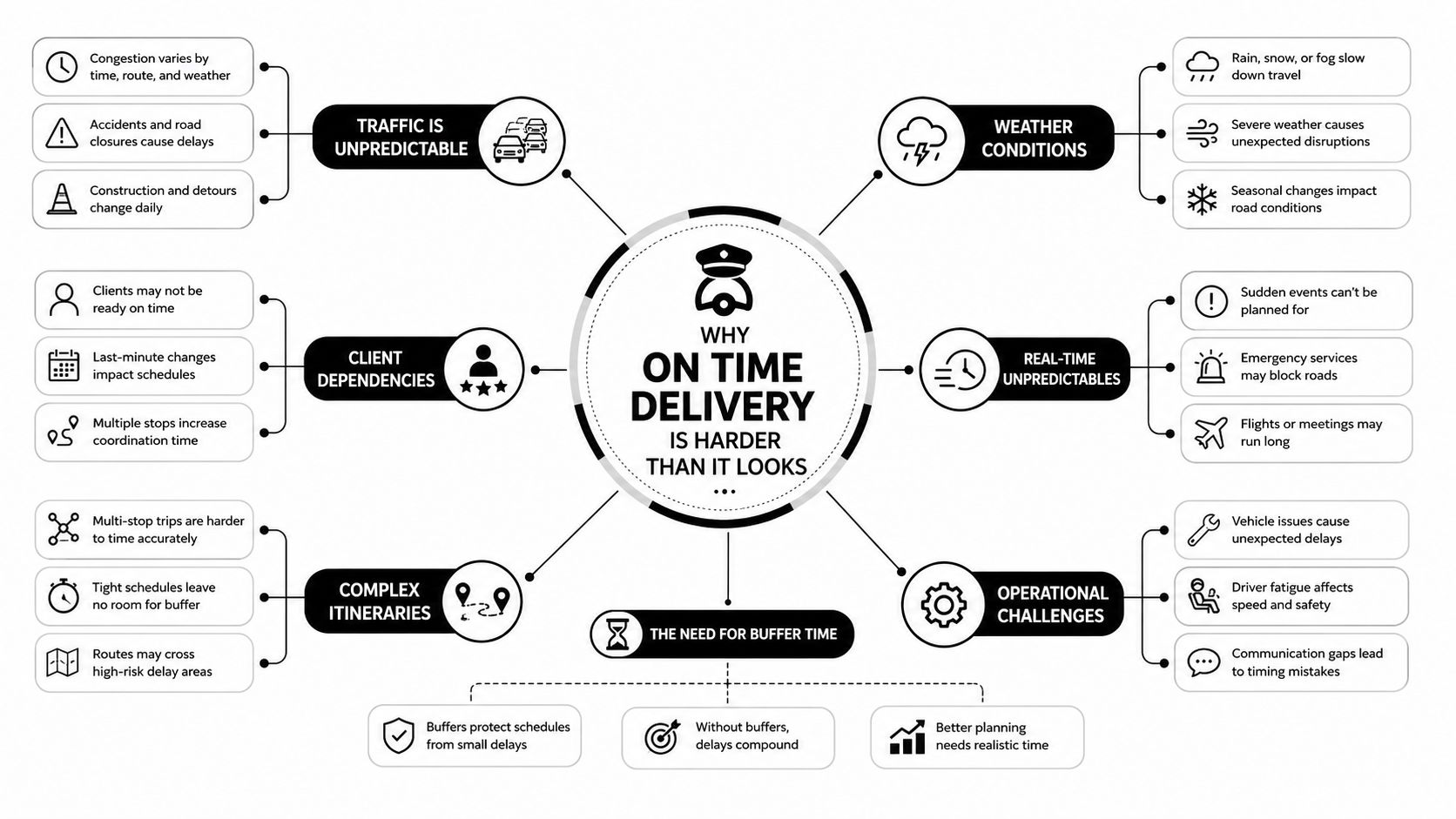
A single company percentage can conceal late performance on airport arrivals, wedding venues, or specific dispatch windows. Monitoring below 90% is often treated as a sign of systemic problems requiring immediate review, particularly when failures cluster around a few routes, carriers, or time periods. For a premium chauffeur operation, the first job is therefore not promising faster service. It's defining a promise that reflects what the passenger will experience.
Inside the Pre-Trip Workflow That Anchors Every Pickup
Punctuality starts before the chauffeur receives the trip. At Max's Luxury Rides, the reservation is reviewed against the relevant flight, hotel, corporate itinerary, or event record rather than accepted as an isolated time entry. That review identifies whether the trip depends on a live arrival, a venue loading instruction, a group movement, or a fixed departure.
From reservation review to dispatch
The first check confirms the essentials: passenger name, pickup address, destination, vehicle class, passenger and luggage details, contact numbers, and any mobility or meeting instructions. For airport trips, the flight number is matched with live feeds from FlightAware and Flightradar24, with updates pushed into the dispatch board so the team can see whether the original timing still makes sense.
Buffer math comes next. The dispatcher considers the terminal, expected traffic band, vehicle class, staging conditions, and the passenger's likely time from landing or arrival to the meeting point. The buffer isn't hidden padding added to make a report look good. It's part of the promise, and it must be explained when the timing affects a corporate itinerary or event schedule.
The dispatch screen surfaces the current flight status, while the routing app pre-loads alternate paths before departure. That matters because a backup route is useful only if the team has already considered where the vehicle can safely stop, load, and continue.
The final handoffs
A chauffeur briefing confirms the route, signage, passenger preferences, terminal instructions, and escalation process. The vehicle then receives a pre-trip check covering cleanliness, fuel or charge status, climate control, luggage capacity, and visible readiness for the assigned service.
The final status sequence creates multiple opportunities to catch slippage:
- T-30: Dispatch confirms the trip remains viable and checks live conditions.
- T-15: The chauffeur confirms position, vehicle readiness, route, and staging plan.
- T-5: Dispatch verifies that the chauffeur is in position or moving to the agreed meeting point.
Every handoff is logged, from booking to dispatch, dispatch to chauffeur, and chauffeur to curbside. If a trip runs late, the team can trace the issue to a specific step instead of blaming “traffic” as a catch-all explanation.
For broader guidance on keeping mobile teams aligned, articles on employee app connectivity offer useful context on communication between drivers and dispatchers while both are away from a desk.
Practical rule: If a dispatcher can't explain who last confirmed the trip, the workflow has already lost control of the pickup.
Contingency Planning When Traffic, Weather, or Flights Shift
A Friday evening gala creates a familiar chain reaction. Rain begins across the route, a highway incident slows access to the venue, and a separate airport flight lands 45 minutes late. The original plan may still be workable for one passenger, but not for a guest with luggage, a fixed dinner start, or an event entrance that closes on schedule.
Dispatch watches for three types of triggers: highway incident alerts, weather radar changes, and flight-status updates. When one of those conditions affects a trip, the dispatch board flags the reservation for review instead of waiting for the chauffeur to discover the problem in traffic.
How the recovery decision works
The secondary route is already loaded in the routing app. Dispatch compares the alternate path with the venue's access rules, loading area, and expected congestion. If the original chauffeur can recover the window, the team keeps the assignment and updates the client early. If the delay has removed that option, dispatch pulls forward a backup chauffeur or reassigns the trip before the passenger reaches the curb.
The communication must distinguish between a developing risk and a confirmed delay. An early message can say:
“We're monitoring rain and a slowdown on the primary route. Your chauffeur is still planned for the agreed pickup window, and we'll update you if that changes.”
Once the operation knows the original window won't hold, the wording must become direct:
“Traffic conditions have removed the original recovery window. We're moving your pickup to [revised time] and dispatching the available vehicle now. We'll continue updating you through the dispatch line.”
That distinction protects trust. Vague reassurance leaves the client waiting without a usable plan.
Each booking carries more than a driver assignment. Airport trips include a backup chauffeur plan, while hotel and venue contact numbers remain on the trip card. The dispatcher also records the threshold for pushing a rebooked pickup time to the client. That threshold shouldn't wait until the original time has passed. It should be triggered when the remaining route, passenger readiness, and access conditions show that recovery is no longer credible.
A late flight doesn't automatically mean a failed trip. A poorly managed promise does. The operation succeeds when it identifies the change, recalculates the plan, communicates before the client has to ask, and records what happened for the next similar booking.
How Clients Can Help Max's Luxury Rides Stay On Time
Clients control many of the inputs that determine whether a pickup window is realistic. A corporate booker might provide a flight number but omit the terminal. An event planner might reserve a Sprinter for a group without confirming luggage volume. A traveler might change the pickup entrance but tell only the chauffeur, leaving dispatch with an outdated trip card.
Those small omissions create avoidable delays. The reservation call should establish the actual operating conditions, not just a date, time, and destination.
Information to confirm at booking
Use this checklist before submitting an airport, corporate, wedding, or event reservation:
- Flight details: Provide the accurate flight number and update the team if the itinerary changes.
- Terminal access: Confirm the terminal, gate information when available, pickup door, loading dock, or venue entrance.
- Group size: State the passenger count and the number of large luggage pieces so the vehicle matches the movement.
- Contact details: Give the active mobile number the chauffeur can reach on the travel day.
- Backup contact: Add a coordinator, assistant, hotel contact, or family member who can respond if the traveler is unreachable.
- Accessibility needs: Note mobility assistance, child seating requirements, or extra loading time before dispatch plans the window.
The on-time delivery guidance from Shipium emphasizes separating service conditions and watching for promise-date problems. The same principle applies here. A pickup promise should reflect the passenger's actual context, not an optimistic time copied from a generic booking form.
Habits that protect the window
On the travel day, respond promptly to chauffeur or dispatch messages. Meet at the agreed location rather than moving between doors without notice, and report schedule changes as soon as they become known. Use the dispatch line for route changes, because dispatch needs the updated instruction in the trip record and may need to coordinate the vehicle, venue, and backup plan together.
A simple traveler instruction works well: confirm the meeting point, keep the listed phone active, watch for dispatch updates, and call before changing the plan. For group movements, the organizer should send the same checklist to every traveler so one person's missing information doesn't delay everyone else.
Tracking On Time Delivery KPIs That Actually Mean Something
A company-wide punctuality figure can look healthy while one important service is struggling. An airport sedan, a Sprinter carrying luggage, and an event shuttle facing venue load-out rules don't carry the same operational risk, so they shouldn't be evaluated as if they do.
The KPI should be segmented by pickup context, vehicle class, and service type. Useful categories include airport pickups, point-to-point corporate transfers, hourly reservations, and event shuttles. Within each category, managers can compare the planned arrival window with the actual arrival record and investigate the exceptions rather than smoothing them into one vanity percentage.
Define the window before reviewing the result
For the operating model described here, a curbside pickup can use an arrival window of minus five to zero minutes, while a residence pickup can use zero to plus five minutes. Those definitions aren't interchangeable. A chauffeur arriving early at a curb may be unable to wait in the same way a vehicle can stage at a private residence.
The table below is an operating framework for reviewing performance. The target and actual fields should be populated from the company's own approved reporting period, not invented to make the dashboard appear stronger.
| Service Type | Vehicle Class | Arrival Window | Target On-Time % | Q3 Actual % |
|---|---|---|---|---|
| Airport pickup | Executive sedan | -5 to 0 minutes | Defined by service policy | Recorded by trip |
| Corporate transfer | Luxury SUV | 0 to +5 minutes | Defined by service policy | Recorded by trip |
| Hourly reservation | Executive sedan or SUV | Agreed service window | Defined by service policy | Recorded by trip |
| Event shuttle | Sprinter, shuttle, or coach | Agreed load-out window | Defined by service policy | Recorded by trip |
A company could report a 92% overall result while an event-shuttle segment sits at 78%, because the supplied delivery performance measurement guide from OnRoute supports examining performance by meaningful operational categories rather than relying on a single aggregate.
Managers should review segmented results weekly, identify recurring causes, and adjust buffers, assignments, or client instructions. Corporate clients can receive a clear summary at review time, with the definitions included. That transparency makes the punctuality promise credible because everyone can see what “on time” means before renewal discussions begin.
The Max's Luxury Rides Promise to Corporate and Event Clients
Procurement managers and event planners aren't buying a percentage on a dashboard. They're buying a chauffeur at the curb within the agreed window, the correct vehicle for the group, a professional who knows the route and passenger details, and a dispatch team that calls before the client has to chase an update.
That experience depends on four operating habits:
- Realistic buffer math accounts for airport access, traffic, vehicle class, luggage, and venue conditions before the time is promised.
- Live flight and traffic monitoring lets dispatch respond to changing conditions rather than treating the original reservation as permanent.
- Segment-level KPI review shows whether airport, corporate, hourly, and event services are performing consistently.
- Direct chauffeur-to-dispatch communication keeps route changes, client updates, and recovery decisions in one controlled workflow.
The promise gap narrows when the company measures the same experience the passenger sees. A vehicle that arrives early but cannot legally stage, a shuttle that reaches the venue but misses the loading instruction, or a sedan assigned to a group with oversized luggage may all appear acceptable in a broad report while failing the client's actual expectation.
“We promise a realistic pickup window, monitor the conditions that can change it, and communicate before a delay becomes the client's problem.”
Max's Luxury Rides Inc. provides airport transfers, corporate transportation, and event service with live flight coordination, 24/7 reservation support, and vehicles ranging from executive sedans to Sprinter vans and coaches. Visit Max's Luxury Rides Inc. to plan a pickup built around a realistic window, clear trip details, and dependable dispatch communication.