
You're at O'Hare, the luggage is down, the meeting start time is getting close, and the ride you booked still has no clear ETA. The app says “driver assigned,” but that's all you get, so every delay feels bigger than it should. That's the exact moment real time tracking stops being a convenience feature and starts becoming the difference between calm coordination and a chain of anxious phone calls.
In corporate travel, event shuttles, and airport transfers, live visibility replaces guesswork with current location, movement status, and proactive updates. When teams implement comprehensive tracking, they see 40 to 60% reductions in delivery-related support inquiries, with customer-facing updates refreshing every 30 to 60 seconds and a benchmark first-attempt delivery success rate of 99.22% in the logistics source cited for this topic, which shows why live status matters when expectations are tight (logistics tracking summary). If you want a useful companion resource on operations visibility, the guide on achieving better transport visibility for operations is worth reading alongside this one.
For a corporate travel manager, the point isn't tech for its own sake. It's knowing whether the chauffeur is five minutes away, whether traffic has changed the plan, and whether passengers should be told before they start wondering. That's the practical promise of real time tracking, and it's why the topic now sits at the center of premium ground transportation planning.
Introduction to Real Time Tracking
A traveler waiting for a car outside a terminal doesn't want a generic confirmation message. They want to know whether the vehicle is on the curb, still in traffic, or already circling to avoid a pickup zone issue. In that setting, real time tracking turns a silent delay into a managed arrival, which is a very different customer experience.
The larger market trend explains why this matters. A 2026 industry roundup pegs the time-tracking software market at $6.1 billion in 2025 and projects it to reach $11.43 billion by 2030, a 13.38% CAGR as organizations demand live visibility (time-tracking market roundup). The same source says 82% of employees don't use a structured time management system and that refocusing after an interruption takes about 23 minutes, which helps explain why fragmented work and fragmented logistics both create hidden waste. In transportation, that waste shows up as repeat calls, missed handoffs, and avoidable waiting.
Practical rule: If the passenger can't see the vehicle's status, your dispatch team will end up narrating the trip by phone.
For luxury transportation, the stakes are even higher because service quality depends on control, polish, and timing. That's why operators increasingly build systems around live location, status alerts, and exception handling instead of relying on one-way booking confirmations. It's not just about being able to answer “Where is the car?” It's about reducing uncertainty before the passenger ever has to ask.
How Real Time Tracking Works
A dispatch team gets a live update only when three layers are working together. One layer identifies where the vehicle is, another layer gathers operational context, and a third layer sends that information to the dashboard, app, or SMS workflow. When those layers stay in sync, the result is live status instead of a stale snapshot that forces staff to guess.
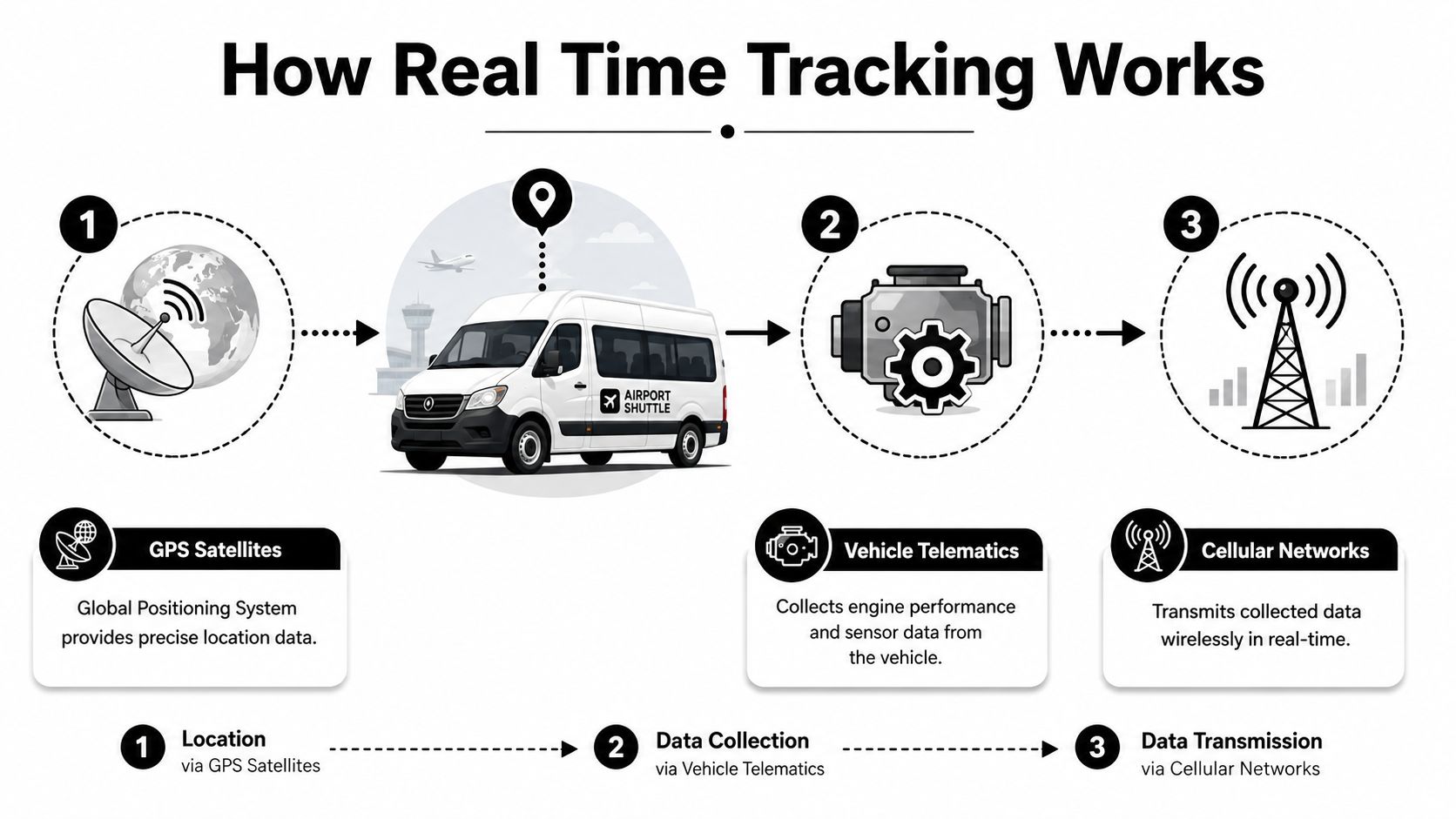
GPS, telematics, and cellular data in simple terms
An airport shuttle moving between terminal pickup zones shows the process clearly. GPS provides the location check, like a stage marker showing where the vehicle sits on the route. Telematics adds the condition report, pulling signals from the engine, sensors, or driver-facing system. Cellular connectivity carries that report back to dispatch.
The location reading alone rarely tells the full story. A vehicle can appear on the map and still be slowed by loading, parking restrictions, or a route change. Dispatch needs both the position and the operating context before deciding whether to wait, reroute, or alert the passenger. Many fleets treat telematics as the link between raw movement and a usable service decision.
Accuracy depends on the device, the signal environment, and the job the vehicle is doing. A tracker specification lists GPS accuracy around 20 m, Wi‑Fi geolocation around 100 m, and cellular triangulation around 500 m, with reporting intervals from 5 to 720 minutes (tracker specification). That spread explains why a downtown hotel pickup, a garage pickup, and an open-air airport lane can produce very different results in daily operations.
For a luxury operator like Max's Luxury Rides, that difference shows up fast. A sedan waiting at a hotel entrance needs tighter location detail than a coach loading at a wide airport curb, because the curbside handoff leaves less room for ambiguity.
Why reporting intervals matter
More frequent updates give dispatchers a clearer view, but they also increase power use and network load. A longer interval saves battery and bandwidth, yet it can leave gaps that matter when a vehicle is approaching a curbside handoff or responding to a delayed flight. Smart systems do not send every possible ping. They choose a cadence that fits the service model.
Live tracking is a balancing act, not a magic switch. The right interval supports the decision your team needs to make without wasting battery or flooding staff with noise.
Many logistics-grade setups also rely on event-driven reporting. A vehicle can update less often while cruising, then send a fresh status when it enters a geofenced airport zone, stops unexpectedly, or changes route. For corporate travel, that keeps the dashboard useful without turning it into a wall of moving dots.
Key Benefits of Real Time Tracking
The main benefit of real time tracking is simple. It makes the next decision easier. Dispatch knows where to place the next car, passengers know whether to leave the lounge, and managers know when a delay needs intervention instead of explanation.
Better ETAs and fewer anxious calls
For corporate travelers, ETA accuracy is the difference between waiting in the lobby and walking outside at the right moment. A live system can update the passenger before they start guessing, which reduces the “where's my ride?” problem that tends to eat up dispatch time. In a premium environment, that matters as much as the ride itself because uncertainty feels like poor service even when the vehicle is only minutes away.
Safety and service discipline
Tracking also gives operators a way to spot route deviations, unusual stops, or aggressive driving patterns. In chauffeur operations, that doesn't mean treating every detour as a problem. It means giving dispatch a chance to verify what's happening before a small issue turns into a missed pickup or an unhappy executive.
Efficiency that shows up in daily operations
The strongest operators use live data to improve dispatch sequencing, route planning, and vehicle utilization. A car that reaches an airport early can be reassigned quickly, while a delayed vehicle can be backed out of a schedule before it creates a cascade of missed appointments. That's where the operational value becomes visible to the finance team as well as the passenger.
Indoor and urban environments can complicate the picture. GPS is typically 3 to 5 m accurate in open sky, but it can degrade to 5 to 15 m in dense urban areas, while Wi‑Fi geolocation can offer about 3 m accuracy indoors in well-covered spaces (indoor accuracy study). That variance matters in parking structures, hotel loops, and terminal garages, where a “live dot” can still drift enough to confuse a careless setup.
Real Life Use Cases
A luxury fleet looks polished only when the hidden coordination works. The clean vehicle and professional chauffeur are the visible parts, but the smoother experience usually comes from the system behind the scenes, especially when flights change, roads clog, or passengers move earlier than expected.
Airport transfers with flight-aware pickups
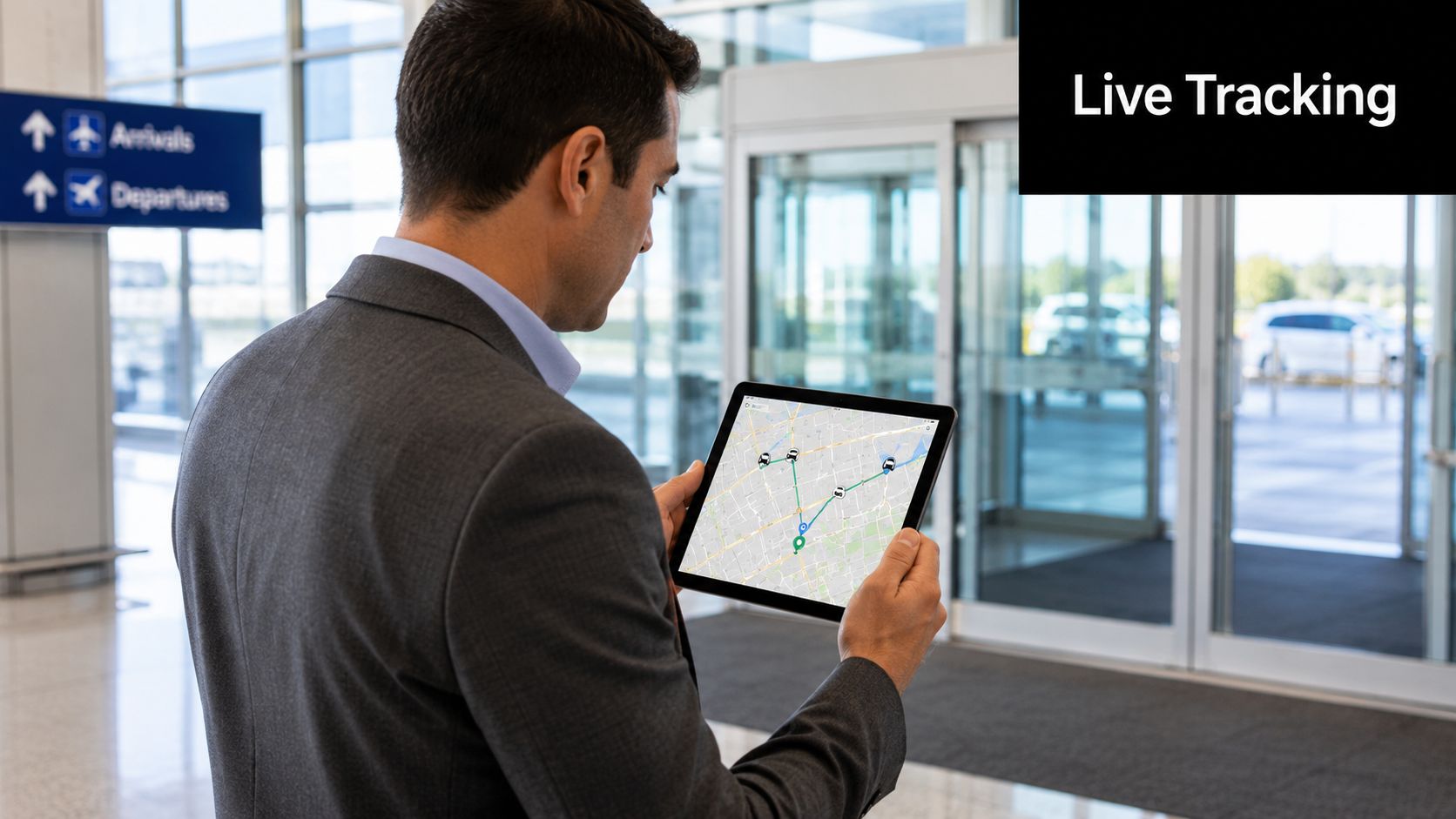
In airport work, the dispatcher has to handle the flight schedule, the terminal layout, and the rider's actual arrival moment. With live tracking in place, a chauffeur can be positioned near the pickup point while the system keeps the team informed about movement toward baggage claim or curbside handoff. If a flight lands late or the passenger exits from a different terminal than expected, the plan can change before the customer starts calling.
For an operator like Max's Luxury Rides, the value is in reducing surprise. A flight-aware pickup workflow gives the team a way to keep the trip feeling private and controlled even when the airport is chaotic. Instead of asking the traveler to interpret updates, the dispatcher can send a precise instruction at the right time.
Corporate travel with one shared view
Corporate itineraries often look simple on paper and messy in practice. One executive lands early, another is held up in customs, and a third needs a different vehicle because the meeting count changed. A single dashboard turns those separate bookings into one operational picture, which helps the travel coordinator make decisions without opening five different threads.
That matters when a company wants consistent service across multiple arrivals and departures. The transportation provider can line up vehicles according to actual movement rather than planned movement, which makes the whole program more resilient. In premium travel, that consistency is often what the client remembers.
Event logistics that flex with the crowd
Concerts, conferences, and sporting events are where real time tracking becomes a crowd-management tool. Shuttles don't just move on a timetable, they respond to waves of attendees leaving early, late, or all at once. If a traffic incident slows one route, dispatch can shift vehicles before a backup becomes visible to everyone waiting at the venue.
Max's Luxury Rides is built around airport transfers, corporate travel, and event packages, so this kind of flexibility matches the service model closely. The same fleet visibility that helps at a terminal can help at a stadium entrance or convention center curb, where timing and communication both need to stay sharp.
A good tracking setup doesn't just tell you where a vehicle is. It tells you which passengers need a message, which vehicles need a reroute, and which schedule items can still be saved.
Implementation Integration Best Practices
A luxury transportation operation can have excellent tracking data and still fail on the ground if the pieces do not connect. A chauffeur may be in the right place on the map, while reservations still shows the old pickup time, dispatch has not seen the delay, and the client is waiting for a message that never goes out. The problem is rarely the map itself. It is the gap between tracking, booking, alerts, and customer communication.
Start with the provider and the data path
Begin by choosing a tracking SDK or telematics provider with three checks in mind. It has to deliver reliable location data in the environments you serve, it has to fit your dispatch software, and it has to handle the update pace you need without filling your team with noise. For luxury transport, that means airports, hotels, suburban roads, and event venues all have to work, not just a polished test route.
The path should be easy to trace. A vehicle sends position and status data to the provider, the provider exposes that data through an API, and your app or dispatch console reads it in near real time. A modular API layer helps because it keeps the tracking source replaceable later, which matters if the fleet expands into new vehicle types or new service regions. In practice, that gives a dispatcher room to adjust without rebuilding the whole system.
Use event-driven alerts, not constant chatter
Webhooks usually fit better than polling loops because they send updates only when something changes. If a vehicle enters a geofence, stops longer than expected, or loses signal, the system can trigger SMS or email alerts automatically. That keeps 24/7 operations focused on exceptions instead of flooding people with every position update.
For battery-constrained devices, the reporting pattern matters even more. A logistics-grade device spec lists reporting intervals from 5 to 720 minutes and shows how accuracy and update frequency have to be balanced against power and network demands (tracker specification). For a luxury fleet, the lesson is simple. A sedan serving a hotel pickup does not need the same reporting rhythm as a vehicle waiting in a staging area, and forcing one pattern across both can create avoidable noise.
Build for precision where it matters
NASA's UWB-based RTLS reports 100 to 1,000 times finer granularity than standard GNSS alone, with tracking resolution below 1% of range in tests up to 3,500 feet (NASA UWB RTLS). That level of precision matters in places where small movements change the outcome, such as depot staging, indoor handoffs, or tight asset movement inside a terminal area. You may not need that everywhere, but it helps separate true location control from broad vehicle visibility.
For Max's Luxury Rides, that distinction shows up in practical situations. A chauffeur lineup at a hotel curb, a luggage transfer near a convention entrance, or a vehicle waiting to be reassigned after an airport delay all benefit from cleaner handoff data than a basic dot on a map can provide. The point is not to add complexity for its own sake, it is to match the tracking method to the operational problem.
A practical integration checklist usually includes:
- Select the data source: confirm GPS, telematics, and cellular support in your service area.
- Define event rules: decide which status changes trigger customer notifications.
- Connect reservations and CRM: make sure the same trip record feeds dispatch and support.
- Test weak-signal environments: garages, terminal areas, and dense urban blocks need real validation.
- Document fallback behavior: dispatch should know what happens when the signal drops.
GET /api/vehicles/{vehicle_id}/status
Authorization: Bearer {token}

Response:
{
  "vehicle_id": "veh_204",
  "status": "en_route",
  "last_update": "2026-08-10T14:32:00Z",
  "location": {
    "latitude": "current value",
    "longitude": "current value"
  }
}
That kind of endpoint is enough to connect tracking with a reservation portal, a chauffeur dispatch screen, or a customer notification flow. The important part is consistency, not the exact shape of the payload. If the same trip record can be read by operations, support, and the client-facing side, the service feels coordinated instead of improvised.
Privacy Security and Compliance
A common mistake is assuming location tracking is harmless because it only shows a vehicle, not a person. In practice, trip patterns can still reveal a lot about who traveled, when they left, and where they went. That means real time tracking has to be treated as sensitive operational data, not casual convenience data.
Consent needs to be explicit and understandable. Passengers should know what gets tracked, why it's tracked, who can see it, and how long it's retained. For compliance-heavy environments, that's not just a policy note. It's part of the service design.
The AWS healthcare lineage example shows the same underlying principle from another industry. It notes that regulations like HIPAA, GDPR, and SOX can require organizations to answer where data came from and what happened to it, and that co-located metadata can make audit questions much easier to answer (AWS S3 annotations for lineage). The transportation parallel is straightforward. If you can't explain who accessed trip data and why, the system is too loose.
A good checklist includes:
- Access controls: limit who can see live and historical trip data.
- Encryption: protect data in transit and at rest.
- Retention rules: delete old records on a defined schedule.
- Audit logs: review access and edits regularly.
- Breach workflow: define who responds, who notifies, and how quickly.
Security controls need to be practical, not theatrical. Operators who track vehicles for executive travel or event logistics should assume the data can be sensitive even when the interface looks simple.
Measuring ROI and Key Performance Indicators
A real time tracking rollout should answer a simple question. Did it make the operation easier to run, or did it only make the map more interesting to watch? For a corporate logistics manager, the answer usually shows up first in the daily friction that disappears, then in the numbers that confirm it.
At Max's Luxury Rides, that can mean fewer calls asking where a chauffeur is, fewer manual check-ins from the dispatch desk, and fewer last-minute corrections when an airport pickup shifts. It can also mean cleaner coordination for executive travel and event transport, where one late update can ripple through several vehicles and several passengers. The value is not in tracking for its own sake. The value is in reducing uncertainty before it turns into service recovery work.
What to measure first
Start with the indicators that operators feel immediately. If customer service hears fewer “where is the car” calls, that is a practical gain. If dispatch can reroute earlier because a flight changed or a road delay appeared, that improves service quality. If the fleet is spread more evenly across the day, that can reduce wasted time between jobs and make vehicle use easier to plan.
| Sample KPIs for Real Time Tracking | ||
|---|---|---|
| KPI | Description | Example Target |
| Support inquiries | Phone or message volume tied to trip-status questions | Lower than the baseline after rollout |
| On-time performance | Trips completed within the planned window | Improve versus baseline |
| Utilization rate | Share of fleet time spent on active service | Improve versus baseline |
| Customer satisfaction | Post-trip service feedback on visibility and communication | Improve versus baseline |
A useful way to read these metrics is to connect each one to a specific operational pain point. Support inquiries show whether passengers and coordinators still need reassurance. On-time performance shows whether the system helps dispatch act early enough. Utilization rate shows whether the fleet is being assigned in a way that avoids idle gaps. Customer satisfaction shows whether passengers feel informed, which matters a great deal in luxury transportation where calm communication is part of the service.
How to make the numbers useful
A dashboard is only helpful when someone uses it to make a decision. Set a baseline before rollout, then compare the same route types, airports, and event patterns after the system is live. Keep airport transfers separate from corporate travel and event work, because each one behaves differently, like three lanes of the same road that slow down for different reasons.
The hidden integration issue is usually not the map. It is the join between tracking, dispatch, and communication tools. If live location data reaches the dispatcher but not the passenger update workflow, the team still spends time copying information by hand. If event operations can see a delay but the chauffeur assignment system does not adjust, the alert becomes noise instead of action. Max's Luxury Rides would see that most clearly on mixed schedules, where a VIP airport run, a corporate shuttle, and an evening event move through the day at different speeds and with different tolerance for delay.
Measure the operational pain first, then the technology. If you do not know which call volume, delay pattern, or dispatch bottleneck you are trying to reduce, the tracking data will not be enough on its own.
That gives managers a cleaner budget discussion. You can justify the system by showing that the operation became easier to manage, not just more visible.
Conclusion and Frequently Asked Questions
Real time tracking turns transportation from a guessing game into a managed process. For corporate travel and events, that means better ETAs, cleaner dispatch decisions, and fewer last-minute surprises. It also means the hidden problems matter more than the flashy ones, especially integration quality, weak-signal coverage, and the way alerts reach the right person at the right time.
FAQ 1. What happens in connectivity blackspots?
Good systems cache data, resend when the signal returns, and use event logic so a brief drop doesn't create false alarms.
FAQ 2. Can it scale for holiday peaks?
Yes, if the platform is built around modular APIs, clear alert rules, and a dispatch process that can handle more trips without manual guesswork.
FAQ 3. How do you balance update frequency and battery life?
Use more frequent updates only where they matter, then rely on event-driven alerts and longer intervals during low-risk movement.
For a transportation team, the smartest next step is a pilot that tests airport pickups, one corporate route, and one event scenario with real dispatch workflows. Then compare what the team sees, what passengers receive, and how many exceptions need human intervention.
Max's Luxury Rides Inc. provides reliable airport transfers, corporate travel, and event transportation with a focus on punctuality, comfort, and clear communication. If you're planning a tracking pilot or want a smoother ground-transport experience built around live visibility, visit Max's Luxury Rides Inc. and start a conversation about a customized solution.